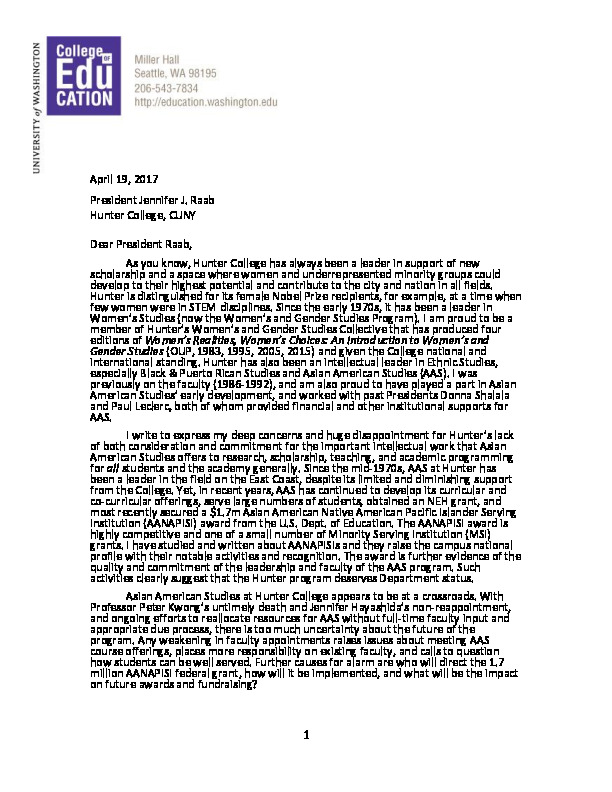
Letter from Dr. Shirley Hune to Hunter President Jennifer J. Raab
Item
UNIVERSITY of WASHINGTON
Colle
Seattle. WA 9!
CATION edu sian wantinan n.edl
April 19, 2017
President Jennifer J. Raab
Hunter College, CUNY
Dear President Raab,
As you know, Hunter College has always been a leader in support of new
scholarship and a space where women and underrepresented minority groups could
develop to their highest potential and contribute to the city and nation in all fields.
Hunter is distinguished for its female Nobel Prize recipients, for example, at a time when
few women were in STEM disciplines. Since the early 1970s, it has been a leader in
Women’s Studies (now the Women’s and Gender Studies Program). | am proud to be a
member of Hunter’s Women’s and Gender Studies Collective that has produced four
editions of Women’s Realities, Women’s Choices: An Introduction to Women’s and
Gender Studies (OUP, 1983, 1995, 2005, 2015) and given the College national and
international standing. Hunter has also been an intellectual leader in Ethnic Studies,
especially Black & Puerto Rican Studies and Asian American Studies (AAS). | was
previously on the faculty (1986-1992), and am also proud to have played a part in Asian
American Studies’ early development, and worked with past Presidents Donna Shalala
and Paul Leclerc, both of whom provided financial and other institutional supports for
AAS.
| write to express my deep concerns and huge disappointment for Hunter’s lack
of both consideration and commitment for the important intellectual work that Asian
American Studies offers to research, scholarship, teaching, and academic programming
for all students and the academy generally. Since the mid-1970s, AAS at Hunter has
been a leader in the field on the East Coast, despite its limited and diminishing support
from the College. Yet, in recent years, AAS has continued to develop its curricular and
co-curricular offerings, serve large numbers of students, obtained an NEH grant, and
most recently secured a $1.7m Asian American Native American Pacific Islander Serving
Institution (AANAPISI) award from the U.S. Dept. of Education. The AANAPISI award is
highly competitive and one of a small number of Minority Serving Institution (MSI)
grants. | have studied and written about AANAPISIs and they raise the campus national
profile with their notable activities and recognition. The award is further evidence of the
quality and commitment of the leadership and faculty of the AAS program. Such
activities clearly suggest that the Hunter program deserves Department status.
Asian American Studies at Hunter College appears to be at a crossroads. With
Professor Peter Kwong’s untimely death and Jennifer Hayashida’s non-reappointment,
and ongoing efforts to reallocate resources for AAS without full-time faculty input and
appropriate due process, there is too much uncertainty about the future of the
program. Any weakening in faculty appointments raises issues about meeting AAS
course offerings, places more responsibility on existing faculty, and calls to question
how students can be well served. Further causes for alarm are who will direct the 1.7
million AANAPISI federal grant, how will it be implemented, and what will be the impact
on future awards and fundraising?
| have just returned from the annual meeting of the Association for Asian
American Studies (AAAS) in Portland, Oregon. With nearly 900 scholars attending from
AAS departments and programs from across the United States, as well as Canada and
Asia, Hunter’s situation was duly and openly discussed. It should be noted that Hunter
College held the first East Coast conference of AAAS in 1989, which launched the
Association as a national organization. That Hunter should lose its standing in AAS is of
great concern to many scholars and academic leaders, as well as students, locally and
nation-wide.
To reduce the uncertainly of AAS at Hunter, | hope that you will clarify to the
faculty, students, and the Asian American scholarly and general community, in New York
City and nationally, what your intentions are in regard to the future of this important
program. Other interdisciplinary programs, including Ethnic Studies and Women’s and
Gender Studies, and other disciplines on campus are also impacted.
In the scope of Hunter’s budget, AAS represents a small financial output, yet it is
bringing in new funding resources and national and international attention to the
significant intellectual and professional work of the College. AAS and its faculty are
valuable educational resources that bring Hunter prestige that is recognized elsewhere.
CUNY also needs to acknowledge Hunter’s role in the field of Asian American Studies
not only in the United States, but elsewhere. AAS is carried out by scholars in
universities in Asian countries as well where their populations overseas, especially in the
U.S., are also subjects of research and interactions. All this is long overdue.
Sincerely yours,
Shirley Hune
Shirley Hune £448, Ph.D.
Professor Emerita of Higher Education Leadership & Policy Studies, University of
Washington and
Professor Emerita of Urban Planning, University of California, Los Angeles (and formerly,
Associate Dean of the Graduate Division, UCLA, 1992-2007)
(Formerly Associate Professor and Professor of Social Foundations of Education, Hunter
College, 1986-1992 and Associate Provost, 1990-92)
Colle
Seattle. WA 9!
CATION edu sian wantinan n.edl
April 19, 2017
President Jennifer J. Raab
Hunter College, CUNY
Dear President Raab,
As you know, Hunter College has always been a leader in support of new
scholarship and a space where women and underrepresented minority groups could
develop to their highest potential and contribute to the city and nation in all fields.
Hunter is distinguished for its female Nobel Prize recipients, for example, at a time when
few women were in STEM disciplines. Since the early 1970s, it has been a leader in
Women’s Studies (now the Women’s and Gender Studies Program). | am proud to be a
member of Hunter’s Women’s and Gender Studies Collective that has produced four
editions of Women’s Realities, Women’s Choices: An Introduction to Women’s and
Gender Studies (OUP, 1983, 1995, 2005, 2015) and given the College national and
international standing. Hunter has also been an intellectual leader in Ethnic Studies,
especially Black & Puerto Rican Studies and Asian American Studies (AAS). | was
previously on the faculty (1986-1992), and am also proud to have played a part in Asian
American Studies’ early development, and worked with past Presidents Donna Shalala
and Paul Leclerc, both of whom provided financial and other institutional supports for
AAS.
| write to express my deep concerns and huge disappointment for Hunter’s lack
of both consideration and commitment for the important intellectual work that Asian
American Studies offers to research, scholarship, teaching, and academic programming
for all students and the academy generally. Since the mid-1970s, AAS at Hunter has
been a leader in the field on the East Coast, despite its limited and diminishing support
from the College. Yet, in recent years, AAS has continued to develop its curricular and
co-curricular offerings, serve large numbers of students, obtained an NEH grant, and
most recently secured a $1.7m Asian American Native American Pacific Islander Serving
Institution (AANAPISI) award from the U.S. Dept. of Education. The AANAPISI award is
highly competitive and one of a small number of Minority Serving Institution (MSI)
grants. | have studied and written about AANAPISIs and they raise the campus national
profile with their notable activities and recognition. The award is further evidence of the
quality and commitment of the leadership and faculty of the AAS program. Such
activities clearly suggest that the Hunter program deserves Department status.
Asian American Studies at Hunter College appears to be at a crossroads. With
Professor Peter Kwong’s untimely death and Jennifer Hayashida’s non-reappointment,
and ongoing efforts to reallocate resources for AAS without full-time faculty input and
appropriate due process, there is too much uncertainty about the future of the
program. Any weakening in faculty appointments raises issues about meeting AAS
course offerings, places more responsibility on existing faculty, and calls to question
how students can be well served. Further causes for alarm are who will direct the 1.7
million AANAPISI federal grant, how will it be implemented, and what will be the impact
on future awards and fundraising?
| have just returned from the annual meeting of the Association for Asian
American Studies (AAAS) in Portland, Oregon. With nearly 900 scholars attending from
AAS departments and programs from across the United States, as well as Canada and
Asia, Hunter’s situation was duly and openly discussed. It should be noted that Hunter
College held the first East Coast conference of AAAS in 1989, which launched the
Association as a national organization. That Hunter should lose its standing in AAS is of
great concern to many scholars and academic leaders, as well as students, locally and
nation-wide.
To reduce the uncertainly of AAS at Hunter, | hope that you will clarify to the
faculty, students, and the Asian American scholarly and general community, in New York
City and nationally, what your intentions are in regard to the future of this important
program. Other interdisciplinary programs, including Ethnic Studies and Women’s and
Gender Studies, and other disciplines on campus are also impacted.
In the scope of Hunter’s budget, AAS represents a small financial output, yet it is
bringing in new funding resources and national and international attention to the
significant intellectual and professional work of the College. AAS and its faculty are
valuable educational resources that bring Hunter prestige that is recognized elsewhere.
CUNY also needs to acknowledge Hunter’s role in the field of Asian American Studies
not only in the United States, but elsewhere. AAS is carried out by scholars in
universities in Asian countries as well where their populations overseas, especially in the
U.S., are also subjects of research and interactions. All this is long overdue.
Sincerely yours,
Shirley Hune
Shirley Hune £448, Ph.D.
Professor Emerita of Higher Education Leadership & Policy Studies, University of
Washington and
Professor Emerita of Urban Planning, University of California, Los Angeles (and formerly,
Associate Dean of the Graduate Division, UCLA, 1992-2007)
(Formerly Associate Professor and Professor of Social Foundations of Education, Hunter
College, 1986-1992 and Associate Provost, 1990-92)
Title
Letter from Dr. Shirley Hune to Hunter President Jennifer J. Raab
Description
This letter was written by Dr. Shirley Hune on April 19, 2017, and addressed to Hunter College President Jennifer J. Raab. In the letter, Dr. Hune, who was instrumental to the development of Asian American studies at Hunter during her time as Assistant Provost (1990-1992), condemns Hunter's lack of commitment and investment in Asian American studies following their failure to meet student demands for an Asian American Studies Department and major and the non-reappointment of Jennifer Hayashida, director of the Asian American Studies Program (AASP).
The non-reappointment of AASP director Jennifer Hayashida in 2017 alongside other efforts to restructure the AASP sparked deep concern over the future of the program. CRAASH called upon the Asian American/Asian American studies community to write to Hunter administrators in protest of the active dismantling of the AASP in the context of a long history of institutional neglect of a program that has, as Hune writes, made Hunter a leader in ethnic studies.
The Hunter College Asian American Studies Program (AASP) was established in 1993. As the only academic program in Asian American studies in the CUNY system, the AASP offers a minor in Asian American Studies and other resources and programming. The AASP supports scholars, artists, and activists advancing scholarship in the fields of Asian American studies and critical ethnic studies and serves as a resource for New York City's Asian American communities. In 2006, the program was at risk of being cut due to a lack of funding. Students formed the Coalition for the Revitalization of Asian American Studies at Hunter (CRAASH) and saved the program within a year. CRAASH is now a student-run club that continues to advocate for the AASP.
The non-reappointment of AASP director Jennifer Hayashida in 2017 alongside other efforts to restructure the AASP sparked deep concern over the future of the program. CRAASH called upon the Asian American/Asian American studies community to write to Hunter administrators in protest of the active dismantling of the AASP in the context of a long history of institutional neglect of a program that has, as Hune writes, made Hunter a leader in ethnic studies.
The Hunter College Asian American Studies Program (AASP) was established in 1993. As the only academic program in Asian American studies in the CUNY system, the AASP offers a minor in Asian American Studies and other resources and programming. The AASP supports scholars, artists, and activists advancing scholarship in the fields of Asian American studies and critical ethnic studies and serves as a resource for New York City's Asian American communities. In 2006, the program was at risk of being cut due to a lack of funding. Students formed the Coalition for the Revitalization of Asian American Studies at Hunter (CRAASH) and saved the program within a year. CRAASH is now a student-run club that continues to advocate for the AASP.
Contributor
Hunter College Asian American Studies Program
Creator
Hune, Shirley
Date
April 19, 2017
Language
English
Rights
Obtained from Contributor - Copyright Unknown
Source
Hunter College Asian American Studies Program
Original Format
Correspondence
Hune, Shirley. Letter. “Letter from Dr. Shirley Hune to Hunter President Jennifer J. Raab.”, CUNY DIGITAL HISTORY ARCHIVE, accessed September 5, 2026, https://stephenz.tailc22a4b.ts.net/s/cdha/item/1576