Women's Studies Advisory Committee Minutes
Item
WOMEN’S STUDIES CERTIFICATE PROGRAM
THE
GRAQUATE SCHOOL
AND 33 WEST 42 STREET, NEW YORK. NY 10036-8099
UNIVERSITV CENTER 212 642-2344
THE CITY UNIVERSITY OF NEW YORK
Women’s Studies Advisory Committee
Minutes of Meeting
April 30, i¥96
Faculty: Meena Alexander. Roz Bologh, Rachel Brownstein. Sandi Cooper, Kay
Deaux, Joyce Gelb. Dorothy Heily. Patricia Laurence. Nancy Miller
{Florence Howe, Jane Marcusj
Students: Jenniter Disney. Tania Levey
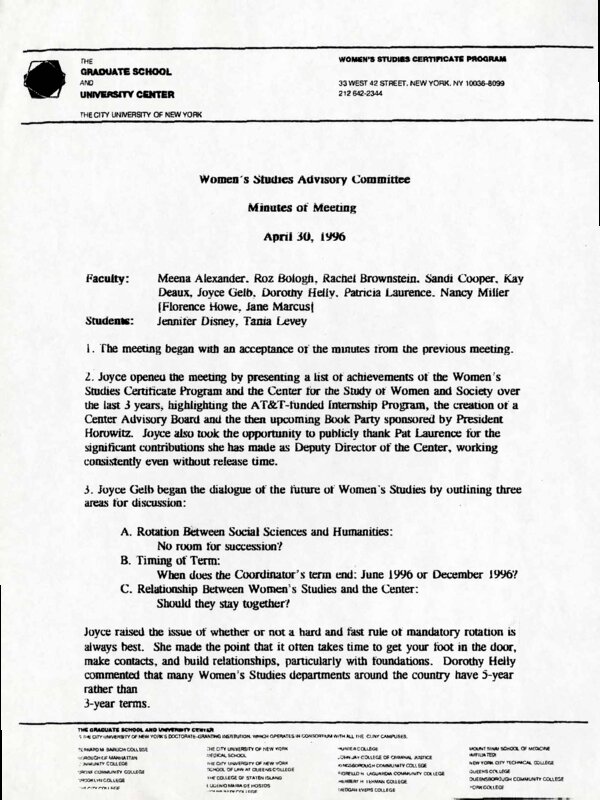
1. The meetung began with an acceptance os the mimutes trom the previous meeting.
2. Joyce openeu the meeting by presenting a list ot achievements of the Women’s
Studies Certificate Program and the Center for the Study or Women and Society over
the last 3 years, highlighting the AT&T-funded Internship Program, the creation of a
Center Advisory Board and the then upcoming Book Party sponsored by President
Horowitz. Joyce also took the opportunity to publicly thank Pat Laurence for the
sigmificant contributions she has made as Deputy Director of the Center, working
consistently even without release time.
= Joyce Gelb began the dialogue of the future of Women’s Studies by Ee three
areas tor discussion:
A. Rotation Between Social Sciences and Humanities:
No room for succession?
B. Timing of Term:
When does the Coordinator’s term end: June 1996 or December {9967
C. Relationship Between Women’s Studies and the Center:
Should they stay together?
Joyce raised the issue of whether or not a hard and fast rule ot mandatory rotation is
always best. She made the point that it otten takes time to get your foot in the door,
make contacts, and build relationships, particularly with foundations. Dorothy Helly
commented that many Women’s Studies departments around the country have 5-year
rather than
3-year terms.
THS GRAOUATE SCHOOL AND UDEVERDTY CENTER
5 146 CITY UNIVERSITY OF NEW YORK'S DOCTORATE-GRANDING INSTITUTION, WRAGH OPERATES IN CONSORTIUM WITH ALL THE CUNY CAMPUSES.
UOUNT SINAI SCHOOL OF MEOICINE
A ARARDM BARUCH COLLEGE HE CITY UNIVERSITY OF NEW YORK UNTER COLLEGE
tAFFILIATEO)
“S7ROUGH GF MANHATTAN SIEDICAL SCHOOL LOWN JAY COLLEGE OF CRIMINAL JUSTICE
JMMUNITY COLLEGE me GIy UNIVERSITY OF NEW YORK KINGSBOROUGH COMMUNIFY COLLEGE NEW YORK CITY TECHNICAL COLLEGE
NRONX GOMMUNITY COLLEGE BUS AC UG ISSA SIG oneGuante connUrury conttGe! QUEENS COLLEGE
Pinot em tee JHE COLLEGE OF STATEN ISLAND [a alee easton ton QUEENSBOROUGH COMMUNITY COLLEGE
ve t wale MARIA DE HOSTOS:
WE COV COMI ERE Bre Paat ace ‘AEDGAH EVERS COLLEGE YORK COLLEGE
Nancy Miller pointed out that the rotation idea was part of a democratizing
move toward inclusion when at the program’s inception it remained too long in the
hands ot a few people. She also commented that there is no need for an extension ot
the 3-year term because despite the claim to interdisciplinarity, the students feel the
social science/ humanities divide. Sandi Cooper also supported the rotation idea
particularly because the CUNY consortium offers a special opportunity tor the
commitment to and respect of diversity both among and between the campuses.
Meena Alexander noted the compiexity of the issue tor her by acknowledging
both the importance of the need for rotation while at the same time understanding the
desire tor follow-through when ideas and events have been set in motion. Kay Deaux
agreed that the idea of rotation was important tor Women’s Studies, especially given
the richness of faculty, yet also put forth the view that maybe 3-year terms with
mandatory rotation is not the best approach tor the Center. The commutment to
rotation of the WSCP coordinator was confirmed.
4. The decision about whether or not to split the Women’s Studies Certiticate Program
and the Center tor the Study of Women and Society was taken up next. Joyce Gelb
stated that such a decision will invoive the disposition of the outgoing and imcomung
coordinator as well as how the President teels. President Horowitz seems inclined to
| keep the two together since it has worked successfuily the past 3 years.
Whether or not the current combined administration actually saves or costs the
Graduate Center money depends upon how the coordinators are being paid: Roz
pointed out that Joyce negotiated a full time appoinmnent, which resulted in the
_combined administration of the WSCP and the Center. This is comparable to 2 course
releases. Joyce also mentioned the difficulty of running programs that are physically
separate.
5. The timing of the end of the WSCP Coordinator’s term has been confirmed in
writing by the Provost's Office and the President as both June 1996 and December
1996, There was some discussion of extending the term to December so the outgoing
and incoming coordinators could work together to facilitate a smooth transition period.
Rachel Brownstein felt that if anyone should have a strong say in that decision, Joyce
should. Joyce responded by saying that it depends on both her fall schedule and the
feelings of the candidate for succession.
6. The process for choosing a new Coordinator for the WSCP was discussed. The
president Solicits nominations from Women’s Studies facuity and students. If
consensus can be reached on one candidate, the faculty as a whole can than make a
recommendation to the President, who ultimately makes the decision. If there are
multiple candidates, many recommendations can be made. Electa Arenal is one
candidate whose interest was confirmed at this time.
THE
GRAQUATE SCHOOL
AND 33 WEST 42 STREET, NEW YORK. NY 10036-8099
UNIVERSITV CENTER 212 642-2344
THE CITY UNIVERSITY OF NEW YORK
Women’s Studies Advisory Committee
Minutes of Meeting
April 30, i¥96
Faculty: Meena Alexander. Roz Bologh, Rachel Brownstein. Sandi Cooper, Kay
Deaux, Joyce Gelb. Dorothy Heily. Patricia Laurence. Nancy Miller
{Florence Howe, Jane Marcusj
Students: Jenniter Disney. Tania Levey
1. The meetung began with an acceptance os the mimutes trom the previous meeting.
2. Joyce openeu the meeting by presenting a list ot achievements of the Women’s
Studies Certificate Program and the Center for the Study or Women and Society over
the last 3 years, highlighting the AT&T-funded Internship Program, the creation of a
Center Advisory Board and the then upcoming Book Party sponsored by President
Horowitz. Joyce also took the opportunity to publicly thank Pat Laurence for the
sigmificant contributions she has made as Deputy Director of the Center, working
consistently even without release time.
= Joyce Gelb began the dialogue of the future of Women’s Studies by Ee three
areas tor discussion:
A. Rotation Between Social Sciences and Humanities:
No room for succession?
B. Timing of Term:
When does the Coordinator’s term end: June 1996 or December {9967
C. Relationship Between Women’s Studies and the Center:
Should they stay together?
Joyce raised the issue of whether or not a hard and fast rule ot mandatory rotation is
always best. She made the point that it otten takes time to get your foot in the door,
make contacts, and build relationships, particularly with foundations. Dorothy Helly
commented that many Women’s Studies departments around the country have 5-year
rather than
3-year terms.
THS GRAOUATE SCHOOL AND UDEVERDTY CENTER
5 146 CITY UNIVERSITY OF NEW YORK'S DOCTORATE-GRANDING INSTITUTION, WRAGH OPERATES IN CONSORTIUM WITH ALL THE CUNY CAMPUSES.
UOUNT SINAI SCHOOL OF MEOICINE
A ARARDM BARUCH COLLEGE HE CITY UNIVERSITY OF NEW YORK UNTER COLLEGE
tAFFILIATEO)
“S7ROUGH GF MANHATTAN SIEDICAL SCHOOL LOWN JAY COLLEGE OF CRIMINAL JUSTICE
JMMUNITY COLLEGE me GIy UNIVERSITY OF NEW YORK KINGSBOROUGH COMMUNIFY COLLEGE NEW YORK CITY TECHNICAL COLLEGE
NRONX GOMMUNITY COLLEGE BUS AC UG ISSA SIG oneGuante connUrury conttGe! QUEENS COLLEGE
Pinot em tee JHE COLLEGE OF STATEN ISLAND [a alee easton ton QUEENSBOROUGH COMMUNITY COLLEGE
ve t wale MARIA DE HOSTOS:
WE COV COMI ERE Bre Paat ace ‘AEDGAH EVERS COLLEGE YORK COLLEGE
Nancy Miller pointed out that the rotation idea was part of a democratizing
move toward inclusion when at the program’s inception it remained too long in the
hands ot a few people. She also commented that there is no need for an extension ot
the 3-year term because despite the claim to interdisciplinarity, the students feel the
social science/ humanities divide. Sandi Cooper also supported the rotation idea
particularly because the CUNY consortium offers a special opportunity tor the
commitment to and respect of diversity both among and between the campuses.
Meena Alexander noted the compiexity of the issue tor her by acknowledging
both the importance of the need for rotation while at the same time understanding the
desire tor follow-through when ideas and events have been set in motion. Kay Deaux
agreed that the idea of rotation was important tor Women’s Studies, especially given
the richness of faculty, yet also put forth the view that maybe 3-year terms with
mandatory rotation is not the best approach tor the Center. The commutment to
rotation of the WSCP coordinator was confirmed.
4. The decision about whether or not to split the Women’s Studies Certiticate Program
and the Center tor the Study of Women and Society was taken up next. Joyce Gelb
stated that such a decision will invoive the disposition of the outgoing and imcomung
coordinator as well as how the President teels. President Horowitz seems inclined to
| keep the two together since it has worked successfuily the past 3 years.
Whether or not the current combined administration actually saves or costs the
Graduate Center money depends upon how the coordinators are being paid: Roz
pointed out that Joyce negotiated a full time appoinmnent, which resulted in the
_combined administration of the WSCP and the Center. This is comparable to 2 course
releases. Joyce also mentioned the difficulty of running programs that are physically
separate.
5. The timing of the end of the WSCP Coordinator’s term has been confirmed in
writing by the Provost's Office and the President as both June 1996 and December
1996, There was some discussion of extending the term to December so the outgoing
and incoming coordinators could work together to facilitate a smooth transition period.
Rachel Brownstein felt that if anyone should have a strong say in that decision, Joyce
should. Joyce responded by saying that it depends on both her fall schedule and the
feelings of the candidate for succession.
6. The process for choosing a new Coordinator for the WSCP was discussed. The
president Solicits nominations from Women’s Studies facuity and students. If
consensus can be reached on one candidate, the faculty as a whole can than make a
recommendation to the President, who ultimately makes the decision. If there are
multiple candidates, many recommendations can be made. Electa Arenal is one
candidate whose interest was confirmed at this time.
Title
Women's Studies Advisory Committee Minutes
Description
These minutes from the Women's Studies Advisory Committee Meeting on April 10, 1996, discussed the future of Women's Studies at the City University of New York (CUNY) Graduate Center. Specifically noted was a conversation about the relationship between the Women's Studies Certificate Program (WSCP) and the Center for the Study of Women and Society (CSWS) and whether the two should remain a single organization. Joyce Gelb, the director of CSWS, stated that the decision depended on the outgoing and incoming coordinator and the president of the Graduate Center, Dr. Frances Degen Horowitz. According to the minutes, President Horowitz seemed to lean toward keeping the two programs enmeshed because they had worked together successfully for three years. The minutes stated that the cost of the combination of the two programs depended on how the coordinators were to be paid; the administrative costs were low because Joyce Gelb had negotiated a full-time position by combining the administration of the WSCP and CSWS. It was noted that Ms. Gelb stated that this combination of administrations was complex because the two programs were in fact physically separate.
Since 1977, the Center for the Study of Women and Society (CSWS), Graduate Center, City University of New York (CUNY) has promoted interdisciplinary feminist scholarship. The Center’s research agenda focuses on the intersectional study of gender, sexuality, race, ethnicity, class, and nation in societies worldwide. The Center co-sponsors the Women’s Studies Certificate Program and, most notably, hosts the only stand-alone Women’s and Gender Studies MA Program in New York City.
Contributor
Center for the Study of Women and Society
Creator
Women's Studies Advisory Committee
Date
April 30, 1996
Language
English
Rights
Copyrighted
Source
Center for the Study of Women and Society
Original Format
Notes / Minutes
Women’s Studies Advisory Committee. Letter. “Women’s Studies Advisory Committee Minutes.”, CUNY DIGITAL HISTORY ARCHIVE, accessed July 8, 2026, https://stephenz.tailc22a4b.ts.net/s/cdha/item/1581