Women's Studies Certificate Program (WSCP) Proposal
Item
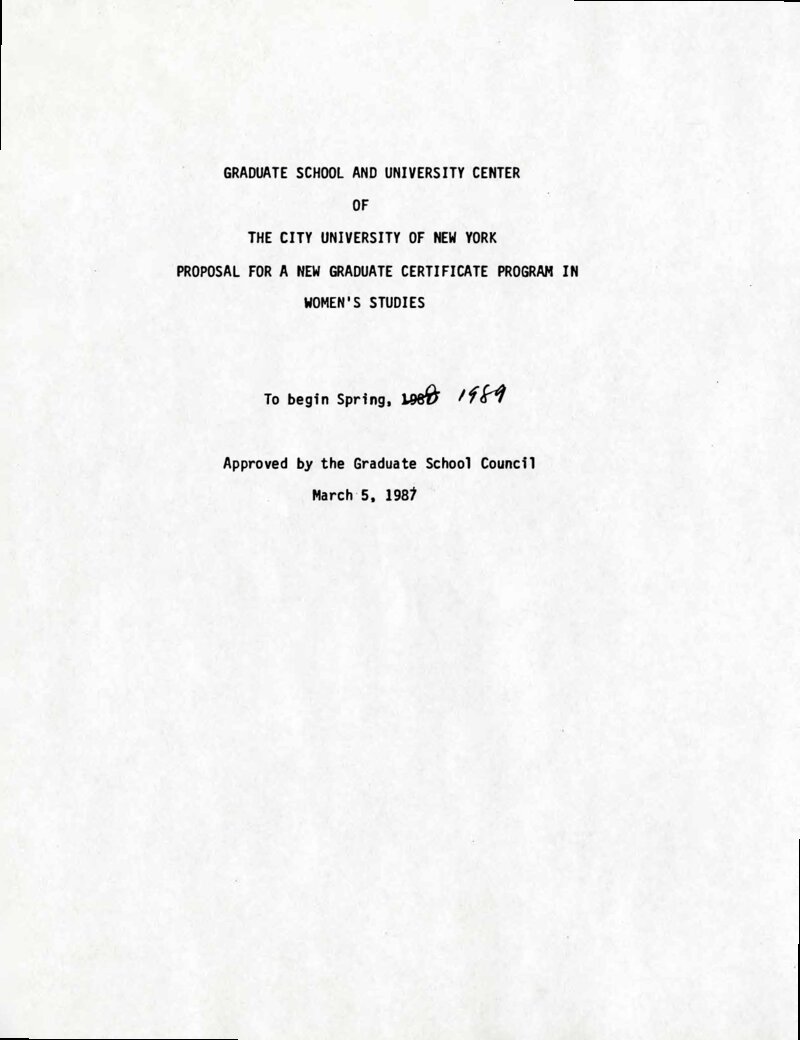
GRADUATE SCHOOL AND UNIVERSITY CENTER
OF
THE CITY UNIVERSITY OF NEW YORK
PROPOSAL FOR A NEW GRADUATE CERTIFICATE PROGRAM IN
WOMEN'S STUDIES
To begin Spring, wed 1954
Approved by the Graduate School Council
March 5, 1987
THE GRADUATE SCHOOL AND UNIVERSITY CENTER
GRADUATE CERTIFICATE PROGRAM
IN WOMEN'S STUDIES
Table of Contents
Purpose and Objectives
Need for a Certificate Program in Women's Studies
Curriculum
Admissions Requirements
Course of Study
Required Courses Description
Sample Students Programs
Students
Faculty
Libraries
Facilities and Equipment
Appendix A Women's Studies Courses, 1988-1981
Appendix B Select Women's Studies Faculty
Appendix C Curricula Vitae
mol
a
—_
i
wo 0 On HT fF F&F WwW om
ry
So
PURPOSE AND OBJECTIVES
The Graduate School of the City University of New York proposes
to offer a Certificate in Women's Studies for students already
enrolled in a Ph.D. program at the Graduate School. Students
matriculating in any of the Ph.D. programs offered at the Graduate
School are eligible for the Certificate Program. The Certificate
will be awarded on the date when the graduate degree is conferred.
The sequence of courses is designed to provide historical,
cross-cultural and interdisciplinary perspectives on women, feminism,
Women's Studies and Gender Studies. The Program examines the
connections between Women's Studies and the traditional disciplines
as well as the new perspectives, questions, and scholarship in
Women's Studies which challenge disciplinary barriers and paradigms.
The Program also offers opportunities to apply the theories and
analytical approaches of Women's Studies to at least one traditional
discipline and to do individual research.
The Certificate Program is specifically designed for students
enrolled in Ph.D. programs and not as a free-standing program. The
Program will provide students with the skills and knowledge to apply
and integrate interdisciplinary Women's Studies scholarship and
perspectives to their doctoral studies and to generate research and
scholarship within their discipline which reflect this education.
Although some Masters of Arts in Liberal Studies (MALS) students
who are specializing in Women's Studies will take these courses
(MALS students presently fill out their programs with doctoral courses),
the courses are designed for doctoral students and assume a level of
competence expected of doctoral students.
NEED FOR A CERTIFICATE PROGRAM IN WOMEN'S STUDIES
In the past fifteen years Women's Studies has established itself
as both an independent and an interdisciplinary field of inquiry.
Women's Studies courses are taught in traditional departments and
in Women's Studies Programs or Departments in the vast majority of
institutions of higher education in the United States and in many
throughout the world, including Great Britain, Canada, France, Egypt,
India, Australia, and Italy. The profusion of publications dedicated
to research on women, the large number of conferences and scholarly
organizations, and the support often tendered by federal agencies
and private foundations attest to the vitality and permanence of this
branch of knowledge.
Graduate programs in Women's Studies have been established
throughout the country, in such institutions as the University of
Michigan, Indiana University, Cornell University, and the University
of Iowa. Most programs offer a Master of Arts or a minor in
Women's Studies, and a few offer a Doctorate. The Certificate
model, however, was adopted at the University of Michigan. Some
of the Women's Studies Programs have been in existence long enough
to be able to trace the careers of their graduates. They report
that the majority of students who did graduate work in Women's
Studies continue to be employed in fields related to women or
Women's Studies. Many graduates are teaching in institutions of
higher education, others work as academic administrators, or in-
women's rights organizations or research institutes, or for
publishers such as The Feminist Press. Substantial numbers of
universities are now making tenure-track appointments in Women's
Studies per se or citing Women's Studies as a preferred field of
specialization in appointments to traditional departments. For
example, in the geographical region of C.U.N.Y., Hunter College
has recently hired a full Professor to direct its Women's Studies
Program and is currently conducting a search for a faculty appotnt-
ment (tenured line, rank open) to teach Women's Studies courses.
Lehman College has a Distinguished Professorship in English for
a Women's Studies scholar and Princeton and Rutgers are looking
for candidates to fill endowed chairs of Women's Studies. Doctoral
degree students generally aspire to academic employment. None-
theless, industry, governmental agencies, non-profit organizations,
publishing houses and the like, have become increasingly aware
of women as a distinct market and job candidates with related
expertise are in growing demand. The Ford Foundation, for
example, procedurally hires program officers with Women's Studies
competencies.
According to the Guide to Women’s Studies, published by the
N.Y.C. Commission on the Status of Women, in the fall semester of
1987 alone C.U.N.Y. colleges offered over 100 undergraduate courses
in Women's Studies, and the Graduate School offered nine. Many
colleges in the C.U.N.Y. system have formal Women's Studies Programs,
but the Graduate School has none. The same anomaly is apparent
throughout New York City, beyond the C.U.N.Y. system: the Guide
to Women's Studies records a proliferation of under-graduate
liberal arts courses at virtually every institution of higher
education in the metropolitan area, with a total of over 380
courses offered in New York City alone, some taught in up to
five sections. Yet, currently there is not any formal mechanism
for graduate education in Women's Studies in the city.
Because of numerous members of the faculty who are already
distinguished as scholars in Women's Studies, and the existence of
the majority of the crucial core courses, the Graduate School of
C.U.N.Y. has an opportunity to assume easily a position of
leadership in this field. This proposal is a modest response
1 The Feminist Press is now located at C.U.N.Y.
2 Sarah Lawrence College ard New York University offer graduate
programs in Women's History (not Women's Studies).
to a clear need in graduate education in New York City, and
one which will require primarily a redeployment of existing
resources at the Graduate School.
The Certificate Program in Women's Studies is designed to
meet the desire for a formal curriculum in Women's Studies expressed
by both students currently enrolled in the Graduate School and
by faculty teaching a wide variety of courses which, though
individually unimpeachable, have not been coordinated so that
they constitute a rational curriculum. The Graduate School
currently offers a concentration in Women's Studies within
Interdisciplinary Studies. Students engaged in this option
take a number of Women's Studies courses offered in the different
programs at the Graduate School. This approach has been inadequate
for student needs and does not lend itself to a defensible course
of study. The Program will assure an interdisciplinary perspective,
which is critical for Women's Studies specialization; a coherent
curriculum; a sequencing of courses to develop a knowledge base;
and a system of advisement to assure a conceptual as well as
individualized program for students and directions for research
endeavors. In addition, students will receive formal recognition
for their Women's Studies concentration which is likely to be an
asset when seeking employment.
It is anticipated that the uniqueness of the Program in the
metropolitan New York area will influence prospective students
in their choice of graduate schools.
The Women's Studies Certificate Program will serve a broad
constituency beyond the students actually enrolled in the Program.
For example, students writing dissertations on women writers will
benefit from course work in feminist literary criticism. Organized
clusters of courses on women are currently evolving in several
Ph.D. programs including History, Psychology, and Sociology. The
courses offered by the Certificate Program in Women's Studies wil]
be of particular interest to students in such courses, while such
concentrations of courses within a single discipline will, in turn,
provide a valuable disciplinary base for students working in
Women's Studies.
For students who have selected the theme of Women's Studies in
the Master of Arts in Liberal Studies, the existence of a
Certificate Program will help to assure that courses are available
and constitute a rational sequence of study.
CURRICULUM
The Certificate in Women's Studies is designed for students
who are presently engaged in doctoral studies at the Graduate
School. Attainment of the certificate entails completion of the
doctoral degree as well as the requirements for the program. The
sequence of courses is designed to provide historical, cross-
Cultural, and interdisciplinary perspectives on women, feminism,
Women's Studies and Gender Studies. The program examines the
connections between Women's Studies and the traditional disciplines
as well as the new perspectives, questions and scholarship in Women's
Studies which challenge disciplinary barriers and paradigms. The
Program also offers opportunities to apply the theories and analytical
approaches of Women's Studies to at least one traditional discipline
and to-do individual research. Thus, students completing the
Certificate Program will have a broad interdisciplinary background
in Women's Studies qualifying them to teach such courses as
"Introduction to Women's Studies," as well as expertise in women
and Women's Studies perspectives within their area of doctoral
studies.
Admissions requirements
The Certificate in Women's Studies is available only to
students pursuing doctoral degrees at the Graduate School.
Students who meet this requirement and wish to enter the Program
must submit a statement of purpose explaining their interest and
background in Women's Studies, their goals and a proposed plan
of study. Students who think they qualify to have the prerequisite
courses waived (e.g. a Women's Studies undergraduate major)
should describe their previous work in Women's Studies. The
Advisory Committee, consisting of faculty.actively involved in
the Women's Studies program and teaching relevant courses, and
the Coordinator will counsel students and suggest mentors whom
students may consult throughout their participation in the
Program. Students in the Program will be expected to take an
active role in shaping their own education.
Course of Study
The student must elect a program of study approved by the
Coordinator and Advisory Committee or by the designated mentor.
The program should include prerequisites (unless they are waived)
plus a combination of required courses and electives totaling a
minimum of 12 credits distributed as follows:
Prerequisites:
MALS U721.00 Classical Feminist Texts (previously titled Feminist
Social Theories, 3 credits) and MALS U722.00 Contemporary Feminist
Thought (3 credits) or interdisciplinary undergraduate courses
with equivalent content (subject to the approval of the Program
Coordinator).
Required courses:
IDS U717 Proseminar in Women's Studies (3 credits); IDS U816
Workshop for Guided Research and Guided Reading in Women's Studies
(3 credits).
Electives:
Two or more electives (a minimum of six credits) to be selected
with the approval of the Coordinator or the designated mentor
from courses offered by Ph.D. programs at the Graduate School.
The Certificate Program is designed to complement existing graduate
programs, and to accept as electives courses which the student
uses to fulfill degree requirements elsewhere in the Graduate
School. Therefore some students may be able to fulfill the require-
ments for the Certificate in as few as two semesters.
Required Courses Descriptions
The curriculum for the Certificate Program in Women's Studies
will consist of 12 graduate credits, two required core courses
and two electives.
-Required courses:
IDS U717 Proseminar in Women's Studies, 3 credits
New course. (approved by the Graduate Schoo? council. Presently offered)
This proseminar will be team-taught by faculty in the Humanities
and Social Sciences. Students will be introduced to the history
and methodologies of Women's Studies, and will become familiar
with the basic research tools and current publications in the
field. The relationship of feminist scholarship to the paradigms
of traditional disciplines will be examined systematically, and
the question whether Women's Studies itself is a discipline will
be explored. Prerequisites: any two graduate courses in a
single discipline or area of study (e.g. literature). The latter
two courses need not have been designated as Women's Studies courses.
Rationale:
Scholars in Women's Studies are inevitably required to use resources
and to think about questions beyond the scope of their Ph.D. speciali-
zation. Therefore it is necessary that students be aware of the
approaches, assumptions, and methods in fields other than their
own, that they develop an ability to analyze such work critically,
and that they learn to cross disciplinary boundaries for fresh insights
into the study of women.
Models for courses in “research and methods” may be found in other
interdisciplinary areas, e.g., IDS U701 Research and Methods in
Medieval Studies and Clas. U801 Introduction to Classical Philology.
IDS U816 Workshop for Guided Research and Guided Reading in Women's
Studies, 3 credits.
Existing course team-taught by faculty in Humanities and Social
Sciences.
This course provides a context in which students can do the
individual research which is the culmination of their work in
Women's Studies and in which they can discuss their work with
other students and faculty. The research projects vary according
to the needs of individual students, but normally they are related
to the student's dissertation. Prerequisite: IDS U717
Electives: Two or more electives (a minimum of six credits) to be
selected with the approval of the Coordinator of the Program or
the designated mentor. A sample list of courses which have been
offered in the past as well as Women's Studies courses which will
be offered in the Spring of 1988 appear in Appendix A. The required
courses are presently offered annually.
Sample Student Programs
There will be some variation among students in the rate with
which they complete the Certificate Program. Some students, for
example, may be exempt from the prerequisite courses, while others
will have to complete these before continuing with the sequence.
Although it is anticipated that many students will enter the
Certificate Program early in graduate education, others may decide
to seek admission towards the end of their course work. Experi-
ence with the Women's Studies Concentration has indicated that
students' interest in pursuing a Women's Studies curriculum is often
stimulated by a Women's Studies course taken within their own
discipline. As there is presently a large number of students
interested in the Certificate Program, it is anticipated that for
the first two years of the program, many of the students will be
at least midway into their graduate education.
The following sample programs represent students who enter
the program with different backgrounds in Women's Studies.
Sample I: Student with no prerequisite waivers (Anthropology students)
Semester I: MALS U721.00 Classical Feminist Texts
Semester II: MALS U722.00 Contemporary Feminist Thought
Semester III: IDS U717 Proseminar in Women's Studies
ANTH U713 Women and Development
Semester IV: IDS U816 Workshop for Guided Research and
Guided Reading in Women's Studies
SOC U879.07 Women and Health Care
Institutions
3 credits
3 credits
3 credits
3 credits
3 credits
3 credits
Sample II: Student with one prerequisite course waived (English student)
Semester I: MALS U722.00 Contemporary Feminist Thought
Semester II: IDS U717 Proseminar in Women's Studies
ENG U855.1 Reading Women/Writing Women:
20th Century British Fiction
Semester III: IDS U816 Workshop for Guided Research and
Reading in Women's Studies
FRE U774 Thinking Women
3 credits
3 credits
3 credits
3 credits
3 credits
Sample III: Student with both prerequisites waived (Sociology student)
Semester I: IDS U717 Proseminar in Women's Studies
SOC U854.03 Feminist Perspectives on
Social and Political Thought
Semester II: IDS U816 Workshop for Guided Research and
Reading in Women's Studies
CJ U722 Women in Criminal Justice
3 credits
3 credits
3 credits
‘3 credits
STUDENTS
The Women's Studies Certificate Program is a compatible
course of study for students in any of the Humanities and
Social Sciences doctoral programs. As such, students will be
drawn from diverse disciplines and the pool of potential students
is quite large. Interest in Women's Studies courses at the
Graduate School is high as is evident by the healthy enrollment
in classes. For example, the statistics for the Spring, 1986
semester were:
ENG U806 .02 Gender Reading 16
FRE 0774.00 Women in/of French Literature 5
IDS U813/ANTH U713 Women and Socio-Econ. Development 6
MALS U772.00 Contemporary Feminist Thought 12
PSY U801.18 Gender and Environment 10
PSY U801.24 Psychology of Women and Work 13
SOC U801.01 Seminar-Feminist Sociological Theory 24
There are approximately 20 students in the Women's Studies
specialization of the MALS program, many of whom will transfer
into doctoral programs (this is historically true) and continue
their studies in Women's Studies. The Graduate School has an
active Feminist Students’ Organization, numbering over 35 students.
Furthermore, several publications,including the Women's Studies
Studies Quarterly, the New York City Commission on the Status
Women, and the National Women's Studies Association all list
information on educational opportunities in Women's Studies.
Their inclusion of the existing concentration in Women's Studies
has resulted in requests for information about the program from
around the country and throughout the world. On the average,
four written requests are received at the Center for the Study
of Women and Society daily. The following five-year projection
of enrollment in the Certificate Program in Women's Studies jis
based on the above:
Year 1 Year 2 Year 3 Year 4 Year 5
1st entering group 10 8
2nd entering group 12 ‘9 6 2
3rd entering group 15 12 8
4th entering group 15 12
5th entering group 15
een
TOTAL 10 20 28 33 37
FACULTY
The instructional faculty will be drawn from the various
Ph.D. Programs at the Graduate School. The Graduate School
has an extraordinarily large number of faculty who do research
On women as well as the Center for the Study of Women and Society
which stimulates and coordinates a substantial portion of this
research. The list of cross-listed courses (see Appendix A)
gives the names of some faculty members who have taught graduate
courses in Women's Studies in recent years. Including the
curricula:-vitae of all the members of the faculty who are concerned
with Women's Studies would have added hundreds of pages to this
proposal. Instead Appendix B lists the names and research areas
of faculty actively engaged in Women's Studies teaching and research.
The curricula vitae of those faculty members whose circumstances
permitted them to participate in the framing of this proposal
appear in Appendix C.
LIBRARIES
The New York City Metropolitan area has the richest resources
for research on women in the world. Indeed, Women's Studies
scholars from around the world travel to New York City to pursue
their work. Students enrolled in the Certificate Program in Women's
Studies will have access to the following:
1. The libraries of the C.U.N.Y. colleges most of which have
extensive collections of books. Moreover, owing to the vitality
and maturity of the Women's Studies programs at several of the
senior colleges (e.g. Hunter College), there are strong collections
of periodicals in Women's Studies. Additionally, some of the colleges
have specialized libraries in Women's Studies. For example, Brooklyn
College has the Herstory Microfilms and Medgar Evers College
maintains a collection on Women and Development.
2. The library of the Graduate Center of C.U.N.Y. Although
there has not been an organized and directed effort to order books
in Women's Studies, the large number. of faculty engaging in Women's
Studies research and teaching related courses has resulted jin a
modest, but solid, number of Women's Studies books and journals.
Additionally, the Graduate School library maintains a Doctoral
Dissertation library which is a valuable resource for students.
Considerable doctoral research on, or relevant to, women fs engaged
in at the Graduate School. As the Certificate program grows, addi-
tional books and publications will be required to fill the gaps.
In supporting the Certificate program, the Graduate School
aeiecromion is prepared to provide the resources necessary for
this.
10
3. The New York Public Library, located across the street
from the Graduate Center, and regularly used by many graduate
students. The New York Public Library has a world reputation
for housing a vast collection on Women's Studies in all divisions.
In addition to maintaining a strong collection of standard books
and journals, the library houses many classical and unique works
as well as valuable special collections. For example, they house
the annual reports of numerous women's organizations (e.g. The Boston
Female Anti-Slavery Societies Annual Report, 1836-1844), the
largest single collection of Virginia Woolf papers (in the Alfred
Berg collection), the National American Women Suffragettes records,
original correspondence and papers of several well-known feminists,
(e.g. Carrie Chapman Catt, Elizabet Cady Stanton, Lucy Stone) and
the History of Women microfilm collection.
4. Numerous collections of archives in New York city on women.
_Accollection of these primary resources on women are listed ina
book entitled A. Guide to Research on Women: Library and Information
Sources in the Greater New York Area which was compiled by the
Center for the Study of Women and Society in collaboration with the
Women's Resource Group of the Association of American College and
Research Librarians. This book, which is being published by The
Feminist Press (publication date, February, 1988) lists close to
200 specialized libraries and collections on women in the metro-
politan area.
FACILITIES AND EQUIPMENT
The Certificate Program in Women's Studies will require an
office and release time for the Director of the program and part-
time secretarial help. Release time and an office for the coor-
dinator of the Women's Studies concentration, as well as a work-
study student, have been provided by the Graduate School for the
past two years. As such, only the secretarial help represents
an increase in required resources. Provisions should also be
made for the supplementary acquisition of books and periodicals
not included in the library and for the sponsorship of lectures
by visiting scholars. The administration has made funds available
for Women's Studies lectures for the past four years. Since the
Certificate program will draw upon the course offerings and faculty
already in place in the doctoral disciplines, and from courses
already offered through the Interdisciplinary Studies Program
no further costs for facilities and equipment are anticipated.
APPENDIX A
WOMEN'S STUDIES COURSES, 1988-1981
APPENDIX A:
Semester
Spring 88
Fall 87-88
Spring 87
Fall 86-87
IDS ‘U808 .09
MALS U722
IDS U816
FRE U774
HIS U743
PSY U801.31
PSY U801 .36
SOC U879.07
ENG U806
ENG U702
CJ U722
IDS U808 .09
IDS U717
IDS U808 .05
EDPSY U880.25
ENG U855.1
POLSC U738
ENG U801 .34
SOC U854.03
ANTH U713
IDS U808
ANTH U714.1
ART U845
ART U871.2
CLAS U733
ENG U756.02
ENG U805 .01
PSY U797
PSY U801 .3
SOC U845
IDS U816
ART U871.09
ENG U750
HIS U749.9
MALS U721
. WOMEN'S STUDIES COURSES 1988-1981
Course No. Instructor
Parlee/Zentella
Bology,
Marcus/Zalk
Caws
Berkin
Denmark
Denmark/Deaux
Katz-Rothman
Joseph
Miller
Price/Sokoloff
Held
Parlee/Rogers
Marcus
Kachuck
Marcus
Gelb
Denmark
Bologh
Mencher
Rothman
Mencher
Nochlin
Park
Pomeroy
Marcus
Brownstein
Denmark
Saegert
Epstein
Brownsteitn/Parlee
Park
Leibowitz
Welter
Lorber
Title
Language and Soctal Identity
Contemporary Feminist Thought
Workshop for Guided Research
and Reading
Thinking Women
American Women, 1603-1860
Psychology of Women and Work
Research fn Psychology of Women
Women and Health Care Institutions
Contemporary Theory: Writing
the Body
Feminist Poetics:
Texts, Contexts
Women in Criminal Justice
Subjects,
Feminist Moral Theories
Proseminar in Women's Studies
Classical Feminist Texts
Gender and Education
Reading Women/Writing Women:
20th Century British Fiction
Women, Politics and the State
Research in Psychology of Women
Feminist Perspectives on
Social and Political Thought
Women and Development
Feminist Social Theories
Gender, Caste and Class
Feminist Theory and Visual
Representation
Women: Sculptors
Women in Ancient Greece
Virginia Woolf: Feminism,
Fiction, Criticism
Feminist Literary Theory
Psychology of Women
Gender and the Environment
Culture of the Workplace
Workshop in Women's Studies
Rmerican Women Sculptors
Poetry of Lowell, Bishop,
Plath and Rich
Women and the Family, 1860-
Present
Feminist Social Theories
Semester
Spring 86
Fall 85-86
Spring 85
Fall 84-85
Fall 83-84
Spring 83
Course No.
IDS U813
ENG U806 .02
FRE U774
MALS U722
PSY U801 .28
PSY U801.24
SOC U801.01
IDS U816
ENG U702 .06
MALS U721
PSY U801 .66
ANTH U717.04
CU U722
HIS U743
MALS U722
PSY U797
SOC U879.07
EDPSY U880.25
ENG U748.01
IDS U816
MALS U721
ENG U702.06
IDS U816.1
MALS U721
POLSC U822.2
PSY U801.69
ANTH U717 .03
IDS U808.01
PHIL U778.10
PSY U801 .23
PSY U797
SOC U842.01
SOC U879.06
Instructor
Mencher
Caws
Sourian
Rassam
Saegert
Denmark
Bologh
Parlee
Rogers
Kachuck
Parlee
Rassam
Price/Sokoloff
Berkin
Lorber
Denmark
Katz-Rothman
Kachuck
Tompkins
Parlee
Muller
Rogers
Parlee
Muller
Karis
Parlee
Leacock
Katz-Rothman
Held
Saegert
Denmark
Aronson
Lorber
Title
Women and Socio-Economic
Deve lopment
Gender Reading
Women in/of French Literature
Contemporary Feminist Thought
Gender and the Environment
Psychology of Women and Work
Feminist Sociological Thought
Workshop in Women's Studies
Early Women Writers in England
Feminist Social Theories
Issues of Gender Differentiation
and Identity
Gender and Culture
Women in Criminal Justice
American Women, 1603-1860
Contemporary Feminist Thought
Psychology of Women
Women in Health Care
Gender and Education
American Literature: A
Feminist Perspective
Workshop in Women's Studies
Feminist Social Theories
Early Women Writers in England
Workshop in Women's Studies
Feminist Social Theories
Constitutional Law: Civil
Liberties
Individual Differences in
Development
Women Cross-Culturally
Contemporary Feminist Thought
Issues in Political Economy
Housing, Community and
Women's Identity
Psychology of Women
Comparative Family Through
History
Women and Health Care Systems
Semester
Fall 82-83-
Spring 82
Fall 81-82
Course No.
ART U871.92
ECON U871
FRE U774
IDS U808
SOC U801.01
ENG U702.01
IDS U813
PSY U797
SOC U814.12
SOC U859
ECO U871
IDS U808
PHIL U776.7
POLSC U826.8
Instructor
Park
Edwards
Lamont
Kelly
Tuchman
Magalener
Mencher
Denmark
Tuchman
Franklin
Edwards
Kelly
Ezorsky
Gittlee
Title
American Women Sculptors
Labor Economics
Women in/of French Literature
Feminist Social Theories
Sociology of Gender
Stratification
Contemporary Women Writers
of Fiction
Women & Socio-Economic
Development
Psychology of Women
Women and Work
Political Economy ‘of
Sex, Race and Class
Labor Economics
Feminist Social Theories
Social Philosophy
Citizen Participation and
Community Organizations
APPENDIX B
SELECT WOMEN'S STUDIES FACULTY
APPENDIX B: SELECT WOMEN'S STUDIES FACULTY
ANTHROPOLOGY:
Joan Mencher
June Nash
ART HISTORY:
Linda Nochlin
CLASSICS:
Sarah B. Pomeroy
CRIMINAL JUSTICE:
Barbara Price
Natalie Sokoloff
ECONOMICS:
Charlotte Muller
EDUCATIONAL PSYCHOLOGY:
Beatrice Kachuck
Carol Kehr Tittle
Sue Rosenberg ‘Zalk
ENGLISH:
Rachel Brownstein
Gerhardt Joseph
Jane Marcus
Nancy Miller
FRENCH:
Mary Ann Caws
Sex Roles; Women and Development;
Women in South Asia
Women in Latin America; Women in
Industrialization
Feminist Theory and Visual Representation
Women in Classical Antiquity
Women and the Criminal Justice System
Women and Criminal Justice; Women arid
Employment
Health and Health Care of Women
Gender and Education; Sex/Gender
Differences; Feminist Theories
Sex Equity in Education; Sex Bias in
Testing; Women and Careers
Psychology of Women; Gender-roles,
parenting-roles
Women and the Novel; Feminist Criticism
and Theory
Gender and Imagery
Feminist Critical Theory; Modern Women
Writers; British Suffrage Movement
18th Century Women Writers; Feminist
Critical Theory
Women and Literature; Women in Surrealism
FRENCH:
= Mary Ann Caws
HISTORY:
Carol Berkin
Kathleen McCarthy
Barbara Welter
LINGUISTICS:
Ana Celia Zentella
PHILOSOPHY :
Virginia Held
POLITICAL SCIENCE:
Joyce Gelb
PSYCHOLOGY:
- Women and Literature; Women in Surrealism
- Women in United States History
- Feminine Philanthropy (giving and
voluntarism); Women and art; Women and
social reform; Gender {ssues
- Women in United States History
- Gender and Language; Sociolinguistics;
Hispanic Women
- Feminist Philosophy
- Women in American and Comparative Politics;
Women and Public Policy
Developmental Psychology:
Mary ParTee - Feminist Psychology; Reproduction
Environmental Psychology:
Katherine Christiansen
Susan Saegert
- Women and homework
- Gender and the Environment
Social-Personality:
Kay Deaux
Florence Denmark
SOCIOLOGY:
Roslyn Bologh
Cynthia Fuchs Epstein
Judith Lorber
Ruth Milkman
Barbara Katz-Rothman
Gaye Tuchman
- Sex roles; Gender and Cognition; Women
Blue Collar Workers
- Psychology of Women; Leadership
- Feminist Social Theorizing; Sociology
of Gender
- Sex Roles; Women's Employment
- Women Physicians; New Reproductive
Technology
- Women and Work; Women and the Labor Unions
- Women and Health Care Issues; Motherhood
- Sociological Approaches to Media; Culture
and Gender
APPENDIX C
CURRICULA VITAE
Curricula Vitae of the following faculty members are included:
Roslyn W. Bologh
Rachel Mayer Brownstein
Mary Ann Caws
Kay Deaux
Florence L. Denmark
Cynthia Fuchs Epstein
Joyce Gelb
Beatrice Kachuck
Judith Lorber
Jane Connor Marcus
Joan P. Mencher
Ruth Michele Milkman
Charlotte F. Muller
June Nash
Linda Nochlin
Mary Brown Parlee
Sarah B. Pomeroy
Katharine Munzer Rogers
Barbara Katz Rothman
Susan Saegert
Carol Kehr Tittle
Sue Rosenberg Zalk
OF
THE CITY UNIVERSITY OF NEW YORK
PROPOSAL FOR A NEW GRADUATE CERTIFICATE PROGRAM IN
WOMEN'S STUDIES
To begin Spring, wed 1954
Approved by the Graduate School Council
March 5, 1987
THE GRADUATE SCHOOL AND UNIVERSITY CENTER
GRADUATE CERTIFICATE PROGRAM
IN WOMEN'S STUDIES
Table of Contents
Purpose and Objectives
Need for a Certificate Program in Women's Studies
Curriculum
Admissions Requirements
Course of Study
Required Courses Description
Sample Students Programs
Students
Faculty
Libraries
Facilities and Equipment
Appendix A Women's Studies Courses, 1988-1981
Appendix B Select Women's Studies Faculty
Appendix C Curricula Vitae
mol
a
—_
i
wo 0 On HT fF F&F WwW om
ry
So
PURPOSE AND OBJECTIVES
The Graduate School of the City University of New York proposes
to offer a Certificate in Women's Studies for students already
enrolled in a Ph.D. program at the Graduate School. Students
matriculating in any of the Ph.D. programs offered at the Graduate
School are eligible for the Certificate Program. The Certificate
will be awarded on the date when the graduate degree is conferred.
The sequence of courses is designed to provide historical,
cross-cultural and interdisciplinary perspectives on women, feminism,
Women's Studies and Gender Studies. The Program examines the
connections between Women's Studies and the traditional disciplines
as well as the new perspectives, questions, and scholarship in
Women's Studies which challenge disciplinary barriers and paradigms.
The Program also offers opportunities to apply the theories and
analytical approaches of Women's Studies to at least one traditional
discipline and to do individual research.
The Certificate Program is specifically designed for students
enrolled in Ph.D. programs and not as a free-standing program. The
Program will provide students with the skills and knowledge to apply
and integrate interdisciplinary Women's Studies scholarship and
perspectives to their doctoral studies and to generate research and
scholarship within their discipline which reflect this education.
Although some Masters of Arts in Liberal Studies (MALS) students
who are specializing in Women's Studies will take these courses
(MALS students presently fill out their programs with doctoral courses),
the courses are designed for doctoral students and assume a level of
competence expected of doctoral students.
NEED FOR A CERTIFICATE PROGRAM IN WOMEN'S STUDIES
In the past fifteen years Women's Studies has established itself
as both an independent and an interdisciplinary field of inquiry.
Women's Studies courses are taught in traditional departments and
in Women's Studies Programs or Departments in the vast majority of
institutions of higher education in the United States and in many
throughout the world, including Great Britain, Canada, France, Egypt,
India, Australia, and Italy. The profusion of publications dedicated
to research on women, the large number of conferences and scholarly
organizations, and the support often tendered by federal agencies
and private foundations attest to the vitality and permanence of this
branch of knowledge.
Graduate programs in Women's Studies have been established
throughout the country, in such institutions as the University of
Michigan, Indiana University, Cornell University, and the University
of Iowa. Most programs offer a Master of Arts or a minor in
Women's Studies, and a few offer a Doctorate. The Certificate
model, however, was adopted at the University of Michigan. Some
of the Women's Studies Programs have been in existence long enough
to be able to trace the careers of their graduates. They report
that the majority of students who did graduate work in Women's
Studies continue to be employed in fields related to women or
Women's Studies. Many graduates are teaching in institutions of
higher education, others work as academic administrators, or in-
women's rights organizations or research institutes, or for
publishers such as The Feminist Press. Substantial numbers of
universities are now making tenure-track appointments in Women's
Studies per se or citing Women's Studies as a preferred field of
specialization in appointments to traditional departments. For
example, in the geographical region of C.U.N.Y., Hunter College
has recently hired a full Professor to direct its Women's Studies
Program and is currently conducting a search for a faculty appotnt-
ment (tenured line, rank open) to teach Women's Studies courses.
Lehman College has a Distinguished Professorship in English for
a Women's Studies scholar and Princeton and Rutgers are looking
for candidates to fill endowed chairs of Women's Studies. Doctoral
degree students generally aspire to academic employment. None-
theless, industry, governmental agencies, non-profit organizations,
publishing houses and the like, have become increasingly aware
of women as a distinct market and job candidates with related
expertise are in growing demand. The Ford Foundation, for
example, procedurally hires program officers with Women's Studies
competencies.
According to the Guide to Women’s Studies, published by the
N.Y.C. Commission on the Status of Women, in the fall semester of
1987 alone C.U.N.Y. colleges offered over 100 undergraduate courses
in Women's Studies, and the Graduate School offered nine. Many
colleges in the C.U.N.Y. system have formal Women's Studies Programs,
but the Graduate School has none. The same anomaly is apparent
throughout New York City, beyond the C.U.N.Y. system: the Guide
to Women's Studies records a proliferation of under-graduate
liberal arts courses at virtually every institution of higher
education in the metropolitan area, with a total of over 380
courses offered in New York City alone, some taught in up to
five sections. Yet, currently there is not any formal mechanism
for graduate education in Women's Studies in the city.
Because of numerous members of the faculty who are already
distinguished as scholars in Women's Studies, and the existence of
the majority of the crucial core courses, the Graduate School of
C.U.N.Y. has an opportunity to assume easily a position of
leadership in this field. This proposal is a modest response
1 The Feminist Press is now located at C.U.N.Y.
2 Sarah Lawrence College ard New York University offer graduate
programs in Women's History (not Women's Studies).
to a clear need in graduate education in New York City, and
one which will require primarily a redeployment of existing
resources at the Graduate School.
The Certificate Program in Women's Studies is designed to
meet the desire for a formal curriculum in Women's Studies expressed
by both students currently enrolled in the Graduate School and
by faculty teaching a wide variety of courses which, though
individually unimpeachable, have not been coordinated so that
they constitute a rational curriculum. The Graduate School
currently offers a concentration in Women's Studies within
Interdisciplinary Studies. Students engaged in this option
take a number of Women's Studies courses offered in the different
programs at the Graduate School. This approach has been inadequate
for student needs and does not lend itself to a defensible course
of study. The Program will assure an interdisciplinary perspective,
which is critical for Women's Studies specialization; a coherent
curriculum; a sequencing of courses to develop a knowledge base;
and a system of advisement to assure a conceptual as well as
individualized program for students and directions for research
endeavors. In addition, students will receive formal recognition
for their Women's Studies concentration which is likely to be an
asset when seeking employment.
It is anticipated that the uniqueness of the Program in the
metropolitan New York area will influence prospective students
in their choice of graduate schools.
The Women's Studies Certificate Program will serve a broad
constituency beyond the students actually enrolled in the Program.
For example, students writing dissertations on women writers will
benefit from course work in feminist literary criticism. Organized
clusters of courses on women are currently evolving in several
Ph.D. programs including History, Psychology, and Sociology. The
courses offered by the Certificate Program in Women's Studies wil]
be of particular interest to students in such courses, while such
concentrations of courses within a single discipline will, in turn,
provide a valuable disciplinary base for students working in
Women's Studies.
For students who have selected the theme of Women's Studies in
the Master of Arts in Liberal Studies, the existence of a
Certificate Program will help to assure that courses are available
and constitute a rational sequence of study.
CURRICULUM
The Certificate in Women's Studies is designed for students
who are presently engaged in doctoral studies at the Graduate
School. Attainment of the certificate entails completion of the
doctoral degree as well as the requirements for the program. The
sequence of courses is designed to provide historical, cross-
Cultural, and interdisciplinary perspectives on women, feminism,
Women's Studies and Gender Studies. The program examines the
connections between Women's Studies and the traditional disciplines
as well as the new perspectives, questions and scholarship in Women's
Studies which challenge disciplinary barriers and paradigms. The
Program also offers opportunities to apply the theories and analytical
approaches of Women's Studies to at least one traditional discipline
and to-do individual research. Thus, students completing the
Certificate Program will have a broad interdisciplinary background
in Women's Studies qualifying them to teach such courses as
"Introduction to Women's Studies," as well as expertise in women
and Women's Studies perspectives within their area of doctoral
studies.
Admissions requirements
The Certificate in Women's Studies is available only to
students pursuing doctoral degrees at the Graduate School.
Students who meet this requirement and wish to enter the Program
must submit a statement of purpose explaining their interest and
background in Women's Studies, their goals and a proposed plan
of study. Students who think they qualify to have the prerequisite
courses waived (e.g. a Women's Studies undergraduate major)
should describe their previous work in Women's Studies. The
Advisory Committee, consisting of faculty.actively involved in
the Women's Studies program and teaching relevant courses, and
the Coordinator will counsel students and suggest mentors whom
students may consult throughout their participation in the
Program. Students in the Program will be expected to take an
active role in shaping their own education.
Course of Study
The student must elect a program of study approved by the
Coordinator and Advisory Committee or by the designated mentor.
The program should include prerequisites (unless they are waived)
plus a combination of required courses and electives totaling a
minimum of 12 credits distributed as follows:
Prerequisites:
MALS U721.00 Classical Feminist Texts (previously titled Feminist
Social Theories, 3 credits) and MALS U722.00 Contemporary Feminist
Thought (3 credits) or interdisciplinary undergraduate courses
with equivalent content (subject to the approval of the Program
Coordinator).
Required courses:
IDS U717 Proseminar in Women's Studies (3 credits); IDS U816
Workshop for Guided Research and Guided Reading in Women's Studies
(3 credits).
Electives:
Two or more electives (a minimum of six credits) to be selected
with the approval of the Coordinator or the designated mentor
from courses offered by Ph.D. programs at the Graduate School.
The Certificate Program is designed to complement existing graduate
programs, and to accept as electives courses which the student
uses to fulfill degree requirements elsewhere in the Graduate
School. Therefore some students may be able to fulfill the require-
ments for the Certificate in as few as two semesters.
Required Courses Descriptions
The curriculum for the Certificate Program in Women's Studies
will consist of 12 graduate credits, two required core courses
and two electives.
-Required courses:
IDS U717 Proseminar in Women's Studies, 3 credits
New course. (approved by the Graduate Schoo? council. Presently offered)
This proseminar will be team-taught by faculty in the Humanities
and Social Sciences. Students will be introduced to the history
and methodologies of Women's Studies, and will become familiar
with the basic research tools and current publications in the
field. The relationship of feminist scholarship to the paradigms
of traditional disciplines will be examined systematically, and
the question whether Women's Studies itself is a discipline will
be explored. Prerequisites: any two graduate courses in a
single discipline or area of study (e.g. literature). The latter
two courses need not have been designated as Women's Studies courses.
Rationale:
Scholars in Women's Studies are inevitably required to use resources
and to think about questions beyond the scope of their Ph.D. speciali-
zation. Therefore it is necessary that students be aware of the
approaches, assumptions, and methods in fields other than their
own, that they develop an ability to analyze such work critically,
and that they learn to cross disciplinary boundaries for fresh insights
into the study of women.
Models for courses in “research and methods” may be found in other
interdisciplinary areas, e.g., IDS U701 Research and Methods in
Medieval Studies and Clas. U801 Introduction to Classical Philology.
IDS U816 Workshop for Guided Research and Guided Reading in Women's
Studies, 3 credits.
Existing course team-taught by faculty in Humanities and Social
Sciences.
This course provides a context in which students can do the
individual research which is the culmination of their work in
Women's Studies and in which they can discuss their work with
other students and faculty. The research projects vary according
to the needs of individual students, but normally they are related
to the student's dissertation. Prerequisite: IDS U717
Electives: Two or more electives (a minimum of six credits) to be
selected with the approval of the Coordinator of the Program or
the designated mentor. A sample list of courses which have been
offered in the past as well as Women's Studies courses which will
be offered in the Spring of 1988 appear in Appendix A. The required
courses are presently offered annually.
Sample Student Programs
There will be some variation among students in the rate with
which they complete the Certificate Program. Some students, for
example, may be exempt from the prerequisite courses, while others
will have to complete these before continuing with the sequence.
Although it is anticipated that many students will enter the
Certificate Program early in graduate education, others may decide
to seek admission towards the end of their course work. Experi-
ence with the Women's Studies Concentration has indicated that
students' interest in pursuing a Women's Studies curriculum is often
stimulated by a Women's Studies course taken within their own
discipline. As there is presently a large number of students
interested in the Certificate Program, it is anticipated that for
the first two years of the program, many of the students will be
at least midway into their graduate education.
The following sample programs represent students who enter
the program with different backgrounds in Women's Studies.
Sample I: Student with no prerequisite waivers (Anthropology students)
Semester I: MALS U721.00 Classical Feminist Texts
Semester II: MALS U722.00 Contemporary Feminist Thought
Semester III: IDS U717 Proseminar in Women's Studies
ANTH U713 Women and Development
Semester IV: IDS U816 Workshop for Guided Research and
Guided Reading in Women's Studies
SOC U879.07 Women and Health Care
Institutions
3 credits
3 credits
3 credits
3 credits
3 credits
3 credits
Sample II: Student with one prerequisite course waived (English student)
Semester I: MALS U722.00 Contemporary Feminist Thought
Semester II: IDS U717 Proseminar in Women's Studies
ENG U855.1 Reading Women/Writing Women:
20th Century British Fiction
Semester III: IDS U816 Workshop for Guided Research and
Reading in Women's Studies
FRE U774 Thinking Women
3 credits
3 credits
3 credits
3 credits
3 credits
Sample III: Student with both prerequisites waived (Sociology student)
Semester I: IDS U717 Proseminar in Women's Studies
SOC U854.03 Feminist Perspectives on
Social and Political Thought
Semester II: IDS U816 Workshop for Guided Research and
Reading in Women's Studies
CJ U722 Women in Criminal Justice
3 credits
3 credits
3 credits
‘3 credits
STUDENTS
The Women's Studies Certificate Program is a compatible
course of study for students in any of the Humanities and
Social Sciences doctoral programs. As such, students will be
drawn from diverse disciplines and the pool of potential students
is quite large. Interest in Women's Studies courses at the
Graduate School is high as is evident by the healthy enrollment
in classes. For example, the statistics for the Spring, 1986
semester were:
ENG U806 .02 Gender Reading 16
FRE 0774.00 Women in/of French Literature 5
IDS U813/ANTH U713 Women and Socio-Econ. Development 6
MALS U772.00 Contemporary Feminist Thought 12
PSY U801.18 Gender and Environment 10
PSY U801.24 Psychology of Women and Work 13
SOC U801.01 Seminar-Feminist Sociological Theory 24
There are approximately 20 students in the Women's Studies
specialization of the MALS program, many of whom will transfer
into doctoral programs (this is historically true) and continue
their studies in Women's Studies. The Graduate School has an
active Feminist Students’ Organization, numbering over 35 students.
Furthermore, several publications,including the Women's Studies
Studies Quarterly, the New York City Commission on the Status
Women, and the National Women's Studies Association all list
information on educational opportunities in Women's Studies.
Their inclusion of the existing concentration in Women's Studies
has resulted in requests for information about the program from
around the country and throughout the world. On the average,
four written requests are received at the Center for the Study
of Women and Society daily. The following five-year projection
of enrollment in the Certificate Program in Women's Studies jis
based on the above:
Year 1 Year 2 Year 3 Year 4 Year 5
1st entering group 10 8
2nd entering group 12 ‘9 6 2
3rd entering group 15 12 8
4th entering group 15 12
5th entering group 15
een
TOTAL 10 20 28 33 37
FACULTY
The instructional faculty will be drawn from the various
Ph.D. Programs at the Graduate School. The Graduate School
has an extraordinarily large number of faculty who do research
On women as well as the Center for the Study of Women and Society
which stimulates and coordinates a substantial portion of this
research. The list of cross-listed courses (see Appendix A)
gives the names of some faculty members who have taught graduate
courses in Women's Studies in recent years. Including the
curricula:-vitae of all the members of the faculty who are concerned
with Women's Studies would have added hundreds of pages to this
proposal. Instead Appendix B lists the names and research areas
of faculty actively engaged in Women's Studies teaching and research.
The curricula vitae of those faculty members whose circumstances
permitted them to participate in the framing of this proposal
appear in Appendix C.
LIBRARIES
The New York City Metropolitan area has the richest resources
for research on women in the world. Indeed, Women's Studies
scholars from around the world travel to New York City to pursue
their work. Students enrolled in the Certificate Program in Women's
Studies will have access to the following:
1. The libraries of the C.U.N.Y. colleges most of which have
extensive collections of books. Moreover, owing to the vitality
and maturity of the Women's Studies programs at several of the
senior colleges (e.g. Hunter College), there are strong collections
of periodicals in Women's Studies. Additionally, some of the colleges
have specialized libraries in Women's Studies. For example, Brooklyn
College has the Herstory Microfilms and Medgar Evers College
maintains a collection on Women and Development.
2. The library of the Graduate Center of C.U.N.Y. Although
there has not been an organized and directed effort to order books
in Women's Studies, the large number. of faculty engaging in Women's
Studies research and teaching related courses has resulted jin a
modest, but solid, number of Women's Studies books and journals.
Additionally, the Graduate School library maintains a Doctoral
Dissertation library which is a valuable resource for students.
Considerable doctoral research on, or relevant to, women fs engaged
in at the Graduate School. As the Certificate program grows, addi-
tional books and publications will be required to fill the gaps.
In supporting the Certificate program, the Graduate School
aeiecromion is prepared to provide the resources necessary for
this.
10
3. The New York Public Library, located across the street
from the Graduate Center, and regularly used by many graduate
students. The New York Public Library has a world reputation
for housing a vast collection on Women's Studies in all divisions.
In addition to maintaining a strong collection of standard books
and journals, the library houses many classical and unique works
as well as valuable special collections. For example, they house
the annual reports of numerous women's organizations (e.g. The Boston
Female Anti-Slavery Societies Annual Report, 1836-1844), the
largest single collection of Virginia Woolf papers (in the Alfred
Berg collection), the National American Women Suffragettes records,
original correspondence and papers of several well-known feminists,
(e.g. Carrie Chapman Catt, Elizabet Cady Stanton, Lucy Stone) and
the History of Women microfilm collection.
4. Numerous collections of archives in New York city on women.
_Accollection of these primary resources on women are listed ina
book entitled A. Guide to Research on Women: Library and Information
Sources in the Greater New York Area which was compiled by the
Center for the Study of Women and Society in collaboration with the
Women's Resource Group of the Association of American College and
Research Librarians. This book, which is being published by The
Feminist Press (publication date, February, 1988) lists close to
200 specialized libraries and collections on women in the metro-
politan area.
FACILITIES AND EQUIPMENT
The Certificate Program in Women's Studies will require an
office and release time for the Director of the program and part-
time secretarial help. Release time and an office for the coor-
dinator of the Women's Studies concentration, as well as a work-
study student, have been provided by the Graduate School for the
past two years. As such, only the secretarial help represents
an increase in required resources. Provisions should also be
made for the supplementary acquisition of books and periodicals
not included in the library and for the sponsorship of lectures
by visiting scholars. The administration has made funds available
for Women's Studies lectures for the past four years. Since the
Certificate program will draw upon the course offerings and faculty
already in place in the doctoral disciplines, and from courses
already offered through the Interdisciplinary Studies Program
no further costs for facilities and equipment are anticipated.
APPENDIX A
WOMEN'S STUDIES COURSES, 1988-1981
APPENDIX A:
Semester
Spring 88
Fall 87-88
Spring 87
Fall 86-87
IDS ‘U808 .09
MALS U722
IDS U816
FRE U774
HIS U743
PSY U801.31
PSY U801 .36
SOC U879.07
ENG U806
ENG U702
CJ U722
IDS U808 .09
IDS U717
IDS U808 .05
EDPSY U880.25
ENG U855.1
POLSC U738
ENG U801 .34
SOC U854.03
ANTH U713
IDS U808
ANTH U714.1
ART U845
ART U871.2
CLAS U733
ENG U756.02
ENG U805 .01
PSY U797
PSY U801 .3
SOC U845
IDS U816
ART U871.09
ENG U750
HIS U749.9
MALS U721
. WOMEN'S STUDIES COURSES 1988-1981
Course No. Instructor
Parlee/Zentella
Bology,
Marcus/Zalk
Caws
Berkin
Denmark
Denmark/Deaux
Katz-Rothman
Joseph
Miller
Price/Sokoloff
Held
Parlee/Rogers
Marcus
Kachuck
Marcus
Gelb
Denmark
Bologh
Mencher
Rothman
Mencher
Nochlin
Park
Pomeroy
Marcus
Brownstein
Denmark
Saegert
Epstein
Brownsteitn/Parlee
Park
Leibowitz
Welter
Lorber
Title
Language and Soctal Identity
Contemporary Feminist Thought
Workshop for Guided Research
and Reading
Thinking Women
American Women, 1603-1860
Psychology of Women and Work
Research fn Psychology of Women
Women and Health Care Institutions
Contemporary Theory: Writing
the Body
Feminist Poetics:
Texts, Contexts
Women in Criminal Justice
Subjects,
Feminist Moral Theories
Proseminar in Women's Studies
Classical Feminist Texts
Gender and Education
Reading Women/Writing Women:
20th Century British Fiction
Women, Politics and the State
Research in Psychology of Women
Feminist Perspectives on
Social and Political Thought
Women and Development
Feminist Social Theories
Gender, Caste and Class
Feminist Theory and Visual
Representation
Women: Sculptors
Women in Ancient Greece
Virginia Woolf: Feminism,
Fiction, Criticism
Feminist Literary Theory
Psychology of Women
Gender and the Environment
Culture of the Workplace
Workshop in Women's Studies
Rmerican Women Sculptors
Poetry of Lowell, Bishop,
Plath and Rich
Women and the Family, 1860-
Present
Feminist Social Theories
Semester
Spring 86
Fall 85-86
Spring 85
Fall 84-85
Fall 83-84
Spring 83
Course No.
IDS U813
ENG U806 .02
FRE U774
MALS U722
PSY U801 .28
PSY U801.24
SOC U801.01
IDS U816
ENG U702 .06
MALS U721
PSY U801 .66
ANTH U717.04
CU U722
HIS U743
MALS U722
PSY U797
SOC U879.07
EDPSY U880.25
ENG U748.01
IDS U816
MALS U721
ENG U702.06
IDS U816.1
MALS U721
POLSC U822.2
PSY U801.69
ANTH U717 .03
IDS U808.01
PHIL U778.10
PSY U801 .23
PSY U797
SOC U842.01
SOC U879.06
Instructor
Mencher
Caws
Sourian
Rassam
Saegert
Denmark
Bologh
Parlee
Rogers
Kachuck
Parlee
Rassam
Price/Sokoloff
Berkin
Lorber
Denmark
Katz-Rothman
Kachuck
Tompkins
Parlee
Muller
Rogers
Parlee
Muller
Karis
Parlee
Leacock
Katz-Rothman
Held
Saegert
Denmark
Aronson
Lorber
Title
Women and Socio-Economic
Deve lopment
Gender Reading
Women in/of French Literature
Contemporary Feminist Thought
Gender and the Environment
Psychology of Women and Work
Feminist Sociological Thought
Workshop in Women's Studies
Early Women Writers in England
Feminist Social Theories
Issues of Gender Differentiation
and Identity
Gender and Culture
Women in Criminal Justice
American Women, 1603-1860
Contemporary Feminist Thought
Psychology of Women
Women in Health Care
Gender and Education
American Literature: A
Feminist Perspective
Workshop in Women's Studies
Feminist Social Theories
Early Women Writers in England
Workshop in Women's Studies
Feminist Social Theories
Constitutional Law: Civil
Liberties
Individual Differences in
Development
Women Cross-Culturally
Contemporary Feminist Thought
Issues in Political Economy
Housing, Community and
Women's Identity
Psychology of Women
Comparative Family Through
History
Women and Health Care Systems
Semester
Fall 82-83-
Spring 82
Fall 81-82
Course No.
ART U871.92
ECON U871
FRE U774
IDS U808
SOC U801.01
ENG U702.01
IDS U813
PSY U797
SOC U814.12
SOC U859
ECO U871
IDS U808
PHIL U776.7
POLSC U826.8
Instructor
Park
Edwards
Lamont
Kelly
Tuchman
Magalener
Mencher
Denmark
Tuchman
Franklin
Edwards
Kelly
Ezorsky
Gittlee
Title
American Women Sculptors
Labor Economics
Women in/of French Literature
Feminist Social Theories
Sociology of Gender
Stratification
Contemporary Women Writers
of Fiction
Women & Socio-Economic
Development
Psychology of Women
Women and Work
Political Economy ‘of
Sex, Race and Class
Labor Economics
Feminist Social Theories
Social Philosophy
Citizen Participation and
Community Organizations
APPENDIX B
SELECT WOMEN'S STUDIES FACULTY
APPENDIX B: SELECT WOMEN'S STUDIES FACULTY
ANTHROPOLOGY:
Joan Mencher
June Nash
ART HISTORY:
Linda Nochlin
CLASSICS:
Sarah B. Pomeroy
CRIMINAL JUSTICE:
Barbara Price
Natalie Sokoloff
ECONOMICS:
Charlotte Muller
EDUCATIONAL PSYCHOLOGY:
Beatrice Kachuck
Carol Kehr Tittle
Sue Rosenberg ‘Zalk
ENGLISH:
Rachel Brownstein
Gerhardt Joseph
Jane Marcus
Nancy Miller
FRENCH:
Mary Ann Caws
Sex Roles; Women and Development;
Women in South Asia
Women in Latin America; Women in
Industrialization
Feminist Theory and Visual Representation
Women in Classical Antiquity
Women and the Criminal Justice System
Women and Criminal Justice; Women arid
Employment
Health and Health Care of Women
Gender and Education; Sex/Gender
Differences; Feminist Theories
Sex Equity in Education; Sex Bias in
Testing; Women and Careers
Psychology of Women; Gender-roles,
parenting-roles
Women and the Novel; Feminist Criticism
and Theory
Gender and Imagery
Feminist Critical Theory; Modern Women
Writers; British Suffrage Movement
18th Century Women Writers; Feminist
Critical Theory
Women and Literature; Women in Surrealism
FRENCH:
= Mary Ann Caws
HISTORY:
Carol Berkin
Kathleen McCarthy
Barbara Welter
LINGUISTICS:
Ana Celia Zentella
PHILOSOPHY :
Virginia Held
POLITICAL SCIENCE:
Joyce Gelb
PSYCHOLOGY:
- Women and Literature; Women in Surrealism
- Women in United States History
- Feminine Philanthropy (giving and
voluntarism); Women and art; Women and
social reform; Gender {ssues
- Women in United States History
- Gender and Language; Sociolinguistics;
Hispanic Women
- Feminist Philosophy
- Women in American and Comparative Politics;
Women and Public Policy
Developmental Psychology:
Mary ParTee - Feminist Psychology; Reproduction
Environmental Psychology:
Katherine Christiansen
Susan Saegert
- Women and homework
- Gender and the Environment
Social-Personality:
Kay Deaux
Florence Denmark
SOCIOLOGY:
Roslyn Bologh
Cynthia Fuchs Epstein
Judith Lorber
Ruth Milkman
Barbara Katz-Rothman
Gaye Tuchman
- Sex roles; Gender and Cognition; Women
Blue Collar Workers
- Psychology of Women; Leadership
- Feminist Social Theorizing; Sociology
of Gender
- Sex Roles; Women's Employment
- Women Physicians; New Reproductive
Technology
- Women and Work; Women and the Labor Unions
- Women and Health Care Issues; Motherhood
- Sociological Approaches to Media; Culture
and Gender
APPENDIX C
CURRICULA VITAE
Curricula Vitae of the following faculty members are included:
Roslyn W. Bologh
Rachel Mayer Brownstein
Mary Ann Caws
Kay Deaux
Florence L. Denmark
Cynthia Fuchs Epstein
Joyce Gelb
Beatrice Kachuck
Judith Lorber
Jane Connor Marcus
Joan P. Mencher
Ruth Michele Milkman
Charlotte F. Muller
June Nash
Linda Nochlin
Mary Brown Parlee
Sarah B. Pomeroy
Katharine Munzer Rogers
Barbara Katz Rothman
Susan Saegert
Carol Kehr Tittle
Sue Rosenberg Zalk
Title
Women's Studies Certificate Program (WSCP) Proposal
Description
This proposal for a certificate program in Women's Studies at the City University of New York (CUNY) Graduate School and University Center (Graduate Center) provided the purpose and objectives, need, and curriculum for such a program. The author asserted that the proposed certificate program was a response to a clear need for graduate education in New York City in Women's Studies, which had established itself as an independent and interdisciplinary field of inquiry internationally for fifteen years. The CUNY Graduate Center's certificate program would be offered to students matriculated in any of its doctoral programs. The certificate program set out to provide students with the skills and knowledge to integrate women's studies in their doctoral studies and generate research and scholarship that reflected this skillset. At the time, the Graduate Center offered a concentration in Women's Studies within interdisciplinary studies, but this had proven inadequate and did not lend itself to a secure course of study. Students who wished to enroll in the certificate program were required to either have a Women's Studies undergraduate major or submit a description of their previous work in the subject with their application. Required courses for the certificate program would include Classical Feminist Texts, Proseminar in Women's Studies, Guided Research and Guided Reading in Women's Studies, and two or more electives, for a minimum of twelve credits. The faculty would be drawn from various doctoral programs at the Graduate Center. The students would have access to all CUNY libraries, the New York Public Library, and a number of collections of archives throughout New York City. This proposal was approved by the Graduate School Council on March 5, 1987, and was set to begin in the Spring 1989 semester.
Since 1977, the Center for the Study of Women and Society (CSWS), Graduate Center, City University of New York (CUNY) has promoted interdisciplinary feminist scholarship. The Center’s research agenda focuses on the intersectional study of gender, sexuality, race, ethnicity, class, and nation in societies worldwide. The Center co-sponsors the Women’s Studies Certificate Program and, most notably, hosts the only stand-alone Women’s and Gender Studies MA Program in New York City.
Contributor
Center for Study of Women and Society
Creator
Center for Study of Women and Society
Date
March 5, 1987
Language
English
Rights
Copyrighted
Source
Center for the Study of Women and Society
Original Format
Report / Paper / Proposal
Center for Study of Women and Society. Letter. “Women’s Studies Certificate Program (WSCP) Proposal.”, CUNY DIGITAL HISTORY ARCHIVE, accessed September 5, 2026, https://stephenz.tailc22a4b.ts.net/s/cdha/item/1605