The Gadfly, February 1967
Item
Vv
2
WHY GOIN THE UNION? ow. a
* 9 + © «© « «© « page four
saad“ stna’
11, No
United Federation of College Teachers = BMCC Chapter
Februar. A
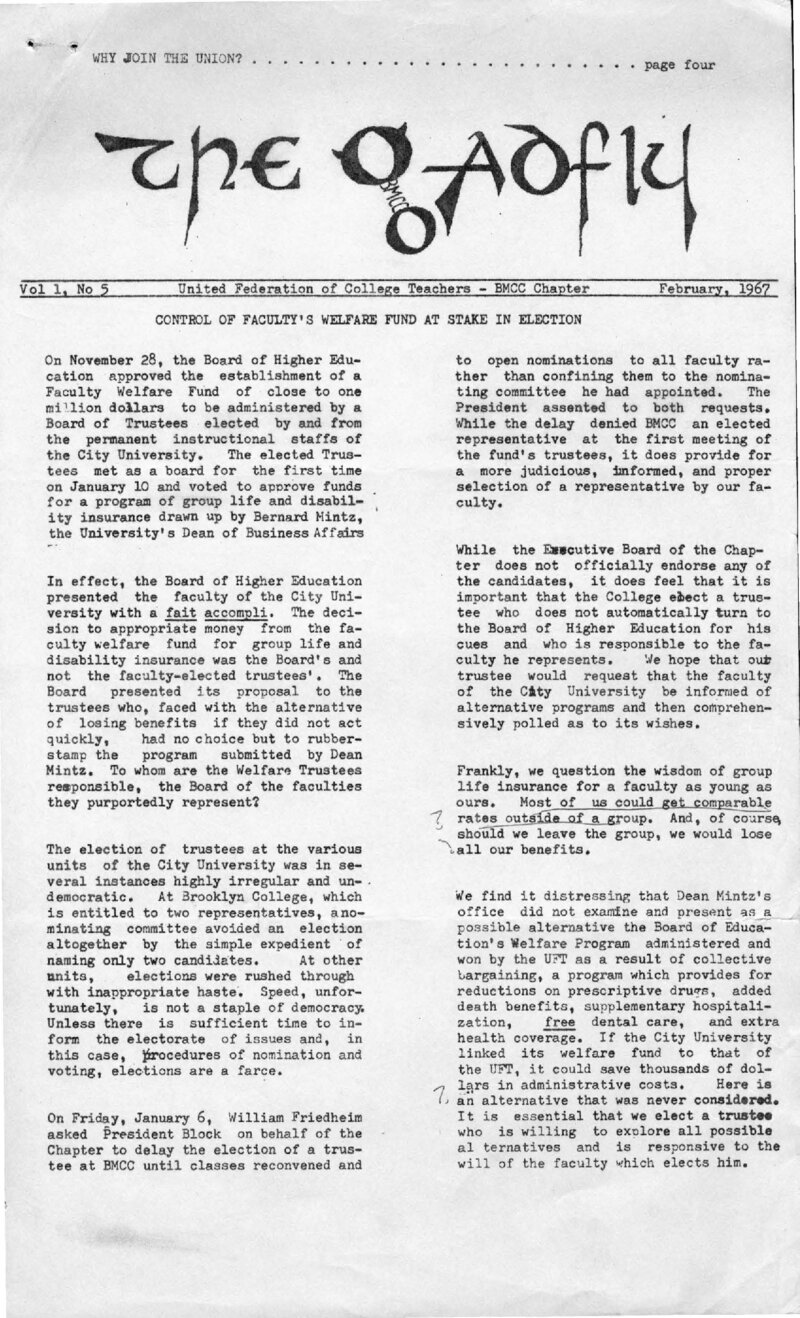
CONTROL OF FACULTY'S WELFARE FUND AT STAKE IN ELECTION
On November 28, the Board of Higher Edu-
cation approved the establishment of a
Faculty Welfare Fund of close to one
million dohlars to be administered by a
Board of Trustees elected by and from
the permanent instructional staffs of
the City University. The elected Trus-
tees met as a board for the first time
on January 10 and voted to approve funds _
for a program of group life and disabil-
ity insurance drawn up by Bernard Mintz,
the University's Dean of Business Affairs
In effect, the Board of Higher Education
presented the faculty of the City Uni-
versity with a fait accompli. The deci-
sion to appropriate money from the fa-
culty welfare fund for group life and
disability insurance was the Board's and
not the faculty-elected trustees'. The
Board presented its proposal to the
trustees who, faced with the alternative
of losing benefits if they did not act
quickly, had no choice but to rubber-
stamp the program submitted by Dean
Mintz. To whom are the Welfare Trustees
responsible, the Board of the faculties
they purportedly represent?
The election of trustees at the various
units of the City University was in se-
veral instances highly irregular and un-.
democratic. At Brooklyn College, which
is entitled to two representatives, ano-
minating committee avoided an election
altogether by the simple expedient of
naming only two candidates. At other
units, elections were rushed through
with inappropriate haste, Speed, unfor-
tunately, is not a staple of democracy
Unless there is sufficient time to in-
form the electorate of issues and, in
this case, rocedures of nomination and
voting, elections are a farce.
On Friday, January 6, William Friedheim
asked President Block on behalf of the
Chapter to delay the election of a trus-
tee at BMCC until classes reconvened and
i
to open nominations to all faculty ra~
ther than confining them to the nomina-
ting committee he had appointed. The
President assented to both requests.
While the delay denied BMCC an elected
representative at the first meeting of
the fund's trustees, it does provide for
a more judicious, informed, and proper
selection of a representative by our fa-
culty.
While the Exscutive Board of the Chap-
ter does not officially endorse any of
the candidates, it does feel that it is
important that the College ebect a trus=-
tee who does not automatically turn to
the Board of Higher Education for his
cues and who is responsible to the fa-
culty he represents, We hope that out
trustee would request that the faculty
of the Chty University be informed of
alternative programs and then comprehen-
sively polled as to its wishes.
Frankly, we question the wisdom of group
life insurance for a faculty as young as
ours. Most of us could omparable
rates outs coup. And, of course
should we leave the group, we would lose
‘all our benefits.
4
We find it distressing that Dean Mintz's
office did not examine and present as _a
possible alternative the Board of Educa-
tion's Welfare Program administered and
won by the UFT as a result of collective
bargaining, a program which provides for
reductions on prescriptive drurs, added
death benefits, supplementary hospitali-
zation, free dental care, and extra
health coverage. If the City University
linked its welfare fund to that of
the UFT, it could save thousands of dol-
lars in administrative costs. Here is
» an alternative that was never considered.
It is essential that we elect a trustee
who is willing to explore all possible
al ternatives and is responsive to the
will of the faculty which elects him.
, PAGE Two
DEPARTMENTAL ELECTIONS
We recently dispatched a communication to the President in which we passed on the
guidelines suggested by the Chapter for departmental elections. The Chapter thought
it advisable that only those who, in terms of type of appointment and service, had a
true stake in their departments, participate in the elections. Pursuing this line of
reasoning, we asked the President to limit participants and candidates to those
faculty on tenure-generating lines who were contracted on or before September 1, 1966.
In an unusually prompt response, the President reaffirmed his intention to call
elections for the Spring in those departments where there are sufficient numbers
eligibld to vote and run for office. The President wrote that he would probably hold
elections "under the provisions set forth in the by-laws of the Board of Higher
Education. These provide that anyone of professorial rank and those instructors
who are tenured may vote in departmental elections." At our next meeting we will
discuss the President's response and the advisability of any further suggestions or
inquiries on the part of the chapter.
STUDENT LITERARY MAGAZINE
"The Gauntlet: A Journal of Literary Expression and Opinion," edited by BMCC students,
Pauline Hahn and David Lissandrello, is on sale in the college bookstere for fifty
cents. It is an excellent publication, certainly the best we have seen eut of a two
year college. The administration has permitted the bookstore to selb the jounnal and
Chapter members are urged to purchase a copy for both your own enjoyment and to
support a worthy venture.
HOLD THE LINE ON LECTURERS
If you will pardon an over-wrought metaphor, the lecturers in the City University
have been condemned to an academic no-man's land. They have neither the rights
nor the security of their colleagues on tenure~generating lines. Their fate and
future employment hangs in balance from semester to semester. Because of their
position, they cannot readily identify with the institutions at which they teach.
Too many lecturers are bad for a faculty's morale.
The Chapter fully understands that because of limitations of budget and the unger-
tainty of scheduling from term to term, it is necessary for departments to keep at
least one or two lecturers in their employ. However, we feel that there are too many
lecturers at BMCC. A cursory survey shows seven in the English Yepartment alone.
In a memorandum, we pointed out to the President that we do not consider this sound
academic policy. In his reply he shared our concern but indicated that temporary
funds forced the situation upon him. He also pointed out that the school has "hired
several lecturers out of regular instructional lines" and that as soon "as we can
be assured of the long range needs for such lines, they will be assigned on a
permanent basis to several departments," The college is committed to expansion
next year. We do not fully understand why the administration cannot immediately
open instructional lines to some of our highly-qualified lecturers. We will explore
the matter further at the next Chapter meeting.
EXAMINATION AND PROCTORING SCHEDULES
On December 19, at the Chapter's direction, the Executive Beard directed a memorandum
to the Office of the Dean of the College expressing concern over the abrupt change
in the scheduling of final examinations. We pointed out that the sudden shift in the
calendar had caused serious dislocations among both students and faculty. What
distressed us most was tha one was consulted before the decision was made. We
stated that, as a matter of course, the faculty should be party to decisions which
vitally affect their classroom teaching. Finally, we indicated that while we assumed
there was good reason for the last-minute revision of the calendar, we felt that
an explanation was in order and asked for assurance that decisions affecting
scheduling for the Spring Semester be made several months in advance.
continued
. PAGE THREE
We had a most encouraging meeting on this matter with Dean Draper on Tuesday, January
17. He apologized and assumed full responsibility for what had happened. "The honeymoon
is over," he said, no lémger could the administration pass its mistakes off to the
College's inexperience and youth. He explained that he would circulate examination
schedules to the departmental chairmen early in the second semester. In turn, he would
instruct the chairmen to consult the members of their departments and, where feasible,
to incorporate their suggestions into the schedules. In this manter, the faculty
would share the responsibility of scheduling with their chairmen and the administration.
Hopefully, by the end of February, the Dean's Office will publish the exam calendar in
its final form.
The Dean was also aware of irritations resulting from the procboring assignments. (In
one case, two proctors were assigned to police the examination of one student.) He
expressed concern, however, over the fact that mamy proctors did not honor their early
morning assignments. As a remedy he suggested that in the future, the chairmen in
concert with members of their departments assign proctors for their ownexams. Dean
Draper felt and we shared the opinion that by Wdecentralizing" the assignment of
proctors, each department could better see after its needs and the convenience of the
faculty.
We were particularly heartened, by Dean Draper's understanding of the problem and his
intention to correct the situation by providing the faculty a more positive role in
the processes of decision making. And we think it is a sign of strength, not weakness,
when someone faces wp to and learns from his mistakes.
EARLY NOTIFICATION
The administration has moved up notification of renewal and termination of contracts
from April to the middle of January. THE GADFLY pressed for such a policy as early as
November. We congratulate the President for a decision that was as wise as it is
humane. Notice in April did not allow those separated from the faculty sufficient time
to seek a position elsewhere. We temper our commendation of the President with a
suggestion that he sned out letters three weeks earlier so that those dismissed have the
benefit of the scholarly conventions convened late in December ,t which many college
and university departments interview and hire for the coming year.
HUAC AND THE UNIVERSITY
The House Un-American Affiars Committee has been subpoenaing membership lists of student
organizations critical of the government's policy in Viedmam from various colleges and
universities throughout the country. The Nation editorialized in its December 12 issue
that acquiescence by institutions of higher learning "'foreshadows a degrading subservience
which calls into question their whole reason for being."
HUAC has consistently abused its congressional prerogatives by flagrantly violating
due process. Insulated from its own libelous acts by legi&kative immunity, the
Committee has pubbished slanderous and unsubstantiated information injurious to the
reputations of countless citizens. Their high-handed attempt to subpoena membership
lists is but the latest chapter in their long history of harassment. The American
Civil Liberties Union has distributed a letter to one thousand college presidents
asking that they resist HUAC's attempts to muffle dissent and curb free inquiry.
This, after all, is what a University is all about.
In response to the ACLU letter, the Deans of Students at the various units of the
City University, including Leon Cohen of BMCC, have suggested that the membership
lists of all student organizations be destroyed. Such a move would effectively limit
HUAC's attempts at intimidation on the campuses of the City University. To implement
the action of the Deans, the Student Activities Committee at BMCC pa:sed a motion
destroying membership lists and instructing the school to notify an organizatyion's
officers before answering to a subpoena. The names of a club's officers, unfortunately,
must remain on file. Hence, those students are still vulnerable. However, if they
abe notified by the administration as soon as a subpoena is issued, they would have
adequate time to enjoin the school from answering and, with the possible help of the
ACLU, test HUAC's right to such information.
The resoltuon of the Student Activities Committee awaits approval by the Faculty
Council. We recommend a yes vote and commend the Deanss of the City University for
their well-founded defense of academic freedom.
. PAGE FOUR
DIPPING INTO THE PORK BARREL
Six weeks ago the Board of Higher Education announced that it had voted to provide the
Presidents of the units of the City University with free housing. The Board reasoned
that their action was necessary if the University was to attract educators of superior
caliber to fill its highest administrative posts: The Board revealed that this was
but a first step toward providing housing (at reduced rates) to the faculty and
subordinate administrators of the University.
The Board's decision smells of pork barrel. ith the city's budget for the University
as parsimonkous as it is, it would seem that there are higher priorities than free
housing for Coliege presidents. Sumehow the Board can squeeze out funds to support
administrators in plush style but when instructors ask for compensation for lost
vacation time, its vupboards are suddenly bare. Free housing will undoubtedly lure
additional applicants for the College Presidencies. But are more applicants necessary?
Certainly the Board need not look outside New York or its own system to attract
qualified administrators to head its colleges.
The promise of faculty housing at reduced rates is nothing but a sop to the instructional
staff. It was obviously intended to appease faculty and quiet any protest 66 the
Board's gratuity to its Presidents. There will not be low cost faculty housing in
the foreseeable future. The Board claims to be working out a plan with Columbia and
New York Universities. On this score the Board's credibility is suspect. Columbia
and NYU have not begun to solve their own housing problems and hence are ill-qquipped
to help the City University lodge its faculty. The Board owes us better justification
for tts lavish disbursement to the college Presidents.
UNIONS FOR PROFESSORS by Israel Kugler
(The following article is reprinted from THE ACTIVIST for Fall, 1966.
Dr Kugler is President of the UFCT's New York Local.)
Teaching in our colleges and universities can hardly be called a true profession able to
attract and hold the finest and most sensitive minds; to sustain that quality of education
reflected in close ties between teacher and student. We do not have a genuine voice in
the formulation of policy affecting the conduct of the profession; we are unabbe te
control the conditions of teaching and learning for maximum effectiveness and creative
growth.
Our colleges and universities are dominated by the corporate structure so typical of
American business. The boards of trustees like the boards of directors; the college
presidents and deans like the managers--determine, in the last analysis, the mode and
degree of compensation, the nature of facilities, the numbers of students admitted, the
size of classes, and the extent of the professional and ancillary staff. In the case of
the public colleges and universities, the "power of the purse" is held by the supra-
power of governmental aithorities such as local and state executive and legislative bodies.
A myth besets out profession--that the college and university teacher is a professional
on appointment, not an employee. By any test of reality, it is others, not the
- #racticing teachers who determine the basic policies affecting the conduct of the
profession. As distasteful as it might seem, the fact is that the college teacher is
an employee. . .. Thus, the ideal of universities developed in Europe in the High
Middle Ages--a guild or community of scholars--had never existed on thr American scene.
We have a vast and growing academic marketplace completely umprepared to cope with the
new goal of universal higher education.
To meet the gorwing need for funds to finance expansion, colleges and universities have
concentrated on developing "reputations" which can attract substantial research grants
from government and private organizations. . . . This development can reach the
frightful state divulged in Michigan State and the University of Pennsylvania where
"research" has indihuded training in spying under the direction of the Central Intellgence
Agency, guerrilla warfare strategy and tactics, and chemical and biological weaponry.
On the current academic market, we have created the individual academic entrepreneur
who has no roots in an educational institution, but who prepares himself by publications,
léesture-cirouttry,; and agreeable academic gentility to job-skip from one high-bidding
college to another. These "stars" are seized by the adademic pirates in college
administrations to grace the faculty with "reputations" that permit these individuals
to take flight from teaching. They are granted good salaries, an office and research
staff, little or no teaching or committee responsibility.
These "stars! embroidered on the faculty fabric hardly hide the fact that for the
bulk of the faculty, conditions remain second-rate. Thus, the profession of,college
teaching lags behind the other professions in competition for the best minds,
. PAGE FIVE
The lesson of Berkeley is that in this development, the student has been forgotton.
He is subjected increasingly to the mass lecture, often magnified by closed-circuit
TV. .. » Only the most inte lectually endewed can overcome the nefarious effects
of this neglect. As a substitute for undergraduate contact between student and faculty
in an educational ecology conducive to true learning, we alse have the growing use
of graduate assistants with full undergraduate teaching assignments. Substandard salaries
for these graduate assistants are also too often accompanied by their complete lack
of voice in curriculum develapment and choice of textbooks. In too many institutions
the non-tenured faculty member is reduced to a state of fear-ridden docility, lest he
anatagonize the administrative powers that be. Competition for the precious promotions,
largely limited by budgetary quotas, also serves to encourage uncreative quiescence.
Accrediting associations and state departments of education have played no significant
rele in correcting t ese abuses and raising the level of the profession. In almost
all instances, these bodies have been captured and controlled by administraters largely
engaged in accrediting each other's institution.
The one organization which has dominated the scene of college teaching, the AAUP is
woefully inadequate. .. . To be sure, it has avowed commendable principles of academic
freedom and tenure, but it lacks the ability to effectively enforce them. The most
dramatic example of this is the continuing effort of the AAUP's Washington office to aid
the St John's University chapter which was infilitrated and captured by administration
forces. This is the chapter which despite the AAUP's excellent motion of censure,
condemned the heroic strike en behalf of the summarily dismissed teachers and refuses
to be critical of the St John's administration.
The AAUP is undemocratic. All key positions are determined by a closely-knit Washington
office. This bureaucratic center curbs local chapters from taking an active course,
lest they "prejudge" the case. . . .« The Annual Meeting of the AAUP cannot adopt policy
unless it is concurred in by the Council or by a subsequent Annual Meeting,
The AAUP is slothful. Its pinnagle sanction of censure takes an average of 2% years
from inception to its publication in the AAUP Bulletin. AAUP censure has become more
and more meaningless. It is not accompanied by boycott or concerted withdrawal of
services. « . «
It has, therefore, become the historic role of the AFT to assume leadership in the
colleges and universities, ensuring quality education for all students capable ef bene-
fitting from some kind of collegiate training. The AFT, with its ties to the organized
labor movement, can unite "town and gown."' It can muster the necessary economic,
political, and social resources that will serve to improve educational institutions as
a whole, rather than the lot of the individual "star." ...
The AFT's approach to higher education is comprehensive. It considers the university
with itss grauduate programs, the 4 year liberal arts college, the community and junior
college of co-equal importance in meeting the varied educational needs of America's youth.
Librarians, teaching assistants, laboratory assistants, registrars, etc. are ont relegated t
to a status of neglect. The AFT strives for excellence in all collegiate institutions
and for proper recognitien of the entire prefessional staff... .
Students must be given a responsible role in college and university evaluation. We
believe in enlarged opportunity, especially for the economically deprived and disad-
vantaged. The AFT supports free tuition in all public colleges and univerisites. For
those students who, despite free tuition, would be unable to go to college because of
economic responsibilities to their families, the AFT advocates a system of stipends
patterned after the GI Bill of Rights, aiding indigent families. ...
Academic freedom in the highest degree is essential for both faculty and students.
As citizens, they are entitled to the freedoms embodied in the Bill of Rights. Teachers
must have the freedom to teach, engage in research, and publish in accordance with
their prefessional conscience. Students must have the freedom of association, advocacy
and the freedom to entertain controversial speakers unfettered by academic restrictions
as long as the teaching and learning process is inhampered. The AFT ovposes loyalty
and disclaimer oaths fer teachers and students. Such oaths tend to inhibit the free
pursuit of truth and knowledge and create a climate of fear and suspicion foreign to
a college or university. We, therefore, make no distinction between secular and
denominational colleges, believing that religious sponsorship should not interfere
with the freedom to teach and leann.
Believing strongly in freedot of assochation, the AFT bélieves that no faculty members
should be required to join >r refrain from joining a campus organization as a condition
of employment or retentivn, We, therefore, do net seek a union or closed shop in
colleges and universities.
PACT SIX
The fcllewing represent some additional highlights of the AFT program for colleges
and universities which will serve to make college teaching more competitive with the
other professions:
SALARY: A basic salary schedule from a minimum of $10,000 to a maximum of $30,000.
PROMOTION: Advancement from beginning rank of Assistant Professor through Full Pro-
fessor by mandatory annual increments with automatic change in title. More rapid
promotions, as determined by departmental colleagues, may be made to award outstanding
achievement.
TENURE: Conferred by departmental colleagues after three years of a rigorous selection
and probationary procedure. Professional incompetence shall be theonly grounds for
dismissal under due process.
GRIEVANCE PROCEDURE: This should be uniform for all faculty members and include the
right of representation at every step with final disposition made by an outside impartial
source.
COLLECTIVE BARGAINING: The above programmatic points, as well as others, can best be
achieved in our view, through the process of collective bargaining. Faculty members,
through a secret ballet, determine whether or not a majority wishes to have the AFT
represent the faculty in negotiating with the college administration. If an AFT affiliake
is chosen, then the faculty is represented by q force equal to that of the administration
in developing a contract. Such a binding contract represents the new position of power
for the faculty. It represents not hostility, but an accomodation of divergent views.
It redresses the imbalance of power between the administration and the faculty! It
creates a climate of courage which will bring férth more creativity on the part of the
facultys-especially the younger and non-tenured. It alone will provide that nece isary
control for the practicing professional--the college and university professor--over the
conditi6ns under which the profession is conducted.
CLASS LOADS
Faculty members wishing to assist in a project researching class loads at the college
should contact Charlotte Croman or Mayer Rossabi who are conducting the investigation
for the union. The matter will also be discussed at the Chapter meeting.
WHO ACCREDITS MIDDLE STATES II by William P. Friedheim
In an unprecedented move the Commission on Institutes of Higher Education of the Middle
States Assdchation of Colleges and Secondary Schools on December 1, 1966 released for
public dissemination its accreditation report on St John's University. In the past
only the Assocttation and the school seeking certification were privy to such infor-
mation. The commission departed from its normal procedure and took the public into its
confidence only because of the extraordinary circumstances surrounding ita evaluation
of St.John's. The report ordered the University to show cause by December 31, 1967
why the Association should not revoke its accreditation. MSA did not, however, remove
St. John's accreditation.
The Commission's statement directing St John's to put its affairs in order followed by
almost a year the dismissal without reason or due process of thirty-one members of the
University's faculty. Although at the time the school was still in session,the Board
of Trustees separated all but ten of that number from their classes. The Vincentiais,
who run the University, in several instances assigned clerical personnel and nuns of
dubious academic standing to cover the classes. The Commission, in light of St John's
arrogant defiance of academic due process, had no choice but to address its report t o
the dismissals.
A reading of the Association's statement is an intellectually numbing experience.
Its tottured sophistry literally streches the mind of a same man. The document is no
more than an unconvincing rationalization, in the face of increasing pressure from
renowned educators and civil libertarians to the contrary, of the Commission's decision
to place St John's on a year's vrobation rather than revoke its accreditation. The
report reflects poorly upon both the processes of accreditation and the general state
of higher education in the United States.
The neport is self-damning. It bares the Association as an organization responsible only
to the colleges it accredits; it is not accountable to the academic community at large.
Administrators, with few exceptions, staff and direct Middle States as they do the five
other regional associations which accredit colleges and universities in the United
States. Of the seventeen members of the MSA's Commission on Institutes of Higher
Learning, only one is of faculty status. The Commission's constituency of Presidents,
Deans, Provosts, Chancellors, and similarly knighted educators goes a long way in
explaining the bastardized pragmatism which characterizes its analysis of St John's.
PAGE SEVEN
Middle States’ concept of accreditation is rather disturbing. The Report on St John's
makes it clear that the Association, when it charges a "team" to visit a school and
render a judgement, seeks merely to measure "educational effectiveness."" What qualities
make for educational effectiveness? The Commission stipulates that a school must have
"worthy objectives?" Unfortunately, as the Commission's survey of St John's reveals,
Middle States shies away from judgements of value. Its definition of "worthy objectives"
is so elastic as to be meaningless. An overzealous concern with the means by which an
institution achieves its goals flaws the approach of the Association's eValuating teams.
By default, MSA leaves the definition of "worthy objectives" solely to the school they
are evaluating.
In a pamphlet with the imposing title, "Accreditation of Educational Institutions
Conducted by Roman Catholic Religious Eommunities for their Own Members," the Commission
elaborates upon its prerequisites for accreditation:
Accreditation is an expression of confidence on the part of competent, representative
observers that an education institution has defined its purposes and educational
aims precisely (italics added), has obtained the resources and established the
conditions under which, in the judgement of experienced colleagues, it should be
able to achieve them and to continue to do so under varying circumstances, and
appears in fact te be accomplishing them in substantial measure.
In this instance the Association did not even choose to modify "purposes and educational
aims" with the adjective "worthy." If we are to take the statement at face value, the
Commission only looks for precision of definitien when it assesses the validity of a
College's objectives. Elsewhere in its official literature, MSA merely notes that goals
should be "realistic" and “apprepriate."' The Association, however, makes a most dama-
ging admission in its public statement on "Membership and Accreditation" dated July,
1966. It reads in part: "The Commission on Institutes of Higher Education . . . publishes
descriptions of good practice from time to time, but it prescribes no minimal criteria
or quantitative standards. . .. It evaluates each applicant for membership in light
of that institution's own reasons for existence." This candid revelation betreys the
Association's pronouncements on standards as a farce and, even worse, irrelevant to the
commission's own view of accreditation. Clarity of objectives and the machinery nece-
ssary for their realization in themselves warrant accreditation for an institution of
higher learning. In essence, the MSA is not primarily concerned with ends but means,
Its literature dwells almost obsessively on the mechanics of administration.
The commission weighs the acts of a college's administration, as the statement on St
John's bears ample witness, by the scahe of their "consequences." The consequences of
an administrative decree are grave only when they lead to what the report continually
refers to as loss of "educational effectiveness."' And how does "educational effective-—
ness" elude a college's grasp? The Commission tells us that when an "episode (has)
led to the resignation of faculty members, withdrawal of students, inability to recruit
replacements or other untoward events," it is symptomatic of an educational instituion's
inabklity to meet "its objectives effectively." Violation of acaedmic freedom or due
process, though "reprehensible" by the Association s own admission, is beside the point,
unless, of course, it deprives a university of its "educational effectiveness." As long
as a college does not lose students and additional faculty, an administration can do as
it pleases. If we are to believe Middle States, administrative efficiency is roughly
equivalent to "educational effectiveness." Consequences are not dire if you have a
"plant" to operate, a faculty to direct, and students to process. The Commission
premises its report on the assumption that the summary dismissal of thirtysane faculty
members dictates the temoval of accreditation only if it impairs the oeration of the
school, By these standards it would have accredited the University of Berlin in 1935.
The composition of Middle States, dominated by administrators, contributes to its myopic
view of the problem. The Association asked all the wrong questions at St John's.
And, even more disturbing, it came up with the wrong answers to questions which were
ireelevant in the first place. If the MSA judges an act by its consequences, it is
obliged to look at more than just the dislocation of students or faculty. Did the
dismissal of thirty-one professors without explanation or due process at all inhibit
freedom of inquiry or speech at the University? While the question is rhetorical, it
is alse pertinent. Unfortunately, it did not merit consideration, or so the report
leads us to believe, when Middle States examined the consequences of the dismissals.
Even before it assessed consequences, the Commission asked another question: did the
Boa¥da of +rustees of the university act responsibly when they dismissed thirty-one
faculty members before the end of a term, relieving all but ten of their classes?
What follows are some painful twists of logic:
» » « the commission can only say that it is convinced that the Board of Trustees
of St John's University believed that the University faced a clear and present
danger to its present existence, and that immediate and drastic action was called
for, and believed further that the action was necessary to avert destruction of
the institution and to prevent riots and bloodshed. Whether or not one can accept
the belief of the trustees as valid in any objective sense, there is no question
whatsoever that the Trustees themselves were satisfied that they faced precisely
such a crisis.
’
The Commission inserted a disclaimer, proclaiming that the report "is making no
comment on the credibility of this belief." Instead, the Association allowed St
John's to establish its own standards of responsibility. The trustees believed
that they were acting responsibly, hence they were acting responsibly. With thid
slick syllogism, the Commission actually freed itself from the anguish of passing
judgement upon the decision of the trustees,
The report is not tdally cyniéal. The Commission did, not openly flaunt principles
generally held dear by the academic community. It covered its tracks with a tr&&l
of platitudes and euphemisms. The report left no. agubt that the dismissals were
"heinous," "reprehensible," and "a violation of dott d,academic practice." In fact,
the Commission doth protest too much. After this virtuoso display of academic
idealism, the Association reasohed that these sentiments had little bearing upon
their assessment of the consequendes of the dismigsals, Middle States avoided a
judgement but implied that had it tendered a decision, it would have ruled ih
favor of the fadtilty members dismissed. While sudh an empty con6olation might
make for good public relations copy, it is of little comfort to the thirty one who
lost their jobs.
Dean Akbert E Méeder Jr of Rutgers; who headed and alone signed the publi¢ report
of the evaluating team which visited St John's, wrote: "the commission does not
believe that accreditation can depend 6n any single action or factér, but rather
must be determined by the weight of all the evidende.'' The statement bears testi-
mony to MSA's ill-conceived approach to accreditation. Academic due process and
freedom are but two of the many factors the Commission had to isolate and appraise.
If St John's rates poorly on academic freedom, it might well have compensated by
Oring high on athletic facilities, parking accomadation, and institutional food.
While the Commission hopefully assigned different values to these factors, its
approach was nonetheless an inadequate measure of the central issue. Academic
freedom is not computable on a shopkeeper's balance sheet. There is an organic
relationship between its violation and the deterioration of the body academic.
When the report diagnased it as just one of many factors, it obscured the inter-
relationship of academic freedom and the pracesses of teaching and learning. In
so doing, the Association again evaded a direct consideration of the Trustees’
highhanded disregard of due process.
The Commission conceives of academic freedom in the same terms that it does ac-
creditation. It asks only that an institution define academic freedom and the means
by which violations are to te processed. The Association points out that it is
"essential" that a "disinterested party" adjudicate appeals. Basically, though,
MSA views academic freedom as a question of mechanics. Even when it does prescribe
what it considers "sound academic practice," MSA permits a University such as St
John's to ignore its standards without less of accreditation. Instead of enforcing
its principles, MSA labors over "consequences."
St John's actions will not seriously affect either enrollment or recruitment of
faculty. The Archdiocese of New York feeds the University a steady stream of
students from its secondary schools. The University can always fall. back upon
various Catholic orders to fill faculty positions which fall vacant.
Back in February, 1966, Father Cahill, the President of St John's, responded te
the "severest censure" in the history of the AAUP with the statement that it was
the MSA "we have to worry about . . . and we have assurances from Middle States
that they do not think this warrants any investigation on their part."" In turn,
the Commission's report built a case to the effect that violation of academic
freedom by itself does not merit the removal of accreditation. If anything, the
MSA's arguments provide a favorable case for accreditation. Why then did the
Commission strap St John's with a "show cause" order? Probably to save face. In
another year the whole nasty mess will fade further from the public view and, at
that time, if the MSA still subscribes to the reasoning which characterizes its
report, it will quietly bring St John's back into its good graces.' Middle States!
ideal of accreditation and, for that matter, of higher educatkon, is mechanistic.
The Association is so caught up with its evaluation of means and consequences
that it has lost sight of academic excellence. Presidents and Deans dominate its
councils and, hence, MSA's concerns are by nature and inclination administrative.
As a result, MSA is willing to concede the definition of standards té the colleges
it accredits. In the case of St John's it went so far as to allow the Vincentians
to judge the responsibility of their own acts. In the process it may have
sacrificed academic freedom to the perverted ethic of bureaucratic efficiency.
MSA files are closed and its reports, with the exception of St John's, secret.
The Association is only responsible to the administrators who staff it and the
colleges it certifios for membership. Accreditation becomes a vicious cycle as
administrators evaluate one another's colleges. For their labor they are handseme-
ly reimbursed; up to $200 a day. An MSA evaluation can tax a college in excess of
$3000. The investment is not extravagant considering that it is a rare occasion
when the MSA denies a school accreditation. At worst, MSA might allude to "ins-
stitutional weaknesses" without, of course, specifying what they are.
Regrettably, no one has asked the question, "Who accredits Middle States?"
PAGE NINE
Cet ee ee ee ee ee ee ee ee ee ee ee ees
SHORT STORY
THE LANGUAGE OF THE FAN by Roger B Dooley
OLDEST MOVIE HOUSE TO CLOSE
The Florence} believed to be the oldest
operating motion picture theatre in this
area, will draw the curtain across its
silver screen for the last time at the end
of this month, Mrs Clara Brenner, the
owner, has announced. Opened in 1915 by
her husband, the late Fred J Brenner, to
serve what was then a new section of the
city, the 300-seat theatre was patronized
by generations of mowie-goers before TV
and changing neighborhood patterns began
to take their toll. The property is to
be sold to the builders of the nearby
South Gate Village apartment project, for
use either as a bowling alley or a parking
lot. Mrs Brenner, who has lived in the
building since its opening, plans to
enjoy her retrrement in Florida.
Even with the truth literally staring her in the face, in the clipping from this mor-
ning's theatre page scotch-taped to the box office wall, she stmll could not really
believe it. Though he did live in a South Gate apartment, the young reporter had
been kind, after all, to take that much interest, just from seeing her sitting alone
here every evening. How could he be expected to understand all that the Florence
had meant to Fred and her and to every one else who had lived around here?
The very name sounded quaint now, but in those days many of the neighborhood theatres
springing up everywhere had been called after actresses: the Ellen Terry, the Lily,
the Pearl, the Maxine, and Florence Lawrence and Florence Turner had been two of the
brightest stars to emerge in the new medium. Were little girls christened any of
those names any more? Mrs Brenner wondered. Or Hazel or Elsie or Maude or Ethel or
any of the other favorites of her generation? Even her own name seemed to recall
Clara Kimball Young rather than Clara Bow.
"Opened in 1915..." It seemed not just fifty years or two wars ago but centuries,
light years away, that world she had known, of hobble skirts and Turkey Trots, of
rides on open-sided, inter-urban trolleys to long-vanished amusement parks, of bbg,
solid houses full of cupolas and gingerbread and stained glass, with front verandas
screened by lilac bushes or magnolia trees, where courting couples could spoon dis-
creetly in porch swings. With her petite figure, slim in the styhe Irene Castle was
making popular, and her hair (long enough to sit on) of a shade then called "auburn,"
massed low on her forehead and done in a soft bun behind, Clara Nagel had never
lacked beaux. She could certainly have done better than Fred Brenner, all her rela-
tives had agreed. Sleeing his father's furniture business to put all the money into
a nickleodeon!
Of course Fred had never let anyone call it that. The Florence was no converted store,
but a specially-designed yellow-brick building, with the name carved in the stone
pediment at the top, and its own electric marquee, where white letters dn black
spelled out the attractions while yellow bulbs, alternately blinking out, seemed to
chase each other forever around the ddge and up and down the vertical sign on which
the name FLORENCE was spelled out from top to bottom. Built-in cases to display the
glossy stills and vivid posters supplied by the studio exchanges flanked the outer
glass doors and divided the mirrors in the tiled lobby, and the crowning glory of which
was a lofty fan-shaped window, up behind the marquee, where the monogram "F" recurred
at regular intervals among the symmetrically twined stems of stylized lilies and
morning glories.
Like the Florence itself, to her Fred had never changed. With his square jaw, his
pince-nez and his hair, however thin and gray, still parted neatly in the middle, he
had to the end looked like her perfect Gibson man -- but she cduld see how the
starched separate collars, the green visor, the office jacket and cuff protectors that
had once been the signs of a trim young man gradually marked him as a spruce old
fellow of an earlier generation. Though the doctors had called it heart trouble,
te ee ee ee ee ee
PAGE TEN
BRR OR OR OR RA RK eS ee ee ee ee ee ee ee ee ee ee ee ey
she knew that worry over the future of the Florence had hastened his death, five
years ago --the future that she had been trying to stave off ever since.
"The last show's already begun.'' She slid aside the little panel in the box office
whndow to speak to a woman who had just walked into the lobby -- a gaunt figure in
a leopard-skin coat, with hair dyed brilliant red and eyes shadowed green to match
her earrings and scarf.
"Mrs Breaner, don't you know me? Mabel -- Mabel McCracken! You remember, the Florence
Faye Fan Club?"
"Why, Mabel!" Mrs Brenner produced an instant lie. ''You look so much the same, I
couldn't believe it was you."
She remembered now -- a gawky, buck-t othed teanager, with her then naturally red
hair shingled in a hideous bob, all knees and elbows sticking out of the straight-
line sacks of 1927. According to movie formula, the ugly duckling should return only
as a @littering swan, but, even without being able to see her left hand, it was
pathetically obvious to Mrs Brenner that Mabel had simply aged from plain girl to
plainer worman.
"You still working the same place, Mabel?" Mrs Brenner ventured, wondering where it
was.
"Oh yes! I'm secretary to the assistant auditor now."' Mabel spoke with such modest
pride that Mrs Brenner could only murmur, "Well, now, imagine that! And what brings
you to this end of town?"
"Oh, Mrs Brenner, need you ask? This momning's paper! It always breaks my heart
whenever any of the old theatres close, but I just can't bear to think of our beleved
Florence being torn down."
Maybe, if more of the old customers, including Mabel Herself, had come back oftener,
we wouldn't be closing, thought Mrs Brenner. Like those people who never thought of
an old friend until they read of his death. But no, that wasn't fair, after all.
A neighborhood movie, like a neighborhood tavern or candy store or any other small
business, when it no longer served a need, had no more reason to exist. Nor for that
matter, had she.
"Well, Mabel, I held out as long as I could. Longer than most,"
"I thought these new big apartments would bring you lots of new customers --expecially
with no other theatres around."
Mrs Brenner shook her head. "All it did was drive away the last of our old ones,
when their houses were torn down. If these young couples go to movies at all, I
guess it must be at drive-ins."
"Oh, I know, but even so--'' Mabel was determined to wax nostalgic, Mrs Brenner saw.
Well, better one mourner at the wake than nnne at all.
"I was going to close up here, Mabel. Why don't you stop upstairs with me for a cup
of coffee?"
"Oh, thank you, Mrs Brenner, that'd be lovely."
Stepping intotthe darkened theatre, where perhaps twenty people, mostly teenage
couples, were watching a horror film, Mrs Brenner whispered to a tall, dark-haired
boy at the candy counter. "I'm leaving now, Jeel. When you close up, there's some
fresh kuchen waiting for you upstairs."
"Good! Thanks, Mrs Brenner. The Maltese Falcon is on the late show tonight."
It was hardly worth keeping an usher anymore, she knew, but Joel was a good boy,
working his way through the local university. He also served as janitor, popcorn
salesman and general handyman --everything, in fact,but projectionist (he had to
be a union man), but, even so, most evenings he had plenty of time to study or to
read books on film history. He felt more at home here than in the house where he
roomed, he said. Joel, at least, would miss the Florence.
"Oh, isn't this lovely!" Mabel exclaimed, as Mrs Brenner switched on the lights in
her living room. "I wish I could get my apartment to look so home-like. Such high
ceilings! And a window seat! It's all co -- so 'Edwardian'!"
POT PCS eee eee ee ee ee ee ee ee ee ee ee
PAGE ELEVEN
FOOT ICICI IIIS IO IOIGIIGI IGT TOI IOI IOI IOI I IO ICIOR IIRC ORIG RIK aa ak
"Well, Fred always liked his comfort. But it's more room than one person needs,
really, the three bedrooms and all." Putting a pot of coffee on the stove and setting
her kuchen on a favorife plate, Mrs Brenner felt a fresh pang at the thought of
leaving this kitchen forever.
"Have you really closed the sale yet3'' Mabel asked.
£
"Just about. I sign to final papers next Monday. I held out for a good price. I
guess I was hoping they'd never meet it. It's not easy pulling up roots after fifty
years -- but, the way I look at it, Fred'd rather see the Florence gone altogether
than standing empty, all boarded up, or turned into a super-market or something
like that."
"I suppose so. You know, what we all loved about the Florence was how nice you and
he valways were to us kids in the neighborhood --the free candy at the Saturday
Matinees amd all. You always seemed to know every one of us."
Mrs Brenner smiled. "Fred said that was just good business. We made generations
of new customers that way. But I guess all you youngsters did kind of fill a place
in our lives."
To be sure, there was no way for Mabel to know, and no reason to tell her now, about
little Freddie, who had died in the flu epidemic of 1918} barely three -- just old
enough to break Fred' heart, and hers, especially since the doctor had told them
there could be -&o more children for them. Their generation had not been afraad
of sentiment, even sentimentality; every Christmas they had continued to hang
Freddie's white kid baby shoes on their little tree, and she still carried a curl
of his fair hair tn a locket around her neck. Impossible to imagine him as man of
fifty now! They had talked for a while of adopting, as they had also thought of
buying a pet, but ultimately, like many another childless couple, they had only
drawn closer together. Leaving the city how would mean leaving the graves of the
two people she had loved most, but she had steeled herself for a clean break with
the past --as if that were possible.
At a knock on the door, a little later, Mabel almost spilled her third cup of coffee.
"Who can that be at this time of night?"
"Just Soel, my usher. He often stops for a snack and the late show. For a boy
his age, you wouldn't believe how much he knows about old-time movies. I guess he's
what they call a buff."
"We were just talking aboug the good old days at the Florence," said Mabel presently,
when Joel was settled in Fred's Morris chair with the rest of the kuchen. "Long
before your time. Half the fun used to be just getting out of the house after
dinner and escaping into another world for the evening. “The Avalon was grander, of
course, but the Flerence was our second home."
"Well, Fred always saif we had to show the public 'third run' didn{t mean "third
rate.'" One of a nationah chain of "cathedrals of the cinema," the Avalon, only
a few blocks away, had from its ofening in 1925 automatically taken over the
second-run trade for this end of the city. "We always managed to hold our own."
"Especially after your grand re-opening!" said Mabel, with a sigh. "Remember, it
was really my idea to dedicate the theatre to Florence Faye."
"Why, so it was, Mabel."' Mrs Brenner recalled how Mabel had pestered Fred into
writing to the star. Florence Faye must have been slipping even then, because,
to Fred's astonishment, she --or her press agent-- had responded not only with an
enormous signed photograph suitable for lobby display but with a strong hint
that if the re-opening could be timed to coincide with the local premiere of her
forthcoming film, Miss Faye herself might just be persuaded to appear. Fred, of
course, had jumped at the chance, with results that led the South Side 3usinessman's
Association to name him the 1927 Man of the Year.
"What a night that was! Look, I still have the picture." From her purse Mabel
produced a yellowed newspaper photo carefully preserved in a plastic case. "Here
we are -~ 'Florence and Her Fans'."
The Gaption sounded like a comic strif, thought Mrs Brenner. Polly and Her Pals,
Frecktes and His Friends, Boots and Her Buddies, and now, . . . Florence and Her Fans.
"Do you know we still have that big picture of her in the basement?" said Joel.
"I came across it one day when I was trying to clean things out."
SOKA HOR AO STOR OH OR OK AOR FOR HR I ok ee ee ee
PAGE TWELVE
FEO ROR RO OIE ROR IIR ROR a aR TOR UO IO RII IGOR IOI ICAI aOR IO RR I OIOR a a oR (RRR OS RR ORR tk
"Ne! Oh, I'd love to see it," said Mabel.
"Business was better than ever after that," said Mrs Brenner, Those had been the days
of two uniformed ushers, of daily newspaper ads and printed weekly programs illustra-
ting the three double-bills with photo-mats the studios supplied, Fred had even moved
down from the prejection booth, and, as manager wearing his best dark suit (a tuxedo
would be going too far, he felt) stood in the lobby to greet every regular by name.
"You know, every time I hear an organ, even in church," said Mabel, "I think of the
way you used to play Charmaine and Diane and Jeanine and all those old theme songs."
"For the big silents, they used to send us the whole score, to play right along with
the action. .. . I hope I can get a decent price for that organ. No one's touched
it in years."
"Then, remember, even after talkies, when they'd flash the words on the screen and we'd
all sing along with you, Now's The Time to Fall in Love and Paradise and We Just Couldn't
Say Goodbye and all these old songs? Why did you ever stop that?"
“Well, for one reason, we were trying to cut costs, and I was needed more in the box
office. Anyway, there just wasn't time left on the program, once we started offering
bingo and dish night and bank night -- even amateur night!"
"But the depression never really hurt your business, did it?" asked Joel, who had been
listening in evident fascination.
"Goodness, no! Movies were about the only entertabhment most people could afford. We
only charged fifteen cents when the Avalon was still charging a quarter, and that made
just enougly difference so more people waited to see the pictures here. Then before we
knew it, we were in the war and every one had money and we all had standing room only
almost every nkght."
"In those days when we really liked a picture, like one of Irene Dunne's or Greer
Garson's, we'd follow it from downtown to the Avalon to the Florence and enjoy it most
of all here, because we thought this'd be the last time ever."
Joel smiled. "Since TV, old movies never die; they don't even fade away. Thanks to
Mrs Brenner here, I've seen more films from the '30's than the '60's."'
"I'm surprised you even have a set," said Mabel. "Considering."
"Of course, poor Fred would never have one in the place,'' said Mrs Brenner. "Still,
it was so quiet here without him. About all I ever watch are our old favorites."
"Oh, but they're never the same, all chopped up to fit the commercials," said Mabel.
“Some of the young snips in our office were brought up on TV, so I suppose they don't
know any better, but they actually laugh at some of the great pictures from our time."
"That kind probably wouldn't have appreciated them then either," said Joel. "On the
other hand, TV has made a lot more serious fans like me. At school the cinema club
packs them in every week just to see the old classics the right way, uncut, ina
theatre. Like we could do here."
"Now, Joel," said Mrs Brenner. "We've been all over that."
"An art house?" said Mabel. "With black coffee instead of popcorn? D bet that'd bring
in the apartment people,"
"Oh, Mabel!" Mrs Brenner gave a faint laugh. "I've tried to keep everything in good
shape but any one can see this place is fifty years old. The youngsters seem to get
rougher in recent years; half the seats and walls are damaged. I guess the Flgrence
has just had its day -- and so have I," é
"Oh, Mrs Brenner!" said Mabel. "Don't say that!"
"No, Mabel, it's too late. Fred's doctor bills ate into our savings more than he ever
knew. And if you knew how much I've lost ever since, just trying to keep open’ yee!
need every cent I can get out of it. .. . Anyway, what would I know about running
an art house, starting a whole new policy at my age?"
"I could handle that for you," said Joel. "We could start with a Bogart festival.
He still packs them in everywhere."
"Jeel feels bike I do about the Florence," said Mabel.”. "And do you know who else'1l
hate to see it go? Florence herself."
"Florence Faye? My goodness, Mabel, what woudd she care even if she's still alive?
You know the theatre was called the Flerence long before her time. We might just as
easily have dedicated it to Florence Vidor."
ORO ROR ORR ROR RIA ROI IORI FIORE oR RII SIC IIR AC RRA Th RCS RC I RH a ae teak ae ok
PAGE THIRTEEN
TEE RRO I ROR IOI IO JOHOR I He tO ee ee ee ee ee ee ee ee |
"But she doesn't know that to this day."
"Mabel, you don't mean to tell me you've kept in touch with Florence Faye all these
years?"
"I certainly have," said Mabel. "They say movie fans are fickle -- maybe they are
nowadays; who could be loyal to the types that pass for stars now? But we really
idolized our stars. When someone's career started fading, like Florence's did with the
talkies, that was just when we faithful ones rallied around her stronger than ever."
“Well, now, I never knew that.!"!
"Oh, yes. Lots of silent stars still have their fans. I'm Florence's last one, I guess.
She writes me a nice long letter about once a year, usually every Christmas."
"Have you ever met her?" asked Joel.
Mabel looked wounded. "Gf course I've met her! Twice in the past twenty years I saved
up and spent my vacation in Hollywood, and she was perfectly lovely to me both times.
The second time I stayed at her house. Joel, do you think you could find that big
picture of her that was unveiled that night?"
"Sure, I guess so. Why?"
"I just thought it might be nice to hang it up in its original place for these last
few weeks, just for old times' sake. I'11 bet lots of your old customers'1ll be dropping
by. I'd like to take a picture of it to send to Florence."
"Well, if it'll please you or Florence Faye," said Mrs Brenner, "I guess it can't do any
harm at this point."
The picture, a silver-framed portrait still, blown up to twice life-size and inscribed,
in fairly legible writing, "To all my dear friends at the Florence Theatre -- May I
always continue to please you as much as you have pleased me by this wonderful honor!",
showed Florence Faye at her most soulfully seductive. The hands sinuously twined under
her chin, the pout of her cupid's bow lips, the pearl bandeau in her dark, marcelled
bob, and especially the plucked eyebrows delicafely contracted above smoldering eyes
in that look of noble anguish that was exclusively hers -- all made clear why studio
publicists had hopefully dubbed her, "America's Leading Lady.'' All the big stars had
been given such labelstthen, Mrs Brenner was reminded: America's Sweetheart, the
Brooklyn Bonfire, the Orchid of the Screen.
"I bet she really had something," said Joel, as he hung the carefully cleaned picture
in its original place of honor over the middle door of the auditorium. "Not the way
they always make the old-time stars look on TV."
Mabel was right; the picture did attract a iumber of curious passers-by. ven a few
more customers than usual showed up on Saturday evening. The last show had begun, and
Mrs Brenner was totalling the meager receipts for the week when she became aware that
someone had been standing for some time in the lobhy gazing at the portrait of Florence
Faye. Mabel again, she thought; really, enough nostalgia was enough. But, glancing
up, she saw a stout, gray-haired woman in her sixties, wearing a mink coat but dressed
in the quietest of tastes. The thought that crossed her mind seemed absurd; the profile
was distinctly double-chinned, and yet those famous anguished eyebrows -- Mrs Brenner
thought she detected a glitter of tears in the dark eyes, as, feeling her gaze, the
woman turned with a smile.
"You must be Mrs Brenner. I hope you don't mind my dropping in on you unannounced
like this."
"Miss Faye!" Mrs Brenner scrambled down from her stool, opened the box office door
and stepped into the lobby, blushing not so much in confusion as in guilty knowledge
of the truth.
"How sweet of you to recognize me! Oh, I know I look my age, but I'm proud of it.
I'd hate to be the subject of one of those ‘How Does She Do It' articles."
Mrs Brenner smiled. "It's so nice of You to come all this way just to say goodiyye to
the Florence."
"It's the least I could do for the one and only theatre ever named in my honor. When
Mabel told me my picture would still be hanging here right to the end, I thought she
might be just saying that to please me. It's such a short flight by jet, I had to see
for myself."
"See, Mrs Brenner?" With a triumphant smile, Mabel herself walked into the hebby. "I
knew Florence wouldn't let us down! I thought I'd let her surprise you."
PPC PSE SCL eee eee eee eee ee ee CeCe ee ee ee
PAG FOURLERN
ee ee ee ee ee ee 2 a
> oe
"Well, she certainly did. But why don't we go upstairs where we can talk more comfor-
tably?" Mrs Brenner stepped into the auditorium long enough to tell Joel.
"Florence Faye in person? This I've got to see. Keep her there ti 11 I come up, will
you?"
A feast or a famine, thought Mrs Brenner. After weeks with no visitor but Joel and
now two at once! But Florence Faye seemed as appreciative as Mabel of the coffee.
"Mabel tells me there's been sometalk of turning this into an art house, for revivals?"
she said presently.
"Oh -~ that was just a wild dream of Joel, the boy who works here. He's a regular bug
on old movies. At this stage of the game, I could hever undertake anything like that,
even if I could afford it."
"I don't think it's such a wild dream at all," said Florence Faye. "New York has at
least half a dozen theatres that show nothing but film classics the year around -~
besides all their museums. It stands to reason that a city like this, with a univer-
sity, ought to be able to support one. . . . Su pose some one were willing to put up
the money to get it started, would you be interested then?"
Mrs Brenner stared at her. "Miss Faye! You don't mean that you -- Why would you take
such a gamble?"
Florence Faye smiled. "All of us retired stars who made our money before the big income
tax and invested it have their hobbies. Colleen Moore has her doll house, Corinne
Griffith has her ball team; and mine is real estate."
"You mean you'd buy this property?"
"Not necessarily. I could come in as a silent partner for a percentage of the gross.
We could work out the details. The point is, this is a well-built little theatre.
Restoping it wouldn't cost a fraction of what it would to build a new one this size."
"Well, I still don't know. I wonder what Fred would think."
"He must have been a good businessman, wasn't he?" said Florence Faye. "Give it a
year. If it fails -- and I don't know why it should -- it'll be a deductible loss for m=
me and you'll be no worse off. You can still schl to the builders, probably at a
higher price than they're offering now. If it succeeds --"
"Lines around the block again!" said Mabel.
"OM, I know, it all sounds wonderful -- but at my age how could I ever manage that
myself2 Maybe I'd just better --'"'
"Joel, who else? said Mabel. "You know he's dying to try it, and I bet heS1l make a
go of it, too."
"If necessary, I could sned some one to help break him in," said Florence Faye. ''To
help publicize the opening and so on."
"Well . . . I suppose Fred himself would have switched policies long ago, only without
him I just didn't have the heart. It's taken you girls to get me moving again --
especially you, Mabel. . . . I wonder if maybe you could come and stay here with me
while all the work is going on?"
"Oh, Mrs Brenner, I'd love to -- just as long as you want me."
"And you, Miss Faye -- I guess I don't have to tell you what you're doing forme."
"And for myself! Don't worry, Mrs Brenner, I wouldn't risk a cent if I didn't think
it would pay off."
Mrs Brenner was almost afraid to believe the truth. "And everything would look just
the way it did originally?"
"Why not? Art nouveau is very much in again, you know --and I must say it holds up bet
ter than that ghastay 1920's modernistic."
"Art nouveau" Mabel echoed, quite carried away. "Why not use that for the name? The
Art Nouveau theatre -- period films in an authentic period setting!"
"Mabel!" Florence Faye looked at her in mock reproach. "Of course I don't insist that
picture be kept in the lobby, but, after all, it was the name that brought me here
both times."
She was so kind, Mrs Brenner was tempted to tell her the truth. But one of the qual-
ities Fred had appreciated most in her was knowing when to keep her mouth shut.
"Why certainly, Miss Faye," she said. "I wouldn't dream of letting this theatre ever
be called anything but the Florence."
2
WHY GOIN THE UNION? ow. a
* 9 + © «© « «© « page four
saad“ stna’
11, No
United Federation of College Teachers = BMCC Chapter
Februar. A
CONTROL OF FACULTY'S WELFARE FUND AT STAKE IN ELECTION
On November 28, the Board of Higher Edu-
cation approved the establishment of a
Faculty Welfare Fund of close to one
million dohlars to be administered by a
Board of Trustees elected by and from
the permanent instructional staffs of
the City University. The elected Trus-
tees met as a board for the first time
on January 10 and voted to approve funds _
for a program of group life and disabil-
ity insurance drawn up by Bernard Mintz,
the University's Dean of Business Affairs
In effect, the Board of Higher Education
presented the faculty of the City Uni-
versity with a fait accompli. The deci-
sion to appropriate money from the fa-
culty welfare fund for group life and
disability insurance was the Board's and
not the faculty-elected trustees'. The
Board presented its proposal to the
trustees who, faced with the alternative
of losing benefits if they did not act
quickly, had no choice but to rubber-
stamp the program submitted by Dean
Mintz. To whom are the Welfare Trustees
responsible, the Board of the faculties
they purportedly represent?
The election of trustees at the various
units of the City University was in se-
veral instances highly irregular and un-.
democratic. At Brooklyn College, which
is entitled to two representatives, ano-
minating committee avoided an election
altogether by the simple expedient of
naming only two candidates. At other
units, elections were rushed through
with inappropriate haste, Speed, unfor-
tunately, is not a staple of democracy
Unless there is sufficient time to in-
form the electorate of issues and, in
this case, rocedures of nomination and
voting, elections are a farce.
On Friday, January 6, William Friedheim
asked President Block on behalf of the
Chapter to delay the election of a trus-
tee at BMCC until classes reconvened and
i
to open nominations to all faculty ra~
ther than confining them to the nomina-
ting committee he had appointed. The
President assented to both requests.
While the delay denied BMCC an elected
representative at the first meeting of
the fund's trustees, it does provide for
a more judicious, informed, and proper
selection of a representative by our fa-
culty.
While the Exscutive Board of the Chap-
ter does not officially endorse any of
the candidates, it does feel that it is
important that the College ebect a trus=-
tee who does not automatically turn to
the Board of Higher Education for his
cues and who is responsible to the fa-
culty he represents, We hope that out
trustee would request that the faculty
of the Chty University be informed of
alternative programs and then comprehen-
sively polled as to its wishes.
Frankly, we question the wisdom of group
life insurance for a faculty as young as
ours. Most of us could omparable
rates outs coup. And, of course
should we leave the group, we would lose
‘all our benefits.
4
We find it distressing that Dean Mintz's
office did not examine and present as _a
possible alternative the Board of Educa-
tion's Welfare Program administered and
won by the UFT as a result of collective
bargaining, a program which provides for
reductions on prescriptive drurs, added
death benefits, supplementary hospitali-
zation, free dental care, and extra
health coverage. If the City University
linked its welfare fund to that of
the UFT, it could save thousands of dol-
lars in administrative costs. Here is
» an alternative that was never considered.
It is essential that we elect a trustee
who is willing to explore all possible
al ternatives and is responsive to the
will of the faculty which elects him.
, PAGE Two
DEPARTMENTAL ELECTIONS
We recently dispatched a communication to the President in which we passed on the
guidelines suggested by the Chapter for departmental elections. The Chapter thought
it advisable that only those who, in terms of type of appointment and service, had a
true stake in their departments, participate in the elections. Pursuing this line of
reasoning, we asked the President to limit participants and candidates to those
faculty on tenure-generating lines who were contracted on or before September 1, 1966.
In an unusually prompt response, the President reaffirmed his intention to call
elections for the Spring in those departments where there are sufficient numbers
eligibld to vote and run for office. The President wrote that he would probably hold
elections "under the provisions set forth in the by-laws of the Board of Higher
Education. These provide that anyone of professorial rank and those instructors
who are tenured may vote in departmental elections." At our next meeting we will
discuss the President's response and the advisability of any further suggestions or
inquiries on the part of the chapter.
STUDENT LITERARY MAGAZINE
"The Gauntlet: A Journal of Literary Expression and Opinion," edited by BMCC students,
Pauline Hahn and David Lissandrello, is on sale in the college bookstere for fifty
cents. It is an excellent publication, certainly the best we have seen eut of a two
year college. The administration has permitted the bookstore to selb the jounnal and
Chapter members are urged to purchase a copy for both your own enjoyment and to
support a worthy venture.
HOLD THE LINE ON LECTURERS
If you will pardon an over-wrought metaphor, the lecturers in the City University
have been condemned to an academic no-man's land. They have neither the rights
nor the security of their colleagues on tenure~generating lines. Their fate and
future employment hangs in balance from semester to semester. Because of their
position, they cannot readily identify with the institutions at which they teach.
Too many lecturers are bad for a faculty's morale.
The Chapter fully understands that because of limitations of budget and the unger-
tainty of scheduling from term to term, it is necessary for departments to keep at
least one or two lecturers in their employ. However, we feel that there are too many
lecturers at BMCC. A cursory survey shows seven in the English Yepartment alone.
In a memorandum, we pointed out to the President that we do not consider this sound
academic policy. In his reply he shared our concern but indicated that temporary
funds forced the situation upon him. He also pointed out that the school has "hired
several lecturers out of regular instructional lines" and that as soon "as we can
be assured of the long range needs for such lines, they will be assigned on a
permanent basis to several departments," The college is committed to expansion
next year. We do not fully understand why the administration cannot immediately
open instructional lines to some of our highly-qualified lecturers. We will explore
the matter further at the next Chapter meeting.
EXAMINATION AND PROCTORING SCHEDULES
On December 19, at the Chapter's direction, the Executive Beard directed a memorandum
to the Office of the Dean of the College expressing concern over the abrupt change
in the scheduling of final examinations. We pointed out that the sudden shift in the
calendar had caused serious dislocations among both students and faculty. What
distressed us most was tha one was consulted before the decision was made. We
stated that, as a matter of course, the faculty should be party to decisions which
vitally affect their classroom teaching. Finally, we indicated that while we assumed
there was good reason for the last-minute revision of the calendar, we felt that
an explanation was in order and asked for assurance that decisions affecting
scheduling for the Spring Semester be made several months in advance.
continued
. PAGE THREE
We had a most encouraging meeting on this matter with Dean Draper on Tuesday, January
17. He apologized and assumed full responsibility for what had happened. "The honeymoon
is over," he said, no lémger could the administration pass its mistakes off to the
College's inexperience and youth. He explained that he would circulate examination
schedules to the departmental chairmen early in the second semester. In turn, he would
instruct the chairmen to consult the members of their departments and, where feasible,
to incorporate their suggestions into the schedules. In this manter, the faculty
would share the responsibility of scheduling with their chairmen and the administration.
Hopefully, by the end of February, the Dean's Office will publish the exam calendar in
its final form.
The Dean was also aware of irritations resulting from the procboring assignments. (In
one case, two proctors were assigned to police the examination of one student.) He
expressed concern, however, over the fact that mamy proctors did not honor their early
morning assignments. As a remedy he suggested that in the future, the chairmen in
concert with members of their departments assign proctors for their ownexams. Dean
Draper felt and we shared the opinion that by Wdecentralizing" the assignment of
proctors, each department could better see after its needs and the convenience of the
faculty.
We were particularly heartened, by Dean Draper's understanding of the problem and his
intention to correct the situation by providing the faculty a more positive role in
the processes of decision making. And we think it is a sign of strength, not weakness,
when someone faces wp to and learns from his mistakes.
EARLY NOTIFICATION
The administration has moved up notification of renewal and termination of contracts
from April to the middle of January. THE GADFLY pressed for such a policy as early as
November. We congratulate the President for a decision that was as wise as it is
humane. Notice in April did not allow those separated from the faculty sufficient time
to seek a position elsewhere. We temper our commendation of the President with a
suggestion that he sned out letters three weeks earlier so that those dismissed have the
benefit of the scholarly conventions convened late in December ,t which many college
and university departments interview and hire for the coming year.
HUAC AND THE UNIVERSITY
The House Un-American Affiars Committee has been subpoenaing membership lists of student
organizations critical of the government's policy in Viedmam from various colleges and
universities throughout the country. The Nation editorialized in its December 12 issue
that acquiescence by institutions of higher learning "'foreshadows a degrading subservience
which calls into question their whole reason for being."
HUAC has consistently abused its congressional prerogatives by flagrantly violating
due process. Insulated from its own libelous acts by legi&kative immunity, the
Committee has pubbished slanderous and unsubstantiated information injurious to the
reputations of countless citizens. Their high-handed attempt to subpoena membership
lists is but the latest chapter in their long history of harassment. The American
Civil Liberties Union has distributed a letter to one thousand college presidents
asking that they resist HUAC's attempts to muffle dissent and curb free inquiry.
This, after all, is what a University is all about.
In response to the ACLU letter, the Deans of Students at the various units of the
City University, including Leon Cohen of BMCC, have suggested that the membership
lists of all student organizations be destroyed. Such a move would effectively limit
HUAC's attempts at intimidation on the campuses of the City University. To implement
the action of the Deans, the Student Activities Committee at BMCC pa:sed a motion
destroying membership lists and instructing the school to notify an organizatyion's
officers before answering to a subpoena. The names of a club's officers, unfortunately,
must remain on file. Hence, those students are still vulnerable. However, if they
abe notified by the administration as soon as a subpoena is issued, they would have
adequate time to enjoin the school from answering and, with the possible help of the
ACLU, test HUAC's right to such information.
The resoltuon of the Student Activities Committee awaits approval by the Faculty
Council. We recommend a yes vote and commend the Deanss of the City University for
their well-founded defense of academic freedom.
. PAGE FOUR
DIPPING INTO THE PORK BARREL
Six weeks ago the Board of Higher Education announced that it had voted to provide the
Presidents of the units of the City University with free housing. The Board reasoned
that their action was necessary if the University was to attract educators of superior
caliber to fill its highest administrative posts: The Board revealed that this was
but a first step toward providing housing (at reduced rates) to the faculty and
subordinate administrators of the University.
The Board's decision smells of pork barrel. ith the city's budget for the University
as parsimonkous as it is, it would seem that there are higher priorities than free
housing for Coliege presidents. Sumehow the Board can squeeze out funds to support
administrators in plush style but when instructors ask for compensation for lost
vacation time, its vupboards are suddenly bare. Free housing will undoubtedly lure
additional applicants for the College Presidencies. But are more applicants necessary?
Certainly the Board need not look outside New York or its own system to attract
qualified administrators to head its colleges.
The promise of faculty housing at reduced rates is nothing but a sop to the instructional
staff. It was obviously intended to appease faculty and quiet any protest 66 the
Board's gratuity to its Presidents. There will not be low cost faculty housing in
the foreseeable future. The Board claims to be working out a plan with Columbia and
New York Universities. On this score the Board's credibility is suspect. Columbia
and NYU have not begun to solve their own housing problems and hence are ill-qquipped
to help the City University lodge its faculty. The Board owes us better justification
for tts lavish disbursement to the college Presidents.
UNIONS FOR PROFESSORS by Israel Kugler
(The following article is reprinted from THE ACTIVIST for Fall, 1966.
Dr Kugler is President of the UFCT's New York Local.)
Teaching in our colleges and universities can hardly be called a true profession able to
attract and hold the finest and most sensitive minds; to sustain that quality of education
reflected in close ties between teacher and student. We do not have a genuine voice in
the formulation of policy affecting the conduct of the profession; we are unabbe te
control the conditions of teaching and learning for maximum effectiveness and creative
growth.
Our colleges and universities are dominated by the corporate structure so typical of
American business. The boards of trustees like the boards of directors; the college
presidents and deans like the managers--determine, in the last analysis, the mode and
degree of compensation, the nature of facilities, the numbers of students admitted, the
size of classes, and the extent of the professional and ancillary staff. In the case of
the public colleges and universities, the "power of the purse" is held by the supra-
power of governmental aithorities such as local and state executive and legislative bodies.
A myth besets out profession--that the college and university teacher is a professional
on appointment, not an employee. By any test of reality, it is others, not the
- #racticing teachers who determine the basic policies affecting the conduct of the
profession. As distasteful as it might seem, the fact is that the college teacher is
an employee. . .. Thus, the ideal of universities developed in Europe in the High
Middle Ages--a guild or community of scholars--had never existed on thr American scene.
We have a vast and growing academic marketplace completely umprepared to cope with the
new goal of universal higher education.
To meet the gorwing need for funds to finance expansion, colleges and universities have
concentrated on developing "reputations" which can attract substantial research grants
from government and private organizations. . . . This development can reach the
frightful state divulged in Michigan State and the University of Pennsylvania where
"research" has indihuded training in spying under the direction of the Central Intellgence
Agency, guerrilla warfare strategy and tactics, and chemical and biological weaponry.
On the current academic market, we have created the individual academic entrepreneur
who has no roots in an educational institution, but who prepares himself by publications,
léesture-cirouttry,; and agreeable academic gentility to job-skip from one high-bidding
college to another. These "stars" are seized by the adademic pirates in college
administrations to grace the faculty with "reputations" that permit these individuals
to take flight from teaching. They are granted good salaries, an office and research
staff, little or no teaching or committee responsibility.
These "stars! embroidered on the faculty fabric hardly hide the fact that for the
bulk of the faculty, conditions remain second-rate. Thus, the profession of,college
teaching lags behind the other professions in competition for the best minds,
. PAGE FIVE
The lesson of Berkeley is that in this development, the student has been forgotton.
He is subjected increasingly to the mass lecture, often magnified by closed-circuit
TV. .. » Only the most inte lectually endewed can overcome the nefarious effects
of this neglect. As a substitute for undergraduate contact between student and faculty
in an educational ecology conducive to true learning, we alse have the growing use
of graduate assistants with full undergraduate teaching assignments. Substandard salaries
for these graduate assistants are also too often accompanied by their complete lack
of voice in curriculum develapment and choice of textbooks. In too many institutions
the non-tenured faculty member is reduced to a state of fear-ridden docility, lest he
anatagonize the administrative powers that be. Competition for the precious promotions,
largely limited by budgetary quotas, also serves to encourage uncreative quiescence.
Accrediting associations and state departments of education have played no significant
rele in correcting t ese abuses and raising the level of the profession. In almost
all instances, these bodies have been captured and controlled by administraters largely
engaged in accrediting each other's institution.
The one organization which has dominated the scene of college teaching, the AAUP is
woefully inadequate. .. . To be sure, it has avowed commendable principles of academic
freedom and tenure, but it lacks the ability to effectively enforce them. The most
dramatic example of this is the continuing effort of the AAUP's Washington office to aid
the St John's University chapter which was infilitrated and captured by administration
forces. This is the chapter which despite the AAUP's excellent motion of censure,
condemned the heroic strike en behalf of the summarily dismissed teachers and refuses
to be critical of the St John's administration.
The AAUP is undemocratic. All key positions are determined by a closely-knit Washington
office. This bureaucratic center curbs local chapters from taking an active course,
lest they "prejudge" the case. . . .« The Annual Meeting of the AAUP cannot adopt policy
unless it is concurred in by the Council or by a subsequent Annual Meeting,
The AAUP is slothful. Its pinnagle sanction of censure takes an average of 2% years
from inception to its publication in the AAUP Bulletin. AAUP censure has become more
and more meaningless. It is not accompanied by boycott or concerted withdrawal of
services. « . «
It has, therefore, become the historic role of the AFT to assume leadership in the
colleges and universities, ensuring quality education for all students capable ef bene-
fitting from some kind of collegiate training. The AFT, with its ties to the organized
labor movement, can unite "town and gown."' It can muster the necessary economic,
political, and social resources that will serve to improve educational institutions as
a whole, rather than the lot of the individual "star." ...
The AFT's approach to higher education is comprehensive. It considers the university
with itss grauduate programs, the 4 year liberal arts college, the community and junior
college of co-equal importance in meeting the varied educational needs of America's youth.
Librarians, teaching assistants, laboratory assistants, registrars, etc. are ont relegated t
to a status of neglect. The AFT strives for excellence in all collegiate institutions
and for proper recognitien of the entire prefessional staff... .
Students must be given a responsible role in college and university evaluation. We
believe in enlarged opportunity, especially for the economically deprived and disad-
vantaged. The AFT supports free tuition in all public colleges and univerisites. For
those students who, despite free tuition, would be unable to go to college because of
economic responsibilities to their families, the AFT advocates a system of stipends
patterned after the GI Bill of Rights, aiding indigent families. ...
Academic freedom in the highest degree is essential for both faculty and students.
As citizens, they are entitled to the freedoms embodied in the Bill of Rights. Teachers
must have the freedom to teach, engage in research, and publish in accordance with
their prefessional conscience. Students must have the freedom of association, advocacy
and the freedom to entertain controversial speakers unfettered by academic restrictions
as long as the teaching and learning process is inhampered. The AFT ovposes loyalty
and disclaimer oaths fer teachers and students. Such oaths tend to inhibit the free
pursuit of truth and knowledge and create a climate of fear and suspicion foreign to
a college or university. We, therefore, make no distinction between secular and
denominational colleges, believing that religious sponsorship should not interfere
with the freedom to teach and leann.
Believing strongly in freedot of assochation, the AFT bélieves that no faculty members
should be required to join >r refrain from joining a campus organization as a condition
of employment or retentivn, We, therefore, do net seek a union or closed shop in
colleges and universities.
PACT SIX
The fcllewing represent some additional highlights of the AFT program for colleges
and universities which will serve to make college teaching more competitive with the
other professions:
SALARY: A basic salary schedule from a minimum of $10,000 to a maximum of $30,000.
PROMOTION: Advancement from beginning rank of Assistant Professor through Full Pro-
fessor by mandatory annual increments with automatic change in title. More rapid
promotions, as determined by departmental colleagues, may be made to award outstanding
achievement.
TENURE: Conferred by departmental colleagues after three years of a rigorous selection
and probationary procedure. Professional incompetence shall be theonly grounds for
dismissal under due process.
GRIEVANCE PROCEDURE: This should be uniform for all faculty members and include the
right of representation at every step with final disposition made by an outside impartial
source.
COLLECTIVE BARGAINING: The above programmatic points, as well as others, can best be
achieved in our view, through the process of collective bargaining. Faculty members,
through a secret ballet, determine whether or not a majority wishes to have the AFT
represent the faculty in negotiating with the college administration. If an AFT affiliake
is chosen, then the faculty is represented by q force equal to that of the administration
in developing a contract. Such a binding contract represents the new position of power
for the faculty. It represents not hostility, but an accomodation of divergent views.
It redresses the imbalance of power between the administration and the faculty! It
creates a climate of courage which will bring férth more creativity on the part of the
facultys-especially the younger and non-tenured. It alone will provide that nece isary
control for the practicing professional--the college and university professor--over the
conditi6ns under which the profession is conducted.
CLASS LOADS
Faculty members wishing to assist in a project researching class loads at the college
should contact Charlotte Croman or Mayer Rossabi who are conducting the investigation
for the union. The matter will also be discussed at the Chapter meeting.
WHO ACCREDITS MIDDLE STATES II by William P. Friedheim
In an unprecedented move the Commission on Institutes of Higher Education of the Middle
States Assdchation of Colleges and Secondary Schools on December 1, 1966 released for
public dissemination its accreditation report on St John's University. In the past
only the Assocttation and the school seeking certification were privy to such infor-
mation. The commission departed from its normal procedure and took the public into its
confidence only because of the extraordinary circumstances surrounding ita evaluation
of St.John's. The report ordered the University to show cause by December 31, 1967
why the Association should not revoke its accreditation. MSA did not, however, remove
St. John's accreditation.
The Commission's statement directing St John's to put its affairs in order followed by
almost a year the dismissal without reason or due process of thirty-one members of the
University's faculty. Although at the time the school was still in session,the Board
of Trustees separated all but ten of that number from their classes. The Vincentiais,
who run the University, in several instances assigned clerical personnel and nuns of
dubious academic standing to cover the classes. The Commission, in light of St John's
arrogant defiance of academic due process, had no choice but to address its report t o
the dismissals.
A reading of the Association's statement is an intellectually numbing experience.
Its tottured sophistry literally streches the mind of a same man. The document is no
more than an unconvincing rationalization, in the face of increasing pressure from
renowned educators and civil libertarians to the contrary, of the Commission's decision
to place St John's on a year's vrobation rather than revoke its accreditation. The
report reflects poorly upon both the processes of accreditation and the general state
of higher education in the United States.
The neport is self-damning. It bares the Association as an organization responsible only
to the colleges it accredits; it is not accountable to the academic community at large.
Administrators, with few exceptions, staff and direct Middle States as they do the five
other regional associations which accredit colleges and universities in the United
States. Of the seventeen members of the MSA's Commission on Institutes of Higher
Learning, only one is of faculty status. The Commission's constituency of Presidents,
Deans, Provosts, Chancellors, and similarly knighted educators goes a long way in
explaining the bastardized pragmatism which characterizes its analysis of St John's.
PAGE SEVEN
Middle States’ concept of accreditation is rather disturbing. The Report on St John's
makes it clear that the Association, when it charges a "team" to visit a school and
render a judgement, seeks merely to measure "educational effectiveness."" What qualities
make for educational effectiveness? The Commission stipulates that a school must have
"worthy objectives?" Unfortunately, as the Commission's survey of St John's reveals,
Middle States shies away from judgements of value. Its definition of "worthy objectives"
is so elastic as to be meaningless. An overzealous concern with the means by which an
institution achieves its goals flaws the approach of the Association's eValuating teams.
By default, MSA leaves the definition of "worthy objectives" solely to the school they
are evaluating.
In a pamphlet with the imposing title, "Accreditation of Educational Institutions
Conducted by Roman Catholic Religious Eommunities for their Own Members," the Commission
elaborates upon its prerequisites for accreditation:
Accreditation is an expression of confidence on the part of competent, representative
observers that an education institution has defined its purposes and educational
aims precisely (italics added), has obtained the resources and established the
conditions under which, in the judgement of experienced colleagues, it should be
able to achieve them and to continue to do so under varying circumstances, and
appears in fact te be accomplishing them in substantial measure.
In this instance the Association did not even choose to modify "purposes and educational
aims" with the adjective "worthy." If we are to take the statement at face value, the
Commission only looks for precision of definitien when it assesses the validity of a
College's objectives. Elsewhere in its official literature, MSA merely notes that goals
should be "realistic" and “apprepriate."' The Association, however, makes a most dama-
ging admission in its public statement on "Membership and Accreditation" dated July,
1966. It reads in part: "The Commission on Institutes of Higher Education . . . publishes
descriptions of good practice from time to time, but it prescribes no minimal criteria
or quantitative standards. . .. It evaluates each applicant for membership in light
of that institution's own reasons for existence." This candid revelation betreys the
Association's pronouncements on standards as a farce and, even worse, irrelevant to the
commission's own view of accreditation. Clarity of objectives and the machinery nece-
ssary for their realization in themselves warrant accreditation for an institution of
higher learning. In essence, the MSA is not primarily concerned with ends but means,
Its literature dwells almost obsessively on the mechanics of administration.
The commission weighs the acts of a college's administration, as the statement on St
John's bears ample witness, by the scahe of their "consequences." The consequences of
an administrative decree are grave only when they lead to what the report continually
refers to as loss of "educational effectiveness."' And how does "educational effective-—
ness" elude a college's grasp? The Commission tells us that when an "episode (has)
led to the resignation of faculty members, withdrawal of students, inability to recruit
replacements or other untoward events," it is symptomatic of an educational instituion's
inabklity to meet "its objectives effectively." Violation of acaedmic freedom or due
process, though "reprehensible" by the Association s own admission, is beside the point,
unless, of course, it deprives a university of its "educational effectiveness." As long
as a college does not lose students and additional faculty, an administration can do as
it pleases. If we are to believe Middle States, administrative efficiency is roughly
equivalent to "educational effectiveness." Consequences are not dire if you have a
"plant" to operate, a faculty to direct, and students to process. The Commission
premises its report on the assumption that the summary dismissal of thirtysane faculty
members dictates the temoval of accreditation only if it impairs the oeration of the
school, By these standards it would have accredited the University of Berlin in 1935.
The composition of Middle States, dominated by administrators, contributes to its myopic
view of the problem. The Association asked all the wrong questions at St John's.
And, even more disturbing, it came up with the wrong answers to questions which were
ireelevant in the first place. If the MSA judges an act by its consequences, it is
obliged to look at more than just the dislocation of students or faculty. Did the
dismissal of thirty-one professors without explanation or due process at all inhibit
freedom of inquiry or speech at the University? While the question is rhetorical, it
is alse pertinent. Unfortunately, it did not merit consideration, or so the report
leads us to believe, when Middle States examined the consequences of the dismissals.
Even before it assessed consequences, the Commission asked another question: did the
Boa¥da of +rustees of the university act responsibly when they dismissed thirty-one
faculty members before the end of a term, relieving all but ten of their classes?
What follows are some painful twists of logic:
» » « the commission can only say that it is convinced that the Board of Trustees
of St John's University believed that the University faced a clear and present
danger to its present existence, and that immediate and drastic action was called
for, and believed further that the action was necessary to avert destruction of
the institution and to prevent riots and bloodshed. Whether or not one can accept
the belief of the trustees as valid in any objective sense, there is no question
whatsoever that the Trustees themselves were satisfied that they faced precisely
such a crisis.
’
The Commission inserted a disclaimer, proclaiming that the report "is making no
comment on the credibility of this belief." Instead, the Association allowed St
John's to establish its own standards of responsibility. The trustees believed
that they were acting responsibly, hence they were acting responsibly. With thid
slick syllogism, the Commission actually freed itself from the anguish of passing
judgement upon the decision of the trustees,
The report is not tdally cyniéal. The Commission did, not openly flaunt principles
generally held dear by the academic community. It covered its tracks with a tr&&l
of platitudes and euphemisms. The report left no. agubt that the dismissals were
"heinous," "reprehensible," and "a violation of dott d,academic practice." In fact,
the Commission doth protest too much. After this virtuoso display of academic
idealism, the Association reasohed that these sentiments had little bearing upon
their assessment of the consequendes of the dismigsals, Middle States avoided a
judgement but implied that had it tendered a decision, it would have ruled ih
favor of the fadtilty members dismissed. While sudh an empty con6olation might
make for good public relations copy, it is of little comfort to the thirty one who
lost their jobs.
Dean Akbert E Méeder Jr of Rutgers; who headed and alone signed the publi¢ report
of the evaluating team which visited St John's, wrote: "the commission does not
believe that accreditation can depend 6n any single action or factér, but rather
must be determined by the weight of all the evidende.'' The statement bears testi-
mony to MSA's ill-conceived approach to accreditation. Academic due process and
freedom are but two of the many factors the Commission had to isolate and appraise.
If St John's rates poorly on academic freedom, it might well have compensated by
Oring high on athletic facilities, parking accomadation, and institutional food.
While the Commission hopefully assigned different values to these factors, its
approach was nonetheless an inadequate measure of the central issue. Academic
freedom is not computable on a shopkeeper's balance sheet. There is an organic
relationship between its violation and the deterioration of the body academic.
When the report diagnased it as just one of many factors, it obscured the inter-
relationship of academic freedom and the pracesses of teaching and learning. In
so doing, the Association again evaded a direct consideration of the Trustees’
highhanded disregard of due process.
The Commission conceives of academic freedom in the same terms that it does ac-
creditation. It asks only that an institution define academic freedom and the means
by which violations are to te processed. The Association points out that it is
"essential" that a "disinterested party" adjudicate appeals. Basically, though,
MSA views academic freedom as a question of mechanics. Even when it does prescribe
what it considers "sound academic practice," MSA permits a University such as St
John's to ignore its standards without less of accreditation. Instead of enforcing
its principles, MSA labors over "consequences."
St John's actions will not seriously affect either enrollment or recruitment of
faculty. The Archdiocese of New York feeds the University a steady stream of
students from its secondary schools. The University can always fall. back upon
various Catholic orders to fill faculty positions which fall vacant.
Back in February, 1966, Father Cahill, the President of St John's, responded te
the "severest censure" in the history of the AAUP with the statement that it was
the MSA "we have to worry about . . . and we have assurances from Middle States
that they do not think this warrants any investigation on their part."" In turn,
the Commission's report built a case to the effect that violation of academic
freedom by itself does not merit the removal of accreditation. If anything, the
MSA's arguments provide a favorable case for accreditation. Why then did the
Commission strap St John's with a "show cause" order? Probably to save face. In
another year the whole nasty mess will fade further from the public view and, at
that time, if the MSA still subscribes to the reasoning which characterizes its
report, it will quietly bring St John's back into its good graces.' Middle States!
ideal of accreditation and, for that matter, of higher educatkon, is mechanistic.
The Association is so caught up with its evaluation of means and consequences
that it has lost sight of academic excellence. Presidents and Deans dominate its
councils and, hence, MSA's concerns are by nature and inclination administrative.
As a result, MSA is willing to concede the definition of standards té the colleges
it accredits. In the case of St John's it went so far as to allow the Vincentians
to judge the responsibility of their own acts. In the process it may have
sacrificed academic freedom to the perverted ethic of bureaucratic efficiency.
MSA files are closed and its reports, with the exception of St John's, secret.
The Association is only responsible to the administrators who staff it and the
colleges it certifios for membership. Accreditation becomes a vicious cycle as
administrators evaluate one another's colleges. For their labor they are handseme-
ly reimbursed; up to $200 a day. An MSA evaluation can tax a college in excess of
$3000. The investment is not extravagant considering that it is a rare occasion
when the MSA denies a school accreditation. At worst, MSA might allude to "ins-
stitutional weaknesses" without, of course, specifying what they are.
Regrettably, no one has asked the question, "Who accredits Middle States?"
PAGE NINE
Cet ee ee ee ee ee ee ee ee ee ee ee ees
SHORT STORY
THE LANGUAGE OF THE FAN by Roger B Dooley
OLDEST MOVIE HOUSE TO CLOSE
The Florence} believed to be the oldest
operating motion picture theatre in this
area, will draw the curtain across its
silver screen for the last time at the end
of this month, Mrs Clara Brenner, the
owner, has announced. Opened in 1915 by
her husband, the late Fred J Brenner, to
serve what was then a new section of the
city, the 300-seat theatre was patronized
by generations of mowie-goers before TV
and changing neighborhood patterns began
to take their toll. The property is to
be sold to the builders of the nearby
South Gate Village apartment project, for
use either as a bowling alley or a parking
lot. Mrs Brenner, who has lived in the
building since its opening, plans to
enjoy her retrrement in Florida.
Even with the truth literally staring her in the face, in the clipping from this mor-
ning's theatre page scotch-taped to the box office wall, she stmll could not really
believe it. Though he did live in a South Gate apartment, the young reporter had
been kind, after all, to take that much interest, just from seeing her sitting alone
here every evening. How could he be expected to understand all that the Florence
had meant to Fred and her and to every one else who had lived around here?
The very name sounded quaint now, but in those days many of the neighborhood theatres
springing up everywhere had been called after actresses: the Ellen Terry, the Lily,
the Pearl, the Maxine, and Florence Lawrence and Florence Turner had been two of the
brightest stars to emerge in the new medium. Were little girls christened any of
those names any more? Mrs Brenner wondered. Or Hazel or Elsie or Maude or Ethel or
any of the other favorites of her generation? Even her own name seemed to recall
Clara Kimball Young rather than Clara Bow.
"Opened in 1915..." It seemed not just fifty years or two wars ago but centuries,
light years away, that world she had known, of hobble skirts and Turkey Trots, of
rides on open-sided, inter-urban trolleys to long-vanished amusement parks, of bbg,
solid houses full of cupolas and gingerbread and stained glass, with front verandas
screened by lilac bushes or magnolia trees, where courting couples could spoon dis-
creetly in porch swings. With her petite figure, slim in the styhe Irene Castle was
making popular, and her hair (long enough to sit on) of a shade then called "auburn,"
massed low on her forehead and done in a soft bun behind, Clara Nagel had never
lacked beaux. She could certainly have done better than Fred Brenner, all her rela-
tives had agreed. Sleeing his father's furniture business to put all the money into
a nickleodeon!
Of course Fred had never let anyone call it that. The Florence was no converted store,
but a specially-designed yellow-brick building, with the name carved in the stone
pediment at the top, and its own electric marquee, where white letters dn black
spelled out the attractions while yellow bulbs, alternately blinking out, seemed to
chase each other forever around the ddge and up and down the vertical sign on which
the name FLORENCE was spelled out from top to bottom. Built-in cases to display the
glossy stills and vivid posters supplied by the studio exchanges flanked the outer
glass doors and divided the mirrors in the tiled lobby, and the crowning glory of which
was a lofty fan-shaped window, up behind the marquee, where the monogram "F" recurred
at regular intervals among the symmetrically twined stems of stylized lilies and
morning glories.
Like the Florence itself, to her Fred had never changed. With his square jaw, his
pince-nez and his hair, however thin and gray, still parted neatly in the middle, he
had to the end looked like her perfect Gibson man -- but she cduld see how the
starched separate collars, the green visor, the office jacket and cuff protectors that
had once been the signs of a trim young man gradually marked him as a spruce old
fellow of an earlier generation. Though the doctors had called it heart trouble,
te ee ee ee ee ee
PAGE TEN
BRR OR OR OR RA RK eS ee ee ee ee ee ee ee ee ee ee ee ey
she knew that worry over the future of the Florence had hastened his death, five
years ago --the future that she had been trying to stave off ever since.
"The last show's already begun.'' She slid aside the little panel in the box office
whndow to speak to a woman who had just walked into the lobby -- a gaunt figure in
a leopard-skin coat, with hair dyed brilliant red and eyes shadowed green to match
her earrings and scarf.
"Mrs Breaner, don't you know me? Mabel -- Mabel McCracken! You remember, the Florence
Faye Fan Club?"
"Why, Mabel!" Mrs Brenner produced an instant lie. ''You look so much the same, I
couldn't believe it was you."
She remembered now -- a gawky, buck-t othed teanager, with her then naturally red
hair shingled in a hideous bob, all knees and elbows sticking out of the straight-
line sacks of 1927. According to movie formula, the ugly duckling should return only
as a @littering swan, but, even without being able to see her left hand, it was
pathetically obvious to Mrs Brenner that Mabel had simply aged from plain girl to
plainer worman.
"You still working the same place, Mabel?" Mrs Brenner ventured, wondering where it
was.
"Oh yes! I'm secretary to the assistant auditor now."' Mabel spoke with such modest
pride that Mrs Brenner could only murmur, "Well, now, imagine that! And what brings
you to this end of town?"
"Oh, Mrs Brenner, need you ask? This momning's paper! It always breaks my heart
whenever any of the old theatres close, but I just can't bear to think of our beleved
Florence being torn down."
Maybe, if more of the old customers, including Mabel Herself, had come back oftener,
we wouldn't be closing, thought Mrs Brenner. Like those people who never thought of
an old friend until they read of his death. But no, that wasn't fair, after all.
A neighborhood movie, like a neighborhood tavern or candy store or any other small
business, when it no longer served a need, had no more reason to exist. Nor for that
matter, had she.
"Well, Mabel, I held out as long as I could. Longer than most,"
"I thought these new big apartments would bring you lots of new customers --expecially
with no other theatres around."
Mrs Brenner shook her head. "All it did was drive away the last of our old ones,
when their houses were torn down. If these young couples go to movies at all, I
guess it must be at drive-ins."
"Oh, I know, but even so--'' Mabel was determined to wax nostalgic, Mrs Brenner saw.
Well, better one mourner at the wake than nnne at all.
"I was going to close up here, Mabel. Why don't you stop upstairs with me for a cup
of coffee?"
"Oh, thank you, Mrs Brenner, that'd be lovely."
Stepping intotthe darkened theatre, where perhaps twenty people, mostly teenage
couples, were watching a horror film, Mrs Brenner whispered to a tall, dark-haired
boy at the candy counter. "I'm leaving now, Jeel. When you close up, there's some
fresh kuchen waiting for you upstairs."
"Good! Thanks, Mrs Brenner. The Maltese Falcon is on the late show tonight."
It was hardly worth keeping an usher anymore, she knew, but Joel was a good boy,
working his way through the local university. He also served as janitor, popcorn
salesman and general handyman --everything, in fact,but projectionist (he had to
be a union man), but, even so, most evenings he had plenty of time to study or to
read books on film history. He felt more at home here than in the house where he
roomed, he said. Joel, at least, would miss the Florence.
"Oh, isn't this lovely!" Mabel exclaimed, as Mrs Brenner switched on the lights in
her living room. "I wish I could get my apartment to look so home-like. Such high
ceilings! And a window seat! It's all co -- so 'Edwardian'!"
POT PCS eee eee ee ee ee ee ee ee ee ee ee
PAGE ELEVEN
FOOT ICICI IIIS IO IOIGIIGI IGT TOI IOI IOI IOI I IO ICIOR IIRC ORIG RIK aa ak
"Well, Fred always liked his comfort. But it's more room than one person needs,
really, the three bedrooms and all." Putting a pot of coffee on the stove and setting
her kuchen on a favorife plate, Mrs Brenner felt a fresh pang at the thought of
leaving this kitchen forever.
"Have you really closed the sale yet3'' Mabel asked.
£
"Just about. I sign to final papers next Monday. I held out for a good price. I
guess I was hoping they'd never meet it. It's not easy pulling up roots after fifty
years -- but, the way I look at it, Fred'd rather see the Florence gone altogether
than standing empty, all boarded up, or turned into a super-market or something
like that."
"I suppose so. You know, what we all loved about the Florence was how nice you and
he valways were to us kids in the neighborhood --the free candy at the Saturday
Matinees amd all. You always seemed to know every one of us."
Mrs Brenner smiled. "Fred said that was just good business. We made generations
of new customers that way. But I guess all you youngsters did kind of fill a place
in our lives."
To be sure, there was no way for Mabel to know, and no reason to tell her now, about
little Freddie, who had died in the flu epidemic of 1918} barely three -- just old
enough to break Fred' heart, and hers, especially since the doctor had told them
there could be -&o more children for them. Their generation had not been afraad
of sentiment, even sentimentality; every Christmas they had continued to hang
Freddie's white kid baby shoes on their little tree, and she still carried a curl
of his fair hair tn a locket around her neck. Impossible to imagine him as man of
fifty now! They had talked for a while of adopting, as they had also thought of
buying a pet, but ultimately, like many another childless couple, they had only
drawn closer together. Leaving the city how would mean leaving the graves of the
two people she had loved most, but she had steeled herself for a clean break with
the past --as if that were possible.
At a knock on the door, a little later, Mabel almost spilled her third cup of coffee.
"Who can that be at this time of night?"
"Just Soel, my usher. He often stops for a snack and the late show. For a boy
his age, you wouldn't believe how much he knows about old-time movies. I guess he's
what they call a buff."
"We were just talking aboug the good old days at the Florence," said Mabel presently,
when Joel was settled in Fred's Morris chair with the rest of the kuchen. "Long
before your time. Half the fun used to be just getting out of the house after
dinner and escaping into another world for the evening. “The Avalon was grander, of
course, but the Flerence was our second home."
"Well, Fred always saif we had to show the public 'third run' didn{t mean "third
rate.'" One of a nationah chain of "cathedrals of the cinema," the Avalon, only
a few blocks away, had from its ofening in 1925 automatically taken over the
second-run trade for this end of the city. "We always managed to hold our own."
"Especially after your grand re-opening!" said Mabel, with a sigh. "Remember, it
was really my idea to dedicate the theatre to Florence Faye."
"Why, so it was, Mabel."' Mrs Brenner recalled how Mabel had pestered Fred into
writing to the star. Florence Faye must have been slipping even then, because,
to Fred's astonishment, she --or her press agent-- had responded not only with an
enormous signed photograph suitable for lobby display but with a strong hint
that if the re-opening could be timed to coincide with the local premiere of her
forthcoming film, Miss Faye herself might just be persuaded to appear. Fred, of
course, had jumped at the chance, with results that led the South Side 3usinessman's
Association to name him the 1927 Man of the Year.
"What a night that was! Look, I still have the picture." From her purse Mabel
produced a yellowed newspaper photo carefully preserved in a plastic case. "Here
we are -~ 'Florence and Her Fans'."
The Gaption sounded like a comic strif, thought Mrs Brenner. Polly and Her Pals,
Frecktes and His Friends, Boots and Her Buddies, and now, . . . Florence and Her Fans.
"Do you know we still have that big picture of her in the basement?" said Joel.
"I came across it one day when I was trying to clean things out."
SOKA HOR AO STOR OH OR OK AOR FOR HR I ok ee ee ee
PAGE TWELVE
FEO ROR RO OIE ROR IIR ROR a aR TOR UO IO RII IGOR IOI ICAI aOR IO RR I OIOR a a oR (RRR OS RR ORR tk
"Ne! Oh, I'd love to see it," said Mabel.
"Business was better than ever after that," said Mrs Brenner, Those had been the days
of two uniformed ushers, of daily newspaper ads and printed weekly programs illustra-
ting the three double-bills with photo-mats the studios supplied, Fred had even moved
down from the prejection booth, and, as manager wearing his best dark suit (a tuxedo
would be going too far, he felt) stood in the lobby to greet every regular by name.
"You know, every time I hear an organ, even in church," said Mabel, "I think of the
way you used to play Charmaine and Diane and Jeanine and all those old theme songs."
"For the big silents, they used to send us the whole score, to play right along with
the action. .. . I hope I can get a decent price for that organ. No one's touched
it in years."
"Then, remember, even after talkies, when they'd flash the words on the screen and we'd
all sing along with you, Now's The Time to Fall in Love and Paradise and We Just Couldn't
Say Goodbye and all these old songs? Why did you ever stop that?"
“Well, for one reason, we were trying to cut costs, and I was needed more in the box
office. Anyway, there just wasn't time left on the program, once we started offering
bingo and dish night and bank night -- even amateur night!"
"But the depression never really hurt your business, did it?" asked Joel, who had been
listening in evident fascination.
"Goodness, no! Movies were about the only entertabhment most people could afford. We
only charged fifteen cents when the Avalon was still charging a quarter, and that made
just enougly difference so more people waited to see the pictures here. Then before we
knew it, we were in the war and every one had money and we all had standing room only
almost every nkght."
"In those days when we really liked a picture, like one of Irene Dunne's or Greer
Garson's, we'd follow it from downtown to the Avalon to the Florence and enjoy it most
of all here, because we thought this'd be the last time ever."
Joel smiled. "Since TV, old movies never die; they don't even fade away. Thanks to
Mrs Brenner here, I've seen more films from the '30's than the '60's."'
"I'm surprised you even have a set," said Mabel. "Considering."
"Of course, poor Fred would never have one in the place,'' said Mrs Brenner. "Still,
it was so quiet here without him. About all I ever watch are our old favorites."
"Oh, but they're never the same, all chopped up to fit the commercials," said Mabel.
“Some of the young snips in our office were brought up on TV, so I suppose they don't
know any better, but they actually laugh at some of the great pictures from our time."
"That kind probably wouldn't have appreciated them then either," said Joel. "On the
other hand, TV has made a lot more serious fans like me. At school the cinema club
packs them in every week just to see the old classics the right way, uncut, ina
theatre. Like we could do here."
"Now, Joel," said Mrs Brenner. "We've been all over that."
"An art house?" said Mabel. "With black coffee instead of popcorn? D bet that'd bring
in the apartment people,"
"Oh, Mabel!" Mrs Brenner gave a faint laugh. "I've tried to keep everything in good
shape but any one can see this place is fifty years old. The youngsters seem to get
rougher in recent years; half the seats and walls are damaged. I guess the Flgrence
has just had its day -- and so have I," é
"Oh, Mrs Brenner!" said Mabel. "Don't say that!"
"No, Mabel, it's too late. Fred's doctor bills ate into our savings more than he ever
knew. And if you knew how much I've lost ever since, just trying to keep open’ yee!
need every cent I can get out of it. .. . Anyway, what would I know about running
an art house, starting a whole new policy at my age?"
"I could handle that for you," said Joel. "We could start with a Bogart festival.
He still packs them in everywhere."
"Jeel feels bike I do about the Florence," said Mabel.”. "And do you know who else'1l
hate to see it go? Florence herself."
"Florence Faye? My goodness, Mabel, what woudd she care even if she's still alive?
You know the theatre was called the Flerence long before her time. We might just as
easily have dedicated it to Florence Vidor."
ORO ROR ORR ROR RIA ROI IORI FIORE oR RII SIC IIR AC RRA Th RCS RC I RH a ae teak ae ok
PAGE THIRTEEN
TEE RRO I ROR IOI IO JOHOR I He tO ee ee ee ee ee ee ee ee |
"But she doesn't know that to this day."
"Mabel, you don't mean to tell me you've kept in touch with Florence Faye all these
years?"
"I certainly have," said Mabel. "They say movie fans are fickle -- maybe they are
nowadays; who could be loyal to the types that pass for stars now? But we really
idolized our stars. When someone's career started fading, like Florence's did with the
talkies, that was just when we faithful ones rallied around her stronger than ever."
“Well, now, I never knew that.!"!
"Oh, yes. Lots of silent stars still have their fans. I'm Florence's last one, I guess.
She writes me a nice long letter about once a year, usually every Christmas."
"Have you ever met her?" asked Joel.
Mabel looked wounded. "Gf course I've met her! Twice in the past twenty years I saved
up and spent my vacation in Hollywood, and she was perfectly lovely to me both times.
The second time I stayed at her house. Joel, do you think you could find that big
picture of her that was unveiled that night?"
"Sure, I guess so. Why?"
"I just thought it might be nice to hang it up in its original place for these last
few weeks, just for old times' sake. I'11 bet lots of your old customers'1ll be dropping
by. I'd like to take a picture of it to send to Florence."
"Well, if it'll please you or Florence Faye," said Mrs Brenner, "I guess it can't do any
harm at this point."
The picture, a silver-framed portrait still, blown up to twice life-size and inscribed,
in fairly legible writing, "To all my dear friends at the Florence Theatre -- May I
always continue to please you as much as you have pleased me by this wonderful honor!",
showed Florence Faye at her most soulfully seductive. The hands sinuously twined under
her chin, the pout of her cupid's bow lips, the pearl bandeau in her dark, marcelled
bob, and especially the plucked eyebrows delicafely contracted above smoldering eyes
in that look of noble anguish that was exclusively hers -- all made clear why studio
publicists had hopefully dubbed her, "America's Leading Lady.'' All the big stars had
been given such labelstthen, Mrs Brenner was reminded: America's Sweetheart, the
Brooklyn Bonfire, the Orchid of the Screen.
"I bet she really had something," said Joel, as he hung the carefully cleaned picture
in its original place of honor over the middle door of the auditorium. "Not the way
they always make the old-time stars look on TV."
Mabel was right; the picture did attract a iumber of curious passers-by. ven a few
more customers than usual showed up on Saturday evening. The last show had begun, and
Mrs Brenner was totalling the meager receipts for the week when she became aware that
someone had been standing for some time in the lobhy gazing at the portrait of Florence
Faye. Mabel again, she thought; really, enough nostalgia was enough. But, glancing
up, she saw a stout, gray-haired woman in her sixties, wearing a mink coat but dressed
in the quietest of tastes. The thought that crossed her mind seemed absurd; the profile
was distinctly double-chinned, and yet those famous anguished eyebrows -- Mrs Brenner
thought she detected a glitter of tears in the dark eyes, as, feeling her gaze, the
woman turned with a smile.
"You must be Mrs Brenner. I hope you don't mind my dropping in on you unannounced
like this."
"Miss Faye!" Mrs Brenner scrambled down from her stool, opened the box office door
and stepped into the lobby, blushing not so much in confusion as in guilty knowledge
of the truth.
"How sweet of you to recognize me! Oh, I know I look my age, but I'm proud of it.
I'd hate to be the subject of one of those ‘How Does She Do It' articles."
Mrs Brenner smiled. "It's so nice of You to come all this way just to say goodiyye to
the Florence."
"It's the least I could do for the one and only theatre ever named in my honor. When
Mabel told me my picture would still be hanging here right to the end, I thought she
might be just saying that to please me. It's such a short flight by jet, I had to see
for myself."
"See, Mrs Brenner?" With a triumphant smile, Mabel herself walked into the hebby. "I
knew Florence wouldn't let us down! I thought I'd let her surprise you."
PPC PSE SCL eee eee eee eee ee ee CeCe ee ee ee
PAG FOURLERN
ee ee ee ee ee ee 2 a
> oe
"Well, she certainly did. But why don't we go upstairs where we can talk more comfor-
tably?" Mrs Brenner stepped into the auditorium long enough to tell Joel.
"Florence Faye in person? This I've got to see. Keep her there ti 11 I come up, will
you?"
A feast or a famine, thought Mrs Brenner. After weeks with no visitor but Joel and
now two at once! But Florence Faye seemed as appreciative as Mabel of the coffee.
"Mabel tells me there's been sometalk of turning this into an art house, for revivals?"
she said presently.
"Oh -~ that was just a wild dream of Joel, the boy who works here. He's a regular bug
on old movies. At this stage of the game, I could hever undertake anything like that,
even if I could afford it."
"I don't think it's such a wild dream at all," said Florence Faye. "New York has at
least half a dozen theatres that show nothing but film classics the year around -~
besides all their museums. It stands to reason that a city like this, with a univer-
sity, ought to be able to support one. . . . Su pose some one were willing to put up
the money to get it started, would you be interested then?"
Mrs Brenner stared at her. "Miss Faye! You don't mean that you -- Why would you take
such a gamble?"
Florence Faye smiled. "All of us retired stars who made our money before the big income
tax and invested it have their hobbies. Colleen Moore has her doll house, Corinne
Griffith has her ball team; and mine is real estate."
"You mean you'd buy this property?"
"Not necessarily. I could come in as a silent partner for a percentage of the gross.
We could work out the details. The point is, this is a well-built little theatre.
Restoping it wouldn't cost a fraction of what it would to build a new one this size."
"Well, I still don't know. I wonder what Fred would think."
"He must have been a good businessman, wasn't he?" said Florence Faye. "Give it a
year. If it fails -- and I don't know why it should -- it'll be a deductible loss for m=
me and you'll be no worse off. You can still schl to the builders, probably at a
higher price than they're offering now. If it succeeds --"
"Lines around the block again!" said Mabel.
"OM, I know, it all sounds wonderful -- but at my age how could I ever manage that
myself2 Maybe I'd just better --'"'
"Joel, who else? said Mabel. "You know he's dying to try it, and I bet heS1l make a
go of it, too."
"If necessary, I could sned some one to help break him in," said Florence Faye. ''To
help publicize the opening and so on."
"Well . . . I suppose Fred himself would have switched policies long ago, only without
him I just didn't have the heart. It's taken you girls to get me moving again --
especially you, Mabel. . . . I wonder if maybe you could come and stay here with me
while all the work is going on?"
"Oh, Mrs Brenner, I'd love to -- just as long as you want me."
"And you, Miss Faye -- I guess I don't have to tell you what you're doing forme."
"And for myself! Don't worry, Mrs Brenner, I wouldn't risk a cent if I didn't think
it would pay off."
Mrs Brenner was almost afraid to believe the truth. "And everything would look just
the way it did originally?"
"Why not? Art nouveau is very much in again, you know --and I must say it holds up bet
ter than that ghastay 1920's modernistic."
"Art nouveau" Mabel echoed, quite carried away. "Why not use that for the name? The
Art Nouveau theatre -- period films in an authentic period setting!"
"Mabel!" Florence Faye looked at her in mock reproach. "Of course I don't insist that
picture be kept in the lobby, but, after all, it was the name that brought me here
both times."
She was so kind, Mrs Brenner was tempted to tell her the truth. But one of the qual-
ities Fred had appreciated most in her was knowing when to keep her mouth shut.
"Why certainly, Miss Faye," she said. "I wouldn't dream of letting this theatre ever
be called anything but the Florence."
Title
The Gadfly, February 1967
Description
This issue of The Gadfly contains editorials, a message from the president of the UFCT's New York Local, a continued critique of the accreditation process (part one found in December 1966 issue), and short fiction by faculty.
The Gadfly was the newsletter of the BMCC chapter of the United Federation of College Teachers (UFCT). The UFCT and the Legislative Conference were the two main organizations that advocated for the concerns of CUNY faculty prior to their merging in 1972 to form the Professional Staff Congress (PSC).
The Gadfly was the newsletter of the BMCC chapter of the United Federation of College Teachers (UFCT). The UFCT and the Legislative Conference were the two main organizations that advocated for the concerns of CUNY faculty prior to their merging in 1972 to form the Professional Staff Congress (PSC).
Contributor
Friedheim, Bill
Creator
United Federation of College Teachers, BMCC
Date
February 1967
Language
English
Publisher
United Federation of College Teachers, BMCC
Relation
12121
Rights
Creative Commons CDHA
Source
Friedheim, Bill
Original Format
Newspaper / Magazine / Journal
United Federation of College Teachers, BMCC. Letter. “The Gadfly, February 1967”. 12121, CUNY DIGITAL HISTORY ARCHIVE, accessed September 5, 2026, https://stephenz.tailc22a4b.ts.net/s/cdha/item/167