Graduate Center Teach-in: A Speech calling for Action
Item
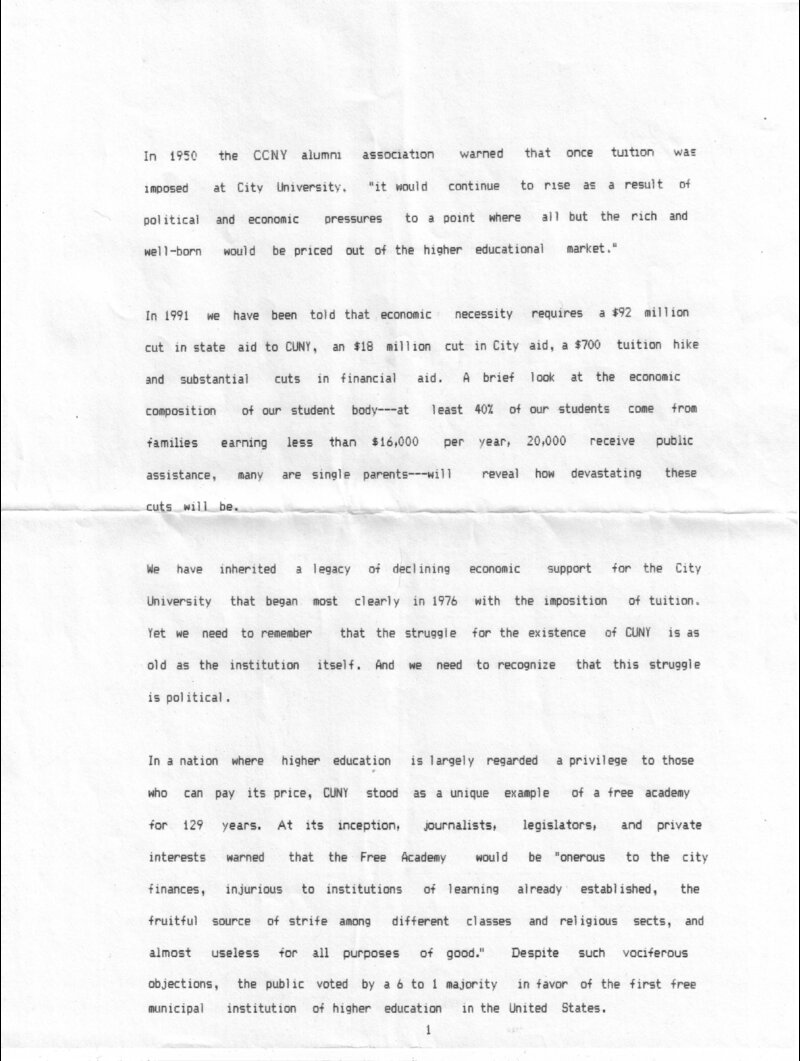
In 1950 the CCNY alumm association warned that once tuition wat
imposed at City University. “it would continue to rise as a result of
political and economic pressures to a point where all but the rich and
well-born would be priced out of the higher educational market."
In 1991 we have been told that economic necessity requires a #92 million
cut in state aid to CUNY, an $18 million cut in City aid, a #700 tuition hike
and substantial cuts in financial aid. A brief look at the economic
composition of our student body---at least 40% of our students come trom
families earning less than $16,000 per year, 20,000 receive public
assistance, many are single parents---will reveal how devastating these
cuts will be.
We have inherited a legacy of declining economic support for the City
University that began most clearly in 1976 with the imposition of tuition.
Yet we need to remember that the struggle for the existence of CUNY is as
old as the institution itself. And we need to recognize that this struggle
is political.
In a nation where higher education is largely regarded a privilege to those
who can pay its price, CUNY stood as a unique example of a free academy
for i29 years. At its inception, journalists, legislators, and private
interests warned that the Free Academy would be “onerous to the city
finances, injurious to institutions of learning already established, the
fruitful source of strife among different classes and religious sects, and
almost useless for all purposes of good." Despite such vociferous
objections, the public voted by aé to i majority in tavor of the first free
municipal institution of higher education in the United States.
i
Free tuition, however, did not mean free education for all. CUNY has never
been funded in relation to the demand for free higher education. Its
funding needs to be situated in relation to fluctuating political and
economic support---the interests of business, the needs of the economy,
the strength of the private university lobby, the force of the demands ot
the public.
While the university did indeed orow over time in response to a burgeoning
demand for higher education, it also implemented admissions policies that
curbed the mumber of students who would attend. By i960’s these
ever-rising entrance requirements effectively prevented most New
Yorkers from attending the university and took on racial significance.
While the ethnic composition of New York City changed dramatically in the
forties and fifties with a flood tide of African-American and Puerto Rican
immigration into the city, it was not reflected in CUNY’s entering classes.
In the 1960’s of the roughly 20% of New fork City high school graduates
admitted to CUNY, 1% were students of color.
In i976 largely as a result of the struggles of African-American and
Puerto Rican students, CUNY implemented an open admissions policy that
guaranteed all New York City high school graduates admission to a CUNY
college. In the fall of 1970, the university admitted a freshman class of
35,000, a 75% increase over the previous year. The ethnic balance of the
university changed dramatically: by 1971, enroliment of students of color
rose to 24% at the senior colleges and 36% in the community colleges,
among the highest representation of students of color for any public
university in the country. Open admissions and free tuition together were a
bold experiment, unique in the nation. | And it was controversial one.
In 1970 when CUNY implemented an open admissions policy Fortune
magazine wrote: “Underlying CUNY’s bold venture are the premises that a
large number of disadvantaged students have the native ability to master
college-level instruction, and that their initial handicaps in reading and
math can be overcome in a fairly short time....I]t is unsettling to think what
the CUNY policy might lead to. Adopted universally, it would bring about a
huge jump in enrollments.”
Former Columbia University ean Jacques Barzun, who presided over a
conference on open admissions in Washington O.C. in 1971, predicted that
“open admissions wil be a minority privilege for which— the entire country
will by paying through various forms of taxation."
& years after open admissions was implemented, tuition was imposed on
the university, ending a 129 year policy of free higher education and
effectively abandoning the new admissions policy. In three years, CUNY
was forced to shrink its teaching staff by nearly 50% and its student body
by 75,000. African-American and Puerto Rican students showed the
greatest enrollment decline on al] levels.
Today CUNY faces some of the most severe budget cuts and tuition hikes
since 1976. At the same time, the CUNY administration has announced a
renewed concern for “stiffer preparation for students" and “higher
educational standards" at CUNY. A quick glance at the history of the
university reveals that such concerns have been most pronounced at times
when there was a desire to limit the student body.
As students, faculty members, interested parties, we need to be aware of
the significance these current trends have for the future of the university.
Right now, enrollment levels are at their highest since i976, the student
body, refreshingly, is composed of people of color, of immigrants, of
students who cannot afford an ivy league price tag. We need to question
requirements that will function to homogenize and burden the student
body. We need to fight budget cuts that threaten the diversity, the
vitality, and ultimately the existence of the university. And we need to act
now for the future of this university is at stake.
imposed at City University. “it would continue to rise as a result of
political and economic pressures to a point where all but the rich and
well-born would be priced out of the higher educational market."
In 1991 we have been told that economic necessity requires a #92 million
cut in state aid to CUNY, an $18 million cut in City aid, a #700 tuition hike
and substantial cuts in financial aid. A brief look at the economic
composition of our student body---at least 40% of our students come trom
families earning less than $16,000 per year, 20,000 receive public
assistance, many are single parents---will reveal how devastating these
cuts will be.
We have inherited a legacy of declining economic support for the City
University that began most clearly in 1976 with the imposition of tuition.
Yet we need to remember that the struggle for the existence of CUNY is as
old as the institution itself. And we need to recognize that this struggle
is political.
In a nation where higher education is largely regarded a privilege to those
who can pay its price, CUNY stood as a unique example of a free academy
for i29 years. At its inception, journalists, legislators, and private
interests warned that the Free Academy would be “onerous to the city
finances, injurious to institutions of learning already established, the
fruitful source of strife among different classes and religious sects, and
almost useless for all purposes of good." Despite such vociferous
objections, the public voted by aé to i majority in tavor of the first free
municipal institution of higher education in the United States.
i
Free tuition, however, did not mean free education for all. CUNY has never
been funded in relation to the demand for free higher education. Its
funding needs to be situated in relation to fluctuating political and
economic support---the interests of business, the needs of the economy,
the strength of the private university lobby, the force of the demands ot
the public.
While the university did indeed orow over time in response to a burgeoning
demand for higher education, it also implemented admissions policies that
curbed the mumber of students who would attend. By i960’s these
ever-rising entrance requirements effectively prevented most New
Yorkers from attending the university and took on racial significance.
While the ethnic composition of New York City changed dramatically in the
forties and fifties with a flood tide of African-American and Puerto Rican
immigration into the city, it was not reflected in CUNY’s entering classes.
In the 1960’s of the roughly 20% of New fork City high school graduates
admitted to CUNY, 1% were students of color.
In i976 largely as a result of the struggles of African-American and
Puerto Rican students, CUNY implemented an open admissions policy that
guaranteed all New York City high school graduates admission to a CUNY
college. In the fall of 1970, the university admitted a freshman class of
35,000, a 75% increase over the previous year. The ethnic balance of the
university changed dramatically: by 1971, enroliment of students of color
rose to 24% at the senior colleges and 36% in the community colleges,
among the highest representation of students of color for any public
university in the country. Open admissions and free tuition together were a
bold experiment, unique in the nation. | And it was controversial one.
In 1970 when CUNY implemented an open admissions policy Fortune
magazine wrote: “Underlying CUNY’s bold venture are the premises that a
large number of disadvantaged students have the native ability to master
college-level instruction, and that their initial handicaps in reading and
math can be overcome in a fairly short time....I]t is unsettling to think what
the CUNY policy might lead to. Adopted universally, it would bring about a
huge jump in enrollments.”
Former Columbia University ean Jacques Barzun, who presided over a
conference on open admissions in Washington O.C. in 1971, predicted that
“open admissions wil be a minority privilege for which— the entire country
will by paying through various forms of taxation."
& years after open admissions was implemented, tuition was imposed on
the university, ending a 129 year policy of free higher education and
effectively abandoning the new admissions policy. In three years, CUNY
was forced to shrink its teaching staff by nearly 50% and its student body
by 75,000. African-American and Puerto Rican students showed the
greatest enrollment decline on al] levels.
Today CUNY faces some of the most severe budget cuts and tuition hikes
since 1976. At the same time, the CUNY administration has announced a
renewed concern for “stiffer preparation for students" and “higher
educational standards" at CUNY. A quick glance at the history of the
university reveals that such concerns have been most pronounced at times
when there was a desire to limit the student body.
As students, faculty members, interested parties, we need to be aware of
the significance these current trends have for the future of the university.
Right now, enrollment levels are at their highest since i976, the student
body, refreshingly, is composed of people of color, of immigrants, of
students who cannot afford an ivy league price tag. We need to question
requirements that will function to homogenize and burden the student
body. We need to fight budget cuts that threaten the diversity, the
vitality, and ultimately the existence of the university. And we need to act
now for the future of this university is at stake.
Title
Graduate Center Teach-in: A Speech calling for Action
Description
“The struggle for the existence of CUNY is as old as the institution itself and. . .this struggle is political.” This speech, delivered by a CUNY Graduate Center student at a 1991 Graduate Center teach-in, sought to put the threat of a $92 million cut in state aid to CUNY, along with a steep tuition hike and additional cuts to students financial aid, into a broader historical context. The speaker argued that the austerity measures were an attack on public education and would directly affect the number of students being admitted, and by extension, the diversity of the student body. Tracing the decline of economic support for CUNY to the imposition of tuition during the 1976 fiscal crisis, which ended a 129-year policy of free tuition at CUNY, the speech concluded with a call for action, arguing that “ . . .the future of this university is at stake”.
The 1991 CUNY strikes were part of the larger story of austerity measures imposed on New York City and the community efforts to resist those measures. On April 16th, students mainly from the Graduate Center Anthropology PhD program occupied the Graduate Center in solidarity with a broader undergraduate mobilization across CUNY against the threat of steep tuition hikes, massive budget cuts, and faculty layoffs. What began as a one-day strike turned into a ten-day take-over in which students and faculty practiced forms of participatory democracy, discussed the root causes of the austerity problems being faced, and debated actions for change. Students often drew on CUNY’s history as the premier urban, public institution of higher education in the United States to argue that education was a right and that the proposed measures threatened working-class New Yorkers' ability to receive an education.
Contributor
McCaffrey, Katherine
Date
1991
Language
English
Rights
Copyrighted
Source
McCaffrey, Katherine
Original Format
Article / Essay
“Graduate Center Teach-In: A Speech Calling for Action”. Letter. 1990, 1990, CUNY DIGITAL HISTORY ARCHIVE, accessed September 5, 2026, https://stephenz.tailc22a4b.ts.net/s/cdha/item/1704