Faculty Action, Fall 1977
Item
FACULTY ACTION iran:
15cents
ge X-523 &
THE BAKKE CASE
MINORITY GAINS ATTACKED
BY NAOMI WORONOV AND MICHAEL ZWEIG
Allan Bakke, a 37-year old white engineer, twice
applied to the University of California Medical School
at Davis and was twice rejected (as he was at a number
of other medical schools). -At the urging of one of the
school's administrators, Bakke filed a suit claiming
that he was excluded because of minority preferential
admissions, that his place was given to minority stu-
dents with lower test scores than his. (Bakke is not
suing on the basis of the 34 white students admitted
with lower test scores than his). The California Su-
preme Court ruled that Bakke was a victim of "'reverse
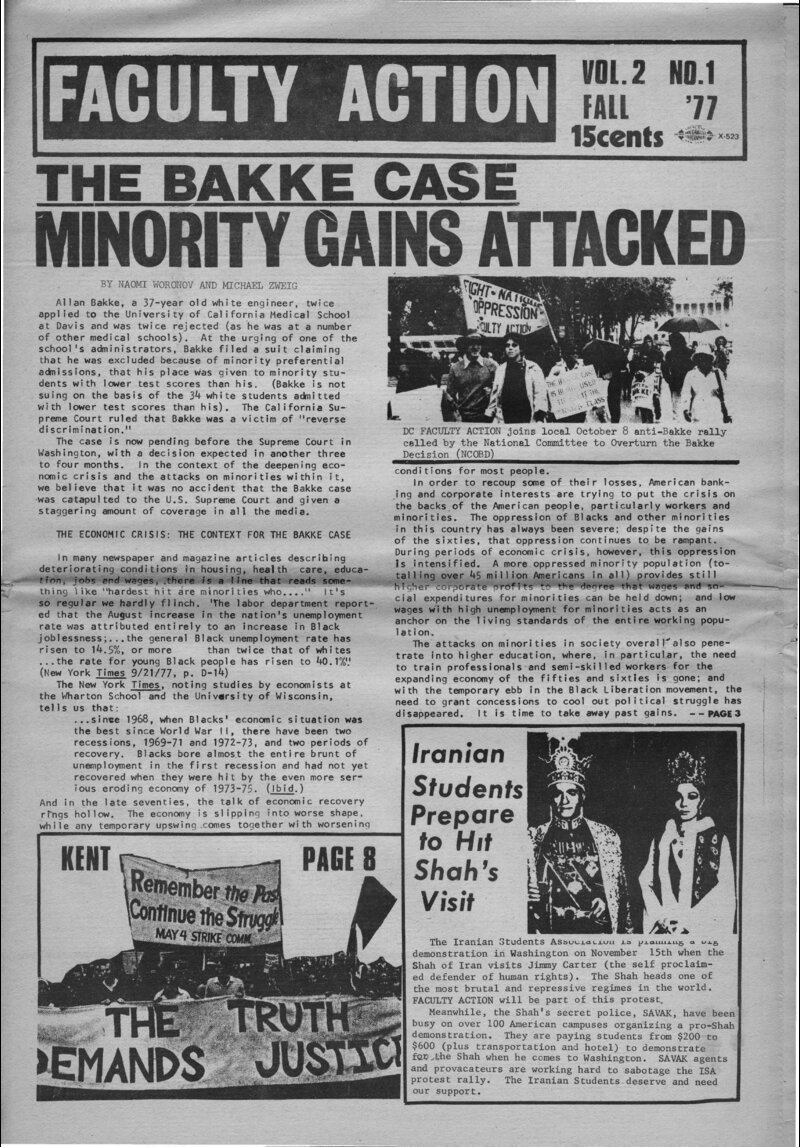
discrimination." DC FACULTY ACTION joins local October 8 anti-Bakke rally
The case is now pending before the Supreme Court in called by the National Committee to Overturn the Bakke
Washington, with a decision expected in another three Decision (NCOBD)
to four months. In the context of the deepening eco-
nomic crisis and the attacks on minorities within it,
we believe that it was no accident that the Bakke case
was catapulted to the U.S. Supreme Court and given a
staggering amount of coverage in all the media.
conditions for most people.
In order to recoup some of their losses, American bank-
_ing and corporate interests are trying to put the crisis on
the backs of the American people, particularly workers and
minorities. The oppression of Blacks and other minorities
in this country has always been severe; despite the gains
of the sixties, that oppression continues to be rampant.
During periods of economic crisis, however, this oppression
is intensified. A more oppressed minority population (to-
illion A SL all) prow des still
THE ECONOMIC CRISIS: THE CONTEXT FOR THE BAKKE CASE
In many newspaper and magazine articles describing
gece orating. conditions in ous loss health care,_ educa- talling © ereks
‘ : eeiieneen hi richer eae a > .
cial expendi tures. for nine cakes can be rats aceati oe low
wages with high unemployment for minorities acts as an
anchor on the living standards of the entire working popu-
lation.
The attacks on minorities in society overall” also pene-
trate into higher education, where, in particular, the need
to train professionals-and semi-skilled workers for the
expanding economy of the fifties and sixties is gone; and
with the temporary ebb in the Black Liberation movement, the
need to grant concessions to cool out political struggle has
disappeared. It is time to take away past gains. -- PAGE3
thing Tike access. hit are minorities oR It's
so regular we hardly flinch. ‘The labor department report-
ed that the August increase in the nation's unemployment
rate was attributed entirely to an increase in Black
joblessness;...the general Black unemployment rate has
risen to 14.5%, or more than twice that of whites
.the rate for young Black people has risen to 40.1%!
(New York Times 9/21/77, p. D-14)
The New York Times, noting studies by economists at
the Wharton School and the University of Wisconsin,
tells us that:
..-Sinee 1968, when Blacks' economic situation was
the best since World War I1, there have been two
recessions, 1969-71 and 1972-73, and two periods of
recovery. Blacks bore almost the entire brunt of
unemployment in the first recession and had not yet
recovered when they were hit by the even more ser-
ious eroding economy of 1973-75. (Ibid.)
And in the late seventies, the talk of economic recovery
rfngs hollow. The economy is slipping into worse shape,
while any temporary upswing .comes together with worsening
KENT PAGE 8
lranian
Students
Prepare
to Hit
Shah's
Visit
The Iranian Students Assuciatiun 1.
demonstration in Washington on November 15th when the
Shah of Iran visits Jimmy Carter (the self proclaim-
ed defender of human rights). The Shah heads one of
the most brutal and repressive regimes in the world.
FACULTY ACTION will be part of this protest,
Meanwhile, the Shah's secret police, SAVAK, have been
busy on over 100 American campuses organizing a pro-Shah
demonstration. They are paying students from $200 to
$600 (plus transportation and hotel) to demonstrate
forthe Shah when he comes to Washington. SAVAK agents
and provacateurs are working hard to sabotage the ISA
protest rally. The Iranian Students deserve and need
our support.
piauuingy a vig
labor force.
Page 2 Faculty Action
OPPOSE THE KLAN AND NAZIS
BY BILL KATZ
On July 4, 1977 the American Nezi Party planned se march
through ‘the predominantly Jewish neighborhood of Skokie,
Tllinois under the banner "Six Million More". That same
dey the Ku Klux Klen held a rally on the steps of the
state house et Columbus, Ohio; when Black youths chel-
lenged the Grand Wizerd, he maced them. Responding to
this assault, and to the outrageous nature of the Klan,
a group of several dozen workers who had helped organize
a counterdemonstretion to the Klan rally ripped the sheets
off the Klan and broke up the rally. Many of these wor-
kers were white.
In Skokie and Columbus the ACLU (American Civil Liber-
ties Union) came to the legal defense of the Klansmen and
the Nazis -- not their victims. Previously in a Klan-Black
clash at Camp: Pendleton, the ACLU came to the defense of
the Klansmen.
On the basis of these defenses, thousands have resigned
from the ACLU; FACULTY ACTION joined others protesting
ACLU policy on a picket line during the summer.
The ACLU position is based on an abstract right of
speech, press and assembly. It ignores the destructive
record of both Nazis and Klansmen that is hardly abstract.
Both groups have advocated genocide and carried it out
when given half the chance. The Nazi party, now outlaw-
in Germany for war crimes against inmocents, prisoners
and civilians, put eight million people to death during
World War II -- and unleashed the world's most devasta-
ting war. Today Nazis throughout the world look forward
to the good old days when they might complete the work
Hitler and his crew began.
The Ku Klux Klan has a sordid, brutal history that is
only less devastating because it operated within the con-
fines of the United States. .It rose during Reconstruct-
ion after the Civil War to terrorize and murder newly
frenchised ex-slaves and their white supporters. It
lynched, msimed and intimidated entire sections of the
southland. Its leeders were upper class whites who
sought restoration of their pre-war power and a docile
In the 1920s and 1930s, when unions —
began organizing southern workers, the Klan extended its
terror to lynching Black and white union activists.
Klan murderers. went unmolested. At the turn of the
century, Governor James Vardaman of Mississippi spoke
for the Klan when he announced "If necessary, every ne-
gro in the state will be lynched; it will be done to
maintain white supremacy." The Klan still parades un-
der the banner of white supremacy, often trying to
present it in the modern terms of "reverse discrimina-
tion", and it longs to return to its violent ways.
Those who would defend the abstract rights of fascists
chase to forget this history. On October 10, 1977, the
president of the German-American Committee of Greater
New York and its fifty chapters was quoted in the New
York Times as stating "There is no real proof thatthe
holocaust actually did happen."» He was opposing high
school classes turning to a study of the holocaust.
FACULTY ACTION CHAPTER
-
NY FACULTY ACTION joins picket at ACLU headquarters, oppos~
ing the KKK and Nazis, and ACLU support of fascist groups
Since the 1930s the Nazis and the Klan have teamed
up, shared public platforms and publications and main-~
tained loose working arrangements. They have not been
denied rights granted to other citizens, and have only
been stopped by furious Americans opposed to their
racism, In the 1920s the Klan paraded 40,000 strong
in Washington, D. C. However in eastern cities, they
met determined civilian hostility and their meetings
were broken up, their speakers chased from town, their
fiery crosses torn down. It took National Guard troops
to quell 6,000 irate Perth Amboy, New Jersey residents
who drove out the Klan in 1923. This proud heritage has
been dropped from the history books.
The appearance in strength of the Klan and Nazis today,
and their tolerance by governments, is related to, the
worsening, economic situation, particularly unemploy-
ment. These fascists divide people by race and religion
and place blame on Jews of Blacks. Tyey are the cutting
edge of a diversionary strategy that keeps employed and
_ unemployed, Black and white, Jews and Christians from
uniting for concerted action to gain jobs and economic
security. They would have us fight each other rather
than the forces that. crests, ppemplements, JDASCULS Womnemame
and racism.
Rights are not abstractions -- and certainly the mur-
der and genocide practiced by Klansmen and Nazis is not
abstract. Such men do not deserve the aid of civil li-
bertarians or anyone else. Fhe tolerance offered them
by the government and the media coverage they receive
stands as testimony that deteriorating economic con-
ditions will not be met with more employment and
job security but by confusion, diversion and efforts to
undermine citizen unity.
Our citizens need a defense of their rights. The
Blacks who battled the Klan at Camp Pendleton, the
Blacks and whites who battled them in Ohio -- should be
candidates for ACLU concern and aid. Let the fascists
take care of themselves. Besides dignifying the people
who would destroy us, the ACLU has muddied the waters
of clear thinking about the vital issues of the day
and done us all a disservice,
FORMED IN WASHINGTON
BY ELIZABETH DORE
On October 16th, thirteen faculty, graduate students
and researchers met in Washington, D.C., to discuss the
need for and possibility of forming an ongoing organi-
zation of progressive intellectuals, which could take up
the progressive struggles of today, particularly those
affecting higher education. Out of this meeting came an
enthusiastic commitment to form a local FACULTY ACTION
chapter in the Washington area.
Represented at the meeting were different nationalities
and faculty from most of the colleges and universities
in the area--Georgetown University, American University,
the University of the District of Columbia (which incor-
porates Federal City College), and the University of
Maryland, College Park campus. General issues about the
nature of the organization were discussed, and people
expressed a unanimous sentiment that D.C. FACULTY ACTION
should not be a‘bne issue" organization, but should be
anorganization of intellectuals capable of taking up @
proad range of struggles. To lay the basis for such a
militant organization and to deepen the understanding of
the role that intellectuals can play in progressive strug-
gles, a committee was formed to draft a provisional state-
ment of the goals of D.C. FACULTY ACTION, These goals
“will be discussed at the next meeting.
At the Octoher 16th meeting, people discussed struggles
developing at their colleges, and representatives from
Tranian student organizations discussed their plans for the
coming visit of the Shah of Iran to the U.S. D.C. FACULTY
ACTION gave its support to the struggles of the Iranian
students and people against the Shah's reactionary regime.
The major concrete issue raised at the meeting was that
of the Bakke decision. Particularly for the D.C. chapter
of FACULTY ACTION, the struggle to overturn the Bakke
decision is of tremendous importance. It was decided
that at the next meeting, concrete steps would be taken
to build for the Novemeber 19th Bakke Conference.
Page 3. Faculty Action
CONTINUED FROM PAGE 1
BAKKE CASE
MINORITYGAINSaTTACKED
As unemployment and inflation soar and government
corruption erupts everywhere, our country's political
and economic leaders turn to the classic ploy of pro-
moting racial hatred and racial competition for every
job and every place in school to help confuse people
politically-and deflect their anger away from the source
of their problems--the profit problems of the corporations
and the banks.
And so they cry that ''those'' people who are going to
school on ''your'' tax dollars are destroying standards of
education for your children. They cry that Blacks and
minorities are equal under our ''color bhind“ laws and
must compete "'equally'' for jobs and education. They
promote the idea through every means at their disposal--
and there are many--that if our cities are crumbling
and crime is rampant in the streets and you can't get
a job or into school, it*s because ''those'' people are
getting a'free ride" -- at your expense-- through wel-
fare, special admissions and affirmative action programs.
In literally every area of employment and education,
public and private, the Bakke case can,in the name of
reverse discrimination, set a precedent for attacking mi-
nority gains. Already lower courts, citing the Bakke
decision, have axed affirmative action programs in hous-
ing, construction and elsewhere, No matter how narrowly
the Supreme Court rules, the Bakke case has helped to
create the political and legal climate for further attacks,
At the same time the case and the publicity around
it have helped to create massive confusion around such ques-
tions as standards and quotas in an effort to win whites
to either participate in or at least quietly tolerate
increased discrimination throughout society in the
name of opposing ''reverse discrimination.''. Such staunch
defenders of "equality'' and ''justice'' as Albert Shanker
and the Wall Street Journal, for example, jumped to
Bakke's defense, claiming they're all for affirmative
action--as long as it ign''t implemented by such means
as quotas. What such forces as Shanker and the Wall
“quotas that comes from their historical use as a means
of excluding persons, particularly Jews, from jobs and
schools. But affirmative action quotas are not exclu-
sionary of whites--they are a means of mandating the it
_ Panel Discussion © .
_ —The Bakke Case and Its Impli-
_ cations
_ —Why Bakke Now? > : —_- i
_...... better health
elusion of minority persons systematically excluded _in
the past. For example, consider that while the physi-
cian/population ratio for the nation is 1/700, the ratios
of minority doctors to minority population are roughly
as follows: Black, 1/3,800; Native American, 1/20,000;
Chicano, 1/30,000. Lawyers? Consider California, which
has a minority population of 25% and a minority lawyer
population of 1%..
; QUOTAS
Quotas put necessary teeth into. affirmative action pro-
grams. The ''good will'' of the government, corporations and
university administrations cannot be relied upon, judging
from their past record and their role in society. But just
for this reason, quotas alone are also not the answer to
discrimination, because quotas on paper are only paper quotas.
Only the organized force of the people, rising again to en-
force the quotas and secure a society free from ‘discrimina-
tion and racism, will solve the problem. Establishing and
defending real quotas is one possible step in that battle,
and has to be judged accordingly in any particular situation.
The University of Salffornia Medical School at Davis
only accepts 100 students a year. Out of that total,
several places are set aside for the Dean of the College,
who invariably fills them with sons and daughters of
wealthy alumni. Only 16 positions are reserved for mi-
nority students under a special admissions program.
In 1974, Bakke was turned away together with 3,600 other
applicants (yes, 3,600!). This is the real problem
thatAllan Bakke together with students of all races con-
front--the system is set up to allow only a limited num-
ber of youth to get a college education, based on the
needs of a capitalist economy, not on the needs of so-
ciety for more college educated people like doctors.
How else can you explain why the American Medical Asso-
ciation limits the training of doctors at a time when
the American people are in desperate need of more and
So can we argue that it was minorities who kept Allan
Bakke from going to medi¢al school? Or was it a system
that dentes millions of young people, of all races. a
college education? continued on p.4
fessions
Concluding Speech
Picket line at the
—The Meaning of the Just-
ice Department's Position
(bag lunch will be
distributed) _
Lunch
Initiated By
__ Lawyers for the People -
: Medical Committee for Human Rights
Workshop 1 — the particu-
lars of discrimination in the pro-
fessions
- —2 workshops with panels from
each of the following profes-
sions: Law, Medicine and
lucation : 3 :
Sponsors
(as of October 26)
: Asian American Legal Defen
Education Fund
Page 4 Faculty Action
WHAT'S BEHIND THE
| book review)
BIG STINK ABOUT STANDARDS
The End of Education by Geoffrey Wagner, Professor of
English at the City College of New York, is a charming
little book which defends standards by attacking knowledge,
defends truth by promoting slander, and defends civili-
zation by attacking Blacks. Normally, we wouldn't dig-
| . nify such nonsense with a review. But Wagner and his
book have attracted considerable attention in the media
as part of the big stink that is currently being raised
about "standards.'"' Standards has become a code word in
this period of economic crisis for driving thousands of
students out of college--particularly minorities. We think
that it is important to expose the anti-intellectual cur-
rents and outright racism that lie behind the arguments of
these self proclaimed defenders of standards--and to ex-
pose the ruling powers who seize on this garbage as justi-
fication for the dismantling of our colleges and univer-
~~" ATTACKS STUDENTS
The sub-title of Wagner's book is'"fhe experience of the
City Univérsity of New York with open enrollment and the
threat t6 higher education in America." Wagner argues
that our universities are being destroyed as a haven of
"disinterested" knowledge. As a result of the student
movement of the sixties, says Wagner, our colleges are
being invaded by hordes of "abusive," "stupid," "hostile"
and "retarded" minority students. who together with "bald-
| ing, bearded guerillas" on the faculty and knee-jerk li-
beral administrators seem bent on destroying education.
Wagner writes that "Remedial classes fat City College/ ,
began to include sizable proportions of Panamanians, Trin-
idadians, Haitians, people with the faintest connection
with America (when they weren't outright illegal aliens),
because news of the bonanza /of open admissions/ soon got
south." And still worse is to come. Our good professor
~ —naintains that his "student Tyrone, sitting in a half-
lotus pose in back of the class with a transistor strapped
to his Afro, and nodding off every two minutes, is going
to be a city teacher's dream by comparison with what will
be occupying his seat in 1984."' The author blames "these"
students for a multitude of sins: raping and sodomizing
female faculty. (which according to Wagner is just one
more good reason not to hire women faculty); overcrowding
the halls and thus by their sheer numbers making it diffi-
cult for a colleague who walks with the aid of crutches
to get to classes; and forcing "our cities to face the
shadow of default.'' After all, Wagner argues, quoting the
neolithic Dr. Barnard of Columbia, "why waste a thousand-
dollar education on a five-dollar boy?"
The only thing that makes these slanderous arguments
even remotely seductive is a kind of dumb sophistry that
goes like this: (1) Over the past several years, the aca-
demic enterprise has gone into serious decline and it has
become more difficult for faculty to teach (true); (2) The
enrollment of students is much greater today than it was
ten years ago (true); (3) Hence, students are to blame
for the big problems facing education today (false!)
Why then have standards declined? Because when CUNY
and state officials opened the doors in response to
the struggles of students and minorities, they had
little commitment to educating open admission students
or to providing the full remedial and financial help
necessary for the success of open admissions.
Another method of argument that Wagner uses is to
take microscopic truth and amgnify it into universal
principle. For example, he tars the progressive
—~
student movement and its faculty supporters by seizing on the
behavior of the some of the outrageous fringes of that move-
ment. He points to the professor "who felt so guilty...
that he met his class sitting under the table so that they
were all of equal rank."' The incident is laughable, silly
and true. But what's the point? Is he suggesting that all
progressive students and faculty are lunatics whose ideal of
learning is squatting under a table?
ATTACKS KNOWLEDGE
After ypu cut through:all of Wagner's malicious and silly
sophisms, the only thing that seems to give his hook an ounce
of credibility is that it claims to defend knowledge. But
upon closer examination it becomes clear that Wagner does
not believe that knowledge has anything to do with reality,
sity." But politics has”always been in the university
or that humanity can in any way develop its knowledge and
understanding of the world in order to change it. All know-
ledge, according to Wagner, reduces to a few abstract truths
which the "masters" developed centuries ago, truths enshrouded
in mystery.that only an elite few can penetrate and understand.
Wagner writes:
As recently as 1965 Professor Alistair Campbell,
chair of Anglo-Saxon at Oxford, could still say,
lish literature proper stops at 1830--after then
only books.'' And by implication, improper books at that.
The recent genuflections to our relevance ritual reverse
this premise--only books written after 1830 are litera-
ture.
What Wagner shares in common with those who genuflect be-
fore everything new is that they both see the accumulated
knowledge of past centuries as irelevant to the present. Those
who worship newness discard the past. Wagner, on the other
hand, studies it only to enshrine and mystify it, not so much
for its own sake--as he would have us believe, but for his
sake. He sees knowledge as intellectual capital which can
advance his own academic career, intellectual capital whose
value is enhanced by keeping it scarce and out of the hands
and heads of open admission students. Knowledge is not some-
thing frozen in time and space, waiting to be discovered in
its pristine purity by Geoffrey Wagner and a privileged elite.
To the contrary, our knowledge of the world is constantly
changing and constantly expanding. Humanity's rich, cumula-
tive knowledge is tested and further developed through ex-
perimentation and our day to day struggles to change nature
and society. Wagner screams about standards because he wants
to narrow the range of knowledge, to build a wall between the
knowledge of the past and the experience of his students--
and because he wants to tell everybody how god awful smart
he is.
Wagner maintains that the "chief remedial action" for
higher education "must be to get politics out of the univer-
ethe
it was privileged Oxford and Cambridge (Wagner's ideal) train-
ing an elite to govern the British empire, or the modern Amer~
ican system of multiversities and community colleges re-
producing the capitalist social order through tracking.
Wagner -insists that open admissions was a political con-
spiracy to destroy the university on the part of radi-
cal students, minorities, progressive faculty and li-
beral administrators. But the administrators he talks
about were never committed to equal educational oppor-
tunity, but rather to a system of expanded admissions
that could track and train students for a growing and
stratified labor market. When the economic base and
the job market began shrinking, these same administra-
tors became willing agents of budget cuts that took
funds away from remedial and financial aid programs.
Like Wagner, they began to take up the cry of standards.
Wagner's polemic does not serve "disinterested" knowledge;
it serves the ruling political and economic interests
who want to cut back higher education to bring it more
in line with the needs of a declining economy. The
question isn't politics or no politics, but whose poli-
tics: that of a small economic elite or that which serves
the vast majority of people by expanding educational
opportunity and the development of humanity's knowledge.
BAKKE
CONTINUED FROM PAGE 3
in the
"Eng-
it is
The Bakke Case crystallizes the important questions of
discrimination and racism today. Some are using the case to
worsen the conditions of minorities and to reverse and blot
out the understanding the American people gained in the civil
righst struggles about the history and condition of minority
peoples in the United States.
Many minority and white faculty fought against discrimina-
tion in the fifties and sixties, and in the course of those
battles exposed a lot of truth about our society. Now again
we must unite to prevent the gains of the past from being
ripped away, and to fight for equality. That is why FACULTY
ACTION is co-sponsoring the ''National Conference on the Bakke
Case, Affirmative Action and the Professions" (see page 3).
We urge our readers to come. :
Page 5 Faculty Action
ORGANIZING A UNION IN
THE FLORIDA U. SYSTEM
BY! BRUCE WILLIAMSON and JAMES FENDRICH (USF -- Tampa)
Ed. Note: This is the first of a three part series
on the successful union organizing drive in the Florida
university system.
—. : ..
Summer '77 - Florida faculty picket Trustees meeting
In 1976, faculty in Florida's state university sys-
tem won the largest faculty bargaining election in the
U.S. in five years. The American Federation of College
Teachers (AFT) won the right to represent 5,400 faculty
and professional employees in the nine-campus system.
The AFT won the election outright with 54% of the vote,
while the AAUP-NEA gathered 15% and only 31% voted no
agent.
= The AFT victory violated the canons of conventional
wisdom. Militant faculty unions are supposed to result
only (a) in liberal or progressive non-South states,
(b) in areas where most of the blue-collar work force,
the university in the political economy and redistributed
the power in the universities in favor of administrators
and extraneous constituencies. Universities shifted from
semi+isolated centers of teaching and scholarship to ac-
tion bureaucracies, serving federal, state and corporate
clients through research and service. tn ilorida, the
central administration. of the university system grew
from a director with a few staff assistants and secre-
taries in the early sixties to a staff of almost 200
by the early seventies. During the two-year period pre-
ng the collective bargaining election when university
budgets were stagnant or decreasing, the Board of Regents
budget jumped by 97%. Although faculty senates were
never very strong, they found the scope and content of
their collective decision-making reduced. Both faculty
autonomy and normative controls were swamped by. management
directives about productivity drives. The belief in
shared government was difficult to maintain when new "pro
fessional'' administrators barked like drill sergeants about
grading procedures, larger classes and classroom contact
hours. Faculty members who had been trained.to view their
positions as professional academicians were treated like
assembly line workers with layoffs, speed-up, and effi-
ciency reports, and without input into.the system in which
they worked:
The third major factor was the crisis atmosphere of
the sixties created by the protest movement. The poli-
tically relevant civil-right and anti-war movements acted
as a catalyst for demanding @ restructuring of univer-
sities. During this period, progressive students and
faculty were part of movement which helped to bring
about some important changes. The retirement of Pres-
ident Johnson, the U.S. withdrawal from Indochina, uni-
versity reforms, and environmental and minority rights
legislation were all major gains. In addition, through-
the K-12 teachers, community college and state workers gut these struggles a current developed among progressive —
are already organized, (c) in omogenous, less presti-
gious 2- and 4-year colleges, not in a 3-tiered univer-
sity system that contains a heterogeneous mixture of
older, well-established universities with 100 or more
doctoral programs, four year universities with masters
programs, and new urban undergraduate institutions,
(d) in those states having strong collective bargaining
legislation which enables public employees to organize,
and (e) where the faculty are urbane, sophisticated and
decidedly left-of-center. In Florida, these conditions
were non-existent.
What were the conditions that enabled a small, ragtag
army to organize thousands. The movement began with an
ill-focused discontent among small groups of faculty
who had regular occasion to meet. In order to under-
stand the movement's success, it is necessary to explore
the forces external and internal to the movement and
the interactions between them in the crucial period
from the initial organizing in 1968 to the election and
certification in 1976. :
-Although faculty discontent is almost endemic, three
major factors contributed to the union drive. The
first and dominant factor was the economic crisis of the
seventies which eroded the living standards and working
conditions of faculty. Faculty salaries failed to
kee! ce with the inflating cost of living over a num-
tetoee years and the crisi¢ culminated in 974-75 when
inflation rocketed above 10% and the Florida state
legislature banned any pay raises for state employees.
When a collective bargaining election became imminent
the following year, the university Chancellor and the
Council of Presidents sent a letter to all faculty mem-
bers promising ''to seek from the 1976 legislature a 22%
salary increase for faculty and other professional per-
sonnel,'' recognizing that ''an increase of that magni tude
would only return the purchasing power of salaries to
the 1972-73 level.'' ~Most faculty members belittled this
pipe dream and saw it as part of the administration's
anti-union ¢ampaign. The union made a mockery of the
Chancellor's promise by printing buttons which said
“Follow me to '73?'!' Economically, the situation was
out of control. :
The second factor contributing to unionization was
the managerial reorganization of higher education. The
sixties witnessed an enormous growth in public higher edu-
cation in Florida. The growth modified the Jocation of
happened.
faculty to question the''system''--the grading system, the
degree system, the university system and even the capi-
talist system. :
The state's administration developed carrot and stick
tactics to deal with the college campuses. The first
was to make necessary concessions and token reforms, giv-
ing students a wider range of courses and representation
on university committees. The second was vigorous re-
pression of unauthorized political activities. In Flor-
ida, there was a rapid turnover of university presidents.
Traditional academic administrators who rose through the
ranks of academic committees and offices were replaced
by hard-liners such as state judges and lawyers.
Thus coming out of the sixties, there was a mood of
discontent and political struggle that provided a core of
activists who led the unionization drive through the
period of the economic crisis and the loss of many pro-
fessional rights by the faculty. The incident that
precipated union organizing was the firing of a faculty
member at the most prestigious institution in the sys-
tem.in 1968, The university fired a psychologist be-
cause of his involvement in local civil rights activity.
The firing aroused progressive faculty. The local AAUP
chapter mobilized respurces that eventually led to the
university beingcensured by thé natienal-AAUP. Nothing
A small contingent of faculty were finally
beginning. to realize that the AAUP as a professional or-
ganization had neither the stomach nor the resources to
effectively counter a hostile and conservative admini-
stration and Board of Regents.
Realizing the inadequate protection of academic free-
dom and the lack of adequate resources to fight the pow-
er of .the university administration, the fired psycholo-
gist called a strategy meeting for an ad hoc Committee
in Defense of Faculty Rights. He argued that the battle
could not be won, admitted defeat and strongly recommended
that the faculty should form a union for self protection.
The original supporters of the defense group were wel]
established liberal professors from law, medicine and the
liberal arts, and young faculty activists. Indeed, the
first two faculty organizers were advisers to Students
for a Democratic Society and the Southern Student Or-
ganizing Committee.
with 50 members--a core of organizers who began an eight
year battle to victory in unionization for 5,400 faculty
The local was chartered on May 1, 1968
NEXT INSTALLMENT: The Eight-year Organizing Drive
port Draper.
cation.
Page 6 *Faculty Action
THE
DRAPER CAPER
Why did the CUNY Board support Draper and
undercut open admissions?
The saga of Edgar Draper, President of Manhattan Com-
munity College, has attracted national attention. On
August 29th, the City University Board of Higher Educa-
tion fired Draper. The Board had affidavits and sworn
statements in its possession testifying that Draper had
helped to doctor an evaluation of Manhattan Community
College by the Middle States Accrediting Association and
that members of his administration had forged signatures
on faculty petitions of support. Faced with a monumental
political and criminal scandal and aware of a long history
of faculty protest, the Board evidently felt that it was
in its best interest to remove Draper. The nagging ques-
tion, though, is why did the Board wait until August,
1977 to let Draper go?
Draper had an unparalleled record at Manhattan ot scan-
dal, incompetence and neglect. On one occasion, his fa-
culty overwhelmingly voted no confidence in his admini-
stration and on another, Draper got a court injunction
to prevent the opening of secret ballots, thus sparing
him the embarassment of a negative count. Draper con-
tinued to Bouse classes in a building full of health
and safety violations despite years of protest and nu-
merous serious accidents (one students lost a finger. One
of his deans vandalized faculty offices (yes, vandalized
faculty offices!) and in 1974 tried to intimidate un-
tenured teachers into attending a testimonial dinner
which Draper threw on his own behalf (see FACULTY ACTION,
Spring, 1977). Despite a driving snowstorm, the faculty
union picketted Draper's "I love me"! dinner and the tes-
timonial turned out to be a collosal dud. The faculty
at Manhattan Community had a proud tradition of standing
up to Draper, even to the point where 75 teachers forci-
bly occupied his office in the Summer of 1976 to protest
the firing of more than 100 full-time colleagues.
Yet, through thick and thin, the Board chose to sup-
Why? Probably because Draper had close «
political ties to Nelson Rockefeller and Manhattan Bor-
ough President Percy Sutton. But the Board's failure
to move against Draper over a period of six years also
speaks volumes about its lack of commitment to open ad-
missions. . Manhattan Community was an open admissions
college with’ an 80% minority enrollment, and the Board,
obviously aware of what it was doing, let Draper run it
into the ground. It only chose to remove him after he
had pared down the school's budget by $2 million and fired
25% of its full-time faculty.
DRAPER SPILLS THE.BEANS
The Board knew what kind of man they were getting when
they appointed Draper President in 1971 after months of
investigation and deliberations. In his 1971 inaugural
address, Draper portrayed himself as an"'educational mana-
ger" who represented the Board’s interest on the Manhat-
tan campus. He made a surprisingly frank and revealing
statement about his view of open admissions.
It is...significant that thousands of young people
who would have been on welfare, in prison, or in or-
ganized revenge against what they view as a hostile
society, are gainfully employed. Herein lies the
great value of an‘urban community college...
If we do our job well, there will be fewer welfare
recipients, far less unemployment, and the needs for
prisons will greatly diminish....As the community
college expands it enrollment towards the lower le-
vel of achievement among high school graduates, it is
bringing into the inner society the young people and
the disadvantaged who have been on the periphery....
This will reduce the area of ideological conflict
and help institutionalize the democratic process.
Draper spilled the beans. Those responsible for ad-
ministering open admissions had little concern for the
aspirations of thousands of students for a decent edu-
Their main concern was cooling out "organized
revenge" against society. This contempt for open admis-
sions students was later reflected in Draper's failure
to establish necessary remedial and support services
In 1974, the Chancellor of the City University chose
to raise a big public stink about Draper's failure to
establish a formal remedial and basic skills program
--rather than quietly handling and correcting this ser-
Faculty and students occupy Draper's office opposing
the firing of over 100 faculty, August 1976
SPEARS ADT EY IR SS TIT SEB 2 RE RRND PEAS OLR
ious matter behind the scenes. Page one stories in the
New York Times slandered and ridiculed the college, its
students and its faculty, and only served to undercut
the school's morale. Draper had a spokesman respond to
the charges about remediation with the following state-
ment:
It should be pointed out that most laymen have a
somewhat confused idea of the relationships which
exist between reading level and functional abilities.
For instance, many jobs in our society (shop-atten-
dant, service-station attendant, warehouseman's
assistant, etc.) call for a fourth grade reading
level. And the New York Times news sections are
written at. a ninth grade leve level.
ee oe
‘Draper ‘made 1 his posit on clear and so_ lid the Board
by its continued support for his presidency.
The Board tolerated Draper with its eyes open because
it was useful to tolerate Draper. He made cuts, he
fired faculty and he seriously compromised open admis-
sions at a time when the city's ruling economic and
political powers wanted to end this expensive concess-
ion to the student movement and the struggles of the
sixties. With a $13 billion bank debt and a
collapsing economic base and job market, the city fathers
and their corporate supporters were becoming more and
more reluctant to spend money on open admissions.
So now Draper is gone and a new president administers
over a college which has been cut down to size. If
Draper had come from the same social class as one of
his students, he would have been criminally prosecuted
for fraud and sent to Attica for a long vacation. In-
stead, the Board gave him a sabbatical with full pay and
the option of returning to the City ‘University as a
$33,000 a-year tenured, full-professor. The real criminals
aren't the stydents--as Draper suggested in his inaugural
address, but those in high places who saw fit to support
Draper all these years.
Special Programs Attacked
SEEK and College Discovery, the special programs
at the City University of New York which have enabled
thousands of minority and working class students..to
get an education, are under attack. As part of a
general assault on welfare and financial aid programs
for low-income families, the city of New York is pre-
sently cuting stipends for SEEK and College Discovery
students who are currently on welfare. The decision
is causing great confusion and havoc. Several schools
monthly checks
are indefinetly withholding students'
because it is unclear how and when the cuts are to be
made.
These latest cuts are part of clear, developing pat-
tern. First the 129-year old tradition of "free tuition"
was ended at CUNY, and then tuition assistance and finan-
cial aid programs have been sliced up, making it increas-
ingly difficult for minority, working class (and even
middle-income) students to se in school.
Page 7 Faculty Action
ministration's "Catch 22" policy of cutting remedial
and special skill programs and then instituting a
basic skills test that sophomores must pass in order
firings loom
g to continue. There is nothing particularly exceptional
about the policies of the Brooklyn College administra-
tion. As the economiccrisis worsens, cuts are being
made everywhere, social services are deteriorating,
living standards are declining and more and more of
the crisis is being put on the backs of the people
The faculty union at Brooklyn College (PSC/AFT) says
it's investigating whether or not the administration
"overreacted", as though it would be fine to accept the
layoffs if they were financially "necessary". Nonsense.
Whether one job is lost, or a hundred lost, for whatever
a Sono dei bl: Son nig Pee eee reason, the loss in faculty and programs is that much an
Roa ania ieee FA aS - Poruent axegt ai attack on the faculty, that much an erosion of education,
firing of close to 400 teachers since June, 1976. The that meh = SRC PLT UGC! Wich if unresisted, simply in-
new firings are being justified on the basis of pro- Te eee beaition oF FisctEy ond Ul be Eibues Oe ee
jections fo ller enrollment and budget for th =F
o096_75 Pea neue ees See toe eta ces to be able to fight every layoff, every program cut
- * : and every new attack on the ability of students to get
oe ie pies oe ee! linked to the new an aangaeiscs We must win our robe to take this Hae
zd ess a pea Jaen eclining (in part) because it is the only way they can become effective wea-
because tuition assistance and financial aid programs Shatin defendevor our LivelinGods and of education
are being cut and because of the Brooklyn College ad- Eee g kee
Abracadabra. Now you see the faculty, and now you
don't. Is it magic? No! It's another college admin-
istration toying with the livlihoods of its faculty
and the education of its students. According to the
October 23rd New York Times, the Brooklyn College ad-
ministration is trying to make between 60 to 100 facul-
conference
to strike gold at Merrill Lynch.
‘The Krugerrand, The world’s most popular
gk! coin. The only legal tender coin that con-
precisely one troy ounce of gold
CONFERENCE ON THE POLITICAL ECONOMY OF HIGHER EDUCATION
---Friday & Saturday, Nov. 11 & 12---
At New York University
KEYNOTE SPEAKER: Samuel Bowles, UMass -- Friday, 8PM,
Schimmel Auditorium, Tisch Building, 40 West 4th St. NYC
PANELS AND WORKSHOPS ON THE THEORY, HISTORY AND POLITICS
OF HIGHER EDUCATION
REGISTRATION: $10 ($6 low income, $2 unemployed & students)
Sponsored by Center for Marxist Studies, NYU; Caucus for
a New Political Science; Center for Critical Rpaies,
Columbia Teachers! College
faculty
action
“Ban The —
Krugerrand!
The American people saw through
the U.S. government's propoganda
about the Vietnam war and will be
able to’see through the racist
South Africa government's "golden
veil" covering the misery and
horror of Apartheid.
There has already been a lot
of activity around South Africa.
--Anti-Krugerrand Coalitions
have been formed in several cities
toé expose the Krugerrand campaign
of the Republic of South Africa as
a gimmick to sell South Africa to
the American people, and as an im-
portant source of revenue
--The Organizing Committee for
a New African Liberation Support
Committee is planning a big con-
ference on southern Africa
--Struggles continue on many
campuses - notably Stanford and
Berkeley - to force universities
to cut all financial ties with
South Africa
For more information, please
contact FACULTY ACTION
Victory to the
People of
Southern Africa
FACULTY ACTION is a progressive
teachers' organization which
takes up issues of concern to
faculty as reflected in the ar-
ticles in this issue of*our pa-
per, and in our activity around
campus and national concerns.
We welcome letters, articles,
comments and criticism, as well
as financial contributions to-
ward the publication of our. pa-
per.and the distribution of
other materials to build the
struggle of faculty.
I would like to be on the
FACULTY ACTION mailing list__
I would like information about
setting up a chapter of FAC-
ULTY ACTION on my -campus
Enclosed is a contribution to
FACULTY ACTION. Please make
checks payable to Faculty Ac-
tion, and send them, and,all
correspondence, to FACULTY
ACTION, Room 368, MCC-CUNY,
1633 Broadway, NY, NY 10019.
Name
Address
City. State Zip, _
Phone
————_———
Institution
— $< —
CARRY ON §
THE SPIRIT
OF KENT
“» JACKSON
Once again Kent State has
become the scene of a fierce struggle.
The Kent State University (KSU) administration
planned to build a gym and destroy the hill where
four students were shot dead and nine others wounded
by national guardsmen on May 4, 1970. Their plans
have run into a brick wall of resistance as students
and other people have stood their ground against
court orders, cops and bulldozers and refused to let
these murders, the struggle around them and all they
stand for be buried. All spring and throughout the
summer students from Kent and campuses around
the country have rallied by the hundreds and thous-
ands to demand ‘’Move the Gym!”
On May 4, 1977—seven years to the day after the
shootings—thousands of students, 50% of the stu—
dent body, struck classes at KSU over four demands—
@ Move the Gym to Another Site
e@ Cancel Classes Permanently on May 4
e Name Four Buildings After the Four Dead
Students
e AStatement From the Administration that
the Shootings Were an Injustice
1500 marched and rallied and later several hundred
seized the ami istration building.
May 12—a week later, thousands demonstrated at
a trustees meeting where the final decision was made
to go ahead and build the gym.
But the construction was pushed back till July.
The University hoped to ride out the wave of strug:
gle and wait for the summer when all the students
were gone. But at the May 12 rally the May 4 Coali-
tion called for a tent city to be set up on the site—to
“ be a fortress of defense and a rallying point over the
summer.
SUMMER LONG BATTLE
So instead of a cooling off period, the summer
became a nightmare for the admin.stration and
the rich bankers and corporation owners on the
Board of Trustees, as hundreds of students stayed
in Kent, lived in Tent City for 62 days, defied ev-
ery move to get them off—court orders, threats of
arrest, harassment, and the beating up of May 4
Coalition leaders. All summer long the action of
the students halted the construction.
July 12-194 arrested as the cops and courts
moved to end Tent City.
July 22—600 held a powerful demonstration
declaring arrests were not going to stop the
struggle. Hundreds defied the court injunction and
marched back into the site.
July 26—Trustees met 50 miles from campus to
give the go ahead for construction and were picketed
by a demonstration. On the way back to campus the
demonstrators were stopped by, police roadblocks and
27 were arrested for the 22nd demonstration and hit
with $2000 bail each.
July 28—62 people retook the hill—over 150 more
protested while the 62 were arrested in the early
morning. This action forced another court order
halting construction that afternoon.
IONS RL RI TL TE ATI AO IAT TE IE
September 24—-3,000 students repre-
senting more than 30 campuses march and
rally on the Kent campus. After the
fence surrounding the site was torn
down, 1,500 of the demonstrators march-
ed onto the site in defiance of a new
court order and the police. FACULTY
ACTION sent a delegation to this demon-.
stration.
October 22--1,500 students from many
different states defy an injunction
and vicious mace and tear gas attacks
Page 8 Faculty Action
students and others come out time after time to de—
fend this site? Why have hundreds taken arrests—
many two or three times? Why have hundreds given
up their jobs and summer vacations to stay in Kent
all summer and support this struggle?
Because Kent State and Jackson State.
the murders and the struggle around them,.
stand as reminders of a time when the rulers of this coun-
try desperately want to cover up.
Reminders of the bloody war they launched to
bring the Vietnamese people under their thumb.
Reminders of their vicious response to protest and
resistance to their policies and their rule.
Reminders of how people by the hundreds ot
tliousands militantly fought to end the war and went
up against the system that caused it.
This is why they want to stamp out the lessons of
Kent and Jackson State.
But for students and for the American people,
those lessons are important. Not just to remember a
time when thousands fought around ending the war,
stopping national oppression and discrimination and
began to move against the system itself. But to use
those lessons to build the struggles that we face to—
from the police, holding a march and
rally at Kent.
eS A WN DATES NERS SE TPS ATO
And through every battle the students gained
support, got better organized and got a better un-
derstanding of who we're up against in this fight and
how to win.
WHAT'S BEHIND THE GYM
What's behind all this? Why are the trustees, the
government, the police, and the courts so determined
to build the gym on this site?
Is it the cost of moving it as they‘ve often claimed?
No-—its already cost them more trying to crush the
struggle than it would to move the gym. For that
matter, half of the trustees could pay the cost out
of their own pockets without hurting.
Js it a lack of land? No. The University purchased
17 acres of land away from the site of the shootings
10 years ago—expressly for this gym.
So what’s going on? And why have thousands of
Faculty Action pamphlet on
Crisis in Higher Education
An Analysis and a Guide to Action
available Dec-order now
The pamphlet attempts to develop an understanding of the cur-
rent crisis in higher education by examining it in the context of
the larger economic crisis and the changing allignment of social
forces,
The pamphlet looks at the nature of college education in
American society, assesses the economic currents and powerful so-
cial movements which influenced the expansion of higher education
in the fifties and sixties, analyzes the plans that ruling circles
have developed for higher education in the seventies, and examines
some key struggles that have erupted on college campuses over
tuition, tenure, standards and the attacks on the past gains of
A final section takes up the need for or-
minorities and women.
60¢.
ganization, for unions, and for progressive organizations like
FACULTY ACTION,
School
Number of copies...Check enclosed for...
Cost: $1 per copy; bulk rate (10 or more)
Add 15¢ per copy for mailing costs.
Checks payable to FACULTY ACTION, Room 368,
MCC-CUNY, 1623 B'way, New York, NY 10019.
Anemones “BY JANE BRATNOBER
TP ARERR ENE EI St SNOT IE
Jane Bratnober is a graduate student
in history at Kent State.
RA ESS A ET RC
LEGAL ASSISTANCE FUNDS
NEEDED AT KENT STATE
-court petitions to have the shoot-
ing site officially commemorated by
the Federal government
-bail and legal fees from the many
recent arrests
Please contribute -- send a check
payable to FACULTY ACTION - Kent
Legal Fund, 1633 Broadway, rm. 368
MCC-CUNY, NY, NY 10019,
15cents
ge X-523 &
THE BAKKE CASE
MINORITY GAINS ATTACKED
BY NAOMI WORONOV AND MICHAEL ZWEIG
Allan Bakke, a 37-year old white engineer, twice
applied to the University of California Medical School
at Davis and was twice rejected (as he was at a number
of other medical schools). -At the urging of one of the
school's administrators, Bakke filed a suit claiming
that he was excluded because of minority preferential
admissions, that his place was given to minority stu-
dents with lower test scores than his. (Bakke is not
suing on the basis of the 34 white students admitted
with lower test scores than his). The California Su-
preme Court ruled that Bakke was a victim of "'reverse
discrimination." DC FACULTY ACTION joins local October 8 anti-Bakke rally
The case is now pending before the Supreme Court in called by the National Committee to Overturn the Bakke
Washington, with a decision expected in another three Decision (NCOBD)
to four months. In the context of the deepening eco-
nomic crisis and the attacks on minorities within it,
we believe that it was no accident that the Bakke case
was catapulted to the U.S. Supreme Court and given a
staggering amount of coverage in all the media.
conditions for most people.
In order to recoup some of their losses, American bank-
_ing and corporate interests are trying to put the crisis on
the backs of the American people, particularly workers and
minorities. The oppression of Blacks and other minorities
in this country has always been severe; despite the gains
of the sixties, that oppression continues to be rampant.
During periods of economic crisis, however, this oppression
is intensified. A more oppressed minority population (to-
illion A SL all) prow des still
THE ECONOMIC CRISIS: THE CONTEXT FOR THE BAKKE CASE
In many newspaper and magazine articles describing
gece orating. conditions in ous loss health care,_ educa- talling © ereks
‘ : eeiieneen hi richer eae a > .
cial expendi tures. for nine cakes can be rats aceati oe low
wages with high unemployment for minorities acts as an
anchor on the living standards of the entire working popu-
lation.
The attacks on minorities in society overall” also pene-
trate into higher education, where, in particular, the need
to train professionals-and semi-skilled workers for the
expanding economy of the fifties and sixties is gone; and
with the temporary ebb in the Black Liberation movement, the
need to grant concessions to cool out political struggle has
disappeared. It is time to take away past gains. -- PAGE3
thing Tike access. hit are minorities oR It's
so regular we hardly flinch. ‘The labor department report-
ed that the August increase in the nation's unemployment
rate was attributed entirely to an increase in Black
joblessness;...the general Black unemployment rate has
risen to 14.5%, or more than twice that of whites
.the rate for young Black people has risen to 40.1%!
(New York Times 9/21/77, p. D-14)
The New York Times, noting studies by economists at
the Wharton School and the University of Wisconsin,
tells us that:
..-Sinee 1968, when Blacks' economic situation was
the best since World War I1, there have been two
recessions, 1969-71 and 1972-73, and two periods of
recovery. Blacks bore almost the entire brunt of
unemployment in the first recession and had not yet
recovered when they were hit by the even more ser-
ious eroding economy of 1973-75. (Ibid.)
And in the late seventies, the talk of economic recovery
rfngs hollow. The economy is slipping into worse shape,
while any temporary upswing .comes together with worsening
KENT PAGE 8
lranian
Students
Prepare
to Hit
Shah's
Visit
The Iranian Students Assuciatiun 1.
demonstration in Washington on November 15th when the
Shah of Iran visits Jimmy Carter (the self proclaim-
ed defender of human rights). The Shah heads one of
the most brutal and repressive regimes in the world.
FACULTY ACTION will be part of this protest,
Meanwhile, the Shah's secret police, SAVAK, have been
busy on over 100 American campuses organizing a pro-Shah
demonstration. They are paying students from $200 to
$600 (plus transportation and hotel) to demonstrate
forthe Shah when he comes to Washington. SAVAK agents
and provacateurs are working hard to sabotage the ISA
protest rally. The Iranian Students deserve and need
our support.
piauuingy a vig
labor force.
Page 2 Faculty Action
OPPOSE THE KLAN AND NAZIS
BY BILL KATZ
On July 4, 1977 the American Nezi Party planned se march
through ‘the predominantly Jewish neighborhood of Skokie,
Tllinois under the banner "Six Million More". That same
dey the Ku Klux Klen held a rally on the steps of the
state house et Columbus, Ohio; when Black youths chel-
lenged the Grand Wizerd, he maced them. Responding to
this assault, and to the outrageous nature of the Klan,
a group of several dozen workers who had helped organize
a counterdemonstretion to the Klan rally ripped the sheets
off the Klan and broke up the rally. Many of these wor-
kers were white.
In Skokie and Columbus the ACLU (American Civil Liber-
ties Union) came to the legal defense of the Klansmen and
the Nazis -- not their victims. Previously in a Klan-Black
clash at Camp: Pendleton, the ACLU came to the defense of
the Klansmen.
On the basis of these defenses, thousands have resigned
from the ACLU; FACULTY ACTION joined others protesting
ACLU policy on a picket line during the summer.
The ACLU position is based on an abstract right of
speech, press and assembly. It ignores the destructive
record of both Nazis and Klansmen that is hardly abstract.
Both groups have advocated genocide and carried it out
when given half the chance. The Nazi party, now outlaw-
in Germany for war crimes against inmocents, prisoners
and civilians, put eight million people to death during
World War II -- and unleashed the world's most devasta-
ting war. Today Nazis throughout the world look forward
to the good old days when they might complete the work
Hitler and his crew began.
The Ku Klux Klan has a sordid, brutal history that is
only less devastating because it operated within the con-
fines of the United States. .It rose during Reconstruct-
ion after the Civil War to terrorize and murder newly
frenchised ex-slaves and their white supporters. It
lynched, msimed and intimidated entire sections of the
southland. Its leeders were upper class whites who
sought restoration of their pre-war power and a docile
In the 1920s and 1930s, when unions —
began organizing southern workers, the Klan extended its
terror to lynching Black and white union activists.
Klan murderers. went unmolested. At the turn of the
century, Governor James Vardaman of Mississippi spoke
for the Klan when he announced "If necessary, every ne-
gro in the state will be lynched; it will be done to
maintain white supremacy." The Klan still parades un-
der the banner of white supremacy, often trying to
present it in the modern terms of "reverse discrimina-
tion", and it longs to return to its violent ways.
Those who would defend the abstract rights of fascists
chase to forget this history. On October 10, 1977, the
president of the German-American Committee of Greater
New York and its fifty chapters was quoted in the New
York Times as stating "There is no real proof thatthe
holocaust actually did happen."» He was opposing high
school classes turning to a study of the holocaust.
FACULTY ACTION CHAPTER
-
NY FACULTY ACTION joins picket at ACLU headquarters, oppos~
ing the KKK and Nazis, and ACLU support of fascist groups
Since the 1930s the Nazis and the Klan have teamed
up, shared public platforms and publications and main-~
tained loose working arrangements. They have not been
denied rights granted to other citizens, and have only
been stopped by furious Americans opposed to their
racism, In the 1920s the Klan paraded 40,000 strong
in Washington, D. C. However in eastern cities, they
met determined civilian hostility and their meetings
were broken up, their speakers chased from town, their
fiery crosses torn down. It took National Guard troops
to quell 6,000 irate Perth Amboy, New Jersey residents
who drove out the Klan in 1923. This proud heritage has
been dropped from the history books.
The appearance in strength of the Klan and Nazis today,
and their tolerance by governments, is related to, the
worsening, economic situation, particularly unemploy-
ment. These fascists divide people by race and religion
and place blame on Jews of Blacks. Tyey are the cutting
edge of a diversionary strategy that keeps employed and
_ unemployed, Black and white, Jews and Christians from
uniting for concerted action to gain jobs and economic
security. They would have us fight each other rather
than the forces that. crests, ppemplements, JDASCULS Womnemame
and racism.
Rights are not abstractions -- and certainly the mur-
der and genocide practiced by Klansmen and Nazis is not
abstract. Such men do not deserve the aid of civil li-
bertarians or anyone else. Fhe tolerance offered them
by the government and the media coverage they receive
stands as testimony that deteriorating economic con-
ditions will not be met with more employment and
job security but by confusion, diversion and efforts to
undermine citizen unity.
Our citizens need a defense of their rights. The
Blacks who battled the Klan at Camp Pendleton, the
Blacks and whites who battled them in Ohio -- should be
candidates for ACLU concern and aid. Let the fascists
take care of themselves. Besides dignifying the people
who would destroy us, the ACLU has muddied the waters
of clear thinking about the vital issues of the day
and done us all a disservice,
FORMED IN WASHINGTON
BY ELIZABETH DORE
On October 16th, thirteen faculty, graduate students
and researchers met in Washington, D.C., to discuss the
need for and possibility of forming an ongoing organi-
zation of progressive intellectuals, which could take up
the progressive struggles of today, particularly those
affecting higher education. Out of this meeting came an
enthusiastic commitment to form a local FACULTY ACTION
chapter in the Washington area.
Represented at the meeting were different nationalities
and faculty from most of the colleges and universities
in the area--Georgetown University, American University,
the University of the District of Columbia (which incor-
porates Federal City College), and the University of
Maryland, College Park campus. General issues about the
nature of the organization were discussed, and people
expressed a unanimous sentiment that D.C. FACULTY ACTION
should not be a‘bne issue" organization, but should be
anorganization of intellectuals capable of taking up @
proad range of struggles. To lay the basis for such a
militant organization and to deepen the understanding of
the role that intellectuals can play in progressive strug-
gles, a committee was formed to draft a provisional state-
ment of the goals of D.C. FACULTY ACTION, These goals
“will be discussed at the next meeting.
At the Octoher 16th meeting, people discussed struggles
developing at their colleges, and representatives from
Tranian student organizations discussed their plans for the
coming visit of the Shah of Iran to the U.S. D.C. FACULTY
ACTION gave its support to the struggles of the Iranian
students and people against the Shah's reactionary regime.
The major concrete issue raised at the meeting was that
of the Bakke decision. Particularly for the D.C. chapter
of FACULTY ACTION, the struggle to overturn the Bakke
decision is of tremendous importance. It was decided
that at the next meeting, concrete steps would be taken
to build for the Novemeber 19th Bakke Conference.
Page 3. Faculty Action
CONTINUED FROM PAGE 1
BAKKE CASE
MINORITYGAINSaTTACKED
As unemployment and inflation soar and government
corruption erupts everywhere, our country's political
and economic leaders turn to the classic ploy of pro-
moting racial hatred and racial competition for every
job and every place in school to help confuse people
politically-and deflect their anger away from the source
of their problems--the profit problems of the corporations
and the banks.
And so they cry that ''those'' people who are going to
school on ''your'' tax dollars are destroying standards of
education for your children. They cry that Blacks and
minorities are equal under our ''color bhind“ laws and
must compete "'equally'' for jobs and education. They
promote the idea through every means at their disposal--
and there are many--that if our cities are crumbling
and crime is rampant in the streets and you can't get
a job or into school, it*s because ''those'' people are
getting a'free ride" -- at your expense-- through wel-
fare, special admissions and affirmative action programs.
In literally every area of employment and education,
public and private, the Bakke case can,in the name of
reverse discrimination, set a precedent for attacking mi-
nority gains. Already lower courts, citing the Bakke
decision, have axed affirmative action programs in hous-
ing, construction and elsewhere, No matter how narrowly
the Supreme Court rules, the Bakke case has helped to
create the political and legal climate for further attacks,
At the same time the case and the publicity around
it have helped to create massive confusion around such ques-
tions as standards and quotas in an effort to win whites
to either participate in or at least quietly tolerate
increased discrimination throughout society in the
name of opposing ''reverse discrimination.''. Such staunch
defenders of "equality'' and ''justice'' as Albert Shanker
and the Wall Street Journal, for example, jumped to
Bakke's defense, claiming they're all for affirmative
action--as long as it ign''t implemented by such means
as quotas. What such forces as Shanker and the Wall
“quotas that comes from their historical use as a means
of excluding persons, particularly Jews, from jobs and
schools. But affirmative action quotas are not exclu-
sionary of whites--they are a means of mandating the it
_ Panel Discussion © .
_ —The Bakke Case and Its Impli-
_ cations
_ —Why Bakke Now? > : —_- i
_...... better health
elusion of minority persons systematically excluded _in
the past. For example, consider that while the physi-
cian/population ratio for the nation is 1/700, the ratios
of minority doctors to minority population are roughly
as follows: Black, 1/3,800; Native American, 1/20,000;
Chicano, 1/30,000. Lawyers? Consider California, which
has a minority population of 25% and a minority lawyer
population of 1%..
; QUOTAS
Quotas put necessary teeth into. affirmative action pro-
grams. The ''good will'' of the government, corporations and
university administrations cannot be relied upon, judging
from their past record and their role in society. But just
for this reason, quotas alone are also not the answer to
discrimination, because quotas on paper are only paper quotas.
Only the organized force of the people, rising again to en-
force the quotas and secure a society free from ‘discrimina-
tion and racism, will solve the problem. Establishing and
defending real quotas is one possible step in that battle,
and has to be judged accordingly in any particular situation.
The University of Salffornia Medical School at Davis
only accepts 100 students a year. Out of that total,
several places are set aside for the Dean of the College,
who invariably fills them with sons and daughters of
wealthy alumni. Only 16 positions are reserved for mi-
nority students under a special admissions program.
In 1974, Bakke was turned away together with 3,600 other
applicants (yes, 3,600!). This is the real problem
thatAllan Bakke together with students of all races con-
front--the system is set up to allow only a limited num-
ber of youth to get a college education, based on the
needs of a capitalist economy, not on the needs of so-
ciety for more college educated people like doctors.
How else can you explain why the American Medical Asso-
ciation limits the training of doctors at a time when
the American people are in desperate need of more and
So can we argue that it was minorities who kept Allan
Bakke from going to medi¢al school? Or was it a system
that dentes millions of young people, of all races. a
college education? continued on p.4
fessions
Concluding Speech
Picket line at the
—The Meaning of the Just-
ice Department's Position
(bag lunch will be
distributed) _
Lunch
Initiated By
__ Lawyers for the People -
: Medical Committee for Human Rights
Workshop 1 — the particu-
lars of discrimination in the pro-
fessions
- —2 workshops with panels from
each of the following profes-
sions: Law, Medicine and
lucation : 3 :
Sponsors
(as of October 26)
: Asian American Legal Defen
Education Fund
Page 4 Faculty Action
WHAT'S BEHIND THE
| book review)
BIG STINK ABOUT STANDARDS
The End of Education by Geoffrey Wagner, Professor of
English at the City College of New York, is a charming
little book which defends standards by attacking knowledge,
defends truth by promoting slander, and defends civili-
zation by attacking Blacks. Normally, we wouldn't dig-
| . nify such nonsense with a review. But Wagner and his
book have attracted considerable attention in the media
as part of the big stink that is currently being raised
about "standards.'"' Standards has become a code word in
this period of economic crisis for driving thousands of
students out of college--particularly minorities. We think
that it is important to expose the anti-intellectual cur-
rents and outright racism that lie behind the arguments of
these self proclaimed defenders of standards--and to ex-
pose the ruling powers who seize on this garbage as justi-
fication for the dismantling of our colleges and univer-
~~" ATTACKS STUDENTS
The sub-title of Wagner's book is'"fhe experience of the
City Univérsity of New York with open enrollment and the
threat t6 higher education in America." Wagner argues
that our universities are being destroyed as a haven of
"disinterested" knowledge. As a result of the student
movement of the sixties, says Wagner, our colleges are
being invaded by hordes of "abusive," "stupid," "hostile"
and "retarded" minority students. who together with "bald-
| ing, bearded guerillas" on the faculty and knee-jerk li-
beral administrators seem bent on destroying education.
Wagner writes that "Remedial classes fat City College/ ,
began to include sizable proportions of Panamanians, Trin-
idadians, Haitians, people with the faintest connection
with America (when they weren't outright illegal aliens),
because news of the bonanza /of open admissions/ soon got
south." And still worse is to come. Our good professor
~ —naintains that his "student Tyrone, sitting in a half-
lotus pose in back of the class with a transistor strapped
to his Afro, and nodding off every two minutes, is going
to be a city teacher's dream by comparison with what will
be occupying his seat in 1984."' The author blames "these"
students for a multitude of sins: raping and sodomizing
female faculty. (which according to Wagner is just one
more good reason not to hire women faculty); overcrowding
the halls and thus by their sheer numbers making it diffi-
cult for a colleague who walks with the aid of crutches
to get to classes; and forcing "our cities to face the
shadow of default.'' After all, Wagner argues, quoting the
neolithic Dr. Barnard of Columbia, "why waste a thousand-
dollar education on a five-dollar boy?"
The only thing that makes these slanderous arguments
even remotely seductive is a kind of dumb sophistry that
goes like this: (1) Over the past several years, the aca-
demic enterprise has gone into serious decline and it has
become more difficult for faculty to teach (true); (2) The
enrollment of students is much greater today than it was
ten years ago (true); (3) Hence, students are to blame
for the big problems facing education today (false!)
Why then have standards declined? Because when CUNY
and state officials opened the doors in response to
the struggles of students and minorities, they had
little commitment to educating open admission students
or to providing the full remedial and financial help
necessary for the success of open admissions.
Another method of argument that Wagner uses is to
take microscopic truth and amgnify it into universal
principle. For example, he tars the progressive
—~
student movement and its faculty supporters by seizing on the
behavior of the some of the outrageous fringes of that move-
ment. He points to the professor "who felt so guilty...
that he met his class sitting under the table so that they
were all of equal rank."' The incident is laughable, silly
and true. But what's the point? Is he suggesting that all
progressive students and faculty are lunatics whose ideal of
learning is squatting under a table?
ATTACKS KNOWLEDGE
After ypu cut through:all of Wagner's malicious and silly
sophisms, the only thing that seems to give his hook an ounce
of credibility is that it claims to defend knowledge. But
upon closer examination it becomes clear that Wagner does
not believe that knowledge has anything to do with reality,
sity." But politics has”always been in the university
or that humanity can in any way develop its knowledge and
understanding of the world in order to change it. All know-
ledge, according to Wagner, reduces to a few abstract truths
which the "masters" developed centuries ago, truths enshrouded
in mystery.that only an elite few can penetrate and understand.
Wagner writes:
As recently as 1965 Professor Alistair Campbell,
chair of Anglo-Saxon at Oxford, could still say,
lish literature proper stops at 1830--after then
only books.'' And by implication, improper books at that.
The recent genuflections to our relevance ritual reverse
this premise--only books written after 1830 are litera-
ture.
What Wagner shares in common with those who genuflect be-
fore everything new is that they both see the accumulated
knowledge of past centuries as irelevant to the present. Those
who worship newness discard the past. Wagner, on the other
hand, studies it only to enshrine and mystify it, not so much
for its own sake--as he would have us believe, but for his
sake. He sees knowledge as intellectual capital which can
advance his own academic career, intellectual capital whose
value is enhanced by keeping it scarce and out of the hands
and heads of open admission students. Knowledge is not some-
thing frozen in time and space, waiting to be discovered in
its pristine purity by Geoffrey Wagner and a privileged elite.
To the contrary, our knowledge of the world is constantly
changing and constantly expanding. Humanity's rich, cumula-
tive knowledge is tested and further developed through ex-
perimentation and our day to day struggles to change nature
and society. Wagner screams about standards because he wants
to narrow the range of knowledge, to build a wall between the
knowledge of the past and the experience of his students--
and because he wants to tell everybody how god awful smart
he is.
Wagner maintains that the "chief remedial action" for
higher education "must be to get politics out of the univer-
ethe
it was privileged Oxford and Cambridge (Wagner's ideal) train-
ing an elite to govern the British empire, or the modern Amer~
ican system of multiversities and community colleges re-
producing the capitalist social order through tracking.
Wagner -insists that open admissions was a political con-
spiracy to destroy the university on the part of radi-
cal students, minorities, progressive faculty and li-
beral administrators. But the administrators he talks
about were never committed to equal educational oppor-
tunity, but rather to a system of expanded admissions
that could track and train students for a growing and
stratified labor market. When the economic base and
the job market began shrinking, these same administra-
tors became willing agents of budget cuts that took
funds away from remedial and financial aid programs.
Like Wagner, they began to take up the cry of standards.
Wagner's polemic does not serve "disinterested" knowledge;
it serves the ruling political and economic interests
who want to cut back higher education to bring it more
in line with the needs of a declining economy. The
question isn't politics or no politics, but whose poli-
tics: that of a small economic elite or that which serves
the vast majority of people by expanding educational
opportunity and the development of humanity's knowledge.
BAKKE
CONTINUED FROM PAGE 3
in the
"Eng-
it is
The Bakke Case crystallizes the important questions of
discrimination and racism today. Some are using the case to
worsen the conditions of minorities and to reverse and blot
out the understanding the American people gained in the civil
righst struggles about the history and condition of minority
peoples in the United States.
Many minority and white faculty fought against discrimina-
tion in the fifties and sixties, and in the course of those
battles exposed a lot of truth about our society. Now again
we must unite to prevent the gains of the past from being
ripped away, and to fight for equality. That is why FACULTY
ACTION is co-sponsoring the ''National Conference on the Bakke
Case, Affirmative Action and the Professions" (see page 3).
We urge our readers to come. :
Page 5 Faculty Action
ORGANIZING A UNION IN
THE FLORIDA U. SYSTEM
BY! BRUCE WILLIAMSON and JAMES FENDRICH (USF -- Tampa)
Ed. Note: This is the first of a three part series
on the successful union organizing drive in the Florida
university system.
—. : ..
Summer '77 - Florida faculty picket Trustees meeting
In 1976, faculty in Florida's state university sys-
tem won the largest faculty bargaining election in the
U.S. in five years. The American Federation of College
Teachers (AFT) won the right to represent 5,400 faculty
and professional employees in the nine-campus system.
The AFT won the election outright with 54% of the vote,
while the AAUP-NEA gathered 15% and only 31% voted no
agent.
= The AFT victory violated the canons of conventional
wisdom. Militant faculty unions are supposed to result
only (a) in liberal or progressive non-South states,
(b) in areas where most of the blue-collar work force,
the university in the political economy and redistributed
the power in the universities in favor of administrators
and extraneous constituencies. Universities shifted from
semi+isolated centers of teaching and scholarship to ac-
tion bureaucracies, serving federal, state and corporate
clients through research and service. tn ilorida, the
central administration. of the university system grew
from a director with a few staff assistants and secre-
taries in the early sixties to a staff of almost 200
by the early seventies. During the two-year period pre-
ng the collective bargaining election when university
budgets were stagnant or decreasing, the Board of Regents
budget jumped by 97%. Although faculty senates were
never very strong, they found the scope and content of
their collective decision-making reduced. Both faculty
autonomy and normative controls were swamped by. management
directives about productivity drives. The belief in
shared government was difficult to maintain when new "pro
fessional'' administrators barked like drill sergeants about
grading procedures, larger classes and classroom contact
hours. Faculty members who had been trained.to view their
positions as professional academicians were treated like
assembly line workers with layoffs, speed-up, and effi-
ciency reports, and without input into.the system in which
they worked:
The third major factor was the crisis atmosphere of
the sixties created by the protest movement. The poli-
tically relevant civil-right and anti-war movements acted
as a catalyst for demanding @ restructuring of univer-
sities. During this period, progressive students and
faculty were part of movement which helped to bring
about some important changes. The retirement of Pres-
ident Johnson, the U.S. withdrawal from Indochina, uni-
versity reforms, and environmental and minority rights
legislation were all major gains. In addition, through-
the K-12 teachers, community college and state workers gut these struggles a current developed among progressive —
are already organized, (c) in omogenous, less presti-
gious 2- and 4-year colleges, not in a 3-tiered univer-
sity system that contains a heterogeneous mixture of
older, well-established universities with 100 or more
doctoral programs, four year universities with masters
programs, and new urban undergraduate institutions,
(d) in those states having strong collective bargaining
legislation which enables public employees to organize,
and (e) where the faculty are urbane, sophisticated and
decidedly left-of-center. In Florida, these conditions
were non-existent.
What were the conditions that enabled a small, ragtag
army to organize thousands. The movement began with an
ill-focused discontent among small groups of faculty
who had regular occasion to meet. In order to under-
stand the movement's success, it is necessary to explore
the forces external and internal to the movement and
the interactions between them in the crucial period
from the initial organizing in 1968 to the election and
certification in 1976. :
-Although faculty discontent is almost endemic, three
major factors contributed to the union drive. The
first and dominant factor was the economic crisis of the
seventies which eroded the living standards and working
conditions of faculty. Faculty salaries failed to
kee! ce with the inflating cost of living over a num-
tetoee years and the crisi¢ culminated in 974-75 when
inflation rocketed above 10% and the Florida state
legislature banned any pay raises for state employees.
When a collective bargaining election became imminent
the following year, the university Chancellor and the
Council of Presidents sent a letter to all faculty mem-
bers promising ''to seek from the 1976 legislature a 22%
salary increase for faculty and other professional per-
sonnel,'' recognizing that ''an increase of that magni tude
would only return the purchasing power of salaries to
the 1972-73 level.'' ~Most faculty members belittled this
pipe dream and saw it as part of the administration's
anti-union ¢ampaign. The union made a mockery of the
Chancellor's promise by printing buttons which said
“Follow me to '73?'!' Economically, the situation was
out of control. :
The second factor contributing to unionization was
the managerial reorganization of higher education. The
sixties witnessed an enormous growth in public higher edu-
cation in Florida. The growth modified the Jocation of
happened.
faculty to question the''system''--the grading system, the
degree system, the university system and even the capi-
talist system. :
The state's administration developed carrot and stick
tactics to deal with the college campuses. The first
was to make necessary concessions and token reforms, giv-
ing students a wider range of courses and representation
on university committees. The second was vigorous re-
pression of unauthorized political activities. In Flor-
ida, there was a rapid turnover of university presidents.
Traditional academic administrators who rose through the
ranks of academic committees and offices were replaced
by hard-liners such as state judges and lawyers.
Thus coming out of the sixties, there was a mood of
discontent and political struggle that provided a core of
activists who led the unionization drive through the
period of the economic crisis and the loss of many pro-
fessional rights by the faculty. The incident that
precipated union organizing was the firing of a faculty
member at the most prestigious institution in the sys-
tem.in 1968, The university fired a psychologist be-
cause of his involvement in local civil rights activity.
The firing aroused progressive faculty. The local AAUP
chapter mobilized respurces that eventually led to the
university beingcensured by thé natienal-AAUP. Nothing
A small contingent of faculty were finally
beginning. to realize that the AAUP as a professional or-
ganization had neither the stomach nor the resources to
effectively counter a hostile and conservative admini-
stration and Board of Regents.
Realizing the inadequate protection of academic free-
dom and the lack of adequate resources to fight the pow-
er of .the university administration, the fired psycholo-
gist called a strategy meeting for an ad hoc Committee
in Defense of Faculty Rights. He argued that the battle
could not be won, admitted defeat and strongly recommended
that the faculty should form a union for self protection.
The original supporters of the defense group were wel]
established liberal professors from law, medicine and the
liberal arts, and young faculty activists. Indeed, the
first two faculty organizers were advisers to Students
for a Democratic Society and the Southern Student Or-
ganizing Committee.
with 50 members--a core of organizers who began an eight
year battle to victory in unionization for 5,400 faculty
The local was chartered on May 1, 1968
NEXT INSTALLMENT: The Eight-year Organizing Drive
port Draper.
cation.
Page 6 *Faculty Action
THE
DRAPER CAPER
Why did the CUNY Board support Draper and
undercut open admissions?
The saga of Edgar Draper, President of Manhattan Com-
munity College, has attracted national attention. On
August 29th, the City University Board of Higher Educa-
tion fired Draper. The Board had affidavits and sworn
statements in its possession testifying that Draper had
helped to doctor an evaluation of Manhattan Community
College by the Middle States Accrediting Association and
that members of his administration had forged signatures
on faculty petitions of support. Faced with a monumental
political and criminal scandal and aware of a long history
of faculty protest, the Board evidently felt that it was
in its best interest to remove Draper. The nagging ques-
tion, though, is why did the Board wait until August,
1977 to let Draper go?
Draper had an unparalleled record at Manhattan ot scan-
dal, incompetence and neglect. On one occasion, his fa-
culty overwhelmingly voted no confidence in his admini-
stration and on another, Draper got a court injunction
to prevent the opening of secret ballots, thus sparing
him the embarassment of a negative count. Draper con-
tinued to Bouse classes in a building full of health
and safety violations despite years of protest and nu-
merous serious accidents (one students lost a finger. One
of his deans vandalized faculty offices (yes, vandalized
faculty offices!) and in 1974 tried to intimidate un-
tenured teachers into attending a testimonial dinner
which Draper threw on his own behalf (see FACULTY ACTION,
Spring, 1977). Despite a driving snowstorm, the faculty
union picketted Draper's "I love me"! dinner and the tes-
timonial turned out to be a collosal dud. The faculty
at Manhattan Community had a proud tradition of standing
up to Draper, even to the point where 75 teachers forci-
bly occupied his office in the Summer of 1976 to protest
the firing of more than 100 full-time colleagues.
Yet, through thick and thin, the Board chose to sup-
Why? Probably because Draper had close «
political ties to Nelson Rockefeller and Manhattan Bor-
ough President Percy Sutton. But the Board's failure
to move against Draper over a period of six years also
speaks volumes about its lack of commitment to open ad-
missions. . Manhattan Community was an open admissions
college with’ an 80% minority enrollment, and the Board,
obviously aware of what it was doing, let Draper run it
into the ground. It only chose to remove him after he
had pared down the school's budget by $2 million and fired
25% of its full-time faculty.
DRAPER SPILLS THE.BEANS
The Board knew what kind of man they were getting when
they appointed Draper President in 1971 after months of
investigation and deliberations. In his 1971 inaugural
address, Draper portrayed himself as an"'educational mana-
ger" who represented the Board’s interest on the Manhat-
tan campus. He made a surprisingly frank and revealing
statement about his view of open admissions.
It is...significant that thousands of young people
who would have been on welfare, in prison, or in or-
ganized revenge against what they view as a hostile
society, are gainfully employed. Herein lies the
great value of an‘urban community college...
If we do our job well, there will be fewer welfare
recipients, far less unemployment, and the needs for
prisons will greatly diminish....As the community
college expands it enrollment towards the lower le-
vel of achievement among high school graduates, it is
bringing into the inner society the young people and
the disadvantaged who have been on the periphery....
This will reduce the area of ideological conflict
and help institutionalize the democratic process.
Draper spilled the beans. Those responsible for ad-
ministering open admissions had little concern for the
aspirations of thousands of students for a decent edu-
Their main concern was cooling out "organized
revenge" against society. This contempt for open admis-
sions students was later reflected in Draper's failure
to establish necessary remedial and support services
In 1974, the Chancellor of the City University chose
to raise a big public stink about Draper's failure to
establish a formal remedial and basic skills program
--rather than quietly handling and correcting this ser-
Faculty and students occupy Draper's office opposing
the firing of over 100 faculty, August 1976
SPEARS ADT EY IR SS TIT SEB 2 RE RRND PEAS OLR
ious matter behind the scenes. Page one stories in the
New York Times slandered and ridiculed the college, its
students and its faculty, and only served to undercut
the school's morale. Draper had a spokesman respond to
the charges about remediation with the following state-
ment:
It should be pointed out that most laymen have a
somewhat confused idea of the relationships which
exist between reading level and functional abilities.
For instance, many jobs in our society (shop-atten-
dant, service-station attendant, warehouseman's
assistant, etc.) call for a fourth grade reading
level. And the New York Times news sections are
written at. a ninth grade leve level.
ee oe
‘Draper ‘made 1 his posit on clear and so_ lid the Board
by its continued support for his presidency.
The Board tolerated Draper with its eyes open because
it was useful to tolerate Draper. He made cuts, he
fired faculty and he seriously compromised open admis-
sions at a time when the city's ruling economic and
political powers wanted to end this expensive concess-
ion to the student movement and the struggles of the
sixties. With a $13 billion bank debt and a
collapsing economic base and job market, the city fathers
and their corporate supporters were becoming more and
more reluctant to spend money on open admissions.
So now Draper is gone and a new president administers
over a college which has been cut down to size. If
Draper had come from the same social class as one of
his students, he would have been criminally prosecuted
for fraud and sent to Attica for a long vacation. In-
stead, the Board gave him a sabbatical with full pay and
the option of returning to the City ‘University as a
$33,000 a-year tenured, full-professor. The real criminals
aren't the stydents--as Draper suggested in his inaugural
address, but those in high places who saw fit to support
Draper all these years.
Special Programs Attacked
SEEK and College Discovery, the special programs
at the City University of New York which have enabled
thousands of minority and working class students..to
get an education, are under attack. As part of a
general assault on welfare and financial aid programs
for low-income families, the city of New York is pre-
sently cuting stipends for SEEK and College Discovery
students who are currently on welfare. The decision
is causing great confusion and havoc. Several schools
monthly checks
are indefinetly withholding students'
because it is unclear how and when the cuts are to be
made.
These latest cuts are part of clear, developing pat-
tern. First the 129-year old tradition of "free tuition"
was ended at CUNY, and then tuition assistance and finan-
cial aid programs have been sliced up, making it increas-
ingly difficult for minority, working class (and even
middle-income) students to se in school.
Page 7 Faculty Action
ministration's "Catch 22" policy of cutting remedial
and special skill programs and then instituting a
basic skills test that sophomores must pass in order
firings loom
g to continue. There is nothing particularly exceptional
about the policies of the Brooklyn College administra-
tion. As the economiccrisis worsens, cuts are being
made everywhere, social services are deteriorating,
living standards are declining and more and more of
the crisis is being put on the backs of the people
The faculty union at Brooklyn College (PSC/AFT) says
it's investigating whether or not the administration
"overreacted", as though it would be fine to accept the
layoffs if they were financially "necessary". Nonsense.
Whether one job is lost, or a hundred lost, for whatever
a Sono dei bl: Son nig Pee eee reason, the loss in faculty and programs is that much an
Roa ania ieee FA aS - Poruent axegt ai attack on the faculty, that much an erosion of education,
firing of close to 400 teachers since June, 1976. The that meh = SRC PLT UGC! Wich if unresisted, simply in-
new firings are being justified on the basis of pro- Te eee beaition oF FisctEy ond Ul be Eibues Oe ee
jections fo ller enrollment and budget for th =F
o096_75 Pea neue ees See toe eta ces to be able to fight every layoff, every program cut
- * : and every new attack on the ability of students to get
oe ie pies oe ee! linked to the new an aangaeiscs We must win our robe to take this Hae
zd ess a pea Jaen eclining (in part) because it is the only way they can become effective wea-
because tuition assistance and financial aid programs Shatin defendevor our LivelinGods and of education
are being cut and because of the Brooklyn College ad- Eee g kee
Abracadabra. Now you see the faculty, and now you
don't. Is it magic? No! It's another college admin-
istration toying with the livlihoods of its faculty
and the education of its students. According to the
October 23rd New York Times, the Brooklyn College ad-
ministration is trying to make between 60 to 100 facul-
conference
to strike gold at Merrill Lynch.
‘The Krugerrand, The world’s most popular
gk! coin. The only legal tender coin that con-
precisely one troy ounce of gold
CONFERENCE ON THE POLITICAL ECONOMY OF HIGHER EDUCATION
---Friday & Saturday, Nov. 11 & 12---
At New York University
KEYNOTE SPEAKER: Samuel Bowles, UMass -- Friday, 8PM,
Schimmel Auditorium, Tisch Building, 40 West 4th St. NYC
PANELS AND WORKSHOPS ON THE THEORY, HISTORY AND POLITICS
OF HIGHER EDUCATION
REGISTRATION: $10 ($6 low income, $2 unemployed & students)
Sponsored by Center for Marxist Studies, NYU; Caucus for
a New Political Science; Center for Critical Rpaies,
Columbia Teachers! College
faculty
action
“Ban The —
Krugerrand!
The American people saw through
the U.S. government's propoganda
about the Vietnam war and will be
able to’see through the racist
South Africa government's "golden
veil" covering the misery and
horror of Apartheid.
There has already been a lot
of activity around South Africa.
--Anti-Krugerrand Coalitions
have been formed in several cities
toé expose the Krugerrand campaign
of the Republic of South Africa as
a gimmick to sell South Africa to
the American people, and as an im-
portant source of revenue
--The Organizing Committee for
a New African Liberation Support
Committee is planning a big con-
ference on southern Africa
--Struggles continue on many
campuses - notably Stanford and
Berkeley - to force universities
to cut all financial ties with
South Africa
For more information, please
contact FACULTY ACTION
Victory to the
People of
Southern Africa
FACULTY ACTION is a progressive
teachers' organization which
takes up issues of concern to
faculty as reflected in the ar-
ticles in this issue of*our pa-
per, and in our activity around
campus and national concerns.
We welcome letters, articles,
comments and criticism, as well
as financial contributions to-
ward the publication of our. pa-
per.and the distribution of
other materials to build the
struggle of faculty.
I would like to be on the
FACULTY ACTION mailing list__
I would like information about
setting up a chapter of FAC-
ULTY ACTION on my -campus
Enclosed is a contribution to
FACULTY ACTION. Please make
checks payable to Faculty Ac-
tion, and send them, and,all
correspondence, to FACULTY
ACTION, Room 368, MCC-CUNY,
1633 Broadway, NY, NY 10019.
Name
Address
City. State Zip, _
Phone
————_———
Institution
— $< —
CARRY ON §
THE SPIRIT
OF KENT
“» JACKSON
Once again Kent State has
become the scene of a fierce struggle.
The Kent State University (KSU) administration
planned to build a gym and destroy the hill where
four students were shot dead and nine others wounded
by national guardsmen on May 4, 1970. Their plans
have run into a brick wall of resistance as students
and other people have stood their ground against
court orders, cops and bulldozers and refused to let
these murders, the struggle around them and all they
stand for be buried. All spring and throughout the
summer students from Kent and campuses around
the country have rallied by the hundreds and thous-
ands to demand ‘’Move the Gym!”
On May 4, 1977—seven years to the day after the
shootings—thousands of students, 50% of the stu—
dent body, struck classes at KSU over four demands—
@ Move the Gym to Another Site
e@ Cancel Classes Permanently on May 4
e Name Four Buildings After the Four Dead
Students
e AStatement From the Administration that
the Shootings Were an Injustice
1500 marched and rallied and later several hundred
seized the ami istration building.
May 12—a week later, thousands demonstrated at
a trustees meeting where the final decision was made
to go ahead and build the gym.
But the construction was pushed back till July.
The University hoped to ride out the wave of strug:
gle and wait for the summer when all the students
were gone. But at the May 12 rally the May 4 Coali-
tion called for a tent city to be set up on the site—to
“ be a fortress of defense and a rallying point over the
summer.
SUMMER LONG BATTLE
So instead of a cooling off period, the summer
became a nightmare for the admin.stration and
the rich bankers and corporation owners on the
Board of Trustees, as hundreds of students stayed
in Kent, lived in Tent City for 62 days, defied ev-
ery move to get them off—court orders, threats of
arrest, harassment, and the beating up of May 4
Coalition leaders. All summer long the action of
the students halted the construction.
July 12-194 arrested as the cops and courts
moved to end Tent City.
July 22—600 held a powerful demonstration
declaring arrests were not going to stop the
struggle. Hundreds defied the court injunction and
marched back into the site.
July 26—Trustees met 50 miles from campus to
give the go ahead for construction and were picketed
by a demonstration. On the way back to campus the
demonstrators were stopped by, police roadblocks and
27 were arrested for the 22nd demonstration and hit
with $2000 bail each.
July 28—62 people retook the hill—over 150 more
protested while the 62 were arrested in the early
morning. This action forced another court order
halting construction that afternoon.
IONS RL RI TL TE ATI AO IAT TE IE
September 24—-3,000 students repre-
senting more than 30 campuses march and
rally on the Kent campus. After the
fence surrounding the site was torn
down, 1,500 of the demonstrators march-
ed onto the site in defiance of a new
court order and the police. FACULTY
ACTION sent a delegation to this demon-.
stration.
October 22--1,500 students from many
different states defy an injunction
and vicious mace and tear gas attacks
Page 8 Faculty Action
students and others come out time after time to de—
fend this site? Why have hundreds taken arrests—
many two or three times? Why have hundreds given
up their jobs and summer vacations to stay in Kent
all summer and support this struggle?
Because Kent State and Jackson State.
the murders and the struggle around them,.
stand as reminders of a time when the rulers of this coun-
try desperately want to cover up.
Reminders of the bloody war they launched to
bring the Vietnamese people under their thumb.
Reminders of their vicious response to protest and
resistance to their policies and their rule.
Reminders of how people by the hundreds ot
tliousands militantly fought to end the war and went
up against the system that caused it.
This is why they want to stamp out the lessons of
Kent and Jackson State.
But for students and for the American people,
those lessons are important. Not just to remember a
time when thousands fought around ending the war,
stopping national oppression and discrimination and
began to move against the system itself. But to use
those lessons to build the struggles that we face to—
from the police, holding a march and
rally at Kent.
eS A WN DATES NERS SE TPS ATO
And through every battle the students gained
support, got better organized and got a better un-
derstanding of who we're up against in this fight and
how to win.
WHAT'S BEHIND THE GYM
What's behind all this? Why are the trustees, the
government, the police, and the courts so determined
to build the gym on this site?
Is it the cost of moving it as they‘ve often claimed?
No-—its already cost them more trying to crush the
struggle than it would to move the gym. For that
matter, half of the trustees could pay the cost out
of their own pockets without hurting.
Js it a lack of land? No. The University purchased
17 acres of land away from the site of the shootings
10 years ago—expressly for this gym.
So what’s going on? And why have thousands of
Faculty Action pamphlet on
Crisis in Higher Education
An Analysis and a Guide to Action
available Dec-order now
The pamphlet attempts to develop an understanding of the cur-
rent crisis in higher education by examining it in the context of
the larger economic crisis and the changing allignment of social
forces,
The pamphlet looks at the nature of college education in
American society, assesses the economic currents and powerful so-
cial movements which influenced the expansion of higher education
in the fifties and sixties, analyzes the plans that ruling circles
have developed for higher education in the seventies, and examines
some key struggles that have erupted on college campuses over
tuition, tenure, standards and the attacks on the past gains of
A final section takes up the need for or-
minorities and women.
60¢.
ganization, for unions, and for progressive organizations like
FACULTY ACTION,
School
Number of copies...Check enclosed for...
Cost: $1 per copy; bulk rate (10 or more)
Add 15¢ per copy for mailing costs.
Checks payable to FACULTY ACTION, Room 368,
MCC-CUNY, 1623 B'way, New York, NY 10019.
Anemones “BY JANE BRATNOBER
TP ARERR ENE EI St SNOT IE
Jane Bratnober is a graduate student
in history at Kent State.
RA ESS A ET RC
LEGAL ASSISTANCE FUNDS
NEEDED AT KENT STATE
-court petitions to have the shoot-
ing site officially commemorated by
the Federal government
-bail and legal fees from the many
recent arrests
Please contribute -- send a check
payable to FACULTY ACTION - Kent
Legal Fund, 1633 Broadway, rm. 368
MCC-CUNY, NY, NY 10019,
Title
Faculty Action, Fall 1977
Description
This issue of Faculty Action focuses on the Bakke case, in which the U.S. Supreme Court upheld the policy of affirmative action in college admissions but ruled out the use of racial quotas. Writing before the decision was issued, the editors connect the effort to roll back expansive admissions policies to the economic crisis that engulfed the US during the 1970s.Faculty Action was a newspaper published by a group of radicals active on New York and New Jersey area campuses. The editors consistently advocated positions to the left of both CUNY administration and the Professional Staff Congress (PSC), the union representing CUNY faculty, and maintained connections with the radical social movements of the day.
Contributor
Friedheim, Bill
Creator
Faculty Action
Date
1977
Language
English
Publisher
Faculty Action
Relation
1711
Rights
Creative Commons CDHA
Source
Friedheim, Bill
Original Format
Newspaper / Magazine / Journal
Faculty Action. Letter. 1976. “Faculty Action, Fall 1977”. 1711, 1976, CUNY DIGITAL HISTORY ARCHIVE, accessed September 5, 2026, https://stephenz.tailc22a4b.ts.net/s/cdha/item/175