STRIKE!, Prism, 1971
Item
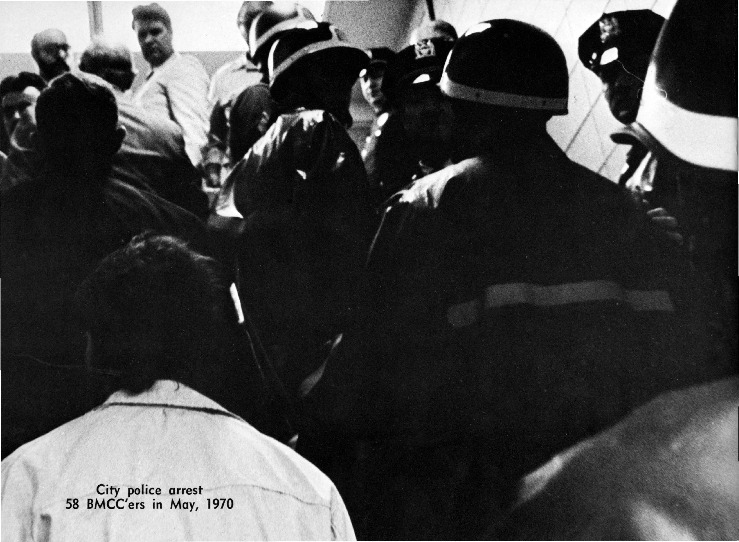
City police arrest
58 BMCC’ers in May, 1970
*
Lu
ns
[s
_
ae)
©
+)
+)
+)
+)
oO
+)
+)
N
Ralph Hudgins Prof. Jim Perlstein
At 1:30, May 5, an official letter from the office of Pres. Block
was read to a regrouped rally of students who had just closed down
the school. The letter gave the President's official comment on the
action: "The school will be closed for the rest of the day."
The reading met with a unanimous cheer from the students who
had opened up the 230 block of rooms in the "A" building and
turned it into an auditorium. The only dissenting voice was that of
Ralph Hudgins who remarked that the President didn't close the
school down but "We closed the school."
It was the climax of a relatively short action which began around
12:00 noon in the auditorium. Louis Chessimard spoke to the crowd of
about 125 people about the demands of the students and the
actions that should be taken. His speech revolved around the effort
to keep the school closed and the classes empty until the demands
were met. Miss Woronov and Mr. Perlstein of the English department
spoke to the crowd about the "movement" and what had come to
pass in light of the killings at Kent U. and Nixon's new military
strategy in S. E. Asia. Prof. Perlstein pointed out that we should ap-
plaud the efforts of Presidents Block and Nixon in finally “opening
our eyes."
Louis Chessimard continued on that point until the group broke
down into a debate and a vote on what actions should be taken.
The vote was nearly unanimous to close down the school and the
crowd began leaving for the "B" building.
By-passing the elevators, the strikers moved up the staircase
directly to the top floors, the strategy being to work their way
down. They met very little resistance since most of the classrooms
had been empty all day long. At the Bio Lab in room 301 some stu-
dents locked themselves in at the approach of the demonstrators
and did not leave until everyone had crowded outside the door,
pounding and shouting for them to get out. The demonstration pro-
ceeded out of the building to the sound of the fire alarms, apparently
satisfied that they had cleared out the building.
In three major groups, they returned chanting to the "A"
building and proceeded directly to the third floor where they ended
up storming the Registrar's offices. The workers locked themselves
inside because as Pres. Block stated later, "they felt threatened."
It was at this point that the President decided to call a conference
to close down the school.
55
56
A BMCC student wearing a plastic President Nixon mask paraded in
front of the "B-bldg." at the height of the 1970 Spring disorders.
ie
oa a
“als
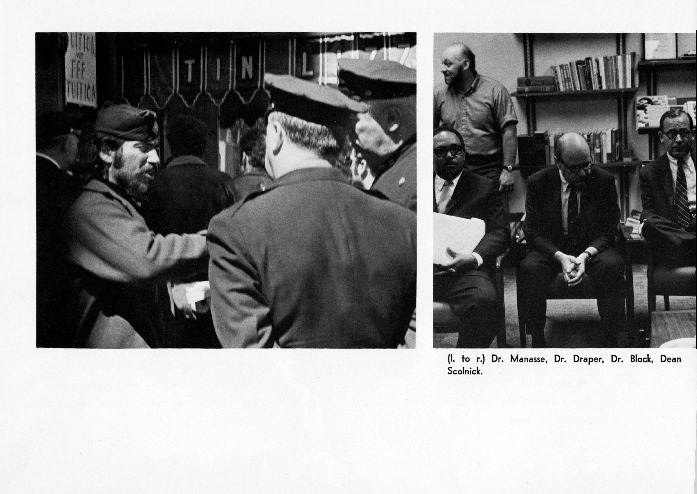
(I. to r.) Dean Draper, President Block, Dean Leon Cohen.
Chanting “Strike!"" and "Shut it down," over 70 student demon-
strators marched from the "B" gym to the office of President Block
and confronted him with a list of demands and a series of arguments
revolving around the present economic crisis in the City University.
Along with the "regular demands" (withdraw all troops from
Southeast Asia, free all political prisoners, cut all ties with the United
States’ “war machine," which seem to top everyone's list nowadays),
there were more demands which seemed closer to home and at least
more relevant to BMCC's situation today.
The two major issues — the founding of a child day-care center
in the college and an expected increase in tuition fees — were
argued back and forth for more than an hour with many sided dis-
cussions on a planned moratorium on the Cambodian affair and
the BMCC bookstore. The demands of the college workers and the
issue of non-representation of their union were also discussed.
Speaking about a day care center, Dean Leon Cohen said that
he “was willing to work with a committee" and to do “everything
in his power" to get a day care center for BMCC's use. Later Presi-
dent Block remarked that the Administration had had the idea
for a day care center two years ago, but ran into too many difficul-
ties with the City's strict regulations. One regulation states that a
day care center must be on the ground floor of the building being
used, and BMCC's facilities fall short of this requirement.
But the case of an expected rise in tuition costs carried, without
a doubt, the majority of emotional appeal. According to Pres. Block,
there has, as yet, not been any increase in the fees. The matter will
be resolved by the Board of Higher Education on May 15. The ad
ministration says that they are trying to bring the Mayor into the
discussion. Pres. Block stressed that there are alternatives to any
increase which our picket signs tell us will bring the fees up to $151.
One alternative would be to cut the proposed budget, formed with
the new “Open Admissions" policy in mind. The President's own
opinion of an increase was that “any increase in rates is abominable."*
The group obviously wasn't satisfied with Block's opinion. He
was asked not to collect any fees at registration, but his reply main.
tained a position that this was a problem involving the entire Univer.
sity system in the City and that he does not have the power to take
such independent action. His answer was the same to an appeal to
close down the school to protest the increase. President Block empha~
sized that he was against the increase but that "Il must fight my own
way." He gave his support to the group "But it has to be done my
way." Amid squeals of approval, President Block was asked to put his
job on the line by taking these independent actions.
Aside from the President and two Deans, the most vocal par.
ticipants in the group included Maria Ramos, President of the Stu.
dent Government. (TWC) Ralph Hudgins, and Louis Chessimard; can-
didate for SG Pres., (TWC).
Chessimard ended the meeting by calling for a 9 a.m. demon.
stration at 100 Centre Street (seat of the City gov't) the following
morning and made clear the group's desire to keep the college
closed indefinitely.
59
IMPASSE
7 com fell You, —
It | wanted to,
. What makes me
What I am.
But | don't
Really want to —
And you don’t
* Give a damn.
fx “ Langston Hughes ©
61
Louis Chessimard outlines grievances
| MANHATTAN
) COMMUNITY
| COLLEGE
May 5, 1970
0 & 8 ho
A rand
JIA
An unknown number of people slept-in at
BMCC on May 6-7 in order to keep the school
building open for use in Thursday's protest rallies
and meetings. No one knew for sure just how
many people did sleep in because they were
spread throughout the "A" building, taking any
room they could find. About thirty people slept
in the "A" lounge. There was no violence and no
news of police action.
A similar sleep-in was cancelled at the South
campus of CCNY because a police action was
threatened if the campus wasn't cleared by I1
p.m. The only report of police at BMCC came
about 7:30 a.m., when word spread that three
policemen were in the hall. At eight, police were
seen standing outside of the building.
At dawn everyone pitched in to clean-up and
get ready for-the day's action. A TV set was
pulled out of the closet in the "A" lounge and
whoever was around watched the Little Rascals
and cartoons — after the news!
MAY 12 — Last night two busloads of TPF
police (approx. 125 men) unloaded at the doors
of BMCC's "A" building and were joined by
the administration and they then ejected about
30 students who were sleeping-in in order to keep
the building open. The doors were locked once
everyone was cleared out of the building.
This morning more than 100 students marched
into President Block's office. Proclaiming that
BMCC was now "a people's college,” they de-
manded that Block and the five deans leave the
premises. The president and the five deans left the
building shortly thereafter and entered a taxicab,
destination unknown.
At the latest report, about 200 students were
milling around inside the "A" building, undecided
as to what to do. Twenty patrolmen were stationed
outside of the building, also undecided as to what
their next action will be. Most of the doors in
the building remain locked and the students are
the official power now.
69
58 BMCC’ers in May, 1970
*
Lu
ns
[s
_
ae)
©
+)
+)
+)
+)
oO
+)
+)
N
Ralph Hudgins Prof. Jim Perlstein
At 1:30, May 5, an official letter from the office of Pres. Block
was read to a regrouped rally of students who had just closed down
the school. The letter gave the President's official comment on the
action: "The school will be closed for the rest of the day."
The reading met with a unanimous cheer from the students who
had opened up the 230 block of rooms in the "A" building and
turned it into an auditorium. The only dissenting voice was that of
Ralph Hudgins who remarked that the President didn't close the
school down but "We closed the school."
It was the climax of a relatively short action which began around
12:00 noon in the auditorium. Louis Chessimard spoke to the crowd of
about 125 people about the demands of the students and the
actions that should be taken. His speech revolved around the effort
to keep the school closed and the classes empty until the demands
were met. Miss Woronov and Mr. Perlstein of the English department
spoke to the crowd about the "movement" and what had come to
pass in light of the killings at Kent U. and Nixon's new military
strategy in S. E. Asia. Prof. Perlstein pointed out that we should ap-
plaud the efforts of Presidents Block and Nixon in finally “opening
our eyes."
Louis Chessimard continued on that point until the group broke
down into a debate and a vote on what actions should be taken.
The vote was nearly unanimous to close down the school and the
crowd began leaving for the "B" building.
By-passing the elevators, the strikers moved up the staircase
directly to the top floors, the strategy being to work their way
down. They met very little resistance since most of the classrooms
had been empty all day long. At the Bio Lab in room 301 some stu-
dents locked themselves in at the approach of the demonstrators
and did not leave until everyone had crowded outside the door,
pounding and shouting for them to get out. The demonstration pro-
ceeded out of the building to the sound of the fire alarms, apparently
satisfied that they had cleared out the building.
In three major groups, they returned chanting to the "A"
building and proceeded directly to the third floor where they ended
up storming the Registrar's offices. The workers locked themselves
inside because as Pres. Block stated later, "they felt threatened."
It was at this point that the President decided to call a conference
to close down the school.
55
56
A BMCC student wearing a plastic President Nixon mask paraded in
front of the "B-bldg." at the height of the 1970 Spring disorders.
ie
oa a
“als
(I. to r.) Dean Draper, President Block, Dean Leon Cohen.
Chanting “Strike!"" and "Shut it down," over 70 student demon-
strators marched from the "B" gym to the office of President Block
and confronted him with a list of demands and a series of arguments
revolving around the present economic crisis in the City University.
Along with the "regular demands" (withdraw all troops from
Southeast Asia, free all political prisoners, cut all ties with the United
States’ “war machine," which seem to top everyone's list nowadays),
there were more demands which seemed closer to home and at least
more relevant to BMCC's situation today.
The two major issues — the founding of a child day-care center
in the college and an expected increase in tuition fees — were
argued back and forth for more than an hour with many sided dis-
cussions on a planned moratorium on the Cambodian affair and
the BMCC bookstore. The demands of the college workers and the
issue of non-representation of their union were also discussed.
Speaking about a day care center, Dean Leon Cohen said that
he “was willing to work with a committee" and to do “everything
in his power" to get a day care center for BMCC's use. Later Presi-
dent Block remarked that the Administration had had the idea
for a day care center two years ago, but ran into too many difficul-
ties with the City's strict regulations. One regulation states that a
day care center must be on the ground floor of the building being
used, and BMCC's facilities fall short of this requirement.
But the case of an expected rise in tuition costs carried, without
a doubt, the majority of emotional appeal. According to Pres. Block,
there has, as yet, not been any increase in the fees. The matter will
be resolved by the Board of Higher Education on May 15. The ad
ministration says that they are trying to bring the Mayor into the
discussion. Pres. Block stressed that there are alternatives to any
increase which our picket signs tell us will bring the fees up to $151.
One alternative would be to cut the proposed budget, formed with
the new “Open Admissions" policy in mind. The President's own
opinion of an increase was that “any increase in rates is abominable."*
The group obviously wasn't satisfied with Block's opinion. He
was asked not to collect any fees at registration, but his reply main.
tained a position that this was a problem involving the entire Univer.
sity system in the City and that he does not have the power to take
such independent action. His answer was the same to an appeal to
close down the school to protest the increase. President Block empha~
sized that he was against the increase but that "Il must fight my own
way." He gave his support to the group "But it has to be done my
way." Amid squeals of approval, President Block was asked to put his
job on the line by taking these independent actions.
Aside from the President and two Deans, the most vocal par.
ticipants in the group included Maria Ramos, President of the Stu.
dent Government. (TWC) Ralph Hudgins, and Louis Chessimard; can-
didate for SG Pres., (TWC).
Chessimard ended the meeting by calling for a 9 a.m. demon.
stration at 100 Centre Street (seat of the City gov't) the following
morning and made clear the group's desire to keep the college
closed indefinitely.
59
IMPASSE
7 com fell You, —
It | wanted to,
. What makes me
What I am.
But | don't
Really want to —
And you don’t
* Give a damn.
fx “ Langston Hughes ©
61
Louis Chessimard outlines grievances
| MANHATTAN
) COMMUNITY
| COLLEGE
May 5, 1970
0 & 8 ho
A rand
JIA
An unknown number of people slept-in at
BMCC on May 6-7 in order to keep the school
building open for use in Thursday's protest rallies
and meetings. No one knew for sure just how
many people did sleep in because they were
spread throughout the "A" building, taking any
room they could find. About thirty people slept
in the "A" lounge. There was no violence and no
news of police action.
A similar sleep-in was cancelled at the South
campus of CCNY because a police action was
threatened if the campus wasn't cleared by I1
p.m. The only report of police at BMCC came
about 7:30 a.m., when word spread that three
policemen were in the hall. At eight, police were
seen standing outside of the building.
At dawn everyone pitched in to clean-up and
get ready for-the day's action. A TV set was
pulled out of the closet in the "A" lounge and
whoever was around watched the Little Rascals
and cartoons — after the news!
MAY 12 — Last night two busloads of TPF
police (approx. 125 men) unloaded at the doors
of BMCC's "A" building and were joined by
the administration and they then ejected about
30 students who were sleeping-in in order to keep
the building open. The doors were locked once
everyone was cleared out of the building.
This morning more than 100 students marched
into President Block's office. Proclaiming that
BMCC was now "a people's college,” they de-
manded that Block and the five deans leave the
premises. The president and the five deans left the
building shortly thereafter and entered a taxicab,
destination unknown.
At the latest report, about 200 students were
milling around inside the "A" building, undecided
as to what to do. Twenty patrolmen were stationed
outside of the building, also undecided as to what
their next action will be. Most of the doors in
the building remain locked and the students are
the official power now.
69
Title
STRIKE!, Prism, 1971
Description
Prism was the Borough of Manhattan Community College's annual yearbook. This 35 page chapter from the 1971 edition details the student strike that, in May 1970, temporarily shut down the college and resulted in 58 arrests. Filled with photos, drawings, poetry, and essays, it vividly portrays the politicized atmosphere of the college. Faculty members, including Jim Perlstein, Bill Friedheim, and Naomi Woronov, supported the students who shut down the school and even slept overnight, in the occupied buildings. Student leaders, including Louis Chessimard and Maria Ramos, had long lists of demands. Along with the "'regular demands' (withdraw all troops from Southeast Asia, free all political prisoners, cut all ties with the United States' 'war machine,' which seem to top everyone's list nowadays,...," their local demands included a call for a campus day care center and their opposition to tuition fee increases. Interesting and representative of the overall political climate, this story was not supressed or diminished but, instead, it received this thorough coverage in the school's yearbook shortly after having taken place.
Contributor
Perlstein, Jim
Creator
Borough of Manhattan Community College
Date
1971
Language
English
Publisher
Borough of Manhattan Community College
Rights
Creative Commons CDHA
Source
Perlstein, Jim
Original Format
Book (excerpt)
Borough of Manhattan Community College. Letter. 1970. “STRIKE!, Prism,&Nbsp;1971”, 1970, CUNY DIGITAL HISTORY ARCHIVE, accessed September 5, 2026, https://stephenz.tailc22a4b.ts.net/s/cdha/item/253