Oral History Interview with Members of The Newt Davidson Collective
Item

DIGITALHISTORYARCHIVE
CUNY Digital History Archive
Transcript of interview with members of the Newt Davidson Collective: Nanette Funk,
Jerry Markowitz, William Tabb, and Mike Wallace
Interviewers: Andrea Ades Vasquez and Steve Brier
December 8, 2014
CUNY Graduate Center, New York, NY
Transcription: Jessica Murray
Transcript edited by: Andrea Ades Vasquez
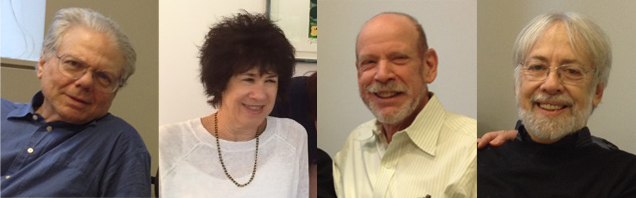
STEVE BRIER: So, it's December 8th, 2014, and we're at the CUNY Graduate Center, and
we're interviewing four people in the Newt Davidson Collective, who will introduce themselves
moving left to right.
NANETTE FUNK: So, I'm Nanette, I'm retired from CUNY—from Brooklyn College, Department
of Philosophy.
MIKE WALLACE: Lucky you. [laughter]
WILLIAM (BILL) TABB: Well, I'm William Tabb, if | was paid as a Distinguished Professor, |
wouldn't have retired. [laughter]
JERRY MARKOWITZ: Bitter, bitter, bitter.
BILL: You better believe I'm bitter!
MIKE: Plus, it's one course, though.
BILL: Just a moment...
MIKE: —still teaching, after...
BILL: Excuse me.
MIKE: You've got more?
STEVE: He wanted to say at least where he taught. [laughter]
BILL: My name is Bill, I'm a retired professor of Economics at Queens College, and of Economic
Sociology and Political Science at The Graduate Center.
MIKE: I'm Mike, I'm still teaching after forty...
JERRY: ...Four years.
MIKE: ...four years, thank you, at John Jay College of Criminal Justice and at intervals in The
Graduate Center.
JERRY: Jerry Markowitz, also at John Jay, and at The Graduate Center in History and Public
Health.
ANDREA ADES VASQUEZ: And, | am Andrea Ades Vasquez from the American Social History
Project, here at The Graduate Center and I'm conducting the interview with Steve, also from
The Graduate Center, in the Department of Urban Education. So, we'd like to start with a little
bit of background from each of you; where were you before you came to CUNY, is there
anything else you want to say about yourself, and, before you arrived at the City University.
NANETTE: So, | think I—there never was a time | was not at CUNY, hahaha. | was an
undergraduate at Brooklyn College, um, from '58 to '61. | went to graduate school there [Cornell]
for three years and taught one year of my first job at Union College, and then started in '66 as
an adjunct at Brooklyn, and retired in 2011. | was there 45 years. And, | grew up across the
street from Brooklyn College.
STEVE: So, you went to Brooklyn College before it was part of CU—before CUNY actually
existed?
NANETTE: Yes.
ANDREA: Go ahead. This is Bill.
BILL: Well, let's see, um, among other colleges | went to City College, where my father also
went. | taught my first—then | went to graduate studies at University of Wisconsin, where |
edited the newsletter of the national coordinating committee, then the war in Vietnam, and, went
south with the civil rights movement. My first job was at University of Connecticut, where | was
fired, um, it was said | was fired on the ‘plus x principle,’ that is, | published more than the rest of
them, but | also published things they didn't like. | was reinstated after a student protest led by
the editors of the college newspaper there. But, after most of the department came and said
they had voted for me, and they didn't understand how possibly the vote could have gone
against me, | came to CUNY, happy to be back in New York, and that was—I came in 1970, |
retired seven years ago.
STEVE: '70, straight to Queens?
BILL: Uh, '70—well, | visited University of California, Berkeley, Stony Brook, lectured other
places.
ANDREA: Mike?
MIKE: | was at Columbia College from '60 to '64, and did graduate work at Columbia, through,
'til the final dissertation in '73. | was a participant in a life-transforming moment at Columbia in
‘68. | went and got a one-year job at Franconia College, hired by Leon Botstein, then the
youngest college president in the known universe. And, while | was up there, Richard
Hofstadter, with whom I'd written a book that came out in '79 at the horrendous age of 54, um,
and | was a little nonplussed, to swear to go next to... two candidates, it turned out, were
Harvard, which was unappealing, and, then because | ran into John Cammett, who is the Dean
of John Jay College of Criminal Justice, and a card-carrying member of the Italian Communist
Party, and | was talking with him, and commiserating, as I'd just been attacked by the Wall
Street Journal, in a lead editorial for something that | had written. | thought, “Oh, well, shit, I'm
never going to get a job, now.' And Cammett says, 'You've been attacked by the Wall Street
Journal! You want a job?!” [laughter]
[00:05:35]
MIKE: So, | came down to John Jay in 1971, and have been there ever since.
ANDREA: Jerry?
JERRY: Jerry Markowitz. | made it a policy at a very early age to follow Bill Tabb wherever he
goes. [laughter]
JERRY: So, | went to Earlham College, and then went to the University of Wisconsin, where it—
| was there between '65 and '70, when everything in the world was happening, it was quite
extraordinary, education in the streets, formation of the teachers’ union, at the—not teachers'
union, the—
MIKE: Graduate assistants
JERRY: —graduate assistants, teaching assistants. And then when | arrived at University of
Wisconsin, the chair of the History Department said, “I can't guarantee you a great education,
but | can guarantee you that you'll get a job when you graduate.” By 1970, that was a lie. There
were no jobs available. | managed to get a job, thanks again to John Cammett, at John Jay, and
have been there, like Mike, ever since.
ANDREA: And, when you first arrived on your CUNY campuses, at your CUNY job, can you tell
us a little bit about your first impressions of the college? What was happening there? What was,
what was the demographics, what was it generally like?
NANETTE: Well, | started there in '66, and so, it was mostly white, | would say, it was probably
over 90% white. In my department, Philosophy, there were virtually no women. There was one
very activist, strong woman, Gertrude Ezorsky to whom | owe my job, because in the fights that
went on, she protected me. And, | must admit, initially, it was the last place, in a way, that |
wanted to be, because | had been there all my life. But, | did want to be in New York, so very
quickly it became very interesting at Brooklyn, politically. | was already very political. But | was
coming back to where | had always been, so it was nothing new, for me.
STEVE: And, it quickly became interesting, or it took time until the struggle for open
admissions?
NANETTE: Well, | started in '66, and in '68 there were all the demonstrations, and Brooklyn was
shut down, and we formed the NUC chapter at the college, and those are the people | still—
STEVE: What's NUC?
NANETTE: New University Conference. And, it was an amazing group of young faculty then.
So, it was a very active and exciting place. It was only, like, maybe two years before it got very
active.
ANDREA: What were the goals of the NUC?
NANETTE: Un, it was in, what was it? | guess it was all the Viethnam—no, no it wasn't Vietnam,
what was it? Um, I'm not sure, | know there were the big demonstrations when the campus—
because of Cambodia...
MIKE: '70 right.
NANETTE: That was '70. But, there was something before '70.
JERRY: It was probably Vietnam stuff that was going on, and, and—
MIKE: King, after all...
JERRY: —and King being assassinated, yeah.
NANETTE: Right. So, it was very active.
BILL: When | got to Queens, which was 1970, the first week there was a dance that the black
students were having to welcome people to the campus. There were not a huge number of
black students, American blacks on the campus. The Jewish Defense League decided to
integrate this particular dance, and it got rather nasty. Until the college President showed up, a
man named Joseph Murphy, the Murphy Center at CUNY is named after him. And he just
reamed the Jewish students in Yiddish, and then Hebrew, because his mother was Jewish, and
he, a good shul bucher, spoke languages that they had no idea Murphy would be able to speak,
4
and that's when | met Joe Murphy, who was very supportive of progressive things on the
campus. The—also the first week, we had an anti-war protest, this was recruiting on the
campus, DOW [Chemical] and all of that, and when | prevented the Dean of Social Studies from
entering the Social Studies building, he being a senior member of my department, | was
exposed to a different side of the campus. Murphy was wonderful to—we were arrested at one
point, and he came down with a wallet full of cash and bailed us all out. When we wanted the
college to cut off contracts with Honeywell, he was very apologetic and said, “Well, I’ve cut off
everything except the heating contract, and really we can't replace it. I'm so sorry.” [laughter]
BILL: So, the—coming from University of Connecticut, where things were quite different; very
reactionary, the demonstrations there got us arrested, but the college President was the one
doing the arresting, um, CUNY was just a really nice place to be. The Dean had hired me,
actually, because | did linear programming, mathematical modeling, and he was a aficionado of
such things, that—because that had been my dissertation work, so, he was particularly upset
about having made what he considered a serious mistake, but, it was a good—Queens was a
very good place to be. The State of New York paid for me to teach interesting students who
were, in fact, interested in the world and what was really going on. Um, the interesting parts for
me were dealing with people studying economics because they wanted to make money, and my
explaining to them, “Anybody can do the standard stuff, what you really have to understand is
how change takes place so you can be ahead. And, you have to know what's going on in the
world.” Where | proceeded to educate them as best | could on how the world really worked, and
they considered this exceedingly useful, because they were going to make a lot of money
understanding this, although some of them caught on fairly early, but it worked well and |
enjoyed my time there until, when they gave us a business program, and we were both
swamped with students who were stupidly wanting to make money.
ANDREA: When was that?
BILL: This is, um, the very late '60s. And, having to hire people—
JERRY: Late '60s or late '70s?
BILL: Um, sorry, hahaha. No, I'm decades off here.
MIKE: What's a decade among friends? [laughter]
BILL: No, no, we're into the 2000s here, and the climate has changed very dramatically, and I'm
having to take part in hiring people. And, one of the things about CUNY is, our salaries had
fallen so low, compared to places really good candidates could get jobs, that we would find
people with broad liberal arts backgrounds who could teach the business courses, um, from a
sensible perspective, highly qualified people went on to work, and the leading business schools
would pay them two, three times as much as we could. And that becomes a difficulty for a
school like CUNY when it's teaching courses that need to be taught very carefully, and you're
not able to get the people you really want.
ANDREA: Mike? You frowned at John Jay earlier.
MIKE: Well, when | arrived in '70, '71, um, there were a couple of things that were extremely
congenial at John Jay. Many things, there was Jerry and Blanche, and John—
BILL: Blanche who? [laughter]
MIKE: First names, first names, yeah, yeah, yeah. The “Newt-nicks” only deal in first names.
STEVE: That's true, absolutely true. And, some pseudonyms, too. [laughter]
MIKE: So, my, my faculty colleagues, and also the administration, John Collins, Vice President
and all... So, um, the second thing was that | was able to work with historian colleagues to set
up MARHO, the Mid-Atlantic Radical Historians Organization, and to run it out of one, and then
two, and then three offices, courtesy of John Cammett, who's—was the Dean and was running
Science and Society at the other end of the History Department. [laughter]
BILL: What's Science and Society? [laughter]
STEVE: We need him at every interview. [laughter]
MIKE: And, we started the program of public forums that went on for ten years. When the
magazine that we put out, The Radical History Review, grew and needed financing, then
Chancellor Joe Murphy was extremely helpful and protective, so it was just, you know,
delightful. And then, the third thing were the students. All of my students were cops. There were
variations, there were black cops and white cops, there were some lady cops, which was always
fun because you’d use some improper bit of language. All of the male cops would turn beet red,
and all eyes would pivot on the woman to see how she was responding to this. But, | got on
famously with them, | mean, and we had just encountered one another—several of these people
on the sides of the barricades, literally enough. That was unfair—our barricades were not as
good as the Architecture School, they prided themselves on their barricades, but they were all
right. So, here | was, | was wearing sandals and | had a beard, and all that, and | discovered
very quickly that the cops hated liberals. But, they thought radicals and lefty stuff, now that
made perfect sense! They had very shrewd notions about the way the world worked; their
understanding of class and power, um, was terrific. So, we had a great time. So, there was all of
that. | think that's enough for starters.
JERRY: But, a lot of my experience is very similar to Mike's. | arrived in 1970, it's the first year
of open admissions. | mean, you know, | owe my job to open admissions. It is—and in the first
couple of years, it is, we're teaching mostly sophomores, and we are teaching almost entirely
cops, all of whom are armed. And, my experience was similar to Mike's. Over the next couple of
years, we're getting more mixed classes—civilians and cops, which had a wonderful dynamic
because they're black and Latino students, and the cops were on a position of equality, really
for the first time, and able to talk to each other. And the conversations were quite extraordinary.
So, it was a very dynamic time, and a lot of discussion and talk about teaching, because we
came out of graduate school where you lectured. | mean, that's what you did, and this clearly
was not going to work. And, so, we tried to develop alternative teaching methods.
STEVE: Just to follow up on this whole issue, you come in as young faculty in the first real
wave, you were a little bit earlier than that, but, in the first wave after open admissions, which is
implemented in 1970. Can you characterize the, sort of the demographics of the faculty?
There's a bunch of young faculty who have to be hired to, kind of, deal with this huge, you know,
increase in number of students in open admissions, and there's this older faculty that had been
there a long time, and other than a John Cammett, or a Joe Murphy, what were the dynamics
between the younger—the new faculty and the old faculty?
MIKE: Well, we had a pedagogical degree, as well as a genealogical, or demographic degree.
The core, supposedly, of the place was Police Studies, and a lot of the professoriate were old
cops, um, who were less amenable to it ...
STEVE: To new demographic—to new pedagogical approaches! [laughter]
MIKE: So, there were real—| mean, | don't know, Jerry has written a whole book on the history
of John Jay, he knows everything there is to know, but, | mean, the sense was, is this was alien
country, and there were struggles which | didn't participate in over the direction of the school,
itself. And, there were little divisions in the History Department, we had a few right-wing
[indecipherable] [00:20:32] but it was, you know, it was captured space, so and then over time,
we being younger and they being older, things progressed and improved, but Jerry's your man.
JERRY: Well, | mean, just to add to that— | think that's right, but | mean, just to add to that—the
vast majority of the new faculty were young, they were radical or liberal, but in the context of the
cops, you know, not cop fans given what was going on in the '60s. So, | think the real split at
John Jay was between the police faculty and the rest of us. And, since we were a relatively new
college, we were in the majority, and | think there wasn't the kind of splits that you had at City
College, between the old guard and the new guard. Um, except in this police, and...
MIKE WALLACE: But, you know, when the crisis came, the fiscal crisis stuff, and they decided
that they were going to either close Jay, or after much carryings-on, keep it, but strip
unnecessary functions. So, history was, at that point—this is, unless | have this as a popular
mythology—the second largest major in the college. Cops loved the history department, and
they were all told, that basically, they had to leave if they wanted to continue on those grounds.
So, we had student numbers as well.
JERRY: Right, oh yeah.
STEVE: What about Brooklyn and Queens? | mean, those were older campuses.
NANETTE: Well, | mean, my department—first of all, when | was first hired, | was an adjunct,
and then when the union came in, | became a full-time lecturer, because | hadn't finished my
dissertation yet at Cornell. But, the Department was run by a horrible, sort of, corrupt guy, who,
when there was—because of open admissions— a chance to hire people, he hired whoever he
could control, they weren't young, leftie types, they were weirdoes. They weren't academically
serious— [Someone asks which department] Philosophy Department. And, in '70, | had to fight
for my job when | would have become a tenured lecturer—because | was friends with an older
woman, who was his [the Chairperson's] enemy. He tried to fire me, and, she fought for me, and
what she did was to do a whole history of what had happened to every woman who had ever
taught in the department, and found out that she was the only one who had ever gotten a
tenured position. And, we had a grievance case. So, the issue was,—[there was a trend of] you
know, we're hiring wonderful, young, liberal, or leftist faculty— it was, completely at, a diagonal
to the trajectory.
STEVE: Was that typical of the college, or just of your department?
NANETTE: Well, it was at my college that the suit was filed, the sex discrimination suit.
NANETTE: The Melani case, because she [Leila Melani] did a history of what had happened [to
women at CUNY]. And so, it was typical that there were no women at the higher levels. | think,
we had noted that in here [tapping Crisis at CUNY] So, | experienced that, it was really nasty,
really nasty. Lying, cheating, blaming the secretary for what didn't go right. | was involved in this
in '70, it was like a full-time job fighting it. | won it, at grievance.
ANDREA: So you saw the transformation, you were there before open admissions, the
planning of it, the implementation of it, can you describe a little bit those—that transformation?
NANETTE: Well, if | compare it to the time | was a student in '58, that was, you know, a largely
Jewish, middle-class—not middle-class, maybe working class? First genera—it was always first
generation going to college student body, but it was all white. There were a handful of blacks, so
that was a radical change with open admissions—and there was tremendous hostility to open
admissions by the faculty, because we're not going to get the—quote, ‘well-educated student
body’ that we had. So, you know, there was a lot of hostility.
ANDREA: And, how about the administration's approach?
NANETTE: | don't remember, at that point, what the administration's approach was. | know the
previou—when | was a student, the administration was the most horrible. It was Gideonse.
STEVE: Gideonse, yeah.
NANETTE: And, um, | don't know exactly—I can't remember now, you know, having been there
so many years, | can't remember exactly what happened, what the administration's attitude was
at that point.
STEVE: What about at Queens?
BILL: | think Queens, Brooklyn, City, Hunter were very similar and quite different than Jay in the
sense that Nanette has described, of a senior faculty at Queens—! would characterize the
senior faculty as right-wing social democrat. That is, they all voted for the Democratic Party, but
in New York, the division between right-wing and left-wing, since there were, at that point, very
few Republicans elected in New York, um, but they had patriarchal views. They were, of course
all anti-communist, and couldn't understand that there was a possible way to be critical of the
Soviet Union, but also anti-imperialist and having an understanding of America's role in the
world that was not that of spreading freedom and democracy, they were very conservative in
those ways. Now, in the larger United States sense, they were liberal, but liberal in the sense
that Mike described, cold war liberals, anti-communist liberals, male chauvinist liberals, and so
on. So that, | think, in all of the senior colleagues—colleges, the younger colleagues coming in
tended to be left, as has been described, we came out of the sixties, had a very different
understanding of our relation to students, and to education, to the world, and to social change.
So that | think there were tensions in all of the senior colleges, very much a generational,
political conflict.
ANDREA: | forget, one of you mentioned the union—
STEVE: Nanette.
ANDREA: —on the campus, right. Any other—was there union presence when you first
arrived?
BILL: See, | think that point is tremendously important. At Brooklyn especially, the younger,
radical people coming in, and at Queens as well, Barbara Bowen, the current President of the
PSC CUNY is from Queens, the Vice President, Steve London is from Brooklyn College. On our
two campuses, we looked around at each other and said, 'Why are we putting up with these
conservative people who don't consider that professors are workers? That won't ally with the
working class of New York to improve the City University? To fight for our students and our own
interests, together?’ They had this professional sense that they were better than mere workers
because they weren't workers. And, we said, "Why do we put up with this union?' We'd been
through the ‘60s, it was the '70s, time to take over the union, make it our union, and to show the
rest of the faculty that we could do far better than these people at good trade unionism.
JERRY: But, did that happen in the '70s? When you came into Queens, was there an active
union that you felt like you could, um, be a part of or even challenge?
BILL: No, there wasn't—at Queens especially, | think there was a decent union, it was people
we could support. We did go to union meetings, in the 70s, maybe pushed them a little left, but
at least on our campus, they were ready to be pushed, which was not true on a lot of other
campuses. | think in Brooklyn, there was more resistance to that.
NANETTE: Right. We were quite active in forming, you know, fighting the LC [Legislative
Caucus] and going to form the PSC [Professional Staff Congress]. Brooklyn was a center of
that.
ANDREA: And, you did it solely on your campus, or was there a citywide communication going
on? As you said, you both may have felt the same thing, was there any communication among
the faculty about...?
NANETTE: | don't know if what—
BILL: After, after a while there was, because, you know, we would see each other at any war
demonstrations and other things, um, | was not a historian, but | was a member of MARHO, um,
and at Wisconsin as a graduate student, | was an economics Ph.D. but | spent a great deal of
time—it was a wonderful history department. And so, and economics—the kind of economics |
did was not really what they did, with some exceptions. So, there was always this cross-
fertilization across the departments of younger people. Was that true at Brooklyn as well?
NANETTE: At this moment there was, because there was political activity, so we all came
together in the NUC [New University Conference] Chapter there, we all came together. So, in
fact, it was the period in which there was, for me, more cross-department contact than later.
STEVE: Hmm. In this period?
NANETTE: Yes.
STEVE: In the early '70s and late '60s? Interesting. That is interesting.
MIKE: See, | don't remember. I... when was this published, NUC? | mean, this was—[laughter]
STEVE: Can we quote you? It was a little later.
MIKE: I, | signed up. | joined the union and | was a delegate too, or something, and | think |
lasted, | think maybe a year. And, it just seemed unbelievably boring. No interest in any
significant issues, but | didn't do anything obstreperous, | just quit. And, | can't remember—it
was pretty early in the game | was there. Then—what was the faculty senate thing?
JERRY: That came much later, but the union—at John Jay, it's interesting because we had a
cop, a form—well, actually a former corrections person, Don MacNamara who was a big—
[00:32:12]
MIKE: Haig Bohigian.
JERRY: Well, he was later, he was later. But, MacNamara was a really terrific class-conscious
corrections person, a big reformer, and he kept trying to get the union, you know, going, but for
the most part, we saw it as pretty irrelevant to what we were doing. And, so we just, basically
ignored it, and the rest of our colleagues ignored it as we—I think the union had virtually no
presence on Jay's campus, at all.
10
STEVE: | think it obviously varies, campus to campus, particularly in this period.
ANDREA: Well, so we're, let's say we're in the early '70s leading up to the point where you've—
this publication, Crisis at CUNY is what brought us to this interview. So, how did you find each
other? How did you—what were the earliest efforts that led to the Newt Davidson Collective?
STEVE: It says in here you came together in—
MIKE: | wonder if somebody else knows the answer to this.
STEVE: —it says in here you came together in '73 to...
MIKE: No. We did a—I don't know who ‘we' was, | mean I'm really slipping, here. But, we did a
flyer.
JERRY: We did a couple of flyers—
MIKE: We did a couple of flyers.
JERRY: —from, Newt Davidson.
MIKE: Yeah, from Newt Davidson. And, you know the—
STEVE: But, tell it—you need to tell it for the record, how does the collective get named?
MIKE: There was a guy, David Newton who was some 80th Street administration person, who
had come out with some—something horrible. [laughter]
MIKE: So, modeling ourselves on the style of an 80th Street memo, or something like that, but
we flipped his name around.
Bill Tabb: Those were quite good.
JERRY: Yes, they were terrific.
ANDREA: Do you have it? Do you have copies of it?
MIKE: And then we—do we have those?
JERRY: No. [laughter]
STEVE: We haven't seen it. Too bad, would be great to find them.
MIKE: This was pre-computer, so, | mean, | can't—
11
STEVE: | know. Someone's got it in an attic in a folder somewhere, and it will turn up.
MIKE: It's so funny, you know you read through this thing, now | just had quick scan, and | mean
there's a lot more that | remember, but all these little references to things like 'mimeo' um...
[laughter]
MIKE: You know, the technology of it was so, another universe.
ANDREA: So you were telling us about those flyers.
BILL: | think the memos that Jerry and Mike are talking about were exceedingly important, they
were very well done. Um, in my—I had a minimal role in those, but | thought they were very well
done. It was the period when we began to see the business logic coming in to CUNY in a way it
had not come in before. That one of the faults of the Crisis at CUNY pamphlet is that it's very
structural, you know, capitalism's the enemy, you can't change anything unless you get rid of
capitalism. Well, right, that's a very—
MIKE: Little contradiction things here and there... [laughter]
MIKE: Not many, though. These master planners...
BILL: Now, now, it was a piece of its time, and tended to be overly structural, and the
differences within what one would call the ruling class, or in New York, the elite, between the old
style, progressive people, many in the business community, that wanted free tuition, that wanted
an educated working class to work for them, and they didn't want a business, screw the
students and impose tuition—they liked the idea of having more educated workers in the city.
They were progressive in that capitalist sense, which we did not deal with adequately.
MIKE: It's in there.
BILL: It's there, but we could—
MIKE: | read it more carefully than you did. [laughter]
ANDREA: Now, don't fight. [laughter]
STEVE: We want them to fight, that's good. [laughter]
MIKE: It's very top-down, very manipulative, very...
NANETTE: Yes, it's ver—very functionalist.
ANDREA: Now, tell us about the build-up.
12
MIKE: But, it did point precisely to that kind of contradiction.
BILL: That's the point, that David Newton comes in, pushing these views, they're very much
Nelson Rockefeller's views, and | think the pamphlet was very good on Nelson Rockefeller—
NANETTE: Yes.
BILL: —and his agenda, which we saw very clearly, and where it would lead, and unfortunately,
we were right on that. Um, the focus on David Newton was because he was introducing these
business-like ways that students are customers that we hear so much about now. All of that had
come to CUNY very early, in this period we're talking about.
JERRY: And, just to add two things: one, that the, uh, the contradiction of this expansion of the
student body to include students who had not been there before, and this new business model
we did not see as accidental, that the two were intimately related. That because we were getting
all of these students, they should be divided up and put into different kinds of categories, and
prepared in a different way than traditional college students were.
MIKE: But, how did it happen?
JERRY: Just one other thing. At the very same time, they had put these television cameras in all
the classrooms, and...
STEVE: They used to have them hanging from a pole.
JERRY: They used to have them hanging. And...
MIKE: Our future.
JERRY: Our future was, you know, we were going to be replaced.
NANETTE: CUMBIN, remember CUMBIN?
MIKE: Yes.
JERRY: Yes.
STEVE: It's in there, it's in there.
MIKE: City University Mutual Benefit Instructional Market [laughter]
STEVE: Good, you remembered that. [laughter]
BILL: That was the second important thing that this pamphlet, Crisis in CUNY, pointed to. And,
that was what are now called MOOCs—
13
JERRY: Yes, right.
BILL: —massive online education. In our case, it wasn't the computer, but it was these
television sets that appeared in every classroom in CUNY, at tremendous expense, and never
were used, but, it was the same design, to replace teachers with technology, and to
proletarianize teachers to be glorified teaching assistants who would follow courses designed
elsewhere for our students in the way Jerry was talking about.
STEVE: I'd like to explore this David Newton connection, because | think he's not a well-known
figure, you guys surfac— [laughter]
STEVE: —you surfaced him by his name, and I'm wondering, do you know anything about when
he came? Was he in the Bowker years, did he come only with—Bowker's there until '71, Kibbee
takes over in '71.
BILL: No, | think he's with Kibbee | wouldn't swear to it, that he comes in then. It's not, | don't
believe, it's not earlier.
STEVE: It's not, it's..
BILL: Because, it is with a new dispensation for a different kind of CUNY that was described so
well just a minute ago.
MIKE: When did that happen, and how did it happen? | just can't remember.
STEVE: Which is the ‘this?’
MIKE: How did the memo thing come about?
ANDREA: And, which campuses were involved?
JERRY: | can't remember how—there were a group of us that, un—
MIKE: One does worry about history, you know. [laughter]
ANDREA: Describe the group a little bit, describe—
JERRY: We worry too much about history.
STEVE: We should have done this interview twenty years ago, but... [laughter]
JERRY: No, | think probably thirty years ago, would have been more like it.
[00:39:43]
14
ANDREA: What—who was the group?
JERRY: | haven't the slightest idea. [laughter]
ANDREA: So glad | asked.
JERRY: Not the slightest idea. There were a group of us who came together and Mike was
always the most impish one, and most creative in terms of coming up with, | mean, we were
discussing what was happening at CUNY, our experience at CUNY, all new, young professors,
and we wanted a way to reach faculty and students where they would actually read. We
understood that a didactic—this is what's happening to you, you know, this is terrible, rise up
and revolt—wouldn't work. And, we got this, these, | think there were two or three of these
single-page, you know, descriptions of a dystopian future told from David Newton's point of
view.
STEVE: So, you mimicked him? In other words, you were mimicking his, one of his memos?
JERRY: Exactly, exactly.
ANDREA: Early Colbert.
STEVE: Ah, | didn't understand that. | didn't understand that.
BILL: Yeah, we had used his memos, and as Jerry says, Mike was just really quite clever, as
basically lead author.
STEVE: Mike has no memory of any of this. [laughter]
ANDREA: It's a good thing they liked you so much, Mike.
MIKE: How, how were we in touch across campuses and all that?
STEVE: That's the question.
JERRY: Okay, let's hope Bill has the answer.
MIKE: | mean, was it through MARHO-y stuff?
BILL: Among the ways, do—does anybody remember Pupin Hall at Columbia?
NANETTE: Yes, | was in.
BILL: Nanette was there, | was there, um, these people don't remember if they were there or
not. [laughter]
15
ANDREA: We're focused on this side of the table for a while.
MIKE: What was happening at Pupin?
BILL: This was a Columbia University— [laughter]
MIKE: Oh, back then!
BILL: Yes.
MIKE: Ah, yeah, go on.
NANETTE: You remember Columbia? [laughter]
MIKE: Columbia, hmm.
JERRY: Dimly, yeah, he remembers it dimly.
BILL: Nanette and | were part of a wider faculty, younger faculty at CUNY and other schools in
the New York area that were invited by our friends at Columbia to join in this sit-in against the
kind of research Columbia was doing for the Defense Department, and these—our friends at
Columbia and comrades felt this should not be done on their campus, and that they didn't want
it. And, so they occupied Pupin Hall, and asked for support from the progressive academic
community. Nannette and | met there, and we met lots of other people who were involved.
NANETTE: Right. We slept in there for a couple of days.
ANDREA: Really, tell us, what was—
STEVE: What year was the occupation, do you remember? [pause, laughter]
STEVE: Well, it's clearly after '68, right? It's '70, it's...
JERRY: Oh no, | think it was '71 or '72.
BILL: Yes, it was, | think Jerry's—
NANETTE: It was really a formative experience, you know, because | hadn't been in that kind of
sit-in and, it was really like a military operation.
STEVE: Yeah.
NANETTE: And, | remember, um, we had guards at the doors so that—
16
MIKE: And the tunnels, remember the tunnels?
NANETTE: | don't know if we had, | don't know if we had guards at the tunnels.
BILL: No that was, no that was the earlier student demonstrations, Mark Rudd and all that—
MIKE: In '68 we had the—
BILL: Yes, that was totally—
MIKE: —they were so stupid, that the whole network of tunnels under all of the buildings. So, we
would move around under those things. It took them a long time to figure out they should lock
the bloody doors.
BILL: Yeah, that was earlier, and it was the Columbia people, this was, um, '71, | think.
MIKE: Yeah. | wasn't there.
BILL: No, you weren't.
JERRY: No, | wasn't there.
BILL: There were these sleeping bodies that were always asleep, and you might have been one
of them. [laughter]
NANETTE: And, | believe that's the physics building, right?
BILL: Yeah, right.
NANETTE: So this was not—
STEVE: So, this is where—were there other Newt Davidson collective people there? Or was it
just the two of you that you remember?
BILL: Well, there were other progressive, young academic faculty—
NANETTE: Yeah, they were from the New School, people were there. What's the economist at
the New School?
BILL: Dave Gordon.
NANETTE: No.
BILL: Steve Hymer? There were a lot of them.
17
NANETTE: No.
STEVE: And David Gordon's at the New School.
BILL: Anwar Shaikh. The New School had a very progre—
NANETTE: British guy?
BILL: Yeah, Ed Nell.
MIKE: So, this might have been '70.
NANETTE: Ed Nell.
STEVE: '70 or '71.
MIKE: This might have been '70? Because, | was in Franconia, that's why | wasn't there.
BILL: So, he wasn't one of the sleeping bodies. [laughter]
BILL: Well, the point was that, of this larger group, the group at CUNY which included, Nanette,
and me, and these guys, also Blanche whatever her name is— [laughter]
STEVE: Blanche Cook, yeah. Thank you. Remember her last name?
BILL: | do remember her last name.
ANDREA: Well, you have here, you have Mike and Junius, and Bill, and Jerry, and Amy —
MIKE: Well, Junius is Ted Burrows.
ANDREA: Right, Junius is Ted Burrows. And Amy, and Nanette, and Bev, and Eric, and Moe,
and Stefan.
NANETTE: | don't know who Stefan is—
MIKE: Moe, | think, was the, | forget his last name, but he was the guy who, then got taken by,
um, Lyndon LaRouche. He was a physicist.
STEVE: Oh, you lost someone to LaRouche? [laughter]
NANETTE: Oh yeah, and he was a really nice guy, it was so sad.
MIKE: He was going to design cold fusion, and | remember one day, he came back, and he
said, he read this essay on Beethoven by LaRouche, and he was converted. [laughter]
18
BILL: It was a diverse group of leftists, and Amy Bridges was at Queens, she was an adjunct,
um, went on to a career elsewhere, and Bev was a counselor at Queens.
STEVE: Remember her last name?
MIKE: Selma? Was that...?
BILL: No. We, in fact, taught a course on the '60s together, somewhere later in the '70s, Bev,
Amy, myself and one or two others at Queens, where the students were really pissed at us,
because we would end up arguing about SDS meetings that had taken place, and why
Kirkpatrick Sale was wrong, and what we [indistinguishable]. [laughter]
BILL: And, they considered themselves the revolutionaries, and we were the old faculty. But, in
terms of Newt, it was the—a group of progressives from within a larger progressive community,
uh, that got together to do this, | think based on an awareness of what was happening to CUNY,
and it had to be analyzed using the talents we had, as academic social scientists.
JERRY: Well, | mean, | think we started out with these little, one-page things.
STEVE: Flyers, they were flyers to be handed out?
JERRY: Flyers that were, sort of, you know, actions. | mean, they were considered actions, and
then, at some point, we realized we didn't know enough, and—
MIKE: We knew the fuck-all, actually.
JERRY: Haha, that's a better way of putting it. And so, | think that's the origin of Crisis at CUNY.
MIKE: Well, the thing that | remember was, Who Rules Columbia? Remember that?
BILL: Yes. And, Who Rules Harvard? before that.
ANDREA: Those were flyers? Those were your flyers?
NANETTE: No, those were both—
MIKE: NYU Ink came out after—
BILL: They were—we were inspired by these things, but—
MIKE: They were predecessors.
BILL: —for us, it was less, who the members of the Board of Higher Education were, at elite
schools that was important because they were connected.
19
JERRY: Exactly.
NANETTE: Right.
BILL: At the City University, they were political appointees, hacks, and from our perspective, it
was the structural things that were happening to the university, that they were implementing that
was a concern.
NANETTE: | should just say that | came in, | think, later. | was the last person to join, and | think
it was from Amy, that she suggested that | join, and you were already in the process of writing
this, so | don't know much about the beginnings, and | think Amy brought me in because, | think,
she and | were in a Marxist study group, and | think you were in it, too.
MIKE: Yeah.
NANETTE: And, so that's how I knew Amy, and that's how | got into it.
ANDREA: So, some of the other names you had were Stefan and Phillip and Mike, and
Blanche, and Vicky, and Bart.
MIKE: Stefan. Who was that? Stefan was a real Marx-o at—but, what was his story? He wasn't
connected within a university. | had a feeling he was dispatched by some central committee—
[laughter]
MIKE: —somewhere, and this whole thing may have been a CP. Here we thought the CP was
kaput, but NO!
NANETTE: You were CP— [indistinguishable]
BILL: It is true, Stefan was a theorist, with a capital T, and would occasionally explain things
to—
MIKE: He was. Yes, yes, or complain if you were not—
BILL: —to the more frivolous of the new left among us.
MIKE: Where was he...?
STEVE: Every group needs such a theoretician, apparently.
BILL: Exactly. It was, it was a diverse group, but | think we worked very well together, because it
was the times, it was sort of—the '60s continued into the '70s, and especially those of us who'd
been student activists in various ways in the '60s. This was just the next logical step, really, in
our politics.
20
JERRY: Right. And, we were looking, | think, for ways to connect up—! mean, because the City
University was so vast—a way for us to make sense of it for ourselves.
MIKE: But it, it did really pose a theoretical problem. | remember being so bowled over by Who
Rules Columbia?; it was blinding in its illumination, you know? "Oh! That's why The Times is
taking the position it is." You know, it's Sulzberger's on the board. "Oh! Tom Watson, IBM, who
knew?" You know?
[00:49:34]
STEVE: Who wrote Who Rules Columbia? Do you guys remember?
MIKE: A bunch of us-types at Columbia. | mean, | was there, but | wasn't involved in that, in that
project. And, then NYU came up with one, so, but Bill was absolutely dead-on, | mean, that was
relatively easy. You looked at the corporate interlinks, and you were halfway done. This was a
political, public university, and required, you know, a different approach.
STEVE: Should we run through just the names and then put that out of the way? Why don't you
keep going, and if you hear a name—
MIKE: Do you know Stefan's last name?
ANDREA: Still on Stefan.
STEVE: Still on Stephan.
ANDREA: No, we don't know his last name. Phillip, and Mike, and Blanche.
STEVE: Blanche is Blanche Cook, obviously.
ANDREA: And Vicki, and Bart.
NANETTE: Bart Meyers.
BILL: Oh, Vicki is, she's now teaching at—
STEVE: Is it Vicky De Grazia | thought it might be Vicky.
MIKE: Vicki? Vicki was involved?
BILL: | didn't know that.
STEVE: Would she deny it now, or would she embrace it?
21
BILL: Well, people were involved to different degrees, and, | wouldn't want to begin to try and
remember who did what back then, but | think the listing is fairly extensive for all the people who
helped at one point or the other.
MIKE: Yes, that's true. That's true.
ANDREA: Yeah, and the other, last two were Andy and Rusty. Those were—
[multiple people]: Rusty Eisenberg.
ANDREA: And then there was an "also," and then there were a few more "also's"— [laughter]
ANDREA: —which, you know | can...
STEVE: They're undistinguished.
NANETTE: No that's Hegel, includes Hegel.
ANDREA: W.H.?
NANETTE: Well, G.W.F. must be Hagel.
MIKE: Well W.H. was W.H. Ferry, who gave us money.
STEVE: Ahh. And Carol Ferry, W.H. and Carol, that's his wife, right?
BILL: They gave us money for the project.
ANDREA: Huh, okay, | should read these names, then.
BILL: The printing costs were extensive.
NANETTE: So, G.W.F. is not Hegel?
MIKE: | remember some huge number, like 10,000 copies, what did we actually run off?
JERRY: Oh, yeah.
BILL: There were a huge number of these things published, they not only went all over the City
University, but all over the country, and to some extent, all over the world. Then we had—we got
requests from all over the place, un—
STEVE: There's a coupon in the back, you can buy it for a buck, if you send that and 25 cents
postage, it's in the back of the pamphlet there.
22
MIKE: Did it make any money?
BILL: | don't know— [laughter]
NANETTE: Mr. Economist? [laughter]
JERRY: What did happen to the money?
STEVE: He's an economist, not an accountant! [laughter]
BILL: Now, it is true that Stefan disappeared— [indistinguishable] [laughter]
MIKE: Theorist is a deep cover!
STEVE: It's Spanish gold going to Moscow, right?
NANETTE: Did we have any agent in here? Any spy?
BILL: We still don't know. | think one of the things that our generation decided was, the '30s
people and the left in the '50s had been so infiltrated by police agents, spies from all sorts of
places, that our sense was, "We don't care if they know what we're doing."
MIKE: Of course there's somebody in the room, you know—
BILL: We just assumed that, and, to let that keep you from doing what needed to be done, you
know, when | was at Wisconsin, we and the people at Berkeley were hauled up before the
House Committee, in our case, it was the Senate Committee on internal trouble-makers, and
the feeling was, "We're happy to tell you what we're doing." Now, this was very different
because in the '50s, they had scared people, and people were rightly scared, they lost their
jobs, their marriages broke up, there were all sorts of dirty tricks going on. Our sense was, "Go
to hell. We're going to do our work, and you can know what we're doing, here's our pamphlet,
read all about it." And, | think that this was part of how '60s people differed from earlier
generations. Yeah, Jerry?
JERRY: But, we did not have tenure. Which is why we did not give our last names. [laughter]
JERRY: So, there was prudence—
ANDREA: Was it actually secret who you were? | mean, given all of the—how many people
were using it, and how well this was circulating, did people really not know who was behind it?
BILL: | think most people did not know. | think if any police agents want— they, of course, could
have found out, but | don't think our immediate departments, which were the people who would
have had to initiate firing us, we had moved beyond the '50s where they could just, the
president of the university or the board could just fire Maurice Shappes or somebody.
23
STEVE: Yeah, like [CCNY President] Robinson did, Maurice Shappes, that's right.
JERRY: | mean, we all got tenure, we all got promoted.
MIKE: But, there—you keep running acro—| think Basil, our Dean at one point was perfectly
astounded to learn that—because he knew this, but he didn't know—
STEVE: He didn't make the connection.
NANETTE: By the way, | think Moe was Moe Levitt.
BILL: Yes, that's right.
MIKE: Moe Levitt.
STEVE: Levitt? LEVITT?
NANETTE: | think so.
ANDREA: And who was he?
MIKE: He was the physicist guy.
NANETTE: He was the guy who became, uh, LaRouche, un—
MIKE: Whatever happened to him, do you know?
NANETTE: He finally left.
JERRY: He did leave.
NANETTE: But, you know, maybe twenty years later or something. And, | can't remember after
that what happened.
ANDREA: And, did you work closely with Bart Meyers at Brooklyn?
NANETTE: Yeah, because he was at Brooklyn. We—he was in NUC—in fact, in terms of, 'We
didn't care what you heard,’ | remember at an NUC meeting at Bart's, we—he put the telephone
in the refrigerator. [laughter]
MIKE: Well, when he tried to recruit me, at one point, but the ‘LaRouche-ie's’ wouldn't let him
come on his own lest | overpower him, so they had this really straight guy who is sitting at his
elbow and was giving the pitch, so they were hyper-conscious about security.
24
STEVE: So, let's just see if we can get—dig a little deeper into the process of writing, because
you don't remember, sort of, the division of labor. Can you say something about the process of
how it was put together? Were sections—there are four chapters, the four chapters are all very
different and an action plan at the end. Were they authored or co-authored by different people,
and then it was kind of, put together?
JERRY: | mean, | think that different people had different responsibilities for different sections,
and you did a first draft. And, Mike and Ted did the editing of, you know, of it all. And, you know,
transformed it wonderfully into what you have—
STEVE: It does have a single voice, it's pretty clear.
JERRY: —yes, which is here.
BILL: Yeah, no, the single voice is basically Mike.
NANETTE: Yeah.
BILL: And, the rest of us researched different aspects—
ANDREA: Yeah, you described a lot of that in the back. All the researching that you did.
Directing people to archive...
JERRY: For example, | did open admissions, and went to—I mean, at that time, there was no
access to any information, and | went as a young faculty member. "I'm doing a project on open
admissions," and got into all the records.
ANDREA: Where?
JERRY: It must have been 80th Street; | don't know where else it would have been.
STEVE: You'd be heartbroken to know that they no longer maintain those records. They're
gone.
JERRY: Oh, Jesus.
STEVE: They managed to disappear them.
JERRY: Well, Newt Davidson collected, maintained an archive of all of our research that we can
all go to now to retrieve that. [laughter]
JERRY: Because, we were historians.
BILL: See, there were other people like Archie Singham, who taught at City College, was a good
friend, and so, we knew people in different places, and some of it was just oral history that
25
wasn't very old history from people who were on other campuses, and what was going on there,
that you know, was different than what wou—but, you know, | took part in stuff, | spoke at City
College when Archie was doing stuff and the group there was doing stuff, and | think other Newt
people did that, so that, there was a very lived sense of what was going on, plus, our historians,
| must say, were um, [sigh], how should | put this? [laughter]
BILL: It was the fault of the rest of us to give them their head, which is why there's too much
history in there. [laughter]
STEVE: Not from my perspective.
BILL: Yeah, the historians love it, but what we were weaker on was the movement stuff, and the
struggles that were going on in the different places, that in my view, if we were doing it today, |
think we'd all agree, we should have done more.
STEVE: Which is at the back. It's heavy on analysis and the last chapter—
BILL: Right. | think—I would hope we could all agree now that it'd be a bit more balanced if we
doing it today.
ANDREA: So, it—was it primarily, did you see it as something that should be taught? Is that—
was that your goal, to really get it in classrooms? Or, did you see it as an organizing tool, at all?
Or...?
JERRY: | would say the latter. | think it was an organizing tool.
NANETTE: But, | think the idea was also to use it—I think | used it at some point in classes.
BILL: Yeah, a lot of people used it in the classroom.
ANDREA: Well, we were recently at a retiree's meeting of the PSC, and there were about
seventy, eighty people in the room, and to our surprise, we said, "Has anybody ever heard of
it?" and most hands went up, and they had used it. They said, not only...
STEVE: Yeah, because | said—they asked me what we were doing on the project, | said, 'Well,
coincidentally, we're interviewing four of the original members of the Newt Davidson collective
next week. How many of you know the Newt Davidson pamphlet?’ It was like, 20, 25% of the
room, | mean it was retirees, so you know, not a surprise.
BILL: Well, no, but that's the point. That was the generation that we impacted with it.
JERRY: And we also made a presentation at MARHO. We we gave a presentation of our first
draft of the pamphlet, and got critiques back from students and faculty who were there.
MIKE: Well, | mean, there's a tremendous amount of work in this thing.
26
STEVE: Yes, unbelievable.
MIKE: | mean, going through this stuff, | mean—
ANDREA: And, the cartoons.
STEVE: | want to, | want to talk about that. | mean, this had this—you know, | joined MARHO in
'76, and this had a very much a feel—a look and feel of an early Radical History Review. |
mean, the look of it, the cartooning, I'm curious about how that decision was made, and...
[00:59:48]
MIKE: Um, well | don't know about decision, | do remember going up to LNS and rifling through
their cartoon collection, um, because it was free. Haha.
STEVE: Which was, it was down in 18th Street or something?
MIKE: No, no way am | going to remember that.
STEVE: Yeah. Liberation News Service.
MIKE: Yeah, and some of it was probably, sort of dumb, | mean little marijuana plants scattered
here and there, and | liked the Newt though, the salamander images, sort of running amok
through the pages...
STEVE: It took, which would have been an—you know, if you could imagine how this had been
produced in the '30s, it would have had a very different feel. This had a very ‘60s feel to it.
MIKE: Yeah, but also, | mean, again, some of the same problems. There's an awful lot of
students, hippie-types sticking their head into the machine and turned into square blockheads,
you know, there's a very, um, coercive sense of things. But, you know, | mean, | remember
somewhere early on—Alan Wolfe read it, and he thought it was really good, but did you—
BILL: This was the earlier Alan Wolfe.
STEVE: | was just going to say.
MIKE: He's gone through many changes. Um, and, he said, ‘But, did we really have to have
capitalism as every third word?' And, | remember arguing something like, "Yes, it's important.
People should get used to thinking in those terms, it's just the word that, you know, means
nothing. It doesn't connect to people." So, yes, we had to do that. But, it was very top-down,
power, and all that, and very abstract, except for all the stuff that quotes from foundation
executives, the quotes from reports. Even now, | mean, | look at them as a whole, it's like some
of these TV interviews with Defense Department honchos will say the damnedest things in front
27
of a camera, and that [clap], just [clap], kept [clap] punching, and the points, and you began to
actually combine large, theoretical overview with, "Oh, yes, this fits into that larger structure."
STEVE: | think your contribution around the issue of foundation, intervention, the way they use
their money to, sort of, move curricula, and sort of organization of the university...
MIKE: No, when | wandered into the Carnegie first operation, | was totally flabbergasted; I'd
never heard any of this stuff before.
STEVE: It's not accidental that the Clark Kerr ran it for a long time, you know?
MIKE: You know, and then there were some things that were off a little bit, like the Gehry plan,
with the platoons and all of that. | mean, it's true, but there were in fact two sides to that, and
who knew? Um, it was the mayor at the time, Mitchel was interested in this as a cost-saving
device, all these immigrants would come in, the schools were crowded, they were on double-
shifts, so, official double-shifts, that's cool. But, John Dewey thought this was the single, most
progressive exciting experiment that they were doing under the auspices of U.S. Steel. And, so
that particular thing, like other things, was full of contradictions that we didn't really adequately
explore.
NANETTE: But, | agree, | think that the founda—you know, what | remember the impact of this
work on me was the foundation stuff, because | had no idea how these plans were really being
worked out somewhere else, not on the campus, not locally, that they were nationwide. That
was, for me, a real eye-opener.
MIKE: That's history, by the way. [laughter]
NANETTE: | don't have anything against history. [laughter] But, | agree with Bill, it was history
topic heavy.
STEVE: But, | think, to explore that point about the structuralist, top-down, what | would call—it's
kind of heavily Gintis and Bowles-y in the way in which it analyzes education as a, kind of, a tool
of capitalist control, and | think—I would tend to agree with Bill, that the back-end of it does not,
sort of, speak to building the kind of movement that was clearly important.
ANDREA: It does speak a lot about the union.
MIKE: There is an organic connection.
BILL: | can't hear you.
ANDREA: A lot about the union. You introduced the whole—
STEVE: Yeah, PSC, the whole thing.
28
ANDREA: —What is to Be Done? section with the whole history of the PSC. The problems,
and...
BILL: Yeah, but—where | disagree with Mike, today, as | did then, and | know | won't do any
better now that I've— [laughter]
BILL: —is that, the history is always a history of struggle. And, when the history part is viewed in
this overdetermined way, where there's no possibility of resisting or changing, or within it,
winning struggles, and then you keep struggles at the end, after doing history in this way, it's a
strong weakness of the pamphlet.
MIKE: | agree.
JERRY: But, | think it's part of another kind of weakness, which was, we were very much a
faculty group, and we—I mean, | don't remember our being very much related to student
struggles that were going on at the time. So, there wasn't that connection—
MIKE: But, we were talking as if—l mean, one of the things that | liked about this, on my quick
lookover, was the very beginning, where it analyzes the community college curriculum. And, it
doesn't just say in the abstract, "You've been trapped into this. This is your four-year program,"
you look at that—
STEVE: Secretarial Science.
NANETTE: That was stunning.
MIKE: Secretarial Science, or Data Processing, and it's written as if this was, you know,
because we weren't students, but it's you know, okay, imagine—we're imagining the student,
and the student is being addressed, but, you know, that's a very different story from having
students.
STEVE: Yeah, no, that captured something fundamental, and what it does is it sort of, frankly,
overturns the kind of triumphalist narrative about open admissions, because we tend to think of
it, frankly, as this kind of golden age from '70 to '76 when the fiscal crisis slammed the door and
everything changed, and when I've taught this to doctoral students, what | say is, 'What you all
were pointing to were the, sort of, major problems within CUNY, despite open admissions. Open
admissions was a huge victory, and a step forward, but in all the ways in which you talk about
this, there's this, kind of, undermining of the basic idea of free public education, because of the
absence of resources, or these structural changes that are being introduced.’
BILL: What isn't there—and, you know, Mike was talking about his run-in with the Wall Street
Journal—my run-in with the Wall Street Journal was, | was teaching in the worker education
program, | was teaching electrician apprentices, who had worked all day, had come at night to
my class, which was economics, they had families, they had a really tough road to get their
union cards, but the union was very clear that it wanted to educate them on the way society
29
worked, their place in that society, as well as their rights as union members and, of course, the
technical skills they needed to be good electricians. That's a lot of stuff. So that my Wall Street
Journal guy who came to one of the classes, the students were asleep. You know, these poor
students were exhausted, and yet, they were coming to this class, and no, they weren't as fresh
as a daisy, like he was, because he hadn't done any work all day, just come to this thing at
night—[laughter]
STEVE: This is a Local 3 program right?
BILL: Yeah, right, right.
STEVE: The Local 3 in the electrician? Empire State? Or, was it city?
BILL: It was, um, the group down on Chambers Street, who are they—
STEVE: Well, now it's either Brooklyn or City. They're both down on Chambers.
BILL: Well, whoever it was, | was working for them in addition to my stuff at Queens. Because, |
think most of us were involved in other kinds of teaching to other kinds of students, but the point
is that, objectively, the working class has a hard time. They work hard, they don't get paid
enough, they don't get what they need, and people are going to be secretaries. Now, | would
have felt better, looking back on it, not that | was thinking this way then, was that, yes, there
being—and | thought the passage that was from Brave New World, or Brave New World,
Revisited; | can't remember, about the alphas and the betas and everybody getting channeled—
MIKE: Slotted.
BILL: —was, slotted, yeah—it was very good, because it explained that. But, | think what the
City University at its best tried to do, and what the members of the faculty tried to do was to give
the secretaries and the x-ray technicians, and all the rest, a broader education, and in that, we
fought with these business-oriented types that just wanted them to cram what they needed, and
keep them ignorant of everything else.
MIKE: Yeah, but you look at that listing of courses, and in the two years, there's one and two-
credit, any univ—any humanities thing was two, not three credits. And they were a total of one
course and, one course and something else.
BILL: Right, yeah, | understand. | would say that today, in the City University, the new
graduation standards—
STEVE: Pathways?
BILL: —Pathways is creating a worse version of that, that all our students are going to graduate
without history, without a broader education. Um, we are going to that now, and it's time for
another Crisis in CUNY pamphlet to explain to everybody what is going on, and to resist it. The
30
point | was making was not that it wasn't an excellent description of what was happening to
them, but that the other side of that, and the need for the broader education, which we
assumed—we should have stated. We should have had a different vision of education, much
more up-front in that discussion. Not that what we had wasn't good, it was.
STEVE: Jerry, you were going to...?
JERRY: Well, | mean, | agree with that. | think that another thing that was going on was that we
were recognizing that, in addition to that kind of lack, that the students were getting, the
students were dropping out in massive numbers, that open admissions was not even fulfilling
the the goal of providing a way for students to get their AA degree or BA degree. That the
resources weren't there for tutoring, the resources weren't there for counseling. You know, so it
was very telling, | mean for those of us going through those years, they were not the golden
years, they were very much years of struggle on all these different levels. And, | think that that's
what we tried to convey here, that we're in the midst of this, and we're in big trouble.
STEVE: Yeah, the fronticepiece to the pamphlet is wonderful, it's worth reading out loud,
because | think it really says something fundamental. "Crisis at CUNY. At this very moment,
CUNY students and faculty are under the gun. People everywhere are being fired. Financial aid
is being slashed. Courses are being chopped. Class sizes increased. The state is moving to
impose tuition, which will drive huge numbers of students out of school. Do you know why this is
happening? Do you know who really runs this university? Do you know whose interests CUNY
really serves?’
JERRY: And, the irony is the fiscal crisis had not hit yet.
STEVE: No, that's— [laughter]
STEVE: —that's exactly why | read it. You anticipate, sadly that— [laughter]
MIKE: You were on top of that. You had the Powell memorandum, all that stuff nailed down? |
mean, | don't know, how generally known was that in '73?
STEVE: What memorandum was this?
MIKE: The Lewis Powell memorandum.
STEVE: Oh, the Lewis Powell —oh gee, that's amazing...
MIKE: That came out in 1971, and this was '73?
STEVE: The soon-to-be Supreme Court Justice, right?
JERRY: Right.
31
BILL: Yes, two months later. We were aware of that then, and we were aware of the
corporatization, and the way class struggle was taking place. Other people from the '60s had a
different understanding, and we think we were maybe, a bit ahead of it, of the time, in
understanding the corporatization of the university, and the effort to proletarianize both the
faculty and to slot the students, which is, | think, our core vision of what was going on.
STEVE: And, did you see that as a, kind of, tension within the administration, or was it a full out
buy-in by the administration, the Kibbee administration to the corporatization? That's what it
feels like in the pamphlet. | mean, and the opposition comes from faculty like yourselves, and
radical students? | mean, were students involved in...?
BILL: See, two things. | think, at the time, we underestimated and didn't do enough to research
the divisions within the New York City elite, because there were a lot of people who worked—
MIKE: In the city elite, or the 80th Street elite?
BILL: No, city.
STEVE: The political elite.
BILL: The political elite, you still had some very good 1930s New Deal-types, um, that Joe
Murphy got appointed—
STEVE: Julius C.C. Edelstein, who would be a perfect example of that, who was around
throughout that whole period.
BILL: Yeah. And so, that there were these progressive figures that we could have allied with,
and it would have been a good thing to pay more attention to, rather than just announcing them
all as a—
MIKE: Yes, it's true.
STEVE: Let me throw out one thing, which has always sort of puzzled me. We haven't talked
much about Albert Bowker, who's someone I'm very interested in as the second Chancellor, the
one most of you didn't—he wasn't Chancellor when you came in, so you don't, didn't have exact
experience with him. You might have, in terms of coming to Brooklyn when you did, but Bowker,
very concerned about the need to expand CUNY dramatically in that whole period, which you
brilliantly lay out there, the history of what's going on in '58, '59, '60, '61 when CUNY comes
together. Bowker forces this great, sort of, crisis in the administration, threatens to quit, and
what he wants to do is, he wants to get more money to build out CUNY, because he sees—he
and Edelstein see what's coming demographically, that it's already started, and they're not going
to be ready to handle this, the baby boom infusion, and large numbers of blacks and Latinos,
and so he's very willing to trade free tuition for a huge infusion of money from the state to build
out CUNY. He doesn't succeed, open admissions gets sort of put off to 1975, and then, as we
know, in '69, the events on the campuses force the Board of Higher Education to, kind of, in
32
effect, move it forward five years, which is when you all get employed. But, I'm wondering if
your attitudes about the, sort of, whole free tuition issue, whether that was a, kind of dogma for
the old progressive-types that you're talking about, who were not willing to, sort of, think more
broadly about what CUNY needed to do, because the point at which CUNY is founded, it is
serving very few students. There's barely 40, 50,000 students in CUNY, what becomes CUNY
when it starts, and then it expands. But, this trade-off between free tuition and the inability to
build out to be cash-poor and starved by the state and the city is a really interesting tension. I'm
just—this is just something that's occupied me for a long time, I'm thinking about it all the time
when | think about the history of CUNY, I'm just curious if you have any...
[01:16:35]
NANETTE: | mean, the only thing for me, personally, was that free tuition was something you
couldn't—I couldn't ever accept morally. | mean,— giving up free tuition, | could never morally
accept that. | grew up with it, | benefitted from it, the students were poor. We saw that once you
open the door, even if you say you're giving grants, the door's open, and it was, it was a non-
negotiable demand, for me [the need to keep free tuition].
STEVE: That's very helpful, yeah.
BILL: | think that's crucial. My father came to this country as an immigrant. If there hadn't been
free tuition, he wouldn't have been able to go to college. The whole sense that, um, the City
University was there for the working class was very important, but it was a restricted working
class when he went to City College. You know, they were all Jewish, young intellectuals, and all
that. But, open admissions was giving the right to all New Yorkers that had been previously for a
smaller number, and we saw that, | think we all saw that as the expansion of a better vision of
how education should work in America, and how the working class needed to be—had the right
to be educated, and didn't have the money, and so, of course, just what Nanette said, this is so
basic that everybody should get free tuition. You know?
MIKE: And, it was basic for the other guys as well. | mean, Rumsfeld and Cheney are pushing
forward to put free tuition at the City University of New York as the number one problem.
STEVE: To solve, yeah, to eliminate.
MIKE: And, at one point, one of them said something like, 'Well, if New York can do it, why not
Minneapolis?’ Hahaha [laughter] Good question!
STEVE: That's exactly right. lt was among the—when they went down to negotiate—you know
this, Bill, | got this from you, | mean, your book—when they go down to negotiate, it's one of the
first things they, that Simon throws in their faces is free tuition at the City University. To say,
"We're not going to bail you out, you're look at—you're providing free education to your citizens."
BILL: And, | think, for us, one thing we would want to say to the people who are listening to this,
should anyone be listening, is that, this corporatization, privatization, and neoliberalism has
33
gone so far since we wrote this pamphlet, that people aren't so much more outraged now than
we were then, is a mystery to us.
ANDREA: So, take us back to the time when students were in the streets, also around this
issue of tuition and, you know, before the fiscal cri—what was your relationship, on your
campuses to students who were taking various actions?
NANETTE: Well, the young faculty were very involved in these kinds of struggles there. At
Brooklyn. | don't know about anywhere else.
BILL: | think at City, for sure.
ANDREA: So, did you support student actions, or did you do things together? Were they
supporting things that you launched?
NANETTE: You know, unfortunately, on my campus, there were two people who would know
best, and one is dead, Bart, and the other isn't here, Renate Bridenthal.
BILL: Oh, | know Renate, we can reach Renate.
STEVE: She was at the retirees’ meeting.
JERRY: Yeah.
NANETTE: Yeah. So, um, but we tried to work—the young faculty tried to work together with
students, there were various kinds of ways in which that was done, but the specifics, | don't
know.
BILL: Now see, the three of us came later, so that a lot of the demonstrations took place before
we came on.
STEVE: Yeah, in '69, right?
JERRY: And, in '75 and '76, for us at John Jay, saving the college was, you know, the most
important thing that we were dealing with. | don't think we were focused on the tuition issue.
BILL: Yeah, also by the time the city fiscal crisis happened, it was everywhere. It was in the high
schools, it was in the welfare offices, we held open the exit gates on the subway when they tried
raising subway fares. The radicals were active in all these things and, no necessarily just on
campus.
STEVE: On campus. Did the collective continue to meet after the pamphlet appeared in '74?
BILL: Not as the group.
34
STEVE: Not as a group? So, this was—
JERRY: No, | mean MARHO continued, and | think—
STEVE: | know that full well.
JERRY: —that would have been the way people would have together, but | don't think...
BILL: | mean, we all stayed in touch because there was ongoing politics, but no, the collective
was to produce this pamphlet, and that was the job.
STEVE: And that was it. Yeah. And the response that you got, you said it had worldwide
distribution, | mean it printed, what did you say, 10,000, potentially?
MIKE: | think it was 10,000, but maybe they're all sitting in a warehouse somewhere.
MIKE: We suspect Jerry's apartment. [laughter]
STEVE: That's how | got my copy! [laughter]
JERRY: | had a house at the time, hahaha.
BILL: And when he left the house, if you were to go to the basement... [laughter]
MIKE: | don't have a sense, honestly, of what kind of impact it had. | don't know, you know, if it
had any impact. It depends on what day you ask me, if | feel gloomy or not, but also, | mean it—
this is a whole thing in communication studies about finally getting around to ask, not how a
message is projected, but how is it received, and we don't know. How would we have known? |
mean, other than random bits of commentary, and we didn't have a polling, market research...
STEVE: Feedback from your colleagues.
ANDREA: It was certainly used, | mean, it was used.
BILL: You guys probably know the name of the graduate student here in political science?
STEVE: Douglas.
BILL: Yeah.
STEVE: He's one of my students.
BILL: Douglas Medina, if you read the article, it will be out in the December journal issue, points
to Newt Davidson's pamphlet as the only so—openly socialist, and insightful, all the nice things,
35
analysis of what was going on, and | think that other students, young academics, have picked
up on the pamphlet and, so it continues to have influence...
MIKE: Well, but that's the analysts, they wouldn't say, because they wouldn't have information,
that this, in fact, was, transformative—
BILL: Yeah, but you'd have to interview all stu—
MIKE: | know, | know, I'm just saying that really, | haven't the faintest idea... Also, it's bloody
long.
STEVE: It is long.
MIKE: | mean, this is a serious commitment of time.
STEVE: It's a serious piece of work, | mean, this is a book.
MIKE: | mean, | did, | used it in seminars and things, in fact, | think | had one that was an
extracurricular seminar, it wasn't on the books, even. But, you know.
We did—Tony Picciano and | taught a course on the history of CUNY that Andrea audited, and
we used it, and Jerry came in, and—
JERRY: Yeah, Mike backed out.
STEVE: Backed out, yeah. [laughter]
STEVE: But, this is why we've wanted to do this for a while.
BILL: At his age, come on. [laughter]
STEVE: But, students are really interested in it, and what | would say, as someone who's been
doing a lot of work on the history of CUNY, I've got two students, Douglas and another student
in Urban Ed who's doing stuff on tuition policy. This is a very good piece of work, and I’m happy
to quote it, and happy to cite it, because it's such a solid piece of, you know, analysis. It really is.
BILL: It is solid. | mean...
JERRY: | quoted it in the history of John Jay. [laughter]
STEVE: That's a little self-referential, don't you think? [laughter]
JERRY: No one would know.
BILL: We're academics. [laughter]
36
NANETTE: What | noticed in looking over this and doing my homework for the meeting, um,
was the numbers, the inflation. It may be 20—what was it? 24,000 dollars for four years at
Columbia, that's outrageous.
MIKE: Right, right, right. Outrageous! [laughter]
STEVE: Well, the statistics in here, particularly about the stuff on women faculty, which | would
assume came from your work at Brooklyn, right? | mean, that was, like, | don't—there aren't
many citations to where the statistics come from.
MIKE: Yeah, there's no footnotes. [laughter]
STEVE: | assumed you didn't make it up.
BILL: No, no, no, look, everything in this is very thoroughly researched and very carefully done.
The—I remember a discussion of footnotes, and the sense was, we want people to_read it, we
don't want them to stop, it's not for, you know, posterity, and grad students who are going to
come in fifty years—
STEVE: Little did you realize.
BILL: Yeah, little. But, the point was, we—l remember the discussion, we decided consciously
not to do footnotes, because we wanted it accessible, we wanted it to move along, and, for
some historians, that was a difficult thing to accept.
MIKE: Not me! [laughter]
MIKE: Look at Gotham, count the number of footnotes, zero. [laughter]
MIKE: To many people's intense annoyance.
STEVE: Mike has always been a great synthesizer, it's one of his real talents and skills as a
historian.
MIKE: It's just grand larceny, which...
STEVE: You learned, you learned from the master, didn't you?
NANETTE: Do you remember how this was distributed? | mean, | don't know.
MIKE: At the campuses, at the campus events.
JERRY: We had a distribution network from the, you know, from thw little pages that we would
do. | mean, we had people on every campus—
37
STEVE: The flyers? You're talking about the flyers.
SEVERAL: Boxes, cardboard boxes. Heavy cardboard boxes.
JERRY: Putting it in people's mailboxes.
[1:27:00]
STEVE: This went to faculty, you literally, you stuffed faculty mailboxes with this?
JERRY: Stuff faculty mailboxes.
ANDREA: No wonder, no wonder so many... many, many taught with it.
STEVE: And the Ferrys helped to finance it, because 10,000, printing costs were much less
then, but that was not cheap, I'm sure.
ANDREA: For how many years was that happening?
JERRY: How many years?
ANDREA: Not, not—you just did it once?
JERRY: Well, for this? We just did it once.
ANDREA: Just once
JERRY: Yeah. But, for the other ones, we did it, you know, whenever the thing came out.
BILL: Yeah, but see, people had been stuffing mailboxes with anti-war and civil rights stuff for a
long time, so it was not that we had invented stuffing faculty mailboxes.
STEVE: Also, many, many more CUNY faculty in 1974 than there were after the fiscal crisis,
right? | mean there were, maybe 6, 7,000 faculty? Maybe more, even.
JERRY: More, i bet.
STEVE: More. So, if you managed to get it distributed across CUNY, that would have taken
up—
BILL: No, it was not universal, there were campuses, we had trouble finding people, people did
not distribute as much, you know, because we were counting on people who only had
tangential—we were actually from very few campuses, the Newt Davidson people.
38
STEVE: So, these three campuses. What other campuses do you remember? Somebody at
City, presumably, for City, and Hunter?
BILL: Who was at Hunter?
JERRY: It's hard to believe we wouldn't have had somebody from Hunter.
STEVE: That would be hard to believe.
BILL: Yeah, but of course then Newt leftists, so the extent to which there's Stakhanovites and
Newt lefties [laughter]
STEVE: That's a really lost reference, see, like ten people in the world who know what
Stakhonovites are. [laughter]
ANDREA: What about community colleges?
MIKE: Stuart Ewen, maybe. Was he...
BILL: No, Stu-ey, Stu-ey, | believe came later.
STEVE: At Hunter? Oh yeah, no, yeah, he came later. Stu Ewen? Oh yeah, yeah, later.
ANDREA: What about community colleges?
BILL: We were weak around community colleges.
NANETTE: Although, BMCC had a very strong leftist group, there.
[many voices]
STEVE: Say again, Nanette, I'm sorry | didn't hear you.
NANETTE: BMCC had a very strong leftist faculty.
STEVE: Well, yeah, Jim Perlstein, and Bill Friedheim, and you know, those—they're active now
in the retirees’ chapter. They were there as early as you were, they came in the '60s, when they
were working out of rented space, you know, above massage parlors on Broadway. [laughter]
BILL: Yeah, Jim remembers that. [laughter]
STEVE: He talked about it just the other day.
NANETTE: You know, for me, the irony was that when | was a student, | graduated in three
years, so | could get out of Brooklyn. [laughter]
39
STEVE: That didn't work out so well, did it? [laughter]
ANDREA: You're still trying.
MIKE: The Alfred Kazin story.
BILL: It actually worked out well, | think. Do you have other questions?
ANDREA: | think we're, you know, unless you have any sort of final, sort of, thoughts about—
STEVE: Final thoughts?
ANDREA: Any things that we might have forgotten to ask, or...
MIKE: Would there be any point in putting, digitizing this, and putting it up online?
STEVE: It's already scanned, so we can easily—we will put this in the archive.
MIKE: Scanned is hard to read.
STEVE: Yeah, so, but it's possible to—this type...
MIKE: Would there any point in doing it?
ANDREA: Yes, absolutely.
STEVE: | think so.
BILL: | think there would, but | think when you put it up—I hope | speak for the rest of us here,
we would really like to see a group of young faculty take up the next Crisis at CUNY pamphlet
that speaks to today's City University.
STEVE: That's a great idea, actually.
NANETTE: Can you put the pamphlet online?
ANDREA: Yeah. We scanned it, we have it as a document.
NANETTE: Oh, is that what you were referring to?
MIKE: Yeah, but, no, I'm thinking digitized.
STEVE: Scan you can't search, and you can't—
40
MIKE: So, it's transposable to different formats, and very important for old people, larger type.
ANDREA: Well, if, you know, it could be re—re-entered, in other words, then it would have to
be retyped.
STEVE: No, no—OCR—we could OCR this.
ANDREA: Yeah, but we'd have to create a searchable text. Right now, we just have it as
pictures of the pages.
MIKE: Well, maybe also, open it up, or have a meeting with ten younger folks, and tape that
discussion, and their response to this, and then, maybe ask them what they would think about
would be the bones of a new version. What would be the issues that—
STEVE: A new version? Yeah, that's actually a very good i—
MIKE: —what kind of information would you want to gather to do it? The big [idea], when we're
talking about how to go about researching your campus, that wasn't bad, | mean, very onerous
demands we were making, but | mean, it really was pointing, this is how you put something like
this together. And, in half an hour, you're going to know much more than we do.
BILL: | also think the union could be involved in this.
STEVE: Yeah.
NANETTE: Yes.
BILL: Because, | think, a lot of the younger union activists would be the natural group that would
go and do it.
MIKE: That's a good idea.
STEVE: That's a very good idea, one thing | could do—I've been asked to teach another, sort
of, seminar in Urban Ed, which would be open to students from all over, on the history of CUNY,
and | could focus it very much on the, sort of, open admissions to the fiscal crisis, period. Use
this as the centerpiece, and have the students themselves begin to generate a kind of—I think
this idea of updating Crisis in CUNY, Crisis in CUNY II, Redux, you know, would not be—it
would be a very good idea.
NANETTE: Yeah, because a lot of the concerns here are exactly the concerns—
STEVE: Exactly.
ANDREA: Well, | mean a lot of these, the sort of, the struggle around Pathways, and even for
the new contract, all of this looks back to this '70s and the union does sort of—
41
BILL: Andrea, to me, that is the most important thing. | don't—I would not like to see
somebody—this is the second edition. | would like to see this generation do what this generation
needs to do, and the extent to which this inspires that, offers any kind of help, is fine, but this is
their project for now, and any help we can be, of course. But, it's—too much of the left is
referent back and not enough of now. It's like all these Marxists who want to be Marx in the
middle of the 19th century, or Lenin in 1905 vs., you know 1910, where, of course, in 1917, he
understood the world differently, as Marx did over his life. All these people who, you know—it
should be now, informed by history, but not, um, restricted by history.
MIKE: Yes, but the informed is where this thing could be a useful tool.
BILL: Yes, absolutely, absolutely.
STEVE: It's shocking to me how little—understanding the recent history of CUNY. | mean, I—it's
amazing to me, even among faculty, how little they understand. I'm doing a book now, with Mike
Fabricant, in part, I'm writing the history chapters, it won’t be just about CUNY, it's about higher
ed in general, but, it's like amazing how un-researched it is, in some ways. Thank God we've got
some students...
ANDREA: That was the point of the archive, which is why we're doing the interviews.
BILL: It's really good you guys are doing this.
ANDREA: The document will go on.
MIKE: One of the things | think is—we've come at this from a completely different perspective
than my 25 words or less narrative on this subject is: It used to be the case that when new
immigrants arrived in New York, there were several institutions whose structure raison d'etre
required incorporating them into the citizenry. Tammany Hall, the Catholic Church, and the
union movement. They're all gone, largely. Um, the only institution that | can think of, in New
York City, whose very existence depends upon servicing and supporting and incorporating, is
the City University of New York. And, it's also got a potential for mobilizing that constituency.
What are, what are we up to? Is it still a quarter of a million? Or...?
STEVE: Oh, it's higher; it's 275,000 now.
MIKE: Yeah. That's a perspective that we were completely innocent of. | mean,—if you're talking
about where things are at now, the connection with the various immigrant movements, is a huge
aspect of the— [indistinguishable]
STEVE: Well, then the challenge is, how do you make, how do you make an argument that's
convincing politically, that does not, sort of, counter-pose, what—for lack of a better term—a
liberal arts education, a broad education in, sort of, how the world works, on the one hand, with
job, you know, preparation, and, what you saw in here in the '70s, and what's going on in CUNY
42
Central now, especially with this new administration, it's all about job preparation, so, you know,
they certainly see the community colleges that way.
ANDREA: Okay, we're going to—thank you guys very much for this interview, and I'IlI—
STEVE: Thank you all.
MIKE: Our pleasure.
ANDREA: Appreciate all of your input, thanks very much.
[end recording 1:36:24]
43
CUNY Digital History Archive
Transcript of interview with members of the Newt Davidson Collective: Nanette Funk,
Jerry Markowitz, William Tabb, and Mike Wallace
Interviewers: Andrea Ades Vasquez and Steve Brier
December 8, 2014
CUNY Graduate Center, New York, NY
Transcription: Jessica Murray
Transcript edited by: Andrea Ades Vasquez
STEVE BRIER: So, it's December 8th, 2014, and we're at the CUNY Graduate Center, and
we're interviewing four people in the Newt Davidson Collective, who will introduce themselves
moving left to right.
NANETTE FUNK: So, I'm Nanette, I'm retired from CUNY—from Brooklyn College, Department
of Philosophy.
MIKE WALLACE: Lucky you. [laughter]
WILLIAM (BILL) TABB: Well, I'm William Tabb, if | was paid as a Distinguished Professor, |
wouldn't have retired. [laughter]
JERRY MARKOWITZ: Bitter, bitter, bitter.
BILL: You better believe I'm bitter!
MIKE: Plus, it's one course, though.
BILL: Just a moment...
MIKE: —still teaching, after...
BILL: Excuse me.
MIKE: You've got more?
STEVE: He wanted to say at least where he taught. [laughter]
BILL: My name is Bill, I'm a retired professor of Economics at Queens College, and of Economic
Sociology and Political Science at The Graduate Center.
MIKE: I'm Mike, I'm still teaching after forty...
JERRY: ...Four years.
MIKE: ...four years, thank you, at John Jay College of Criminal Justice and at intervals in The
Graduate Center.
JERRY: Jerry Markowitz, also at John Jay, and at The Graduate Center in History and Public
Health.
ANDREA ADES VASQUEZ: And, | am Andrea Ades Vasquez from the American Social History
Project, here at The Graduate Center and I'm conducting the interview with Steve, also from
The Graduate Center, in the Department of Urban Education. So, we'd like to start with a little
bit of background from each of you; where were you before you came to CUNY, is there
anything else you want to say about yourself, and, before you arrived at the City University.
NANETTE: So, | think I—there never was a time | was not at CUNY, hahaha. | was an
undergraduate at Brooklyn College, um, from '58 to '61. | went to graduate school there [Cornell]
for three years and taught one year of my first job at Union College, and then started in '66 as
an adjunct at Brooklyn, and retired in 2011. | was there 45 years. And, | grew up across the
street from Brooklyn College.
STEVE: So, you went to Brooklyn College before it was part of CU—before CUNY actually
existed?
NANETTE: Yes.
ANDREA: Go ahead. This is Bill.
BILL: Well, let's see, um, among other colleges | went to City College, where my father also
went. | taught my first—then | went to graduate studies at University of Wisconsin, where |
edited the newsletter of the national coordinating committee, then the war in Vietnam, and, went
south with the civil rights movement. My first job was at University of Connecticut, where | was
fired, um, it was said | was fired on the ‘plus x principle,’ that is, | published more than the rest of
them, but | also published things they didn't like. | was reinstated after a student protest led by
the editors of the college newspaper there. But, after most of the department came and said
they had voted for me, and they didn't understand how possibly the vote could have gone
against me, | came to CUNY, happy to be back in New York, and that was—I came in 1970, |
retired seven years ago.
STEVE: '70, straight to Queens?
BILL: Uh, '70—well, | visited University of California, Berkeley, Stony Brook, lectured other
places.
ANDREA: Mike?
MIKE: | was at Columbia College from '60 to '64, and did graduate work at Columbia, through,
'til the final dissertation in '73. | was a participant in a life-transforming moment at Columbia in
‘68. | went and got a one-year job at Franconia College, hired by Leon Botstein, then the
youngest college president in the known universe. And, while | was up there, Richard
Hofstadter, with whom I'd written a book that came out in '79 at the horrendous age of 54, um,
and | was a little nonplussed, to swear to go next to... two candidates, it turned out, were
Harvard, which was unappealing, and, then because | ran into John Cammett, who is the Dean
of John Jay College of Criminal Justice, and a card-carrying member of the Italian Communist
Party, and | was talking with him, and commiserating, as I'd just been attacked by the Wall
Street Journal, in a lead editorial for something that | had written. | thought, “Oh, well, shit, I'm
never going to get a job, now.' And Cammett says, 'You've been attacked by the Wall Street
Journal! You want a job?!” [laughter]
[00:05:35]
MIKE: So, | came down to John Jay in 1971, and have been there ever since.
ANDREA: Jerry?
JERRY: Jerry Markowitz. | made it a policy at a very early age to follow Bill Tabb wherever he
goes. [laughter]
JERRY: So, | went to Earlham College, and then went to the University of Wisconsin, where it—
| was there between '65 and '70, when everything in the world was happening, it was quite
extraordinary, education in the streets, formation of the teachers’ union, at the—not teachers'
union, the—
MIKE: Graduate assistants
JERRY: —graduate assistants, teaching assistants. And then when | arrived at University of
Wisconsin, the chair of the History Department said, “I can't guarantee you a great education,
but | can guarantee you that you'll get a job when you graduate.” By 1970, that was a lie. There
were no jobs available. | managed to get a job, thanks again to John Cammett, at John Jay, and
have been there, like Mike, ever since.
ANDREA: And, when you first arrived on your CUNY campuses, at your CUNY job, can you tell
us a little bit about your first impressions of the college? What was happening there? What was,
what was the demographics, what was it generally like?
NANETTE: Well, | started there in '66, and so, it was mostly white, | would say, it was probably
over 90% white. In my department, Philosophy, there were virtually no women. There was one
very activist, strong woman, Gertrude Ezorsky to whom | owe my job, because in the fights that
went on, she protected me. And, | must admit, initially, it was the last place, in a way, that |
wanted to be, because | had been there all my life. But, | did want to be in New York, so very
quickly it became very interesting at Brooklyn, politically. | was already very political. But | was
coming back to where | had always been, so it was nothing new, for me.
STEVE: And, it quickly became interesting, or it took time until the struggle for open
admissions?
NANETTE: Well, | started in '66, and in '68 there were all the demonstrations, and Brooklyn was
shut down, and we formed the NUC chapter at the college, and those are the people | still—
STEVE: What's NUC?
NANETTE: New University Conference. And, it was an amazing group of young faculty then.
So, it was a very active and exciting place. It was only, like, maybe two years before it got very
active.
ANDREA: What were the goals of the NUC?
NANETTE: Un, it was in, what was it? | guess it was all the Viethnam—no, no it wasn't Vietnam,
what was it? Um, I'm not sure, | know there were the big demonstrations when the campus—
because of Cambodia...
MIKE: '70 right.
NANETTE: That was '70. But, there was something before '70.
JERRY: It was probably Vietnam stuff that was going on, and, and—
MIKE: King, after all...
JERRY: —and King being assassinated, yeah.
NANETTE: Right. So, it was very active.
BILL: When | got to Queens, which was 1970, the first week there was a dance that the black
students were having to welcome people to the campus. There were not a huge number of
black students, American blacks on the campus. The Jewish Defense League decided to
integrate this particular dance, and it got rather nasty. Until the college President showed up, a
man named Joseph Murphy, the Murphy Center at CUNY is named after him. And he just
reamed the Jewish students in Yiddish, and then Hebrew, because his mother was Jewish, and
he, a good shul bucher, spoke languages that they had no idea Murphy would be able to speak,
4
and that's when | met Joe Murphy, who was very supportive of progressive things on the
campus. The—also the first week, we had an anti-war protest, this was recruiting on the
campus, DOW [Chemical] and all of that, and when | prevented the Dean of Social Studies from
entering the Social Studies building, he being a senior member of my department, | was
exposed to a different side of the campus. Murphy was wonderful to—we were arrested at one
point, and he came down with a wallet full of cash and bailed us all out. When we wanted the
college to cut off contracts with Honeywell, he was very apologetic and said, “Well, I’ve cut off
everything except the heating contract, and really we can't replace it. I'm so sorry.” [laughter]
BILL: So, the—coming from University of Connecticut, where things were quite different; very
reactionary, the demonstrations there got us arrested, but the college President was the one
doing the arresting, um, CUNY was just a really nice place to be. The Dean had hired me,
actually, because | did linear programming, mathematical modeling, and he was a aficionado of
such things, that—because that had been my dissertation work, so, he was particularly upset
about having made what he considered a serious mistake, but, it was a good—Queens was a
very good place to be. The State of New York paid for me to teach interesting students who
were, in fact, interested in the world and what was really going on. Um, the interesting parts for
me were dealing with people studying economics because they wanted to make money, and my
explaining to them, “Anybody can do the standard stuff, what you really have to understand is
how change takes place so you can be ahead. And, you have to know what's going on in the
world.” Where | proceeded to educate them as best | could on how the world really worked, and
they considered this exceedingly useful, because they were going to make a lot of money
understanding this, although some of them caught on fairly early, but it worked well and |
enjoyed my time there until, when they gave us a business program, and we were both
swamped with students who were stupidly wanting to make money.
ANDREA: When was that?
BILL: This is, um, the very late '60s. And, having to hire people—
JERRY: Late '60s or late '70s?
BILL: Um, sorry, hahaha. No, I'm decades off here.
MIKE: What's a decade among friends? [laughter]
BILL: No, no, we're into the 2000s here, and the climate has changed very dramatically, and I'm
having to take part in hiring people. And, one of the things about CUNY is, our salaries had
fallen so low, compared to places really good candidates could get jobs, that we would find
people with broad liberal arts backgrounds who could teach the business courses, um, from a
sensible perspective, highly qualified people went on to work, and the leading business schools
would pay them two, three times as much as we could. And that becomes a difficulty for a
school like CUNY when it's teaching courses that need to be taught very carefully, and you're
not able to get the people you really want.
ANDREA: Mike? You frowned at John Jay earlier.
MIKE: Well, when | arrived in '70, '71, um, there were a couple of things that were extremely
congenial at John Jay. Many things, there was Jerry and Blanche, and John—
BILL: Blanche who? [laughter]
MIKE: First names, first names, yeah, yeah, yeah. The “Newt-nicks” only deal in first names.
STEVE: That's true, absolutely true. And, some pseudonyms, too. [laughter]
MIKE: So, my, my faculty colleagues, and also the administration, John Collins, Vice President
and all... So, um, the second thing was that | was able to work with historian colleagues to set
up MARHO, the Mid-Atlantic Radical Historians Organization, and to run it out of one, and then
two, and then three offices, courtesy of John Cammett, who's—was the Dean and was running
Science and Society at the other end of the History Department. [laughter]
BILL: What's Science and Society? [laughter]
STEVE: We need him at every interview. [laughter]
MIKE: And, we started the program of public forums that went on for ten years. When the
magazine that we put out, The Radical History Review, grew and needed financing, then
Chancellor Joe Murphy was extremely helpful and protective, so it was just, you know,
delightful. And then, the third thing were the students. All of my students were cops. There were
variations, there were black cops and white cops, there were some lady cops, which was always
fun because you’d use some improper bit of language. All of the male cops would turn beet red,
and all eyes would pivot on the woman to see how she was responding to this. But, | got on
famously with them, | mean, and we had just encountered one another—several of these people
on the sides of the barricades, literally enough. That was unfair—our barricades were not as
good as the Architecture School, they prided themselves on their barricades, but they were all
right. So, here | was, | was wearing sandals and | had a beard, and all that, and | discovered
very quickly that the cops hated liberals. But, they thought radicals and lefty stuff, now that
made perfect sense! They had very shrewd notions about the way the world worked; their
understanding of class and power, um, was terrific. So, we had a great time. So, there was all of
that. | think that's enough for starters.
JERRY: But, a lot of my experience is very similar to Mike's. | arrived in 1970, it's the first year
of open admissions. | mean, you know, | owe my job to open admissions. It is—and in the first
couple of years, it is, we're teaching mostly sophomores, and we are teaching almost entirely
cops, all of whom are armed. And, my experience was similar to Mike's. Over the next couple of
years, we're getting more mixed classes—civilians and cops, which had a wonderful dynamic
because they're black and Latino students, and the cops were on a position of equality, really
for the first time, and able to talk to each other. And the conversations were quite extraordinary.
So, it was a very dynamic time, and a lot of discussion and talk about teaching, because we
came out of graduate school where you lectured. | mean, that's what you did, and this clearly
was not going to work. And, so, we tried to develop alternative teaching methods.
STEVE: Just to follow up on this whole issue, you come in as young faculty in the first real
wave, you were a little bit earlier than that, but, in the first wave after open admissions, which is
implemented in 1970. Can you characterize the, sort of the demographics of the faculty?
There's a bunch of young faculty who have to be hired to, kind of, deal with this huge, you know,
increase in number of students in open admissions, and there's this older faculty that had been
there a long time, and other than a John Cammett, or a Joe Murphy, what were the dynamics
between the younger—the new faculty and the old faculty?
MIKE: Well, we had a pedagogical degree, as well as a genealogical, or demographic degree.
The core, supposedly, of the place was Police Studies, and a lot of the professoriate were old
cops, um, who were less amenable to it ...
STEVE: To new demographic—to new pedagogical approaches! [laughter]
MIKE: So, there were real—| mean, | don't know, Jerry has written a whole book on the history
of John Jay, he knows everything there is to know, but, | mean, the sense was, is this was alien
country, and there were struggles which | didn't participate in over the direction of the school,
itself. And, there were little divisions in the History Department, we had a few right-wing
[indecipherable] [00:20:32] but it was, you know, it was captured space, so and then over time,
we being younger and they being older, things progressed and improved, but Jerry's your man.
JERRY: Well, | mean, just to add to that— | think that's right, but | mean, just to add to that—the
vast majority of the new faculty were young, they were radical or liberal, but in the context of the
cops, you know, not cop fans given what was going on in the '60s. So, | think the real split at
John Jay was between the police faculty and the rest of us. And, since we were a relatively new
college, we were in the majority, and | think there wasn't the kind of splits that you had at City
College, between the old guard and the new guard. Um, except in this police, and...
MIKE WALLACE: But, you know, when the crisis came, the fiscal crisis stuff, and they decided
that they were going to either close Jay, or after much carryings-on, keep it, but strip
unnecessary functions. So, history was, at that point—this is, unless | have this as a popular
mythology—the second largest major in the college. Cops loved the history department, and
they were all told, that basically, they had to leave if they wanted to continue on those grounds.
So, we had student numbers as well.
JERRY: Right, oh yeah.
STEVE: What about Brooklyn and Queens? | mean, those were older campuses.
NANETTE: Well, | mean, my department—first of all, when | was first hired, | was an adjunct,
and then when the union came in, | became a full-time lecturer, because | hadn't finished my
dissertation yet at Cornell. But, the Department was run by a horrible, sort of, corrupt guy, who,
when there was—because of open admissions— a chance to hire people, he hired whoever he
could control, they weren't young, leftie types, they were weirdoes. They weren't academically
serious— [Someone asks which department] Philosophy Department. And, in '70, | had to fight
for my job when | would have become a tenured lecturer—because | was friends with an older
woman, who was his [the Chairperson's] enemy. He tried to fire me, and, she fought for me, and
what she did was to do a whole history of what had happened to every woman who had ever
taught in the department, and found out that she was the only one who had ever gotten a
tenured position. And, we had a grievance case. So, the issue was,—[there was a trend of] you
know, we're hiring wonderful, young, liberal, or leftist faculty— it was, completely at, a diagonal
to the trajectory.
STEVE: Was that typical of the college, or just of your department?
NANETTE: Well, it was at my college that the suit was filed, the sex discrimination suit.
NANETTE: The Melani case, because she [Leila Melani] did a history of what had happened [to
women at CUNY]. And so, it was typical that there were no women at the higher levels. | think,
we had noted that in here [tapping Crisis at CUNY] So, | experienced that, it was really nasty,
really nasty. Lying, cheating, blaming the secretary for what didn't go right. | was involved in this
in '70, it was like a full-time job fighting it. | won it, at grievance.
ANDREA: So you saw the transformation, you were there before open admissions, the
planning of it, the implementation of it, can you describe a little bit those—that transformation?
NANETTE: Well, if | compare it to the time | was a student in '58, that was, you know, a largely
Jewish, middle-class—not middle-class, maybe working class? First genera—it was always first
generation going to college student body, but it was all white. There were a handful of blacks, so
that was a radical change with open admissions—and there was tremendous hostility to open
admissions by the faculty, because we're not going to get the—quote, ‘well-educated student
body’ that we had. So, you know, there was a lot of hostility.
ANDREA: And, how about the administration's approach?
NANETTE: | don't remember, at that point, what the administration's approach was. | know the
previou—when | was a student, the administration was the most horrible. It was Gideonse.
STEVE: Gideonse, yeah.
NANETTE: And, um, | don't know exactly—I can't remember now, you know, having been there
so many years, | can't remember exactly what happened, what the administration's attitude was
at that point.
STEVE: What about at Queens?
BILL: | think Queens, Brooklyn, City, Hunter were very similar and quite different than Jay in the
sense that Nanette has described, of a senior faculty at Queens—! would characterize the
senior faculty as right-wing social democrat. That is, they all voted for the Democratic Party, but
in New York, the division between right-wing and left-wing, since there were, at that point, very
few Republicans elected in New York, um, but they had patriarchal views. They were, of course
all anti-communist, and couldn't understand that there was a possible way to be critical of the
Soviet Union, but also anti-imperialist and having an understanding of America's role in the
world that was not that of spreading freedom and democracy, they were very conservative in
those ways. Now, in the larger United States sense, they were liberal, but liberal in the sense
that Mike described, cold war liberals, anti-communist liberals, male chauvinist liberals, and so
on. So that, | think, in all of the senior colleagues—colleges, the younger colleagues coming in
tended to be left, as has been described, we came out of the sixties, had a very different
understanding of our relation to students, and to education, to the world, and to social change.
So that | think there were tensions in all of the senior colleges, very much a generational,
political conflict.
ANDREA: | forget, one of you mentioned the union—
STEVE: Nanette.
ANDREA: —on the campus, right. Any other—was there union presence when you first
arrived?
BILL: See, | think that point is tremendously important. At Brooklyn especially, the younger,
radical people coming in, and at Queens as well, Barbara Bowen, the current President of the
PSC CUNY is from Queens, the Vice President, Steve London is from Brooklyn College. On our
two campuses, we looked around at each other and said, 'Why are we putting up with these
conservative people who don't consider that professors are workers? That won't ally with the
working class of New York to improve the City University? To fight for our students and our own
interests, together?’ They had this professional sense that they were better than mere workers
because they weren't workers. And, we said, "Why do we put up with this union?' We'd been
through the ‘60s, it was the '70s, time to take over the union, make it our union, and to show the
rest of the faculty that we could do far better than these people at good trade unionism.
JERRY: But, did that happen in the '70s? When you came into Queens, was there an active
union that you felt like you could, um, be a part of or even challenge?
BILL: No, there wasn't—at Queens especially, | think there was a decent union, it was people
we could support. We did go to union meetings, in the 70s, maybe pushed them a little left, but
at least on our campus, they were ready to be pushed, which was not true on a lot of other
campuses. | think in Brooklyn, there was more resistance to that.
NANETTE: Right. We were quite active in forming, you know, fighting the LC [Legislative
Caucus] and going to form the PSC [Professional Staff Congress]. Brooklyn was a center of
that.
ANDREA: And, you did it solely on your campus, or was there a citywide communication going
on? As you said, you both may have felt the same thing, was there any communication among
the faculty about...?
NANETTE: | don't know if what—
BILL: After, after a while there was, because, you know, we would see each other at any war
demonstrations and other things, um, | was not a historian, but | was a member of MARHO, um,
and at Wisconsin as a graduate student, | was an economics Ph.D. but | spent a great deal of
time—it was a wonderful history department. And so, and economics—the kind of economics |
did was not really what they did, with some exceptions. So, there was always this cross-
fertilization across the departments of younger people. Was that true at Brooklyn as well?
NANETTE: At this moment there was, because there was political activity, so we all came
together in the NUC [New University Conference] Chapter there, we all came together. So, in
fact, it was the period in which there was, for me, more cross-department contact than later.
STEVE: Hmm. In this period?
NANETTE: Yes.
STEVE: In the early '70s and late '60s? Interesting. That is interesting.
MIKE: See, | don't remember. I... when was this published, NUC? | mean, this was—[laughter]
STEVE: Can we quote you? It was a little later.
MIKE: I, | signed up. | joined the union and | was a delegate too, or something, and | think |
lasted, | think maybe a year. And, it just seemed unbelievably boring. No interest in any
significant issues, but | didn't do anything obstreperous, | just quit. And, | can't remember—it
was pretty early in the game | was there. Then—what was the faculty senate thing?
JERRY: That came much later, but the union—at John Jay, it's interesting because we had a
cop, a form—well, actually a former corrections person, Don MacNamara who was a big—
[00:32:12]
MIKE: Haig Bohigian.
JERRY: Well, he was later, he was later. But, MacNamara was a really terrific class-conscious
corrections person, a big reformer, and he kept trying to get the union, you know, going, but for
the most part, we saw it as pretty irrelevant to what we were doing. And, so we just, basically
ignored it, and the rest of our colleagues ignored it as we—I think the union had virtually no
presence on Jay's campus, at all.
10
STEVE: | think it obviously varies, campus to campus, particularly in this period.
ANDREA: Well, so we're, let's say we're in the early '70s leading up to the point where you've—
this publication, Crisis at CUNY is what brought us to this interview. So, how did you find each
other? How did you—what were the earliest efforts that led to the Newt Davidson Collective?
STEVE: It says in here you came together in—
MIKE: | wonder if somebody else knows the answer to this.
STEVE: —it says in here you came together in '73 to...
MIKE: No. We did a—I don't know who ‘we' was, | mean I'm really slipping, here. But, we did a
flyer.
JERRY: We did a couple of flyers—
MIKE: We did a couple of flyers.
JERRY: —from, Newt Davidson.
MIKE: Yeah, from Newt Davidson. And, you know the—
STEVE: But, tell it—you need to tell it for the record, how does the collective get named?
MIKE: There was a guy, David Newton who was some 80th Street administration person, who
had come out with some—something horrible. [laughter]
MIKE: So, modeling ourselves on the style of an 80th Street memo, or something like that, but
we flipped his name around.
Bill Tabb: Those were quite good.
JERRY: Yes, they were terrific.
ANDREA: Do you have it? Do you have copies of it?
MIKE: And then we—do we have those?
JERRY: No. [laughter]
STEVE: We haven't seen it. Too bad, would be great to find them.
MIKE: This was pre-computer, so, | mean, | can't—
11
STEVE: | know. Someone's got it in an attic in a folder somewhere, and it will turn up.
MIKE: It's so funny, you know you read through this thing, now | just had quick scan, and | mean
there's a lot more that | remember, but all these little references to things like 'mimeo' um...
[laughter]
MIKE: You know, the technology of it was so, another universe.
ANDREA: So you were telling us about those flyers.
BILL: | think the memos that Jerry and Mike are talking about were exceedingly important, they
were very well done. Um, in my—I had a minimal role in those, but | thought they were very well
done. It was the period when we began to see the business logic coming in to CUNY in a way it
had not come in before. That one of the faults of the Crisis at CUNY pamphlet is that it's very
structural, you know, capitalism's the enemy, you can't change anything unless you get rid of
capitalism. Well, right, that's a very—
MIKE: Little contradiction things here and there... [laughter]
MIKE: Not many, though. These master planners...
BILL: Now, now, it was a piece of its time, and tended to be overly structural, and the
differences within what one would call the ruling class, or in New York, the elite, between the old
style, progressive people, many in the business community, that wanted free tuition, that wanted
an educated working class to work for them, and they didn't want a business, screw the
students and impose tuition—they liked the idea of having more educated workers in the city.
They were progressive in that capitalist sense, which we did not deal with adequately.
MIKE: It's in there.
BILL: It's there, but we could—
MIKE: | read it more carefully than you did. [laughter]
ANDREA: Now, don't fight. [laughter]
STEVE: We want them to fight, that's good. [laughter]
MIKE: It's very top-down, very manipulative, very...
NANETTE: Yes, it's ver—very functionalist.
ANDREA: Now, tell us about the build-up.
12
MIKE: But, it did point precisely to that kind of contradiction.
BILL: That's the point, that David Newton comes in, pushing these views, they're very much
Nelson Rockefeller's views, and | think the pamphlet was very good on Nelson Rockefeller—
NANETTE: Yes.
BILL: —and his agenda, which we saw very clearly, and where it would lead, and unfortunately,
we were right on that. Um, the focus on David Newton was because he was introducing these
business-like ways that students are customers that we hear so much about now. All of that had
come to CUNY very early, in this period we're talking about.
JERRY: And, just to add two things: one, that the, uh, the contradiction of this expansion of the
student body to include students who had not been there before, and this new business model
we did not see as accidental, that the two were intimately related. That because we were getting
all of these students, they should be divided up and put into different kinds of categories, and
prepared in a different way than traditional college students were.
MIKE: But, how did it happen?
JERRY: Just one other thing. At the very same time, they had put these television cameras in all
the classrooms, and...
STEVE: They used to have them hanging from a pole.
JERRY: They used to have them hanging. And...
MIKE: Our future.
JERRY: Our future was, you know, we were going to be replaced.
NANETTE: CUMBIN, remember CUMBIN?
MIKE: Yes.
JERRY: Yes.
STEVE: It's in there, it's in there.
MIKE: City University Mutual Benefit Instructional Market [laughter]
STEVE: Good, you remembered that. [laughter]
BILL: That was the second important thing that this pamphlet, Crisis in CUNY, pointed to. And,
that was what are now called MOOCs—
13
JERRY: Yes, right.
BILL: —massive online education. In our case, it wasn't the computer, but it was these
television sets that appeared in every classroom in CUNY, at tremendous expense, and never
were used, but, it was the same design, to replace teachers with technology, and to
proletarianize teachers to be glorified teaching assistants who would follow courses designed
elsewhere for our students in the way Jerry was talking about.
STEVE: I'd like to explore this David Newton connection, because | think he's not a well-known
figure, you guys surfac— [laughter]
STEVE: —you surfaced him by his name, and I'm wondering, do you know anything about when
he came? Was he in the Bowker years, did he come only with—Bowker's there until '71, Kibbee
takes over in '71.
BILL: No, | think he's with Kibbee | wouldn't swear to it, that he comes in then. It's not, | don't
believe, it's not earlier.
STEVE: It's not, it's..
BILL: Because, it is with a new dispensation for a different kind of CUNY that was described so
well just a minute ago.
MIKE: When did that happen, and how did it happen? | just can't remember.
STEVE: Which is the ‘this?’
MIKE: How did the memo thing come about?
ANDREA: And, which campuses were involved?
JERRY: | can't remember how—there were a group of us that, un—
MIKE: One does worry about history, you know. [laughter]
ANDREA: Describe the group a little bit, describe—
JERRY: We worry too much about history.
STEVE: We should have done this interview twenty years ago, but... [laughter]
JERRY: No, | think probably thirty years ago, would have been more like it.
[00:39:43]
14
ANDREA: What—who was the group?
JERRY: | haven't the slightest idea. [laughter]
ANDREA: So glad | asked.
JERRY: Not the slightest idea. There were a group of us who came together and Mike was
always the most impish one, and most creative in terms of coming up with, | mean, we were
discussing what was happening at CUNY, our experience at CUNY, all new, young professors,
and we wanted a way to reach faculty and students where they would actually read. We
understood that a didactic—this is what's happening to you, you know, this is terrible, rise up
and revolt—wouldn't work. And, we got this, these, | think there were two or three of these
single-page, you know, descriptions of a dystopian future told from David Newton's point of
view.
STEVE: So, you mimicked him? In other words, you were mimicking his, one of his memos?
JERRY: Exactly, exactly.
ANDREA: Early Colbert.
STEVE: Ah, | didn't understand that. | didn't understand that.
BILL: Yeah, we had used his memos, and as Jerry says, Mike was just really quite clever, as
basically lead author.
STEVE: Mike has no memory of any of this. [laughter]
ANDREA: It's a good thing they liked you so much, Mike.
MIKE: How, how were we in touch across campuses and all that?
STEVE: That's the question.
JERRY: Okay, let's hope Bill has the answer.
MIKE: | mean, was it through MARHO-y stuff?
BILL: Among the ways, do—does anybody remember Pupin Hall at Columbia?
NANETTE: Yes, | was in.
BILL: Nanette was there, | was there, um, these people don't remember if they were there or
not. [laughter]
15
ANDREA: We're focused on this side of the table for a while.
MIKE: What was happening at Pupin?
BILL: This was a Columbia University— [laughter]
MIKE: Oh, back then!
BILL: Yes.
MIKE: Ah, yeah, go on.
NANETTE: You remember Columbia? [laughter]
MIKE: Columbia, hmm.
JERRY: Dimly, yeah, he remembers it dimly.
BILL: Nanette and | were part of a wider faculty, younger faculty at CUNY and other schools in
the New York area that were invited by our friends at Columbia to join in this sit-in against the
kind of research Columbia was doing for the Defense Department, and these—our friends at
Columbia and comrades felt this should not be done on their campus, and that they didn't want
it. And, so they occupied Pupin Hall, and asked for support from the progressive academic
community. Nannette and | met there, and we met lots of other people who were involved.
NANETTE: Right. We slept in there for a couple of days.
ANDREA: Really, tell us, what was—
STEVE: What year was the occupation, do you remember? [pause, laughter]
STEVE: Well, it's clearly after '68, right? It's '70, it's...
JERRY: Oh no, | think it was '71 or '72.
BILL: Yes, it was, | think Jerry's—
NANETTE: It was really a formative experience, you know, because | hadn't been in that kind of
sit-in and, it was really like a military operation.
STEVE: Yeah.
NANETTE: And, | remember, um, we had guards at the doors so that—
16
MIKE: And the tunnels, remember the tunnels?
NANETTE: | don't know if we had, | don't know if we had guards at the tunnels.
BILL: No that was, no that was the earlier student demonstrations, Mark Rudd and all that—
MIKE: In '68 we had the—
BILL: Yes, that was totally—
MIKE: —they were so stupid, that the whole network of tunnels under all of the buildings. So, we
would move around under those things. It took them a long time to figure out they should lock
the bloody doors.
BILL: Yeah, that was earlier, and it was the Columbia people, this was, um, '71, | think.
MIKE: Yeah. | wasn't there.
BILL: No, you weren't.
JERRY: No, | wasn't there.
BILL: There were these sleeping bodies that were always asleep, and you might have been one
of them. [laughter]
NANETTE: And, | believe that's the physics building, right?
BILL: Yeah, right.
NANETTE: So this was not—
STEVE: So, this is where—were there other Newt Davidson collective people there? Or was it
just the two of you that you remember?
BILL: Well, there were other progressive, young academic faculty—
NANETTE: Yeah, they were from the New School, people were there. What's the economist at
the New School?
BILL: Dave Gordon.
NANETTE: No.
BILL: Steve Hymer? There were a lot of them.
17
NANETTE: No.
STEVE: And David Gordon's at the New School.
BILL: Anwar Shaikh. The New School had a very progre—
NANETTE: British guy?
BILL: Yeah, Ed Nell.
MIKE: So, this might have been '70.
NANETTE: Ed Nell.
STEVE: '70 or '71.
MIKE: This might have been '70? Because, | was in Franconia, that's why | wasn't there.
BILL: So, he wasn't one of the sleeping bodies. [laughter]
BILL: Well, the point was that, of this larger group, the group at CUNY which included, Nanette,
and me, and these guys, also Blanche whatever her name is— [laughter]
STEVE: Blanche Cook, yeah. Thank you. Remember her last name?
BILL: | do remember her last name.
ANDREA: Well, you have here, you have Mike and Junius, and Bill, and Jerry, and Amy —
MIKE: Well, Junius is Ted Burrows.
ANDREA: Right, Junius is Ted Burrows. And Amy, and Nanette, and Bev, and Eric, and Moe,
and Stefan.
NANETTE: | don't know who Stefan is—
MIKE: Moe, | think, was the, | forget his last name, but he was the guy who, then got taken by,
um, Lyndon LaRouche. He was a physicist.
STEVE: Oh, you lost someone to LaRouche? [laughter]
NANETTE: Oh yeah, and he was a really nice guy, it was so sad.
MIKE: He was going to design cold fusion, and | remember one day, he came back, and he
said, he read this essay on Beethoven by LaRouche, and he was converted. [laughter]
18
BILL: It was a diverse group of leftists, and Amy Bridges was at Queens, she was an adjunct,
um, went on to a career elsewhere, and Bev was a counselor at Queens.
STEVE: Remember her last name?
MIKE: Selma? Was that...?
BILL: No. We, in fact, taught a course on the '60s together, somewhere later in the '70s, Bev,
Amy, myself and one or two others at Queens, where the students were really pissed at us,
because we would end up arguing about SDS meetings that had taken place, and why
Kirkpatrick Sale was wrong, and what we [indistinguishable]. [laughter]
BILL: And, they considered themselves the revolutionaries, and we were the old faculty. But, in
terms of Newt, it was the—a group of progressives from within a larger progressive community,
uh, that got together to do this, | think based on an awareness of what was happening to CUNY,
and it had to be analyzed using the talents we had, as academic social scientists.
JERRY: Well, | mean, | think we started out with these little, one-page things.
STEVE: Flyers, they were flyers to be handed out?
JERRY: Flyers that were, sort of, you know, actions. | mean, they were considered actions, and
then, at some point, we realized we didn't know enough, and—
MIKE: We knew the fuck-all, actually.
JERRY: Haha, that's a better way of putting it. And so, | think that's the origin of Crisis at CUNY.
MIKE: Well, the thing that | remember was, Who Rules Columbia? Remember that?
BILL: Yes. And, Who Rules Harvard? before that.
ANDREA: Those were flyers? Those were your flyers?
NANETTE: No, those were both—
MIKE: NYU Ink came out after—
BILL: They were—we were inspired by these things, but—
MIKE: They were predecessors.
BILL: —for us, it was less, who the members of the Board of Higher Education were, at elite
schools that was important because they were connected.
19
JERRY: Exactly.
NANETTE: Right.
BILL: At the City University, they were political appointees, hacks, and from our perspective, it
was the structural things that were happening to the university, that they were implementing that
was a concern.
NANETTE: | should just say that | came in, | think, later. | was the last person to join, and | think
it was from Amy, that she suggested that | join, and you were already in the process of writing
this, so | don't know much about the beginnings, and | think Amy brought me in because, | think,
she and | were in a Marxist study group, and | think you were in it, too.
MIKE: Yeah.
NANETTE: And, so that's how I knew Amy, and that's how | got into it.
ANDREA: So, some of the other names you had were Stefan and Phillip and Mike, and
Blanche, and Vicky, and Bart.
MIKE: Stefan. Who was that? Stefan was a real Marx-o at—but, what was his story? He wasn't
connected within a university. | had a feeling he was dispatched by some central committee—
[laughter]
MIKE: —somewhere, and this whole thing may have been a CP. Here we thought the CP was
kaput, but NO!
NANETTE: You were CP— [indistinguishable]
BILL: It is true, Stefan was a theorist, with a capital T, and would occasionally explain things
to—
MIKE: He was. Yes, yes, or complain if you were not—
BILL: —to the more frivolous of the new left among us.
MIKE: Where was he...?
STEVE: Every group needs such a theoretician, apparently.
BILL: Exactly. It was, it was a diverse group, but | think we worked very well together, because it
was the times, it was sort of—the '60s continued into the '70s, and especially those of us who'd
been student activists in various ways in the '60s. This was just the next logical step, really, in
our politics.
20
JERRY: Right. And, we were looking, | think, for ways to connect up—! mean, because the City
University was so vast—a way for us to make sense of it for ourselves.
MIKE: But it, it did really pose a theoretical problem. | remember being so bowled over by Who
Rules Columbia?; it was blinding in its illumination, you know? "Oh! That's why The Times is
taking the position it is." You know, it's Sulzberger's on the board. "Oh! Tom Watson, IBM, who
knew?" You know?
[00:49:34]
STEVE: Who wrote Who Rules Columbia? Do you guys remember?
MIKE: A bunch of us-types at Columbia. | mean, | was there, but | wasn't involved in that, in that
project. And, then NYU came up with one, so, but Bill was absolutely dead-on, | mean, that was
relatively easy. You looked at the corporate interlinks, and you were halfway done. This was a
political, public university, and required, you know, a different approach.
STEVE: Should we run through just the names and then put that out of the way? Why don't you
keep going, and if you hear a name—
MIKE: Do you know Stefan's last name?
ANDREA: Still on Stefan.
STEVE: Still on Stephan.
ANDREA: No, we don't know his last name. Phillip, and Mike, and Blanche.
STEVE: Blanche is Blanche Cook, obviously.
ANDREA: And Vicki, and Bart.
NANETTE: Bart Meyers.
BILL: Oh, Vicki is, she's now teaching at—
STEVE: Is it Vicky De Grazia | thought it might be Vicky.
MIKE: Vicki? Vicki was involved?
BILL: | didn't know that.
STEVE: Would she deny it now, or would she embrace it?
21
BILL: Well, people were involved to different degrees, and, | wouldn't want to begin to try and
remember who did what back then, but | think the listing is fairly extensive for all the people who
helped at one point or the other.
MIKE: Yes, that's true. That's true.
ANDREA: Yeah, and the other, last two were Andy and Rusty. Those were—
[multiple people]: Rusty Eisenberg.
ANDREA: And then there was an "also," and then there were a few more "also's"— [laughter]
ANDREA: —which, you know | can...
STEVE: They're undistinguished.
NANETTE: No that's Hegel, includes Hegel.
ANDREA: W.H.?
NANETTE: Well, G.W.F. must be Hagel.
MIKE: Well W.H. was W.H. Ferry, who gave us money.
STEVE: Ahh. And Carol Ferry, W.H. and Carol, that's his wife, right?
BILL: They gave us money for the project.
ANDREA: Huh, okay, | should read these names, then.
BILL: The printing costs were extensive.
NANETTE: So, G.W.F. is not Hegel?
MIKE: | remember some huge number, like 10,000 copies, what did we actually run off?
JERRY: Oh, yeah.
BILL: There were a huge number of these things published, they not only went all over the City
University, but all over the country, and to some extent, all over the world. Then we had—we got
requests from all over the place, un—
STEVE: There's a coupon in the back, you can buy it for a buck, if you send that and 25 cents
postage, it's in the back of the pamphlet there.
22
MIKE: Did it make any money?
BILL: | don't know— [laughter]
NANETTE: Mr. Economist? [laughter]
JERRY: What did happen to the money?
STEVE: He's an economist, not an accountant! [laughter]
BILL: Now, it is true that Stefan disappeared— [indistinguishable] [laughter]
MIKE: Theorist is a deep cover!
STEVE: It's Spanish gold going to Moscow, right?
NANETTE: Did we have any agent in here? Any spy?
BILL: We still don't know. | think one of the things that our generation decided was, the '30s
people and the left in the '50s had been so infiltrated by police agents, spies from all sorts of
places, that our sense was, "We don't care if they know what we're doing."
MIKE: Of course there's somebody in the room, you know—
BILL: We just assumed that, and, to let that keep you from doing what needed to be done, you
know, when | was at Wisconsin, we and the people at Berkeley were hauled up before the
House Committee, in our case, it was the Senate Committee on internal trouble-makers, and
the feeling was, "We're happy to tell you what we're doing." Now, this was very different
because in the '50s, they had scared people, and people were rightly scared, they lost their
jobs, their marriages broke up, there were all sorts of dirty tricks going on. Our sense was, "Go
to hell. We're going to do our work, and you can know what we're doing, here's our pamphlet,
read all about it." And, | think that this was part of how '60s people differed from earlier
generations. Yeah, Jerry?
JERRY: But, we did not have tenure. Which is why we did not give our last names. [laughter]
JERRY: So, there was prudence—
ANDREA: Was it actually secret who you were? | mean, given all of the—how many people
were using it, and how well this was circulating, did people really not know who was behind it?
BILL: | think most people did not know. | think if any police agents want— they, of course, could
have found out, but | don't think our immediate departments, which were the people who would
have had to initiate firing us, we had moved beyond the '50s where they could just, the
president of the university or the board could just fire Maurice Shappes or somebody.
23
STEVE: Yeah, like [CCNY President] Robinson did, Maurice Shappes, that's right.
JERRY: | mean, we all got tenure, we all got promoted.
MIKE: But, there—you keep running acro—| think Basil, our Dean at one point was perfectly
astounded to learn that—because he knew this, but he didn't know—
STEVE: He didn't make the connection.
NANETTE: By the way, | think Moe was Moe Levitt.
BILL: Yes, that's right.
MIKE: Moe Levitt.
STEVE: Levitt? LEVITT?
NANETTE: | think so.
ANDREA: And who was he?
MIKE: He was the physicist guy.
NANETTE: He was the guy who became, uh, LaRouche, un—
MIKE: Whatever happened to him, do you know?
NANETTE: He finally left.
JERRY: He did leave.
NANETTE: But, you know, maybe twenty years later or something. And, | can't remember after
that what happened.
ANDREA: And, did you work closely with Bart Meyers at Brooklyn?
NANETTE: Yeah, because he was at Brooklyn. We—he was in NUC—in fact, in terms of, 'We
didn't care what you heard,’ | remember at an NUC meeting at Bart's, we—he put the telephone
in the refrigerator. [laughter]
MIKE: Well, when he tried to recruit me, at one point, but the ‘LaRouche-ie's’ wouldn't let him
come on his own lest | overpower him, so they had this really straight guy who is sitting at his
elbow and was giving the pitch, so they were hyper-conscious about security.
24
STEVE: So, let's just see if we can get—dig a little deeper into the process of writing, because
you don't remember, sort of, the division of labor. Can you say something about the process of
how it was put together? Were sections—there are four chapters, the four chapters are all very
different and an action plan at the end. Were they authored or co-authored by different people,
and then it was kind of, put together?
JERRY: | mean, | think that different people had different responsibilities for different sections,
and you did a first draft. And, Mike and Ted did the editing of, you know, of it all. And, you know,
transformed it wonderfully into what you have—
STEVE: It does have a single voice, it's pretty clear.
JERRY: —yes, which is here.
BILL: Yeah, no, the single voice is basically Mike.
NANETTE: Yeah.
BILL: And, the rest of us researched different aspects—
ANDREA: Yeah, you described a lot of that in the back. All the researching that you did.
Directing people to archive...
JERRY: For example, | did open admissions, and went to—I mean, at that time, there was no
access to any information, and | went as a young faculty member. "I'm doing a project on open
admissions," and got into all the records.
ANDREA: Where?
JERRY: It must have been 80th Street; | don't know where else it would have been.
STEVE: You'd be heartbroken to know that they no longer maintain those records. They're
gone.
JERRY: Oh, Jesus.
STEVE: They managed to disappear them.
JERRY: Well, Newt Davidson collected, maintained an archive of all of our research that we can
all go to now to retrieve that. [laughter]
JERRY: Because, we were historians.
BILL: See, there were other people like Archie Singham, who taught at City College, was a good
friend, and so, we knew people in different places, and some of it was just oral history that
25
wasn't very old history from people who were on other campuses, and what was going on there,
that you know, was different than what wou—but, you know, | took part in stuff, | spoke at City
College when Archie was doing stuff and the group there was doing stuff, and | think other Newt
people did that, so that, there was a very lived sense of what was going on, plus, our historians,
| must say, were um, [sigh], how should | put this? [laughter]
BILL: It was the fault of the rest of us to give them their head, which is why there's too much
history in there. [laughter]
STEVE: Not from my perspective.
BILL: Yeah, the historians love it, but what we were weaker on was the movement stuff, and the
struggles that were going on in the different places, that in my view, if we were doing it today, |
think we'd all agree, we should have done more.
STEVE: Which is at the back. It's heavy on analysis and the last chapter—
BILL: Right. | think—I would hope we could all agree now that it'd be a bit more balanced if we
doing it today.
ANDREA: So, it—was it primarily, did you see it as something that should be taught? Is that—
was that your goal, to really get it in classrooms? Or, did you see it as an organizing tool, at all?
Or...?
JERRY: | would say the latter. | think it was an organizing tool.
NANETTE: But, | think the idea was also to use it—I think | used it at some point in classes.
BILL: Yeah, a lot of people used it in the classroom.
ANDREA: Well, we were recently at a retiree's meeting of the PSC, and there were about
seventy, eighty people in the room, and to our surprise, we said, "Has anybody ever heard of
it?" and most hands went up, and they had used it. They said, not only...
STEVE: Yeah, because | said—they asked me what we were doing on the project, | said, 'Well,
coincidentally, we're interviewing four of the original members of the Newt Davidson collective
next week. How many of you know the Newt Davidson pamphlet?’ It was like, 20, 25% of the
room, | mean it was retirees, so you know, not a surprise.
BILL: Well, no, but that's the point. That was the generation that we impacted with it.
JERRY: And we also made a presentation at MARHO. We we gave a presentation of our first
draft of the pamphlet, and got critiques back from students and faculty who were there.
MIKE: Well, | mean, there's a tremendous amount of work in this thing.
26
STEVE: Yes, unbelievable.
MIKE: | mean, going through this stuff, | mean—
ANDREA: And, the cartoons.
STEVE: | want to, | want to talk about that. | mean, this had this—you know, | joined MARHO in
'76, and this had a very much a feel—a look and feel of an early Radical History Review. |
mean, the look of it, the cartooning, I'm curious about how that decision was made, and...
[00:59:48]
MIKE: Um, well | don't know about decision, | do remember going up to LNS and rifling through
their cartoon collection, um, because it was free. Haha.
STEVE: Which was, it was down in 18th Street or something?
MIKE: No, no way am | going to remember that.
STEVE: Yeah. Liberation News Service.
MIKE: Yeah, and some of it was probably, sort of dumb, | mean little marijuana plants scattered
here and there, and | liked the Newt though, the salamander images, sort of running amok
through the pages...
STEVE: It took, which would have been an—you know, if you could imagine how this had been
produced in the '30s, it would have had a very different feel. This had a very ‘60s feel to it.
MIKE: Yeah, but also, | mean, again, some of the same problems. There's an awful lot of
students, hippie-types sticking their head into the machine and turned into square blockheads,
you know, there's a very, um, coercive sense of things. But, you know, | mean, | remember
somewhere early on—Alan Wolfe read it, and he thought it was really good, but did you—
BILL: This was the earlier Alan Wolfe.
STEVE: | was just going to say.
MIKE: He's gone through many changes. Um, and, he said, ‘But, did we really have to have
capitalism as every third word?' And, | remember arguing something like, "Yes, it's important.
People should get used to thinking in those terms, it's just the word that, you know, means
nothing. It doesn't connect to people." So, yes, we had to do that. But, it was very top-down,
power, and all that, and very abstract, except for all the stuff that quotes from foundation
executives, the quotes from reports. Even now, | mean, | look at them as a whole, it's like some
of these TV interviews with Defense Department honchos will say the damnedest things in front
27
of a camera, and that [clap], just [clap], kept [clap] punching, and the points, and you began to
actually combine large, theoretical overview with, "Oh, yes, this fits into that larger structure."
STEVE: | think your contribution around the issue of foundation, intervention, the way they use
their money to, sort of, move curricula, and sort of organization of the university...
MIKE: No, when | wandered into the Carnegie first operation, | was totally flabbergasted; I'd
never heard any of this stuff before.
STEVE: It's not accidental that the Clark Kerr ran it for a long time, you know?
MIKE: You know, and then there were some things that were off a little bit, like the Gehry plan,
with the platoons and all of that. | mean, it's true, but there were in fact two sides to that, and
who knew? Um, it was the mayor at the time, Mitchel was interested in this as a cost-saving
device, all these immigrants would come in, the schools were crowded, they were on double-
shifts, so, official double-shifts, that's cool. But, John Dewey thought this was the single, most
progressive exciting experiment that they were doing under the auspices of U.S. Steel. And, so
that particular thing, like other things, was full of contradictions that we didn't really adequately
explore.
NANETTE: But, | agree, | think that the founda—you know, what | remember the impact of this
work on me was the foundation stuff, because | had no idea how these plans were really being
worked out somewhere else, not on the campus, not locally, that they were nationwide. That
was, for me, a real eye-opener.
MIKE: That's history, by the way. [laughter]
NANETTE: | don't have anything against history. [laughter] But, | agree with Bill, it was history
topic heavy.
STEVE: But, | think, to explore that point about the structuralist, top-down, what | would call—it's
kind of heavily Gintis and Bowles-y in the way in which it analyzes education as a, kind of, a tool
of capitalist control, and | think—I would tend to agree with Bill, that the back-end of it does not,
sort of, speak to building the kind of movement that was clearly important.
ANDREA: It does speak a lot about the union.
MIKE: There is an organic connection.
BILL: | can't hear you.
ANDREA: A lot about the union. You introduced the whole—
STEVE: Yeah, PSC, the whole thing.
28
ANDREA: —What is to Be Done? section with the whole history of the PSC. The problems,
and...
BILL: Yeah, but—where | disagree with Mike, today, as | did then, and | know | won't do any
better now that I've— [laughter]
BILL: —is that, the history is always a history of struggle. And, when the history part is viewed in
this overdetermined way, where there's no possibility of resisting or changing, or within it,
winning struggles, and then you keep struggles at the end, after doing history in this way, it's a
strong weakness of the pamphlet.
MIKE: | agree.
JERRY: But, | think it's part of another kind of weakness, which was, we were very much a
faculty group, and we—I mean, | don't remember our being very much related to student
struggles that were going on at the time. So, there wasn't that connection—
MIKE: But, we were talking as if—l mean, one of the things that | liked about this, on my quick
lookover, was the very beginning, where it analyzes the community college curriculum. And, it
doesn't just say in the abstract, "You've been trapped into this. This is your four-year program,"
you look at that—
STEVE: Secretarial Science.
NANETTE: That was stunning.
MIKE: Secretarial Science, or Data Processing, and it's written as if this was, you know,
because we weren't students, but it's you know, okay, imagine—we're imagining the student,
and the student is being addressed, but, you know, that's a very different story from having
students.
STEVE: Yeah, no, that captured something fundamental, and what it does is it sort of, frankly,
overturns the kind of triumphalist narrative about open admissions, because we tend to think of
it, frankly, as this kind of golden age from '70 to '76 when the fiscal crisis slammed the door and
everything changed, and when I've taught this to doctoral students, what | say is, 'What you all
were pointing to were the, sort of, major problems within CUNY, despite open admissions. Open
admissions was a huge victory, and a step forward, but in all the ways in which you talk about
this, there's this, kind of, undermining of the basic idea of free public education, because of the
absence of resources, or these structural changes that are being introduced.’
BILL: What isn't there—and, you know, Mike was talking about his run-in with the Wall Street
Journal—my run-in with the Wall Street Journal was, | was teaching in the worker education
program, | was teaching electrician apprentices, who had worked all day, had come at night to
my class, which was economics, they had families, they had a really tough road to get their
union cards, but the union was very clear that it wanted to educate them on the way society
29
worked, their place in that society, as well as their rights as union members and, of course, the
technical skills they needed to be good electricians. That's a lot of stuff. So that my Wall Street
Journal guy who came to one of the classes, the students were asleep. You know, these poor
students were exhausted, and yet, they were coming to this class, and no, they weren't as fresh
as a daisy, like he was, because he hadn't done any work all day, just come to this thing at
night—[laughter]
STEVE: This is a Local 3 program right?
BILL: Yeah, right, right.
STEVE: The Local 3 in the electrician? Empire State? Or, was it city?
BILL: It was, um, the group down on Chambers Street, who are they—
STEVE: Well, now it's either Brooklyn or City. They're both down on Chambers.
BILL: Well, whoever it was, | was working for them in addition to my stuff at Queens. Because, |
think most of us were involved in other kinds of teaching to other kinds of students, but the point
is that, objectively, the working class has a hard time. They work hard, they don't get paid
enough, they don't get what they need, and people are going to be secretaries. Now, | would
have felt better, looking back on it, not that | was thinking this way then, was that, yes, there
being—and | thought the passage that was from Brave New World, or Brave New World,
Revisited; | can't remember, about the alphas and the betas and everybody getting channeled—
MIKE: Slotted.
BILL: —was, slotted, yeah—it was very good, because it explained that. But, | think what the
City University at its best tried to do, and what the members of the faculty tried to do was to give
the secretaries and the x-ray technicians, and all the rest, a broader education, and in that, we
fought with these business-oriented types that just wanted them to cram what they needed, and
keep them ignorant of everything else.
MIKE: Yeah, but you look at that listing of courses, and in the two years, there's one and two-
credit, any univ—any humanities thing was two, not three credits. And they were a total of one
course and, one course and something else.
BILL: Right, yeah, | understand. | would say that today, in the City University, the new
graduation standards—
STEVE: Pathways?
BILL: —Pathways is creating a worse version of that, that all our students are going to graduate
without history, without a broader education. Um, we are going to that now, and it's time for
another Crisis in CUNY pamphlet to explain to everybody what is going on, and to resist it. The
30
point | was making was not that it wasn't an excellent description of what was happening to
them, but that the other side of that, and the need for the broader education, which we
assumed—we should have stated. We should have had a different vision of education, much
more up-front in that discussion. Not that what we had wasn't good, it was.
STEVE: Jerry, you were going to...?
JERRY: Well, | mean, | agree with that. | think that another thing that was going on was that we
were recognizing that, in addition to that kind of lack, that the students were getting, the
students were dropping out in massive numbers, that open admissions was not even fulfilling
the the goal of providing a way for students to get their AA degree or BA degree. That the
resources weren't there for tutoring, the resources weren't there for counseling. You know, so it
was very telling, | mean for those of us going through those years, they were not the golden
years, they were very much years of struggle on all these different levels. And, | think that that's
what we tried to convey here, that we're in the midst of this, and we're in big trouble.
STEVE: Yeah, the fronticepiece to the pamphlet is wonderful, it's worth reading out loud,
because | think it really says something fundamental. "Crisis at CUNY. At this very moment,
CUNY students and faculty are under the gun. People everywhere are being fired. Financial aid
is being slashed. Courses are being chopped. Class sizes increased. The state is moving to
impose tuition, which will drive huge numbers of students out of school. Do you know why this is
happening? Do you know who really runs this university? Do you know whose interests CUNY
really serves?’
JERRY: And, the irony is the fiscal crisis had not hit yet.
STEVE: No, that's— [laughter]
STEVE: —that's exactly why | read it. You anticipate, sadly that— [laughter]
MIKE: You were on top of that. You had the Powell memorandum, all that stuff nailed down? |
mean, | don't know, how generally known was that in '73?
STEVE: What memorandum was this?
MIKE: The Lewis Powell memorandum.
STEVE: Oh, the Lewis Powell —oh gee, that's amazing...
MIKE: That came out in 1971, and this was '73?
STEVE: The soon-to-be Supreme Court Justice, right?
JERRY: Right.
31
BILL: Yes, two months later. We were aware of that then, and we were aware of the
corporatization, and the way class struggle was taking place. Other people from the '60s had a
different understanding, and we think we were maybe, a bit ahead of it, of the time, in
understanding the corporatization of the university, and the effort to proletarianize both the
faculty and to slot the students, which is, | think, our core vision of what was going on.
STEVE: And, did you see that as a, kind of, tension within the administration, or was it a full out
buy-in by the administration, the Kibbee administration to the corporatization? That's what it
feels like in the pamphlet. | mean, and the opposition comes from faculty like yourselves, and
radical students? | mean, were students involved in...?
BILL: See, two things. | think, at the time, we underestimated and didn't do enough to research
the divisions within the New York City elite, because there were a lot of people who worked—
MIKE: In the city elite, or the 80th Street elite?
BILL: No, city.
STEVE: The political elite.
BILL: The political elite, you still had some very good 1930s New Deal-types, um, that Joe
Murphy got appointed—
STEVE: Julius C.C. Edelstein, who would be a perfect example of that, who was around
throughout that whole period.
BILL: Yeah. And so, that there were these progressive figures that we could have allied with,
and it would have been a good thing to pay more attention to, rather than just announcing them
all as a—
MIKE: Yes, it's true.
STEVE: Let me throw out one thing, which has always sort of puzzled me. We haven't talked
much about Albert Bowker, who's someone I'm very interested in as the second Chancellor, the
one most of you didn't—he wasn't Chancellor when you came in, so you don't, didn't have exact
experience with him. You might have, in terms of coming to Brooklyn when you did, but Bowker,
very concerned about the need to expand CUNY dramatically in that whole period, which you
brilliantly lay out there, the history of what's going on in '58, '59, '60, '61 when CUNY comes
together. Bowker forces this great, sort of, crisis in the administration, threatens to quit, and
what he wants to do is, he wants to get more money to build out CUNY, because he sees—he
and Edelstein see what's coming demographically, that it's already started, and they're not going
to be ready to handle this, the baby boom infusion, and large numbers of blacks and Latinos,
and so he's very willing to trade free tuition for a huge infusion of money from the state to build
out CUNY. He doesn't succeed, open admissions gets sort of put off to 1975, and then, as we
know, in '69, the events on the campuses force the Board of Higher Education to, kind of, in
32
effect, move it forward five years, which is when you all get employed. But, I'm wondering if
your attitudes about the, sort of, whole free tuition issue, whether that was a, kind of dogma for
the old progressive-types that you're talking about, who were not willing to, sort of, think more
broadly about what CUNY needed to do, because the point at which CUNY is founded, it is
serving very few students. There's barely 40, 50,000 students in CUNY, what becomes CUNY
when it starts, and then it expands. But, this trade-off between free tuition and the inability to
build out to be cash-poor and starved by the state and the city is a really interesting tension. I'm
just—this is just something that's occupied me for a long time, I'm thinking about it all the time
when | think about the history of CUNY, I'm just curious if you have any...
[01:16:35]
NANETTE: | mean, the only thing for me, personally, was that free tuition was something you
couldn't—I couldn't ever accept morally. | mean,— giving up free tuition, | could never morally
accept that. | grew up with it, | benefitted from it, the students were poor. We saw that once you
open the door, even if you say you're giving grants, the door's open, and it was, it was a non-
negotiable demand, for me [the need to keep free tuition].
STEVE: That's very helpful, yeah.
BILL: | think that's crucial. My father came to this country as an immigrant. If there hadn't been
free tuition, he wouldn't have been able to go to college. The whole sense that, um, the City
University was there for the working class was very important, but it was a restricted working
class when he went to City College. You know, they were all Jewish, young intellectuals, and all
that. But, open admissions was giving the right to all New Yorkers that had been previously for a
smaller number, and we saw that, | think we all saw that as the expansion of a better vision of
how education should work in America, and how the working class needed to be—had the right
to be educated, and didn't have the money, and so, of course, just what Nanette said, this is so
basic that everybody should get free tuition. You know?
MIKE: And, it was basic for the other guys as well. | mean, Rumsfeld and Cheney are pushing
forward to put free tuition at the City University of New York as the number one problem.
STEVE: To solve, yeah, to eliminate.
MIKE: And, at one point, one of them said something like, 'Well, if New York can do it, why not
Minneapolis?’ Hahaha [laughter] Good question!
STEVE: That's exactly right. lt was among the—when they went down to negotiate—you know
this, Bill, | got this from you, | mean, your book—when they go down to negotiate, it's one of the
first things they, that Simon throws in their faces is free tuition at the City University. To say,
"We're not going to bail you out, you're look at—you're providing free education to your citizens."
BILL: And, | think, for us, one thing we would want to say to the people who are listening to this,
should anyone be listening, is that, this corporatization, privatization, and neoliberalism has
33
gone so far since we wrote this pamphlet, that people aren't so much more outraged now than
we were then, is a mystery to us.
ANDREA: So, take us back to the time when students were in the streets, also around this
issue of tuition and, you know, before the fiscal cri—what was your relationship, on your
campuses to students who were taking various actions?
NANETTE: Well, the young faculty were very involved in these kinds of struggles there. At
Brooklyn. | don't know about anywhere else.
BILL: | think at City, for sure.
ANDREA: So, did you support student actions, or did you do things together? Were they
supporting things that you launched?
NANETTE: You know, unfortunately, on my campus, there were two people who would know
best, and one is dead, Bart, and the other isn't here, Renate Bridenthal.
BILL: Oh, | know Renate, we can reach Renate.
STEVE: She was at the retirees’ meeting.
JERRY: Yeah.
NANETTE: Yeah. So, um, but we tried to work—the young faculty tried to work together with
students, there were various kinds of ways in which that was done, but the specifics, | don't
know.
BILL: Now see, the three of us came later, so that a lot of the demonstrations took place before
we came on.
STEVE: Yeah, in '69, right?
JERRY: And, in '75 and '76, for us at John Jay, saving the college was, you know, the most
important thing that we were dealing with. | don't think we were focused on the tuition issue.
BILL: Yeah, also by the time the city fiscal crisis happened, it was everywhere. It was in the high
schools, it was in the welfare offices, we held open the exit gates on the subway when they tried
raising subway fares. The radicals were active in all these things and, no necessarily just on
campus.
STEVE: On campus. Did the collective continue to meet after the pamphlet appeared in '74?
BILL: Not as the group.
34
STEVE: Not as a group? So, this was—
JERRY: No, | mean MARHO continued, and | think—
STEVE: | know that full well.
JERRY: —that would have been the way people would have together, but | don't think...
BILL: | mean, we all stayed in touch because there was ongoing politics, but no, the collective
was to produce this pamphlet, and that was the job.
STEVE: And that was it. Yeah. And the response that you got, you said it had worldwide
distribution, | mean it printed, what did you say, 10,000, potentially?
MIKE: | think it was 10,000, but maybe they're all sitting in a warehouse somewhere.
MIKE: We suspect Jerry's apartment. [laughter]
STEVE: That's how | got my copy! [laughter]
JERRY: | had a house at the time, hahaha.
BILL: And when he left the house, if you were to go to the basement... [laughter]
MIKE: | don't have a sense, honestly, of what kind of impact it had. | don't know, you know, if it
had any impact. It depends on what day you ask me, if | feel gloomy or not, but also, | mean it—
this is a whole thing in communication studies about finally getting around to ask, not how a
message is projected, but how is it received, and we don't know. How would we have known? |
mean, other than random bits of commentary, and we didn't have a polling, market research...
STEVE: Feedback from your colleagues.
ANDREA: It was certainly used, | mean, it was used.
BILL: You guys probably know the name of the graduate student here in political science?
STEVE: Douglas.
BILL: Yeah.
STEVE: He's one of my students.
BILL: Douglas Medina, if you read the article, it will be out in the December journal issue, points
to Newt Davidson's pamphlet as the only so—openly socialist, and insightful, all the nice things,
35
analysis of what was going on, and | think that other students, young academics, have picked
up on the pamphlet and, so it continues to have influence...
MIKE: Well, but that's the analysts, they wouldn't say, because they wouldn't have information,
that this, in fact, was, transformative—
BILL: Yeah, but you'd have to interview all stu—
MIKE: | know, | know, I'm just saying that really, | haven't the faintest idea... Also, it's bloody
long.
STEVE: It is long.
MIKE: | mean, this is a serious commitment of time.
STEVE: It's a serious piece of work, | mean, this is a book.
MIKE: | mean, | did, | used it in seminars and things, in fact, | think | had one that was an
extracurricular seminar, it wasn't on the books, even. But, you know.
We did—Tony Picciano and | taught a course on the history of CUNY that Andrea audited, and
we used it, and Jerry came in, and—
JERRY: Yeah, Mike backed out.
STEVE: Backed out, yeah. [laughter]
STEVE: But, this is why we've wanted to do this for a while.
BILL: At his age, come on. [laughter]
STEVE: But, students are really interested in it, and what | would say, as someone who's been
doing a lot of work on the history of CUNY, I've got two students, Douglas and another student
in Urban Ed who's doing stuff on tuition policy. This is a very good piece of work, and I’m happy
to quote it, and happy to cite it, because it's such a solid piece of, you know, analysis. It really is.
BILL: It is solid. | mean...
JERRY: | quoted it in the history of John Jay. [laughter]
STEVE: That's a little self-referential, don't you think? [laughter]
JERRY: No one would know.
BILL: We're academics. [laughter]
36
NANETTE: What | noticed in looking over this and doing my homework for the meeting, um,
was the numbers, the inflation. It may be 20—what was it? 24,000 dollars for four years at
Columbia, that's outrageous.
MIKE: Right, right, right. Outrageous! [laughter]
STEVE: Well, the statistics in here, particularly about the stuff on women faculty, which | would
assume came from your work at Brooklyn, right? | mean, that was, like, | don't—there aren't
many citations to where the statistics come from.
MIKE: Yeah, there's no footnotes. [laughter]
STEVE: | assumed you didn't make it up.
BILL: No, no, no, look, everything in this is very thoroughly researched and very carefully done.
The—I remember a discussion of footnotes, and the sense was, we want people to_read it, we
don't want them to stop, it's not for, you know, posterity, and grad students who are going to
come in fifty years—
STEVE: Little did you realize.
BILL: Yeah, little. But, the point was, we—l remember the discussion, we decided consciously
not to do footnotes, because we wanted it accessible, we wanted it to move along, and, for
some historians, that was a difficult thing to accept.
MIKE: Not me! [laughter]
MIKE: Look at Gotham, count the number of footnotes, zero. [laughter]
MIKE: To many people's intense annoyance.
STEVE: Mike has always been a great synthesizer, it's one of his real talents and skills as a
historian.
MIKE: It's just grand larceny, which...
STEVE: You learned, you learned from the master, didn't you?
NANETTE: Do you remember how this was distributed? | mean, | don't know.
MIKE: At the campuses, at the campus events.
JERRY: We had a distribution network from the, you know, from thw little pages that we would
do. | mean, we had people on every campus—
37
STEVE: The flyers? You're talking about the flyers.
SEVERAL: Boxes, cardboard boxes. Heavy cardboard boxes.
JERRY: Putting it in people's mailboxes.
[1:27:00]
STEVE: This went to faculty, you literally, you stuffed faculty mailboxes with this?
JERRY: Stuff faculty mailboxes.
ANDREA: No wonder, no wonder so many... many, many taught with it.
STEVE: And the Ferrys helped to finance it, because 10,000, printing costs were much less
then, but that was not cheap, I'm sure.
ANDREA: For how many years was that happening?
JERRY: How many years?
ANDREA: Not, not—you just did it once?
JERRY: Well, for this? We just did it once.
ANDREA: Just once
JERRY: Yeah. But, for the other ones, we did it, you know, whenever the thing came out.
BILL: Yeah, but see, people had been stuffing mailboxes with anti-war and civil rights stuff for a
long time, so it was not that we had invented stuffing faculty mailboxes.
STEVE: Also, many, many more CUNY faculty in 1974 than there were after the fiscal crisis,
right? | mean there were, maybe 6, 7,000 faculty? Maybe more, even.
JERRY: More, i bet.
STEVE: More. So, if you managed to get it distributed across CUNY, that would have taken
up—
BILL: No, it was not universal, there were campuses, we had trouble finding people, people did
not distribute as much, you know, because we were counting on people who only had
tangential—we were actually from very few campuses, the Newt Davidson people.
38
STEVE: So, these three campuses. What other campuses do you remember? Somebody at
City, presumably, for City, and Hunter?
BILL: Who was at Hunter?
JERRY: It's hard to believe we wouldn't have had somebody from Hunter.
STEVE: That would be hard to believe.
BILL: Yeah, but of course then Newt leftists, so the extent to which there's Stakhanovites and
Newt lefties [laughter]
STEVE: That's a really lost reference, see, like ten people in the world who know what
Stakhonovites are. [laughter]
ANDREA: What about community colleges?
MIKE: Stuart Ewen, maybe. Was he...
BILL: No, Stu-ey, Stu-ey, | believe came later.
STEVE: At Hunter? Oh yeah, no, yeah, he came later. Stu Ewen? Oh yeah, yeah, later.
ANDREA: What about community colleges?
BILL: We were weak around community colleges.
NANETTE: Although, BMCC had a very strong leftist group, there.
[many voices]
STEVE: Say again, Nanette, I'm sorry | didn't hear you.
NANETTE: BMCC had a very strong leftist faculty.
STEVE: Well, yeah, Jim Perlstein, and Bill Friedheim, and you know, those—they're active now
in the retirees’ chapter. They were there as early as you were, they came in the '60s, when they
were working out of rented space, you know, above massage parlors on Broadway. [laughter]
BILL: Yeah, Jim remembers that. [laughter]
STEVE: He talked about it just the other day.
NANETTE: You know, for me, the irony was that when | was a student, | graduated in three
years, so | could get out of Brooklyn. [laughter]
39
STEVE: That didn't work out so well, did it? [laughter]
ANDREA: You're still trying.
MIKE: The Alfred Kazin story.
BILL: It actually worked out well, | think. Do you have other questions?
ANDREA: | think we're, you know, unless you have any sort of final, sort of, thoughts about—
STEVE: Final thoughts?
ANDREA: Any things that we might have forgotten to ask, or...
MIKE: Would there be any point in putting, digitizing this, and putting it up online?
STEVE: It's already scanned, so we can easily—we will put this in the archive.
MIKE: Scanned is hard to read.
STEVE: Yeah, so, but it's possible to—this type...
MIKE: Would there any point in doing it?
ANDREA: Yes, absolutely.
STEVE: | think so.
BILL: | think there would, but | think when you put it up—I hope | speak for the rest of us here,
we would really like to see a group of young faculty take up the next Crisis at CUNY pamphlet
that speaks to today's City University.
STEVE: That's a great idea, actually.
NANETTE: Can you put the pamphlet online?
ANDREA: Yeah. We scanned it, we have it as a document.
NANETTE: Oh, is that what you were referring to?
MIKE: Yeah, but, no, I'm thinking digitized.
STEVE: Scan you can't search, and you can't—
40
MIKE: So, it's transposable to different formats, and very important for old people, larger type.
ANDREA: Well, if, you know, it could be re—re-entered, in other words, then it would have to
be retyped.
STEVE: No, no—OCR—we could OCR this.
ANDREA: Yeah, but we'd have to create a searchable text. Right now, we just have it as
pictures of the pages.
MIKE: Well, maybe also, open it up, or have a meeting with ten younger folks, and tape that
discussion, and their response to this, and then, maybe ask them what they would think about
would be the bones of a new version. What would be the issues that—
STEVE: A new version? Yeah, that's actually a very good i—
MIKE: —what kind of information would you want to gather to do it? The big [idea], when we're
talking about how to go about researching your campus, that wasn't bad, | mean, very onerous
demands we were making, but | mean, it really was pointing, this is how you put something like
this together. And, in half an hour, you're going to know much more than we do.
BILL: | also think the union could be involved in this.
STEVE: Yeah.
NANETTE: Yes.
BILL: Because, | think, a lot of the younger union activists would be the natural group that would
go and do it.
MIKE: That's a good idea.
STEVE: That's a very good idea, one thing | could do—I've been asked to teach another, sort
of, seminar in Urban Ed, which would be open to students from all over, on the history of CUNY,
and | could focus it very much on the, sort of, open admissions to the fiscal crisis, period. Use
this as the centerpiece, and have the students themselves begin to generate a kind of—I think
this idea of updating Crisis in CUNY, Crisis in CUNY II, Redux, you know, would not be—it
would be a very good idea.
NANETTE: Yeah, because a lot of the concerns here are exactly the concerns—
STEVE: Exactly.
ANDREA: Well, | mean a lot of these, the sort of, the struggle around Pathways, and even for
the new contract, all of this looks back to this '70s and the union does sort of—
41
BILL: Andrea, to me, that is the most important thing. | don't—I would not like to see
somebody—this is the second edition. | would like to see this generation do what this generation
needs to do, and the extent to which this inspires that, offers any kind of help, is fine, but this is
their project for now, and any help we can be, of course. But, it's—too much of the left is
referent back and not enough of now. It's like all these Marxists who want to be Marx in the
middle of the 19th century, or Lenin in 1905 vs., you know 1910, where, of course, in 1917, he
understood the world differently, as Marx did over his life. All these people who, you know—it
should be now, informed by history, but not, um, restricted by history.
MIKE: Yes, but the informed is where this thing could be a useful tool.
BILL: Yes, absolutely, absolutely.
STEVE: It's shocking to me how little—understanding the recent history of CUNY. | mean, I—it's
amazing to me, even among faculty, how little they understand. I'm doing a book now, with Mike
Fabricant, in part, I'm writing the history chapters, it won’t be just about CUNY, it's about higher
ed in general, but, it's like amazing how un-researched it is, in some ways. Thank God we've got
some students...
ANDREA: That was the point of the archive, which is why we're doing the interviews.
BILL: It's really good you guys are doing this.
ANDREA: The document will go on.
MIKE: One of the things | think is—we've come at this from a completely different perspective
than my 25 words or less narrative on this subject is: It used to be the case that when new
immigrants arrived in New York, there were several institutions whose structure raison d'etre
required incorporating them into the citizenry. Tammany Hall, the Catholic Church, and the
union movement. They're all gone, largely. Um, the only institution that | can think of, in New
York City, whose very existence depends upon servicing and supporting and incorporating, is
the City University of New York. And, it's also got a potential for mobilizing that constituency.
What are, what are we up to? Is it still a quarter of a million? Or...?
STEVE: Oh, it's higher; it's 275,000 now.
MIKE: Yeah. That's a perspective that we were completely innocent of. | mean,—if you're talking
about where things are at now, the connection with the various immigrant movements, is a huge
aspect of the— [indistinguishable]
STEVE: Well, then the challenge is, how do you make, how do you make an argument that's
convincing politically, that does not, sort of, counter-pose, what—for lack of a better term—a
liberal arts education, a broad education in, sort of, how the world works, on the one hand, with
job, you know, preparation, and, what you saw in here in the '70s, and what's going on in CUNY
42
Central now, especially with this new administration, it's all about job preparation, so, you know,
they certainly see the community colleges that way.
ANDREA: Okay, we're going to—thank you guys very much for this interview, and I'IlI—
STEVE: Thank you all.
MIKE: Our pleasure.
ANDREA: Appreciate all of your input, thanks very much.
[end recording 1:36:24]
43
Title
Oral History Interview with Members of The Newt Davidson Collective
Description
Audio and transcription of oral history interview with Nanette Funk, Jerry Markowitz, Bill Tabb, and Mike Wallace, four of the original members of The Newt Davidson Collective.
Contributor
Vásquez, Andrea Ades
Creator
Vásquez, Andrea Ades
Date
December 8, 2014
Language
English
Relation
2301
16
Rights
Creative Commons CDHA
Source
CUNY Digital History Archive
interviewer
Vásquez, Andrea Ades
Brier, Steve
interviewee
Funk, Nanette
Markowitz, Jerry
Tabb, Bill
Wallace, Mike
Location
CUNY Graduate Center
Transcription
CUNY Digital History Archive
Transcript of interview with members of the Newt Davidson Collective: Nanette Funk, Jerry Markowitz, William Tabb, and Mike Wallace
Interviewers: Andrea Ades Vásquez and Steve Brier
December 8, 2014
CUNY Graduate Center, New York, NY
Transcription: Jessica Murray
Transcript edited by: Andrea Ades Vásquez
____________________________________________________________________________
STEVE BRIER: So, it's December 8th, 2014, and we're at the CUNY Graduate Center, and we're interviewing four people in the Newt Davidson Collective, who will introduce themselves moving left to right.
NANETTE FUNK: So, I'm Nanette, I'm retired from CUNY—from Brooklyn College, Department of Philosophy.
MIKE WALLACE: Lucky you. [laughter]
WILLIAM (BILL) TABB: Well, I'm William Tabb, if I was paid as a Distinguished Professor, I wouldn't have retired. [laughter]
JERRY MARKOWITZ: Bitter, bitter, bitter.
BILL: You better believe I'm bitter!
MIKE: Plus, it's one course, though.
BILL: Just a moment...
MIKE: —still teaching, after...
BILL: Excuse me.
MIKE: You've got more?
STEVE: He wanted to say at least where he taught. [laughter]
BILL: My name is Bill, I'm a retired professor of Economics at Queens College, and of Economic Sociology and Political Science at The Graduate Center.
MIKE: I'm Mike, I'm still teaching after forty...
JERRY: ...Four years.
MIKE: ...four years, thank you, at John Jay College of Criminal Justice and at intervals in The Graduate Center.
JERRY: Jerry Markowitz, also at John Jay, and at The Graduate Center in History and Public Health.
ANDREA ADES VASQUEZ: And, I am Andrea Ades Vásquez from the American Social History Project, here at The Graduate Center and I'm conducting the interview with Steve, also from The Graduate Center, in the Department of Urban Education. So, we'd like to start with a little bit of background from each of you; where were you before you came to CUNY, is there anything else you want to say about yourself, and, before you arrived at the City University.
NANETTE: So, I think I—there never was a time I was not at CUNY, hahaha. I was an undergraduate at Brooklyn College, um, from '58 to '61. I went to graduate school there [Cornell] for three years and taught one year of my first job at Union College, and then started in '66 as an adjunct at Brooklyn, and retired in 2011. I was there 45 years. And, I grew up across the street from Brooklyn College.
STEVE: So, you went to Brooklyn College before it was part of CU—before CUNY actually existed?
NANETTE: Yes.
ANDREA: Go ahead. This is Bill.
BILL: Well, let's see, um, among other colleges I went to City College, where my father also went. I taught my first—then I went to graduate studies at University of Wisconsin, where I edited the newsletter of the national coordinating committee, then the war in Vietnam, and, went south with the civil rights movement. My first job was at University of Connecticut, where I was fired, um, it was said I was fired on the ‘plus x principle,’ that is, I published more than the rest of them, but I also published things they didn't like. I was reinstated after a student protest led by the editors of the college newspaper there. But, after most of the department came and said they had voted for me, and they didn't understand how possibly the vote could have gone against me, I came to CUNY, happy to be back in New York, and that was—I came in 1970, I retired seven years ago.
STEVE: '70, straight to Queens?
BILL: Uh, '70—well, I visited University of California, Berkeley, Stony Brook, lectured other places.
ANDREA: Mike?
MIKE: I was at Columbia College from '60 to '64, and did graduate work at Columbia, through, 'til the final dissertation in '73. I was a participant in a life-transforming moment at Columbia in '68. I went and got a one-year job at Franconia College, hired by Leon Botstein, then the youngest college president in the known universe. And, while I was up there, Richard Hofstadter, with whom I'd written a book that came out in '79 at the horrendous age of 54, um, and I was a little nonplussed, to swear to go next to... two candidates, it turned out, were Harvard, which was unappealing, and, then because I ran into John Cammett, who is the Dean of John Jay College of Criminal Justice, and a card-carrying member of the Italian Communist Party, and I was talking with him, and commiserating, as I'd just been attacked by the Wall Street Journal, in a lead editorial for something that I had written. I thought, “Oh, well, shit, I'm never going to get a job, now.' And Cammett says, 'You've been attacked by the Wall Street Journal! You want a job?!” [laughter]
[00:05:35]
MIKE: So, I came down to John Jay in 1971, and have been there ever since.
ANDREA: Jerry?
JERRY: Jerry Markowitz. I made it a policy at a very early age to follow Bill Tabb wherever he goes. [laughter]
JERRY: So, I went to Earlham College, and then went to the University of Wisconsin, where it—I was there between '65 and '70, when everything in the world was happening, it was quite extraordinary, education in the streets, formation of the teachers' union, at the—not teachers' union, the—
MIKE: Graduate assistants
JERRY: —graduate assistants, teaching assistants. And then when I arrived at University of Wisconsin, the chair of the History Department said, “I can't guarantee you a great education, but I can guarantee you that you'll get a job when you graduate.” By 1970, that was a lie. There were no jobs available. I managed to get a job, thanks again to John Cammett, at John Jay, and have been there, like Mike, ever since.
ANDREA: And, when you first arrived on your CUNY campuses, at your CUNY job, can you tell us a little bit about your first impressions of the college? What was happening there? What was, what was the demographics, what was it generally like?
NANETTE: Well, I started there in '66, and so, it was mostly white, I would say, it was probably over 90% white. In my department, Philosophy, there were virtually no women. There was one very activist, strong woman, Gertrude Ezorsky to whom I owe my job, because in the fights that went on, she protected me. And, I must admit, initially, it was the last place, in a way, that I wanted to be, because I had been there all my life. But, I did want to be in New York, so very quickly it became very interesting at Brooklyn, politically. I was already very political. But I was coming back to where I had always been, so it was nothing new, for me.
STEVE: And, it quickly became interesting, or it took time until the struggle for open admissions?
NANETTE: Well, I started in '66, and in '68 there were all the demonstrations, and Brooklyn was shut down, and we formed the NUC chapter at the college, and those are the people I still—
STEVE: What's NUC?
NANETTE: New University Conference. And, it was an amazing group of young faculty then. So, it was a very active and exciting place. It was only, like, maybe two years before it got very active.
ANDREA: What were the goals of the NUC?
NANETTE: Um, it was in, what was it? I guess it was all the Vietnam—no, no it wasn't Vietnam, what was it? Um, I'm not sure, I know there were the big demonstrations when the campus—because of Cambodia…
MIKE: '70 right.
NANETTE: That was '70. But, there was something before '70.
JERRY: It was probably Vietnam stuff that was going on, and, and—
MIKE: King, after all...
JERRY: —and King being assassinated, yeah.
NANETTE: Right. So, it was very active.
BILL: When I got to Queens, which was 1970, the first week there was a dance that the black students were having to welcome people to the campus. There were not a huge number of black students, American blacks on the campus. The Jewish Defense League decided to integrate this particular dance, and it got rather nasty. Until the college President showed up, a man named Joseph Murphy, the Murphy Center at CUNY is named after him. And he just reamed the Jewish students in Yiddish, and then Hebrew, because his mother was Jewish, and he, a good shul bucher, spoke languages that they had no idea Murphy would be able to speak, and that's when I met Joe Murphy, who was very supportive of progressive things on the campus. The—also the first week, we had an anti-war protest, this was recruiting on the campus, DOW [Chemical] and all of that, and when I prevented the Dean of Social Studies from entering the Social Studies building, he being a senior member of my department, I was exposed to a different side of the campus. Murphy was wonderful to—we were arrested at one point, and he came down with a wallet full of cash and bailed us all out. When we wanted the college to cut off contracts with Honeywell, he was very apologetic and said, “Well, I’ve cut off everything except the heating contract, and really we can't replace it. I'm so sorry.” [laughter]
BILL: So, the—coming from University of Connecticut, where things were quite different; very reactionary, the demonstrations there got us arrested, but the college President was the one doing the arresting, um, CUNY was just a really nice place to be. The Dean had hired me, actually, because I did linear programming, mathematical modeling, and he was a aficionado of such things, that—because that had been my dissertation work, so, he was particularly upset about having made what he considered a serious mistake, but, it was a good—Queens was a very good place to be. The State of New York paid for me to teach interesting students who were, in fact, interested in the world and what was really going on. Um, the interesting parts for me were dealing with people studying economics because they wanted to make money, and my explaining to them, “Anybody can do the standard stuff, what you really have to understand is how change takes place so you can be ahead. And, you have to know what's going on in the world.” Where I proceeded to educate them as best I could on how the world really worked, and they considered this exceedingly useful, because they were going to make a lot of money understanding this, although some of them caught on fairly early, but it worked well and I enjoyed my time there until, when they gave us a business program, and we were both swamped with students who were stupidly wanting to make money.
ANDREA: When was that?
BILL: This is, um, the very late '60s. And, having to hire people—
JERRY: Late '60s or late '70s?
BILL: Um, sorry, hahaha. No, I'm decades off here.
MIKE: What's a decade among friends? [laughter]
BILL: No, no, we're into the 2000s here, and the climate has changed very dramatically, and I'm having to take part in hiring people. And, one of the things about CUNY is, our salaries had fallen so low, compared to places really good candidates could get jobs, that we would find people with broad liberal arts backgrounds who could teach the business courses, um, from a sensible perspective, highly qualified people went on to work, and the leading business schools would pay them two, three times as much as we could. And that becomes a difficulty for a school like CUNY when it's teaching courses that need to be taught very carefully, and you're not able to get the people you really want.
ANDREA: Mike? You frowned at John Jay earlier.
MIKE: Well, when I arrived in '70, '71, um, there were a couple of things that were extremely congenial at John Jay. Many things, there was Jerry and Blanche, and John—
BILL: Blanche who? [laughter]
MIKE: First names, first names, yeah, yeah, yeah. The “Newt-nicks” only deal in first names.
STEVE: That's true, absolutely true. And, some pseudonyms, too. [laughter]
MIKE: So, my, my faculty colleagues, and also the administration, John Collins, Vice President and all... So, um, the second thing was that I was able to work with historian colleagues to set up MARHO, the Mid-Atlantic Radical Historians Organization, and to run it out of one, and then two, and then three offices, courtesy of John Cammett, who's—was the Dean and was running Science and Society at the other end of the History Department. [laughter]
BILL: What's Science and Society? [laughter]
STEVE: We need him at every interview. [laughter]
MIKE: And, we started the program of public forums that went on for ten years. When the magazine that we put out, The Radical History Review, grew and needed financing, then Chancellor Joe Murphy was extremely helpful and protective, so it was just, you know, delightful. And then, the third thing were the students. All of my students were cops. There were variations, there were black cops and white cops, there were some lady cops, which was always fun because you’d use some improper bit of language. All of the male cops would turn beet red, and all eyes would pivot on the woman to see how she was responding to this. But, I got on famously with them, I mean, and we had just encountered one another—several of these people on the sides of the barricades, literally enough. That was unfair—our barricades were not as good as the Architecture School, they prided themselves on their barricades, but they were all right. So, here I was, I was wearing sandals and I had a beard, and all that, and I discovered very quickly that the cops hated liberals. But, they thought radicals and lefty stuff, now that made perfect sense! They had very shrewd notions about the way the world worked; their understanding of class and power, um, was terrific. So, we had a great time. So, there was all of that. I think that's enough for starters.
JERRY: But, a lot of my experience is very similar to Mike's. I arrived in 1970, it's the first year of open admissions. I mean, you know, I owe my job to open admissions. It is—and in the first couple of years, it is, we're teaching mostly sophomores, and we are teaching almost entirely cops, all of whom are armed. And, my experience was similar to Mike's. Over the next couple of years, we're getting more mixed classes—civilians and cops, which had a wonderful dynamic because they're black and Latino students, and the cops were on a position of equality, really for the first time, and able to talk to each other. And the conversations were quite extraordinary. So, it was a very dynamic time, and a lot of discussion and talk about teaching, because we came out of graduate school where you lectured. I mean, that's what you did, and this clearly was not going to work. And, so, we tried to develop alternative teaching methods.
STEVE: Just to follow up on this whole issue, you come in as young faculty in the first real wave, you were a little bit earlier than that, but, in the first wave after open admissions, which is implemented in 1970. Can you characterize the, sort of the demographics of the faculty? There's a bunch of young faculty who have to be hired to, kind of, deal with this huge, you know, increase in number of students in open admissions, and there's this older faculty that had been there a long time, and other than a John Cammett, or a Joe Murphy, what were the dynamics between the younger—the new faculty and the old faculty?
MIKE: Well, we had a pedagogical degree, as well as a genealogical, or demographic degree. The core, supposedly, of the place was Police Studies, and a lot of the professoriate were old cops, um, who were less amenable to it ...
STEVE: To new demographic—to new pedagogical approaches! [laughter]
MIKE: So, there were real—I mean, I don't know, Jerry has written a whole book on the history of John Jay, he knows everything there is to know, but, I mean, the sense was, is this was alien country, and there were struggles which I didn't participate in over the direction of the school, itself. And, there were little divisions in the History Department, we had a few right-wing [indecipherable] [00:20:32] but it was, you know, it was captured space, so and then over time, we being younger and they being older, things progressed and improved, but Jerry's your man.
JERRY: Well, I mean, just to add to that— I think that's right, but I mean, just to add to that—the vast majority of the new faculty were young, they were radical or liberal, but in the context of the cops, you know, not cop fans given what was going on in the '60s. So, I think the real split at John Jay was between the police faculty and the rest of us. And, since we were a relatively new college, we were in the majority, and I think there wasn't the kind of splits that you had at City College, between the old guard and the new guard. Um, except in this police, and...
MIKE WALLACE: But, you know, when the crisis came, the fiscal crisis stuff, and they decided that they were going to either close Jay, or after much carryings-on, keep it, but strip unnecessary functions. So, history was, at that point—this is, unless I have this as a popular mythology—the second largest major in the college. Cops loved the history department, and they were all told, that basically, they had to leave if they wanted to continue on those grounds. So, we had student numbers as well.
JERRY: Right, oh yeah.
STEVE: What about Brooklyn and Queens? I mean, those were older campuses.
NANETTE: Well, I mean, my department—first of all, when I was first hired, I was an adjunct, and then when the union came in, I became a full-time lecturer, because I hadn't finished my dissertation yet at Cornell. But, the Department was run by a horrible, sort of, corrupt guy, who, when there was—because of open admissions— a chance to hire people, he hired whoever he could control, they weren't young, leftie types, they were weirdoes. They weren't academically serious— [someone asks which department] Philosophy Department. And, in '70, I had to fight for my job when I would have become a tenured lecturer—because I was friends with an older woman, who was his [the Chairperson's] enemy. He tried to fire me, and, she fought for me, and what she did was to do a whole history of what had happened to every woman who had ever taught in the department, and found out that she was the only one who had ever gotten a tenured position. And, we had a grievance case. So, the issue was,—[there was a trend of] you know, we're hiring wonderful, young, liberal, or leftist faculty— it was, completely at, a diagonal to the trajectory.
STEVE: Was that typical of the college, or just of your department?
NANETTE: Well, it was at my college that the suit was filed, the sex discrimination suit.
NANETTE: The Melani case, because she [Leila Melani] did a history of what had happened [to women at CUNY]. And so, it was typical that there were no women at the higher levels. I think, we had noted that in here [tapping Crisis at CUNY] So, I experienced that, it was really nasty, really nasty. Lying, cheating, blaming the secretary for what didn't go right. I was involved in this in '70, it was like a full-time job fighting it. I won it, at grievance.
ANDREA: So you saw the transformation, you were there before open admissions, the planning of it, the implementation of it, can you describe a little bit those—that transformation?
NANETTE: Well, if I compare it to the time I was a student in '58, that was, you know, a largely Jewish, middle-class—not middle-class, maybe working class? First genera—it was always first generation going to college student body, but it was all white. There were a handful of blacks, so that was a radical change with open admissions—and there was tremendous hostility to open admissions by the faculty, because we're not going to get the—quote, ‘well-educated student body’ that we had. So, you know, there was a lot of hostility.
ANDREA: And, how about the administration's approach?
NANETTE: I don't remember, at that point, what the administration's approach was. I know the previou—when I was a student, the administration was the most horrible. It was Gideonse.
STEVE: Gideonse, yeah.
NANETTE: And, um, I don't know exactly—I can't remember now, you know, having been there so many years, I can't remember exactly what happened, what the administration's attitude was at that point.
STEVE: What about at Queens?
BILL: I think Queens, Brooklyn, City, Hunter were very similar and quite different than Jay in the sense that Nanette has described, of a senior faculty at Queens—I would characterize the senior faculty as right-wing social democrat. That is, they all voted for the Democratic Party, but in New York, the division between right-wing and left-wing, since there were, at that point, very few Republicans elected in New York, um, but they had patriarchal views. They were, of course all anti-communist, and couldn't understand that there was a possible way to be critical of the Soviet Union, but also anti-imperialist and having an understanding of America's role in the world that was not that of spreading freedom and democracy, they were very conservative in those ways. Now, in the larger United States sense, they were liberal, but liberal in the sense that Mike described, cold war liberals, anti-communist liberals, male chauvinist liberals, and so on. So that, I think, in all of the senior colleagues—colleges, the younger colleagues coming in tended to be left, as has been described, we came out of the sixties, had a very different understanding of our relation to students, and to education, to the world, and to social change. So that I think there were tensions in all of the senior colleges, very much a generational, political conflict.
ANDREA: I forget, one of you mentioned the union—
STEVE: Nanette.
ANDREA: —on the campus, right. Any other—was there union presence when you first arrived?
BILL: See, I think that point is tremendously important. At Brooklyn especially, the younger, radical people coming in, and at Queens as well, Barbara Bowen, the current President of the PSC CUNY is from Queens, the Vice President, Steve London is from Brooklyn College. On our two campuses, we looked around at each other and said, 'Why are we putting up with these conservative people who don't consider that professors are workers? That won't ally with the working class of New York to improve the City University? To fight for our students and our own interests, together?' They had this professional sense that they were better than mere workers because they weren't workers. And, we said, "Why do we put up with this union?' We'd been through the '60s, it was the '70s, time to take over the union, make it our union, and to show the rest of the faculty that we could do far better than these people at good trade unionism.
JERRY: But, did that happen in the '70s? When you came into Queens, was there an active union that you felt like you could, um, be a part of or even challenge?
BILL: No, there wasn't—at Queens especially, I think there was a decent union, it was people we could support. We did go to union meetings, in the 70s, maybe pushed them a little left, but at least on our campus, they were ready to be pushed, which was not true on a lot of other campuses. I think in Brooklyn, there was more resistance to that.
NANETTE: Right. We were quite active in forming, you know, fighting the LC [Legislative Caucus] and going to form the PSC [Professional Staff Congress]. Brooklyn was a center of that.
ANDREA: And, you did it solely on your campus, or was there a citywide communication going on? As you said, you both may have felt the same thing, was there any communication among the faculty about...?
NANETTE: I don't know if what—
BILL: After, after a while there was, because, you know, we would see each other at any war demonstrations and other things, um, I was not a historian, but I was a member of MARHO, um, and at Wisconsin as a graduate student, I was an economics Ph.D. but I spent a great deal of time—it was a wonderful history department. And so, and economics—the kind of economics I did was not really what they did, with some exceptions. So, there was always this cross-fertilization across the departments of younger people. Was that true at Brooklyn as well?
NANETTE: At this moment there was, because there was political activity, so we all came together in the NUC [New University Conference] Chapter there, we all came together. So, in fact, it was the period in which there was, for me, more cross-department contact than later.
STEVE: Hmm. In this period?
NANETTE: Yes.
STEVE: In the early '70s and late '60s? Interesting. That is interesting.
MIKE: See, I don't remember. I... when was this published, NUC? I mean, this was—[laughter]
STEVE: Can we quote you? It was a little later.
MIKE: I, I signed up. I joined the union and I was a delegate too, or something, and I think I lasted, I think maybe a year. And, it just seemed unbelievably boring. No interest in any significant issues, but I didn't do anything obstreperous, I just quit. And, I can't remember—it was pretty early in the game I was there. Then—what was the faculty senate thing?
JERRY: That came much later, but the union—at John Jay, it's interesting because we had a cop, a form—well, actually a former corrections person, Don MacNamara who was a big—
[00:32:12]
MIKE: Haig Bohigian.
JERRY: Well, he was later, he was later. But, MacNamara was a really terrific class-conscious corrections person, a big reformer, and he kept trying to get the union, you know, going, but for the most part, we saw it as pretty irrelevant to what we were doing. And, so we just, basically ignored it, and the rest of our colleagues ignored it as we—I think the union had virtually no presence on Jay's campus, at all.
STEVE: I think it obviously varies, campus to campus, particularly in this period.
ANDREA: Well, so we're, let's say we're in the early '70s leading up to the point where you've—this publication, Crisis at CUNY is what brought us to this interview. So, how did you find each other? How did you—what were the earliest efforts that led to the Newt Davidson Collective?
STEVE: It says in here you came together in—
MIKE: I wonder if somebody else knows the answer to this.
STEVE: —it says in here you came together in '73 to...
MIKE: No. We did a—I don't know who 'we' was, I mean I'm really slipping, here. But, we did a flyer.
JERRY: We did a couple of flyers—
MIKE: We did a couple of flyers.
JERRY: —from, Newt Davidson.
MIKE: Yeah, from Newt Davidson. And, you know the—
STEVE: But, tell it—you need to tell it for the record, how does the collective get named?
MIKE: There was a guy, David Newton who was some 80th Street administration person, who had come out with some—something horrible. [laughter]
MIKE: So, modeling ourselves on the style of an 80th Street memo, or something like that, but we flipped his name around.
Bill Tabb: Those were quite good.
JERRY: Yes, they were terrific.
ANDREA: Do you have it? Do you have copies of it?
MIKE: And then we—do we have those?
JERRY: No. [laughter]
STEVE: We haven't seen it. Too bad, would be great to find them.
MIKE: This was pre-computer, so, I mean, I can't—
STEVE: I know. Someone's got it in an attic in a folder somewhere, and it will turn up.
MIKE: It's so funny, you know you read through this thing, now I just had quick scan, and I mean there's a lot more that I remember, but all these little references to things like 'mimeo' um... [laughter]
MIKE: You know, the technology of it was so, another universe.
ANDREA: So you were telling us about those flyers.
BILL: I think the memos that Jerry and Mike are talking about were exceedingly important, they were very well done. Um, in my—I had a minimal role in those, but I thought they were very well done. It was the period when we began to see the business logic coming in to CUNY in a way it had not come in before. That one of the faults of the Crisis at CUNY pamphlet is that it's very structural, you know, capitalism's the enemy, you can't change anything unless you get rid of capitalism. Well, right, that's a very—
MIKE: Little contradiction things here and there... [laughter]
MIKE: Not many, though. These master planners...
BILL: Now, now, it was a piece of its time, and tended to be overly structural, and the differences within what one would call the ruling class, or in New York, the elite, between the old style, progressive people, many in the business community, that wanted free tuition, that wanted an educated working class to work for them, and they didn't want a business, screw the students and impose tuition—they liked the idea of having more educated workers in the city. They were progressive in that capitalist sense, which we did not deal with adequately.
MIKE: It's in there.
BILL: It's there, but we could—
MIKE: I read it more carefully than you did. [laughter]
ANDREA: Now, don't fight. [laughter]
STEVE: We want them to fight, that's good. [laughter]
MIKE: It's very top-down, very manipulative, very...
NANETTE: Yes, it's ver—very functionalist.
ANDREA: Now, tell us about the build-up.
MIKE: But, it did point precisely to that kind of contradiction.
BILL: That's the point, that David Newton comes in, pushing these views, they're very much Nelson Rockefeller's views, and I think the pamphlet was very good on Nelson Rockefeller—
NANETTE: Yes.
BILL: —and his agenda, which we saw very clearly, and where it would lead, and unfortunately, we were right on that. Um, the focus on David Newton was because he was introducing these business-like ways that students are customers that we hear so much about now. All of that had come to CUNY very early, in this period we're talking about.
JERRY: And, just to add two things: one, that the, uh, the contradiction of this expansion of the student body to include students who had not been there before, and this new business model we did not see as accidental, that the two were intimately related. That because we were getting all of these students, they should be divided up and put into different kinds of categories, and prepared in a different way than traditional college students were.
MIKE: But, how did it happen?
JERRY: Just one other thing. At the very same time, they had put these television cameras in all the classrooms, and...
STEVE: They used to have them hanging from a pole.
JERRY: They used to have them hanging. And...
MIKE: Our future.
JERRY: Our future was, you know, we were going to be replaced.
NANETTE: CUMBIN, remember CUMBIN?
MIKE: Yes.
JERRY: Yes.
STEVE: It's in there, it's in there.
MIKE: City University Mutual Benefit Instructional Market [laughter]
STEVE: Good, you remembered that. [laughter]
BILL: That was the second important thing that this pamphlet, Crisis in CUNY, pointed to. And, that was what are now called MOOCs—
JERRY: Yes, right.
BILL: —massive online education. In our case, it wasn't the computer, but it was these television sets that appeared in every classroom in CUNY, at tremendous expense, and never were used, but, it was the same design, to replace teachers with technology, and to proletarianize teachers to be glorified teaching assistants who would follow courses designed elsewhere for our students in the way Jerry was talking about.
STEVE: I'd like to explore this David Newton connection, because I think he's not a well-known figure, you guys surfac— [laughter]
STEVE: —you surfaced him by his name, and I'm wondering, do you know anything about when he came? Was he in the Bowker years, did he come only with—Bowker's there until '71, Kibbee takes over in '71.
BILL: No, I think he's with Kibbee I wouldn't swear to it, that he comes in then. It's not, I don't believe, it's not earlier.
STEVE: It's not, it's..
BILL: Because, it is with a new dispensation for a different kind of CUNY that was described so well just a minute ago.
MIKE: When did that happen, and how did it happen? I just can't remember.
STEVE: Which is the ‘this?’
MIKE: How did the memo thing come about?
ANDREA: And, which campuses were involved?
JERRY: I can't remember how—there were a group of us that, um—
MIKE: One does worry about history, you know. [laughter]
ANDREA: Describe the group a little bit, describe—
JERRY: We worry too much about history.
STEVE: We should have done this interview twenty years ago, but... [laughter]
JERRY: No, I think probably thirty years ago, would have been more like it.
[00:39:43]
ANDREA: What—who was the group?
JERRY: I haven't the slightest idea. [laughter]
ANDREA: So glad I asked.
JERRY: Not the slightest idea. There were a group of us who came together and Mike was always the most impish one, and most creative in terms of coming up with, I mean, we were discussing what was happening at CUNY, our experience at CUNY, all new, young professors, and we wanted a way to reach faculty and students where they would actually read. We understood that a didactic—this is what's happening to you, you know, this is terrible, rise up and revolt—wouldn't work. And, we got this, these, I think there were two or three of these single-page, you know, descriptions of a dystopian future told from David Newton's point of view.
STEVE: So, you mimicked him? In other words, you were mimicking his, one of his memos?
JERRY: Exactly, exactly.
ANDREA: Early Colbert.
STEVE: Ah, I didn't understand that. I didn't understand that.
BILL: Yeah, we had used his memos, and as Jerry says, Mike was just really quite clever, as basically lead author.
STEVE: Mike has no memory of any of this. [laughter]
ANDREA: It's a good thing they liked you so much, Mike.
MIKE: How, how were we in touch across campuses and all that?
STEVE: That's the question.
JERRY: Okay, let's hope Bill has the answer.
MIKE: I mean, was it through MARHO-y stuff?
BILL: Among the ways, do—does anybody remember Pupin Hall at Columbia?
NANETTE: Yes, I was in.
BILL: Nanette was there, I was there, um, these people don't remember if they were there or not. [laughter]
ANDREA: We're focused on this side of the table for a while.
MIKE: What was happening at Pupin?
BILL: This was a Columbia University— [laughter]
MIKE: Oh, back then!
BILL: Yes.
MIKE: Ah, yeah, go on.
NANETTE: You remember Columbia? [laughter]
MIKE: Columbia, hmm.
JERRY: Dimly, yeah, he remembers it dimly.
BILL: Nanette and I were part of a wider faculty, younger faculty at CUNY and other schools in the New York area that were invited by our friends at Columbia to join in this sit-in against the kind of research Columbia was doing for the Defense Department, and these—our friends at Columbia and comrades felt this should not be done on their campus, and that they didn't want it. And, so they occupied Pupin Hall, and asked for support from the progressive academic community. Nannette and I met there, and we met lots of other people who were involved.
NANETTE: Right. We slept in there for a couple of days.
ANDREA: Really, tell us, what was—
STEVE: What year was the occupation, do you remember? [pause, laughter]
STEVE: Well, it's clearly after '68, right? It's '70, it's...
JERRY: Oh no, I think it was '71 or '72.
BILL: Yes, it was, I think Jerry's—
NANETTE: It was really a formative experience, you know, because I hadn't been in that kind of sit-in and, it was really like a military operation.
STEVE: Yeah.
NANETTE: And, I remember, um, we had guards at the doors so that—
MIKE: And the tunnels, remember the tunnels?
NANETTE: I don't know if we had, I don't know if we had guards at the tunnels.
BILL: No that was, no that was the earlier student demonstrations, Mark Rudd and all that—
MIKE: In '68 we had the—
BILL: Yes, that was totally—
MIKE: —they were so stupid, that the whole network of tunnels under all of the buildings. So, we would move around under those things. It took them a long time to figure out they should lock the bloody doors.
BILL: Yeah, that was earlier, and it was the Columbia people, this was, um, '71, I think.
MIKE: Yeah. I wasn't there.
BILL: No, you weren't.
JERRY: No, I wasn't there.
BILL: There were these sleeping bodies that were always asleep, and you might have been one of them. [laughter]
NANETTE: And, I believe that's the physics building, right?
BILL: Yeah, right.
NANETTE: So this was not—
STEVE: So, this is where—were there other Newt Davidson collective people there? Or was it just the two of you that you remember?
BILL: Well, there were other progressive, young academic faculty—
NANETTE: Yeah, they were from the New School, people were there. What's the economist at the New School?
BILL: Dave Gordon.
NANETTE: No.
BILL: Steve Hymer? There were a lot of them.
NANETTE: No.
STEVE: And David Gordon's at the New School.
BILL: Anwar Shaikh. The New School had a very progre—
NANETTE: British guy?
BILL: Yeah, Ed Nell.
MIKE: So, this might have been '70.
NANETTE: Ed Nell.
STEVE: '70 or '71.
MIKE: This might have been '70? Because, I was in Franconia, that's why I wasn't there.
BILL: So, he wasn't one of the sleeping bodies. [laughter]
BILL: Well, the point was that, of this larger group, the group at CUNY which included, Nanette, and me, and these guys, also Blanche whatever her name is— [laughter]
STEVE: Blanche Cook, yeah. Thank you. Remember her last name?
BILL: I do remember her last name.
ANDREA: Well, you have here, you have Mike and Junius, and Bill, and Jerry, and Amy —
MIKE: Well, Junius is Ted Burrows.
ANDREA: Right, Junius is Ted Burrows. And Amy, and Nanette, and Bev, and Eric, and Moe, and Stefan.
NANETTE: I don't know who Stefan is—
MIKE: Moe, I think, was the, I forget his last name, but he was the guy who, then got taken by, um, Lyndon LaRouche. He was a physicist.
STEVE: Oh, you lost someone to LaRouche? [laughter]
NANETTE: Oh yeah, and he was a really nice guy, it was so sad.
MIKE: He was going to design cold fusion, and I remember one day, he came back, and he said, he read this essay on Beethoven by LaRouche, and he was converted. [laughter]
BILL: It was a diverse group of leftists, and Amy Bridges was at Queens, she was an adjunct, um, went on to a career elsewhere, and Bev was a counselor at Queens.
STEVE: Remember her last name?
MIKE: Selma? Was that...?
BILL: No. We, in fact, taught a course on the '60s together, somewhere later in the '70s, Bev, Amy, myself and one or two others at Queens, where the students were really pissed at us, because we would end up arguing about SDS meetings that had taken place, and why Kirkpatrick Sale was wrong, and what we [indistinguishable]. [laughter]
BILL: And, they considered themselves the revolutionaries, and we were the old faculty. But, in terms of Newt, it was the—a group of progressives from within a larger progressive community, uh, that got together to do this, I think based on an awareness of what was happening to CUNY, and it had to be analyzed using the talents we had, as academic social scientists.
JERRY: Well, I mean, I think we started out with these little, one-page things.
STEVE: Flyers, they were flyers to be handed out?
JERRY: Flyers that were, sort of, you know, actions. I mean, they were considered actions, and then, at some point, we realized we didn't know enough, and—
MIKE: We knew the fuck-all, actually.
JERRY: Haha, that's a better way of putting it. And so, I think that's the origin of Crisis at CUNY.
MIKE: Well, the thing that I remember was, Who Rules Columbia? Remember that?
BILL: Yes. And, Who Rules Harvard? before that.
ANDREA: Those were flyers? Those were your flyers?
NANETTE: No, those were both—
MIKE: NYU Ink came out after—
BILL: They were—we were inspired by these things, but—
MIKE: They were predecessors.
BILL: —for us, it was less, who the members of the Board of Higher Education were, at elite schools that was important because they were connected.
JERRY: Exactly.
NANETTE: Right.
BILL: At the City University, they were political appointees, hacks, and from our perspective, it was the structural things that were happening to the university, that they were implementing that was a concern.
NANETTE: I should just say that I came in, I think, later. I was the last person to join, and I think it was from Amy, that she suggested that I join, and you were already in the process of writing this, so I don't know much about the beginnings, and I think Amy brought me in because, I think, she and I were in a Marxist study group, and I think you were in it, too.
MIKE: Yeah.
NANETTE: And, so that's how I knew Amy, and that's how I got into it.
ANDREA: So, some of the other names you had were Stefan and Phillip and Mike, and Blanche, and Vicky, and Bart.
MIKE: Stefan. Who was that? Stefan was a real Marx-o at—but, what was his story? He wasn't connected within a university. I had a feeling he was dispatched by some central committee— [laughter]
MIKE: —somewhere, and this whole thing may have been a CP. Here we thought the CP was kaput, but NO!
NANETTE: You were CP— [indistinguishable]
BILL: It is true, Stefan was a theorist, with a capital T, and would occasionally explain things to—
MIKE: He was. Yes, yes, or complain if you were not—
BILL: —to the more frivolous of the new left among us.
MIKE: Where was he...?
STEVE: Every group needs such a theoretician, apparently.
BILL: Exactly. It was, it was a diverse group, but I think we worked very well together, because it was the times, it was sort of—the '60s continued into the '70s, and especially those of us who'd been student activists in various ways in the '60s. This was just the next logical step, really, in our politics.
JERRY: Right. And, we were looking, I think, for ways to connect up—I mean, because the City University was so vast—a way for us to make sense of it for ourselves.
MIKE: But it, it did really pose a theoretical problem. I remember being so bowled over by Who Rules Columbia?; it was blinding in its illumination, you know? "Oh! That's why The Times is taking the position it is." You know, it's Sulzberger's on the board. "Oh! Tom Watson, IBM, who knew?" You know?
[00:49:34]
STEVE: Who wrote Who Rules Columbia? Do you guys remember?
MIKE: A bunch of us-types at Columbia. I mean, I was there, but I wasn't involved in that, in that project. And, then NYU came up with one, so, but Bill was absolutely dead-on, I mean, that was relatively easy. You looked at the corporate interlinks, and you were halfway done. This was a political, public university, and required, you know, a different approach.
STEVE: Should we run through just the names and then put that out of the way? Why don't you keep going, and if you hear a name—
MIKE: Do you know Stefan's last name?
ANDREA: Still on Stefan.
STEVE: Still on Stephan.
ANDREA: No, we don't know his last name. Phillip, and Mike, and Blanche.
STEVE: Blanche is Blanche Cook, obviously.
ANDREA: And Vicki, and Bart.
NANETTE: Bart Meyers.
BILL: Oh, Vicki is, she's now teaching at—
STEVE: Is it Vicky De Grazia I thought it might be Vicky.
MIKE: Vicki? Vicki was involved?
BILL: I didn't know that.
STEVE: Would she deny it now, or would she embrace it?
BILL: Well, people were involved to different degrees, and, I wouldn't want to begin to try and remember who did what back then, but I think the listing is fairly extensive for all the people who helped at one point or the other.
MIKE: Yes, that's true. That's true.
ANDREA: Yeah, and the other, last two were Andy and Rusty. Those were—
[multiple people]: Rusty Eisenberg.
ANDREA: And then there was an "also," and then there were a few more "also's"— [laughter]
ANDREA: —which, you know I can...
STEVE: They're undistinguished.
NANETTE: No that's Hegel, includes Hegel.
ANDREA: W.H.?
NANETTE: Well, G.W.F. must be Hagel.
MIKE: Well W.H. was W.H. Ferry, who gave us money.
STEVE: Ahh. And Carol Ferry, W.H. and Carol, that's his wife, right?
BILL: They gave us money for the project.
ANDREA: Huh, okay, I should read these names, then.
BILL: The printing costs were extensive.
NANETTE: So, G.W.F. is not Hegel?
MIKE: I remember some huge number, like 10,000 copies, what did we actually run off?
JERRY: Oh, yeah.
BILL: There were a huge number of these things published, they not only went all over the City University, but all over the country, and to some extent, all over the world. Then we had—we got requests from all over the place, um—
STEVE: There's a coupon in the back, you can buy it for a buck, if you send that and 25 cents postage, it's in the back of the pamphlet there.
MIKE: Did it make any money?
BILL: I don't know— [laughter]
NANETTE: Mr. Economist? [laughter]
JERRY: What did happen to the money?
STEVE: He's an economist, not an accountant! [laughter]
BILL: Now, it is true that Stefan disappeared— [indistinguishable] [laughter]
MIKE: Theorist is a deep cover!
STEVE: It's Spanish gold going to Moscow, right?
NANETTE: Did we have any agent in here? Any spy?
BILL: We still don't know. I think one of the things that our generation decided was, the '30s people and the left in the '50s had been so infiltrated by police agents, spies from all sorts of places, that our sense was, "We don't care if they know what we're doing."
MIKE: Of course there's somebody in the room, you know—
BILL: We just assumed that, and, to let that keep you from doing what needed to be done, you know, when I was at Wisconsin, we and the people at Berkeley were hauled up before the House Committee, in our case, it was the Senate Committee on internal trouble-makers, and the feeling was, "We're happy to tell you what we're doing." Now, this was very different because in the '50s, they had scared people, and people were rightly scared, they lost their jobs, their marriages broke up, there were all sorts of dirty tricks going on. Our sense was, "Go to hell. We're going to do our work, and you can know what we're doing, here's our pamphlet, read all about it." And, I think that this was part of how '60s people differed from earlier generations. Yeah, Jerry?
JERRY: But, we did not have tenure. Which is why we did not give our last names. [laughter]
JERRY: So, there was prudence—
ANDREA: Was it actually secret who you were? I mean, given all of the—how many people were using it, and how well this was circulating, did people really not know who was behind it?
BILL: I think most people did not know. I think if any police agents want— they, of course, could have found out, but I don't think our immediate departments, which were the people who would have had to initiate firing us, we had moved beyond the '50s where they could just, the president of the university or the board could just fire Maurice Shappes or somebody.
STEVE: Yeah, like [CCNY President] Robinson did, Maurice Shappes, that's right.
JERRY: I mean, we all got tenure, we all got promoted.
MIKE: But, there—you keep running acro—I think Basil, our Dean at one point was perfectly astounded to learn that—because he knew this, but he didn't know—
STEVE: He didn't make the connection.
NANETTE: By the way, I think Moe was Moe Levitt.
BILL: Yes, that's right.
MIKE: Moe Levitt.
STEVE: Levitt? L E V I T T?
NANETTE: I think so.
ANDREA: And who was he?
MIKE: He was the physicist guy.
NANETTE: He was the guy who became, uh, LaRouche, um—
MIKE: Whatever happened to him, do you know?
NANETTE: He finally left.
JERRY: He did leave.
NANETTE: But, you know, maybe twenty years later or something. And, I can't remember after that what happened.
ANDREA: And, did you work closely with Bart Meyers at Brooklyn?
NANETTE: Yeah, because he was at Brooklyn. We—he was in NUC—in fact, in terms of, 'We didn't care what you heard,' I remember at an NUC meeting at Bart's, we—he put the telephone in the refrigerator. [laughter]
MIKE: Well, when he tried to recruit me, at one point, but the ‘LaRouche-ie's’ wouldn't let him come on his own lest I overpower him, so they had this really straight guy who is sitting at his elbow and was giving the pitch, so they were hyper-conscious about security.
STEVE: So, let's just see if we can get—dig a little deeper into the process of writing, because you don't remember, sort of, the division of labor. Can you say something about the process of how it was put together? Were sections—there are four chapters, the four chapters are all very different and an action plan at the end. Were they authored or co-authored by different people, and then it was kind of, put together?
JERRY: I mean, I think that different people had different responsibilities for different sections, and you did a first draft. And, Mike and Ted did the editing of, you know, of it all. And, you know, transformed it wonderfully into what you have—
STEVE: It does have a single voice, it's pretty clear.
JERRY: —yes, which is here.
BILL: Yeah, no, the single voice is basically Mike.
NANETTE: Yeah.
BILL: And, the rest of us researched different aspects—
ANDREA: Yeah, you described a lot of that in the back. All the researching that you did. Directing people to archive...
JERRY: For example, I did open admissions, and went to—I mean, at that time, there was no access to any information, and I went as a young faculty member. "I'm doing a project on open admissions," and got into all the records.
ANDREA: Where?
JERRY: It must have been 80th Street; I don't know where else it would have been.
STEVE: You'd be heartbroken to know that they no longer maintain those records. They're gone.
JERRY: Oh, Jesus.
STEVE: They managed to disappear them.
JERRY: Well, Newt Davidson collected, maintained an archive of all of our research that we can all go to now to retrieve that. [laughter]
JERRY: Because, we were historians.
BILL: See, there were other people like Archie Singham, who taught at City College, was a good friend, and so, we knew people in different places, and some of it was just oral history that wasn't very old history from people who were on other campuses, and what was going on there, that you know, was different than what wou—but, you know, I took part in stuff, I spoke at City College when Archie was doing stuff and the group there was doing stuff, and I think other Newt people did that, so that, there was a very lived sense of what was going on, plus, our historians, I must say, were um, [sigh], how should I put this? [laughter]
BILL: It was the fault of the rest of us to give them their head, which is why there's too much history in there. [laughter]
STEVE: Not from my perspective.
BILL: Yeah, the historians love it, but what we were weaker on was the movement stuff, and the struggles that were going on in the different places, that in my view, if we were doing it today, I think we'd all agree, we should have done more.
STEVE: Which is at the back. It's heavy on analysis and the last chapter—
BILL: Right. I think—I would hope we could all agree now that it'd be a bit more balanced if we doing it today.
ANDREA: So, it—was it primarily, did you see it as something that should be taught? Is that—was that your goal, to really get it in classrooms? Or, did you see it as an organizing tool, at all? Or...?
JERRY: I would say the latter. I think it was an organizing tool.
NANETTE: But, I think the idea was also to use it—I think I used it at some point in classes.
BILL: Yeah, a lot of people used it in the classroom.
ANDREA: Well, we were recently at a retiree's meeting of the PSC, and there were about seventy, eighty people in the room, and to our surprise, we said, "Has anybody ever heard of it?" and most hands went up, and they had used it. They said, not only...
STEVE: Yeah, because I said—they asked me what we were doing on the project, I said, 'Well, coincidentally, we're interviewing four of the original members of the Newt Davidson collective next week. How many of you know the Newt Davidson pamphlet?' It was like, 20, 25% of the room, I mean it was retirees, so you know, not a surprise.
BILL: Well, no, but that's the point. That was the generation that we impacted with it.
JERRY: And we also made a presentation at MARHO. We we gave a presentation of our first draft of the pamphlet, and got critiques back from students and faculty who were there.
MIKE: Well, I mean, there's a tremendous amount of work in this thing.
STEVE: Yes, unbelievable.
MIKE: I mean, going through this stuff, I mean—
ANDREA: And, the cartoons.
STEVE: I want to, I want to talk about that. I mean, this had this—you know, I joined MARHO in '76, and this had a very much a feel—a look and feel of an early Radical History Review. I mean, the look of it, the cartooning, I'm curious about how that decision was made, and...
[00:59:48]
MIKE: Um, well I don't know about decision, I do remember going up to LNS and rifling through their cartoon collection, um, because it was free. Haha.
STEVE: Which was, it was down in 18th Street or something?
MIKE: No, no way am I going to remember that.
STEVE: Yeah. Liberation News Service.
MIKE: Yeah, and some of it was probably, sort of dumb, I mean little marijuana plants scattered here and there, and I liked the Newt though, the salamander images, sort of running amok through the pages...
STEVE: It took, which would have been an—you know, if you could imagine how this had been produced in the '30s, it would have had a very different feel. This had a very '60s feel to it.
MIKE: Yeah, but also, I mean, again, some of the same problems. There's an awful lot of students, hippie-types sticking their head into the machine and turned into square blockheads, you know, there's a very, um, coercive sense of things. But, you know, I mean, I remember somewhere early on—Alan Wolfe read it, and he thought it was really good, but did you—
BILL: This was the earlier Alan Wolfe.
STEVE: I was just going to say.
MIKE: He's gone through many changes. Um, and, he said, 'But, did we really have to have capitalism as every third word?' And, I remember arguing something like, "Yes, it's important. People should get used to thinking in those terms, it's just the word that, you know, means nothing. It doesn't connect to people." So, yes, we had to do that. But, it was very top-down, power, and all that, and very abstract, except for all the stuff that quotes from foundation executives, the quotes from reports. Even now, I mean, I look at them as a whole, it's like some of these TV interviews with Defense Department honchos will say the damnedest things in front of a camera, and that [clap], just [clap], kept [clap] punching, and the points, and you began to actually combine large, theoretical overview with, "Oh, yes, this fits into that larger structure."
STEVE: I think your contribution around the issue of foundation, intervention, the way they use their money to, sort of, move curricula, and sort of organization of the university...
MIKE: No, when I wandered into the Carnegie first operation, I was totally flabbergasted; I'd never heard any of this stuff before.
STEVE: It's not accidental that the Clark Kerr ran it for a long time, you know?
MIKE: You know, and then there were some things that were off a little bit, like the Gehry plan, with the platoons and all of that. I mean, it's true, but there were in fact two sides to that, and who knew? Um, it was the mayor at the time, Mitchel was interested in this as a cost-saving device, all these immigrants would come in, the schools were crowded, they were on double-shifts, so, official double-shifts, that's cool. But, John Dewey thought this was the single, most progressive exciting experiment that they were doing under the auspices of U.S. Steel. And, so that particular thing, like other things, was full of contradictions that we didn't really adequately explore.
NANETTE: But, I agree, I think that the founda—you know, what I remember the impact of this work on me was the foundation stuff, because I had no idea how these plans were really being worked out somewhere else, not on the campus, not locally, that they were nationwide. That was, for me, a real eye-opener.
MIKE: That's history, by the way. [laughter]
NANETTE: I don't have anything against history. [laughter] But, I agree with Bill, it was history topic heavy.
STEVE: But, I think, to explore that point about the structuralist, top-down, what I would call—it's kind of heavily Gintis and Bowles-y in the way in which it analyzes education as a, kind of, a tool of capitalist control, and I think—I would tend to agree with Bill, that the back-end of it does not, sort of, speak to building the kind of movement that was clearly important.
ANDREA: It does speak a lot about the union.
MIKE: There is an organic connection.
BILL: I can't hear you.
ANDREA: A lot about the union. You introduced the whole—
STEVE: Yeah, PSC, the whole thing.
ANDREA: —What is to Be Done? section with the whole history of the PSC. The problems, and...
BILL: Yeah, but—where I disagree with Mike, today, as I did then, and I know I won't do any better now that I've— [laughter]
BILL: —is that, the history is always a history of struggle. And, when the history part is viewed in this overdetermined way, where there's no possibility of resisting or changing, or within it, winning struggles, and then you keep struggles at the end, after doing history in this way, it's a strong weakness of the pamphlet.
MIKE: I agree.
JERRY: But, I think it's part of another kind of weakness, which was, we were very much a faculty group, and we—I mean, I don't remember our being very much related to student struggles that were going on at the time. So, there wasn't that connection—
MIKE: But, we were talking as if—I mean, one of the things that I liked about this, on my quick lookover, was the very beginning, where it analyzes the community college curriculum. And, it doesn't just say in the abstract, "You've been trapped into this. This is your four-year program," you look at that—
STEVE: Secretarial Science.
NANETTE: That was stunning.
MIKE: Secretarial Science, or Data Processing, and it's written as if this was, you know, because we weren't students, but it's you know, okay, imagine—we're imagining the student, and the student is being addressed, but, you know, that's a very different story from having students.
STEVE: Yeah, no, that captured something fundamental, and what it does is it sort of, frankly, overturns the kind of triumphalist narrative about open admissions, because we tend to think of it, frankly, as this kind of golden age from '70 to '76 when the fiscal crisis slammed the door and everything changed, and when I've taught this to doctoral students, what I say is, 'What you all were pointing to were the, sort of, major problems within CUNY, despite open admissions. Open admissions was a huge victory, and a step forward, but in all the ways in which you talk about this, there's this, kind of, undermining of the basic idea of free public education, because of the absence of resources, or these structural changes that are being introduced.'
BILL: What isn't there—and, you know, Mike was talking about his run-in with the Wall Street Journal—my run-in with the Wall Street Journal was, I was teaching in the worker education program, I was teaching electrician apprentices, who had worked all day, had come at night to my class, which was economics, they had families, they had a really tough road to get their union cards, but the union was very clear that it wanted to educate them on the way society worked, their place in that society, as well as their rights as union members and, of course, the technical skills they needed to be good electricians. That's a lot of stuff. So that my Wall Street Journal guy who came to one of the classes, the students were asleep. You know, these poor students were exhausted, and yet, they were coming to this class, and no, they weren't as fresh as a daisy, like he was, because he hadn't done any work all day, just come to this thing at night—[laughter]
STEVE: This is a Local 3 program right?
BILL: Yeah, right, right.
STEVE: The Local 3 in the electrician? Empire State? Or, was it city?
BILL: It was, um, the group down on Chambers Street, who are they—
STEVE: Well, now it's either Brooklyn or City. They're both down on Chambers.
BILL: Well, whoever it was, I was working for them in addition to my stuff at Queens. Because, I think most of us were involved in other kinds of teaching to other kinds of students, but the point is that, objectively, the working class has a hard time. They work hard, they don't get paid enough, they don't get what they need, and people are going to be secretaries. Now, I would have felt better, looking back on it, not that I was thinking this way then, was that, yes, there being—and I thought the passage that was from Brave New World, or Brave New World, Revisited; I can't remember, about the alphas and the betas and everybody getting channeled—
MIKE: Slotted.
BILL: —was, slotted, yeah—it was very good, because it explained that. But, I think what the City University at its best tried to do, and what the members of the faculty tried to do was to give the secretaries and the x-ray technicians, and all the rest, a broader education, and in that, we fought with these business-oriented types that just wanted them to cram what they needed, and keep them ignorant of everything else.
MIKE: Yeah, but you look at that listing of courses, and in the two years, there's one and two-credit, any univ—any humanities thing was two, not three credits. And they were a total of one course and, one course and something else.
BILL: Right, yeah, I understand. I would say that today, in the City University, the new graduation standards—
STEVE: Pathways?
BILL: —Pathways is creating a worse version of that, that all our students are going to graduate without history, without a broader education. Um, we are going to that now, and it's time for another Crisis in CUNY pamphlet to explain to everybody what is going on, and to resist it. The point I was making was not that it wasn't an excellent description of what was happening to them, but that the other side of that, and the need for the broader education, which we assumed—we should have stated. We should have had a different vision of education, much more up-front in that discussion. Not that what we had wasn't good, it was.
STEVE: Jerry, you were going to...?
JERRY: Well, I mean, I agree with that. I think that another thing that was going on was that we were recognizing that, in addition to that kind of lack, that the students were getting, the students were dropping out in massive numbers, that open admissions was not even fulfilling the the goal of providing a way for students to get their AA degree or BA degree. That the resources weren't there for tutoring, the resources weren't there for counseling. You know, so it was very telling, I mean for those of us going through those years, they were not the golden years, they were very much years of struggle on all these different levels. And, I think that that's what we tried to convey here, that we're in the midst of this, and we're in big trouble.
STEVE: Yeah, the fronticepiece to the pamphlet is wonderful, it's worth reading out loud, because I think it really says something fundamental. "Crisis at CUNY. At this very moment, CUNY students and faculty are under the gun. People everywhere are being fired. Financial aid is being slashed. Courses are being chopped. Class sizes increased. The state is moving to impose tuition, which will drive huge numbers of students out of school. Do you know why this is happening? Do you know who really runs this university? Do you know whose interests CUNY really serves?'
JERRY: And, the irony is the fiscal crisis had not hit yet.
STEVE: No, that's— [laughter]
STEVE: —that's exactly why I read it. You anticipate, sadly that— [laughter]
MIKE: You were on top of that. You had the Powell memorandum, all that stuff nailed down? I mean, I don't know, how generally known was that in '73?
STEVE: What memorandum was this?
MIKE: The Lewis Powell memorandum.
STEVE: Oh, the Lewis Powell —oh gee, that's amazing...
MIKE: That came out in 1971, and this was '73?
STEVE: The soon-to-be Supreme Court Justice, right?
JERRY: Right.
BILL: Yes, two months later. We were aware of that then, and we were aware of the corporatization, and the way class struggle was taking place. Other people from the '60s had a different understanding, and we think we were maybe, a bit ahead of it, of the time, in understanding the corporatization of the university, and the effort to proletarianize both the faculty and to slot the students, which is, I think, our core vision of what was going on.
STEVE: And, did you see that as a, kind of, tension within the administration, or was it a full out buy-in by the administration, the Kibbee administration to the corporatization? That's what it feels like in the pamphlet. I mean, and the opposition comes from faculty like yourselves, and radical students? I mean, were students involved in...?
BILL: See, two things. I think, at the time, we underestimated and didn't do enough to research the divisions within the New York City elite, because there were a lot of people who worked—
MIKE: In the city elite, or the 80th Street elite?
BILL: No, city.
STEVE: The political elite.
BILL: The political elite, you still had some very good 1930s New Deal-types, um, that Joe Murphy got appointed—
STEVE: Julius C.C. Edelstein, who would be a perfect example of that, who was around throughout that whole period.
BILL: Yeah. And so, that there were these progressive figures that we could have allied with, and it would have been a good thing to pay more attention to, rather than just announcing them all as a—
MIKE: Yes, it's true.
STEVE: Let me throw out one thing, which has always sort of puzzled me. We haven't talked much about Albert Bowker, who's someone I'm very interested in as the second Chancellor, the one most of you didn't—he wasn't Chancellor when you came in, so you don't, didn't have exact experience with him. You might have, in terms of coming to Brooklyn when you did, but Bowker, very concerned about the need to expand CUNY dramatically in that whole period, which you brilliantly lay out there, the history of what's going on in '58, '59, '60, '61 when CUNY comes together. Bowker forces this great, sort of, crisis in the administration, threatens to quit, and what he wants to do is, he wants to get more money to build out CUNY, because he sees—he and Edelstein see what's coming demographically, that it's already started, and they're not going to be ready to handle this, the baby boom infusion, and large numbers of blacks and Latinos, and so he's very willing to trade free tuition for a huge infusion of money from the state to build out CUNY. He doesn't succeed, open admissions gets sort of put off to 1975, and then, as we know, in '69, the events on the campuses force the Board of Higher Education to, kind of, in effect, move it forward five years, which is when you all get employed. But, I'm wondering if your attitudes about the, sort of, whole free tuition issue, whether that was a, kind of dogma for the old progressive-types that you're talking about, who were not willing to, sort of, think more broadly about what CUNY needed to do, because the point at which CUNY is founded, it is serving very few students. There's barely 40, 50,000 students in CUNY, what becomes CUNY when it starts, and then it expands. But, this trade-off between free tuition and the inability to build out to be cash-poor and starved by the state and the city is a really interesting tension. I'm just—this is just something that's occupied me for a long time, I'm thinking about it all the time when I think about the history of CUNY, I'm just curious if you have any...
[01:16:35]
NANETTE: I mean, the only thing for me, personally, was that free tuition was something you couldn't—I couldn't ever accept morally. I mean,— giving up free tuition, I could never morally accept that. I grew up with it, I benefitted from it, the students were poor. We saw that once you open the door, even if you say you're giving grants, the door's open, and it was, it was a non-negotiable demand, for me [the need to keep free tuition].
STEVE: That's very helpful, yeah.
BILL: I think that's crucial. My father came to this country as an immigrant. If there hadn't been free tuition, he wouldn't have been able to go to college. The whole sense that, um, the City University was there for the working class was very important, but it was a restricted working class when he went to City College. You know, they were all Jewish, young intellectuals, and all that. But, open admissions was giving the right to all New Yorkers that had been previously for a smaller number, and we saw that, I think we all saw that as the expansion of a better vision of how education should work in America, and how the working class needed to be—had the right to be educated, and didn't have the money, and so, of course, just what Nanette said, this is so basic that everybody should get free tuition. You know?
MIKE: And, it was basic for the other guys as well. I mean, Rumsfeld and Cheney are pushing forward to put free tuition at the City University of New York as the number one problem.
STEVE: To solve, yeah, to eliminate.
MIKE: And, at one point, one of them said something like, 'Well, if New York can do it, why not Minneapolis?' Hahaha [laughter] Good question!
STEVE: That's exactly right. It was among the—when they went down to negotiate—you know this, Bill, I got this from you, I mean, your book—when they go down to negotiate, it's one of the first things they, that Simon throws in their faces is free tuition at the City University. To say, "We're not going to bail you out, you're look at—you're providing free education to your citizens."
BILL: And, I think, for us, one thing we would want to say to the people who are listening to this, should anyone be listening, is that, this corporatization, privatization, and neoliberalism has gone so far since we wrote this pamphlet, that people aren't so much more outraged now than we were then, is a mystery to us.
ANDREA: So, take us back to the time when students were in the streets, also around this issue of tuition and, you know, before the fiscal cri—what was your relationship, on your campuses to students who were taking various actions?
NANETTE: Well, the young faculty were very involved in these kinds of struggles there. At Brooklyn. I don't know about anywhere else.
BILL: I think at City, for sure.
ANDREA: So, did you support student actions, or did you do things together? Were they supporting things that you launched?
NANETTE: You know, unfortunately, on my campus, there were two people who would know best, and one is dead, Bart, and the other isn't here, Renate Bridenthal.
BILL: Oh, I know Renate, we can reach Renate.
STEVE: She was at the retirees’ meeting.
JERRY: Yeah.
NANETTE: Yeah. So, um, but we tried to work—the young faculty tried to work together with students, there were various kinds of ways in which that was done, but the specifics, I don't know.
BILL: Now see, the three of us came later, so that a lot of the demonstrations took place before we came on.
STEVE: Yeah, in '69, right?
JERRY: And, in '75 and '76, for us at John Jay, saving the college was, you know, the most important thing that we were dealing with. I don't think we were focused on the tuition issue.
BILL: Yeah, also by the time the city fiscal crisis happened, it was everywhere. It was in the high schools, it was in the welfare offices, we held open the exit gates on the subway when they tried raising subway fares. The radicals were active in all these things and, no necessarily just on campus.
STEVE: On campus. Did the collective continue to meet after the pamphlet appeared in '74?
BILL: Not as the group.
STEVE: Not as a group? So, this was—
JERRY: No, I mean MARHO continued, and I think—
STEVE: I know that full well.
JERRY: —that would have been the way people would have together, but I don't think...
BILL: I mean, we all stayed in touch because there was ongoing politics, but no, the collective was to produce this pamphlet, and that was the job.
STEVE: And that was it. Yeah. And the response that you got, you said it had worldwide distribution, I mean it printed, what did you say, 10,000, potentially?
MIKE: I think it was 10,000, but maybe they're all sitting in a warehouse somewhere.
MIKE: We suspect Jerry's apartment. [laughter]
STEVE: That's how I got my copy! [laughter]
JERRY: I had a house at the time, hahaha.
BILL: And when he left the house, if you were to go to the basement... [laughter]
MIKE: I don't have a sense, honestly, of what kind of impact it had. I don't know, you know, if it had any impact. It depends on what day you ask me, if I feel gloomy or not, but also, I mean it—this is a whole thing in communication studies about finally getting around to ask, not how a message is projected, but how is it received, and we don't know. How would we have known? I mean, other than random bits of commentary, and we didn't have a polling, market research...
STEVE: Feedback from your colleagues.
ANDREA: It was certainly used, I mean, it was used.
BILL: You guys probably know the name of the graduate student here in political science?
STEVE: Douglas.
BILL: Yeah.
STEVE: He's one of my students.
BILL: Douglas Medina, if you read the article, it will be out in the December journal issue, points to Newt Davidson's pamphlet as the only so—openly socialist, and insightful, all the nice things, analysis of what was going on, and I think that other students, young academics, have picked up on the pamphlet and, so it continues to have influence...
MIKE: Well, but that's the analysts, they wouldn't say, because they wouldn't have information, that this, in fact, was, transformative—
BILL: Yeah, but you'd have to interview all stu—
MIKE: I know, I know, I'm just saying that really, I haven't the faintest idea... Also, it's bloody long.
STEVE: It is long.
MIKE: I mean, this is a serious commitment of time.
STEVE: It's a serious piece of work, I mean, this is a book.
MIKE: I mean, I did, I used it in seminars and things, in fact, I think I had one that was an extracurricular seminar, it wasn't on the books, even. But, you know.
We did—Tony Picciano and I taught a course on the history of CUNY that Andrea audited, and we used it, and Jerry came in, and—
JERRY: Yeah, Mike backed out.
STEVE: Backed out, yeah. [laughter]
STEVE: But, this is why we've wanted to do this for a while.
BILL: At his age, come on. [laughter]
STEVE: But, students are really interested in it, and what I would say, as someone who's been doing a lot of work on the history of CUNY, I've got two students, Douglas and another student in Urban Ed who's doing stuff on tuition policy. This is a very good piece of work, and I’m happy to quote it, and happy to cite it, because it's such a solid piece of, you know, analysis. It really is.
BILL: It is solid. I mean...
JERRY: I quoted it in the history of John Jay. [laughter]
STEVE: That's a little self-referential, don't you think? [laughter]
JERRY: No one would know.
BILL: We're academics. [laughter]
NANETTE: What I noticed in looking over this and doing my homework for the meeting, um, was the numbers, the inflation. It may be 20—what was it? 24,000 dollars for four years at Columbia, that's outrageous.
MIKE: Right, right, right. Outrageous! [laughter]
STEVE: Well, the statistics in here, particularly about the stuff on women faculty, which I would assume came from your work at Brooklyn, right? I mean, that was, like, I don't—there aren't many citations to where the statistics come from.
MIKE: Yeah, there's no footnotes. [laughter]
STEVE: I assumed you didn't make it up.
BILL: No, no, no, look, everything in this is very thoroughly researched and very carefully done. The—I remember a discussion of footnotes, and the sense was, we want people to read it, we don't want them to stop, it's not for, you know, posterity, and grad students who are going to come in fifty years—
STEVE: Little did you realize.
BILL: Yeah, little. But, the point was, we—I remember the discussion, we decided consciously not to do footnotes, because we wanted it accessible, we wanted it to move along, and, for some historians, that was a difficult thing to accept.
MIKE: Not me! [laughter]
MIKE: Look at Gotham, count the number of footnotes, zero. [laughter]
MIKE: To many people's intense annoyance.
STEVE: Mike has always been a great synthesizer, it's one of his real talents and skills as a historian.
MIKE: It's just grand larceny, which...
STEVE: You learned, you learned from the master, didn't you?
NANETTE: Do you remember how this was distributed? I mean, I don't know.
MIKE: At the campuses, at the campus events.
JERRY: We had a distribution network from the, you know, from thw little pages that we would do. I mean, we had people on every campus—
STEVE: The flyers? You're talking about the flyers.
SEVERAL: Boxes, cardboard boxes. Heavy cardboard boxes.
JERRY: Putting it in people's mailboxes.
[1:27:00]
STEVE: This went to faculty, you literally, you stuffed faculty mailboxes with this?
JERRY: Stuff faculty mailboxes.
ANDREA: No wonder, no wonder so many... many, many taught with it.
STEVE: And the Ferrys helped to finance it, because 10,000, printing costs were much less then, but that was not cheap, I'm sure.
ANDREA: For how many years was that happening?
JERRY: How many years?
ANDREA: Not, not—you just did it once?
JERRY: Well, for this? We just did it once.
ANDREA: Just once
JERRY: Yeah. But, for the other ones, we did it, you know, whenever the thing came out.
BILL: Yeah, but see, people had been stuffing mailboxes with anti-war and civil rights stuff for a long time, so it was not that we had invented stuffing faculty mailboxes.
STEVE: Also, many, many more CUNY faculty in 1974 than there were after the fiscal crisis, right? I mean there were, maybe 6, 7,000 faculty? Maybe more, even.
JERRY: More, i bet.
STEVE: More. So, if you managed to get it distributed across CUNY, that would have taken up—
BILL: No, it was not universal, there were campuses, we had trouble finding people, people did not distribute as much, you know, because we were counting on people who only had tangential—we were actually from very few campuses, the Newt Davidson people.
STEVE: So, these three campuses. What other campuses do you remember? Somebody at City, presumably, for City, and Hunter?
BILL: Who was at Hunter?
JERRY: It's hard to believe we wouldn't have had somebody from Hunter.
STEVE: That would be hard to believe.
BILL: Yeah, but of course then Newt leftists, so the extent to which there's Stakhanovites and Newt lefties [laughter]
STEVE: That's a really lost reference, see, like ten people in the world who know what Stakhonovites are. [laughter]
ANDREA: What about community colleges?
MIKE: Stuart Ewen, maybe. Was he...
BILL: No, Stu-ey, Stu-ey, I believe came later.
STEVE: At Hunter? Oh yeah, no, yeah, he came later. Stu Ewen? Oh yeah, yeah, later.
ANDREA: What about community colleges?
BILL: We were weak around community colleges.
NANETTE: Although, BMCC had a very strong leftist group, there.
[many voices]
STEVE: Say again, Nanette, I'm sorry I didn't hear you.
NANETTE: BMCC had a very strong leftist faculty.
STEVE: Well, yeah, Jim Perlstein, and Bill Friedheim, and you know, those—they're active now in the retirees’ chapter. They were there as early as you were, they came in the '60s, when they were working out of rented space, you know, above massage parlors on Broadway. [laughter]
BILL: Yeah, Jim remembers that. [laughter]
STEVE: He talked about it just the other day.
NANETTE: You know, for me, the irony was that when I was a student, I graduated in three years, so I could get out of Brooklyn. [laughter]
STEVE: That didn't work out so well, did it? [laughter]
ANDREA: You're still trying.
MIKE: The Alfred Kazin story.
BILL: It actually worked out well, I think. Do you have other questions?
ANDREA: I think we're, you know, unless you have any sort of final, sort of, thoughts about—
STEVE: Final thoughts?
ANDREA: Any things that we might have forgotten to ask, or...
MIKE: Would there be any point in putting, digitizing this, and putting it up online?
STEVE: It's already scanned, so we can easily—we will put this in the archive.
MIKE: Scanned is hard to read.
STEVE: Yeah, so, but it's possible to—this type...
MIKE: Would there any point in doing it?
ANDREA: Yes, absolutely.
STEVE: I think so.
BILL: I think there would, but I think when you put it up—I hope I speak for the rest of us here, we would really like to see a group of young faculty take up the next Crisis at CUNY pamphlet that speaks to today's City University.
STEVE: That's a great idea, actually.
NANETTE: Can you put the pamphlet online?
ANDREA: Yeah. We scanned it, we have it as a document.
NANETTE: Oh, is that what you were referring to?
MIKE: Yeah, but, no, I'm thinking digitized.
STEVE: Scan you can't search, and you can't—
MIKE: So, it's transposable to different formats, and very important for old people, larger type.
ANDREA: Well, if, you know, it could be re—re-entered, in other words, then it would have to be retyped.
STEVE: No, no—OCR—we could OCR this.
ANDREA: Yeah, but we'd have to create a searchable text. Right now, we just have it as pictures of the pages.
MIKE: Well, maybe also, open it up, or have a meeting with ten younger folks, and tape that discussion, and their response to this, and then, maybe ask them what they would think about would be the bones of a new version. What would be the issues that—
STEVE: A new version? Yeah, that's actually a very good i—
MIKE: —what kind of information would you want to gather to do it? The big [idea], when we're talking about how to go about researching your campus, that wasn't bad, I mean, very onerous demands we were making, but I mean, it really was pointing, this is how you put something like this together. And, in half an hour, you're going to know much more than we do.
BILL: I also think the union could be involved in this.
STEVE: Yeah.
NANETTE: Yes.
BILL: Because, I think, a lot of the younger union activists would be the natural group that would go and do it.
MIKE: That's a good idea.
STEVE: That's a very good idea, one thing I could do—I've been asked to teach another, sort of, seminar in Urban Ed, which would be open to students from all over, on the history of CUNY, and I could focus it very much on the, sort of, open admissions to the fiscal crisis, period. Use this as the centerpiece, and have the students themselves begin to generate a kind of—I think this idea of updating Crisis in CUNY, Crisis in CUNY II, Redux, you know, would not be—it would be a very good idea.
NANETTE: Yeah, because a lot of the concerns here are exactly the concerns—
STEVE: Exactly.
ANDREA: Well, I mean a lot of these, the sort of, the struggle around Pathways, and even for the new contract, all of this looks back to this '70s and the union does sort of—
BILL: Andrea, to me, that is the most important thing. I don't—I would not like to see somebody—this is the second edition. I would like to see this generation do what this generation needs to do, and the extent to which this inspires that, offers any kind of help, is fine, but this is their project for now, and any help we can be, of course. But, it's—too much of the left is referent back and not enough of now. It's like all these Marxists who want to be Marx in the middle of the 19th century, or Lenin in 1905 vs., you know 1910, where, of course, in 1917, he understood the world differently, as Marx did over his life. All these people who, you know—it should be now, informed by history, but not, um, restricted by history.
MIKE: Yes, but the informed is where this thing could be a useful tool.
BILL: Yes, absolutely, absolutely.
STEVE: It's shocking to me how little—understanding the recent history of CUNY. I mean, I—it's amazing to me, even among faculty, how little they understand. I'm doing a book now, with Mike Fabricant, in part, I'm writing the history chapters, it won’t be just about CUNY, it's about higher ed in general, but, it's like amazing how un-researched it is, in some ways. Thank God we've got some students...
ANDREA: That was the point of the archive, which is why we're doing the interviews.
BILL: It's really good you guys are doing this.
ANDREA: The document will go on.
MIKE: One of the things I think is—we've come at this from a completely different perspective than my 25 words or less narrative on this subject is: It used to be the case that when new immigrants arrived in New York, there were several institutions whose structure raison d'etre required incorporating them into the citizenry. Tammany Hall, the Catholic Church, and the union movement. They're all gone, largely. Um, the only institution that I can think of, in New York City, whose very existence depends upon servicing and supporting and incorporating, is the City University of New York. And, it's also got a potential for mobilizing that constituency. What are, what are we up to? Is it still a quarter of a million? Or...?
STEVE: Oh, it's higher; it's 275,000 now.
MIKE: Yeah. That's a perspective that we were completely innocent of. I mean,—if you're talking about where things are at now, the connection with the various immigrant movements, is a huge aspect of the— [indistinguishable]
STEVE: Well, then the challenge is, how do you make, how do you make an argument that's convincing politically, that does not, sort of, counter-pose, what—for lack of a better term—a liberal arts education, a broad education in, sort of, how the world works, on the one hand, with job, you know, preparation, and, what you saw in here in the '70s, and what's going on in CUNY Central now, especially with this new administration, it's all about job preparation, so, you know, they certainly see the community colleges that way.
ANDREA: Okay, we're going to—thank you guys very much for this interview, and I'll—
STEVE: Thank you all.
MIKE: Our pleasure.
ANDREA: Appreciate all of your input, thanks very much.
[end recording 01:36:24]
Transcript of interview with members of the Newt Davidson Collective: Nanette Funk, Jerry Markowitz, William Tabb, and Mike Wallace
Interviewers: Andrea Ades Vásquez and Steve Brier
December 8, 2014
CUNY Graduate Center, New York, NY
Transcription: Jessica Murray
Transcript edited by: Andrea Ades Vásquez
____________________________________________________________________________
STEVE BRIER: So, it's December 8th, 2014, and we're at the CUNY Graduate Center, and we're interviewing four people in the Newt Davidson Collective, who will introduce themselves moving left to right.
NANETTE FUNK: So, I'm Nanette, I'm retired from CUNY—from Brooklyn College, Department of Philosophy.
MIKE WALLACE: Lucky you. [laughter]
WILLIAM (BILL) TABB: Well, I'm William Tabb, if I was paid as a Distinguished Professor, I wouldn't have retired. [laughter]
JERRY MARKOWITZ: Bitter, bitter, bitter.
BILL: You better believe I'm bitter!
MIKE: Plus, it's one course, though.
BILL: Just a moment...
MIKE: —still teaching, after...
BILL: Excuse me.
MIKE: You've got more?
STEVE: He wanted to say at least where he taught. [laughter]
BILL: My name is Bill, I'm a retired professor of Economics at Queens College, and of Economic Sociology and Political Science at The Graduate Center.
MIKE: I'm Mike, I'm still teaching after forty...
JERRY: ...Four years.
MIKE: ...four years, thank you, at John Jay College of Criminal Justice and at intervals in The Graduate Center.
JERRY: Jerry Markowitz, also at John Jay, and at The Graduate Center in History and Public Health.
ANDREA ADES VASQUEZ: And, I am Andrea Ades Vásquez from the American Social History Project, here at The Graduate Center and I'm conducting the interview with Steve, also from The Graduate Center, in the Department of Urban Education. So, we'd like to start with a little bit of background from each of you; where were you before you came to CUNY, is there anything else you want to say about yourself, and, before you arrived at the City University.
NANETTE: So, I think I—there never was a time I was not at CUNY, hahaha. I was an undergraduate at Brooklyn College, um, from '58 to '61. I went to graduate school there [Cornell] for three years and taught one year of my first job at Union College, and then started in '66 as an adjunct at Brooklyn, and retired in 2011. I was there 45 years. And, I grew up across the street from Brooklyn College.
STEVE: So, you went to Brooklyn College before it was part of CU—before CUNY actually existed?
NANETTE: Yes.
ANDREA: Go ahead. This is Bill.
BILL: Well, let's see, um, among other colleges I went to City College, where my father also went. I taught my first—then I went to graduate studies at University of Wisconsin, where I edited the newsletter of the national coordinating committee, then the war in Vietnam, and, went south with the civil rights movement. My first job was at University of Connecticut, where I was fired, um, it was said I was fired on the ‘plus x principle,’ that is, I published more than the rest of them, but I also published things they didn't like. I was reinstated after a student protest led by the editors of the college newspaper there. But, after most of the department came and said they had voted for me, and they didn't understand how possibly the vote could have gone against me, I came to CUNY, happy to be back in New York, and that was—I came in 1970, I retired seven years ago.
STEVE: '70, straight to Queens?
BILL: Uh, '70—well, I visited University of California, Berkeley, Stony Brook, lectured other places.
ANDREA: Mike?
MIKE: I was at Columbia College from '60 to '64, and did graduate work at Columbia, through, 'til the final dissertation in '73. I was a participant in a life-transforming moment at Columbia in '68. I went and got a one-year job at Franconia College, hired by Leon Botstein, then the youngest college president in the known universe. And, while I was up there, Richard Hofstadter, with whom I'd written a book that came out in '79 at the horrendous age of 54, um, and I was a little nonplussed, to swear to go next to... two candidates, it turned out, were Harvard, which was unappealing, and, then because I ran into John Cammett, who is the Dean of John Jay College of Criminal Justice, and a card-carrying member of the Italian Communist Party, and I was talking with him, and commiserating, as I'd just been attacked by the Wall Street Journal, in a lead editorial for something that I had written. I thought, “Oh, well, shit, I'm never going to get a job, now.' And Cammett says, 'You've been attacked by the Wall Street Journal! You want a job?!” [laughter]
[00:05:35]
MIKE: So, I came down to John Jay in 1971, and have been there ever since.
ANDREA: Jerry?
JERRY: Jerry Markowitz. I made it a policy at a very early age to follow Bill Tabb wherever he goes. [laughter]
JERRY: So, I went to Earlham College, and then went to the University of Wisconsin, where it—I was there between '65 and '70, when everything in the world was happening, it was quite extraordinary, education in the streets, formation of the teachers' union, at the—not teachers' union, the—
MIKE: Graduate assistants
JERRY: —graduate assistants, teaching assistants. And then when I arrived at University of Wisconsin, the chair of the History Department said, “I can't guarantee you a great education, but I can guarantee you that you'll get a job when you graduate.” By 1970, that was a lie. There were no jobs available. I managed to get a job, thanks again to John Cammett, at John Jay, and have been there, like Mike, ever since.
ANDREA: And, when you first arrived on your CUNY campuses, at your CUNY job, can you tell us a little bit about your first impressions of the college? What was happening there? What was, what was the demographics, what was it generally like?
NANETTE: Well, I started there in '66, and so, it was mostly white, I would say, it was probably over 90% white. In my department, Philosophy, there were virtually no women. There was one very activist, strong woman, Gertrude Ezorsky to whom I owe my job, because in the fights that went on, she protected me. And, I must admit, initially, it was the last place, in a way, that I wanted to be, because I had been there all my life. But, I did want to be in New York, so very quickly it became very interesting at Brooklyn, politically. I was already very political. But I was coming back to where I had always been, so it was nothing new, for me.
STEVE: And, it quickly became interesting, or it took time until the struggle for open admissions?
NANETTE: Well, I started in '66, and in '68 there were all the demonstrations, and Brooklyn was shut down, and we formed the NUC chapter at the college, and those are the people I still—
STEVE: What's NUC?
NANETTE: New University Conference. And, it was an amazing group of young faculty then. So, it was a very active and exciting place. It was only, like, maybe two years before it got very active.
ANDREA: What were the goals of the NUC?
NANETTE: Um, it was in, what was it? I guess it was all the Vietnam—no, no it wasn't Vietnam, what was it? Um, I'm not sure, I know there were the big demonstrations when the campus—because of Cambodia…
MIKE: '70 right.
NANETTE: That was '70. But, there was something before '70.
JERRY: It was probably Vietnam stuff that was going on, and, and—
MIKE: King, after all...
JERRY: —and King being assassinated, yeah.
NANETTE: Right. So, it was very active.
BILL: When I got to Queens, which was 1970, the first week there was a dance that the black students were having to welcome people to the campus. There were not a huge number of black students, American blacks on the campus. The Jewish Defense League decided to integrate this particular dance, and it got rather nasty. Until the college President showed up, a man named Joseph Murphy, the Murphy Center at CUNY is named after him. And he just reamed the Jewish students in Yiddish, and then Hebrew, because his mother was Jewish, and he, a good shul bucher, spoke languages that they had no idea Murphy would be able to speak, and that's when I met Joe Murphy, who was very supportive of progressive things on the campus. The—also the first week, we had an anti-war protest, this was recruiting on the campus, DOW [Chemical] and all of that, and when I prevented the Dean of Social Studies from entering the Social Studies building, he being a senior member of my department, I was exposed to a different side of the campus. Murphy was wonderful to—we were arrested at one point, and he came down with a wallet full of cash and bailed us all out. When we wanted the college to cut off contracts with Honeywell, he was very apologetic and said, “Well, I’ve cut off everything except the heating contract, and really we can't replace it. I'm so sorry.” [laughter]
BILL: So, the—coming from University of Connecticut, where things were quite different; very reactionary, the demonstrations there got us arrested, but the college President was the one doing the arresting, um, CUNY was just a really nice place to be. The Dean had hired me, actually, because I did linear programming, mathematical modeling, and he was a aficionado of such things, that—because that had been my dissertation work, so, he was particularly upset about having made what he considered a serious mistake, but, it was a good—Queens was a very good place to be. The State of New York paid for me to teach interesting students who were, in fact, interested in the world and what was really going on. Um, the interesting parts for me were dealing with people studying economics because they wanted to make money, and my explaining to them, “Anybody can do the standard stuff, what you really have to understand is how change takes place so you can be ahead. And, you have to know what's going on in the world.” Where I proceeded to educate them as best I could on how the world really worked, and they considered this exceedingly useful, because they were going to make a lot of money understanding this, although some of them caught on fairly early, but it worked well and I enjoyed my time there until, when they gave us a business program, and we were both swamped with students who were stupidly wanting to make money.
ANDREA: When was that?
BILL: This is, um, the very late '60s. And, having to hire people—
JERRY: Late '60s or late '70s?
BILL: Um, sorry, hahaha. No, I'm decades off here.
MIKE: What's a decade among friends? [laughter]
BILL: No, no, we're into the 2000s here, and the climate has changed very dramatically, and I'm having to take part in hiring people. And, one of the things about CUNY is, our salaries had fallen so low, compared to places really good candidates could get jobs, that we would find people with broad liberal arts backgrounds who could teach the business courses, um, from a sensible perspective, highly qualified people went on to work, and the leading business schools would pay them two, three times as much as we could. And that becomes a difficulty for a school like CUNY when it's teaching courses that need to be taught very carefully, and you're not able to get the people you really want.
ANDREA: Mike? You frowned at John Jay earlier.
MIKE: Well, when I arrived in '70, '71, um, there were a couple of things that were extremely congenial at John Jay. Many things, there was Jerry and Blanche, and John—
BILL: Blanche who? [laughter]
MIKE: First names, first names, yeah, yeah, yeah. The “Newt-nicks” only deal in first names.
STEVE: That's true, absolutely true. And, some pseudonyms, too. [laughter]
MIKE: So, my, my faculty colleagues, and also the administration, John Collins, Vice President and all... So, um, the second thing was that I was able to work with historian colleagues to set up MARHO, the Mid-Atlantic Radical Historians Organization, and to run it out of one, and then two, and then three offices, courtesy of John Cammett, who's—was the Dean and was running Science and Society at the other end of the History Department. [laughter]
BILL: What's Science and Society? [laughter]
STEVE: We need him at every interview. [laughter]
MIKE: And, we started the program of public forums that went on for ten years. When the magazine that we put out, The Radical History Review, grew and needed financing, then Chancellor Joe Murphy was extremely helpful and protective, so it was just, you know, delightful. And then, the third thing were the students. All of my students were cops. There were variations, there were black cops and white cops, there were some lady cops, which was always fun because you’d use some improper bit of language. All of the male cops would turn beet red, and all eyes would pivot on the woman to see how she was responding to this. But, I got on famously with them, I mean, and we had just encountered one another—several of these people on the sides of the barricades, literally enough. That was unfair—our barricades were not as good as the Architecture School, they prided themselves on their barricades, but they were all right. So, here I was, I was wearing sandals and I had a beard, and all that, and I discovered very quickly that the cops hated liberals. But, they thought radicals and lefty stuff, now that made perfect sense! They had very shrewd notions about the way the world worked; their understanding of class and power, um, was terrific. So, we had a great time. So, there was all of that. I think that's enough for starters.
JERRY: But, a lot of my experience is very similar to Mike's. I arrived in 1970, it's the first year of open admissions. I mean, you know, I owe my job to open admissions. It is—and in the first couple of years, it is, we're teaching mostly sophomores, and we are teaching almost entirely cops, all of whom are armed. And, my experience was similar to Mike's. Over the next couple of years, we're getting more mixed classes—civilians and cops, which had a wonderful dynamic because they're black and Latino students, and the cops were on a position of equality, really for the first time, and able to talk to each other. And the conversations were quite extraordinary. So, it was a very dynamic time, and a lot of discussion and talk about teaching, because we came out of graduate school where you lectured. I mean, that's what you did, and this clearly was not going to work. And, so, we tried to develop alternative teaching methods.
STEVE: Just to follow up on this whole issue, you come in as young faculty in the first real wave, you were a little bit earlier than that, but, in the first wave after open admissions, which is implemented in 1970. Can you characterize the, sort of the demographics of the faculty? There's a bunch of young faculty who have to be hired to, kind of, deal with this huge, you know, increase in number of students in open admissions, and there's this older faculty that had been there a long time, and other than a John Cammett, or a Joe Murphy, what were the dynamics between the younger—the new faculty and the old faculty?
MIKE: Well, we had a pedagogical degree, as well as a genealogical, or demographic degree. The core, supposedly, of the place was Police Studies, and a lot of the professoriate were old cops, um, who were less amenable to it ...
STEVE: To new demographic—to new pedagogical approaches! [laughter]
MIKE: So, there were real—I mean, I don't know, Jerry has written a whole book on the history of John Jay, he knows everything there is to know, but, I mean, the sense was, is this was alien country, and there were struggles which I didn't participate in over the direction of the school, itself. And, there were little divisions in the History Department, we had a few right-wing [indecipherable] [00:20:32] but it was, you know, it was captured space, so and then over time, we being younger and they being older, things progressed and improved, but Jerry's your man.
JERRY: Well, I mean, just to add to that— I think that's right, but I mean, just to add to that—the vast majority of the new faculty were young, they were radical or liberal, but in the context of the cops, you know, not cop fans given what was going on in the '60s. So, I think the real split at John Jay was between the police faculty and the rest of us. And, since we were a relatively new college, we were in the majority, and I think there wasn't the kind of splits that you had at City College, between the old guard and the new guard. Um, except in this police, and...
MIKE WALLACE: But, you know, when the crisis came, the fiscal crisis stuff, and they decided that they were going to either close Jay, or after much carryings-on, keep it, but strip unnecessary functions. So, history was, at that point—this is, unless I have this as a popular mythology—the second largest major in the college. Cops loved the history department, and they were all told, that basically, they had to leave if they wanted to continue on those grounds. So, we had student numbers as well.
JERRY: Right, oh yeah.
STEVE: What about Brooklyn and Queens? I mean, those were older campuses.
NANETTE: Well, I mean, my department—first of all, when I was first hired, I was an adjunct, and then when the union came in, I became a full-time lecturer, because I hadn't finished my dissertation yet at Cornell. But, the Department was run by a horrible, sort of, corrupt guy, who, when there was—because of open admissions— a chance to hire people, he hired whoever he could control, they weren't young, leftie types, they were weirdoes. They weren't academically serious— [someone asks which department] Philosophy Department. And, in '70, I had to fight for my job when I would have become a tenured lecturer—because I was friends with an older woman, who was his [the Chairperson's] enemy. He tried to fire me, and, she fought for me, and what she did was to do a whole history of what had happened to every woman who had ever taught in the department, and found out that she was the only one who had ever gotten a tenured position. And, we had a grievance case. So, the issue was,—[there was a trend of] you know, we're hiring wonderful, young, liberal, or leftist faculty— it was, completely at, a diagonal to the trajectory.
STEVE: Was that typical of the college, or just of your department?
NANETTE: Well, it was at my college that the suit was filed, the sex discrimination suit.
NANETTE: The Melani case, because she [Leila Melani] did a history of what had happened [to women at CUNY]. And so, it was typical that there were no women at the higher levels. I think, we had noted that in here [tapping Crisis at CUNY] So, I experienced that, it was really nasty, really nasty. Lying, cheating, blaming the secretary for what didn't go right. I was involved in this in '70, it was like a full-time job fighting it. I won it, at grievance.
ANDREA: So you saw the transformation, you were there before open admissions, the planning of it, the implementation of it, can you describe a little bit those—that transformation?
NANETTE: Well, if I compare it to the time I was a student in '58, that was, you know, a largely Jewish, middle-class—not middle-class, maybe working class? First genera—it was always first generation going to college student body, but it was all white. There were a handful of blacks, so that was a radical change with open admissions—and there was tremendous hostility to open admissions by the faculty, because we're not going to get the—quote, ‘well-educated student body’ that we had. So, you know, there was a lot of hostility.
ANDREA: And, how about the administration's approach?
NANETTE: I don't remember, at that point, what the administration's approach was. I know the previou—when I was a student, the administration was the most horrible. It was Gideonse.
STEVE: Gideonse, yeah.
NANETTE: And, um, I don't know exactly—I can't remember now, you know, having been there so many years, I can't remember exactly what happened, what the administration's attitude was at that point.
STEVE: What about at Queens?
BILL: I think Queens, Brooklyn, City, Hunter were very similar and quite different than Jay in the sense that Nanette has described, of a senior faculty at Queens—I would characterize the senior faculty as right-wing social democrat. That is, they all voted for the Democratic Party, but in New York, the division between right-wing and left-wing, since there were, at that point, very few Republicans elected in New York, um, but they had patriarchal views. They were, of course all anti-communist, and couldn't understand that there was a possible way to be critical of the Soviet Union, but also anti-imperialist and having an understanding of America's role in the world that was not that of spreading freedom and democracy, they were very conservative in those ways. Now, in the larger United States sense, they were liberal, but liberal in the sense that Mike described, cold war liberals, anti-communist liberals, male chauvinist liberals, and so on. So that, I think, in all of the senior colleagues—colleges, the younger colleagues coming in tended to be left, as has been described, we came out of the sixties, had a very different understanding of our relation to students, and to education, to the world, and to social change. So that I think there were tensions in all of the senior colleges, very much a generational, political conflict.
ANDREA: I forget, one of you mentioned the union—
STEVE: Nanette.
ANDREA: —on the campus, right. Any other—was there union presence when you first arrived?
BILL: See, I think that point is tremendously important. At Brooklyn especially, the younger, radical people coming in, and at Queens as well, Barbara Bowen, the current President of the PSC CUNY is from Queens, the Vice President, Steve London is from Brooklyn College. On our two campuses, we looked around at each other and said, 'Why are we putting up with these conservative people who don't consider that professors are workers? That won't ally with the working class of New York to improve the City University? To fight for our students and our own interests, together?' They had this professional sense that they were better than mere workers because they weren't workers. And, we said, "Why do we put up with this union?' We'd been through the '60s, it was the '70s, time to take over the union, make it our union, and to show the rest of the faculty that we could do far better than these people at good trade unionism.
JERRY: But, did that happen in the '70s? When you came into Queens, was there an active union that you felt like you could, um, be a part of or even challenge?
BILL: No, there wasn't—at Queens especially, I think there was a decent union, it was people we could support. We did go to union meetings, in the 70s, maybe pushed them a little left, but at least on our campus, they were ready to be pushed, which was not true on a lot of other campuses. I think in Brooklyn, there was more resistance to that.
NANETTE: Right. We were quite active in forming, you know, fighting the LC [Legislative Caucus] and going to form the PSC [Professional Staff Congress]. Brooklyn was a center of that.
ANDREA: And, you did it solely on your campus, or was there a citywide communication going on? As you said, you both may have felt the same thing, was there any communication among the faculty about...?
NANETTE: I don't know if what—
BILL: After, after a while there was, because, you know, we would see each other at any war demonstrations and other things, um, I was not a historian, but I was a member of MARHO, um, and at Wisconsin as a graduate student, I was an economics Ph.D. but I spent a great deal of time—it was a wonderful history department. And so, and economics—the kind of economics I did was not really what they did, with some exceptions. So, there was always this cross-fertilization across the departments of younger people. Was that true at Brooklyn as well?
NANETTE: At this moment there was, because there was political activity, so we all came together in the NUC [New University Conference] Chapter there, we all came together. So, in fact, it was the period in which there was, for me, more cross-department contact than later.
STEVE: Hmm. In this period?
NANETTE: Yes.
STEVE: In the early '70s and late '60s? Interesting. That is interesting.
MIKE: See, I don't remember. I... when was this published, NUC? I mean, this was—[laughter]
STEVE: Can we quote you? It was a little later.
MIKE: I, I signed up. I joined the union and I was a delegate too, or something, and I think I lasted, I think maybe a year. And, it just seemed unbelievably boring. No interest in any significant issues, but I didn't do anything obstreperous, I just quit. And, I can't remember—it was pretty early in the game I was there. Then—what was the faculty senate thing?
JERRY: That came much later, but the union—at John Jay, it's interesting because we had a cop, a form—well, actually a former corrections person, Don MacNamara who was a big—
[00:32:12]
MIKE: Haig Bohigian.
JERRY: Well, he was later, he was later. But, MacNamara was a really terrific class-conscious corrections person, a big reformer, and he kept trying to get the union, you know, going, but for the most part, we saw it as pretty irrelevant to what we were doing. And, so we just, basically ignored it, and the rest of our colleagues ignored it as we—I think the union had virtually no presence on Jay's campus, at all.
STEVE: I think it obviously varies, campus to campus, particularly in this period.
ANDREA: Well, so we're, let's say we're in the early '70s leading up to the point where you've—this publication, Crisis at CUNY is what brought us to this interview. So, how did you find each other? How did you—what were the earliest efforts that led to the Newt Davidson Collective?
STEVE: It says in here you came together in—
MIKE: I wonder if somebody else knows the answer to this.
STEVE: —it says in here you came together in '73 to...
MIKE: No. We did a—I don't know who 'we' was, I mean I'm really slipping, here. But, we did a flyer.
JERRY: We did a couple of flyers—
MIKE: We did a couple of flyers.
JERRY: —from, Newt Davidson.
MIKE: Yeah, from Newt Davidson. And, you know the—
STEVE: But, tell it—you need to tell it for the record, how does the collective get named?
MIKE: There was a guy, David Newton who was some 80th Street administration person, who had come out with some—something horrible. [laughter]
MIKE: So, modeling ourselves on the style of an 80th Street memo, or something like that, but we flipped his name around.
Bill Tabb: Those were quite good.
JERRY: Yes, they were terrific.
ANDREA: Do you have it? Do you have copies of it?
MIKE: And then we—do we have those?
JERRY: No. [laughter]
STEVE: We haven't seen it. Too bad, would be great to find them.
MIKE: This was pre-computer, so, I mean, I can't—
STEVE: I know. Someone's got it in an attic in a folder somewhere, and it will turn up.
MIKE: It's so funny, you know you read through this thing, now I just had quick scan, and I mean there's a lot more that I remember, but all these little references to things like 'mimeo' um... [laughter]
MIKE: You know, the technology of it was so, another universe.
ANDREA: So you were telling us about those flyers.
BILL: I think the memos that Jerry and Mike are talking about were exceedingly important, they were very well done. Um, in my—I had a minimal role in those, but I thought they were very well done. It was the period when we began to see the business logic coming in to CUNY in a way it had not come in before. That one of the faults of the Crisis at CUNY pamphlet is that it's very structural, you know, capitalism's the enemy, you can't change anything unless you get rid of capitalism. Well, right, that's a very—
MIKE: Little contradiction things here and there... [laughter]
MIKE: Not many, though. These master planners...
BILL: Now, now, it was a piece of its time, and tended to be overly structural, and the differences within what one would call the ruling class, or in New York, the elite, between the old style, progressive people, many in the business community, that wanted free tuition, that wanted an educated working class to work for them, and they didn't want a business, screw the students and impose tuition—they liked the idea of having more educated workers in the city. They were progressive in that capitalist sense, which we did not deal with adequately.
MIKE: It's in there.
BILL: It's there, but we could—
MIKE: I read it more carefully than you did. [laughter]
ANDREA: Now, don't fight. [laughter]
STEVE: We want them to fight, that's good. [laughter]
MIKE: It's very top-down, very manipulative, very...
NANETTE: Yes, it's ver—very functionalist.
ANDREA: Now, tell us about the build-up.
MIKE: But, it did point precisely to that kind of contradiction.
BILL: That's the point, that David Newton comes in, pushing these views, they're very much Nelson Rockefeller's views, and I think the pamphlet was very good on Nelson Rockefeller—
NANETTE: Yes.
BILL: —and his agenda, which we saw very clearly, and where it would lead, and unfortunately, we were right on that. Um, the focus on David Newton was because he was introducing these business-like ways that students are customers that we hear so much about now. All of that had come to CUNY very early, in this period we're talking about.
JERRY: And, just to add two things: one, that the, uh, the contradiction of this expansion of the student body to include students who had not been there before, and this new business model we did not see as accidental, that the two were intimately related. That because we were getting all of these students, they should be divided up and put into different kinds of categories, and prepared in a different way than traditional college students were.
MIKE: But, how did it happen?
JERRY: Just one other thing. At the very same time, they had put these television cameras in all the classrooms, and...
STEVE: They used to have them hanging from a pole.
JERRY: They used to have them hanging. And...
MIKE: Our future.
JERRY: Our future was, you know, we were going to be replaced.
NANETTE: CUMBIN, remember CUMBIN?
MIKE: Yes.
JERRY: Yes.
STEVE: It's in there, it's in there.
MIKE: City University Mutual Benefit Instructional Market [laughter]
STEVE: Good, you remembered that. [laughter]
BILL: That was the second important thing that this pamphlet, Crisis in CUNY, pointed to. And, that was what are now called MOOCs—
JERRY: Yes, right.
BILL: —massive online education. In our case, it wasn't the computer, but it was these television sets that appeared in every classroom in CUNY, at tremendous expense, and never were used, but, it was the same design, to replace teachers with technology, and to proletarianize teachers to be glorified teaching assistants who would follow courses designed elsewhere for our students in the way Jerry was talking about.
STEVE: I'd like to explore this David Newton connection, because I think he's not a well-known figure, you guys surfac— [laughter]
STEVE: —you surfaced him by his name, and I'm wondering, do you know anything about when he came? Was he in the Bowker years, did he come only with—Bowker's there until '71, Kibbee takes over in '71.
BILL: No, I think he's with Kibbee I wouldn't swear to it, that he comes in then. It's not, I don't believe, it's not earlier.
STEVE: It's not, it's..
BILL: Because, it is with a new dispensation for a different kind of CUNY that was described so well just a minute ago.
MIKE: When did that happen, and how did it happen? I just can't remember.
STEVE: Which is the ‘this?’
MIKE: How did the memo thing come about?
ANDREA: And, which campuses were involved?
JERRY: I can't remember how—there were a group of us that, um—
MIKE: One does worry about history, you know. [laughter]
ANDREA: Describe the group a little bit, describe—
JERRY: We worry too much about history.
STEVE: We should have done this interview twenty years ago, but... [laughter]
JERRY: No, I think probably thirty years ago, would have been more like it.
[00:39:43]
ANDREA: What—who was the group?
JERRY: I haven't the slightest idea. [laughter]
ANDREA: So glad I asked.
JERRY: Not the slightest idea. There were a group of us who came together and Mike was always the most impish one, and most creative in terms of coming up with, I mean, we were discussing what was happening at CUNY, our experience at CUNY, all new, young professors, and we wanted a way to reach faculty and students where they would actually read. We understood that a didactic—this is what's happening to you, you know, this is terrible, rise up and revolt—wouldn't work. And, we got this, these, I think there were two or three of these single-page, you know, descriptions of a dystopian future told from David Newton's point of view.
STEVE: So, you mimicked him? In other words, you were mimicking his, one of his memos?
JERRY: Exactly, exactly.
ANDREA: Early Colbert.
STEVE: Ah, I didn't understand that. I didn't understand that.
BILL: Yeah, we had used his memos, and as Jerry says, Mike was just really quite clever, as basically lead author.
STEVE: Mike has no memory of any of this. [laughter]
ANDREA: It's a good thing they liked you so much, Mike.
MIKE: How, how were we in touch across campuses and all that?
STEVE: That's the question.
JERRY: Okay, let's hope Bill has the answer.
MIKE: I mean, was it through MARHO-y stuff?
BILL: Among the ways, do—does anybody remember Pupin Hall at Columbia?
NANETTE: Yes, I was in.
BILL: Nanette was there, I was there, um, these people don't remember if they were there or not. [laughter]
ANDREA: We're focused on this side of the table for a while.
MIKE: What was happening at Pupin?
BILL: This was a Columbia University— [laughter]
MIKE: Oh, back then!
BILL: Yes.
MIKE: Ah, yeah, go on.
NANETTE: You remember Columbia? [laughter]
MIKE: Columbia, hmm.
JERRY: Dimly, yeah, he remembers it dimly.
BILL: Nanette and I were part of a wider faculty, younger faculty at CUNY and other schools in the New York area that were invited by our friends at Columbia to join in this sit-in against the kind of research Columbia was doing for the Defense Department, and these—our friends at Columbia and comrades felt this should not be done on their campus, and that they didn't want it. And, so they occupied Pupin Hall, and asked for support from the progressive academic community. Nannette and I met there, and we met lots of other people who were involved.
NANETTE: Right. We slept in there for a couple of days.
ANDREA: Really, tell us, what was—
STEVE: What year was the occupation, do you remember? [pause, laughter]
STEVE: Well, it's clearly after '68, right? It's '70, it's...
JERRY: Oh no, I think it was '71 or '72.
BILL: Yes, it was, I think Jerry's—
NANETTE: It was really a formative experience, you know, because I hadn't been in that kind of sit-in and, it was really like a military operation.
STEVE: Yeah.
NANETTE: And, I remember, um, we had guards at the doors so that—
MIKE: And the tunnels, remember the tunnels?
NANETTE: I don't know if we had, I don't know if we had guards at the tunnels.
BILL: No that was, no that was the earlier student demonstrations, Mark Rudd and all that—
MIKE: In '68 we had the—
BILL: Yes, that was totally—
MIKE: —they were so stupid, that the whole network of tunnels under all of the buildings. So, we would move around under those things. It took them a long time to figure out they should lock the bloody doors.
BILL: Yeah, that was earlier, and it was the Columbia people, this was, um, '71, I think.
MIKE: Yeah. I wasn't there.
BILL: No, you weren't.
JERRY: No, I wasn't there.
BILL: There were these sleeping bodies that were always asleep, and you might have been one of them. [laughter]
NANETTE: And, I believe that's the physics building, right?
BILL: Yeah, right.
NANETTE: So this was not—
STEVE: So, this is where—were there other Newt Davidson collective people there? Or was it just the two of you that you remember?
BILL: Well, there were other progressive, young academic faculty—
NANETTE: Yeah, they were from the New School, people were there. What's the economist at the New School?
BILL: Dave Gordon.
NANETTE: No.
BILL: Steve Hymer? There were a lot of them.
NANETTE: No.
STEVE: And David Gordon's at the New School.
BILL: Anwar Shaikh. The New School had a very progre—
NANETTE: British guy?
BILL: Yeah, Ed Nell.
MIKE: So, this might have been '70.
NANETTE: Ed Nell.
STEVE: '70 or '71.
MIKE: This might have been '70? Because, I was in Franconia, that's why I wasn't there.
BILL: So, he wasn't one of the sleeping bodies. [laughter]
BILL: Well, the point was that, of this larger group, the group at CUNY which included, Nanette, and me, and these guys, also Blanche whatever her name is— [laughter]
STEVE: Blanche Cook, yeah. Thank you. Remember her last name?
BILL: I do remember her last name.
ANDREA: Well, you have here, you have Mike and Junius, and Bill, and Jerry, and Amy —
MIKE: Well, Junius is Ted Burrows.
ANDREA: Right, Junius is Ted Burrows. And Amy, and Nanette, and Bev, and Eric, and Moe, and Stefan.
NANETTE: I don't know who Stefan is—
MIKE: Moe, I think, was the, I forget his last name, but he was the guy who, then got taken by, um, Lyndon LaRouche. He was a physicist.
STEVE: Oh, you lost someone to LaRouche? [laughter]
NANETTE: Oh yeah, and he was a really nice guy, it was so sad.
MIKE: He was going to design cold fusion, and I remember one day, he came back, and he said, he read this essay on Beethoven by LaRouche, and he was converted. [laughter]
BILL: It was a diverse group of leftists, and Amy Bridges was at Queens, she was an adjunct, um, went on to a career elsewhere, and Bev was a counselor at Queens.
STEVE: Remember her last name?
MIKE: Selma? Was that...?
BILL: No. We, in fact, taught a course on the '60s together, somewhere later in the '70s, Bev, Amy, myself and one or two others at Queens, where the students were really pissed at us, because we would end up arguing about SDS meetings that had taken place, and why Kirkpatrick Sale was wrong, and what we [indistinguishable]. [laughter]
BILL: And, they considered themselves the revolutionaries, and we were the old faculty. But, in terms of Newt, it was the—a group of progressives from within a larger progressive community, uh, that got together to do this, I think based on an awareness of what was happening to CUNY, and it had to be analyzed using the talents we had, as academic social scientists.
JERRY: Well, I mean, I think we started out with these little, one-page things.
STEVE: Flyers, they were flyers to be handed out?
JERRY: Flyers that were, sort of, you know, actions. I mean, they were considered actions, and then, at some point, we realized we didn't know enough, and—
MIKE: We knew the fuck-all, actually.
JERRY: Haha, that's a better way of putting it. And so, I think that's the origin of Crisis at CUNY.
MIKE: Well, the thing that I remember was, Who Rules Columbia? Remember that?
BILL: Yes. And, Who Rules Harvard? before that.
ANDREA: Those were flyers? Those were your flyers?
NANETTE: No, those were both—
MIKE: NYU Ink came out after—
BILL: They were—we were inspired by these things, but—
MIKE: They were predecessors.
BILL: —for us, it was less, who the members of the Board of Higher Education were, at elite schools that was important because they were connected.
JERRY: Exactly.
NANETTE: Right.
BILL: At the City University, they were political appointees, hacks, and from our perspective, it was the structural things that were happening to the university, that they were implementing that was a concern.
NANETTE: I should just say that I came in, I think, later. I was the last person to join, and I think it was from Amy, that she suggested that I join, and you were already in the process of writing this, so I don't know much about the beginnings, and I think Amy brought me in because, I think, she and I were in a Marxist study group, and I think you were in it, too.
MIKE: Yeah.
NANETTE: And, so that's how I knew Amy, and that's how I got into it.
ANDREA: So, some of the other names you had were Stefan and Phillip and Mike, and Blanche, and Vicky, and Bart.
MIKE: Stefan. Who was that? Stefan was a real Marx-o at—but, what was his story? He wasn't connected within a university. I had a feeling he was dispatched by some central committee— [laughter]
MIKE: —somewhere, and this whole thing may have been a CP. Here we thought the CP was kaput, but NO!
NANETTE: You were CP— [indistinguishable]
BILL: It is true, Stefan was a theorist, with a capital T, and would occasionally explain things to—
MIKE: He was. Yes, yes, or complain if you were not—
BILL: —to the more frivolous of the new left among us.
MIKE: Where was he...?
STEVE: Every group needs such a theoretician, apparently.
BILL: Exactly. It was, it was a diverse group, but I think we worked very well together, because it was the times, it was sort of—the '60s continued into the '70s, and especially those of us who'd been student activists in various ways in the '60s. This was just the next logical step, really, in our politics.
JERRY: Right. And, we were looking, I think, for ways to connect up—I mean, because the City University was so vast—a way for us to make sense of it for ourselves.
MIKE: But it, it did really pose a theoretical problem. I remember being so bowled over by Who Rules Columbia?; it was blinding in its illumination, you know? "Oh! That's why The Times is taking the position it is." You know, it's Sulzberger's on the board. "Oh! Tom Watson, IBM, who knew?" You know?
[00:49:34]
STEVE: Who wrote Who Rules Columbia? Do you guys remember?
MIKE: A bunch of us-types at Columbia. I mean, I was there, but I wasn't involved in that, in that project. And, then NYU came up with one, so, but Bill was absolutely dead-on, I mean, that was relatively easy. You looked at the corporate interlinks, and you were halfway done. This was a political, public university, and required, you know, a different approach.
STEVE: Should we run through just the names and then put that out of the way? Why don't you keep going, and if you hear a name—
MIKE: Do you know Stefan's last name?
ANDREA: Still on Stefan.
STEVE: Still on Stephan.
ANDREA: No, we don't know his last name. Phillip, and Mike, and Blanche.
STEVE: Blanche is Blanche Cook, obviously.
ANDREA: And Vicki, and Bart.
NANETTE: Bart Meyers.
BILL: Oh, Vicki is, she's now teaching at—
STEVE: Is it Vicky De Grazia I thought it might be Vicky.
MIKE: Vicki? Vicki was involved?
BILL: I didn't know that.
STEVE: Would she deny it now, or would she embrace it?
BILL: Well, people were involved to different degrees, and, I wouldn't want to begin to try and remember who did what back then, but I think the listing is fairly extensive for all the people who helped at one point or the other.
MIKE: Yes, that's true. That's true.
ANDREA: Yeah, and the other, last two were Andy and Rusty. Those were—
[multiple people]: Rusty Eisenberg.
ANDREA: And then there was an "also," and then there were a few more "also's"— [laughter]
ANDREA: —which, you know I can...
STEVE: They're undistinguished.
NANETTE: No that's Hegel, includes Hegel.
ANDREA: W.H.?
NANETTE: Well, G.W.F. must be Hagel.
MIKE: Well W.H. was W.H. Ferry, who gave us money.
STEVE: Ahh. And Carol Ferry, W.H. and Carol, that's his wife, right?
BILL: They gave us money for the project.
ANDREA: Huh, okay, I should read these names, then.
BILL: The printing costs were extensive.
NANETTE: So, G.W.F. is not Hegel?
MIKE: I remember some huge number, like 10,000 copies, what did we actually run off?
JERRY: Oh, yeah.
BILL: There were a huge number of these things published, they not only went all over the City University, but all over the country, and to some extent, all over the world. Then we had—we got requests from all over the place, um—
STEVE: There's a coupon in the back, you can buy it for a buck, if you send that and 25 cents postage, it's in the back of the pamphlet there.
MIKE: Did it make any money?
BILL: I don't know— [laughter]
NANETTE: Mr. Economist? [laughter]
JERRY: What did happen to the money?
STEVE: He's an economist, not an accountant! [laughter]
BILL: Now, it is true that Stefan disappeared— [indistinguishable] [laughter]
MIKE: Theorist is a deep cover!
STEVE: It's Spanish gold going to Moscow, right?
NANETTE: Did we have any agent in here? Any spy?
BILL: We still don't know. I think one of the things that our generation decided was, the '30s people and the left in the '50s had been so infiltrated by police agents, spies from all sorts of places, that our sense was, "We don't care if they know what we're doing."
MIKE: Of course there's somebody in the room, you know—
BILL: We just assumed that, and, to let that keep you from doing what needed to be done, you know, when I was at Wisconsin, we and the people at Berkeley were hauled up before the House Committee, in our case, it was the Senate Committee on internal trouble-makers, and the feeling was, "We're happy to tell you what we're doing." Now, this was very different because in the '50s, they had scared people, and people were rightly scared, they lost their jobs, their marriages broke up, there were all sorts of dirty tricks going on. Our sense was, "Go to hell. We're going to do our work, and you can know what we're doing, here's our pamphlet, read all about it." And, I think that this was part of how '60s people differed from earlier generations. Yeah, Jerry?
JERRY: But, we did not have tenure. Which is why we did not give our last names. [laughter]
JERRY: So, there was prudence—
ANDREA: Was it actually secret who you were? I mean, given all of the—how many people were using it, and how well this was circulating, did people really not know who was behind it?
BILL: I think most people did not know. I think if any police agents want— they, of course, could have found out, but I don't think our immediate departments, which were the people who would have had to initiate firing us, we had moved beyond the '50s where they could just, the president of the university or the board could just fire Maurice Shappes or somebody.
STEVE: Yeah, like [CCNY President] Robinson did, Maurice Shappes, that's right.
JERRY: I mean, we all got tenure, we all got promoted.
MIKE: But, there—you keep running acro—I think Basil, our Dean at one point was perfectly astounded to learn that—because he knew this, but he didn't know—
STEVE: He didn't make the connection.
NANETTE: By the way, I think Moe was Moe Levitt.
BILL: Yes, that's right.
MIKE: Moe Levitt.
STEVE: Levitt? L E V I T T?
NANETTE: I think so.
ANDREA: And who was he?
MIKE: He was the physicist guy.
NANETTE: He was the guy who became, uh, LaRouche, um—
MIKE: Whatever happened to him, do you know?
NANETTE: He finally left.
JERRY: He did leave.
NANETTE: But, you know, maybe twenty years later or something. And, I can't remember after that what happened.
ANDREA: And, did you work closely with Bart Meyers at Brooklyn?
NANETTE: Yeah, because he was at Brooklyn. We—he was in NUC—in fact, in terms of, 'We didn't care what you heard,' I remember at an NUC meeting at Bart's, we—he put the telephone in the refrigerator. [laughter]
MIKE: Well, when he tried to recruit me, at one point, but the ‘LaRouche-ie's’ wouldn't let him come on his own lest I overpower him, so they had this really straight guy who is sitting at his elbow and was giving the pitch, so they were hyper-conscious about security.
STEVE: So, let's just see if we can get—dig a little deeper into the process of writing, because you don't remember, sort of, the division of labor. Can you say something about the process of how it was put together? Were sections—there are four chapters, the four chapters are all very different and an action plan at the end. Were they authored or co-authored by different people, and then it was kind of, put together?
JERRY: I mean, I think that different people had different responsibilities for different sections, and you did a first draft. And, Mike and Ted did the editing of, you know, of it all. And, you know, transformed it wonderfully into what you have—
STEVE: It does have a single voice, it's pretty clear.
JERRY: —yes, which is here.
BILL: Yeah, no, the single voice is basically Mike.
NANETTE: Yeah.
BILL: And, the rest of us researched different aspects—
ANDREA: Yeah, you described a lot of that in the back. All the researching that you did. Directing people to archive...
JERRY: For example, I did open admissions, and went to—I mean, at that time, there was no access to any information, and I went as a young faculty member. "I'm doing a project on open admissions," and got into all the records.
ANDREA: Where?
JERRY: It must have been 80th Street; I don't know where else it would have been.
STEVE: You'd be heartbroken to know that they no longer maintain those records. They're gone.
JERRY: Oh, Jesus.
STEVE: They managed to disappear them.
JERRY: Well, Newt Davidson collected, maintained an archive of all of our research that we can all go to now to retrieve that. [laughter]
JERRY: Because, we were historians.
BILL: See, there were other people like Archie Singham, who taught at City College, was a good friend, and so, we knew people in different places, and some of it was just oral history that wasn't very old history from people who were on other campuses, and what was going on there, that you know, was different than what wou—but, you know, I took part in stuff, I spoke at City College when Archie was doing stuff and the group there was doing stuff, and I think other Newt people did that, so that, there was a very lived sense of what was going on, plus, our historians, I must say, were um, [sigh], how should I put this? [laughter]
BILL: It was the fault of the rest of us to give them their head, which is why there's too much history in there. [laughter]
STEVE: Not from my perspective.
BILL: Yeah, the historians love it, but what we were weaker on was the movement stuff, and the struggles that were going on in the different places, that in my view, if we were doing it today, I think we'd all agree, we should have done more.
STEVE: Which is at the back. It's heavy on analysis and the last chapter—
BILL: Right. I think—I would hope we could all agree now that it'd be a bit more balanced if we doing it today.
ANDREA: So, it—was it primarily, did you see it as something that should be taught? Is that—was that your goal, to really get it in classrooms? Or, did you see it as an organizing tool, at all? Or...?
JERRY: I would say the latter. I think it was an organizing tool.
NANETTE: But, I think the idea was also to use it—I think I used it at some point in classes.
BILL: Yeah, a lot of people used it in the classroom.
ANDREA: Well, we were recently at a retiree's meeting of the PSC, and there were about seventy, eighty people in the room, and to our surprise, we said, "Has anybody ever heard of it?" and most hands went up, and they had used it. They said, not only...
STEVE: Yeah, because I said—they asked me what we were doing on the project, I said, 'Well, coincidentally, we're interviewing four of the original members of the Newt Davidson collective next week. How many of you know the Newt Davidson pamphlet?' It was like, 20, 25% of the room, I mean it was retirees, so you know, not a surprise.
BILL: Well, no, but that's the point. That was the generation that we impacted with it.
JERRY: And we also made a presentation at MARHO. We we gave a presentation of our first draft of the pamphlet, and got critiques back from students and faculty who were there.
MIKE: Well, I mean, there's a tremendous amount of work in this thing.
STEVE: Yes, unbelievable.
MIKE: I mean, going through this stuff, I mean—
ANDREA: And, the cartoons.
STEVE: I want to, I want to talk about that. I mean, this had this—you know, I joined MARHO in '76, and this had a very much a feel—a look and feel of an early Radical History Review. I mean, the look of it, the cartooning, I'm curious about how that decision was made, and...
[00:59:48]
MIKE: Um, well I don't know about decision, I do remember going up to LNS and rifling through their cartoon collection, um, because it was free. Haha.
STEVE: Which was, it was down in 18th Street or something?
MIKE: No, no way am I going to remember that.
STEVE: Yeah. Liberation News Service.
MIKE: Yeah, and some of it was probably, sort of dumb, I mean little marijuana plants scattered here and there, and I liked the Newt though, the salamander images, sort of running amok through the pages...
STEVE: It took, which would have been an—you know, if you could imagine how this had been produced in the '30s, it would have had a very different feel. This had a very '60s feel to it.
MIKE: Yeah, but also, I mean, again, some of the same problems. There's an awful lot of students, hippie-types sticking their head into the machine and turned into square blockheads, you know, there's a very, um, coercive sense of things. But, you know, I mean, I remember somewhere early on—Alan Wolfe read it, and he thought it was really good, but did you—
BILL: This was the earlier Alan Wolfe.
STEVE: I was just going to say.
MIKE: He's gone through many changes. Um, and, he said, 'But, did we really have to have capitalism as every third word?' And, I remember arguing something like, "Yes, it's important. People should get used to thinking in those terms, it's just the word that, you know, means nothing. It doesn't connect to people." So, yes, we had to do that. But, it was very top-down, power, and all that, and very abstract, except for all the stuff that quotes from foundation executives, the quotes from reports. Even now, I mean, I look at them as a whole, it's like some of these TV interviews with Defense Department honchos will say the damnedest things in front of a camera, and that [clap], just [clap], kept [clap] punching, and the points, and you began to actually combine large, theoretical overview with, "Oh, yes, this fits into that larger structure."
STEVE: I think your contribution around the issue of foundation, intervention, the way they use their money to, sort of, move curricula, and sort of organization of the university...
MIKE: No, when I wandered into the Carnegie first operation, I was totally flabbergasted; I'd never heard any of this stuff before.
STEVE: It's not accidental that the Clark Kerr ran it for a long time, you know?
MIKE: You know, and then there were some things that were off a little bit, like the Gehry plan, with the platoons and all of that. I mean, it's true, but there were in fact two sides to that, and who knew? Um, it was the mayor at the time, Mitchel was interested in this as a cost-saving device, all these immigrants would come in, the schools were crowded, they were on double-shifts, so, official double-shifts, that's cool. But, John Dewey thought this was the single, most progressive exciting experiment that they were doing under the auspices of U.S. Steel. And, so that particular thing, like other things, was full of contradictions that we didn't really adequately explore.
NANETTE: But, I agree, I think that the founda—you know, what I remember the impact of this work on me was the foundation stuff, because I had no idea how these plans were really being worked out somewhere else, not on the campus, not locally, that they were nationwide. That was, for me, a real eye-opener.
MIKE: That's history, by the way. [laughter]
NANETTE: I don't have anything against history. [laughter] But, I agree with Bill, it was history topic heavy.
STEVE: But, I think, to explore that point about the structuralist, top-down, what I would call—it's kind of heavily Gintis and Bowles-y in the way in which it analyzes education as a, kind of, a tool of capitalist control, and I think—I would tend to agree with Bill, that the back-end of it does not, sort of, speak to building the kind of movement that was clearly important.
ANDREA: It does speak a lot about the union.
MIKE: There is an organic connection.
BILL: I can't hear you.
ANDREA: A lot about the union. You introduced the whole—
STEVE: Yeah, PSC, the whole thing.
ANDREA: —What is to Be Done? section with the whole history of the PSC. The problems, and...
BILL: Yeah, but—where I disagree with Mike, today, as I did then, and I know I won't do any better now that I've— [laughter]
BILL: —is that, the history is always a history of struggle. And, when the history part is viewed in this overdetermined way, where there's no possibility of resisting or changing, or within it, winning struggles, and then you keep struggles at the end, after doing history in this way, it's a strong weakness of the pamphlet.
MIKE: I agree.
JERRY: But, I think it's part of another kind of weakness, which was, we were very much a faculty group, and we—I mean, I don't remember our being very much related to student struggles that were going on at the time. So, there wasn't that connection—
MIKE: But, we were talking as if—I mean, one of the things that I liked about this, on my quick lookover, was the very beginning, where it analyzes the community college curriculum. And, it doesn't just say in the abstract, "You've been trapped into this. This is your four-year program," you look at that—
STEVE: Secretarial Science.
NANETTE: That was stunning.
MIKE: Secretarial Science, or Data Processing, and it's written as if this was, you know, because we weren't students, but it's you know, okay, imagine—we're imagining the student, and the student is being addressed, but, you know, that's a very different story from having students.
STEVE: Yeah, no, that captured something fundamental, and what it does is it sort of, frankly, overturns the kind of triumphalist narrative about open admissions, because we tend to think of it, frankly, as this kind of golden age from '70 to '76 when the fiscal crisis slammed the door and everything changed, and when I've taught this to doctoral students, what I say is, 'What you all were pointing to were the, sort of, major problems within CUNY, despite open admissions. Open admissions was a huge victory, and a step forward, but in all the ways in which you talk about this, there's this, kind of, undermining of the basic idea of free public education, because of the absence of resources, or these structural changes that are being introduced.'
BILL: What isn't there—and, you know, Mike was talking about his run-in with the Wall Street Journal—my run-in with the Wall Street Journal was, I was teaching in the worker education program, I was teaching electrician apprentices, who had worked all day, had come at night to my class, which was economics, they had families, they had a really tough road to get their union cards, but the union was very clear that it wanted to educate them on the way society worked, their place in that society, as well as their rights as union members and, of course, the technical skills they needed to be good electricians. That's a lot of stuff. So that my Wall Street Journal guy who came to one of the classes, the students were asleep. You know, these poor students were exhausted, and yet, they were coming to this class, and no, they weren't as fresh as a daisy, like he was, because he hadn't done any work all day, just come to this thing at night—[laughter]
STEVE: This is a Local 3 program right?
BILL: Yeah, right, right.
STEVE: The Local 3 in the electrician? Empire State? Or, was it city?
BILL: It was, um, the group down on Chambers Street, who are they—
STEVE: Well, now it's either Brooklyn or City. They're both down on Chambers.
BILL: Well, whoever it was, I was working for them in addition to my stuff at Queens. Because, I think most of us were involved in other kinds of teaching to other kinds of students, but the point is that, objectively, the working class has a hard time. They work hard, they don't get paid enough, they don't get what they need, and people are going to be secretaries. Now, I would have felt better, looking back on it, not that I was thinking this way then, was that, yes, there being—and I thought the passage that was from Brave New World, or Brave New World, Revisited; I can't remember, about the alphas and the betas and everybody getting channeled—
MIKE: Slotted.
BILL: —was, slotted, yeah—it was very good, because it explained that. But, I think what the City University at its best tried to do, and what the members of the faculty tried to do was to give the secretaries and the x-ray technicians, and all the rest, a broader education, and in that, we fought with these business-oriented types that just wanted them to cram what they needed, and keep them ignorant of everything else.
MIKE: Yeah, but you look at that listing of courses, and in the two years, there's one and two-credit, any univ—any humanities thing was two, not three credits. And they were a total of one course and, one course and something else.
BILL: Right, yeah, I understand. I would say that today, in the City University, the new graduation standards—
STEVE: Pathways?
BILL: —Pathways is creating a worse version of that, that all our students are going to graduate without history, without a broader education. Um, we are going to that now, and it's time for another Crisis in CUNY pamphlet to explain to everybody what is going on, and to resist it. The point I was making was not that it wasn't an excellent description of what was happening to them, but that the other side of that, and the need for the broader education, which we assumed—we should have stated. We should have had a different vision of education, much more up-front in that discussion. Not that what we had wasn't good, it was.
STEVE: Jerry, you were going to...?
JERRY: Well, I mean, I agree with that. I think that another thing that was going on was that we were recognizing that, in addition to that kind of lack, that the students were getting, the students were dropping out in massive numbers, that open admissions was not even fulfilling the the goal of providing a way for students to get their AA degree or BA degree. That the resources weren't there for tutoring, the resources weren't there for counseling. You know, so it was very telling, I mean for those of us going through those years, they were not the golden years, they were very much years of struggle on all these different levels. And, I think that that's what we tried to convey here, that we're in the midst of this, and we're in big trouble.
STEVE: Yeah, the fronticepiece to the pamphlet is wonderful, it's worth reading out loud, because I think it really says something fundamental. "Crisis at CUNY. At this very moment, CUNY students and faculty are under the gun. People everywhere are being fired. Financial aid is being slashed. Courses are being chopped. Class sizes increased. The state is moving to impose tuition, which will drive huge numbers of students out of school. Do you know why this is happening? Do you know who really runs this university? Do you know whose interests CUNY really serves?'
JERRY: And, the irony is the fiscal crisis had not hit yet.
STEVE: No, that's— [laughter]
STEVE: —that's exactly why I read it. You anticipate, sadly that— [laughter]
MIKE: You were on top of that. You had the Powell memorandum, all that stuff nailed down? I mean, I don't know, how generally known was that in '73?
STEVE: What memorandum was this?
MIKE: The Lewis Powell memorandum.
STEVE: Oh, the Lewis Powell —oh gee, that's amazing...
MIKE: That came out in 1971, and this was '73?
STEVE: The soon-to-be Supreme Court Justice, right?
JERRY: Right.
BILL: Yes, two months later. We were aware of that then, and we were aware of the corporatization, and the way class struggle was taking place. Other people from the '60s had a different understanding, and we think we were maybe, a bit ahead of it, of the time, in understanding the corporatization of the university, and the effort to proletarianize both the faculty and to slot the students, which is, I think, our core vision of what was going on.
STEVE: And, did you see that as a, kind of, tension within the administration, or was it a full out buy-in by the administration, the Kibbee administration to the corporatization? That's what it feels like in the pamphlet. I mean, and the opposition comes from faculty like yourselves, and radical students? I mean, were students involved in...?
BILL: See, two things. I think, at the time, we underestimated and didn't do enough to research the divisions within the New York City elite, because there were a lot of people who worked—
MIKE: In the city elite, or the 80th Street elite?
BILL: No, city.
STEVE: The political elite.
BILL: The political elite, you still had some very good 1930s New Deal-types, um, that Joe Murphy got appointed—
STEVE: Julius C.C. Edelstein, who would be a perfect example of that, who was around throughout that whole period.
BILL: Yeah. And so, that there were these progressive figures that we could have allied with, and it would have been a good thing to pay more attention to, rather than just announcing them all as a—
MIKE: Yes, it's true.
STEVE: Let me throw out one thing, which has always sort of puzzled me. We haven't talked much about Albert Bowker, who's someone I'm very interested in as the second Chancellor, the one most of you didn't—he wasn't Chancellor when you came in, so you don't, didn't have exact experience with him. You might have, in terms of coming to Brooklyn when you did, but Bowker, very concerned about the need to expand CUNY dramatically in that whole period, which you brilliantly lay out there, the history of what's going on in '58, '59, '60, '61 when CUNY comes together. Bowker forces this great, sort of, crisis in the administration, threatens to quit, and what he wants to do is, he wants to get more money to build out CUNY, because he sees—he and Edelstein see what's coming demographically, that it's already started, and they're not going to be ready to handle this, the baby boom infusion, and large numbers of blacks and Latinos, and so he's very willing to trade free tuition for a huge infusion of money from the state to build out CUNY. He doesn't succeed, open admissions gets sort of put off to 1975, and then, as we know, in '69, the events on the campuses force the Board of Higher Education to, kind of, in effect, move it forward five years, which is when you all get employed. But, I'm wondering if your attitudes about the, sort of, whole free tuition issue, whether that was a, kind of dogma for the old progressive-types that you're talking about, who were not willing to, sort of, think more broadly about what CUNY needed to do, because the point at which CUNY is founded, it is serving very few students. There's barely 40, 50,000 students in CUNY, what becomes CUNY when it starts, and then it expands. But, this trade-off between free tuition and the inability to build out to be cash-poor and starved by the state and the city is a really interesting tension. I'm just—this is just something that's occupied me for a long time, I'm thinking about it all the time when I think about the history of CUNY, I'm just curious if you have any...
[01:16:35]
NANETTE: I mean, the only thing for me, personally, was that free tuition was something you couldn't—I couldn't ever accept morally. I mean,— giving up free tuition, I could never morally accept that. I grew up with it, I benefitted from it, the students were poor. We saw that once you open the door, even if you say you're giving grants, the door's open, and it was, it was a non-negotiable demand, for me [the need to keep free tuition].
STEVE: That's very helpful, yeah.
BILL: I think that's crucial. My father came to this country as an immigrant. If there hadn't been free tuition, he wouldn't have been able to go to college. The whole sense that, um, the City University was there for the working class was very important, but it was a restricted working class when he went to City College. You know, they were all Jewish, young intellectuals, and all that. But, open admissions was giving the right to all New Yorkers that had been previously for a smaller number, and we saw that, I think we all saw that as the expansion of a better vision of how education should work in America, and how the working class needed to be—had the right to be educated, and didn't have the money, and so, of course, just what Nanette said, this is so basic that everybody should get free tuition. You know?
MIKE: And, it was basic for the other guys as well. I mean, Rumsfeld and Cheney are pushing forward to put free tuition at the City University of New York as the number one problem.
STEVE: To solve, yeah, to eliminate.
MIKE: And, at one point, one of them said something like, 'Well, if New York can do it, why not Minneapolis?' Hahaha [laughter] Good question!
STEVE: That's exactly right. It was among the—when they went down to negotiate—you know this, Bill, I got this from you, I mean, your book—when they go down to negotiate, it's one of the first things they, that Simon throws in their faces is free tuition at the City University. To say, "We're not going to bail you out, you're look at—you're providing free education to your citizens."
BILL: And, I think, for us, one thing we would want to say to the people who are listening to this, should anyone be listening, is that, this corporatization, privatization, and neoliberalism has gone so far since we wrote this pamphlet, that people aren't so much more outraged now than we were then, is a mystery to us.
ANDREA: So, take us back to the time when students were in the streets, also around this issue of tuition and, you know, before the fiscal cri—what was your relationship, on your campuses to students who were taking various actions?
NANETTE: Well, the young faculty were very involved in these kinds of struggles there. At Brooklyn. I don't know about anywhere else.
BILL: I think at City, for sure.
ANDREA: So, did you support student actions, or did you do things together? Were they supporting things that you launched?
NANETTE: You know, unfortunately, on my campus, there were two people who would know best, and one is dead, Bart, and the other isn't here, Renate Bridenthal.
BILL: Oh, I know Renate, we can reach Renate.
STEVE: She was at the retirees’ meeting.
JERRY: Yeah.
NANETTE: Yeah. So, um, but we tried to work—the young faculty tried to work together with students, there were various kinds of ways in which that was done, but the specifics, I don't know.
BILL: Now see, the three of us came later, so that a lot of the demonstrations took place before we came on.
STEVE: Yeah, in '69, right?
JERRY: And, in '75 and '76, for us at John Jay, saving the college was, you know, the most important thing that we were dealing with. I don't think we were focused on the tuition issue.
BILL: Yeah, also by the time the city fiscal crisis happened, it was everywhere. It was in the high schools, it was in the welfare offices, we held open the exit gates on the subway when they tried raising subway fares. The radicals were active in all these things and, no necessarily just on campus.
STEVE: On campus. Did the collective continue to meet after the pamphlet appeared in '74?
BILL: Not as the group.
STEVE: Not as a group? So, this was—
JERRY: No, I mean MARHO continued, and I think—
STEVE: I know that full well.
JERRY: —that would have been the way people would have together, but I don't think...
BILL: I mean, we all stayed in touch because there was ongoing politics, but no, the collective was to produce this pamphlet, and that was the job.
STEVE: And that was it. Yeah. And the response that you got, you said it had worldwide distribution, I mean it printed, what did you say, 10,000, potentially?
MIKE: I think it was 10,000, but maybe they're all sitting in a warehouse somewhere.
MIKE: We suspect Jerry's apartment. [laughter]
STEVE: That's how I got my copy! [laughter]
JERRY: I had a house at the time, hahaha.
BILL: And when he left the house, if you were to go to the basement... [laughter]
MIKE: I don't have a sense, honestly, of what kind of impact it had. I don't know, you know, if it had any impact. It depends on what day you ask me, if I feel gloomy or not, but also, I mean it—this is a whole thing in communication studies about finally getting around to ask, not how a message is projected, but how is it received, and we don't know. How would we have known? I mean, other than random bits of commentary, and we didn't have a polling, market research...
STEVE: Feedback from your colleagues.
ANDREA: It was certainly used, I mean, it was used.
BILL: You guys probably know the name of the graduate student here in political science?
STEVE: Douglas.
BILL: Yeah.
STEVE: He's one of my students.
BILL: Douglas Medina, if you read the article, it will be out in the December journal issue, points to Newt Davidson's pamphlet as the only so—openly socialist, and insightful, all the nice things, analysis of what was going on, and I think that other students, young academics, have picked up on the pamphlet and, so it continues to have influence...
MIKE: Well, but that's the analysts, they wouldn't say, because they wouldn't have information, that this, in fact, was, transformative—
BILL: Yeah, but you'd have to interview all stu—
MIKE: I know, I know, I'm just saying that really, I haven't the faintest idea... Also, it's bloody long.
STEVE: It is long.
MIKE: I mean, this is a serious commitment of time.
STEVE: It's a serious piece of work, I mean, this is a book.
MIKE: I mean, I did, I used it in seminars and things, in fact, I think I had one that was an extracurricular seminar, it wasn't on the books, even. But, you know.
We did—Tony Picciano and I taught a course on the history of CUNY that Andrea audited, and we used it, and Jerry came in, and—
JERRY: Yeah, Mike backed out.
STEVE: Backed out, yeah. [laughter]
STEVE: But, this is why we've wanted to do this for a while.
BILL: At his age, come on. [laughter]
STEVE: But, students are really interested in it, and what I would say, as someone who's been doing a lot of work on the history of CUNY, I've got two students, Douglas and another student in Urban Ed who's doing stuff on tuition policy. This is a very good piece of work, and I’m happy to quote it, and happy to cite it, because it's such a solid piece of, you know, analysis. It really is.
BILL: It is solid. I mean...
JERRY: I quoted it in the history of John Jay. [laughter]
STEVE: That's a little self-referential, don't you think? [laughter]
JERRY: No one would know.
BILL: We're academics. [laughter]
NANETTE: What I noticed in looking over this and doing my homework for the meeting, um, was the numbers, the inflation. It may be 20—what was it? 24,000 dollars for four years at Columbia, that's outrageous.
MIKE: Right, right, right. Outrageous! [laughter]
STEVE: Well, the statistics in here, particularly about the stuff on women faculty, which I would assume came from your work at Brooklyn, right? I mean, that was, like, I don't—there aren't many citations to where the statistics come from.
MIKE: Yeah, there's no footnotes. [laughter]
STEVE: I assumed you didn't make it up.
BILL: No, no, no, look, everything in this is very thoroughly researched and very carefully done. The—I remember a discussion of footnotes, and the sense was, we want people to read it, we don't want them to stop, it's not for, you know, posterity, and grad students who are going to come in fifty years—
STEVE: Little did you realize.
BILL: Yeah, little. But, the point was, we—I remember the discussion, we decided consciously not to do footnotes, because we wanted it accessible, we wanted it to move along, and, for some historians, that was a difficult thing to accept.
MIKE: Not me! [laughter]
MIKE: Look at Gotham, count the number of footnotes, zero. [laughter]
MIKE: To many people's intense annoyance.
STEVE: Mike has always been a great synthesizer, it's one of his real talents and skills as a historian.
MIKE: It's just grand larceny, which...
STEVE: You learned, you learned from the master, didn't you?
NANETTE: Do you remember how this was distributed? I mean, I don't know.
MIKE: At the campuses, at the campus events.
JERRY: We had a distribution network from the, you know, from thw little pages that we would do. I mean, we had people on every campus—
STEVE: The flyers? You're talking about the flyers.
SEVERAL: Boxes, cardboard boxes. Heavy cardboard boxes.
JERRY: Putting it in people's mailboxes.
[1:27:00]
STEVE: This went to faculty, you literally, you stuffed faculty mailboxes with this?
JERRY: Stuff faculty mailboxes.
ANDREA: No wonder, no wonder so many... many, many taught with it.
STEVE: And the Ferrys helped to finance it, because 10,000, printing costs were much less then, but that was not cheap, I'm sure.
ANDREA: For how many years was that happening?
JERRY: How many years?
ANDREA: Not, not—you just did it once?
JERRY: Well, for this? We just did it once.
ANDREA: Just once
JERRY: Yeah. But, for the other ones, we did it, you know, whenever the thing came out.
BILL: Yeah, but see, people had been stuffing mailboxes with anti-war and civil rights stuff for a long time, so it was not that we had invented stuffing faculty mailboxes.
STEVE: Also, many, many more CUNY faculty in 1974 than there were after the fiscal crisis, right? I mean there were, maybe 6, 7,000 faculty? Maybe more, even.
JERRY: More, i bet.
STEVE: More. So, if you managed to get it distributed across CUNY, that would have taken up—
BILL: No, it was not universal, there were campuses, we had trouble finding people, people did not distribute as much, you know, because we were counting on people who only had tangential—we were actually from very few campuses, the Newt Davidson people.
STEVE: So, these three campuses. What other campuses do you remember? Somebody at City, presumably, for City, and Hunter?
BILL: Who was at Hunter?
JERRY: It's hard to believe we wouldn't have had somebody from Hunter.
STEVE: That would be hard to believe.
BILL: Yeah, but of course then Newt leftists, so the extent to which there's Stakhanovites and Newt lefties [laughter]
STEVE: That's a really lost reference, see, like ten people in the world who know what Stakhonovites are. [laughter]
ANDREA: What about community colleges?
MIKE: Stuart Ewen, maybe. Was he...
BILL: No, Stu-ey, Stu-ey, I believe came later.
STEVE: At Hunter? Oh yeah, no, yeah, he came later. Stu Ewen? Oh yeah, yeah, later.
ANDREA: What about community colleges?
BILL: We were weak around community colleges.
NANETTE: Although, BMCC had a very strong leftist group, there.
[many voices]
STEVE: Say again, Nanette, I'm sorry I didn't hear you.
NANETTE: BMCC had a very strong leftist faculty.
STEVE: Well, yeah, Jim Perlstein, and Bill Friedheim, and you know, those—they're active now in the retirees’ chapter. They were there as early as you were, they came in the '60s, when they were working out of rented space, you know, above massage parlors on Broadway. [laughter]
BILL: Yeah, Jim remembers that. [laughter]
STEVE: He talked about it just the other day.
NANETTE: You know, for me, the irony was that when I was a student, I graduated in three years, so I could get out of Brooklyn. [laughter]
STEVE: That didn't work out so well, did it? [laughter]
ANDREA: You're still trying.
MIKE: The Alfred Kazin story.
BILL: It actually worked out well, I think. Do you have other questions?
ANDREA: I think we're, you know, unless you have any sort of final, sort of, thoughts about—
STEVE: Final thoughts?
ANDREA: Any things that we might have forgotten to ask, or...
MIKE: Would there be any point in putting, digitizing this, and putting it up online?
STEVE: It's already scanned, so we can easily—we will put this in the archive.
MIKE: Scanned is hard to read.
STEVE: Yeah, so, but it's possible to—this type...
MIKE: Would there any point in doing it?
ANDREA: Yes, absolutely.
STEVE: I think so.
BILL: I think there would, but I think when you put it up—I hope I speak for the rest of us here, we would really like to see a group of young faculty take up the next Crisis at CUNY pamphlet that speaks to today's City University.
STEVE: That's a great idea, actually.
NANETTE: Can you put the pamphlet online?
ANDREA: Yeah. We scanned it, we have it as a document.
NANETTE: Oh, is that what you were referring to?
MIKE: Yeah, but, no, I'm thinking digitized.
STEVE: Scan you can't search, and you can't—
MIKE: So, it's transposable to different formats, and very important for old people, larger type.
ANDREA: Well, if, you know, it could be re—re-entered, in other words, then it would have to be retyped.
STEVE: No, no—OCR—we could OCR this.
ANDREA: Yeah, but we'd have to create a searchable text. Right now, we just have it as pictures of the pages.
MIKE: Well, maybe also, open it up, or have a meeting with ten younger folks, and tape that discussion, and their response to this, and then, maybe ask them what they would think about would be the bones of a new version. What would be the issues that—
STEVE: A new version? Yeah, that's actually a very good i—
MIKE: —what kind of information would you want to gather to do it? The big [idea], when we're talking about how to go about researching your campus, that wasn't bad, I mean, very onerous demands we were making, but I mean, it really was pointing, this is how you put something like this together. And, in half an hour, you're going to know much more than we do.
BILL: I also think the union could be involved in this.
STEVE: Yeah.
NANETTE: Yes.
BILL: Because, I think, a lot of the younger union activists would be the natural group that would go and do it.
MIKE: That's a good idea.
STEVE: That's a very good idea, one thing I could do—I've been asked to teach another, sort of, seminar in Urban Ed, which would be open to students from all over, on the history of CUNY, and I could focus it very much on the, sort of, open admissions to the fiscal crisis, period. Use this as the centerpiece, and have the students themselves begin to generate a kind of—I think this idea of updating Crisis in CUNY, Crisis in CUNY II, Redux, you know, would not be—it would be a very good idea.
NANETTE: Yeah, because a lot of the concerns here are exactly the concerns—
STEVE: Exactly.
ANDREA: Well, I mean a lot of these, the sort of, the struggle around Pathways, and even for the new contract, all of this looks back to this '70s and the union does sort of—
BILL: Andrea, to me, that is the most important thing. I don't—I would not like to see somebody—this is the second edition. I would like to see this generation do what this generation needs to do, and the extent to which this inspires that, offers any kind of help, is fine, but this is their project for now, and any help we can be, of course. But, it's—too much of the left is referent back and not enough of now. It's like all these Marxists who want to be Marx in the middle of the 19th century, or Lenin in 1905 vs., you know 1910, where, of course, in 1917, he understood the world differently, as Marx did over his life. All these people who, you know—it should be now, informed by history, but not, um, restricted by history.
MIKE: Yes, but the informed is where this thing could be a useful tool.
BILL: Yes, absolutely, absolutely.
STEVE: It's shocking to me how little—understanding the recent history of CUNY. I mean, I—it's amazing to me, even among faculty, how little they understand. I'm doing a book now, with Mike Fabricant, in part, I'm writing the history chapters, it won’t be just about CUNY, it's about higher ed in general, but, it's like amazing how un-researched it is, in some ways. Thank God we've got some students...
ANDREA: That was the point of the archive, which is why we're doing the interviews.
BILL: It's really good you guys are doing this.
ANDREA: The document will go on.
MIKE: One of the things I think is—we've come at this from a completely different perspective than my 25 words or less narrative on this subject is: It used to be the case that when new immigrants arrived in New York, there were several institutions whose structure raison d'etre required incorporating them into the citizenry. Tammany Hall, the Catholic Church, and the union movement. They're all gone, largely. Um, the only institution that I can think of, in New York City, whose very existence depends upon servicing and supporting and incorporating, is the City University of New York. And, it's also got a potential for mobilizing that constituency. What are, what are we up to? Is it still a quarter of a million? Or...?
STEVE: Oh, it's higher; it's 275,000 now.
MIKE: Yeah. That's a perspective that we were completely innocent of. I mean,—if you're talking about where things are at now, the connection with the various immigrant movements, is a huge aspect of the— [indistinguishable]
STEVE: Well, then the challenge is, how do you make, how do you make an argument that's convincing politically, that does not, sort of, counter-pose, what—for lack of a better term—a liberal arts education, a broad education in, sort of, how the world works, on the one hand, with job, you know, preparation, and, what you saw in here in the '70s, and what's going on in CUNY Central now, especially with this new administration, it's all about job preparation, so, you know, they certainly see the community colleges that way.
ANDREA: Okay, we're going to—thank you guys very much for this interview, and I'll—
STEVE: Thank you all.
MIKE: Our pleasure.
ANDREA: Appreciate all of your input, thanks very much.
[end recording 01:36:24]
Original Format
Digital
Duration
01:36:24
Vásquez, Andrea Ades. “Oral History Interview With Members of The Newt Davidson Collective”. 2301, CUNY DIGITAL HISTORY ARCHIVE, accessed September 5, 2026, https://stephenz.tailc22a4b.ts.net/s/cdha/item/258