"Major Goals, 1987-88"
Item
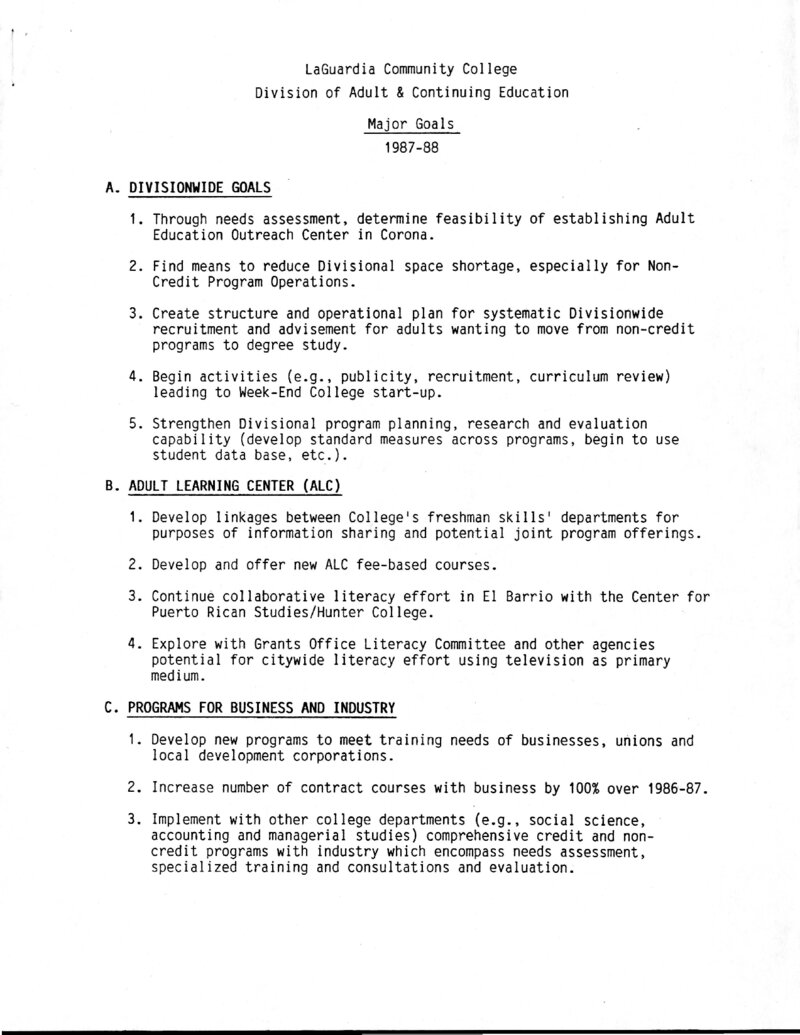
LaGuardia Community College
Division of Adult & Continuing Education
Major Goals
1987-88
A. DIVISIONWIDE GOALS
1.
Through needs assessment, determine feasibility of establishing Adult
Education Outreach Center in Corona.
. Find means to reduce Divisional space shortage, especially for Non-
Credit Program Operations.
Create structure and operational plan for systematic Divisionwide
recruitment and advisement for adults wanting to move from non-credit
programs to degree study.
. Begin activities (e.g., publicity, recruitment, curriculum review)
leading to Week-End College start-up.
Strengthen Divisional program planning, research and evaluation
capability (develop standard measures across programs, begin to use
student data base, etc.).
B. ADULT LEARNING CENTER (ALC)
1.
Develop linkages between College's freshman skills' departments for
purposes of information sharing and potential joint program offerings.
- Develop and offer new ALC fee-based courses.
. Continue collaborative literacy effort in El Barrio with the Center for
Puerto Rican Studies/Hunter College.
- Explore with Grants Office Literacy Committee and other agencies
potential for citywide literacy effort using television as primary
medium.
C. PROGRAMS FOR BUSINESS AND INDUSTRY
1.
2.
3.
Develop new programs to meet training needs of businesses, unions and
local development corporations.
Increase number of contract courses with business by 100% over 1986-87.
Implement with other college departments (e.g., social science,
accounting and managerial studies) comprehensive credit and non-
credit programs with industry which encompass needs assessment,
specialized training and consultations and evaluation.
PROGRAMS FOR BUSINESS AND INDUSTRY (continued)
4.
5.
Offer two "lunchtime samplers" to the International Design Center
(IDC-NY) (e.g., time/stress management, computer applications/
computer assisted design software).
Offer second cycle of Small Business Management Program for Korean
retailers in collaboration with Korean Manpower Development, Inc.
D. COMMUNITY SERVICES PROGRAMS
1. Programs for Deaf Adults
a) Continue to develop and strengthen academic and career related
credit and non-credit curricula and programs for deaf students
(refine GIS levels, revise GED prep courses, integrate computers
into different instructional levels).
b) Continue to enhance counseling, interpreting and tutoring services
for deaf students especially during evening hours.
c) Develop and implement, as feasible, American Sign Language and
Interpreter Training programs.
College for Children
a) Strengthen existing program through more advertising, decreasing
number of course cancellations, enlarging instructor pool and
adding parent orientation workshops.
b) Develop new program options including: more pre-school offerings,
a teen program and activities for special populations (e.g., deaf,
homeless, hospitalized).
c) Increase program outreach to community and study feasibility of
creating weekday "summer camp" for 1988.
Project Enable (Homeless Families)
a) Strengthen program by creating separate components for high school
equivalency, job skills training and off-site career workshops.
b) Initiate job coaching - career mentoring project through support
from New York Community Trust.
c) Begin outreach to Hispanic homeless heads of household through GED,
ESL and Career Preparation classes.
4. JobWard Bound Program
a) Expand training areas to include bank teller and automotive mechanics.
b) Work to regularize program funding and staff lines to be incorporated
into College's annual budget (rather than special legislative
allocation).
-2-
E. ENGLISH LANGUAGE CENTER
1.
a)
b)
c)
d
e
a)
b
rr
a
~~
Freshman English as a Second Language (FESL)
Work to further integrate ESL and English instruction through LESA
cluster.
Continue to experiment with a variety of instructional approaches
including: ESL Express, same teacher teaching same students through
several ESL levels, combining ESL instruction with content course
instruction.
Develop curriculum and instructional approaches which will allow
combining several ESL levels in one class for use at off-campus
sites.
Explore potential for creating alternate learning structure (mini-
college) for ESL students in health-related programs.
Continue professional development activities including: 6th Annual
ESL conference, orientation and quarterly workshops for adjunct
faculty, micro-computer training.
- English as a Second Language - non-credit
Continue curriculum development and revision for intensive levels
(DIP, AIEP, EIP).
Computerize registration and administrative processes for intensive
and non-intensive levels.
Continue to develop advanced workshops in areas of particular
student interest.
Develop new recruitment strategies, especially focused on Asian
communities.
Write and submit grant proposals which combine ESL instruction
with vocational instruction (e.g., word processing, pre-nursing,
food services).
F. EXTENDED DAY
Ts
2.
Continue implementation of Week-End College for September 1988 start-up.
Continue work with departments to develop new schedule patterns (e.g,
6 p.m. class starts, mini-quarters of five and six weeks).
. Work with Natural and Applied Science Department to begin planning
for evening nursing program.
. Work with Cooperative Education Division to develop appropriate COOP/
educational experiences for evening students.
EXTENDED DAY (continued)
5.
Encourage across all College Divisions sufficient level of services
for evening and week-end students.
G. ADULT CAREER COUNSELING & RESOURCE CENTER (ACCRC)
1. Refine career choice seminars and increase number of offerings, especially
2.
3.
4.
for ESL and ABE students at lower levels.
Increase fee-based offerings targetted to resume writing, vocational
testing, college searches for high school students.
Work with Division program units and academic departments to implement
new FIPSE Project Teach, designed to recruit non-traditional populations
to teaching careers.
Increase visibility and service capabilities of ACCRC through recruitment
events, and career information seminars on and off-campus.
H. EXTENSION PROGRAMS
1. Astoria Adult Education Center
a) Continue to increase quality and quantity of course offerings through
ongoing community outreach especially to older adults, various
community organizations and the Steinway library branch.
b) Develop and implement business plan to more fully use Center for
Travel and Tourism, Real Estate courses and Business Uses of the
Computer.
Continue with New York Hospital/Cornell Medical Center monthly work-
shops (e.g., burn prevention, hypertension, breast cancer detection).
lo}
~~
d) Explore potential for joint programs with other agencies with
facilities for classes in dance and aerobics, cooking, woodworking.
. Chinatown Center
a) Increase new Center's visibility through running community
orientations and distribution of new brochure.
b) Continue to pursue funding to support Canal Street Business
Inprovement Project and ESP for the medical professions.
c) Develop new course offerings (e.g., Chinese language, Asian American
Heritage). .
- Woodside at the Bulova School
a) Explore with Bulova staff expansion of offerings in recreation and
computer areas.
-4-
EXTENSION PROGRAMS (continued)
b) Work with Director to clarify direction and scope of joint offerings
and future developments.
4. Solidaridad Humana
Explore options to redesign program including multi-level students
in single sections, expanding bilingual offerings and combining ESL
with content courses.
5. CAMBA
Expand program, which serves refugees from southeast Asia, South and
Central America, to include GED instruction and nurse's aide training.
6. Korean Project
Explore potential of creating credit program off-campus targetted to
Korean community.
I. HEALTH SERVICES PROGRAMS
1. Expand EMT-A training to include refresher courses and Advanced First
Aid bridge program for high school students wanting to become EMT's.
2. Begin offering CPR instructor courses and Emergency Vehicle Operators
courses. (EVOC).
3. Continue COSI Career Ladder Nursing program with new group of 90 pre-
nursing students; evaluate progress and success of students currently
enrolled.
4. Begin planning with Natural and Applied Science Department for offering
of Continuing Education courses for nurses and other health care
professionals.
PROGRAM OPERATIONS
1. Work to standardize Divisional Administrative policies and procedures
including fee discounts, student and faculty evaluation and teacher
pay.
2. In collaboration with Accounting and Managerial Studies Department,
begin Continuing Education certification program for CPA's.
3. Continue to explore with Accounting/Managerial Studies and Computer
Information Systems Departments, feasibility of offering courses for
credit or non-credit. .
4. Expand, within space and equipment constraints, telecommunications,
service engineer and computer courses.
K. SPECIAL POPULATIONS AND PROJECTS
1.
nN
.
w
.
Corrections Education
a) Implement new Vocational Education Services Center for ex-offenders.
b) Implement expanded corrections program on Rikers Island to include
both North and Anna M. Kross facilities.
EastSide Connection
a) Develop more cost effective advertising strategies and evaluate
program effectiveness in terms of enrollment and costs.
b) Expand offerings to include women's literature, art and psychology.
Older Adults
a) Establish LaGuardia Wellness Task Force as initial College response
to needs of Queens older adults for fitness and cardiac conditioning.
b) Develop new offerings/activities including: community newspaper
forum on health needs of older adults, film festival of World War II
films and comedies of depression years.
c) Expand Best of Broadway offerings, Phase II Club activities and
pursue National Endowment for Humanities funding for Older Adult
project.
4. Research and Planning
a) Continue efforts to revive and redéfine the Alternative Degree
Program clarifying for students and faculty alternative ways of
gaining/granting credit.
b) Plan and offer professional development activities and workshops
for Divisional staff.
c) Arrange, as requested, for Divisional staff interaction with inter-
national visitors.
- Taxi Institute
a) Reproduce curriculum and program materials for dissemination to
other cities developing similar programs.
b) Develop and offer transportation-related courses for fleet owners/
drivers, bus drivers and other dispatchers.
-6-
SPECIAL POPULATIONS AND PROJECTS (continued)
6. Travel and Tourism
a) Offer first sequence of non-credit travel courses at Astoria and
EastSide Connection.
b) Work with Accounting/Managerial Studies Department to further refine
credit and non-credit offerings, devise promotional materials and
establish shared fiscal and program responsibilities.
7. Women's Program
a) Continue to expand Office Automation Training Program to include
a management development component for unemployed, underemployed
heads of household.
b) Develop, seek funding, and implement new women's program offerings
(e.g., financial success, parenting, new careers).
| c) Offer 4th Annual Third World Women's Conference, "Lifting As We
| Climb: An Intergenerational Dialogue."
|
| 8. Veteran's Program
|
a) Integrate computer and videotape instruction in reading, writing
and math.
b) Strengthen outreach efforts to Veterans Associations, other Upward
Bound projects and the Veteran's Administration.
Division of Adult & Continuing Education
Major Goals
1987-88
A. DIVISIONWIDE GOALS
1.
Through needs assessment, determine feasibility of establishing Adult
Education Outreach Center in Corona.
. Find means to reduce Divisional space shortage, especially for Non-
Credit Program Operations.
Create structure and operational plan for systematic Divisionwide
recruitment and advisement for adults wanting to move from non-credit
programs to degree study.
. Begin activities (e.g., publicity, recruitment, curriculum review)
leading to Week-End College start-up.
Strengthen Divisional program planning, research and evaluation
capability (develop standard measures across programs, begin to use
student data base, etc.).
B. ADULT LEARNING CENTER (ALC)
1.
Develop linkages between College's freshman skills' departments for
purposes of information sharing and potential joint program offerings.
- Develop and offer new ALC fee-based courses.
. Continue collaborative literacy effort in El Barrio with the Center for
Puerto Rican Studies/Hunter College.
- Explore with Grants Office Literacy Committee and other agencies
potential for citywide literacy effort using television as primary
medium.
C. PROGRAMS FOR BUSINESS AND INDUSTRY
1.
2.
3.
Develop new programs to meet training needs of businesses, unions and
local development corporations.
Increase number of contract courses with business by 100% over 1986-87.
Implement with other college departments (e.g., social science,
accounting and managerial studies) comprehensive credit and non-
credit programs with industry which encompass needs assessment,
specialized training and consultations and evaluation.
PROGRAMS FOR BUSINESS AND INDUSTRY (continued)
4.
5.
Offer two "lunchtime samplers" to the International Design Center
(IDC-NY) (e.g., time/stress management, computer applications/
computer assisted design software).
Offer second cycle of Small Business Management Program for Korean
retailers in collaboration with Korean Manpower Development, Inc.
D. COMMUNITY SERVICES PROGRAMS
1. Programs for Deaf Adults
a) Continue to develop and strengthen academic and career related
credit and non-credit curricula and programs for deaf students
(refine GIS levels, revise GED prep courses, integrate computers
into different instructional levels).
b) Continue to enhance counseling, interpreting and tutoring services
for deaf students especially during evening hours.
c) Develop and implement, as feasible, American Sign Language and
Interpreter Training programs.
College for Children
a) Strengthen existing program through more advertising, decreasing
number of course cancellations, enlarging instructor pool and
adding parent orientation workshops.
b) Develop new program options including: more pre-school offerings,
a teen program and activities for special populations (e.g., deaf,
homeless, hospitalized).
c) Increase program outreach to community and study feasibility of
creating weekday "summer camp" for 1988.
Project Enable (Homeless Families)
a) Strengthen program by creating separate components for high school
equivalency, job skills training and off-site career workshops.
b) Initiate job coaching - career mentoring project through support
from New York Community Trust.
c) Begin outreach to Hispanic homeless heads of household through GED,
ESL and Career Preparation classes.
4. JobWard Bound Program
a) Expand training areas to include bank teller and automotive mechanics.
b) Work to regularize program funding and staff lines to be incorporated
into College's annual budget (rather than special legislative
allocation).
-2-
E. ENGLISH LANGUAGE CENTER
1.
a)
b)
c)
d
e
a)
b
rr
a
~~
Freshman English as a Second Language (FESL)
Work to further integrate ESL and English instruction through LESA
cluster.
Continue to experiment with a variety of instructional approaches
including: ESL Express, same teacher teaching same students through
several ESL levels, combining ESL instruction with content course
instruction.
Develop curriculum and instructional approaches which will allow
combining several ESL levels in one class for use at off-campus
sites.
Explore potential for creating alternate learning structure (mini-
college) for ESL students in health-related programs.
Continue professional development activities including: 6th Annual
ESL conference, orientation and quarterly workshops for adjunct
faculty, micro-computer training.
- English as a Second Language - non-credit
Continue curriculum development and revision for intensive levels
(DIP, AIEP, EIP).
Computerize registration and administrative processes for intensive
and non-intensive levels.
Continue to develop advanced workshops in areas of particular
student interest.
Develop new recruitment strategies, especially focused on Asian
communities.
Write and submit grant proposals which combine ESL instruction
with vocational instruction (e.g., word processing, pre-nursing,
food services).
F. EXTENDED DAY
Ts
2.
Continue implementation of Week-End College for September 1988 start-up.
Continue work with departments to develop new schedule patterns (e.g,
6 p.m. class starts, mini-quarters of five and six weeks).
. Work with Natural and Applied Science Department to begin planning
for evening nursing program.
. Work with Cooperative Education Division to develop appropriate COOP/
educational experiences for evening students.
EXTENDED DAY (continued)
5.
Encourage across all College Divisions sufficient level of services
for evening and week-end students.
G. ADULT CAREER COUNSELING & RESOURCE CENTER (ACCRC)
1. Refine career choice seminars and increase number of offerings, especially
2.
3.
4.
for ESL and ABE students at lower levels.
Increase fee-based offerings targetted to resume writing, vocational
testing, college searches for high school students.
Work with Division program units and academic departments to implement
new FIPSE Project Teach, designed to recruit non-traditional populations
to teaching careers.
Increase visibility and service capabilities of ACCRC through recruitment
events, and career information seminars on and off-campus.
H. EXTENSION PROGRAMS
1. Astoria Adult Education Center
a) Continue to increase quality and quantity of course offerings through
ongoing community outreach especially to older adults, various
community organizations and the Steinway library branch.
b) Develop and implement business plan to more fully use Center for
Travel and Tourism, Real Estate courses and Business Uses of the
Computer.
Continue with New York Hospital/Cornell Medical Center monthly work-
shops (e.g., burn prevention, hypertension, breast cancer detection).
lo}
~~
d) Explore potential for joint programs with other agencies with
facilities for classes in dance and aerobics, cooking, woodworking.
. Chinatown Center
a) Increase new Center's visibility through running community
orientations and distribution of new brochure.
b) Continue to pursue funding to support Canal Street Business
Inprovement Project and ESP for the medical professions.
c) Develop new course offerings (e.g., Chinese language, Asian American
Heritage). .
- Woodside at the Bulova School
a) Explore with Bulova staff expansion of offerings in recreation and
computer areas.
-4-
EXTENSION PROGRAMS (continued)
b) Work with Director to clarify direction and scope of joint offerings
and future developments.
4. Solidaridad Humana
Explore options to redesign program including multi-level students
in single sections, expanding bilingual offerings and combining ESL
with content courses.
5. CAMBA
Expand program, which serves refugees from southeast Asia, South and
Central America, to include GED instruction and nurse's aide training.
6. Korean Project
Explore potential of creating credit program off-campus targetted to
Korean community.
I. HEALTH SERVICES PROGRAMS
1. Expand EMT-A training to include refresher courses and Advanced First
Aid bridge program for high school students wanting to become EMT's.
2. Begin offering CPR instructor courses and Emergency Vehicle Operators
courses. (EVOC).
3. Continue COSI Career Ladder Nursing program with new group of 90 pre-
nursing students; evaluate progress and success of students currently
enrolled.
4. Begin planning with Natural and Applied Science Department for offering
of Continuing Education courses for nurses and other health care
professionals.
PROGRAM OPERATIONS
1. Work to standardize Divisional Administrative policies and procedures
including fee discounts, student and faculty evaluation and teacher
pay.
2. In collaboration with Accounting and Managerial Studies Department,
begin Continuing Education certification program for CPA's.
3. Continue to explore with Accounting/Managerial Studies and Computer
Information Systems Departments, feasibility of offering courses for
credit or non-credit. .
4. Expand, within space and equipment constraints, telecommunications,
service engineer and computer courses.
K. SPECIAL POPULATIONS AND PROJECTS
1.
nN
.
w
.
Corrections Education
a) Implement new Vocational Education Services Center for ex-offenders.
b) Implement expanded corrections program on Rikers Island to include
both North and Anna M. Kross facilities.
EastSide Connection
a) Develop more cost effective advertising strategies and evaluate
program effectiveness in terms of enrollment and costs.
b) Expand offerings to include women's literature, art and psychology.
Older Adults
a) Establish LaGuardia Wellness Task Force as initial College response
to needs of Queens older adults for fitness and cardiac conditioning.
b) Develop new offerings/activities including: community newspaper
forum on health needs of older adults, film festival of World War II
films and comedies of depression years.
c) Expand Best of Broadway offerings, Phase II Club activities and
pursue National Endowment for Humanities funding for Older Adult
project.
4. Research and Planning
a) Continue efforts to revive and redéfine the Alternative Degree
Program clarifying for students and faculty alternative ways of
gaining/granting credit.
b) Plan and offer professional development activities and workshops
for Divisional staff.
c) Arrange, as requested, for Divisional staff interaction with inter-
national visitors.
- Taxi Institute
a) Reproduce curriculum and program materials for dissemination to
other cities developing similar programs.
b) Develop and offer transportation-related courses for fleet owners/
drivers, bus drivers and other dispatchers.
-6-
SPECIAL POPULATIONS AND PROJECTS (continued)
6. Travel and Tourism
a) Offer first sequence of non-credit travel courses at Astoria and
EastSide Connection.
b) Work with Accounting/Managerial Studies Department to further refine
credit and non-credit offerings, devise promotional materials and
establish shared fiscal and program responsibilities.
7. Women's Program
a) Continue to expand Office Automation Training Program to include
a management development component for unemployed, underemployed
heads of household.
b) Develop, seek funding, and implement new women's program offerings
(e.g., financial success, parenting, new careers).
| c) Offer 4th Annual Third World Women's Conference, "Lifting As We
| Climb: An Intergenerational Dialogue."
|
| 8. Veteran's Program
|
a) Integrate computer and videotape instruction in reading, writing
and math.
b) Strengthen outreach efforts to Veterans Associations, other Upward
Bound projects and the Veteran's Administration.
Title
"Major Goals, 1987-88"
Description
This 1987-8 report lists the "major goals" of LaGuardia Community College's Division of Adult & Continuing Education. Outlining each of the components within the division, the report highlights the many initiatives of the college, particularly emphasizing the diverse students served via the school's continuing education programs. From its earliest years, LaGuardia committed itself to offering educational opportunities to underserved populations in western Queens.
Contributor
Khan, Fern
Creator
Division of Adult & Continuing Education
Date
1988
Language
English
Relation
2882
3002
Rights
Obtained from Contributor - Copyright Unknown
Source
Khan, Fern
Original Format
Report / Paper / Proposal
Division of Adult & Continuing Education. Letter. 1987. “‘Major Goals, 1987-88’”. 2882, 1987, CUNY DIGITAL HISTORY ARCHIVE, accessed September 5, 2026, https://stephenz.tailc22a4b.ts.net/s/cdha/item/365