Handbook for Teachers of Deaf/Hard-Of-Hearing Students
Item
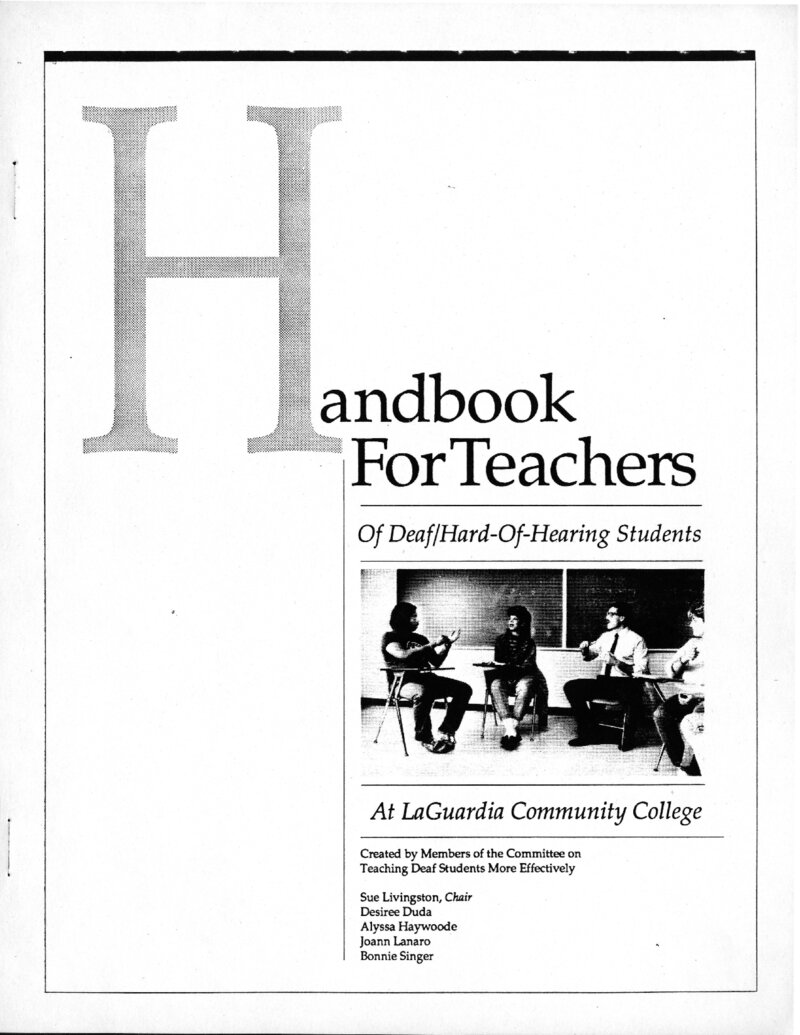
For Teachers
Of Deaf/Hard-Of-Hearing Students
F
At LaGuardia Community College
Created by Members of the Committee on
Teaching Deaf Students More Effectively
Sue Livingston, Chair
Desiree Duda
Alyssa Haywoode
Joann Lanaro
Bonnie Singer
ACKNOWLEDGEMENTS
A special word of thanks to Professor
Jonathan Clymer who graciously agreed to
photograph the students who appear on the cover of
this handbook and to Professor Joann Lanaro and
Ms. Jasmat Persaud who most expertly typed it.
Fiorello H. LaGuardia Community College THE CITY UNIVERSITY OF NEW YORK
31-10 THOMSON AVENUE, LONG ISLAND CITY, N.Y. 11101 « Telephone (718) 482-7200
Dear Colleagues,
You have in your possession a practical and unique guide
which if followed closely, will enable you to work effectively
with deaf and hard-of-hearing students. The suggestions and
answers to many questions are culled from two important sources:
1) experiences of instructors and 2) experiences of deaf
students as learners.
Whether your concerns are related to the use and function of
an interpreter, using lip reading to communicate, helpful
teaching strategies or American Sign Language, this handbook will
provide helpful insights and answers. The section on Helping
Students to Become Active Learners in particular should be shared
with all teachers regardless of whether their students are deaf
or hearing.
I wish to thank Professor Sue Livingston and her colleagues,
Bonnie Singer, Alyssa Haywoode, Desiree Duda, and Joann Lanaro,
who worked on this project.
Sincerely,
Fern J. Khan, Associate Dean
Adult and Continuing Education
DL.
III.
Iv.
TABLE OF CONTENTS
TNETORUSCION: sie Siac cack ecb eatonsueseseeeees
Special Considerations ....cccccccccccce
The Interpreting Situation ........2ee0-%
Tips for Communicating ...cceccccccscccce
Helping Students Become Active Learners
Page
10
16
19
INTRODUCTION
This handbook has been prepared for the LaGuardia Community
College instructor who has a deaf or hard-of-hearing student in
his/her class. We hope to present some helpful suggestions and
answers to many questions about how to manage this unique
educational situation. In this book, you will learn about the
special attention that should be given to deaf and hard-of-
hearing students, the interpreting situation, general pedagogical
considerations, and basic communication strategies between deaf
and hearing people.
The most important thing to remember when working with deaf
students is that they are students before they are "deaf or hard-
of-hearing." They come to LaGuardia for the same reasons as
others do, to learn. They have the same ranges of intelligence,
motivation and scholastic skills. Hearing losses do not affect
the mind, only the auditory canal.
The term "deafness" can be more precisely defined by an
individual's hearing level. "Deaf" refers to a severe or
profound hearing loss where all speech frequencies are inaudible.
The term "hard- of-hearing" refers to a mild or moderate hearing
loss. A student may be able to distinguish certain speech
frequencies and is most likely to be helped by a hearing aid.
Depending upon the hearing level and sign language abilities of
the deaf or hard-of-hearing student, he/she will be provided with
an oral interpreter (mouths what an instructor says) or a sign
language interpreter (uses American Sign Language--ASL) to
translate what the instructor says.
Equally significant as a student's level of hearing, is the
age of onset of this loss. Those who are born deaf or suffer a
hearing loss at an early age (especially in the pre-lingual
stage) evidence the most severe disability because they have
never heard spoken English. Their impairments generally extend
beyond hearing to the reading and writing of English. These
students will most likely have not acquired English as their
first language. Those students who lost their hearing later in
life, most likely have already acquired English as a first
language because they have had access to sound and English at an
early age.
Deaf students who use sign language to communicate fall
within a continuum ranging from American Sign Language
(a visual-gestural language with its own vocabulary and syntax)
Signed English (signs using English syntax).
American Sign Language Continuum
ASL MORE ASL-LIKE MORE ENGLISH-LIKE SIGNED ENGLISH
The language used by the deaf or hard-of-hearing LaGuardia
student typifies all aspects of this continuum from strong ASL
Page 2
users to Signed English users. Some students may not even use
sign language and therefore may not even socialize with other
deaf persons in their personal lives.
The student's success in acquiring English skills is
dependent upon many factors, but basically, the student who has
had an early hearing loss and lacks early exposure to English
will have a more difficult time communicating in English. Such
students do not acquire linguistic competence in any language
until formal instruction begins in school.
Unfortunately, there are many myths about deafness that may
distort our views of deaf or hard-of-hearing students. The
following is a list of some of the fallacies which many people
still believe to be true:
Deaf persons know braille
Sign Language is universal
Deaf people do not have voice boxes or vocal chords
Deaf people have intellectual, social or other physical
defects
*» All deaf people can lip-read
Shouting helps a deaf person to hear
Deaf people can't drive
Deafness is equated with the term "Deaf and Dumb"
Such attitudes may be innocent, originating from fears,
guilt, and inexperience with deaf or hard-of-hearing persons. As
a form of prejudice, they can not only reduce your expectations
of a student's performance but often result in the humiliation,
alienation, and complete withdrawal of a student. These
attitudes can be more disabling than any hearing loss.
Page 3
Worth noting, is that there are many successful deaf adults
who have contributed greatly to our society. Among them are
famous writers, artists, lawyers, scientists, educators,
playwrights, and authors; not to mention Gallaudet University's
new President and Emmy and Academy Award winning actresses.
There is no doubt that as an instructor you will be
challenged by the presence of a deaf or hard-of-hearing student
in your class. In some cases, you may find that changes in your
habits will be necessary to reach these students. Please bear in
mind that they are eager to learn, and with your help can become
valuable members of the community.
If you have any questions, the faculty and professional
staff of the Programs for Deaf Adults (PDA) (Center III building,
7th floor) are available to discuss any questions you may have.
Please call the general number (ext. 5320) and ask to speak to
either the Director, Counselor, Coordinator of Interpreting
Services, or the Academic Coordinator.
Page 4
SPECIAL CONSIDERATIONS IN TEACHING DEAF STUDENTS
It is indeed a unique opportunity to teach a deaf student.
This uniqueness, however, presupposes certain accommodations
which need to be made if teaching and learning are to be as
effective as possible for deaf students. Many of the suggestions
for accommodations which follow have stemmed from deaf students
who have attended committee meetings during the last year and a
half and represent real concerns that they felt needed to be
addressed. Other suggestions have originated with faculty
members who have had deaf students in their classes and who have
seen problems that needed attention. As such, they represent the
uniqueness of this teaching experience and the results of the
thinking of our committee members.
(I) If students must watch an interpreter, how do they take
notes? ,
Although there are deaf adults skilled at taking notes as
they watch an interpreter, the majority find it difficult at
best. The chance of losing information during the head bobbing
that occurs between pad and interpreter is far too great for
students unskilled at the process as well as unfamiliar with the
content of what is being discussed. Using a notetaker allows
deaf students to focus their full attention on both the
interpreter and the instructor. Considering how important good
notes are, committee members suggested that during the first week
of classes, deaf students approach their professors to request
Page 5
that they select a student who they feel is qualified to take
clear and complete notes. Deaf students will either provide the
notetaker with carbon paper or will ask to duplicate notes taken.
The key concern here is that the notetaker be competent, and it
was the feeling of the committee that this can best be judged by
the professors soon after classes begin.
(II) Do deaf students need more time to complete in-class
writing assignments?
Simply put, yes! As inexperienced readers and writers, most
deaf students require additional time to express themselves in
written English. In Basic Reading and English classes deaf
students are allotted double time to complete in-class
assignments and tests and it was the committee's suggestion to
maintain this necessary accommodation in other classes as well.
(If you need to arrange for a room and a proctor to oversee the
students’ as they complete their work, contact Sue Livingston at
5621 or 5625.)
(III) What other special considerations are advisable when deaf
students take final exams or give oral presentations?
Many times deaf students possess the requisite information
to successfully complete exams but are stymied by the questions
used to elicit this information. In situations where deaf
students are puzzled by what is being asked, we suggest that the
class interpreter be allowed to interpret the examination
questions for the students.
Page 6
Also, there might be times when deaf students need to
present a report or essay orally to their classmates. In these
situations deaf students might wish to use a special interpreter-
-one that they feel knows their signing style more intimately
than others and can thereby provide a smoother, more accurate
interpretation. We suggest that for these times the students be
allowed to make their presentations on a day that their preferred
interpreter is available.
(IV) Does it matter where deaf students sit?
Deaf students will most often sit in the front row off to a
side directly facing their interpreter. It is suggested,
however, that in classes where a large percentage of work is
written on the blackboard, that the interpreter, the student, the
instructor and the area where writing is being done on the board
be in the same line of sight so that students can look up and see
signs and writing in one glance as opposed to head-bobbing from
side to side to catch signs and writing together.
(V) Are deaf students provided with special services other than
interpreters and notetakers?
Yes. Deaf students at LaGuardia are fortunate to have
special sections of CSE 098/099 (Basic Reading) and ENX 098/099
exclusively geared for their needs. Classes are limited to deaf
students and an experienced educator of deaf students teaches
both classes. In addition, deaf students are offered special
tutoring by tutors who are competent both in sign and in the
content area in need of assistance. It is strongly suggested
Page 7
that faculty members encourage deaf students to make use of the
tutoring services available to them. Perhaps encourage is too
mild a word here. What we feel are needed are additional
assignments that supplement class instruction for those students
who are having difficulty keeping up. Although creating these
assignments and monitoring them mean more work for you, in the
end it will mean a more successful experience for the deaf
students in your class.
(VI) How do deaf students follow discussions that move quickly
or students who may sometimes talk at the same time?
Although most interpreters can keep up with the quick pace
of conversation, when they can't, they will interrupt and request
that the discussion be slowed down a bit. When students speak at
the same time, however, it becomes impossible for the interpreter
to interpret what both students are saying and therefore
imperative that only one student speak at a time.
(VII) How shall I best communicate with deaf students?
Some faculty members have said that, when possible, they
prefer to communicate directly to deaf students without the use
af an interpreter (perhaps with a student who has some residual
hearing or is a proficient lipreader) as a way of truly gauging a
student's strengths and weaknesses in communicating. Although
there is nothing wrong with this we caution that you check what
the student has understood from the conversation by perhaps
having him briefly repeat the important aspects of what was
Page 8
covered. We have found that too often some deaf students say yes
when asked if they understood something when in fact they became
confused way at the beginning of the conversation. If you choose
to use an interpreter for a conversation between your deaf
students and you, look directly at the student when you talk and
not the interpreter. Avoid asking the interpreter to ask the
student a question ("Ask her/him")--instead ask the question
directly to the student yourself.
(VIII) If I am planning a special trip with my class, will the
interpreter come as well?
When special trips are planned, it is best to contact the
Coordinator of Interpreter Services to arrange for an interpreter
to accompany you. Most interpreters who work at LaGuardia work
several classes back-to-back and therefore will miss a scheduled
class if they are "off campus."
(IX) How might I go about getting background information on a
deaf stuaent e.g., when did the hearing loss occur and what is
its extent?
Questions of this nature can usually be answered by the
counselors in the Programs for Deaf Adults who work intimately
with all deaf students on campus.
Page 9
THE INTERPRETING SITUATION
What is an Interpreter?
An interpreter is a professional who facilitates
communication from one or more individuals who share a common
language to one or more individuals who share a different common
language. A Sign Language interpreter performs this task between
the hearing English-speaking community and the signing (and oral)
deaf or hard-of-hearing community. Since deaf or hard-of-hearing
students may communicate in different ways, the interpreter will
interpret in the mode used by that student.
Teaching is a process. When you are teaching a deaf a
hard-of-hearing student, the interpreter is an important part of
that process. Together with the interpreter and the student you
become an educational team in the classroom. By working together
closely, the team can manage the teaching process effectively.
What are some tips to help each member of the educational team
function most effectively?
Classroom Management
If a student needs an interpreter for class, (s)he should
request one at registration through Interpreter Services. It is
the student's responsibility to meet with the interpreter before
class to discuss technical vocabulary and the signs used. While
in class, the student is responsible for all the material and
Page 10
assignments required for the class. However, if a student is
late or misses a class, the interpreter is not responsible for
supplying the missed information.
The interpreter is responsible to attend every class (s)he
is scheduled for. If (s)he is unable to go to class, the
interpreter will inform the Coordinator of Interpreter Services
as soon as possible. A substitute interpreter will be assigned
if one is available. The interpreter will wait twenty minutes
for the student to arrive (or thirty minutes if the class is
longer than seventy minutes) and then call the Coordinator of
Interpreter Services for re-assignment. The interpreter will
become familiar with the vocabulary so (s)he can interpret
correctly. Any problems that may happen in an interpreting
situation should first be discussed among the student(s),
instructor and interpreter. Contact the Coordinator of
Interpreter Services if the problem can't be resolved.
The instructor should handle any problem that happens in the
classroom i.e., a deaf or hard-of-hearing student's disruption
(talking or signing) during the lecture. The instructor should
not rely on the interpreter for teaching the content material,
introducing new vocabulary and explaining difficult concepts.
Interpreters are not teacher aides. The instructor is
responsible for monitoring students during tests. If (s)he steps
out of the room, the interpreter is only responsible for
Page 11
facilitating communication and not supervising students. If
handouts will be discussed during class, try to make one
available for the interpreter to refer to.
Seating and Lighting
The student should find a seat that is a comfortable
distance from the interpreter. (S)he should be seated where
(s)he can easily see the blackboard, the teacher and the
interpreter. It is both the student's and interpreter's
responsibility to take care of any special seating arrangements.
The interpreter should sit where there is sufficient light,
no glare from the window and no other "visual noise"
(environmental noise from the hall, adjoining classrooms or
offices) to interfere with communication. This will enable
him/her to see and hear all the information that is communicated,
including input from other students in the classroom.
The instructor should let the interpreter know what the
class format will be; i.e. movies, presentations, discussions,
room changes, etc. If a movie will be shown, ask Media Services
to bring a light for the interpreter along with the other
equipment. Try not to walk in front of the interpreter and block
the student's view.
Communication
The student should sign and fingerspell clearly so the
interpreter can easily understand him/her. If the student
doesn't understand the subject matter, it is his/her
responsibility to ask the instructor, NOT the interpreter. (S)he
Page 12
may ask the instructor or other students to slow down or speak
louder if the interpreter is having difficulty hearing or
understanding the speaker.
The interpreter will interpret everything that is spoken or
heard in the classroom including private conversations if they
are audible. (S)he will not tutor, edit or alter conversations,
express his/her opinion, participate in discussions, answer
questions for students or instructors, or have his/her own
conversation with instructors or students during the interpreting
process. The interpreter may ask the instructor or students to
slow down or speak louder if (s)he can't hear or understand the
speaker.
The interpreter is a knowledgeable professional who can be
helpful on matters relating to the interpreting process, but
(s)he won't mind being ignored on a personal level. It's a
tribute to his/her skill if you forget (s)he is there.
The instructor should speak directly to the student in a
natural way. Do not speak slowly or with exaggerated mouth
movements. Address the student directly; do not say to the
interpreter "Tell him/her...." Try not to engage the interpreter
in conversation during class; you can always have a private chat
before or afterwards. If reading directly from a text or notes,
try to speak slowly; we all have a tendency to speak at a more
rapid pace when reading. If you want to let the student
participate, observe the interpreter to see when the appropriate
Page 13
time is to solicit student input. If the student doesn't
understand, try rewording the question. In a group discussion,
encourage your students to speak one at a time. It's difficult
for anyone to hear more than one speaker at a time. When other
students speak or ask questions, indicate who is talking by
saying his/her name; this way the interpreter can indicate to the
deaf/hard-of-hearing student who the speaker is.
Where can I go for additional help?
If you have a question, problem or need more information
regarding your interpreting situation you can contact the
Coordinator of Interpreter Services in Room C-731, Center 3
Building. The Coordinator is responsible for scheduling
interpreters for LaGuardia classes, special events and other
related activities.
If you want to speak to the student after class and would
like the interpreter to stay, ask the interpreter if this is
possible ((S)he may have another interpreting assignment.). If
it is not, an interpreter can be provided for a separate meeting
with the student. Sufficient notice (generally one week) is
necessary in order to schedule an interpreter.
If it is not possible to schedule an interpreter for your
class, here are some accommodations that can be made:
The deaf/hard of hearing student(s) should sit in an
accessible location.
The instructor should speak more slowly or write important
information on the board.
Other students should speak one at a time.
Page 14
If the student feels (s)he cannot benefit from the class without
an interpreter, (s)he and/or the instructor must make a decision
regarding how to handle the "absence."
Page 15
TIPS FOR COMMUNICATING
Listed below are some classroom suggestions that have been
used by experienced teachers of deaf and hard-of-hearing
students. This section is divided into two parts: tips for
communicating with deaf and hard-of-hearing students on a one-to-
one basis and tips for communicating with deaf and hard-of-
hearing students in the classroom.
Communicating on a One-to-One Basis
You can communicate with a deaf/hard-of-hearing student in
several ways. Some students use speech only, or a combination of
sign language, fingerspelling and speech. You can use speech
only, writing or you can enlist the aid of an interpreter. The
key is to find out which combination of techniques works best
with the student. Keep in mind it is not HOW you exchange ideas
but that’ you DO.
When using writing as a form of communication with a
student, take the following points into consideration:
1. Keep your message short and simple. Establish the
subject area, avoid assumptions, and make your sentences
clear and concise.
2. It is not necessary to write out every word. Short
phrases or a few words often are sufficient to transfer the
information.
a3 Do not use yes or no questions. Open-ended questions
ensure a response that allows you to see if your message was
received correctly. For example, avoid saying, "Did you
understand the paragraph?" It would be better to say, "Tell
me what this paragraph means."
Page 16
4. Face the student after your have written your message.
If you can see each other's facial expressions,
communication will be easier and more accurate.
5. Use visual representations if you are explaining
specific or technical vocabulary to a deaf/hard-of-hearing
student. Diagrams, e.g., help the student comprehend the
information.
Communicating in a Classroom Situation
Provide difficult or technical vocabulary in advance, if
possible. It is difficult, if not impossible to lipread and read
the fingerspelling of unfamiliar vocabulary. If new vocabulary
cannot be presented in advance, write the terms on paper, a
chalkboard, or an overhead projector. If a lecture is to be
given or a film shown, a brief outline or script given to the
student in advance helps in following the presentation.
If the student is lipreading, avoid unnecessary pacing and
speaking when writing on a chalkboard. It is difficult to
lipread a person in motion, and impossible to lipread one whose
back is ‘turned. “When using the blackboard, write on the board
then face the groups and explain the work. If you use an
overhead projector, do not look down at the projector while
speaking.
In question-and-answer periods, the student may raise
his/her hand and sign the question to the interpreter. The
interpreter will verbalize the question to the instructor and the
class, and then sign the response back to the student. Be sure
to allow time for this to occur.
Page 17
Please keep the following point in mind when having a
deaf/hard-of-hearing student read in class. Since the student is
looking down and reading, he/she cannot hear you when you resume
your lecture or give special instructions. The student cannot
receive any information while reading from a textbook or a
computer screen. Hence, the instructor should signal the student
when he/she resumes his/her lecture.
Review the student's progress as frequently as possible and
direct the student to the necessary support services he or she
may need to pass the course. If you need to know what services
are available, please call the Program for Deaf Adults Counselor.
Page 18
HELPING STUDENTS BECOME ACTIVE LEARNERS
Introduction
Incorporating a deaf student into a hearing classroom does
not involve an extensive modification of teaching style, but
rather an awareness of how to help such students perform well
within the existing class structure. While this section suggests
ways to enhance the learning process of deaf and hard-of-hearing
students, the suggestions described below are equally useful in
helping hearing students to become better learners.
I. Setting the stage
Providing the students with a focus or orientation for each
lecture can improve student performance by helping them to
anticipate and target/recognize key concepts during the lecture.
Directing students attention to relevant material can be
facilitated by:
1. Beginning each class with a brief overview of the
day's lesson
2. Providing a brief summary of the previous class and
its relationship to the present lecture. This can
help student put the lesson in context and may
correct misunderstandings.
3. Posing specific questions at the beginning of the
class, and instructing students to listen for the
answers during the lecture.
II. Presentation
Deaf and hard-of-hearing students can benefit from visual
reinforcement of lecture content. Use of the following can
Page 19
provide a visual dimension to the classroom work:
1. An overhead projector
2. A list of key concepts and vocabulary on the chalkboard
which can be referred to during the lecture
3. A follow along outline of the lecture which students can
fill in as the class proceeds
4. When possible link course material to information
students may already know. The more students can relate
what they are learning to what they already know, the better
they will remember the material.
5. Listing important information, such as assignments or
schedule changes, on the blackboard will help to insure that
students are informed. You may also want to develop a means
of notifying the student of class cancellations, so that
he/she can inform interpreter services.
III. Be Specific
Students often perform below their ability because they do
not clearly understand what they are expected to do.
1. Indicate clearly, concretely and specifically what you
are looking for on exams, term papers, and homework
assignments (i.e., spelling counts).
2. Use specific examples. For example, instead of saying
"Notice how Fitzgerald uses symbolism in this story," point
out the specific details, "Notice how Fitzgerald uses the
automobile as a symbol of recklessness in the lives of the
wealthy." Or "Watch how the acid turns the blue litmus
paper red" rather than "Watch this chemical reaction."
3. Providing frequent oral and written feedback can help
students to understand and improve incorrect assignments,
perceptions and working habits, in addition to providing
them with the motivation to do better.
4. When a student gives a puzzled look or halting reply to
a question it may help to rephrase the question in more
direct terms.
Page 20
Iv.
Examinations and study guides
1. Review old examinations with students
2. Consider allowing partial credit on tests and
assignments, or using partial knowledge demonstrated on a
test as a springboard to help students improve in weak areas.
3. Ask clear specific questions on examinations. Complexly
phrased questions can confuse students and prevent them from
responding to the best of their ability.
4. When student performance on essay examinations is
consistently poor, an oral (signed) examination or interview
about course material may be more useful in assessing a
student's knowledge.
Page 21
Of Deaf/Hard-Of-Hearing Students
F
At LaGuardia Community College
Created by Members of the Committee on
Teaching Deaf Students More Effectively
Sue Livingston, Chair
Desiree Duda
Alyssa Haywoode
Joann Lanaro
Bonnie Singer
ACKNOWLEDGEMENTS
A special word of thanks to Professor
Jonathan Clymer who graciously agreed to
photograph the students who appear on the cover of
this handbook and to Professor Joann Lanaro and
Ms. Jasmat Persaud who most expertly typed it.
Fiorello H. LaGuardia Community College THE CITY UNIVERSITY OF NEW YORK
31-10 THOMSON AVENUE, LONG ISLAND CITY, N.Y. 11101 « Telephone (718) 482-7200
Dear Colleagues,
You have in your possession a practical and unique guide
which if followed closely, will enable you to work effectively
with deaf and hard-of-hearing students. The suggestions and
answers to many questions are culled from two important sources:
1) experiences of instructors and 2) experiences of deaf
students as learners.
Whether your concerns are related to the use and function of
an interpreter, using lip reading to communicate, helpful
teaching strategies or American Sign Language, this handbook will
provide helpful insights and answers. The section on Helping
Students to Become Active Learners in particular should be shared
with all teachers regardless of whether their students are deaf
or hearing.
I wish to thank Professor Sue Livingston and her colleagues,
Bonnie Singer, Alyssa Haywoode, Desiree Duda, and Joann Lanaro,
who worked on this project.
Sincerely,
Fern J. Khan, Associate Dean
Adult and Continuing Education
DL.
III.
Iv.
TABLE OF CONTENTS
TNETORUSCION: sie Siac cack ecb eatonsueseseeeees
Special Considerations ....cccccccccccce
The Interpreting Situation ........2ee0-%
Tips for Communicating ...cceccccccscccce
Helping Students Become Active Learners
Page
10
16
19
INTRODUCTION
This handbook has been prepared for the LaGuardia Community
College instructor who has a deaf or hard-of-hearing student in
his/her class. We hope to present some helpful suggestions and
answers to many questions about how to manage this unique
educational situation. In this book, you will learn about the
special attention that should be given to deaf and hard-of-
hearing students, the interpreting situation, general pedagogical
considerations, and basic communication strategies between deaf
and hearing people.
The most important thing to remember when working with deaf
students is that they are students before they are "deaf or hard-
of-hearing." They come to LaGuardia for the same reasons as
others do, to learn. They have the same ranges of intelligence,
motivation and scholastic skills. Hearing losses do not affect
the mind, only the auditory canal.
The term "deafness" can be more precisely defined by an
individual's hearing level. "Deaf" refers to a severe or
profound hearing loss where all speech frequencies are inaudible.
The term "hard- of-hearing" refers to a mild or moderate hearing
loss. A student may be able to distinguish certain speech
frequencies and is most likely to be helped by a hearing aid.
Depending upon the hearing level and sign language abilities of
the deaf or hard-of-hearing student, he/she will be provided with
an oral interpreter (mouths what an instructor says) or a sign
language interpreter (uses American Sign Language--ASL) to
translate what the instructor says.
Equally significant as a student's level of hearing, is the
age of onset of this loss. Those who are born deaf or suffer a
hearing loss at an early age (especially in the pre-lingual
stage) evidence the most severe disability because they have
never heard spoken English. Their impairments generally extend
beyond hearing to the reading and writing of English. These
students will most likely have not acquired English as their
first language. Those students who lost their hearing later in
life, most likely have already acquired English as a first
language because they have had access to sound and English at an
early age.
Deaf students who use sign language to communicate fall
within a continuum ranging from American Sign Language
(a visual-gestural language with its own vocabulary and syntax)
Signed English (signs using English syntax).
American Sign Language Continuum
ASL MORE ASL-LIKE MORE ENGLISH-LIKE SIGNED ENGLISH
The language used by the deaf or hard-of-hearing LaGuardia
student typifies all aspects of this continuum from strong ASL
Page 2
users to Signed English users. Some students may not even use
sign language and therefore may not even socialize with other
deaf persons in their personal lives.
The student's success in acquiring English skills is
dependent upon many factors, but basically, the student who has
had an early hearing loss and lacks early exposure to English
will have a more difficult time communicating in English. Such
students do not acquire linguistic competence in any language
until formal instruction begins in school.
Unfortunately, there are many myths about deafness that may
distort our views of deaf or hard-of-hearing students. The
following is a list of some of the fallacies which many people
still believe to be true:
Deaf persons know braille
Sign Language is universal
Deaf people do not have voice boxes or vocal chords
Deaf people have intellectual, social or other physical
defects
*» All deaf people can lip-read
Shouting helps a deaf person to hear
Deaf people can't drive
Deafness is equated with the term "Deaf and Dumb"
Such attitudes may be innocent, originating from fears,
guilt, and inexperience with deaf or hard-of-hearing persons. As
a form of prejudice, they can not only reduce your expectations
of a student's performance but often result in the humiliation,
alienation, and complete withdrawal of a student. These
attitudes can be more disabling than any hearing loss.
Page 3
Worth noting, is that there are many successful deaf adults
who have contributed greatly to our society. Among them are
famous writers, artists, lawyers, scientists, educators,
playwrights, and authors; not to mention Gallaudet University's
new President and Emmy and Academy Award winning actresses.
There is no doubt that as an instructor you will be
challenged by the presence of a deaf or hard-of-hearing student
in your class. In some cases, you may find that changes in your
habits will be necessary to reach these students. Please bear in
mind that they are eager to learn, and with your help can become
valuable members of the community.
If you have any questions, the faculty and professional
staff of the Programs for Deaf Adults (PDA) (Center III building,
7th floor) are available to discuss any questions you may have.
Please call the general number (ext. 5320) and ask to speak to
either the Director, Counselor, Coordinator of Interpreting
Services, or the Academic Coordinator.
Page 4
SPECIAL CONSIDERATIONS IN TEACHING DEAF STUDENTS
It is indeed a unique opportunity to teach a deaf student.
This uniqueness, however, presupposes certain accommodations
which need to be made if teaching and learning are to be as
effective as possible for deaf students. Many of the suggestions
for accommodations which follow have stemmed from deaf students
who have attended committee meetings during the last year and a
half and represent real concerns that they felt needed to be
addressed. Other suggestions have originated with faculty
members who have had deaf students in their classes and who have
seen problems that needed attention. As such, they represent the
uniqueness of this teaching experience and the results of the
thinking of our committee members.
(I) If students must watch an interpreter, how do they take
notes? ,
Although there are deaf adults skilled at taking notes as
they watch an interpreter, the majority find it difficult at
best. The chance of losing information during the head bobbing
that occurs between pad and interpreter is far too great for
students unskilled at the process as well as unfamiliar with the
content of what is being discussed. Using a notetaker allows
deaf students to focus their full attention on both the
interpreter and the instructor. Considering how important good
notes are, committee members suggested that during the first week
of classes, deaf students approach their professors to request
Page 5
that they select a student who they feel is qualified to take
clear and complete notes. Deaf students will either provide the
notetaker with carbon paper or will ask to duplicate notes taken.
The key concern here is that the notetaker be competent, and it
was the feeling of the committee that this can best be judged by
the professors soon after classes begin.
(II) Do deaf students need more time to complete in-class
writing assignments?
Simply put, yes! As inexperienced readers and writers, most
deaf students require additional time to express themselves in
written English. In Basic Reading and English classes deaf
students are allotted double time to complete in-class
assignments and tests and it was the committee's suggestion to
maintain this necessary accommodation in other classes as well.
(If you need to arrange for a room and a proctor to oversee the
students’ as they complete their work, contact Sue Livingston at
5621 or 5625.)
(III) What other special considerations are advisable when deaf
students take final exams or give oral presentations?
Many times deaf students possess the requisite information
to successfully complete exams but are stymied by the questions
used to elicit this information. In situations where deaf
students are puzzled by what is being asked, we suggest that the
class interpreter be allowed to interpret the examination
questions for the students.
Page 6
Also, there might be times when deaf students need to
present a report or essay orally to their classmates. In these
situations deaf students might wish to use a special interpreter-
-one that they feel knows their signing style more intimately
than others and can thereby provide a smoother, more accurate
interpretation. We suggest that for these times the students be
allowed to make their presentations on a day that their preferred
interpreter is available.
(IV) Does it matter where deaf students sit?
Deaf students will most often sit in the front row off to a
side directly facing their interpreter. It is suggested,
however, that in classes where a large percentage of work is
written on the blackboard, that the interpreter, the student, the
instructor and the area where writing is being done on the board
be in the same line of sight so that students can look up and see
signs and writing in one glance as opposed to head-bobbing from
side to side to catch signs and writing together.
(V) Are deaf students provided with special services other than
interpreters and notetakers?
Yes. Deaf students at LaGuardia are fortunate to have
special sections of CSE 098/099 (Basic Reading) and ENX 098/099
exclusively geared for their needs. Classes are limited to deaf
students and an experienced educator of deaf students teaches
both classes. In addition, deaf students are offered special
tutoring by tutors who are competent both in sign and in the
content area in need of assistance. It is strongly suggested
Page 7
that faculty members encourage deaf students to make use of the
tutoring services available to them. Perhaps encourage is too
mild a word here. What we feel are needed are additional
assignments that supplement class instruction for those students
who are having difficulty keeping up. Although creating these
assignments and monitoring them mean more work for you, in the
end it will mean a more successful experience for the deaf
students in your class.
(VI) How do deaf students follow discussions that move quickly
or students who may sometimes talk at the same time?
Although most interpreters can keep up with the quick pace
of conversation, when they can't, they will interrupt and request
that the discussion be slowed down a bit. When students speak at
the same time, however, it becomes impossible for the interpreter
to interpret what both students are saying and therefore
imperative that only one student speak at a time.
(VII) How shall I best communicate with deaf students?
Some faculty members have said that, when possible, they
prefer to communicate directly to deaf students without the use
af an interpreter (perhaps with a student who has some residual
hearing or is a proficient lipreader) as a way of truly gauging a
student's strengths and weaknesses in communicating. Although
there is nothing wrong with this we caution that you check what
the student has understood from the conversation by perhaps
having him briefly repeat the important aspects of what was
Page 8
covered. We have found that too often some deaf students say yes
when asked if they understood something when in fact they became
confused way at the beginning of the conversation. If you choose
to use an interpreter for a conversation between your deaf
students and you, look directly at the student when you talk and
not the interpreter. Avoid asking the interpreter to ask the
student a question ("Ask her/him")--instead ask the question
directly to the student yourself.
(VIII) If I am planning a special trip with my class, will the
interpreter come as well?
When special trips are planned, it is best to contact the
Coordinator of Interpreter Services to arrange for an interpreter
to accompany you. Most interpreters who work at LaGuardia work
several classes back-to-back and therefore will miss a scheduled
class if they are "off campus."
(IX) How might I go about getting background information on a
deaf stuaent e.g., when did the hearing loss occur and what is
its extent?
Questions of this nature can usually be answered by the
counselors in the Programs for Deaf Adults who work intimately
with all deaf students on campus.
Page 9
THE INTERPRETING SITUATION
What is an Interpreter?
An interpreter is a professional who facilitates
communication from one or more individuals who share a common
language to one or more individuals who share a different common
language. A Sign Language interpreter performs this task between
the hearing English-speaking community and the signing (and oral)
deaf or hard-of-hearing community. Since deaf or hard-of-hearing
students may communicate in different ways, the interpreter will
interpret in the mode used by that student.
Teaching is a process. When you are teaching a deaf a
hard-of-hearing student, the interpreter is an important part of
that process. Together with the interpreter and the student you
become an educational team in the classroom. By working together
closely, the team can manage the teaching process effectively.
What are some tips to help each member of the educational team
function most effectively?
Classroom Management
If a student needs an interpreter for class, (s)he should
request one at registration through Interpreter Services. It is
the student's responsibility to meet with the interpreter before
class to discuss technical vocabulary and the signs used. While
in class, the student is responsible for all the material and
Page 10
assignments required for the class. However, if a student is
late or misses a class, the interpreter is not responsible for
supplying the missed information.
The interpreter is responsible to attend every class (s)he
is scheduled for. If (s)he is unable to go to class, the
interpreter will inform the Coordinator of Interpreter Services
as soon as possible. A substitute interpreter will be assigned
if one is available. The interpreter will wait twenty minutes
for the student to arrive (or thirty minutes if the class is
longer than seventy minutes) and then call the Coordinator of
Interpreter Services for re-assignment. The interpreter will
become familiar with the vocabulary so (s)he can interpret
correctly. Any problems that may happen in an interpreting
situation should first be discussed among the student(s),
instructor and interpreter. Contact the Coordinator of
Interpreter Services if the problem can't be resolved.
The instructor should handle any problem that happens in the
classroom i.e., a deaf or hard-of-hearing student's disruption
(talking or signing) during the lecture. The instructor should
not rely on the interpreter for teaching the content material,
introducing new vocabulary and explaining difficult concepts.
Interpreters are not teacher aides. The instructor is
responsible for monitoring students during tests. If (s)he steps
out of the room, the interpreter is only responsible for
Page 11
facilitating communication and not supervising students. If
handouts will be discussed during class, try to make one
available for the interpreter to refer to.
Seating and Lighting
The student should find a seat that is a comfortable
distance from the interpreter. (S)he should be seated where
(s)he can easily see the blackboard, the teacher and the
interpreter. It is both the student's and interpreter's
responsibility to take care of any special seating arrangements.
The interpreter should sit where there is sufficient light,
no glare from the window and no other "visual noise"
(environmental noise from the hall, adjoining classrooms or
offices) to interfere with communication. This will enable
him/her to see and hear all the information that is communicated,
including input from other students in the classroom.
The instructor should let the interpreter know what the
class format will be; i.e. movies, presentations, discussions,
room changes, etc. If a movie will be shown, ask Media Services
to bring a light for the interpreter along with the other
equipment. Try not to walk in front of the interpreter and block
the student's view.
Communication
The student should sign and fingerspell clearly so the
interpreter can easily understand him/her. If the student
doesn't understand the subject matter, it is his/her
responsibility to ask the instructor, NOT the interpreter. (S)he
Page 12
may ask the instructor or other students to slow down or speak
louder if the interpreter is having difficulty hearing or
understanding the speaker.
The interpreter will interpret everything that is spoken or
heard in the classroom including private conversations if they
are audible. (S)he will not tutor, edit or alter conversations,
express his/her opinion, participate in discussions, answer
questions for students or instructors, or have his/her own
conversation with instructors or students during the interpreting
process. The interpreter may ask the instructor or students to
slow down or speak louder if (s)he can't hear or understand the
speaker.
The interpreter is a knowledgeable professional who can be
helpful on matters relating to the interpreting process, but
(s)he won't mind being ignored on a personal level. It's a
tribute to his/her skill if you forget (s)he is there.
The instructor should speak directly to the student in a
natural way. Do not speak slowly or with exaggerated mouth
movements. Address the student directly; do not say to the
interpreter "Tell him/her...." Try not to engage the interpreter
in conversation during class; you can always have a private chat
before or afterwards. If reading directly from a text or notes,
try to speak slowly; we all have a tendency to speak at a more
rapid pace when reading. If you want to let the student
participate, observe the interpreter to see when the appropriate
Page 13
time is to solicit student input. If the student doesn't
understand, try rewording the question. In a group discussion,
encourage your students to speak one at a time. It's difficult
for anyone to hear more than one speaker at a time. When other
students speak or ask questions, indicate who is talking by
saying his/her name; this way the interpreter can indicate to the
deaf/hard-of-hearing student who the speaker is.
Where can I go for additional help?
If you have a question, problem or need more information
regarding your interpreting situation you can contact the
Coordinator of Interpreter Services in Room C-731, Center 3
Building. The Coordinator is responsible for scheduling
interpreters for LaGuardia classes, special events and other
related activities.
If you want to speak to the student after class and would
like the interpreter to stay, ask the interpreter if this is
possible ((S)he may have another interpreting assignment.). If
it is not, an interpreter can be provided for a separate meeting
with the student. Sufficient notice (generally one week) is
necessary in order to schedule an interpreter.
If it is not possible to schedule an interpreter for your
class, here are some accommodations that can be made:
The deaf/hard of hearing student(s) should sit in an
accessible location.
The instructor should speak more slowly or write important
information on the board.
Other students should speak one at a time.
Page 14
If the student feels (s)he cannot benefit from the class without
an interpreter, (s)he and/or the instructor must make a decision
regarding how to handle the "absence."
Page 15
TIPS FOR COMMUNICATING
Listed below are some classroom suggestions that have been
used by experienced teachers of deaf and hard-of-hearing
students. This section is divided into two parts: tips for
communicating with deaf and hard-of-hearing students on a one-to-
one basis and tips for communicating with deaf and hard-of-
hearing students in the classroom.
Communicating on a One-to-One Basis
You can communicate with a deaf/hard-of-hearing student in
several ways. Some students use speech only, or a combination of
sign language, fingerspelling and speech. You can use speech
only, writing or you can enlist the aid of an interpreter. The
key is to find out which combination of techniques works best
with the student. Keep in mind it is not HOW you exchange ideas
but that’ you DO.
When using writing as a form of communication with a
student, take the following points into consideration:
1. Keep your message short and simple. Establish the
subject area, avoid assumptions, and make your sentences
clear and concise.
2. It is not necessary to write out every word. Short
phrases or a few words often are sufficient to transfer the
information.
a3 Do not use yes or no questions. Open-ended questions
ensure a response that allows you to see if your message was
received correctly. For example, avoid saying, "Did you
understand the paragraph?" It would be better to say, "Tell
me what this paragraph means."
Page 16
4. Face the student after your have written your message.
If you can see each other's facial expressions,
communication will be easier and more accurate.
5. Use visual representations if you are explaining
specific or technical vocabulary to a deaf/hard-of-hearing
student. Diagrams, e.g., help the student comprehend the
information.
Communicating in a Classroom Situation
Provide difficult or technical vocabulary in advance, if
possible. It is difficult, if not impossible to lipread and read
the fingerspelling of unfamiliar vocabulary. If new vocabulary
cannot be presented in advance, write the terms on paper, a
chalkboard, or an overhead projector. If a lecture is to be
given or a film shown, a brief outline or script given to the
student in advance helps in following the presentation.
If the student is lipreading, avoid unnecessary pacing and
speaking when writing on a chalkboard. It is difficult to
lipread a person in motion, and impossible to lipread one whose
back is ‘turned. “When using the blackboard, write on the board
then face the groups and explain the work. If you use an
overhead projector, do not look down at the projector while
speaking.
In question-and-answer periods, the student may raise
his/her hand and sign the question to the interpreter. The
interpreter will verbalize the question to the instructor and the
class, and then sign the response back to the student. Be sure
to allow time for this to occur.
Page 17
Please keep the following point in mind when having a
deaf/hard-of-hearing student read in class. Since the student is
looking down and reading, he/she cannot hear you when you resume
your lecture or give special instructions. The student cannot
receive any information while reading from a textbook or a
computer screen. Hence, the instructor should signal the student
when he/she resumes his/her lecture.
Review the student's progress as frequently as possible and
direct the student to the necessary support services he or she
may need to pass the course. If you need to know what services
are available, please call the Program for Deaf Adults Counselor.
Page 18
HELPING STUDENTS BECOME ACTIVE LEARNERS
Introduction
Incorporating a deaf student into a hearing classroom does
not involve an extensive modification of teaching style, but
rather an awareness of how to help such students perform well
within the existing class structure. While this section suggests
ways to enhance the learning process of deaf and hard-of-hearing
students, the suggestions described below are equally useful in
helping hearing students to become better learners.
I. Setting the stage
Providing the students with a focus or orientation for each
lecture can improve student performance by helping them to
anticipate and target/recognize key concepts during the lecture.
Directing students attention to relevant material can be
facilitated by:
1. Beginning each class with a brief overview of the
day's lesson
2. Providing a brief summary of the previous class and
its relationship to the present lecture. This can
help student put the lesson in context and may
correct misunderstandings.
3. Posing specific questions at the beginning of the
class, and instructing students to listen for the
answers during the lecture.
II. Presentation
Deaf and hard-of-hearing students can benefit from visual
reinforcement of lecture content. Use of the following can
Page 19
provide a visual dimension to the classroom work:
1. An overhead projector
2. A list of key concepts and vocabulary on the chalkboard
which can be referred to during the lecture
3. A follow along outline of the lecture which students can
fill in as the class proceeds
4. When possible link course material to information
students may already know. The more students can relate
what they are learning to what they already know, the better
they will remember the material.
5. Listing important information, such as assignments or
schedule changes, on the blackboard will help to insure that
students are informed. You may also want to develop a means
of notifying the student of class cancellations, so that
he/she can inform interpreter services.
III. Be Specific
Students often perform below their ability because they do
not clearly understand what they are expected to do.
1. Indicate clearly, concretely and specifically what you
are looking for on exams, term papers, and homework
assignments (i.e., spelling counts).
2. Use specific examples. For example, instead of saying
"Notice how Fitzgerald uses symbolism in this story," point
out the specific details, "Notice how Fitzgerald uses the
automobile as a symbol of recklessness in the lives of the
wealthy." Or "Watch how the acid turns the blue litmus
paper red" rather than "Watch this chemical reaction."
3. Providing frequent oral and written feedback can help
students to understand and improve incorrect assignments,
perceptions and working habits, in addition to providing
them with the motivation to do better.
4. When a student gives a puzzled look or halting reply to
a question it may help to rephrase the question in more
direct terms.
Page 20
Iv.
Examinations and study guides
1. Review old examinations with students
2. Consider allowing partial credit on tests and
assignments, or using partial knowledge demonstrated on a
test as a springboard to help students improve in weak areas.
3. Ask clear specific questions on examinations. Complexly
phrased questions can confuse students and prevent them from
responding to the best of their ability.
4. When student performance on essay examinations is
consistently poor, an oral (signed) examination or interview
about course material may be more useful in assessing a
student's knowledge.
Page 21
Title
Handbook for Teachers of Deaf/Hard-Of-Hearing Students
Description
This is a handbook that was created for use by professors at LaGuardia Community College who had "a deaf or hard-of-hearing student in his/her class." The guidebook seeks to educate its readers on the realities of life with a hearing disability while shattering some existing myths. The authors include FAQs regarding "special considerations" for Deaf students including focus on the frequent need for in-class interpreters. The book also includes tips on classroom layout, communication techniques, and ways in which to engage Deaf students within existing teaching styles.
LaGuardia Community College's commitment to education for the deaf can be traced to the early 1970s, and represented just one of the school's many efforts to provide opportunities for underserved populations within its Continuing Education division.
LaGuardia Community College's commitment to education for the deaf can be traced to the early 1970s, and represented just one of the school's many efforts to provide opportunities for underserved populations within its Continuing Education division.
Contributor
Khan, Fern
Creator
Committee on Teaching Deaf Students More Effectively
Language
English
Relation
1261
Rights
Obtained from Contributor - Copyright Unknown
Source
Khan, Fern
Original Format
Curricular Material
Committee on Teaching Deaf Students More Effectively. Letter. n.d. “Handbook for Teachers of Deaf Hard-Of-Hearing Students”. 1261, CUNY DIGITAL HISTORY ARCHIVE, accessed September 5, 2026, https://stephenz.tailc22a4b.ts.net/s/cdha/item/367