"College in Queens Teaches the Deaf"
Item
THE NEW YORK TIMES, MONDAY, SEPTEMBER 17, 1984
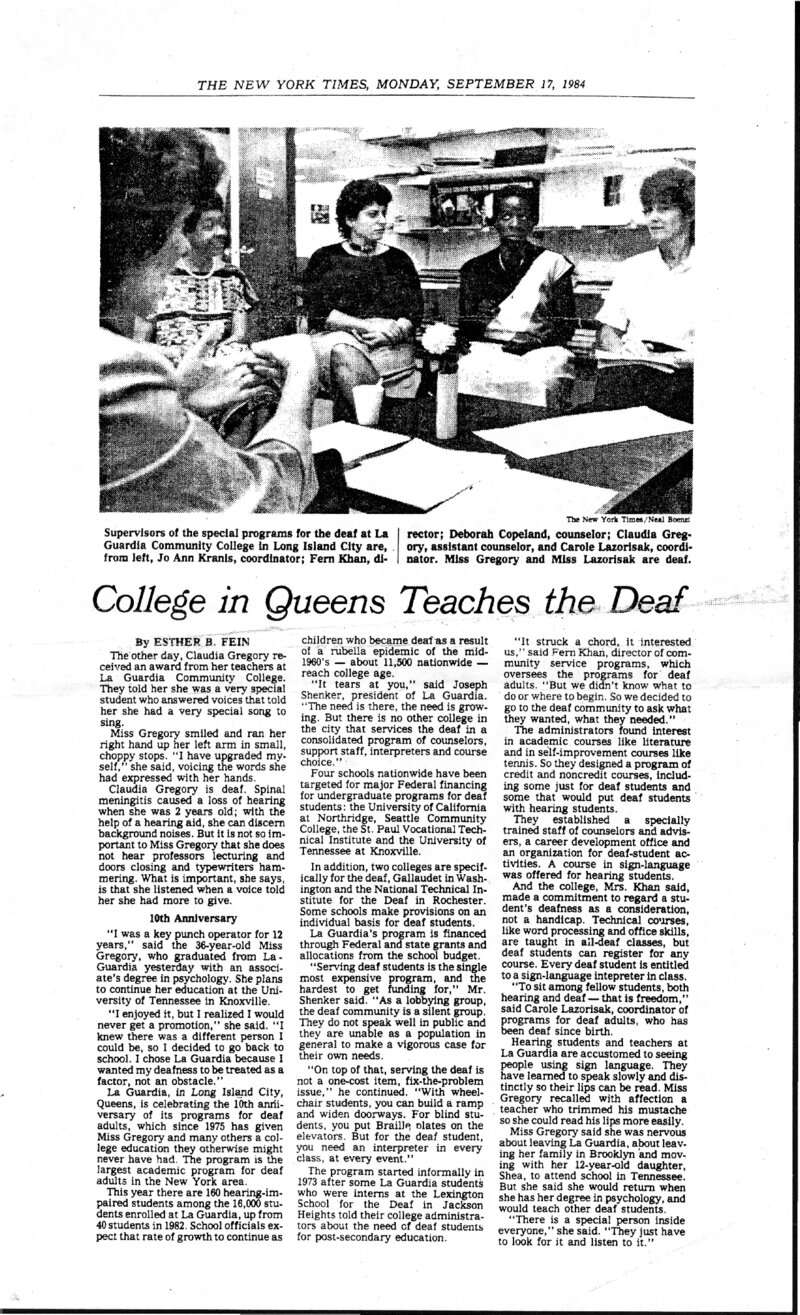
Supervisors of the special programs for the deaf at La
Guardia Community College in Long Island City are, .
from left, Jo Ann Kranis, coordinator; Fern Khan, di-
R25
The New York Times /Neal Boenzi
rector; Deborah Copeland, counselor; Claudia Greg-
ory, assistant counselor, and Carole Lazorisak, coordi-
nator. Miss Gregory and Miss Lazorisak are deaf.
College in Queens Teaches the. Deaf
By ESTHER B. FEIN
The other day, Claudia Gregory re-
ceived an award from her teachers at
La Guardia Community College.
They told her she was a very special
student who answered voices that told
her she had a very special song to
sing.
Miss Gregory smiled and ran her
right hand up her left arm in small,
choppy stops. ‘‘I have upgraded my-
self,’’ she said, voicing the words she
had expressed with her hands.
Claudia Gregory is deaf. Spinal
meningitis caused a loss of hearing
when she was 2 years old; with the
help of a hearing aid, she can discern
background noises. But it is not so im-
portant to Miss Gregory that she does
not hear professors lecturing and
doors closing and typewriters ham-
mering. What is important, she says,
is that she listened when a voice told
her she had more to give.
10th Anniversary
“I was a key punch operator for 12
years,’’ said the 36-year-old Miss
Gregory, who graduated from La-
Guardia yesterday with an associ-
ate’s degree in psychology. She plans
to continue her education at the Uni-
versity of Tennessee in Knoxville.
“T enjoyed it, but I realized I would
never get a promotion,”’ she said. ‘‘I
knew there was a different person I
could be, so I decided to go back to
school. I chose La Guardia because I
wanted my deafness to be treated as a
factor, not an obstacle.”’
La Guardia, in Long Island City,
Queens, is celebrating the 10th anrii-
versary of its programs for deaf
adults, which since 1975 has given
Miss Gregory and many others a col-
lege education they otherwise might
never have had. The program is the
largest academic program for deaf
adults in the New York area.
This year there are 160 hearing-im-
paired students among the 16,000 stu-
dents enrolled at La Guardia, up from
40 students in 1982. School officials ex-
pect that rate of growth to continue as
children who became deafias a result
of a rubella epidemic of the mid-
1960’s — about 11,500 nationwide —
reach college age.
“It tears at you,’’ said Joseph
Shenker, president of La Guardia.
‘The need is there, the need is grow-
ing. But there is no other college in
the city that services the deaf in a
consolidated program of counselors,
support staff, interpreters and course
choice.”
Four schools nationwide have been
targeted for major Federal financing
for undergraduate programs for deaf
students: the University of California
at Northridge, Seattle Community
College, the St. Paul Vocational Tech-
nical Institute and the University of
Tennessee at Knoxville.
In addition, two colleges are specif-
ically for the deaf, Gallaudet in Wash-
ington and the National Technical In-
stitute for the Deaf in Rochester.
Some schools make provisions on an
individual basis for deaf students.
La Guardia’s program is financed
through Federal and state grants and
allocations from the school budget.
“Serving deaf students is the single
most expensive program, and the
hardest to get funding for,” Mr.
Shenker said. ‘‘As a lobbying group,
the deaf community is a silent group.
They do not speak well in public and
they are unable as a population in
general to make a vigorous case for
their own needs.
“On top of that, serving the deaf is
not a one-cost item, fix-the-problem
issue,’’ he continued. ‘‘With wheel-
chair students, you can build a ramp
and widen doorways. For blind stu-
dents, you put Braille vlates on the
elevators. But for the deaf student,
you need an interpreter in every
class, at every event.’’
The program started informally in
1973 after some La Guardia students
who were interns at the Lexington
School ‘for the Deaf in Jackson
Heights told their college administra-
tors about the need cf deaf students
for post-secondary education.
“It struck a chord, it interested
us,’’ said Fern Khan, director of com-
munity service programs, which
oversees the programs for deaf
adults. ‘‘But we didn’t know what te
do or where to begin. So we decided to
go to the deaf community to ask what
they wanted, what they needed.”
The administrators found interest
in academic. courses like literature
and in self-improvement courses like
tennis. So they designed a program of
credit and noncredit courses, includ-
ing some just for deaf students and
some that would put deaf students
with hearing students.
They established a_ specially
trained staff of counselors and advis-
ers, a career development office and
an organization for deaf-student ac-
tivities. A course in sign-language
was offered for hearing students.
And the college, Mrs. Khan said,
made a commitment to regard a stu-
dent’s deafness as a consideration,
not a handicap. Technical courses,
like word processing and office skills,
are taught in ail-deaf classes, but
deaf students can register for any
course. Every deaf student is entitled
to a sign-language intepreter in class.
“To sit among fellow students, both
hearing and deaf — that is freedom,”’
said Carole Lazorisak, coordinator of
programs for deaf adults, who has
been deaf since birth.
Hearing students and teachers at
La Guardia are accustomed to seeing
people using sign language. They
have learned to speak slowly and dis-
tinctly so their lips can be read. Miss
Gregory recalled with affection a
teacher who trimmed his mustache
so she could read his lips more easily.
Miss Gregory said she was nervous
about leaving La Guardia, about leav-
ing her family in Brooklyn and mov-
ing with her 12-year-old daughter,
Shea, to attend school in Tennessee.
But she said she would return when
she has her degree in psychology, and
would teach other deaf students.
“There is a special person inside
everyone,”’ she said. ‘‘They just have
to look for it and listen to it.”
Supervisors of the special programs for the deaf at La
Guardia Community College in Long Island City are, .
from left, Jo Ann Kranis, coordinator; Fern Khan, di-
R25
The New York Times /Neal Boenzi
rector; Deborah Copeland, counselor; Claudia Greg-
ory, assistant counselor, and Carole Lazorisak, coordi-
nator. Miss Gregory and Miss Lazorisak are deaf.
College in Queens Teaches the. Deaf
By ESTHER B. FEIN
The other day, Claudia Gregory re-
ceived an award from her teachers at
La Guardia Community College.
They told her she was a very special
student who answered voices that told
her she had a very special song to
sing.
Miss Gregory smiled and ran her
right hand up her left arm in small,
choppy stops. ‘‘I have upgraded my-
self,’’ she said, voicing the words she
had expressed with her hands.
Claudia Gregory is deaf. Spinal
meningitis caused a loss of hearing
when she was 2 years old; with the
help of a hearing aid, she can discern
background noises. But it is not so im-
portant to Miss Gregory that she does
not hear professors lecturing and
doors closing and typewriters ham-
mering. What is important, she says,
is that she listened when a voice told
her she had more to give.
10th Anniversary
“I was a key punch operator for 12
years,’’ said the 36-year-old Miss
Gregory, who graduated from La-
Guardia yesterday with an associ-
ate’s degree in psychology. She plans
to continue her education at the Uni-
versity of Tennessee in Knoxville.
“T enjoyed it, but I realized I would
never get a promotion,”’ she said. ‘‘I
knew there was a different person I
could be, so I decided to go back to
school. I chose La Guardia because I
wanted my deafness to be treated as a
factor, not an obstacle.”’
La Guardia, in Long Island City,
Queens, is celebrating the 10th anrii-
versary of its programs for deaf
adults, which since 1975 has given
Miss Gregory and many others a col-
lege education they otherwise might
never have had. The program is the
largest academic program for deaf
adults in the New York area.
This year there are 160 hearing-im-
paired students among the 16,000 stu-
dents enrolled at La Guardia, up from
40 students in 1982. School officials ex-
pect that rate of growth to continue as
children who became deafias a result
of a rubella epidemic of the mid-
1960’s — about 11,500 nationwide —
reach college age.
“It tears at you,’’ said Joseph
Shenker, president of La Guardia.
‘The need is there, the need is grow-
ing. But there is no other college in
the city that services the deaf in a
consolidated program of counselors,
support staff, interpreters and course
choice.”
Four schools nationwide have been
targeted for major Federal financing
for undergraduate programs for deaf
students: the University of California
at Northridge, Seattle Community
College, the St. Paul Vocational Tech-
nical Institute and the University of
Tennessee at Knoxville.
In addition, two colleges are specif-
ically for the deaf, Gallaudet in Wash-
ington and the National Technical In-
stitute for the Deaf in Rochester.
Some schools make provisions on an
individual basis for deaf students.
La Guardia’s program is financed
through Federal and state grants and
allocations from the school budget.
“Serving deaf students is the single
most expensive program, and the
hardest to get funding for,” Mr.
Shenker said. ‘‘As a lobbying group,
the deaf community is a silent group.
They do not speak well in public and
they are unable as a population in
general to make a vigorous case for
their own needs.
“On top of that, serving the deaf is
not a one-cost item, fix-the-problem
issue,’’ he continued. ‘‘With wheel-
chair students, you can build a ramp
and widen doorways. For blind stu-
dents, you put Braille vlates on the
elevators. But for the deaf student,
you need an interpreter in every
class, at every event.’’
The program started informally in
1973 after some La Guardia students
who were interns at the Lexington
School ‘for the Deaf in Jackson
Heights told their college administra-
tors about the need cf deaf students
for post-secondary education.
“It struck a chord, it interested
us,’’ said Fern Khan, director of com-
munity service programs, which
oversees the programs for deaf
adults. ‘‘But we didn’t know what te
do or where to begin. So we decided to
go to the deaf community to ask what
they wanted, what they needed.”
The administrators found interest
in academic. courses like literature
and in self-improvement courses like
tennis. So they designed a program of
credit and noncredit courses, includ-
ing some just for deaf students and
some that would put deaf students
with hearing students.
They established a_ specially
trained staff of counselors and advis-
ers, a career development office and
an organization for deaf-student ac-
tivities. A course in sign-language
was offered for hearing students.
And the college, Mrs. Khan said,
made a commitment to regard a stu-
dent’s deafness as a consideration,
not a handicap. Technical courses,
like word processing and office skills,
are taught in ail-deaf classes, but
deaf students can register for any
course. Every deaf student is entitled
to a sign-language intepreter in class.
“To sit among fellow students, both
hearing and deaf — that is freedom,”’
said Carole Lazorisak, coordinator of
programs for deaf adults, who has
been deaf since birth.
Hearing students and teachers at
La Guardia are accustomed to seeing
people using sign language. They
have learned to speak slowly and dis-
tinctly so their lips can be read. Miss
Gregory recalled with affection a
teacher who trimmed his mustache
so she could read his lips more easily.
Miss Gregory said she was nervous
about leaving La Guardia, about leav-
ing her family in Brooklyn and mov-
ing with her 12-year-old daughter,
Shea, to attend school in Tennessee.
But she said she would return when
she has her degree in psychology, and
would teach other deaf students.
“There is a special person inside
everyone,”’ she said. ‘‘They just have
to look for it and listen to it.”
Title
"College in Queens Teaches the Deaf"
Description
This New York Times article from September 1984 highlights the efforts of LaGuardia Community College to provide educational opportunities to Deaf students. Written on the 10th anniversary of the creation of the Programs for Deaf Adults department at LGCC, the article includes statements from LaGuardia students, faculty, and administration. LaGuardia's formal commitment to Deaf education began in 1974 and became a noteworthy component of the school's Continuing Education division.
Contributor
Khan, Fern
Creator
Fein, Esther
Date
September 17, 1984
Language
English
Publisher
New York Times
Rights
Copyrighted
Source
Khan, Fern
Original Format
Article / Essay
Fein, Esther. Letter. “‘College in Queens Teaches the Deaf’.”, CUNY DIGITAL HISTORY ARCHIVE, accessed September 5, 2026, https://stephenz.tailc22a4b.ts.net/s/cdha/item/369