"Breaking Tradition — Planning and Organizing a Conference on Education and Employment Opportunities"
Item
ROBERT JONES, M.ED., M.DIV.
Rev. Jones is coordinator, Continuing Education of Visually Impaired Adults (CEVIA)*,
LaGuardia Community College, City University of New York.
LaGuardia Community College, 31-10 Thomson Ave., Long Island City, NY 11101
Abstract: Many diverse elements were brought together to plan and exe-
cute an unprecedented conference focused on the employment and career-
planning needs of blind and visually handicapped women. This article
provides a blueprint of the process from beginning to end.
A minority within a minority—blind and
visually impaired women employed, un-
deremployed or unemployed—was the
focus of the cooperative venture that ma-
terialized on Saturday, November 6, 1982
in the all-day conference ‘Breaking Tradi-
tion: Education and Career Opportunities
for Blind and Visually Impaired Women.”
Planning, organizing and conducting
the conference involved an exceptional
degree of teamwork which saw elements
of New York City’s academic community
operating in tandem with a number of
public and voluntary agencies for visually
impaired persons anda group of concerned
individuals. This account of how the con-
ference was conceived and brought to reali-
ty is designed not only to identify and ac-
knowledge the roles played by these di-
verse elements, but to serve as a kind of
blueprint that may prove useful if similar
efforts are undertaken elsewhere.
The initial impetus for the conference
came from CEVIA, a consortium of the
Board of Higher Education, 12 of the 18
colleges that constitute the City Univer-
sity of New York (CUNY), and agencies.
The schools belonging to the consortium
are Baruch College, Bronx Community
College, Brooklyn College, City College,
College of Staten Island, Hostos Commu-
nity College, Lehman College, LaGuardia
Community College, Manhattan Commu-
nity College, Medgar Evers College,
Queens College, and Queensborough
*Funded by New York Community Trust.
274 JOURNAL OF VISUAL IMPAIRMENT & BLINDNESS
Community College. The private agencies
included American Foundation for the
Blind (AFB), Recording for the Blind, the
New York State Commission for the Blind/
Visually Handicapped, U.S. Department of
Education Rehabilitation Services Admin-
istration, and Vacations and Community
JUNE 1983
Services for the Blind.
In mid-1982, with the state of the econ-
omy exacerbating the employment prob-
lems, informal inquiries by the writer
brought offers of co-sponsorship for a
conference on women and employment
from AFB, which had already begun ex-
ploring issues related to women and
blindness, and from the Women’s Pro-
gram of LaGuardia Community College.
At the core of a conference advisory com-
mittee were Mary Ellen Mulholland, AFB’s
director of publications and information
services and editor-in-chief of the Jour-
nal of Visual Impairment & Blindness;
Sandra Watson, director of LaGuardia’s
Women’s Program; and myself in the role
of CEVIA coordinator. Four other knowl-
edgeable women accepted invitations to
serve on the committee: Dr. Karen Lux-
ton, director of the Baruch College Com-
puter Center for the Visually Impaired;
Sherrell Powell, assistant professor of oc-
cupational therapy at LaGuardia Commu-
nity College; Elena Hanrahan, director of
volunteers, New York Eye and Ear Hospi-
tal; and Frances A. Koestler, editor of the
Matilda Ziegler Magazine for the Blind.
At a series of meetings during the sum-
mer the committee worked out a theme
and format for the conference, drew up a
list of potential program participants, dis-
cussed the various forms of promotion
and publicity that would attract atten-
dance, and zeroed in on a host of sundry
but essential details.
On the question of theme, an ERIC
search revealed little specific research in
visually impaired women and employ-
ment. Ann Cupolo, deputy coordinator of
the Disability Rights Education and De-
fense Fund in California, confirmed the
dearth of information. Thus, there were
no guidelines, other than good sense based
on experience, or the principal needs of
the women for whom the conference
would be held.
A conscious decision was made that the
program participants would be invited as
individuals rather than as representatives
of agencies or disciplines. All but two of
the 30 who eventually carried out program
assignments were visually impaired or
blind women.
A simple format was devised. There
would be welcoming speeches by Fern
Khan, professor and director of Commu-
nity Service Programs at LaGuardia and
Sandra Watson, and introductory com-
ments by Dr. Luxton. The morning ses-
sion would lead off with a panel of role
models: Laura Gardner, telling how she
created a job for herself; Deborah Kent,
discussing career changing and what it en-
tailed; Emerald McKenzie; and Karen Sand-
haus, talking as a recent college graduate
on her first job. The panelists would
describe the limitations they had to over-
come and extrapolate from those experi-
ences concepts and suggestions that
might be useful to the audience.
The conferees would then divide into
small groups, each led by a moderator. A
“respondent”’ leader would kick off the
group sessions by reacting to the ideas of-
fered by the panelists. These informal inter-
changes would continue at lunch where, it
was hoped, some “‘networking’’ would
evolve as group members interacted with
others who shared similar interests.
The afternoon session would feature
the four formal presentations whose texts
are published in this section: Ferne K.
Roberts, on “The Expansion of Educa-
tional Opportunities,” Judith M. Dixon on
“Attitudinal Barriers and Strategies for
Overcoming Them,” Eunice Fiorito on
“Choices and Chances in the 80s,” and
Alice Fisher Rubin on ‘‘Career Trends in
the 80s.” A question-and-answer period,
followed by ‘wine & cheese, would con-
clude the day.
On the whole, the agenda worked out
more or less as planned. But there were in-
evitable changes, dicated by some last-
minute unavailabilities of scheduled speak-
ers, an influx of “‘walk-in’’ conferees who
has not previously registered and—the
bugaboo of every conference that has ever
been held—insufficient time at virtually
every juncture.
While the conference itself was free of
charge, CEVIA could not afford to defray
program participants’ travel and other ex-
penses, nor could it meet all of the other
costs entailed in conducting the day’s
events. A fee for luncheon had to be set.
Consideration had to be given to the pos-
sibility that some conferees might be dia-
betic, or vegetarians.
Mobility was a prime consideration. Stu-
dent escorts were recruited by the Women’s
Program, their stipends shared by the Pro-
gram and CEVIA. The escorts learned the
appropriate techniques for escorting
blind or visually impaired people. The
area’s auxiliary police force was asked to
provide street escort from the elevated
train station on busy Queens Boulevard.
Publicity and promotion efforts were
handled for the most part by AFB and the
LaGuardia Community College public re-
lations office. AFB designed an announce-
ment and registration form for publica-
tion in the September and October issues
of JVIB. It also provided approximately
300 mailing labels addressed to women’s
publications and broadcast media, and to
agencies in metropolitan New York which
conduct medical, recreational, reha-
bilitation and other service programs for
blind persons. The LaGuardia public rela-
tions office wrote press releases, in-
cluding some in Spanish and Chinese. The
Women’s Program took on recruitment of
escorts who could speak Spanish or Chi-
nese. American sign language interpreters
were engaged.
AFB supplied braille paper, lent slates
and styluses and prepared the large print
program materials. Brailled conference
materials were prepared by the Baruch
College Computer Center, with AFB and
CEVIA sharing the expense.
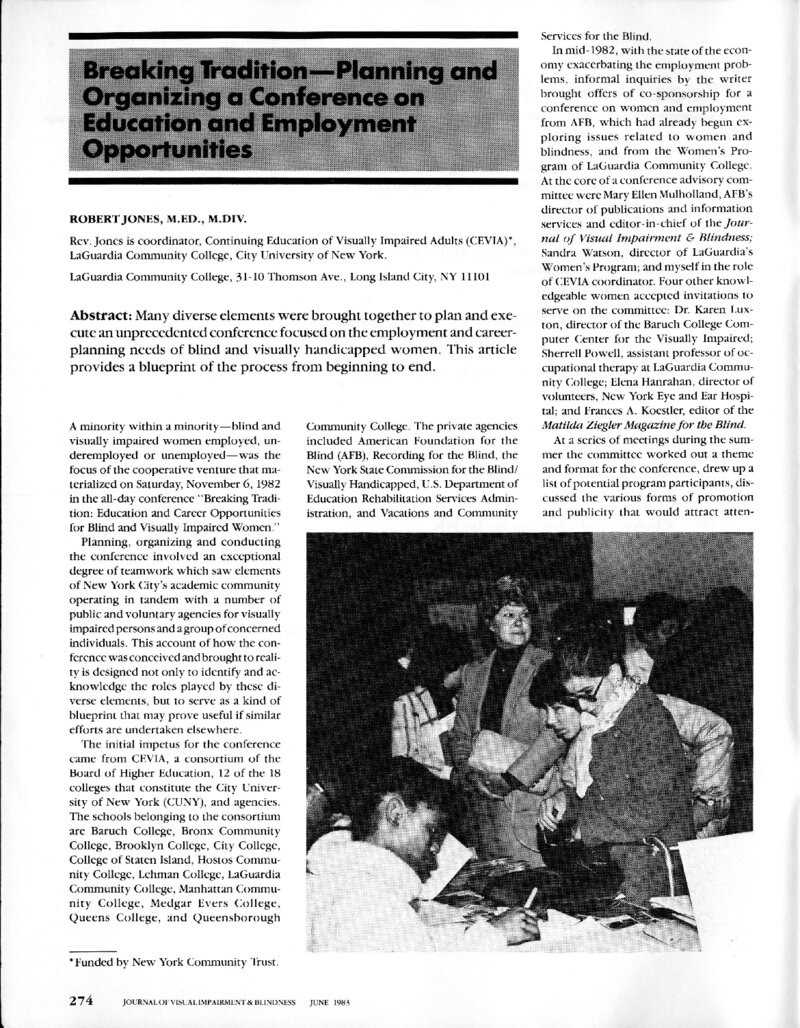
How many participants could we ex-
pect? Guesstimates ranged from a low of
70 to a high of 200. The final figure was
170 although we did not know until the
very day of the conference that the 150
advanced registrations would be swelled
by 20 ‘‘walk-ins.”’ The majority came
from New York City and nearby Nassau
County, but we also had people from up-
state New York, California, North Caro-
lina, Massachusetts, Illinois, Georgia and
New Jersey, even one from Japan.
The larger than anticipated attendance
created a space problem. Our original plan
had been to have discussion groups of 12 to
15 people each. Another college meeting
limited the number of rooms available to
us, so in the end we had to settle for four
groups of about 25 persons each. The mod-
erators were Adrienne Asch, Kay McDon-
JOURNAL OF VISUAL IMPAIRMENT & BLINDNESS
ald, Emerald McKenzie and Pam Schneider.
Discussion ‘respondents’ were Jamie Ca-
sabianca, Karen Eisenstat, Jane Thomas, Jill
Ferst, Sue Harden and Sherrell Powell.
Assignment of conferees to the groups
was based on self-identified categories
derived from the registration forms. Each
group was salted with people from vari-
ous categories: employed, unemployed,
housewives, students (college and high
school), and participant/observers. Deaf
women or those who were Spanish-or
Chinese-speaking were carefully placed.
Participation by males was restricted: the
15 men who attended represented agen-
cies or specific professional disciplines.
Cooperative endeavor took care of
many of the other details. AFB assigned
staff members—Corinne Kirchner, Col-
leen Davis, Margaret King, Jackie Packer
and Robin Tannenbaum—to serve as re-
corders for the group session. Special ar-
rangements were made to accommodate
the needs of the dog guides that accompa-
nied about 35 of the women. Last-minute
housing was arranged for out-of-town
program participants by the New York In-
stitute for the Education of the Blind. A
nearly life-sized terra cotta sculpture, A
Seated Woman,” was installed in the lob-
by by New York artist Margo Krasne.
The major national follow up planned
was publication of this special section of
JVIB. There may well be by-products in the
form of similar conferences in other cities.
Inquiries have been received from agencies
on the West Coast, in the Southeast, in
upstate New York, Israel, and Australia.
Locally, steps have been initiated by
CEVIA to increase accessibility to CUNY
programs for visually impaired adults. One
outreach effort was a special mailing on
educational opportunities at CUNY, pro-
duced in collaboration with Recording
for the Blind and sent to its subscribers in
New York City. Meetings have been held
with teachers in the New York Board of
Education and the regional Veterans Asso-
ciation. Special pilot courses on integrating
visually impaired students with sighted stu-
dents have been given for adjunct staff
teaching classes in Adult Basic Education
and English As a Second Language. LaGuar-
dia Community College gave an on-cam-
pus course on Resources for the Newly
Blind, based on the model established by
the Vision Foundation in Massachusetts.
Continued collaboration with LaGuardia’s
Women’s Program is planned.
Out of what proved to be a memorably
worthwhile enterprise come these few
nuggets of afterthought that may prove of
value to those contemplating events of a
similar nature:
© Tackle it only with strong support staff
275
JUNE 1983
capable of detailed follow-through work.
This will insure, among other things, that
coffee is delivered to the right location!
© Registration invariably takes longer
than anticipated. Movements of crowds
of people is a problem requiring special
attention.
¢ Interesting topics discussed by inter-
ested people eat up time, whether on the
audience floor or at the speaker’s plat-
form, in the corridors or over coffee.
FRANCES A. KOESTLER
© Be prepared for the unexpected: e.g.,
speakers delayed by wayfaring taxis, un-
typed thank-you notes, locked rooms, in-
operable microphones, angry or tearful
leaders or participants, and so on down the
line.
© Once the agenda is planned, un-plan
it! Circumstances will conspire to do so
anyway. Stay flexible.
© Relax and enjoy it.
Perhaps the most telling final word on
Ms. Koestler is editor, Matilda Ziegler Magazine for the Blind.
Matilda Ziegler Magazine for the Blind, 20 W. 17th St., New York, NY 10011
Abstract: This summary of the proceedings at the conference on ‘‘Edu-
cation and Employment Opportunities for Blind and Visually Impaired
Women” lists the major factors identified as roadblocks to satisfactory
career development and points to a variety of coping strategies that can
help overcome the dual handicap of gender and disability.
Underscoring and counterpointing a
dominant theme—that the combination
of gender and disability subjects visually
impaired women to double-barreled dis-
crimination—the women and girls (their
ages ranged from 15 to 64) who attended
the conference focused on internal and
external coping strategies relative to jobs
and careers.
Speaker after speaker, and in their own
informal group discussions, the conferees
heard confirmations of what they them-
selves had always known or suspected to
be among the causes of their plight:
¢ Almost from birth, visually impaired
females are brought up by overprotective
parents to be passive, sheltered, and
dependent on others for decisions. In
many instances, such traits are reinforced
by teachers, school guidance counselors,
rehabilitation workers, and, most damag-
ing ofall, by the women’s own self-image.
* Given such an upbringing, self-
knowledge is hard to come by. Timidity
and fear of failure keep visually impaired
276
JOURNAL OF VISUAL IMPAIRMENT & BLINDNESS.
women from exploring potential avenues
of experience, yet failure is one of the
most valuable of teachers.
© By leaving decision-making to others,
visually impaired women find themselves
at the mercy of stereotyped attitudes that
inhibit their right to pursue valid personal
goals. Lacking training in assertive behav-
ior, they tend to accept what is offered
them because they do not know how to
make their wishes known or respected.
© The “blindness system’ is not ade-
quately geared to embrace the wider world
of employment. Vocational rehabilitation
counselors have narrow concepts of what
visually impaired persons are capable of
doing, especially in professional or mana-
gerial areas; their placement practices tend
to focus on the low-risk, low-pay end of
the job market.
¢ The disability insurance system in-
vokes built-in disincentives that make it
easier, and often financially more advan-
tageous, to live on grants than to accept
low-paying employment.
JUNE 1983
our conference was the comment in a let-
ter received from a participant. ‘‘This
workshop didn’t provide all the answers,
but it gave us a focus anda starting point.”
To which I can only add the hope that this
was so, and express heartfelt thanks to all
whose joint efforts made at least a begin-
ning dent in the traditional barriers that
have kept blind and visually impaired
women from their rightful place in the
world of work.
Given the foregoing realities, what
remedies need to be sought?
First and foremost, it was universally
stressed, is proper preparation in the form
of sound educational background, compe-
tence in basic skills (reading, writing, typ-
ing, information gathering, mobility), and
familiarity with visual or other technolog-
ical aids that can add to efficient perform-
ance. To the objection that typing skills
may automatically assign a woman to a
clerical slot, it was pointed out that the in-
creasing prevalence of computer usage is
making knowledge of the keyboard a pre-
requisite for all kinds of tasks, professional
and executive as well as secretarial.
Self-knowledge Essential
Self-knowledge is another essential for
successful pursuit of a career. If, for exam-
ple, a woman’s strength is in working with
people rather than with paper, any attempt
to force her into a field that entails heavy
clerical, statistical, or writing components
should be resisted. Career decisions are the
prerogative of the individual.
Work experience of any kind is a valu-
able asset. Summer jobs, part-time jobs,
and volunteer service not only build con-
fidence and hone skills, but have a cumu-
lative effect in persuading prospective
employers of a woman’s versatility and ca-
pacity to perform in a variety of settings.
Some companies offer unpaid apprentice-
ships or internships in professional fields.
These are worth pursuing.
Colleges with work-study programs
and efficient placement offices should be
sought out. Another consideration in
choosing a college is whether or not it
provides specialized services for handi-
capped students.
A study of business trends can point the
way to job opportunities. For the present,
elementary school teaching positions are
apt to be in short supply, thanks to the low
birth rates of recent decades; on the other
hand, health care services are expanding
because of the steady increase in the elder-
ly population. Career planning should
take a long-range view.
Rev. Jones is coordinator, Continuing Education of Visually Impaired Adults (CEVIA)*,
LaGuardia Community College, City University of New York.
LaGuardia Community College, 31-10 Thomson Ave., Long Island City, NY 11101
Abstract: Many diverse elements were brought together to plan and exe-
cute an unprecedented conference focused on the employment and career-
planning needs of blind and visually handicapped women. This article
provides a blueprint of the process from beginning to end.
A minority within a minority—blind and
visually impaired women employed, un-
deremployed or unemployed—was the
focus of the cooperative venture that ma-
terialized on Saturday, November 6, 1982
in the all-day conference ‘Breaking Tradi-
tion: Education and Career Opportunities
for Blind and Visually Impaired Women.”
Planning, organizing and conducting
the conference involved an exceptional
degree of teamwork which saw elements
of New York City’s academic community
operating in tandem with a number of
public and voluntary agencies for visually
impaired persons anda group of concerned
individuals. This account of how the con-
ference was conceived and brought to reali-
ty is designed not only to identify and ac-
knowledge the roles played by these di-
verse elements, but to serve as a kind of
blueprint that may prove useful if similar
efforts are undertaken elsewhere.
The initial impetus for the conference
came from CEVIA, a consortium of the
Board of Higher Education, 12 of the 18
colleges that constitute the City Univer-
sity of New York (CUNY), and agencies.
The schools belonging to the consortium
are Baruch College, Bronx Community
College, Brooklyn College, City College,
College of Staten Island, Hostos Commu-
nity College, Lehman College, LaGuardia
Community College, Manhattan Commu-
nity College, Medgar Evers College,
Queens College, and Queensborough
*Funded by New York Community Trust.
274 JOURNAL OF VISUAL IMPAIRMENT & BLINDNESS
Community College. The private agencies
included American Foundation for the
Blind (AFB), Recording for the Blind, the
New York State Commission for the Blind/
Visually Handicapped, U.S. Department of
Education Rehabilitation Services Admin-
istration, and Vacations and Community
JUNE 1983
Services for the Blind.
In mid-1982, with the state of the econ-
omy exacerbating the employment prob-
lems, informal inquiries by the writer
brought offers of co-sponsorship for a
conference on women and employment
from AFB, which had already begun ex-
ploring issues related to women and
blindness, and from the Women’s Pro-
gram of LaGuardia Community College.
At the core of a conference advisory com-
mittee were Mary Ellen Mulholland, AFB’s
director of publications and information
services and editor-in-chief of the Jour-
nal of Visual Impairment & Blindness;
Sandra Watson, director of LaGuardia’s
Women’s Program; and myself in the role
of CEVIA coordinator. Four other knowl-
edgeable women accepted invitations to
serve on the committee: Dr. Karen Lux-
ton, director of the Baruch College Com-
puter Center for the Visually Impaired;
Sherrell Powell, assistant professor of oc-
cupational therapy at LaGuardia Commu-
nity College; Elena Hanrahan, director of
volunteers, New York Eye and Ear Hospi-
tal; and Frances A. Koestler, editor of the
Matilda Ziegler Magazine for the Blind.
At a series of meetings during the sum-
mer the committee worked out a theme
and format for the conference, drew up a
list of potential program participants, dis-
cussed the various forms of promotion
and publicity that would attract atten-
dance, and zeroed in on a host of sundry
but essential details.
On the question of theme, an ERIC
search revealed little specific research in
visually impaired women and employ-
ment. Ann Cupolo, deputy coordinator of
the Disability Rights Education and De-
fense Fund in California, confirmed the
dearth of information. Thus, there were
no guidelines, other than good sense based
on experience, or the principal needs of
the women for whom the conference
would be held.
A conscious decision was made that the
program participants would be invited as
individuals rather than as representatives
of agencies or disciplines. All but two of
the 30 who eventually carried out program
assignments were visually impaired or
blind women.
A simple format was devised. There
would be welcoming speeches by Fern
Khan, professor and director of Commu-
nity Service Programs at LaGuardia and
Sandra Watson, and introductory com-
ments by Dr. Luxton. The morning ses-
sion would lead off with a panel of role
models: Laura Gardner, telling how she
created a job for herself; Deborah Kent,
discussing career changing and what it en-
tailed; Emerald McKenzie; and Karen Sand-
haus, talking as a recent college graduate
on her first job. The panelists would
describe the limitations they had to over-
come and extrapolate from those experi-
ences concepts and suggestions that
might be useful to the audience.
The conferees would then divide into
small groups, each led by a moderator. A
“respondent”’ leader would kick off the
group sessions by reacting to the ideas of-
fered by the panelists. These informal inter-
changes would continue at lunch where, it
was hoped, some “‘networking’’ would
evolve as group members interacted with
others who shared similar interests.
The afternoon session would feature
the four formal presentations whose texts
are published in this section: Ferne K.
Roberts, on “The Expansion of Educa-
tional Opportunities,” Judith M. Dixon on
“Attitudinal Barriers and Strategies for
Overcoming Them,” Eunice Fiorito on
“Choices and Chances in the 80s,” and
Alice Fisher Rubin on ‘‘Career Trends in
the 80s.” A question-and-answer period,
followed by ‘wine & cheese, would con-
clude the day.
On the whole, the agenda worked out
more or less as planned. But there were in-
evitable changes, dicated by some last-
minute unavailabilities of scheduled speak-
ers, an influx of “‘walk-in’’ conferees who
has not previously registered and—the
bugaboo of every conference that has ever
been held—insufficient time at virtually
every juncture.
While the conference itself was free of
charge, CEVIA could not afford to defray
program participants’ travel and other ex-
penses, nor could it meet all of the other
costs entailed in conducting the day’s
events. A fee for luncheon had to be set.
Consideration had to be given to the pos-
sibility that some conferees might be dia-
betic, or vegetarians.
Mobility was a prime consideration. Stu-
dent escorts were recruited by the Women’s
Program, their stipends shared by the Pro-
gram and CEVIA. The escorts learned the
appropriate techniques for escorting
blind or visually impaired people. The
area’s auxiliary police force was asked to
provide street escort from the elevated
train station on busy Queens Boulevard.
Publicity and promotion efforts were
handled for the most part by AFB and the
LaGuardia Community College public re-
lations office. AFB designed an announce-
ment and registration form for publica-
tion in the September and October issues
of JVIB. It also provided approximately
300 mailing labels addressed to women’s
publications and broadcast media, and to
agencies in metropolitan New York which
conduct medical, recreational, reha-
bilitation and other service programs for
blind persons. The LaGuardia public rela-
tions office wrote press releases, in-
cluding some in Spanish and Chinese. The
Women’s Program took on recruitment of
escorts who could speak Spanish or Chi-
nese. American sign language interpreters
were engaged.
AFB supplied braille paper, lent slates
and styluses and prepared the large print
program materials. Brailled conference
materials were prepared by the Baruch
College Computer Center, with AFB and
CEVIA sharing the expense.
How many participants could we ex-
pect? Guesstimates ranged from a low of
70 to a high of 200. The final figure was
170 although we did not know until the
very day of the conference that the 150
advanced registrations would be swelled
by 20 ‘‘walk-ins.”’ The majority came
from New York City and nearby Nassau
County, but we also had people from up-
state New York, California, North Caro-
lina, Massachusetts, Illinois, Georgia and
New Jersey, even one from Japan.
The larger than anticipated attendance
created a space problem. Our original plan
had been to have discussion groups of 12 to
15 people each. Another college meeting
limited the number of rooms available to
us, so in the end we had to settle for four
groups of about 25 persons each. The mod-
erators were Adrienne Asch, Kay McDon-
JOURNAL OF VISUAL IMPAIRMENT & BLINDNESS
ald, Emerald McKenzie and Pam Schneider.
Discussion ‘respondents’ were Jamie Ca-
sabianca, Karen Eisenstat, Jane Thomas, Jill
Ferst, Sue Harden and Sherrell Powell.
Assignment of conferees to the groups
was based on self-identified categories
derived from the registration forms. Each
group was salted with people from vari-
ous categories: employed, unemployed,
housewives, students (college and high
school), and participant/observers. Deaf
women or those who were Spanish-or
Chinese-speaking were carefully placed.
Participation by males was restricted: the
15 men who attended represented agen-
cies or specific professional disciplines.
Cooperative endeavor took care of
many of the other details. AFB assigned
staff members—Corinne Kirchner, Col-
leen Davis, Margaret King, Jackie Packer
and Robin Tannenbaum—to serve as re-
corders for the group session. Special ar-
rangements were made to accommodate
the needs of the dog guides that accompa-
nied about 35 of the women. Last-minute
housing was arranged for out-of-town
program participants by the New York In-
stitute for the Education of the Blind. A
nearly life-sized terra cotta sculpture, A
Seated Woman,” was installed in the lob-
by by New York artist Margo Krasne.
The major national follow up planned
was publication of this special section of
JVIB. There may well be by-products in the
form of similar conferences in other cities.
Inquiries have been received from agencies
on the West Coast, in the Southeast, in
upstate New York, Israel, and Australia.
Locally, steps have been initiated by
CEVIA to increase accessibility to CUNY
programs for visually impaired adults. One
outreach effort was a special mailing on
educational opportunities at CUNY, pro-
duced in collaboration with Recording
for the Blind and sent to its subscribers in
New York City. Meetings have been held
with teachers in the New York Board of
Education and the regional Veterans Asso-
ciation. Special pilot courses on integrating
visually impaired students with sighted stu-
dents have been given for adjunct staff
teaching classes in Adult Basic Education
and English As a Second Language. LaGuar-
dia Community College gave an on-cam-
pus course on Resources for the Newly
Blind, based on the model established by
the Vision Foundation in Massachusetts.
Continued collaboration with LaGuardia’s
Women’s Program is planned.
Out of what proved to be a memorably
worthwhile enterprise come these few
nuggets of afterthought that may prove of
value to those contemplating events of a
similar nature:
© Tackle it only with strong support staff
275
JUNE 1983
capable of detailed follow-through work.
This will insure, among other things, that
coffee is delivered to the right location!
© Registration invariably takes longer
than anticipated. Movements of crowds
of people is a problem requiring special
attention.
¢ Interesting topics discussed by inter-
ested people eat up time, whether on the
audience floor or at the speaker’s plat-
form, in the corridors or over coffee.
FRANCES A. KOESTLER
© Be prepared for the unexpected: e.g.,
speakers delayed by wayfaring taxis, un-
typed thank-you notes, locked rooms, in-
operable microphones, angry or tearful
leaders or participants, and so on down the
line.
© Once the agenda is planned, un-plan
it! Circumstances will conspire to do so
anyway. Stay flexible.
© Relax and enjoy it.
Perhaps the most telling final word on
Ms. Koestler is editor, Matilda Ziegler Magazine for the Blind.
Matilda Ziegler Magazine for the Blind, 20 W. 17th St., New York, NY 10011
Abstract: This summary of the proceedings at the conference on ‘‘Edu-
cation and Employment Opportunities for Blind and Visually Impaired
Women” lists the major factors identified as roadblocks to satisfactory
career development and points to a variety of coping strategies that can
help overcome the dual handicap of gender and disability.
Underscoring and counterpointing a
dominant theme—that the combination
of gender and disability subjects visually
impaired women to double-barreled dis-
crimination—the women and girls (their
ages ranged from 15 to 64) who attended
the conference focused on internal and
external coping strategies relative to jobs
and careers.
Speaker after speaker, and in their own
informal group discussions, the conferees
heard confirmations of what they them-
selves had always known or suspected to
be among the causes of their plight:
¢ Almost from birth, visually impaired
females are brought up by overprotective
parents to be passive, sheltered, and
dependent on others for decisions. In
many instances, such traits are reinforced
by teachers, school guidance counselors,
rehabilitation workers, and, most damag-
ing ofall, by the women’s own self-image.
* Given such an upbringing, self-
knowledge is hard to come by. Timidity
and fear of failure keep visually impaired
276
JOURNAL OF VISUAL IMPAIRMENT & BLINDNESS.
women from exploring potential avenues
of experience, yet failure is one of the
most valuable of teachers.
© By leaving decision-making to others,
visually impaired women find themselves
at the mercy of stereotyped attitudes that
inhibit their right to pursue valid personal
goals. Lacking training in assertive behav-
ior, they tend to accept what is offered
them because they do not know how to
make their wishes known or respected.
© The “blindness system’ is not ade-
quately geared to embrace the wider world
of employment. Vocational rehabilitation
counselors have narrow concepts of what
visually impaired persons are capable of
doing, especially in professional or mana-
gerial areas; their placement practices tend
to focus on the low-risk, low-pay end of
the job market.
¢ The disability insurance system in-
vokes built-in disincentives that make it
easier, and often financially more advan-
tageous, to live on grants than to accept
low-paying employment.
JUNE 1983
our conference was the comment in a let-
ter received from a participant. ‘‘This
workshop didn’t provide all the answers,
but it gave us a focus anda starting point.”
To which I can only add the hope that this
was so, and express heartfelt thanks to all
whose joint efforts made at least a begin-
ning dent in the traditional barriers that
have kept blind and visually impaired
women from their rightful place in the
world of work.
Given the foregoing realities, what
remedies need to be sought?
First and foremost, it was universally
stressed, is proper preparation in the form
of sound educational background, compe-
tence in basic skills (reading, writing, typ-
ing, information gathering, mobility), and
familiarity with visual or other technolog-
ical aids that can add to efficient perform-
ance. To the objection that typing skills
may automatically assign a woman to a
clerical slot, it was pointed out that the in-
creasing prevalence of computer usage is
making knowledge of the keyboard a pre-
requisite for all kinds of tasks, professional
and executive as well as secretarial.
Self-knowledge Essential
Self-knowledge is another essential for
successful pursuit of a career. If, for exam-
ple, a woman’s strength is in working with
people rather than with paper, any attempt
to force her into a field that entails heavy
clerical, statistical, or writing components
should be resisted. Career decisions are the
prerogative of the individual.
Work experience of any kind is a valu-
able asset. Summer jobs, part-time jobs,
and volunteer service not only build con-
fidence and hone skills, but have a cumu-
lative effect in persuading prospective
employers of a woman’s versatility and ca-
pacity to perform in a variety of settings.
Some companies offer unpaid apprentice-
ships or internships in professional fields.
These are worth pursuing.
Colleges with work-study programs
and efficient placement offices should be
sought out. Another consideration in
choosing a college is whether or not it
provides specialized services for handi-
capped students.
A study of business trends can point the
way to job opportunities. For the present,
elementary school teaching positions are
apt to be in short supply, thanks to the low
birth rates of recent decades; on the other
hand, health care services are expanding
because of the steady increase in the elder-
ly population. Career planning should
take a long-range view.
Title
"Breaking Tradition — Planning and Organizing a Conference on Education and Employment Opportunities"
Description
In this article from the Journal of Visual Impairment & Blindness, Robert Jones, a professor at LaGuardia Community College, examines a number of the considerations that are involved in designing and holding a conference aimed at addressing the employment needs of women with visual impairments. In doing so, Jones presents a case study that describes the planning and realization of a November 6, 1982 conference that was put together with the cooperation of different organizations and CUNY colleges. Leading the efforts from within CUNY were LaGuardia's representatives on the planning committee. The college 's commitment to meeting the needs of underserved student populations quickly became a defining characteristic of LaGuardia's Continuing Education division in its early years.
Contributor
Khan, Fern
Creator
Jones, Robert
Date
June 1983
Language
English
Publisher
Journal of Visual Impairment & Blindness
Rights
Obtained from Contributor - Copyright Unknown
Source
Khan, Fern
Original Format
Article / Essay
Jones, Robert. Letter. 1983. “‘Breaking Tradition — Planning and Organizing a Conference on Education and Employment Opportunities’”, 1983, CUNY DIGITAL HISTORY ARCHIVE, accessed September 5, 2026, https://stephenz.tailc22a4b.ts.net/s/cdha/item/373