"A Bright New 'Downtown' Is Taking Shape in Queens"
Item
FRIDAY, JUNE 2, 1972
By DEIRDRE CARMODY
An ambitious plan to
change the Jamaica Avenue
area of Queens froma shabby
shopping street under the
elevated tracks into a major
metropolitan center is rapid-
ly advancing off the drawing
boards into the first flush of
reality.
Construction has been
completed on seven pieces
of the sprawling jigsaw
puzzle, which planners hope
will become a new downtown
for all of Queens. It will in-
elude an office building dis-
trict, parking facilities, edu-
cational and medical com-
plexes, shops and a rejuve-
nated residential area.
The progress of the plan
is being watched with inter-
est by urban designers. Not
only does it attempt the
radical transformation of a
particular area; it is also the
prototype of the “subcenter”
concept of the urban planning
that the Regional Plan Asso-
ciation has suggested may be
the salvation of the metro-
politan area.
The Subcenter Ideal
A subcenter—as described
in the association’s projec-
tion of what the metropoli-
tan region should be like in
the year 2000—is a major
“downtown” area in a high-
density section such as
Queens, Brooklyn or north-
ern New Jersey. The idea is
to provide a core for those
areas that will help siphon
off the concentration of
. workers and shoppers who
now travel long distances
daily into Manhattan, strain-
ing its services and choking
the transportation system.
he New Hork Gimes
A Bright New ‘Downtown’ Is Taking Shape in Queens
CO
TT
To
LIR
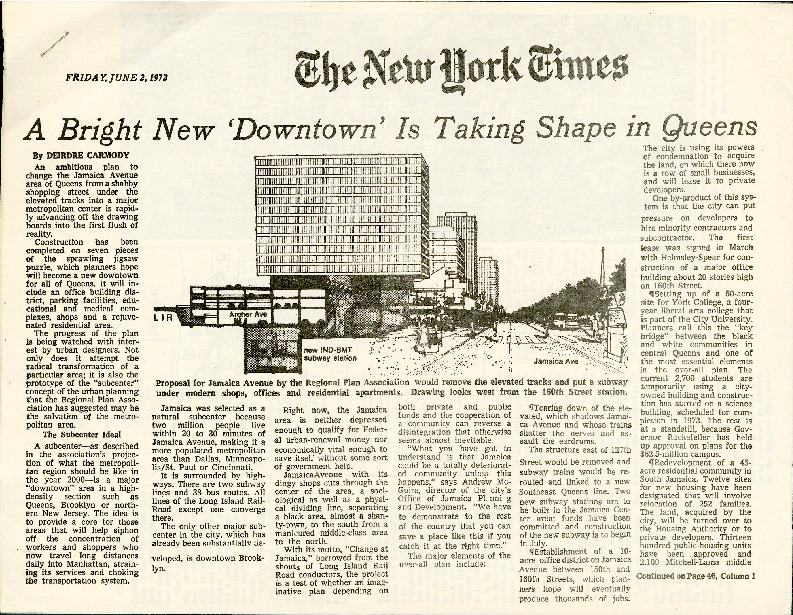
Proposal for Jamaica Avenue by the Regional Plan Association would remove the elevated tracks and put a subway
a new IND-BMT
ee subway station
under modern shops, offices and residential apartments. Drawing looks west from the 160th Street station.
Jamaica was selected as a
natural subcenter because
two million people live
within 20 to 30 minutes of
Jamaica Avenue, making it a
more populated metropolitan
area than Dallas, Minneapo-
lis/St. Paul or Cincinnati.
It is surrounded by high-
ways. There are two subway
lines and 38 bus routes. All
lines of the Long Island Rail-
Road except one converge
there.
The only other major sub-
center in the city, which has
already been substantially de-
veloped, is downtown Brook-
lyn.
Right now, the Jamaica
area is neither depressed
enough to qualify for Feder-
al urban-renewal money nor
economically vital enough to
save itself without some sort
of government help.
JamaicaAvenue with its
dingy shops cuts through the
center of the area, a soci-
ological as well as a physi-
cal dividing line, separating
a black area, almost a shan-
ty-town, to the south from a
manicured middle-class area
to the north.
With its motto, “Change at
Jamaica,” borrowed from the
shouts of Long Island Rail
Road conductors, the project
is a test of whether an imag-
inative plan depending on
both private and public
funds and the cooperation of
a@ community can reverse a
disintegration that otherwise
seems almost inevitable.
“What you have got to
understand is that Jamaica
could be a totally deteriorat-
ed community unless this
happens,” says Andrew Mc-
Guire, director of the city’s
Office of Jamaica Pl.nni g
and Development. “We have
to demonstrate to the rest
of the country that you can
save a place like this if you
catch it at the right time.”
The major elements of the
over-all plan include:
Tearing down of the ele-
vated, which shadows Jamai-
ca Avenue and whose trains
shatter the nerves and as-
sault the eardrums.
The structure east of 127th
Street would be removed and
subway trains would be re-
routed and linked to a new
Southeast Queens line. Two
new subway stations are to
be built in the Jamaica Cen-
ter area; funds have been
committed and construction
of the new subway is to begin
in July.
@Establishment of a 10-
acre office district on Jamaica
Avenue between 150th and
160th Streets, which plan-
ners hope will eventually
produce thousands of jobs.
The city is using its powers
of condemnation to acquire
the land, on which there now
is a row of small businesses,
and will lease it to private
developers.
One by-product of this sys-
tem is that the city can put
pressure on developers to
hire minority contractors and
subcontractor. The first
lease was signed in March
with Helmsley-Spear for con-
struction of a major office
building about 20 stories high
on 160th Street.
@Setting up of a 50-acre
site for York College, a four-
year liberal arts college that
is part of the City University.
Planners call this the “key
bridge” between the black
and white communities - in
central Queens and one of
the most essential elements
in the over-all plan. The
current 2,700 students are
temporarily using a city-
owned building and construc-
tion has started on a science
building, scheduled for com-
pletion in 1973. The rest is
at a standstill, because Gov-
ernor, Rockefeller has held
up approval on plans for the
$62.5-million campus.
@Redevelopment of a 45-
acre residential community in
South Jamaica. Twelve sites
for new housing have been
designated that will involve
relocation of 252 families.
The land, acquired by the
city, will be turned over to
the Housing Authority or to
private developers. Thirteen
hundred public-housing units
have been .approved and
2,100 Mitchell-Lama middle
Continued on Page 46, Column I
Continued From Page 39
income units are in the plan-
ning stage. The plan also
calls for supplemental serv-
ices such as day-care centers
and schools.
_GSetting up of a univer-
sity center with a hospital
and a school. This is also
still in the planning stage,
although the Queens Hospital
Center in Jamaica is compil-
ing a master plan and plan-
ners hope it will build a
new complex in the Jamaica
Center.
Building of a Long Is-
land Railroad span on the
route to Kennedy Interna-
tional Airport. This is still
in the planning stage and
has been the subject of a
squabble between the Parks
Department and the Metro-
politan Transportation Au-
thority over planned tunnel-
ing through Forest Park.
Other Projects
Other individual projects
are either completed or un-
der construction. These in-
clude two new parking facil-
ities, a 10-story New York
Telephone Company building;
the Gertz-Allied stores com-
plex with a garage, retail
shops and office space next
to the existing Gertz depart-
ment store;.a privately-spon-
‘sored housing project for the
elderly; Queens Family Court
and Queens Civil Court.
So far $400-million in pub-
lic funds has been committed
to Jamaica Center, which in-
cludes money for. subways
and removal of the elevated;
parking garages, office-site
acquisition and York College.
About $100-million in private
funds will go toward office
development.
As it happens, the lengthy
process of assembling the
pieces and guiding them
through the stages of ap-
proval was originally
prompted by a prospective
tenant who pulled out before
the project got under way.
’ Lufthansa Airlines. was
looking for office space near
the airport in the late nine-
teen-sixties. Members of
the Regional Plan Associa-
tion (which had issued a de-
tailed study of Jamaica as
the ideal spot for a subcen-
ter), several Jamaica busi-*
ness leaders and Ken Patton,
the city’s Economic Develop-
ment Administrator and one
THE NEW YORK TIMES, FRIDAY, JUNE 2, 1972
A New ‘Downtown’ for Queens
~kmdyg, 4241 Ue
Jamaica
Redevelopment
Completed
1. New York Telephone Company
2. Housing for the Elderly
3. Queens County Family Court
4, Parking Deck
Centra] Pkwy,
Jamaica
5. Carter Community Health Center
6. Hillcrest High School
7. York College temporary
headquarters
In Progress
8. York College
9. Jamaica Center Office Develop- :
ment District & new subway station
10. South Jamaica Community
Development Plan
11. Gertz Allied Complex
12. Municipal Parking Garage
13. Queens County Civil Court
14. J. F. Kennedy Airport
Railroad Spur
15. Finance Administration
16, Subway station
17, Southeast Queens subway
18. Ja Avenue
Elevated removal.
of the prime movers behind
the project, went to a num-
ber of city officials and pri-
vate developers to push the
plan, with Lufthansa repre-
sentatives in tow. Things be-
gan to move and it looked
as if Lufthansa had finally
kicked off the redevelopment
of Jamaica.
“So I took the head of
Lufthansa to lunch with
George Fowlkes [now Com-
missioner of Commerce and
Industry] to celebrate,” Mr.
Patton recalls. “We went to
a fancy French restaurant for
a $75 lunch—you know, paté
maison, the works—for
which I was paying myself.
Then the head of Lufthansa
turned to me and said, ‘We’ve
decided to move to Nassau
County.’”
Nonetheless, the project
moved forward. In 1969,
Mayor Lindsay established an
office in Jamaica to expedite
redevelopment. F. Carlisle
Towery, an architect and ur-
ban designer who had pre-
ared the report on Jamaica
‘or the Regional Plan Asso-
PAG HOK ON
Proposed:
19. Medical Center
20.L.L.R.R. Jamaica Station renovation
21. Mary Immaculate Hospital expansion
The New York Times/June 2, 1972
ciation, was made executive
director of the Greater Ja-
maica Development Corpora-
tion to supervise the project,
and a steering committee rep-
resenting about 100 commu-
nity groups was set up. a
One of the hardest fought
battles, which is still continu-
ing, has been over York Col-
lege, the City University’s
newest college.
In 1967 and 1968 the Board
of Higher Education was per-
suaded. to abandon its choice
of Fort Totten—about 150
bucolic acres on a peninsula §
in. Little Neck Bay—for a
smaller, more expensive and §:
far less attractive site in
South Jamaica, on the ground
that an urban college should §
be where its students were.
Then, last January, Gover-
nor Rockefeller refused to
approve plans for the York
campus,
Shoppers crowding busy Jamaica Avenue in Queens. The
shopping area is a potential subcenter for two million
New Yorkers, thirty minutes away by mass transit.
THE NEW YORK TIMES, FRIDAY, JUNE 2, 1972
Photographs for The New York Times by BARTON SILVERMAN
The avenue as it is now, from elevated vantage point at 160th Street. Church steeple and King Park are at right.
The Mayor and Queens
Borough President Donald
Manes protested. A spokes-
man for the Governor said
that their rebuttals were
being studied and there are
hints from the Governor’s
aides that they are being
given favorable consideration.
Community Aspect
One of the major questions
the Jamaica redevelopment
raises is whether the com-
munity could support it with-
out being torn by the internal
hostilities and power struggles
that so often surface during
such projects.
“You are dealing with a
community which is com-
pletely ignorant of what de-
velopment is all about,” said
Dr. Canute Bernard, a surgeon
and former chairman of the
South Jamaica Steering Com-
mittee. “They think there is
a big bonanza waiting to be
grabbed for the community
leaders working on _ the
project.
“You've got to keep the
community informed so that
when Helmsley-Spear comes
in with a bulldozer, you don’t
get the community saying,
‘Here comes White Man to
take over my land.’”
One thing the planners are
determined to avert is con-
struction of housing at ran-
dom instead of as part of the
over-all plan.
“But it would be criminal
to do anything but go the
long route and plan for
schooling, day-care centers
and sewerage,” said Dr.
Bernard. “To put up quick
housing would just create an-
other high-rise brick ghetto.”
By DEIRDRE CARMODY
An ambitious plan to
change the Jamaica Avenue
area of Queens froma shabby
shopping street under the
elevated tracks into a major
metropolitan center is rapid-
ly advancing off the drawing
boards into the first flush of
reality.
Construction has been
completed on seven pieces
of the sprawling jigsaw
puzzle, which planners hope
will become a new downtown
for all of Queens. It will in-
elude an office building dis-
trict, parking facilities, edu-
cational and medical com-
plexes, shops and a rejuve-
nated residential area.
The progress of the plan
is being watched with inter-
est by urban designers. Not
only does it attempt the
radical transformation of a
particular area; it is also the
prototype of the “subcenter”
concept of the urban planning
that the Regional Plan Asso-
ciation has suggested may be
the salvation of the metro-
politan area.
The Subcenter Ideal
A subcenter—as described
in the association’s projec-
tion of what the metropoli-
tan region should be like in
the year 2000—is a major
“downtown” area in a high-
density section such as
Queens, Brooklyn or north-
ern New Jersey. The idea is
to provide a core for those
areas that will help siphon
off the concentration of
. workers and shoppers who
now travel long distances
daily into Manhattan, strain-
ing its services and choking
the transportation system.
he New Hork Gimes
A Bright New ‘Downtown’ Is Taking Shape in Queens
CO
TT
To
LIR
Proposal for Jamaica Avenue by the Regional Plan Association would remove the elevated tracks and put a subway
a new IND-BMT
ee subway station
under modern shops, offices and residential apartments. Drawing looks west from the 160th Street station.
Jamaica was selected as a
natural subcenter because
two million people live
within 20 to 30 minutes of
Jamaica Avenue, making it a
more populated metropolitan
area than Dallas, Minneapo-
lis/St. Paul or Cincinnati.
It is surrounded by high-
ways. There are two subway
lines and 38 bus routes. All
lines of the Long Island Rail-
Road except one converge
there.
The only other major sub-
center in the city, which has
already been substantially de-
veloped, is downtown Brook-
lyn.
Right now, the Jamaica
area is neither depressed
enough to qualify for Feder-
al urban-renewal money nor
economically vital enough to
save itself without some sort
of government help.
JamaicaAvenue with its
dingy shops cuts through the
center of the area, a soci-
ological as well as a physi-
cal dividing line, separating
a black area, almost a shan-
ty-town, to the south from a
manicured middle-class area
to the north.
With its motto, “Change at
Jamaica,” borrowed from the
shouts of Long Island Rail
Road conductors, the project
is a test of whether an imag-
inative plan depending on
both private and public
funds and the cooperation of
a@ community can reverse a
disintegration that otherwise
seems almost inevitable.
“What you have got to
understand is that Jamaica
could be a totally deteriorat-
ed community unless this
happens,” says Andrew Mc-
Guire, director of the city’s
Office of Jamaica Pl.nni g
and Development. “We have
to demonstrate to the rest
of the country that you can
save a place like this if you
catch it at the right time.”
The major elements of the
over-all plan include:
Tearing down of the ele-
vated, which shadows Jamai-
ca Avenue and whose trains
shatter the nerves and as-
sault the eardrums.
The structure east of 127th
Street would be removed and
subway trains would be re-
routed and linked to a new
Southeast Queens line. Two
new subway stations are to
be built in the Jamaica Cen-
ter area; funds have been
committed and construction
of the new subway is to begin
in July.
@Establishment of a 10-
acre office district on Jamaica
Avenue between 150th and
160th Streets, which plan-
ners hope will eventually
produce thousands of jobs.
The city is using its powers
of condemnation to acquire
the land, on which there now
is a row of small businesses,
and will lease it to private
developers.
One by-product of this sys-
tem is that the city can put
pressure on developers to
hire minority contractors and
subcontractor. The first
lease was signed in March
with Helmsley-Spear for con-
struction of a major office
building about 20 stories high
on 160th Street.
@Setting up of a 50-acre
site for York College, a four-
year liberal arts college that
is part of the City University.
Planners call this the “key
bridge” between the black
and white communities - in
central Queens and one of
the most essential elements
in the over-all plan. The
current 2,700 students are
temporarily using a city-
owned building and construc-
tion has started on a science
building, scheduled for com-
pletion in 1973. The rest is
at a standstill, because Gov-
ernor, Rockefeller has held
up approval on plans for the
$62.5-million campus.
@Redevelopment of a 45-
acre residential community in
South Jamaica. Twelve sites
for new housing have been
designated that will involve
relocation of 252 families.
The land, acquired by the
city, will be turned over to
the Housing Authority or to
private developers. Thirteen
hundred public-housing units
have been .approved and
2,100 Mitchell-Lama middle
Continued on Page 46, Column I
Continued From Page 39
income units are in the plan-
ning stage. The plan also
calls for supplemental serv-
ices such as day-care centers
and schools.
_GSetting up of a univer-
sity center with a hospital
and a school. This is also
still in the planning stage,
although the Queens Hospital
Center in Jamaica is compil-
ing a master plan and plan-
ners hope it will build a
new complex in the Jamaica
Center.
Building of a Long Is-
land Railroad span on the
route to Kennedy Interna-
tional Airport. This is still
in the planning stage and
has been the subject of a
squabble between the Parks
Department and the Metro-
politan Transportation Au-
thority over planned tunnel-
ing through Forest Park.
Other Projects
Other individual projects
are either completed or un-
der construction. These in-
clude two new parking facil-
ities, a 10-story New York
Telephone Company building;
the Gertz-Allied stores com-
plex with a garage, retail
shops and office space next
to the existing Gertz depart-
ment store;.a privately-spon-
‘sored housing project for the
elderly; Queens Family Court
and Queens Civil Court.
So far $400-million in pub-
lic funds has been committed
to Jamaica Center, which in-
cludes money for. subways
and removal of the elevated;
parking garages, office-site
acquisition and York College.
About $100-million in private
funds will go toward office
development.
As it happens, the lengthy
process of assembling the
pieces and guiding them
through the stages of ap-
proval was originally
prompted by a prospective
tenant who pulled out before
the project got under way.
’ Lufthansa Airlines. was
looking for office space near
the airport in the late nine-
teen-sixties. Members of
the Regional Plan Associa-
tion (which had issued a de-
tailed study of Jamaica as
the ideal spot for a subcen-
ter), several Jamaica busi-*
ness leaders and Ken Patton,
the city’s Economic Develop-
ment Administrator and one
THE NEW YORK TIMES, FRIDAY, JUNE 2, 1972
A New ‘Downtown’ for Queens
~kmdyg, 4241 Ue
Jamaica
Redevelopment
Completed
1. New York Telephone Company
2. Housing for the Elderly
3. Queens County Family Court
4, Parking Deck
Centra] Pkwy,
Jamaica
5. Carter Community Health Center
6. Hillcrest High School
7. York College temporary
headquarters
In Progress
8. York College
9. Jamaica Center Office Develop- :
ment District & new subway station
10. South Jamaica Community
Development Plan
11. Gertz Allied Complex
12. Municipal Parking Garage
13. Queens County Civil Court
14. J. F. Kennedy Airport
Railroad Spur
15. Finance Administration
16, Subway station
17, Southeast Queens subway
18. Ja Avenue
Elevated removal.
of the prime movers behind
the project, went to a num-
ber of city officials and pri-
vate developers to push the
plan, with Lufthansa repre-
sentatives in tow. Things be-
gan to move and it looked
as if Lufthansa had finally
kicked off the redevelopment
of Jamaica.
“So I took the head of
Lufthansa to lunch with
George Fowlkes [now Com-
missioner of Commerce and
Industry] to celebrate,” Mr.
Patton recalls. “We went to
a fancy French restaurant for
a $75 lunch—you know, paté
maison, the works—for
which I was paying myself.
Then the head of Lufthansa
turned to me and said, ‘We’ve
decided to move to Nassau
County.’”
Nonetheless, the project
moved forward. In 1969,
Mayor Lindsay established an
office in Jamaica to expedite
redevelopment. F. Carlisle
Towery, an architect and ur-
ban designer who had pre-
ared the report on Jamaica
‘or the Regional Plan Asso-
PAG HOK ON
Proposed:
19. Medical Center
20.L.L.R.R. Jamaica Station renovation
21. Mary Immaculate Hospital expansion
The New York Times/June 2, 1972
ciation, was made executive
director of the Greater Ja-
maica Development Corpora-
tion to supervise the project,
and a steering committee rep-
resenting about 100 commu-
nity groups was set up. a
One of the hardest fought
battles, which is still continu-
ing, has been over York Col-
lege, the City University’s
newest college.
In 1967 and 1968 the Board
of Higher Education was per-
suaded. to abandon its choice
of Fort Totten—about 150
bucolic acres on a peninsula §
in. Little Neck Bay—for a
smaller, more expensive and §:
far less attractive site in
South Jamaica, on the ground
that an urban college should §
be where its students were.
Then, last January, Gover-
nor Rockefeller refused to
approve plans for the York
campus,
Shoppers crowding busy Jamaica Avenue in Queens. The
shopping area is a potential subcenter for two million
New Yorkers, thirty minutes away by mass transit.
THE NEW YORK TIMES, FRIDAY, JUNE 2, 1972
Photographs for The New York Times by BARTON SILVERMAN
The avenue as it is now, from elevated vantage point at 160th Street. Church steeple and King Park are at right.
The Mayor and Queens
Borough President Donald
Manes protested. A spokes-
man for the Governor said
that their rebuttals were
being studied and there are
hints from the Governor’s
aides that they are being
given favorable consideration.
Community Aspect
One of the major questions
the Jamaica redevelopment
raises is whether the com-
munity could support it with-
out being torn by the internal
hostilities and power struggles
that so often surface during
such projects.
“You are dealing with a
community which is com-
pletely ignorant of what de-
velopment is all about,” said
Dr. Canute Bernard, a surgeon
and former chairman of the
South Jamaica Steering Com-
mittee. “They think there is
a big bonanza waiting to be
grabbed for the community
leaders working on _ the
project.
“You've got to keep the
community informed so that
when Helmsley-Spear comes
in with a bulldozer, you don’t
get the community saying,
‘Here comes White Man to
take over my land.’”
One thing the planners are
determined to avert is con-
struction of housing at ran-
dom instead of as part of the
over-all plan.
“But it would be criminal
to do anything but go the
long route and plan for
schooling, day-care centers
and sewerage,” said Dr.
Bernard. “To put up quick
housing would just create an-
other high-rise brick ghetto.”
Title
"A Bright New 'Downtown' Is Taking Shape in Queens"
Description
This New York Times article from June 2nd 1972 discusses the progress and development of a once "ambitious" construction plan on Jamaica Avenue in Queens. The plan, which set about for the "radical transformation" of the area, focused, in no small part, on the creation of a 50-acre permanent campus for York College. As the article states, development planners called the college's construction as the "'key bridge' between the black and white communities in central Queens and one of the most essential elements in the over-all plan." The fiscal crisis of the 1970s, however, along with battles with Governor Nelson Rockefeller, threatened York's existence as a four-year school and stalled construction efforts throughout the decade. It was not until 1986 that the college moved into their permanent and present location.Though founded in 1966 as the fifth senior college of the City University of New York, York College spent two decades without a permanent campus. Relying first on rented space in Bayside, Queens, the school temporarily re-located to the Queensborough Community College campus from 1968-1971, following which administration relied on a mix of rented and purchased buildings until the opening of their permanent campus in 1986.
Creator
Carmody, Deirdre
Date
June 2, 1972
Language
English
Publisher
New York Times
Relation
5222
5212
Rights
Copyrighted
Source
York College Archives
Original Format
Article / Essay
Carmody, Deirdre. Letter. “‘A Bright New ’Downtown’ Is Taking Shape in Queens’”. 5222, CUNY DIGITAL HISTORY ARCHIVE, accessed September 5, 2026, https://stephenz.tailc22a4b.ts.net/s/cdha/item/775