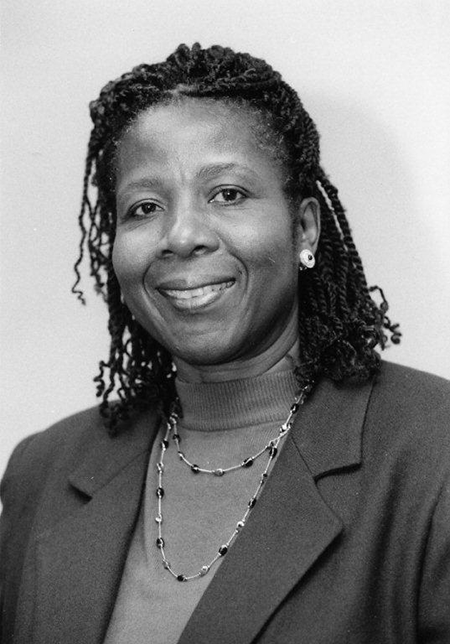
Oral History Interview with Vera Weekes
Item

CUNY
DIGITALHISTORYARCHIVE
CUNY Digital History Archive
Transcript of interview with Vera Weekes
Interviewers: Jean Weisman and Andrea Vasquez
November 6, 2014
New York, NY
Transcription: Transcript Divas Inc.
Transcript edited by: Andrea Vasquez
Jean Weisman: Today is November 6, 2014, and we're interviewing Vera Weekes.
I’m Jean Weisman, and Andrea Vasquez is here both as a technician and to ask
questions. Vera, what was your first job at CUNY?
Vera Weekes: I was an assistant at the Caribbean Research Center at Medgar Evers
College. I started working there November 1990. And I became a HEO [Higher
Education Officer] April 1, 1991.
Jean: Whatis your current job?
Vera: Jama senior paralegal, and a BIA accredited representative at Citizenship
Now, Medgar Evers College.
Jean: What’s a BIA accredited?
Vera: Board of Immigration Appeals. It means, basically, | can—even though I’m
not an attorney—I can go and represent clients at the interviews, or whatever
they’re doing. So that gives me, kind of the same, a little position like an attorney,
but not a full-fledged attorney. But I can do representation.
Andrea Vasquez: And would you tell us a little bit about your background? What
led you to that position?
Vera: Well, first of all, 1am an immigrant. I came to this country in 1989, and, like
all immigrants, I had to work hard. I remember that I went to a school just to get a
foot start, or head start. And I went to - I think the school was called Career
Builders. And I paid $1000 for the course, that used to really help me to get a job in
America. And the lady said to me, “Well, you do not have any American experience.”
And I was shocked. Because I said to her, “You mean I’ve lived and work in England?
I’ve had senior positions in England. So that doesn’t count? And I'd been a teacher in
the high schools and the college in Montserrat, and that doesn’t count?” You know,
so that was really a shocker, that. Okay, so because you don’t have accreditation in
America, you are nobody. So, from then on, I wasn’t going to take any backseat. So, it
was all, go to school, whatever.
Jean: How did you hear about CUNY?
Vera: Well, my children actually attended university. My daughter, when she came,
had already done high school, first year of college, so she went straight to Bronx
Community College. And my neighbor, who knew me from back home, knew of all
my experience, and qualities, and hard work, so he was happy to recruit me at
Medgar Evers College. So that’s how come I entered there. But, really, when I left
Montserrat, I only had two aims and desires. One was to be a professor, and the
other was to work on Wall Street. Those were the only two desires.
Jean: Small ambitions.
Vera: I had actually applied to Hunter College to do my Ph.D., you know, when I
was in Montserrat, and I had gotten accepted. But, you know, I didn’t move at that
time. I came subsequently to that.
Jean: Is the PSC active at Medgar Evers College?
Vera: Oh, yes. We have meetings at least once per quarter, if not more.
Andrea Vasquez: When you first arrived, in 1990, were you immediately involved
with the union at all? Was there a union presence at Medgar when you got there?
Vera: There was a HEO chapter. Not a chapter, but there is a HEO organization at
Medgar. So, I knew of it, and sometime soon after Jean approached me and asked me
to join the union, so, of course, I spoke to folks who were in the HEO chapter. So, at
that time, you know, they thought -- Okay. It was new. New caucus was new,
because the old guards were, I think, gone. I didn’t know too much about the history.
Andrea: So, this was later? This was in 2000, or something?
Jean: Yeah. That was when we were running for office.
Vera: Right.
Jean: In about 2000.
Vera: Two thousand, right, so... There still is a HEO organization. So, they had their
own rules and regulations, and so on.
Andrea: And so before the new caucus was there, you didn’t know about the union
at all?
Vera: Well, I wouldn't say I didn’t know about it, but maybe not involved in it. I
mean, I know there’s a union, because one thing | always tell my children and
myself, “I will never work anyplace where there is no union.” So, of course, I knew
about it. Don’t offer me any job if it’s not union. I’m coming from a union
background. All my life I’ve worked in union shops.
Jean: What are the issues for HEO’s at Medgar Evers?
Vera: Well, recently, there were, to me, a lot of turmoil, I would call it, because
people were being moved around. And, whenever you have changing of the guards...
For want of a better word, I would say ‘turnover,’ because people leave, and then
you have new people come. We have a new President, who is probably there maybe
a year. And the HR Director is there probably a year.
And, so, people don’t know about the culture of, you know, of the college, and so on.
So, sometimes it’s a little hard. But I find that they will tell me certain things. And
when I tell them to call the union and complain, then they don’t do it, so for me, my
observation is there seems to some fear going along. And there’s some unfairness
from the outside looking in ...
Jean: They’re afraid of the union? Is that what you're saying?
Vera: No. They’re not afraid of the union. They know of the union because we’ve
had a very, very, very good union rep. We used to have meetings every month under
Dr. Jackson, before Dr. Jackson left.
Andrea: The President, right? He was the President.
Vera: He was the President there for many years. And he advised me to have
meetings every month. He wanted me to have meetings every month, because he
looked at it as educating the members, because my thing is, if the members... A lot of
them don’t read, they don’t read upon the agreement, and they go along, you know.
So, we used to go through the agreement what the... and he loved it. So, he advised
us to have meetings every month, and they can ask questions, and they feel freer to
do that. So, a lot of them knew about their rights, and what they can and cannot do.
Andrea: So, when you first became involved in the union, when Jean asked you
to join the chapter and take a role in the chapter, as you became involved, what did
you feel about being a HEO in the union? What was it like to become active as a HEO
in the union?
[00:09:00]
Vera: Well, it was exciting times, because we were going... We started off, and there
was Iris, and Jean, and Authyrine. We were like the four people trying to the HEO
chapter revived. And we, actually, split up the colleges. So, I was responsible for
certain colleges, Jean had certain colleges, Authurine had some, and Iris had some.
So, you know, we could drop in anytime. So, it was a good time. It was very, very
exciting, and I think all the members were excited. They learned a lot. And, just by us
going on campus... 1 remember once, we went over to, not York, Kingsborough
Community College. So we used to go during lunchtime and have meetings, and then
come back to work.
Andrea: And what issues did you feel came up for you guys, then?
Vera: Well, I think, for the first time, the HEOs felt represented. They felt they had a
say, because the union was geared towards faculty and not really towards HEOs. So,
this is how we came up with... You know, over time, and having the... what do you
call it? The Labor Management Committee on campus, and what their rights are, in
terms of the 40-hour week and all of that.
Jean: And, were there struggles that you were involved in? Was there a campaign
around the Labor Management committee?
Vera: Oh, yes.
Andrea: You want to tell us a little bit about that?
Vera: Some people will work, because HEOs want to get the job done. So, you know,
I’ve slept at the office, you know. I mean, I’ve stayed at the office from Friday, and I
left my office on Monday night. So... And sometimes when I’m doing proposals, I will
do an overnight at the office, and I’d stay there all night and get stuff done.
So, the President... We went to the President, because you have some managers who
are mean-spirited, in the sense that a HEO would stay late and get the job done. But
let’s say they want to go out or leave early. They would bring the sheet and say,
“Sign.” So, we had a meeting with Dr. Jackson. And he told all of the leaders...
Because, what I did once, I asked him to address the HEOs. And I also sent an
invitation to the HR person to come and address the HEOs And I also asked the labor
designee to come and address the HEOs. I said, “They’re your employees. You tell
them what you expect of them.” You know, not having it all over...
And Dr. Jackson distinctly advised them; he didn’t put it in writing, but he said,
“Lisa,” who is his assistant, if he’s having any function. He said, “Lisa stays.” And I’ve
seen Lisa at events. She stays until the event is completed. Nobody gets overtime.
But he says, “Okay. She stays.” So, if Lisa wants to take her son to the doctor, I let her
go. I don’t ask her to sign anything. So, what he’s saying, it’s a give-and-take. You
can’t want them to stay and get the job done, they don’t get paid, and should they
want a favor, you’re becoming mean-spirited. So, that was one of the concerns he
advised them to do. He didn’t put it in black and white, but that was that
understanding.
Andrea: And was there a citywide similar situation for other people that
you've heard about when you were organizing on other campuses, for example? Or
were there different issues?
Vera: Well, I think it’s, basically, you know, the same sort of issues. I know there
was one serious one where they won some overtime with the people at one of these
colleges. They had to stay, the folks in... Bursar, those people. We spoke to some
people, but I think, again, it’s individuals, individual management. Because when I
asked on campus, what is your procedure? And they would tell me the HEO, “We do
not have a problem.” Because whatever it is, their managers give them days off. So,
everything is done, the informal organization. And that’s what Dr. Jackson was
saying. So, I think... You know, you may get the odd one or two manager who doesn’t
understand how to be bigger, but kind of, a punitive kind of management style.
Jean: How did you get your position as a member of the Executive Council?
Vera: Okay. I think, once I got into the union, I was... 1 think I was there every day. I
think everything that was going, I was in it, because, at that time, the union wanted
to diversify and, you know, have some color in it, and I was... I think I was the only
person of color that was, more or less, visible. So, I came to everything. I was... You
know, I started off as a delegate. I just know I was just there, doing everything. I was
Grievance Counselor, I was on the Executive, I’m on the Legislative... You know, I
was just there everyday.
Jean: Well, did you feel that you had an influence on the policies of the union, or
what was going on with the union?
Vera: Yeah, I think so. I mean... You know, we had a group, when we all sat down
together, and we looked at issues, and so on, and demands. I think we did. I think
there were... You know, I’m proud of that little document, that one-page document
that we got out of all our years of struggle. In the sense that it is now mandatory. It’s
not left at the wills and fancies of punitive managers to accord over time. It’s your
right now. And I think that’s a big achievement.
[00:16:20]
The Labor Management is also an achievement,... | know Kingsborough College had
some successes with it. And I think maybe John Jay. A few colleges have had success.
But it’s a lot of work. It’s really a lot of work, people did it but if you’re going to do all
of that, it’s... you have your own job to do, so it may not be as easy to do.
Andrea: How long did you serve and go to demonstrations?
Vera: I’ma little... Well, you know, really at Medgar, now. I know years ago, we had
a vibrant student body, and you were able to achieve more. I know that they used to
go up to Albany and lobby.
Andrea: In the ‘90s you're talking about?
Vera: No, this is during Dr. Jackson’s time. So, I would think maybe in the ‘90s,
because some of them have jobs now. But I don’t see that... Maybe it’s a different age
group. Maybe back then, they were a little bit more mature.
Andrea: So, tell us about what that was like to have all of that student activism on
the campus? And how were you, or faculty, involved? Were the HEOs and faculty
involved together or was it very separate?
Jean: It was separate, but you may have some of them as work-study students, and
they had their own clubs, and you could talk to them. You'd give them fliers. And I
think it’s probably that bunch that was there. There were probably a little bit more
politically astute. So, now what you have, you probably have a younger generation
that is not... They don’t have the same background. I mean like, say, those people
that were there; the older people. Some of them had a lot of background from the
Caribbean, and brought with them their own political things.
You know, but those were... 1 mean, I don’t have a lot of time, now, since I’m doing
Immigration, to go around, because it’s very, very demanding. And we work by
appointments, and they don’t miss the appointments. So, I couldn’t do that now,
what I did years ago. I’d have to make sure that I block off a lot of time.
Jean: Remember you told me you got referrals from all over the city?
Vera: Allover the city, and the thing about it is that now I’m trying to wean them
off, because, you know, I’ve been doing this since 2007, so this is seven years. So, I
start off with some clients where they get their Green Card, then they become
citizens, then they file for their children, and then their children are getting their
citizenship, so they’ve been with me, like, seven years. And they come there, and
they ask for Miss Vera. And they don’t want to see anyone else. So, you know, I have
to tell them, “You've got to see other people.” Sometimes they go and they sit with
someone else, and they get up because they think they were coming to see me. So I
tell them, “Please don’t do that.”
Jean: But they’re not students at Medgar?
Vera: No. We serve anybody.
Jean: So you area really strong connection to the community?
Vera: Oh, yes. All over.
Jean: And, not only your immediate community, the whole city.
Vera: All over. And we even have people outside of New York City coming.
Jean: Whatis your family situation?
Vera: You mean presently? Well, presently, I’m ready to retire. As soon as we get
this elusive contract on the way so I can... And my husband is already retired.
Andrea: Let me follow up. You mentioned the contract. When you were on the
Executive Counsel, you must have been there for some contracts. What was that
like?
Vera: Well, I wasn’t really part of the team. We did go and observe, because they
choose whoever they want. Iris was... Well, it was Iris and Jean, at one time, who
were in that group. And we had the opportunity to come and do observations.
Jean: And was there a campaign to get a good contract, that you were involved in?
Vera: Oh, yes. We always have campaigns. And, we would go around and talk to
people one-on-one. You know, they’re very receptive and, no problems, really, on
campus, in terms of, you know, giving them advice and getting cooperation.
Jean: Tell us about your experience in Montserrat, and the work you did in the U.S.
Congress.
Vera: Strange. I was telling the legislative coordinator about my work with
Congress. When I was in Montserrat, I really didn’t join the union of my free will,
because I have four children. So, the President wanted someone to help with the
secretarial duties. So, he came and asked me, and I warned him, I said, “Listen. I have
four children.” I have extended family, because all my family are in England. I was
living in England and came back, because the government wanted us to come back;
my husband to help with science, and I was to help with business.
So, he says, “No. It’s just to help with the secretarial part of it. You’re not getting
involved.” But, eventually, I ended up being the secretary, the Vice President,
everything. And we actually used to produce a newspaper. So, even though I was not
supposed to go in to do a lot of work, I ended up doing a lot of work, and we used to
raise a lot of money for the...you know. So, we didn’t increase membership; we
raised funds. That’s how we did it back then.
And then I came here in 1989. And then in 1995, we had the volcano in Montserrat,
and I was very much involved in trying to get a bill introduced in Congress for the
Montserratians to get permanent residence. Because, you know, I did several site
visits, and, you have to be strong when you see people who had palatial homes were
now subjected to sleeping in cots. And everything they had, they had lost. So, it
wasn’t a good experience.
So when I came back, I was so traumatized. So, I started... | sent out something on
the blog, and I said, “Oh, can you adopt a family?” So I was looking for people to
adopt a family and just give them the support. But people didn’t want to do that, so
they just sent me money, and then I would go down and distribute the money to the
families. And, I did that, maybe, like, on four occasions. And then | realized -- Okay,
they can’t go back. So why not see if I could get permanent status. And we did very
well. We had a lot of... Major donors introduced the bill. We had a lot of co-sponsors.
And I would go up to Congress, and I would visit the 435 members of Congress. And
I would go on a Monday, and I come back on a Thursday. So, I visited every single
person and leave it. And they were very supportive. I had several co-sponsors, and
the bill was going fine. And then came 9/11. And once 9/11 came, the country
became very anti-immigrant. So, the bill was re-introduced again, but you know, it
just petered out. And then after a while, Tom Ridge decided that he was going to
terminate TPS (Temporary Protected Status) So, you know, I worked on it for, like,
five, six years. So it was a lot of work. Just going up, by myself, to lobby, was that.
So... It will be 20 years.
Jean: Did that experience help you, in terms of doing union work? Did you work on
the Legislative Committee, or work with the Legislative Committee?
Vera: Right, right, right, because, you know, now! think I can talk to anybody. I can
do any lobbying. You know, you just got to set it up, and so on. So, you know, I love
to go to Albany. And I try to go as often as I can, because, you know, it’s real issues.
It’s not every issue that pertains to the HEOs because we got a win situation. And
when I’m talking to the HEOs I said, “Look. It took us ten years to not pay that 3%.”
Right?
I think you had penned that beautifully where you said that when they were
doing...when the city was giving the tenure to the other group. The TIAA - CREF
employees were left off. Because you penned it, Jean penned it very nicely. It was
really an oversight. And so for ten years, we went up to Albany. Sometimes we were
saying the same thing, you know, and you go from one person, you're going to the
next assemblyman, Senator, like, you’re saying the same thing, and... But I said,
“After ten years, we won.”
So, it’s not a walk in the park, so you have to tell folks. I said, “Don’t become
despondent. If you say it enough times, and you're persistent, you will get through.”
If you believe in what you're fighting for, do not give up. Walk. Let your boots do the
walking and your mouth do the talking. If you believe it, it will happen. And it
happened.
Jean: You were studying the history of the PSC and the people that were involved.
And is there anything you'd like to add, in terms of your own impressions or the
importance of the PSC?
Vera: As I started off saying, I will not work anyplace that is not unionized. I realize
we are living more now in an anti-union era, but I usually say, “As weak as the union
may be, it is still strong,” you know. And I can give you an example at the college that
happened a few months ago. Someone worked in HR. She was a HEO associate, and
they terminated her for no reason. She was a HEO associate, and those people told
her, “You have no rights.” And they moved her. And she doesn’t even have a job
description. But the job they offered her is an assistant to a HEO. That is the power
of the union.
If she was unionized, it would never happen. And the poor young lady; she was by
me last week. I said to her, “Listen. I don’t know what to tell you. You got to pull
yourself up.” She’s just a shadow of herself, because when you’re in HR, you’re out of
the union. They used that, and trampled the poor girl. So, that, in a nutshell, is the
power of the union.
Jean: Is she in the union now?
Vera: She’s in the union now, but it’s, like, they just picked her up off the street, and
offered her a job. Even though all her benefits are there, she...
Jean: She got demoted.
Vera: Yes. And she’s just like anybody, so she has to... She wouldn’t get 13.3b until
the next 8, 9 years.
Jean: Explain what 13.3b is.
Vera: Okay. After you’ve been in the union for four years; every year you're
evaluated, and they will say whether they’re going to reappoint you or non-
reappointment, and that goes on every year for four years. After that, it’s done every
two years. And then you get two two-year reappointments. So, that’s about eight
years. Then, you're not evaluated... You’re evaluated, but they can’t just get rid of
you like that. They have to give you three annual negative evaluations [in order to
fire you].
We call it tenure but it’s different from faculty, because they have to give you three
annual negative evaluations. There was talk of Management wanting to make it
three annual...three negative evaluations. And they could come three times in the
month, and boot you out. So, at least, that you have some kind of job security. Even
though it’s not full security, but you have three years in which to make your case. So,
what we normally advise our colleagues: The first time you get a negative
evaluation, call the union. And that’s the advice we give to everybody. Call your
union and have a talk. Don’t take anything for granted. So, that, to me, is the power
of having the union on your side.
[00:32:16]
Andrea: And the other issue, the issue of the HEO series being a non-promotional
series. Have you had experiences around that struggle?
Vera: Yes. I actually made that one of my agenda items for every HEO meeting that
I have. The reason being, many years ago, I remember we had a HEO meeting at
Hunter College. I don’t know if Jean remembered it. And we had asked Steve London
had come as a speaker, and J think Iris was there. And this lady, she didn’t cry, she
bawled. She was from BMCC. And we used to go there and have HEO too. Because, as
I said, we had all these colleges, and we used to visit them. It was very, very nice. I
loved it. And, she came to the meeting, and she just bawled because she’s stuck as a
HEO associate, all these years; she’s not getting any more monies, there’s no
promotion, and she just felt that her back was against the wall.
Andrea: She was at the top salary step. She couldn't go...
Vera: Right. There was nowhere else. She couldn’t get any increments. It’s not
promotional. And, her supervisor, who was a full HEO, he said, “Listen. I would do
anything in the world just for her to be able to get an increment or two, but because
you can’t have a full HEO reporting to a full HEO. So, you know, those are the
ramifications of that.
So, I always use that incident to advise HEOs “Okay. You need to start thinking
whether you want to spend the rest of your life in CUNY. And you have to look at the
salary. And once you reach the top, you're stuck. You could be stuck there for 15
years, and there’s no way out.” So, you know, and I usually say, “The lady didn’t cry,
she bawled.” That’s how traumatic it was. But that’s the reality. You know, how can
we, sort of, work around that once? Most people are happy until they get to the point
of no return, where there’s nowhere else to go. And there may not be another job
that they can move to.
Andrea: And did that experience move you to organize around this issue? Was
there a campaign to change this? Contract, anything like that?
Vera: Well, we always talk about how to do it, you know, but it’s going to take... You
know, having gone through the whole reclassification issue. It’s not that easy.
Andrea: So, that was posed as a solution...
Vera: Yes. Right. So, one of the things I would try to do is educate them, so that
remember, do not become complacent in the job that you have. Because, if you’re a
HEO assistant now, okay, you can go to school, you can do other things, you may
move yourself out of that. You probably could become a computer tech. So if you’re
just doing clerical work, and you’re at the front desk, doing admin, think about ways
you can change your position down the road, and not finding ten years, when you
reach the top, and there’s no way out. So, start, you know, focusing on career
movement, than reaching the stage where the young lady was. I mean, at her stage,
there’s no way to go, because she wasn’t just, like, a 35-year-old. You know, I don’t
know if she’s retired by now, but when you reach a certain stage and age in life, then
you have take what is there.
So, my focus has always been to tell people what is there. Then they can make
intelligent decisions. And maybe those would be the same advocates who will push
for the reclassification to be changed. Because once they reach the endline - ok, I
know I'm talking about... Okay. I want it to be... Not that I could not have been a full
HEO but when the Vice President, who was doing the reclassification, they didn’t ask
for my input, and they didn’t know what they were doing. So, they did it without
consultation.
When I changed from a HEO assistant to a HEO associate, the labor designee had me
involved, so we worked on it together. So when it reached 80* Street, (no longer) it
was okay. These people didn’t involve me. And so, when it got to 80" Street, it
wasn’t completed properly. They returned it. By the time they returned it, it was too
late because there was a freeze. You know, so...
Jean: But you did get the HEO associate?
Vera: Yes. I got the HEO associate.
Jean: But the other people that were working on it, didn’t...?
Vera: On the full HEO didn’t do it right.
Jean: Isee.
Vera: And then, you know, all these years I’m just there. But I’m not going to bawl
over it because that is what the contract...
Jean: And you're, basically, in charge of the department, right?
Vera: Yes. 1 was the director for...
Andrea: Maybe my last question about the past has to do with your mentioning the
freeze. And I alluded to it with student activism, and things like that. But things must
have changed when the budget was seen as so problematic. Did you experience any
change in the culture? -- You mentioned the culture of the college or in the practice
of what could be done, and what could not be done, as a result?
Vera: I mean, where there’s good will... It’s not that I didn’t try, because there’s
always a way to get around giving more money. And I went to the President, and I
said, look, there’s this chapter, whatever, part of the agreement. I mean, if someone
has skills, and so on, you can give them a 30% increase. And they do it. They get it
done for their friends. You know what I mean? But, then he said to me, he said,
“Look, Vera. I’m willing to do it, but they’ve clipped my wings.” He said, “I don’t have
the power that I used to have. I don’t have it anymore.” What you going to do?
So, you know, there’s a lot of issues, and I think people become frustrated when they
don’t see any promotion. And, it’s the same old same where you come in, you’re
doing all that effort, and your probably getting the same salary for ten years or 15
years. And so, maybe sometimes you may be moving them to another department,
or something, you know. I don’t know.
Because people become complacent and, you know, they could be harboring... I’m
working and I’m not getting any money for the effort I’m putting in, you know? But
these are real challenges, and I think our biggest challenge would be how do we deal
with the reclassification and promotion? So, I think if we... That’s something that we
could work on, and maybe, you know, come up with something that’s workable.
Andrea: Well, as you said earlier -- Just keep plugging away at those issues, and at
the worst, and, hopefully, we break through some day soon.
Vera: Yes. Yeah.
Andrea: Soon.
Vera: Yes.
Andrea: This contract.
Vera: No. You just have to be strong, and that’s what I tell them. I said, “It took ten
years, but we didn’t lose what we wanted.” So, we got it in ten. It may have taken 20.
But if you believe that it’s right, then you do it. And that’s how you win battles, you
know. And then we need more people to come in so that we have more people to
fight the battles.
I usually say, “Management don’t like unions.” You know, but, as weak...because
unions have lost. I’ve lived in England where I see union lost. They, virtually killed
the union under Margaret Thatcher’s reign. And, more and more, I remember when
Roger Toussaint went to jail because he was saying, you know, “We have to protect
the younger people coming in.” And, more and more the people, the younger people,
are the new entrants, and getting the privilege that we have the union rights. So, by
them tapping away at the entry-level people, you have to understand, this is a tactic.
The union is going to become weaker and weaker.
So, even though it’s the new entries, it’s eventually what the union is going to look
like, because things that we’ve had, they’re not going to have. But, remember, once
we move off the scene, it’s these new things that they these new people, will be the
backbone of the union. So, you know, that’s something that we have to fight for so
that it’s not weakened too much for the new people, because we're there to say,
“Yeah, yeah, yeah. Have all these little privileges and rights.” But they won’t be
around.
Jean: Well, thank you very much. Your insights have been really important, and
you really provide an important history of the PSC when you speak.
Andrea: Thank you, Vera.
Vera: Right. Thank you.
[End of recorded material 00:43:19]
DIGITALHISTORYARCHIVE
CUNY Digital History Archive
Transcript of interview with Vera Weekes
Interviewers: Jean Weisman and Andrea Vasquez
November 6, 2014
New York, NY
Transcription: Transcript Divas Inc.
Transcript edited by: Andrea Vasquez
Jean Weisman: Today is November 6, 2014, and we're interviewing Vera Weekes.
I’m Jean Weisman, and Andrea Vasquez is here both as a technician and to ask
questions. Vera, what was your first job at CUNY?
Vera Weekes: I was an assistant at the Caribbean Research Center at Medgar Evers
College. I started working there November 1990. And I became a HEO [Higher
Education Officer] April 1, 1991.
Jean: Whatis your current job?
Vera: Jama senior paralegal, and a BIA accredited representative at Citizenship
Now, Medgar Evers College.
Jean: What’s a BIA accredited?
Vera: Board of Immigration Appeals. It means, basically, | can—even though I’m
not an attorney—I can go and represent clients at the interviews, or whatever
they’re doing. So that gives me, kind of the same, a little position like an attorney,
but not a full-fledged attorney. But I can do representation.
Andrea Vasquez: And would you tell us a little bit about your background? What
led you to that position?
Vera: Well, first of all, 1am an immigrant. I came to this country in 1989, and, like
all immigrants, I had to work hard. I remember that I went to a school just to get a
foot start, or head start. And I went to - I think the school was called Career
Builders. And I paid $1000 for the course, that used to really help me to get a job in
America. And the lady said to me, “Well, you do not have any American experience.”
And I was shocked. Because I said to her, “You mean I’ve lived and work in England?
I’ve had senior positions in England. So that doesn’t count? And I'd been a teacher in
the high schools and the college in Montserrat, and that doesn’t count?” You know,
so that was really a shocker, that. Okay, so because you don’t have accreditation in
America, you are nobody. So, from then on, I wasn’t going to take any backseat. So, it
was all, go to school, whatever.
Jean: How did you hear about CUNY?
Vera: Well, my children actually attended university. My daughter, when she came,
had already done high school, first year of college, so she went straight to Bronx
Community College. And my neighbor, who knew me from back home, knew of all
my experience, and qualities, and hard work, so he was happy to recruit me at
Medgar Evers College. So that’s how come I entered there. But, really, when I left
Montserrat, I only had two aims and desires. One was to be a professor, and the
other was to work on Wall Street. Those were the only two desires.
Jean: Small ambitions.
Vera: I had actually applied to Hunter College to do my Ph.D., you know, when I
was in Montserrat, and I had gotten accepted. But, you know, I didn’t move at that
time. I came subsequently to that.
Jean: Is the PSC active at Medgar Evers College?
Vera: Oh, yes. We have meetings at least once per quarter, if not more.
Andrea Vasquez: When you first arrived, in 1990, were you immediately involved
with the union at all? Was there a union presence at Medgar when you got there?
Vera: There was a HEO chapter. Not a chapter, but there is a HEO organization at
Medgar. So, I knew of it, and sometime soon after Jean approached me and asked me
to join the union, so, of course, I spoke to folks who were in the HEO chapter. So, at
that time, you know, they thought -- Okay. It was new. New caucus was new,
because the old guards were, I think, gone. I didn’t know too much about the history.
Andrea: So, this was later? This was in 2000, or something?
Jean: Yeah. That was when we were running for office.
Vera: Right.
Jean: In about 2000.
Vera: Two thousand, right, so... There still is a HEO organization. So, they had their
own rules and regulations, and so on.
Andrea: And so before the new caucus was there, you didn’t know about the union
at all?
Vera: Well, I wouldn't say I didn’t know about it, but maybe not involved in it. I
mean, I know there’s a union, because one thing | always tell my children and
myself, “I will never work anyplace where there is no union.” So, of course, I knew
about it. Don’t offer me any job if it’s not union. I’m coming from a union
background. All my life I’ve worked in union shops.
Jean: What are the issues for HEO’s at Medgar Evers?
Vera: Well, recently, there were, to me, a lot of turmoil, I would call it, because
people were being moved around. And, whenever you have changing of the guards...
For want of a better word, I would say ‘turnover,’ because people leave, and then
you have new people come. We have a new President, who is probably there maybe
a year. And the HR Director is there probably a year.
And, so, people don’t know about the culture of, you know, of the college, and so on.
So, sometimes it’s a little hard. But I find that they will tell me certain things. And
when I tell them to call the union and complain, then they don’t do it, so for me, my
observation is there seems to some fear going along. And there’s some unfairness
from the outside looking in ...
Jean: They’re afraid of the union? Is that what you're saying?
Vera: No. They’re not afraid of the union. They know of the union because we’ve
had a very, very, very good union rep. We used to have meetings every month under
Dr. Jackson, before Dr. Jackson left.
Andrea: The President, right? He was the President.
Vera: He was the President there for many years. And he advised me to have
meetings every month. He wanted me to have meetings every month, because he
looked at it as educating the members, because my thing is, if the members... A lot of
them don’t read, they don’t read upon the agreement, and they go along, you know.
So, we used to go through the agreement what the... and he loved it. So, he advised
us to have meetings every month, and they can ask questions, and they feel freer to
do that. So, a lot of them knew about their rights, and what they can and cannot do.
Andrea: So, when you first became involved in the union, when Jean asked you
to join the chapter and take a role in the chapter, as you became involved, what did
you feel about being a HEO in the union? What was it like to become active as a HEO
in the union?
[00:09:00]
Vera: Well, it was exciting times, because we were going... We started off, and there
was Iris, and Jean, and Authyrine. We were like the four people trying to the HEO
chapter revived. And we, actually, split up the colleges. So, I was responsible for
certain colleges, Jean had certain colleges, Authurine had some, and Iris had some.
So, you know, we could drop in anytime. So, it was a good time. It was very, very
exciting, and I think all the members were excited. They learned a lot. And, just by us
going on campus... 1 remember once, we went over to, not York, Kingsborough
Community College. So we used to go during lunchtime and have meetings, and then
come back to work.
Andrea: And what issues did you feel came up for you guys, then?
Vera: Well, I think, for the first time, the HEOs felt represented. They felt they had a
say, because the union was geared towards faculty and not really towards HEOs. So,
this is how we came up with... You know, over time, and having the... what do you
call it? The Labor Management Committee on campus, and what their rights are, in
terms of the 40-hour week and all of that.
Jean: And, were there struggles that you were involved in? Was there a campaign
around the Labor Management committee?
Vera: Oh, yes.
Andrea: You want to tell us a little bit about that?
Vera: Some people will work, because HEOs want to get the job done. So, you know,
I’ve slept at the office, you know. I mean, I’ve stayed at the office from Friday, and I
left my office on Monday night. So... And sometimes when I’m doing proposals, I will
do an overnight at the office, and I’d stay there all night and get stuff done.
So, the President... We went to the President, because you have some managers who
are mean-spirited, in the sense that a HEO would stay late and get the job done. But
let’s say they want to go out or leave early. They would bring the sheet and say,
“Sign.” So, we had a meeting with Dr. Jackson. And he told all of the leaders...
Because, what I did once, I asked him to address the HEOs. And I also sent an
invitation to the HR person to come and address the HEOs And I also asked the labor
designee to come and address the HEOs. I said, “They’re your employees. You tell
them what you expect of them.” You know, not having it all over...
And Dr. Jackson distinctly advised them; he didn’t put it in writing, but he said,
“Lisa,” who is his assistant, if he’s having any function. He said, “Lisa stays.” And I’ve
seen Lisa at events. She stays until the event is completed. Nobody gets overtime.
But he says, “Okay. She stays.” So, if Lisa wants to take her son to the doctor, I let her
go. I don’t ask her to sign anything. So, what he’s saying, it’s a give-and-take. You
can’t want them to stay and get the job done, they don’t get paid, and should they
want a favor, you’re becoming mean-spirited. So, that was one of the concerns he
advised them to do. He didn’t put it in black and white, but that was that
understanding.
Andrea: And was there a citywide similar situation for other people that
you've heard about when you were organizing on other campuses, for example? Or
were there different issues?
Vera: Well, I think it’s, basically, you know, the same sort of issues. I know there
was one serious one where they won some overtime with the people at one of these
colleges. They had to stay, the folks in... Bursar, those people. We spoke to some
people, but I think, again, it’s individuals, individual management. Because when I
asked on campus, what is your procedure? And they would tell me the HEO, “We do
not have a problem.” Because whatever it is, their managers give them days off. So,
everything is done, the informal organization. And that’s what Dr. Jackson was
saying. So, I think... You know, you may get the odd one or two manager who doesn’t
understand how to be bigger, but kind of, a punitive kind of management style.
Jean: How did you get your position as a member of the Executive Council?
Vera: Okay. I think, once I got into the union, I was... 1 think I was there every day. I
think everything that was going, I was in it, because, at that time, the union wanted
to diversify and, you know, have some color in it, and I was... I think I was the only
person of color that was, more or less, visible. So, I came to everything. I was... You
know, I started off as a delegate. I just know I was just there, doing everything. I was
Grievance Counselor, I was on the Executive, I’m on the Legislative... You know, I
was just there everyday.
Jean: Well, did you feel that you had an influence on the policies of the union, or
what was going on with the union?
Vera: Yeah, I think so. I mean... You know, we had a group, when we all sat down
together, and we looked at issues, and so on, and demands. I think we did. I think
there were... You know, I’m proud of that little document, that one-page document
that we got out of all our years of struggle. In the sense that it is now mandatory. It’s
not left at the wills and fancies of punitive managers to accord over time. It’s your
right now. And I think that’s a big achievement.
[00:16:20]
The Labor Management is also an achievement,... | know Kingsborough College had
some successes with it. And I think maybe John Jay. A few colleges have had success.
But it’s a lot of work. It’s really a lot of work, people did it but if you’re going to do all
of that, it’s... you have your own job to do, so it may not be as easy to do.
Andrea: How long did you serve and go to demonstrations?
Vera: I’ma little... Well, you know, really at Medgar, now. I know years ago, we had
a vibrant student body, and you were able to achieve more. I know that they used to
go up to Albany and lobby.
Andrea: In the ‘90s you're talking about?
Vera: No, this is during Dr. Jackson’s time. So, I would think maybe in the ‘90s,
because some of them have jobs now. But I don’t see that... Maybe it’s a different age
group. Maybe back then, they were a little bit more mature.
Andrea: So, tell us about what that was like to have all of that student activism on
the campus? And how were you, or faculty, involved? Were the HEOs and faculty
involved together or was it very separate?
Jean: It was separate, but you may have some of them as work-study students, and
they had their own clubs, and you could talk to them. You'd give them fliers. And I
think it’s probably that bunch that was there. There were probably a little bit more
politically astute. So, now what you have, you probably have a younger generation
that is not... They don’t have the same background. I mean like, say, those people
that were there; the older people. Some of them had a lot of background from the
Caribbean, and brought with them their own political things.
You know, but those were... 1 mean, I don’t have a lot of time, now, since I’m doing
Immigration, to go around, because it’s very, very demanding. And we work by
appointments, and they don’t miss the appointments. So, I couldn’t do that now,
what I did years ago. I’d have to make sure that I block off a lot of time.
Jean: Remember you told me you got referrals from all over the city?
Vera: Allover the city, and the thing about it is that now I’m trying to wean them
off, because, you know, I’ve been doing this since 2007, so this is seven years. So, I
start off with some clients where they get their Green Card, then they become
citizens, then they file for their children, and then their children are getting their
citizenship, so they’ve been with me, like, seven years. And they come there, and
they ask for Miss Vera. And they don’t want to see anyone else. So, you know, I have
to tell them, “You've got to see other people.” Sometimes they go and they sit with
someone else, and they get up because they think they were coming to see me. So I
tell them, “Please don’t do that.”
Jean: But they’re not students at Medgar?
Vera: No. We serve anybody.
Jean: So you area really strong connection to the community?
Vera: Oh, yes. All over.
Jean: And, not only your immediate community, the whole city.
Vera: All over. And we even have people outside of New York City coming.
Jean: Whatis your family situation?
Vera: You mean presently? Well, presently, I’m ready to retire. As soon as we get
this elusive contract on the way so I can... And my husband is already retired.
Andrea: Let me follow up. You mentioned the contract. When you were on the
Executive Counsel, you must have been there for some contracts. What was that
like?
Vera: Well, I wasn’t really part of the team. We did go and observe, because they
choose whoever they want. Iris was... Well, it was Iris and Jean, at one time, who
were in that group. And we had the opportunity to come and do observations.
Jean: And was there a campaign to get a good contract, that you were involved in?
Vera: Oh, yes. We always have campaigns. And, we would go around and talk to
people one-on-one. You know, they’re very receptive and, no problems, really, on
campus, in terms of, you know, giving them advice and getting cooperation.
Jean: Tell us about your experience in Montserrat, and the work you did in the U.S.
Congress.
Vera: Strange. I was telling the legislative coordinator about my work with
Congress. When I was in Montserrat, I really didn’t join the union of my free will,
because I have four children. So, the President wanted someone to help with the
secretarial duties. So, he came and asked me, and I warned him, I said, “Listen. I have
four children.” I have extended family, because all my family are in England. I was
living in England and came back, because the government wanted us to come back;
my husband to help with science, and I was to help with business.
So, he says, “No. It’s just to help with the secretarial part of it. You’re not getting
involved.” But, eventually, I ended up being the secretary, the Vice President,
everything. And we actually used to produce a newspaper. So, even though I was not
supposed to go in to do a lot of work, I ended up doing a lot of work, and we used to
raise a lot of money for the...you know. So, we didn’t increase membership; we
raised funds. That’s how we did it back then.
And then I came here in 1989. And then in 1995, we had the volcano in Montserrat,
and I was very much involved in trying to get a bill introduced in Congress for the
Montserratians to get permanent residence. Because, you know, I did several site
visits, and, you have to be strong when you see people who had palatial homes were
now subjected to sleeping in cots. And everything they had, they had lost. So, it
wasn’t a good experience.
So when I came back, I was so traumatized. So, I started... | sent out something on
the blog, and I said, “Oh, can you adopt a family?” So I was looking for people to
adopt a family and just give them the support. But people didn’t want to do that, so
they just sent me money, and then I would go down and distribute the money to the
families. And, I did that, maybe, like, on four occasions. And then | realized -- Okay,
they can’t go back. So why not see if I could get permanent status. And we did very
well. We had a lot of... Major donors introduced the bill. We had a lot of co-sponsors.
And I would go up to Congress, and I would visit the 435 members of Congress. And
I would go on a Monday, and I come back on a Thursday. So, I visited every single
person and leave it. And they were very supportive. I had several co-sponsors, and
the bill was going fine. And then came 9/11. And once 9/11 came, the country
became very anti-immigrant. So, the bill was re-introduced again, but you know, it
just petered out. And then after a while, Tom Ridge decided that he was going to
terminate TPS (Temporary Protected Status) So, you know, I worked on it for, like,
five, six years. So it was a lot of work. Just going up, by myself, to lobby, was that.
So... It will be 20 years.
Jean: Did that experience help you, in terms of doing union work? Did you work on
the Legislative Committee, or work with the Legislative Committee?
Vera: Right, right, right, because, you know, now! think I can talk to anybody. I can
do any lobbying. You know, you just got to set it up, and so on. So, you know, I love
to go to Albany. And I try to go as often as I can, because, you know, it’s real issues.
It’s not every issue that pertains to the HEOs because we got a win situation. And
when I’m talking to the HEOs I said, “Look. It took us ten years to not pay that 3%.”
Right?
I think you had penned that beautifully where you said that when they were
doing...when the city was giving the tenure to the other group. The TIAA - CREF
employees were left off. Because you penned it, Jean penned it very nicely. It was
really an oversight. And so for ten years, we went up to Albany. Sometimes we were
saying the same thing, you know, and you go from one person, you're going to the
next assemblyman, Senator, like, you’re saying the same thing, and... But I said,
“After ten years, we won.”
So, it’s not a walk in the park, so you have to tell folks. I said, “Don’t become
despondent. If you say it enough times, and you're persistent, you will get through.”
If you believe in what you're fighting for, do not give up. Walk. Let your boots do the
walking and your mouth do the talking. If you believe it, it will happen. And it
happened.
Jean: You were studying the history of the PSC and the people that were involved.
And is there anything you'd like to add, in terms of your own impressions or the
importance of the PSC?
Vera: As I started off saying, I will not work anyplace that is not unionized. I realize
we are living more now in an anti-union era, but I usually say, “As weak as the union
may be, it is still strong,” you know. And I can give you an example at the college that
happened a few months ago. Someone worked in HR. She was a HEO associate, and
they terminated her for no reason. She was a HEO associate, and those people told
her, “You have no rights.” And they moved her. And she doesn’t even have a job
description. But the job they offered her is an assistant to a HEO. That is the power
of the union.
If she was unionized, it would never happen. And the poor young lady; she was by
me last week. I said to her, “Listen. I don’t know what to tell you. You got to pull
yourself up.” She’s just a shadow of herself, because when you’re in HR, you’re out of
the union. They used that, and trampled the poor girl. So, that, in a nutshell, is the
power of the union.
Jean: Is she in the union now?
Vera: She’s in the union now, but it’s, like, they just picked her up off the street, and
offered her a job. Even though all her benefits are there, she...
Jean: She got demoted.
Vera: Yes. And she’s just like anybody, so she has to... She wouldn’t get 13.3b until
the next 8, 9 years.
Jean: Explain what 13.3b is.
Vera: Okay. After you’ve been in the union for four years; every year you're
evaluated, and they will say whether they’re going to reappoint you or non-
reappointment, and that goes on every year for four years. After that, it’s done every
two years. And then you get two two-year reappointments. So, that’s about eight
years. Then, you're not evaluated... You’re evaluated, but they can’t just get rid of
you like that. They have to give you three annual negative evaluations [in order to
fire you].
We call it tenure but it’s different from faculty, because they have to give you three
annual negative evaluations. There was talk of Management wanting to make it
three annual...three negative evaluations. And they could come three times in the
month, and boot you out. So, at least, that you have some kind of job security. Even
though it’s not full security, but you have three years in which to make your case. So,
what we normally advise our colleagues: The first time you get a negative
evaluation, call the union. And that’s the advice we give to everybody. Call your
union and have a talk. Don’t take anything for granted. So, that, to me, is the power
of having the union on your side.
[00:32:16]
Andrea: And the other issue, the issue of the HEO series being a non-promotional
series. Have you had experiences around that struggle?
Vera: Yes. I actually made that one of my agenda items for every HEO meeting that
I have. The reason being, many years ago, I remember we had a HEO meeting at
Hunter College. I don’t know if Jean remembered it. And we had asked Steve London
had come as a speaker, and J think Iris was there. And this lady, she didn’t cry, she
bawled. She was from BMCC. And we used to go there and have HEO too. Because, as
I said, we had all these colleges, and we used to visit them. It was very, very nice. I
loved it. And, she came to the meeting, and she just bawled because she’s stuck as a
HEO associate, all these years; she’s not getting any more monies, there’s no
promotion, and she just felt that her back was against the wall.
Andrea: She was at the top salary step. She couldn't go...
Vera: Right. There was nowhere else. She couldn’t get any increments. It’s not
promotional. And, her supervisor, who was a full HEO, he said, “Listen. I would do
anything in the world just for her to be able to get an increment or two, but because
you can’t have a full HEO reporting to a full HEO. So, you know, those are the
ramifications of that.
So, I always use that incident to advise HEOs “Okay. You need to start thinking
whether you want to spend the rest of your life in CUNY. And you have to look at the
salary. And once you reach the top, you're stuck. You could be stuck there for 15
years, and there’s no way out.” So, you know, and I usually say, “The lady didn’t cry,
she bawled.” That’s how traumatic it was. But that’s the reality. You know, how can
we, sort of, work around that once? Most people are happy until they get to the point
of no return, where there’s nowhere else to go. And there may not be another job
that they can move to.
Andrea: And did that experience move you to organize around this issue? Was
there a campaign to change this? Contract, anything like that?
Vera: Well, we always talk about how to do it, you know, but it’s going to take... You
know, having gone through the whole reclassification issue. It’s not that easy.
Andrea: So, that was posed as a solution...
Vera: Yes. Right. So, one of the things I would try to do is educate them, so that
remember, do not become complacent in the job that you have. Because, if you’re a
HEO assistant now, okay, you can go to school, you can do other things, you may
move yourself out of that. You probably could become a computer tech. So if you’re
just doing clerical work, and you’re at the front desk, doing admin, think about ways
you can change your position down the road, and not finding ten years, when you
reach the top, and there’s no way out. So, start, you know, focusing on career
movement, than reaching the stage where the young lady was. I mean, at her stage,
there’s no way to go, because she wasn’t just, like, a 35-year-old. You know, I don’t
know if she’s retired by now, but when you reach a certain stage and age in life, then
you have take what is there.
So, my focus has always been to tell people what is there. Then they can make
intelligent decisions. And maybe those would be the same advocates who will push
for the reclassification to be changed. Because once they reach the endline - ok, I
know I'm talking about... Okay. I want it to be... Not that I could not have been a full
HEO but when the Vice President, who was doing the reclassification, they didn’t ask
for my input, and they didn’t know what they were doing. So, they did it without
consultation.
When I changed from a HEO assistant to a HEO associate, the labor designee had me
involved, so we worked on it together. So when it reached 80* Street, (no longer) it
was okay. These people didn’t involve me. And so, when it got to 80" Street, it
wasn’t completed properly. They returned it. By the time they returned it, it was too
late because there was a freeze. You know, so...
Jean: But you did get the HEO associate?
Vera: Yes. I got the HEO associate.
Jean: But the other people that were working on it, didn’t...?
Vera: On the full HEO didn’t do it right.
Jean: Isee.
Vera: And then, you know, all these years I’m just there. But I’m not going to bawl
over it because that is what the contract...
Jean: And you're, basically, in charge of the department, right?
Vera: Yes. 1 was the director for...
Andrea: Maybe my last question about the past has to do with your mentioning the
freeze. And I alluded to it with student activism, and things like that. But things must
have changed when the budget was seen as so problematic. Did you experience any
change in the culture? -- You mentioned the culture of the college or in the practice
of what could be done, and what could not be done, as a result?
Vera: I mean, where there’s good will... It’s not that I didn’t try, because there’s
always a way to get around giving more money. And I went to the President, and I
said, look, there’s this chapter, whatever, part of the agreement. I mean, if someone
has skills, and so on, you can give them a 30% increase. And they do it. They get it
done for their friends. You know what I mean? But, then he said to me, he said,
“Look, Vera. I’m willing to do it, but they’ve clipped my wings.” He said, “I don’t have
the power that I used to have. I don’t have it anymore.” What you going to do?
So, you know, there’s a lot of issues, and I think people become frustrated when they
don’t see any promotion. And, it’s the same old same where you come in, you’re
doing all that effort, and your probably getting the same salary for ten years or 15
years. And so, maybe sometimes you may be moving them to another department,
or something, you know. I don’t know.
Because people become complacent and, you know, they could be harboring... I’m
working and I’m not getting any money for the effort I’m putting in, you know? But
these are real challenges, and I think our biggest challenge would be how do we deal
with the reclassification and promotion? So, I think if we... That’s something that we
could work on, and maybe, you know, come up with something that’s workable.
Andrea: Well, as you said earlier -- Just keep plugging away at those issues, and at
the worst, and, hopefully, we break through some day soon.
Vera: Yes. Yeah.
Andrea: Soon.
Vera: Yes.
Andrea: This contract.
Vera: No. You just have to be strong, and that’s what I tell them. I said, “It took ten
years, but we didn’t lose what we wanted.” So, we got it in ten. It may have taken 20.
But if you believe that it’s right, then you do it. And that’s how you win battles, you
know. And then we need more people to come in so that we have more people to
fight the battles.
I usually say, “Management don’t like unions.” You know, but, as weak...because
unions have lost. I’ve lived in England where I see union lost. They, virtually killed
the union under Margaret Thatcher’s reign. And, more and more, I remember when
Roger Toussaint went to jail because he was saying, you know, “We have to protect
the younger people coming in.” And, more and more the people, the younger people,
are the new entrants, and getting the privilege that we have the union rights. So, by
them tapping away at the entry-level people, you have to understand, this is a tactic.
The union is going to become weaker and weaker.
So, even though it’s the new entries, it’s eventually what the union is going to look
like, because things that we’ve had, they’re not going to have. But, remember, once
we move off the scene, it’s these new things that they these new people, will be the
backbone of the union. So, you know, that’s something that we have to fight for so
that it’s not weakened too much for the new people, because we're there to say,
“Yeah, yeah, yeah. Have all these little privileges and rights.” But they won’t be
around.
Jean: Well, thank you very much. Your insights have been really important, and
you really provide an important history of the PSC when you speak.
Andrea: Thank you, Vera.
Vera: Right. Thank you.
[End of recorded material 00:43:19]
Title
Oral History Interview with Vera Weekes
Description
Originally from Montserrat, Vera Weekes discusses her experience immigrating to the United States in 1989 and her subsequent decades at Medgar Evers College beginning in 1990. A senior paralegal and a Board of Immigration Appeals accredited representative at Citizenship Now, Vera assisted students and community members with immigration issues. In this interview, Vera discusses her work at the college, including her participation and leadership in her union, the Professional Staff Congress. She served on the union's executive council and as a delegate for non-teaching instructional staff in the Higher Education Officer (HEO) series. She describes the struggles of colleagues across the university who had no opportunity for professional advancement and how she approached her many years of struggle to improve their positions.
Contributor
Vásquez, Andrea
Creator
Weisman, Jean
Vásquez, Andrea
Date
November 6, 2014
Language
English
Rights
Obtained from Contributor - Copyright Unknown
Source
Vásquez, Andrea Ades
interviewer
Weisman, Jean
Vásquez, Andrea
interviewee
Weekes, Vera
Location
New York City
Transcription
CUNY Digital History Archive
Transcript of interview with Vera Weekes
Interviewers: Jean Weisman and Andrea Vásquez
November 6, 2014
New York, NY
Transcription: Transcript Divas Inc.
Transcript edited by: Andrea Vásquez
________________________________
Jean Weisman: Today is November 6, 2014, and we’re interviewing Vera Weekes. I’m Jean Weisman, and Andrea Vásquez is here both as a technician and to ask questions. Vera, what was your first job at CUNY?
Vera Weekes: I was an assistant at the Caribbean Research Center at Medgar Evers College. I started working there November 1990. And I became a HEO [Higher Education Officer] April 1, 1991.
Jean: What is your current job?
Vera: I am a senior paralegal, and a BIA accredited representative at Citizenship Now, Medgar Evers College.
Jean: What’s a BIA accredited?
Vera: Board of Immigration Appeals. It means, basically, I can—even though I’m not an attorney—I can go and represent clients at the interviews, or whatever they’re doing. So that gives me, kind of the same, a little position like an attorney, but not a full-fledged attorney. But I can do representation.
Andrea Vásquez: And would you tell us a little bit about your background? What led you to that position?
Vera: Well, first of all, I am an immigrant. I came to this country in 1989, and, like all immigrants, I had to work hard. I remember that I went to a school just to get a foot start, or head start. And I went to – I think the school was called Career Builders. And I paid $1000 for the course, that used to really help me to get a job in America. And the lady said to me, “Well, you do not have any American experience.” And I was shocked. Because I said to her, “You mean I’ve lived and work in England? I’ve had senior positions in England. So that doesn’t count? And I’d been a teacher in the high schools and the college in Montserrat, and that doesn’t count?” You know, so that was really a shocker, that. Okay, so because you don’t have accreditation in America, you are nobody. So, from then on, I wasn’t going to take any backseat. So, it was all, go to school, whatever.
Jean: How did you hear about CUNY?
Vera: Well, my children actually attended university. My daughter, when she came, had already done high school, first year of college, so she went straight to Bronx Community College. And my neighbor, who knew me from back home, knew of all my experience, and qualities, and hard work, so he was happy to recruit me at Medgar Evers College. So that’s how come I entered there. But, really, when I left Montserrat, I only had two aims and desires. One was to be a professor, and the other was to work on Wall Street. Those were the only two desires.
Jean: Small ambitions.
Vera: I had actually applied to Hunter College to do my Ph.D., you know, when I was in Montserrat, and I had gotten accepted. But, you know, I didn’t move at that time. I came subsequently to that.
Jean: Is the PSC active at Medgar Evers College?
Vera: Oh, yes. We have meetings at least once per quarter, if not more.
Andrea Vasquez: When you first arrived, in 1990, were you immediately involved with the union at all? Was there a union presence at Medgar when you got there?
Vera: There was a HEO chapter. Not a chapter, but there is a HEO organization at Medgar. So, I knew of it, and sometime soon after Jean approached me and asked me to join the union, so, of course, I spoke to folks who were in the HEO chapter. So, at that time, you know, they thought –– Okay. It was new. New caucus was new, because the old guards were, I think, gone. I didn’t know too much about the history.
Andrea: So, this was later? This was in 2000, or something?
Jean: Yeah. That was when we were running for office.
Vera: Right.
Jean: In about 2000.
Vera: Two thousand, right, so… There still is a HEO organization. So, they had their own rules and regulations, and so on.
Andrea: And so before the new caucus was there, you didn’t know about the union at all?
Vera: Well, I wouldn’t say I didn’t know about it, but maybe not involved in it. I mean, I know there’s a union, because one thing I always tell my children and myself, “I will never work anyplace where there is no union.” So, of course, I knew about it. Don’t offer me any job if it’s not union. I’m coming from a union background. All my life I’ve worked in union shops.
Jean: What are the issues for HEO’s at Medgar Evers?
Vera: Well, recently, there were, to me, a lot of turmoil, I would call it, because people were being moved around. And, whenever you have changing of the guards… For want of a better word, I would say ‘turnover,’ because people leave, and then you have new people come. We have a new President, who is probably there maybe a year. And the HR Director is there probably a year.
And, so, people don’t know about the culture of, you know, of the college, and so on. So, sometimes it’s a little hard. But I find that they will tell me certain things. And when I tell them to call the union and complain, then they don’t do it, so for me, my observation is there seems to some fear going along. And there’s some unfairness from the outside looking in …
Jean: They’re afraid of the union? Is that what you’re saying?
Vera: No. They’re not afraid of the union. They know of the union because we’ve had a very, very, very good union rep. We used to have meetings every month under Dr. Jackson, before Dr. Jackson left.
Andrea: The President, right? He was the President.
Vera: He was the President there for many years. And he advised me to have meetings every month. He wanted me to have meetings every month, because he looked at it as educating the members, because my thing is, if the members… A lot of them don’t read, they don’t read upon the agreement, and they go along, you know. So, we used to go through the agreement what the... and he loved it. So, he advised us to have meetings every month, and they can ask questions, and they feel freer to do that. So, a lot of them knew about their rights, and what they can and cannot do.
Andrea: So, when you first became involved in the union, when Jean asked you to join the chapter and take a role in the chapter, as you became involved, what did you feel about being a HEO in the union? What was it like to become active as a HEO in the union?
[00:09:00]
Vera: Well, it was exciting times, because we were going… We started off, and there was Iris, and Jean, and Authyrine. We were like the four people trying to the HEO chapter revived. And we, actually, split up the colleges. So, I was responsible for certain colleges, Jean had certain colleges, Authurine had some, and Iris had some.
So, you know, we could drop in anytime. So, it was a good time. It was very, very exciting, and I think all the members were excited. They learned a lot. And, just by us going on campus… I remember once, we went over to, not York, Kingsborough Community College. So we used to go during lunchtime and have meetings, and then come back to work.
Andrea: And what issues did you feel came up for you guys, then?
Vera: Well, I think, for the first time, the HEOs felt represented. They felt they had a say, because the union was geared towards faculty and not really towards HEOs. So, this is how we came up with… You know, over time, and having the... what do you call it? The Labor Management Committee on campus, and what their rights are, in terms of the 40-hour week and all of that.
Jean: And, were there struggles that you were involved in? Was there a campaign around the Labor Management committee?
Vera: Oh, yes.
Andrea: You want to tell us a little bit about that?
Vera: Some people will work, because HEOs want to get the job done. So, you know, I’ve slept at the office, you know. I mean, I’ve stayed at the office from Friday, and I left my office on Monday night. So… And sometimes when I’m doing proposals, I will do an overnight at the office, and I’d stay there all night and get stuff done.
So, the President… We went to the President, because you have some managers who are mean-spirited, in the sense that a HEO would stay late and get the job done. But let’s say they want to go out or leave early. They would bring the sheet and say, “Sign.” So, we had a meeting with Dr. Jackson. And he told all of the leaders… Because, what I did once, I asked him to address the HEOs. And I also sent an invitation to the HR person to come and address the HEOs And I also asked the labor designee to come and address the HEOs. I said, “They’re your employees. You tell them what you expect of them.” You know, not having it all over...
And Dr. Jackson distinctly advised them; he didn’t put it in writing, but he said, “Lisa,” who is his assistant, if he’s having any function. He said, “Lisa stays.” And I’ve seen Lisa at events. She stays until the event is completed. Nobody gets overtime. But he says, “Okay. She stays.” So, if Lisa wants to take her son to the doctor, I let her go. I don’t ask her to sign anything. So, what he’s saying, it’s a give-and-take. You can’t want them to stay and get the job done, they don’t get paid, and should they want a favor, you’re becoming mean-spirited. So, that was one of the concerns he advised them to do. He didn’t put it in black and white, but that was that understanding.
Andrea: And was there a citywide similar situation for other people that you’ve heard about when you were organizing on other campuses, for example? Or were there different issues?
Vera: Well, I think it’s, basically, you know, the same sort of issues. I know there was one serious one where they won some overtime with the people at one of these colleges. They had to stay, the folks in… Bursar, those people. We spoke to some people, but I think, again, it’s individuals, individual management. Because when I asked on campus, what is your procedure? And they would tell me the HEO, “We do not have a problem.” Because whatever it is, their managers give them days off. So, everything is done, the informal organization. And that’s what Dr. Jackson was saying. So, I think… You know, you may get the odd one or two manager who doesn’t understand how to be bigger, but kind of, a punitive kind of management style.
Jean: How did you get your position as a member of the Executive Council?
Vera: Okay. I think, once I got into the union, I was… I think I was there every day. I think everything that was going, I was in it, because, at that time, the union wanted to diversify and, you know, have some color in it, and I was… I think I was the only person of color that was, more or less, visible. So, I came to everything. I was… You know, I started off as a delegate. I just know I was just there, doing everything. I was Grievance Counselor, I was on the Executive, I’m on the Legislative... You know, I was just there everyday.
Jean: Well, did you feel that you had an influence on the policies of the union, or what was going on with the union?
Vera: Yeah, I think so. I mean… You know, we had a group, when we all sat down together, and we looked at issues, and so on, and demands. I think we did. I think there were… You know, I’m proud of that little document, that one-page document that we got out of all our years of struggle. In the sense that it is now mandatory. It’s not left at the wills and fancies of punitive managers to accord over time. It’s your right now. And I think that’s a big achievement.
[00:16:20]
The Labor Management is also an achievement,… I know Kingsborough College had some successes with it. And I think maybe John Jay. A few colleges have had success. But it’s a lot of work. It’s really a lot of work, people did it but if you’re going to do all of that, it’s… you have your own job to do, so it may not be as easy to do.
Andrea: How long did you serve and go to demonstrations?
Vera: I’m a little… Well, you know, really at Medgar, now. I know years ago, we had a vibrant student body, and you were able to achieve more. I know that they used to go up to Albany and lobby.
Andrea: In the ‘90s you’re talking about?
Vera: No, this is during Dr. Jackson’s time. So, I would think maybe in the ‘90s, because some of them have jobs now. But I don’t see that… Maybe it’s a different age group. Maybe back then, they were a little bit more mature.
Andrea: So, tell us about what that was like to have all of that student activism on the campus? And how were you, or faculty, involved? Were the HEOs and faculty involved together or was it very separate?
Jean: It was separate, but you may have some of them as work-study students, and they had their own clubs, and you could talk to them. You’d give them fliers. And I think it’s probably that bunch that was there. There were probably a little bit more politically astute. So, now what you have, you probably have a younger generation that is not… They don’t have the same background. I mean like, say, those people that were there; the older people. Some of them had a lot of background from the Caribbean, and brought with them their own political things.
You know, but those were… I mean, I don’t have a lot of time, now, since I’m doing Immigration, to go around, because it’s very, very demanding. And we work by appointments, and they don’t miss the appointments. So, I couldn’t do that now, what I did years ago. I’d have to make sure that I block off a lot of time.
Jean: Remember you told me you got referrals from all over the city?
Vera: All over the city, and the thing about it is that now I’m trying to wean them off, because, you know, I’ve been doing this since 2007, so this is seven years. So, I start off with some clients where they get their Green Card, then they become citizens, then they file for their children, and then their children are getting their citizenship, so they’ve been with me, like, seven years. And they come there, and they ask for Miss Vera. And they don’t want to see anyone else. So, you know, I have to tell them, “You’ve got to see other people.” Sometimes they go and they sit with someone else, and they get up because they think they were coming to see me. So I tell them, “Please don’t do that.”
Jean: But they’re not students at Medgar?
Vera: No. We serve anybody.
Jean: So you are a really strong connection to the community?
Vera: Oh, yes. All over.
Jean: And, not only your immediate community, the whole city.
Vera: All over. And we even have people outside of New York City coming.
Jean: What is your family situation?
Vera: You mean presently? Well, presently, I’m ready to retire. As soon as we get this elusive contract on the way so I can… And my husband is already retired.
Andrea: Let me follow up. You mentioned the contract. When you were on the Executive Counsel, you must have been there for some contracts. What was that like?
Vera: Well, I wasn’t really part of the team. We did go and observe, because they choose whoever they want. Iris was… Well, it was Iris and Jean, at one time, who were in that group. And we had the opportunity to come and do observations.
Jean: And was there a campaign to get a good contract, that you were involved in?
Vera: Oh, yes. We always have campaigns. And, we would go around and talk to people one-on-one. You know, they’re very receptive and, no problems, really, on campus, in terms of, you know, giving them advice and getting cooperation.
Jean: Tell us about your experience in Montserrat, and the work you did in the U.S. Congress.
Vera: Strange. I was telling the legislative coordinator about my work with Congress. When I was in Montserrat, I really didn’t join the union of my free will, because I have four children. So, the President wanted someone to help with the secretarial duties. So, he came and asked me, and I warned him, I said, “Listen. I have four children.” I have extended family, because all my family are in England. I was living in England and came back, because the government wanted us to come back; my husband to help with science, and I was to help with business.
So, he says, “No. It’s just to help with the secretarial part of it. You’re not getting involved.” But, eventually, I ended up being the secretary, the Vice President, everything. And we actually used to produce a newspaper. So, even though I was not supposed to go in to do a lot of work, I ended up doing a lot of work, and we used to raise a lot of money for the…you know. So, we didn’t increase membership; we raised funds. That’s how we did it back then.
And then I came here in 1989. And then in 1995, we had the volcano in Montserrat, and I was very much involved in trying to get a bill introduced in Congress for the Montserratians to get permanent residence. Because, you know, I did several site visits, and, you have to be strong when you see people who had palatial homes were now subjected to sleeping in cots. And everything they had, they had lost. So, it wasn’t a good experience.
So when I came back, I was so traumatized. So, I started… I sent out something on the blog, and I said, “Oh, can you adopt a family?” So I was looking for people to adopt a family and just give them the support. But people didn’t want to do that, so they just sent me money, and then I would go down and distribute the money to the families. And, I did that, maybe, like, on four occasions. And then I realized –– Okay, they can’t go back. So why not see if I could get permanent status. And we did very well. We had a lot of… Major donors introduced the bill. We had a lot of co-sponsors.
And I would go up to Congress, and I would visit the 435 members of Congress. And I would go on a Monday, and I come back on a Thursday. So, I visited every single person and leave it. And they were very supportive. I had several co-sponsors, and the bill was going fine. And then came 9/11. And once 9/11 came, the country became very anti-immigrant. So, the bill was re-introduced again, but you know, it just petered out. And then after a while, Tom Ridge decided that he was going to terminate TPS (Temporary Protected Status) So, you know, I worked on it for, like, five, six years. So it was a lot of work. Just going up, by myself, to lobby, was that. So… It will be 20 years.
Jean: Did that experience help you, in terms of doing union work? Did you work on the Legislative Committee, or work with the Legislative Committee?
Vera: Right, right, right, because, you know, now I think I can talk to anybody. I can do any lobbying. You know, you just got to set it up, and so on. So, you know, I love to go to Albany. And I try to go as often as I can, because, you know, it’s real issues. It’s not every issue that pertains to the HEOs because we got a win situation. And when I’m talking to the HEOs I said, “Look. It took us ten years to not pay that 3%.” Right?
I think you had penned that beautifully where you said that when they were doing…when the city was giving the tenure to the other group. The TIAA - CREF employees were left off. Because you penned it, Jean penned it very nicely. It was really an oversight. And so for ten years, we went up to Albany. Sometimes we were saying the same thing, you know, and you go from one person, you’re going to the next assemblyman, Senator, like, you’re saying the same thing, and… But I said, “After ten years, we won.”
So, it’s not a walk in the park, so you have to tell folks. I said, “Don’t become despondent. If you say it enough times, and you’re persistent, you will get through.” If you believe in what you’re fighting for, do not give up. Walk. Let your boots do the walking and your mouth do the talking. If you believe it, it will happen. And it happened.
Jean: You were studying the history of the PSC and the people that were involved. And is there anything you’d like to add, in terms of your own impressions or the importance of the PSC?
Vera: As I started off saying, I will not work anyplace that is not unionized. I realize we are living more now in an anti-union era, but I usually say, “As weak as the union may be, it is still strong,” you know. And I can give you an example at the college that happened a few months ago. Someone worked in HR. She was a HEO associate, and they terminated her for no reason. She was a HEO associate, and those people told her, “You have no rights.” And they moved her. And she doesn’t even have a job description. But the job they offered her is an assistant to a HEO. That is the power of the union.
If she was unionized, it would never happen. And the poor young lady; she was by me last week. I said to her, “Listen. I don’t know what to tell you. You got to pull yourself up.” She’s just a shadow of herself, because when you’re in HR, you’re out of the union. They used that, and trampled the poor girl. So, that, in a nutshell, is the power of the union.
Jean: Is she in the union now?
Vera: She’s in the union now, but it’s, like, they just picked her up off the street, and offered her a job. Even though all her benefits are there, she…
Jean: She got demoted.
Vera: Yes. And she’s just like anybody, so she has to… She wouldn’t get 13.3b until the next 8, 9 years.
Jean: Explain what 13.3b is.
Vera: Okay. After you’ve been in the union for four years; every year you’re evaluated, and they will say whether they’re going to reappoint you or non-reappointment, and that goes on every year for four years. After that, it’s done every two years. And then you get two two-year reappointments. So, that’s about eight years. Then, you’re not evaluated… You’re evaluated, but they can’t just get rid of you like that. They have to give you three annual negative evaluations [in order to fire you].
We call it tenure but it’s different from faculty, because they have to give you three annual negative evaluations. There was talk of Management wanting to make it three annual…three negative evaluations. And they could come three times in the month, and boot you out. So, at least, that you have some kind of job security. Even though it’s not full security, but you have three years in which to make your case. So, what we normally advise our colleagues: The first time you get a negative evaluation, call the union. And that’s the advice we give to everybody. Call your union and have a talk. Don’t take anything for granted. So, that, to me, is the power of having the union on your side.
[00:32:16]
Andrea: And the other issue, the issue of the HEO series being a non-promotional series. Have you had experiences around that struggle?
Vera: Yes. I actually made that one of my agenda items for every HEO meeting that I have. The reason being, many years ago, I remember we had a HEO meeting at Hunter College. I don’t know if Jean remembered it. And we had asked Steve London had come as a speaker, and I think Iris was there. And this lady, she didn’t cry, she bawled. She was from BMCC. And we used to go there and have HEO too. Because, as I said, we had all these colleges, and we used to visit them. It was very, very nice. I loved it. And, she came to the meeting, and she just bawled because she’s stuck as a HEO associate, all these years; she’s not getting any more monies, there’s no promotion, and she just felt that her back was against the wall.
Andrea: She was at the top salary step. She couldn’t go…
Vera: Right. There was nowhere else. She couldn’t get any increments. It’s not promotional. And, her supervisor, who was a full HEO, he said, “Listen. I would do anything in the world just for her to be able to get an increment or two, but because you can’t have a full HEO reporting to a full HEO. So, you know, those are the ramifications of that.
So, I always use that incident to advise HEOs “Okay. You need to start thinking whether you want to spend the rest of your life in CUNY. And you have to look at the salary. And once you reach the top, you’re stuck. You could be stuck there for 15 years, and there’s no way out.” So, you know, and I usually say, “The lady didn’t cry, she bawled.” That’s how traumatic it was. But that’s the reality. You know, how can we, sort of, work around that once? Most people are happy until they get to the point of no return, where there’s nowhere else to go. And there may not be another job that they can move to.
Andrea: And did that experience move you to organize around this issue? Was there a campaign to change this? Contract, anything like that?
Vera: Well, we always talk about how to do it, you know, but it’s going to take… You know, having gone through the whole reclassification issue. It’s not that easy.
Andrea: So, that was posed as a solution…
Vera: Yes. Right. So, one of the things I would try to do is educate them, so that remember, do not become complacent in the job that you have. Because, if you’re a HEO assistant now, okay, you can go to school, you can do other things, you may move yourself out of that. You probably could become a computer tech. So if you’re just doing clerical work, and you’re at the front desk, doing admin, think about ways you can change your position down the road, and not finding ten years, when you reach the top, and there’s no way out. So, start, you know, focusing on career movement, than reaching the stage where the young lady was. I mean, at her stage, there’s no way to go, because she wasn’t just, like, a 35-year-old. You know, I don’t know if she’s retired by now, but when you reach a certain stage and age in life, then you have take what is there.
So, my focus has always been to tell people what is there. Then they can make intelligent decisions. And maybe those would be the same advocates who will push for the reclassification to be changed. Because once they reach the endline – ok, I know I’m talking about… Okay. I want it to be… Not that I could not have been a full HEO but when the Vice President, who was doing the reclassification, they didn’t ask for my input, and they didn’t know what they were doing. So, they did it without consultation.
When I changed from a HEO assistant to a HEO associate, the labor designee had me involved, so we worked on it together. So when it reached 80th Street, (no longer) it was okay. These people didn’t involve me. And so, when it got to 80th Street, it wasn’t completed properly. They returned it. By the time they returned it, it was too late because there was a freeze. You know, so…
Jean: But you did get the HEO associate?
Vera: Yes. I got the HEO associate.
Jean: But the other people that were working on it, didn’t…?
Vera: On the full HEO didn’t do it right.
Jean: I see.
Vera: And then, you know, all these years I’m just there. But I’m not going to bawl over it because that is what the contract…
Jean: And you’re, basically, in charge of the department, right?
Vera: Yes. I was the director for…
Andrea: Maybe my last question about the past has to do with your mentioning the freeze. And I alluded to it with student activism, and things like that. But things must have changed when the budget was seen as so problematic. Did you experience any change in the culture? –– You mentioned the culture of the college or in the practice of what could be done, and what could not be done, as a result?
Vera: I mean, where there’s good will… It’s not that I didn’t try, because there’s always a way to get around giving more money. And I went to the President, and I said, look, there’s this chapter, whatever, part of the agreement. I mean, if someone has skills, and so on, you can give them a 30% increase. And they do it. They get it done for their friends. You know what I mean? But, then he said to me, he said, “Look, Vera. I’m willing to do it, but they’ve clipped my wings.” He said, “I don’t have the power that I used to have. I don’t have it anymore.” What you going to do?
So, you know, there’s a lot of issues, and I think people become frustrated when they don’t see any promotion. And, it’s the same old same where you come in, you’re doing all that effort, and your probably getting the same salary for ten years or 15 years. And so, maybe sometimes you may be moving them to another department, or something, you know. I don’t know.
Because people become complacent and, you know, they could be harboring... I’m working and I’m not getting any money for the effort I’m putting in, you know? But these are real challenges, and I think our biggest challenge would be how do we deal with the reclassification and promotion? So, I think if we… That’s something that we could work on, and maybe, you know, come up with something that’s workable.
Andrea: Well, as you said earlier –– Just keep plugging away at those issues, and at the worst, and, hopefully, we break through some day soon.
Vera: Yes. Yeah.
Andrea: Soon.
Vera: Yes.
Andrea: This contract.
Vera: No. You just have to be strong, and that’s what I tell them. I said, “It took ten years, but we didn’t lose what we wanted.” So, we got it in ten. It may have taken 20. But if you believe that it’s right, then you do it. And that’s how you win battles, you know. And then we need more people to come in so that we have more people to fight the battles.
I usually say, “Management don’t like unions.” You know, but, as weak…because unions have lost. I’ve lived in England where I see union lost. They, virtually killed the union under Margaret Thatcher’s reign. And, more and more, I remember when Roger Toussaint went to jail because he was saying, you know, “We have to protect the younger people coming in.” And, more and more the people, the younger people, are the new entrants, and getting the privilege that we have the union rights. So, by them tapping away at the entry-level people, you have to understand, this is a tactic. The union is going to become weaker and weaker.
So, even though it’s the new entries, it’s eventually what the union is going to look like, because things that we’ve had, they’re not going to have. But, remember, once we move off the scene, it’s these new things that they these new people, will be the backbone of the union. So, you know, that’s something that we have to fight for so that it’s not weakened too much for the new people, because we’re there to say, “Yeah, yeah, yeah. Have all these little privileges and rights.” But they won’t be around.
Jean: Well, thank you very much. Your insights have been really important, and you really provide an important history of the PSC when you speak.
Andrea: Thank you, Vera.
Vera: Right. Thank you.
[End of recorded material 00:43:19]
Original Format
Digital
Duration
00:43:19
Weisman, Jean, and Vásquez, Andrea. “Oral History Interview With Vera Weekes.”, CUNY DIGITAL HISTORY ARCHIVE, accessed September 5, 2026, https://stephenz.tailc22a4b.ts.net/s/cdha/item/886