"Administrative Management of the School System of New York City"
Item
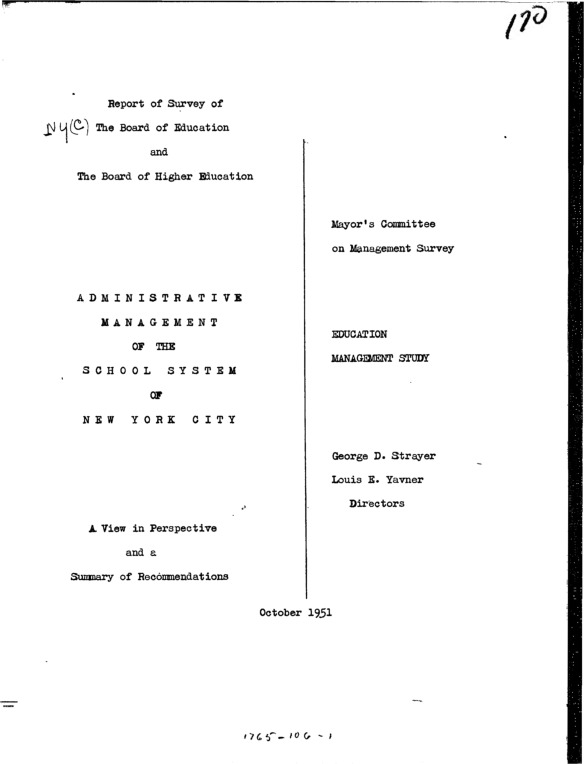
Report of Survey of
N yc) The Board of Education
and
The Board of Higher Biucation
Mayor's Committee
on Management Survey
ADMINISTRATIVE
MANAGEMENT
EDUCATION
OF THE
MANAGEMENT STUDY
SCHOOL SYSTEM
or
NEW YORK CITY
George D. Strayer
Louis E. Yavner
o ; Directors
A View in Perspective
and a
Summary of Recommendations
October 1951
1765 -10G ~>)
COMMITTEE
LAZARUS JOSEPH
Chairman
SAUL LEVY
Vice Chairman
BENJAMIN FIELDING
Secretary
ABRAHAM D. BEAME
MISS CHARLOTTE CARR
SAMUEL DAVIS
ROBERT W. DOWLING
HENRY EPSTEIN
LAWRENCE GEROSA
BERNARD F. GIMBEL
PETER GRIMM
GEORGE H. HALLETT, JR.
MORRIS IUSHEWITZ
JOHN S. LINEN
GEORGE F. MAND
THOMAS JEFFERSON MILEY
MRS, RALPH B. MORRIS
ROBERT MOSES
NATHAN M. OHRBACH
THOMAS J. PATTERSON
DELMONT PFEFFER
GENEROSO POPE JR.
CHARLES F, PREUSSE
JAMES C. QUINN
WILLIAM REID
VICTOR S. RIESENFELD
DR. CHANNING TOBIAS
THOMAS TOZZI
MAYOR'S COMMITTEE ON MANAGEMENT SURVEY
OF THE CITY OF NEW YORK
131 LIVINGSTON STREET
BROOKLYN 2, N. Y.
MAIN 4-5613
‘
GEORGE D. STRAYER
LOUIS E. YAVNER
Directors
EDUCATION MANAGEMENT STUDY
October 15, 1951
Honorable Lazarus Joseph
Comptroller of the City of New York
Municipal Building
New York 7, N. Y-
Dear Mr. Comptroller:
We submit herewith our Final Report on the Administrative
Management of the School System of the City of New York.
It marks the conclusion of an intensive 13-month study by
a staff of some 20 analysts under our direction.
In April 1951 we submitted to the Mayor's Committee on
Management Survey an Interim Report which dealt with some
aspects of the Division of Housing of the Board of Educa-
tion, and with related administrative problems. Following
immediate endorsement by the Board of Education of our
major recommendation for top reorganization of the adminis-
trative structure, also endorsed by the Mayor's Committee,
Superintendent of Schools William Jansen wrote to the Board
of Education on May 22, 1951: "Since I find the report
essentially constructive and agree with its major findings,
I believe that there should not be any delay in acting upon
the recommendations that give immediate promise of adminis-
trative improvement.®
This spirit of mutual cooperation has marked the entire
study, and we are deeply grateful to Dr. Jansen for his
unstinting help and advice, and for the many hours, day
‘and evening, which he devoted to conferring with us about
all parts of the study.
At the outset of the study the Board of Education desig-
nated Charles Gilman, its Auditor, to act as its liaison
officer. Mr. Gilman, on whom governors, mayors, and city,
state, and educational officers have relied for many years
K 1732
to provide accurate and dependable information about school business
and fiscal affairs, proved to be no less an authority for use We leaned
heavily on his wealth of experience and his great ability as a business
executivee We cannot let this occasion pass without expressing our sin-
cere appreciation.
So many scores of Board officials and employees were helpful that we can
only thank them all, without a special listing. Yet, we imposed so often
upon two gifted men, Jules Haut, Construction Consultant to the Board, and
Basil T. Coleman, Statistician of the Division of Housing, that we must
state our indebtedness to them.
All of the members of the Board of Education were most generous in their
assistance. While we conferred more often, because of their special
background, with Maximillian Moss, President of the Board, Charles Bensley,
Chairman of the Committee on Buildings and Sites, and James Marshall, the
senior member of the Board, we received helpful cooperation and advice
from all members.
Officials of the Board of Higher Education were equally cooperative. To
Dr. Ordway Tead, Chairman of the Board, Henry E. Schultz, Chairman of the
Executive Committee, and Mrs. Pearl Max, Administrator of the Board, we
owe muche
A study of this magnitude presents its own policy and administrative pro-
blems. Often these could not have been solved except for the unflagging
support of the Sub-Committee on Education, consisting of Mrs. Ralph Be Morris,
its chairman, Miss Charlotte Carr, Samuel Davis, and Dr. Channing Tobias.
Nor could these problems have been met without the wise counsel and constant
help of Dr. Luther Gulick, Executive Director of the Mayor's Committee on
Management Survey. We are also indebted for a great deal of assistance to
Dr. Gulick's executive assistant, Carl Heyel.
Of the efforts of our own staff we are especially appreciativee This Final
Report reflects their competence, imagination, and diligence. Particularly
it reflects the leadership and creative ability of Maurice G. Postley,
assistant director of the study, Herbert 0. Patchel, chief engineer,
Lester J. Rosner, executive assistant, Clarence Weiner, economist and
statistician, and Elwood L- Prestwood, chief research associates We call
special attention also to the important contributions of two of our
consultants, the architectural firm of Reisner and Urbahn, which prepared
the chapter on “Architectural Considerations," and Dr. David G. Salten,
Superintendent of Schools of Long Beach, New York, who directed the study
of the Board of Examiners.
Sincerely yours,
George D. Strayer and Louis E. Yavner
Directors of the Study
Members ‘of the
Board of Education
1950-1951
Maximilian Moss, President
Charles J. Bensley James Marshall
Andrew G. Clauson, Jr. Dr. Charles F. Rank
Rev. John M- Coleman George A- Timone
Vito F. Lanza Cornelius J. Walsh
MAYOR'S COMMITTEE ON MANAGEMENT SURVEY
Mayor Vincent Impellitteri
Lazarus Joseph, Chairman
Saul Levy, Vice Chairman
Benjamin Fielding, Secretary
md
ts cs ‘
Abraham D. Beame = Thomas Jefferson Miley
Miss Charlotte Carr Mrs. Ralph Be Morris
Samuel Davis Robert Moses
Robert W. Dowling Nathan Me Ohrbach
Henry Epstein Thomas J. Patterson
Lawrence Gerosa Delmont Pfeffer
: Bernard F. Gimbel Generoso Pope, Jre
: Peter Grim Charles F. Preusse
George H. Hallett, Jre James C. Quinn
Charles Horowitz . ~ William Reid
Morris Iushewitz Victor S. Riesenfeld
John S. .Linen Dr. Channing Tobias
George F. Mand Thomas Tozzi -.
John P. McGrath
Dr. Luther Gulick, Executive Director
Carl Heyel, Executive Assistant
eo
Subcommittee for Education*
oP) és es a
Mrs. Ralph B. Morris, Chairman
Mrs. Charlotte Carr
Samuel Davis
Dr. Channing Tobias
* And the officers of the Committee, ex officio
STAFF OF THE EDUCATION MANAGEMENT STUDY
Directors
Louis E. Yavner
Assistant Director
Maurice G.. Postley
Executive Assistant
Lester J. Rosner
George D. Strayer
Chief Engineer
Herbert 0. Patchel
Chief Research Associate
Elwood Prestwood
Economist
Clarence M. Weiner
Consultants
Reisner and Urbahn
David G Salten
Staff Members
Eileen Ahern
Edward M. Applebaum
Lee Ariel
Jerome Barry
‘Meyer D. Bashein
David Bernstein
William H. Bisnoff
Gerald R. Coleman
Francis Cowan, Jre
Evelyn Fassberg
iii.
Harold He. Goldberg
Noble C. Hiebert
Burton S. Klapper
Morris J. Lieberman
Samuel London
Pauline H. Rogers
Gertrude Ruskin
Samuel Vigman
Lester E. Vogel
Raymond W. Young
CHAPTER
II
III
Iv
vI
VII
VIII
ix
xaI
XxTII
XVI
XVII
XVIII
XXII
XXIII
XXVI
XXVII
XXVIII.
TABLE OF CONTENTS
VOLUME ONE
THE ADMINISTRATION OF SCHOOLS IN NEW YORK CITY
THE ADMINISTRATIVE STAFF
THE ASSISTANT SUPERINTENDENT. ‘
THE PRINCIPAL AND THE FIELD SUPERINTENDENT
THE ORGANIZATION OF SCHOOLS
W ORGANIZATION OF CLASSES
CUSTODIAL SERVICE
SCHOOL UTILIZATION
SCHOOL CONSTRUCTION
ARCHITECTURAL CONSIDERATIONS
WTHE SUPPLY OPERATION -=- A. MANAGEMENT CHALLENGE
THE SCHOOL BUS TRANSPORTATION PROGRAM
PAYROLL MECHANIZATION
RECORDS MANAGEMENT
VOLUME TWO ,
SCHOOL LUNCH PROGRAMS
EDUCATIONAL RESEARCH AND STATISTICS
STATISTICAL AND TABULATING OPERATIONS
TEACHERS ASSIGNED TO HEADQUARTERS
THE BOARD OF EXAMINERS
PERSONNEL ADMINISTRATION
‘OFFICE SERVICES
OFFICE OF BUSINESS AFFAIRS
FISCAL RELATIONSHIPS OF THE BOARD OF EDUCATION
WITH THE MUNICIPAL GOVERNMENT
FISCAL AND POLITICAL RESPONSIBILITY
LOCAL SCHOOL BOARDS
THE ROAD AHEADs. A DECENTRALIZED SCHOOL SYSTEM
THE ADMINISTRATION OF THE MUNICIPAL COLLEGES
THE NEED FOR TECHNICAL INSTITUTES AND COMMUNITY COLLEGES
THE FISCAL RELATIONSHIPS OF THE BOARD OF HIGHER EDUCATION
FISCAL CONTROL BY THE BUDGET DIRECTOR AND THE COMPTROLLER
FOR INCORPORATION IN THE STATE. UNIVERSITY
Ve
PAGE
13
108
119
130
251
310
363
380
527
566
588
625
667
678
708
749
823
878
897
906
960
986
993
1001
1052
1084.
1129
1176
A VIEW IN PERSPECTIVE
The First Objective
From more than a thousand pages of this Final Report, from many
thousands of pages of work papers, from hundreds of conferences, this
prefatory digest presents the essence of a year of observation, study and
analysis of the largest public school system of any city in the world.
The first objective of the Education Management Study was to
determine whether the activities now conducted by the Board of Education
and the Board of Higher Education are so organized and administered as
to fulfill their potential in providng an educationally satisfactory
programe.
From,the beginning, the Mayor's Committee, on Management Survey
properly recognized that the administrative process cannot be separated
from the objectives and programs. to be gerved. Bans the Committee
adopted the objective set forth in the preceding paragraph, as part of
the scope of this study.
The categorical answer to the first question is that the activities
of the two Boards are not so “organized and administered so as to fulfill
their potential in providing an educationally satisfactory program."
This fundamental finding, if stated in such direct terms, is subject
to dangerous misinterpretation, for it implies a vast failure that is
simply not tas fact.
Viewing the milieu in which the two educational boards have functioned
and placing their activities in perspective, there is much to be found that
is encouraging, stimulating and promisings.
That, compressed for the moment into capsule form, brings us to the
next objective of this study.
The Second Objective
The statement of scope adopted by the Committee says:
"The second objective is to determine whether it is possible to make
administrative improvements in the school system that will result in more
value for the public's money; whether needs for increased service can be
met at least in part by feasible economies in éxisting services."
The categorical answer to that question is that administrative
improvements can be made that will result in more value for the public's
moneys Further, this report finds that needs for more service can be met
in part, at least, from feasible economies in existing services.
That simple statement of findings, like the first one, is also subject
to misconstruction for it would be. an injustice to many competent, hard-
working, self-sacrificing persons to permit an inference to be drawn of a
degree of callous disregard for the public interest. It would also be an
injustice to infer that there’ is anything but a high dégree of integrity at
all levels of the school system; the very few cases of dishonest activity
that arise are so small in relation to the size of the staff that it must be
recognized that the Board of Education has a very praiseworthy record..
Some Improvements Can Begin Today
Certainly the most casual observer will agree that a great responsibility
is imposed upon the Survey staff in presenting this report to make every
reasonable effort to maintain a clear perspective of the vast panorama that
is New York's educational system.
Toward this end, the attention of the reader is directed to the large
number of findings in many areas of activities. The Interim Report and this
Final Report propose changes in administration that should lead to operating
savings or added values of over $3,500,000 a year. The Final Report also
shows how savings in future Capital Budgets can be made, savings that total
$4,667,000, “in addition to similar savings proposed in the Interim Report.
Some of these changes are necessarily linked to each other, but many
are note It is not necessary to make all the changes simultaneously. It
may not even be practicable. Many of them are not at all related to each
other. They can be attacked, in different places in the school system, one
at a time, but not necessarily all at one times.
That there will be disagreement as to technique in one respect or
another is inevitable, but that is not a reason for failing to correct
administrative error or waste where it is clearly discernible to the impartial
eyee Indeed, there are areas where the techniquesof analysis revealed in
both the Interim Report and the Final Report can now be extended by the
present school staff. The pursuit of these threads of ‘administration may
save even greater sums than have been indicated.
Differing Views About What Is Significant
But there is a great deal more to the story than that. The Final
Report, touching so many faqets of educational problems in New York, may
well provoke in the minds of different persons a wide variety of different
centers of interest. Running the gamut of scores of proposals, there will
be those individuals who will find the method of selecting Board members
most important; those who will select as most vital the problem of financing
the schools; those who will accent the urgency of reorganized top management;
those who ‘will be alarmed at evidences of waste-through poor planning and
organization, and so on.
To serve a useful arid constructive’ purpose, this report seeks to show
the relationship of the many factors to éach other, but seeks also to show:
how ‘they are severatle, how they may be approached separately and how im-
provements may be achieved along many different ‘avenues so long as there
is tolerance and the will to achieve improvement.
The Emphases of the Report
Since the emphasis of a management report is necessarily upon existing
conditions that can be improved, it is the imperfect condition that is singled
out for identification and analysis. The normal--indeed the superb--is taken
for granted. It would therefore be unfortunate if such a study as this, in
its insistence upon what may be done more efficiently, should seem to ignore
what is well done. The Education Management Study could hardly report in de-
tail upon the constructive aspects of New York City's educational system
and at the same time perform its duty in the light of the two objectives cited
above, and other responsibilities..
It is nonetheless regrettable that specific mention cannot be made of
individuals and their work, for ‘New York City could not carry on its extensive
and important educational program were it not for the devotion and intelligent
application of thousands. of men and women, many of whom serve far beyond the
call of duty with neither hope nor wish of personal recognition.
The criticisms directed at the school system by this report indicate
the need for far-reaching and basic improvements. This, however, should not
obscure or deny the simple fact that there are many schools throughout the
system in each of which a broad-visioned principal has established
excellent staff, pupil, parent and community relationships; where a generally
alert and professionally-minded teaching staff is implementing a judiciously
selected program of democratic and effective learning; where the school
routines and business arrangements are wisely planned and efficiently
administered; and where, in short, an institution of learning, soundly based
on modern and progressive philosophy of education is carrying out the task
which the community has a right to expect of it. Nor should it obscure
or deny the fact that the headquarters organization has many individuals and
units whose work is outstandingly efficient, constructive, and far-sighted.
Drastic, Affirmative | Action is Necessary
Turning from the examples of superior individual or group performance,
and viewing the enterprise broadly, it is clear that drastic, affirmative
action is necessary to eradicate many grave faults in the schoo] system.
These faults are costly in terms of dollars, but they have an additional
significance of the first order. They obstruct the school system from
achieving its objective, which is the best possible education for the in-
dividual child consistent with the amount of money available.
To waste an educational dollar is unpardonable as a matter of financial
prudence, but it is all the more serious when it is clear that the money can’
be used more effectively as an instrument of education.
Pressures Prevent Planning
The single greatest weakness of the school system is that it is an
administrative patchwork quilt. It grew in response to immediate demands
or impulses. Butits ‘growth was not planned.
New York City has expanded prodigiously through the years. The school
system has striven to keep pace with the giant.
Divisions, boards, committees, bureaus and offices were created and
fastened onto the organization at the al ner the immediate crisis seemed
to require..
Under normal circumstances, so colossal an undertaking would chart its
course in terms of known and reasonably predictable future demands. It would,
in short, plan its growth. Each successive organizational move would be viewed
as part of a whole. Whether this was practicable, though desirable, is quite
beside the point today. The existing conditions have grown up under the stress
of daily burdens over a long period of years and a retrospective journey to
find fault with individuals serves no constructive purpose.
After careful effort in cooperation with members of the Boara of
Education, the Superintendent of Schools, ‘and other top executives, the
Interim Report presented a plan of reorganization to meet the school systems
needs. With this record before it, it may be hoped that the Board of Education
will not now be préssuredintoa different series of organizational changes that
will create more problems than they: will solve.
Two Examples of Poor Planning
The effects of rapid growth, which has sometimes causéd improvisation
instead of basic planning, may be encountered in many places in the school
i at ss
system. For instance, at the vé
: ator of the Board of Education, two
unrelated courses have been followed in organizing the headquarters staff
and assigning administrative personnel. One is based upon school levels -
elementery, junior high school and senior high school, the other upon
administrative functions that relate to all these levels. This lack of a
basic, over-all plan may be observed also farther out from the center of
the system in the organization of the various divisions and bureaus, where
subdivisions have been established without clear-cut standards for a guide.
Sometimes the gonnection seems almost haphazard, as when community education
was first placed in the Division of Housing, then in the Division of Child
‘Yalfore, later in the Elementary Schools Division and more recently in the
Junior High Schoolg Division.
Sometimes growth without basic planning has produced differing systems
that exist side by side, causing a confusion of methods and an inequality of
results. An example is the custodiel service. The original direct civil
service system waa abandoned and supplanted by an indirect, quasi-contractual
system, under which it was found that sane custodians in full charge of the
operation of small school buildings received less net income than cleaners in
large schools, susreent custodian-enginears in large schools were the
beneficiaries of a much larger net compensation than the Superintendent of
the Bureau of Plant Operation and Maintenance, several echelons higher in
rank. The modified indirect system was deviséd in an attempt to patch up the
situation, but after it had bean installed in ahout half the schools there
was ample evidence that, it was no panagea for inequities, and it was extended
to no more schools, Now, the two systems coexist, with the essential inequities
7
still uncorrected. More important, extreme variations are found in the
quality of custodial service rolesaas so that while some schools are
immaculate, others are dirty and ill-kept. -
So it goes throughout the system. Improvisation can be seen in many
quarters, where fundamental planning is requisite.
The remedy is obvious. A basic appraisal of aims and methods is
needed in every part of the school system.
The People and Their Schools
The first objective established by the Mayor's committee, to which
reference was made at the outset, penetrates to the core of the over-all
problem of education in New York City. The "potential in providing a sat-
isfactory educational program" involves a consideration of fundamentals.
One of these fundamentals is thé relationship between the people and
their schools.
)
Though it is axiomatic, the fact bears repetition that the whole con-
cept of public education in the United States assums that the public schools
belong to the people. And this implies a closeness between the people and
their schools. To realize their "potential in providing a satisfactory
educational program," the schools must be near the people in conformance
with that American tradition.
The tragic fact in New York City is that notwithstanding the best of
effort and intention by everyone the people of the city are not nearly as
close to their schools as people are in other communities throughout the
United States. This may be a problem equally as difficult to solve in other
large cities, but that is not a reason for abandoning all hope in New York City.
8
Even the slightest glance at the relationship of the community to the
schools elsewhere throughout the United States will convince any impartial
observer that public participation in school affairs is the best insurence
of well-administered schools. A glimpse, for example, at the extraordinary
school experience of the people of Arlington County, Virginia, will reveal
how public participation stimulates and gives life to the public schools.
Arlington County, with a background of aloof administration for perhaps a
hundred years, learned what public participation can mean in the improvement
of the schools. This now famous experience has been repeated in varying
degrees during the past few years all over the country. The beginnings of
similar experimentation in New York City is reported in this Final Report.
Public Participation Means Better Education
The record is clear that public participation means’ better education
for children--and, at the same time, more efficient and therefore more
economical administratione The public is quick to sense waste in the schools
because the public is concerned with getting maximum education for the
educational dollar.
; In examining the potentials, therefore, of the educational system in
New York, the Education Management Study came to grips with the problem that
exists today, the separation of the people from their schools. A way to
appraise this problem would have been to identify it and suggest that public
interest may be awakened. But such a coyrse would leave the city precisely
where it is today. It is for this reason that the Survey staff has considered a
change in the essential pattern of relationships so that a new era may dawn
in New York City for the people and their schools.
SUMARY OF, MAT OR RECOMMENDATIONS _ ge.
G
The Administration of Schools in New York City g
1. Relieve the members of the Board of Hiucation from consideration of
a miltitude of administrative matters which properly should be the con=-
cern of the professional staff. This would permit the Board to give
more adequate consideration to major policy questions.
2. Differentiate clearly the responsibilities of the lay Board of
Education and the professional staff of the schools. Members of the
Board commonly assume administrative responsibilities, thus undermining
the basic functional relationships which should exist in the operation
of the school system. The Board should retain full responsibility for
determining policies which in its judgment will produce an adequate
system of public education. But reponsibility for implementing and
administering policies should be vested clearly in the professional
staff.
3- End the current practice of certain Board members acting as indi-
viduals on school problems. They have a responsibility for acting
as members of a Board...
II. The Administrative Staff
4. Vest full control and responsibility far the school system's super-
visory and administrative staff in the Superintendent of Schools. As
chief executive officer of the school system, he would be responsible
and accountable for all staff work.
5. Reorganize the top administrative structure to provide urgently
11
needed assistance to the Superintendent of Schools in executing his
functions and responsibilities. Three new major positions should be
established: a Deputy Superintendent of Schools, an Administrator of
Housing, and an Administrator of Business Affairs.
6. Assign to the Deputy Superintendent of Schools the authority and
responsibility for coordinating the work of the eight associate super-
intendents, each to be given a specific functional responsibility in
the proposed headquarters reorganization.
7- Assign to the Administrator of Housing all major functions relating
to the building, modernization, operation and maintenancé of school
buildings. This Administrator should head an office with four major
divisions: Programming; Construction and Contract Repairs; Plant
Operation and Maintenance; and Administration. The Programming Division
would have responsibility for effective plant utilization, determining
school building needs, establishing priorities of need and for site
selection. The Construction and Contract Repairs Division would plan
for. arid construct new buildings, develop and execute modernization
programs and contract for major’additions and repairs to existing school
buildings. The Plant Operation and Maintenance Division would have
responsibility for custodial services, the operation of repair shops,
and géneral maintenance and repair services for school buildings. ‘The
Administration Division would be responsible for providing the facilita-
tive services to the other divisions, maintaining personnel and cost
data, budget estimating and general administrative work.
8. Assign to the Administrator of Business Affairs these major responsi~
12
re
bilities: budget estimating and preparation; all accounting and auditing
services; purchase, storage and distribution of school textbooks, supplies
and equipment; school transportation service; operation of the school
lunch programs; budgetary and management analysis and review; and fiscal
controlse
9. Create eight functional divisions in the headquarters organization
each to be headed by an associate superintendent reporting to the Deputy
Superintendent of Schools. These divisions are: Instruction, Curriculum,
Organization, Research, Personnel, Child Welfare, ‘Special Services, and
Public Informatione
10. Make the Division of Instruction responsible for the educational
programs now offered by four separate divisions: Aiaaentary schools,
junior high schools, vocational high schools and academic high schools.
The education of children and youth is a continuing process from kinder~
garten through the high school. The program of educatjon provided in
the New York City Schools should be integrated, not cut up into separate
unitse There are different emphases at different age levels, but they
should be considered in relation to the total education being provided.
il. Assign to the Division of Curriculum adn dety ter for the improve-
ment of the instructional program relating to curricujpm development.
This Division should enlist and use effectively the ideas, talents and
abilities of teachers and principals in the schools as well as those of
the headquarters staff.
*
12e. Make the Division of Organization responsible for important regula-
tory and management functionse This Division should be charged with the
responsibility for child accounting and the preparation of reports re-
13
quired for establishing eligibility of the school system for state and
federal appropriations. It should have responsibility for the organi-
zation of all schools and play a mjor role in determining class size.
13- Gonsolidate all the research activities carried on in the school
system in one Division of Research. This Division should undertake
research for any department of the school system that needs such assis~
tance. In addition to its own independent research studies the Division
should engage in codperative projects with other school divisions.
14. Fix responsibility on all personnel matters in the Division of
Personnel. The present aval personnel organization structure should
be ended. One administrative department should be charged with auth-
ority and responsibility for personnel transactions covering all em-
ployees of the Board of Education - the civil service administrative
staff as well as the teaching and professional supervisory staffs.
The Associate Superintendent in charge of this Division should be
the School Superintendent's representative in all relationships with
the Board of Examiners.
15. Assign to the Division of Child Welfare responsibility for pro-
viding the clinical services that some pupils require and the special
facilities that physically and mentally handicapped and emotionally
disturbed children need. Clinical services should be provided by spe-
eial service teams assigned to the offices of the field assistant
superintendents.
16. Make the Division of Special Services responsible for a variety
of special functions which will vary from time to time depending upon
the needs of the schools. Among its regular assignments, it should
Uy
CHAPTER
have responsibility for the health and attendance programs and for
civil defense.
17. Charge the Division of Public Information with the important assign-
mént of establishing a public information program as a two-way process - -
a cooperative search for mutual understanding and effective teamwork
between the people of the city and the school staffs. It should encourage
a continuous, positive approach to public relations by all school personnel.
It should work closely with the assistant superintendents in the field in
the effort to use community resources effectively.
ITI. The Assistant Superintendent
18, Make the field superintendent the administrative officer in charge
of all schools in his area, to include the vocational and academic high
schools, as well as- the elementary and junior high schools, This would
permit the planning of a continuing and integrated program of education
from the kindergarten through the high school.
19. Vest in the field superintendent full authority and supervision over
the staff assigned to his office.
20, Clarify the basic functions of the field superintendent. He should
have the responsibility for developing @ program .of education, authiov‘inea
by the Board of Education, in such manner as to serve most ‘effectively the
needs of the children, youth, and adults in his area. He should play a
major role in the organization and reorganization of schéols. He should
seek to develop new methods, new materials, and new procedures for the
improvement of instruction. He should work toward better school-comnunity
relationships.
15
“
A a
21. -Restore some degree of local autonomy to the community in the opera-
tion of the schools. Headquarters offices should be concerned with deter-
mining school policies and providing basic services for the schools. Also
they should retain controls relating to the execution of policy 4, bis
field. But the field superintendent shoula be given sufficient leeway
to adapt programs and policies to express community needs.
22. Organize and staff the office of the field superintendent so that
the superintendent will be relieved of time-consuming, routine matters
which should properly be handled by staff assistants. He should be
freed from the burden of petty administrative detail to permit. him to
act as an educational and community leader. The number and types of
skilled supervisory aides may vary from district to district depending
upon the local problems encountered and the special programs undertaken.
IV. Zhe Principal and the Field Superintendent
23. Vest in the field superintendents fyll authority over staff assigned
and provide additional. staff specialists to improve the supervisory ser-
vices offered to the schools in their areas. In most cages, services
offered to elementary schools are excellent. However,some inadequacies
were found, chiefly traceable to lack of adequate staff in the field
superintendents! offices and limitations on the power of superintendents
to organize and direct their staffs.
2h. Organize a system of teacher supervision in the junior high schools
(similar to the first assistants in the senior high schools) for a more
effective program of supervision. In the alternative, enlarge the fiela
superintendent's staff of specialists so that the junior high schools
ot
CHAPTER
could be serviced as well as the elementary schools. The relationships
that now exist between the junior high school principals ami the field
superintendents are, for the most part, superficial. Regulatory con-
trol of these schools in both curriculum and organization presently
comes from headquarters offices.
25. Establish clearly the major functions and responsibilities of the
school principal. These are: execution of policies determined by the
Board of Education; organization of his school to meet the needs of the
community; provision of supervisory assistance for all teachers assigned;
sponsorship of in-service training programs far teachers; study and parti-
cipation in commnity life in order to know and understand the community;
and provision of democratic leadership for his téeading staff.
26. Release and give scope to the creative talents of teachers by making
them responsible partic ipants in the development of educational programs.
Too many teachers in the school system have been given little or no
opportunity to participate constructively and creatively in the planning
or evaluation of curriculums and teaching methods.
V-_ The Oreenization of Schools.
27- lessen the degree of departmentalization of classes in the junior
high schools. The tendency to pattern the junior high school after the
senior high school has resulted in excessive depart nmentalization in the
former. The transition of the student from the 6th grade elementary to
the junior high school has been made almost as abrupt as between 8th-year
elementary and the senior high school. Thus, the junior high school
originally organized to bridge the gap between elementary ‘and secondary
7
CHAPTER
education has been departmentalized to a point where it creates a similer
gap of its own.
28. Make a number of the senior high schools comprehensive in purpose
and program so that all youth in the city may have access to varied cur-
riculums regardless of the school in which registered. -The proposed
comprehensive high school would provide & program sufficiently flexible
to care for the interests of all students: general exploratory courses
for those undecided in interest or vocation; general courses with voca~
tional emphasis for. those who plan. to terminate their formal education
upon finishing high school; and enriched courses and accelerated programs
for those with special talents and abilities, Some specialization, parti-
cularly in the vocational fields, is clearly advisable and training in
highly specialized fields will continue to demand high schools with
specialized programs.
We
anization of Classes
296 Continue the development of special educational facilities for
atypical children. ‘The New York City School system has made excellent
progress towards meeting the special needs of the mentally retarded, the
physically handicapped and the emotionally maladjusted children in the
City. Special facilities have also been developed at all school levels
for the intellectually gifted youngsters. The New York City program for
atypical children ranks as one of the mst effective in the nation.
However, special classes for children with special educational needs are
not always available at the most convenient times or places and further
development of this phase of the school program is needed.
CHAPTER VII. Custodial Service
30. Design and install adequate quality: controls to eliminate the cur-
rent extreme variations in the quality of custodial service. This re-
quires developing standards of performance, measuring performance against
the standards, and providing incentives, positive and negative, to assure
performance.
31. Develop standards to govern supervision over custodial service, with
provision for an effective rating system.
32. Revise the system of allotting monies for custodial supplies to each
school.
33- Compensate custodians in relation to their work load. The present
compensation schedule is unjust, with certain gustodians earning far
more than they should and others earning much less than they should.
34. $Improve the proposed new schedule of custodial compensation which
has some advantages over the present schedules but leaves uncorrected
some difficulties of the present schedules.
35- Require custodians to charge no mare than scheduled fees for use
of their schools by outside organizations after school hours.
36. Promote custodians, so long as the present quasi-contractval system
is continued, on the basis of proven ability, dependability and other
performance characteristics. The present promotion system ignores these
qualifications.
37. Require custodial helpers provided by the custodians to furnish
proof of good character ami good health before they are permitted to
have the freedom of the schools.
19
CURET ES.
38. Require custodians, so long as they have the quasi-contractual
status, to provide proper working conditions: for their employeese
39. Abolish the present quasi-contractual system of custodial service.
It has failed to work, ani each variation attempted has failed to work.
4O. Substitute for the quasi-contractual system either a true direct
civil service system, or a true contractual system. The additional
eost of a civil- service system as compared with the present system
would be about $1,400,000 and not the $3,600,000 estimated in 1946 by
a Board of Education committee. A true contractual system might prove
the least costly of all three: if adopted the change-over should be a
gradual onee
VIII. School Utilization
41. Convert: the 6-year Board of Biucation estimate of capital outlay
projects, required by the City Charter, from one designed only to ccmply
with the legal requirements into a long range program which should be a
carefully conceived plan of action for each neighborhood of the City, a
realistic step-by-step project for improving the plant of the school
system. It should constitute an integrated program for each neighborhood
and for the City as a whole, instead of containing, as it does now,
mutually inconsistent proposals.
42. Develop a capital budget program through a school-by~school, neighbor-
hood-by-neighborhood review of existing facilities in relatim to need.
43. Develop a long range program whose objective will be to provide
adequate school facilities in every neighborhood of the City at all
educational levels.
4h. Modertiize existing facilities to bring them as close to existing
standards as possible.
45- Close obsolete structures if they cannot. be modernized, either by
(a) merger of school districts with nearby schools which now have modern
facilities or which could have them through modernization; or (b) replace-
ment by new construction, preferably on sites so selected as to permit
the replacement of two or more obsolete structures, either immediately
or when the peak of the area's enrollments has passed.
46. Repair all buildings that are structurally sound and educationally
adequate (i.e., with classrooms of sufficient size, well-lighted and
ventilated, sufficient sanitary facilities, etc.), but which cannot now
be used at normal capacity because of needed repairs.
47. Reallocate space use so that offices and administrative units do
not occupy buildings or classrooms needed for instruction, and so that
junior high schools, academic and vocational high schools, either in
annexes or entire buildings, do not occupy space needed for elementary
classes.
48. Review, and where necessary redistrict “school: boundaries at- all
educational levels throughout the city so that overcrowding and the use
of older buildings is reduced and the more molern, suitable facilities
are more fully utilized.
49. Eliminate traffic hazards, in so far as modern traffic control and
engineering techniques permit, to equalize the use of existing facilities.
50. Reduce or eliminate social and racial tensions, through full mobi-
lization of modern group work and community relations techniques, so
21
that, available school facilities can be more fully utilized.
51. Engage in advance planning of school facilities adjacent to large-
scale housing projects, and the long-term lease of classroom space in
large-scale public and private hosing developments, for. kindergarten
and the lower gradese
52-e Convert suitable facilities to juniar high school use where this
will relieve overcrowding in K~-8 elementary schools and the ninth grade
of vocational and academic high schools, or conversely, convert in same
neighborhoods, underutilized or unsuitable junior high school capacity
to elementary school use.
53. Use mre bus and subway transportation,particularly by upper grade
pupils, so as to use classroom space that would otherwise remain empty.
She Construct new facilities sych as elementary, junior high, vocational
or academic high school buildings, as a last measure, where the above
alternatives are insufficient or impossible.
55+ Establish as soon as possible, the Division of Programming in the
proposed orice of Housing which was recommended in the Hlucation Manage-
ment Study's Interim Report published last April. Give it the function,
which no individual or unit in the school system now has the facilities
to execute, of developing and comtantly reviewing the long range capital
budget program. Properly organized, the Division of Programming should
eliminate the present difficulties which stem from a combination of
unimaginative leadership, inadequate administration and insufficient
staff. Additional staff will cost mmey, but it will be an inconsequen-
tial sum compared to the dollar savings effected by eliminating the
22
* CHAPTER
cost of maintaining, repairing and operating obsolete buildings that
could be abandoned -- to say nothing of the intangible cost in lost
educational values borne by childrén needlessly attending substamiard
schools.
56. Establish within the Division of Programming two major unitsr a
School Population Analysis Unit to be headed by a Chief Statistician,
and a Schools Facilities analysis Unit to be headed by a Chief Engineer.
57- Close P.S. 70 Manhattan, an example of an obsolete structure: that
can be closed, and save $18,000 a@ year’ in maintenance operation and
overhead. Not only is this school presently unnecessary, but ‘the
Board's request in its 1952-57 Capital Program for $1,300,000 to replace
P.S. 70 is unwarranted. ‘Instead, what is needed for this neighborhood
is a new junior high school. ‘
58. Revise the Board of Education's East Harlem Capital Program as
proposed in the Report to bring speedier relief’ from overcrowding.
Close obsolete schools without replacement and improve the educational
facilities of the area -=- at 2/3rds the cost proposed: by the Board of
Eiucation, or a ‘saving of $3,367,000 in the ‘proposed expenditure.
IX. ‘School Construction - -
59. ‘Reorganize the Bureau of Construction to provide first that its
head should be one competent as an edministrator rdther than necessarily
as an architect, and second, ‘so that clearly-defined organizational
units deal with the separate basic functions of design and construction.
60. Establish a Research Bureau in the Division of Housing to be
charged with the responsibility of examining new ‘ideas in school design
23
in. order to incorporate new educational methods and to make use of new
materials or building.methods.
61. Improve planning and design to avoid hazards, discomfort and need
for repairs, as illustrated in the Final Report.
62. Improve inspection which has often been either insufficient or
inept, to eliminate hazards and waste.
63. Revise systems and procedures to permit gréater efficiency and to
avoid waste of educational funds.
64. ‘Police the guarantee periods so that these do not lapse before
contractors are required to make repairs of faulty constructions
65. Correct the change-order practices and procedures, which are now
extraordinarily confusede The Bureau of Construction performance in
connection with change-orders is poor and extravagant, partly because
the responsibility and authority are divided.
66. Provide, for staniard arbitration clauses in contract forms to enable
adjustment of disputes without present expense and loss of time.
67. Revise the procedure for making test boringst because of legal
restrictions, test borings are either frequently inadequate or are
negotiated by contractual subterfuges that evade the existing law.
68. Employ: permanent civil service -employees instead of provisionals
who often-have less ability than the job requires and whose turnover rate
is high because incentive to stay is lacking.
69. Improve working conditions, which are very poor. This may also help
improve employee morale, which is very low.
70. Develop standard plans for such units as classrooms, shops, audi-
2h
toriums, lunchrooms, gymasiums, cafeterias and toilet rooms, instead
of attempting to staflardize plans for an entire school. When the stendard
unit plans are assembled with appropriate foundation plans they would
constitute the plans for schools of varying sizes and shapes and would
meet practically all functional, neighborhood and topographical require-
mentse
71. Experiment with farming out architectural work to private archi-
tects, but maintain careful controls so as tq campare costs and the
productivity of new. ideas in school construction.
72. Write instructions and rules for architects, stripped of pedagogical
terminology but containing the objectives and philosophy of education,
so that they are a source of information or even instruction, not a prop
for the weak or a defense far the uninformed. ;
73- Stop the emphasis on 4-story buildings as the general solution to
the City's school problems.
74. Spend more, time analyzing the rapid changes in building materials,
equipment and methods; for example, the use of moving stairways in mlti-
story schoolse
75+ Consider the feasibility of building schools that can accommodate a
wave of student population through the various grades,changing in function
as the demands change -=- because of nedmnberhooe and population changes -~
from primary to secondary and then high school functions.
76+ Investigate planning of buildings that may be readily changed to
other occupancy after their use ag schools is ended.
25
Sinica
T7e Utilize a research bureau for maintenance and remodel ing as well
as for new constructions
78. Design so that the result is economical, satisfactory, pedagogically
‘correct and also pleasant to the least common denominator, the child,
because children respond less: to efficiency than to delight.
796 Supply freedom of action in site selection by more freedom-in
planning that will make it possible to use irregularly shaped plots.
80. Fit the basic structure - colums, floors and roofs ~ to a basic
common module independent of mechanical services, interior partitions
and even exterior walls, so as to mke it a relatively easy ‘dnd inex-
pensive process to make interior and even exterior changes in the
building as- use ‘changes.
81. Consider the use for exterior walls of ‘recently-developed manufac-
tured panels; and of similar interior partitions in moduler size which
are easily demountable and reusable, and which would permit greater
flexibility in use. Study the practicability of using demountable
interior walls which would accommodate wiring and piping, so as to cut
down on maintenance expenseSe
62. Study the development of miti-use space, especially in widened
corridors and circulation arease
83. Recognize the yeal need for plahning not only for today's needs
but for an expanding school program that eventually will inc1uie
younger children and older youth. If these future needs are not built
into today's schools they may become obsolete within a decade or two.
26
CHAPTER XI. The Supply Operation ~~ A Management Challenge
8h. Create a Board of Supply Standardization within the school system.
This Board, to be effective, mst have a full comprehension of the nature
of its problem and be prepared to act forcefully along the following lines:
(a) Drastic reduction in the number of non-list requisitionse
(b) Elimination of useless items from approved lists, abolition
of duplications on the supply lists, and inclusion of items on the lists
that are now repetitively requisitioned as non-list. items, requiring
thousands of separate and costly transactions.
(c) Rigid rules and regulations requiring schools to adhere to
requisitioning systems.
(a4) Better planning of supply needs to reduce greatly the waste~-
ful, repetitious requisitioning of the same items during the school year.
85. Coordinate- management of supplies by implementing the top reorgani-
zation plan recammended in the Interim Report of the Hducation Management
Study.
86. Eliminate the preseht system of segregating supply accounts among
ten divisions and consolidate these accomts into a centralized opera~
tion, thus saving many thousands of man-hours of work, and also giving
fiscal responsibility to the local principals.
87. Frovide more space for storage of supplies in the Long Island City
depository, thereby eliminating wasteful shifting about of the same
supplies because of lack of spacée
88. Create a requisition revolving fund ar similar device to enable
schools to requisition on the basis of exact knowledge of moneys avail-~
27
able, to replace the present guess requisitioning that results in a flow
of thousands of requisitions through the Bureau dyring the school year,
causing a never-ending backloge
89. Create-a purchase revolving fund to permit the Bureau of Supplies
@ legal, stabilized system of financing that would assure desirable
flexibility in operation.
90. Transfer from the Bureau of Supplies functions not related to pur-
chasing, such as auditing of carfare and domestic science bills.
91. Assign adequate personnel to the Bureau of Supplies to compensate
the Bureau for additional functions assigned to it without any help to
do the wark, such as the purchase of mechanics' materials, furniture,
and initial equipment in new school, buildings.
°92. Establish an in-service training :course for all -school employees
concerned with requisitioning or other supply functions in order that
they may have a better understanding of the supply operation and thus
contribute to improving its efficiency.
93 Enact State legislation raising from $1,000 to $2,500 the level at
which the Board of Education mst Purchase under formal contract pro-
cedureSe , . »
94. Grant authority to the Superintendent of School Supplies to enter
into contracts for the Board of Eiucatione
CHAPTER XII. The School Bus Trensportation Program
95- Prepare a manual on the school bus transportation program which
would clearly set forth program objectives and policies, the organiza-
tional responsibilities of those concerned with the program, and the
28
basic operating procedures for administration. 4 clear statement of
what the program is, what it covers and what it does not cover, and
who is responsible far specified phases, should help in reducing the
number of complaints received concerning the program and also make
unnecessary many time-consuming conferences ‘now held to clarify opera~
ting responsibilities.
96. Improve the public relations a apeets of the school bus program,
which is the most liberal in the country, by a continuing program of
education to acquaint parents and parent groups with the factors and
reasons underlying the basic policy decisions relating to the service
provided. Much confusion and irritation are caused by inadequate public
understanding of the factors, especially the cost factors, which must
be weighed carefully by members of the Board of Education and school
officials in developing a sound programe
‘ 97- Improve the system of controls and reports maintained on the school
bus program. Sound appraisal of the WOH ot the Transportation Section
of the Bureau of Supplies is hampered by inadequate administrative
reports and records. for example, no daily or summary record is kept
of complaints relating to service. This record should be installed
immediately; it furnishes a key method of evaluating program performance.
The Transportatim Section should also render periodic reports on its
work so that the Board's top supervisory officials would be in position
to review and appraise the effectiveness of the program more easily than
can be done at present. There should also be more detailed analyses of
the reports on accidents submitted by the private bus company. These
29
reports are not presently checked for accuracy with the schoolse In
addition, the accident data are neither broken down by appropriate
category nor summarizede These accident reports could provide the basis
for the planning and execution of a sound accident - prevention programe
XTII. Payroll Mechanization
98. Centralize and mechianize the preparation of all school. payrolls.
It is estimated that the clerical time that could be saved through payroll
mechanization approximates 1,350 man-days a month or the equivalent of
71 full time school clerks, a clerical time value of more than $200,000
a@ yeare In the larger high schools, the recommended payroll procedure
should permit the elimination of those clerical positions in which employees
devote the major part of their time to payroll work. Probably 20 or more
positions would be involved.
99- Simplify the payroll procecure by adopting the plan of equating all
dates of entry and dates of return to duty after leaves, to ‘ihe: first
calendar day of the month. Under the present procedure, a teacher's
increment date can fall on any calendar day of the yeare qhip scant ios
unduly complicates payroll preparation and auditing.
100. Give local school principals Rie authority to approve payment
for absences not exceeding ten days in the fiscal year, instead of only
four dayse This will reduce drastically the number of absence refunds and
the special payroll computations required for such refunds.
101. Adopt the policy of prorating annual leave for newly - appointed
teacherse About $13,000 could have been saved on leave payments for new
appointees in fiscal 1950-51 if this policy had been in effect.
30
CHAPTER XIV. Records Management
102- Develop a central program on records management in the school
system. The present lack of clearly-defined policy on records maintenance,
retirement, storage and disposal has created many problemse It has meant
the loss or destruction of some permanent school records that are of great
importance in the lives of former pupilse It has meant the accumulation
of hundreds of tons of useless papers and documentse It has meant the
loss of countless man-hours in locating valuable record information. It
has meant the ‘waste of moneye It is estimated that approximately $25,000
can be saved in filing cabinets alone at the headquarters building by the
installation of an effective records management program.
103- Appoint a Records Management Committee which would have these
functions: analysis of basic records maintained in the school system;
the establishment of standards and controls for record making and record
keeping; the adoption of procedures for the preservation of important
permanent records; the study of records management methods, systems and
equipment with a view to adopting those of value to the Board; and the
development of retention schedules for the orderly, systematic retirement
and destruction of records.
104. Establish a Records Management unit within the Office Services
Division of the proposed Office of Business Affairs, to be headed by a
records management officer trained and experienced in this work. This
unit would be charged with responsibility for implementing the policies and
decisions of the Records Management Committee.
105. Utilize more effectively the present storage space in the two
basements and attic in the headquarters buildings About 35,000 square
feet of good storage space, worth at least $35,000, can be used to
establish a modern records center for the Board of Educatione
XV. School Lunch Program
106. Eliminate the disparities that still exist in the operation of the
schogl lunch programe Although the program in the elementary and junior
high schools has been essentially unified, in the senior high benisste,
each cafeteria operates as a self-contained unit, doing its own buying
and selling, its own hiring and firing of employees, its own gaining or
losing of fundse The cafeterias that find it difficult to make ends.
meet, perhaps through inherent difficulties in operating conditions,
are obliged to compromise on some lunch program objectives with resul-
tant inequalities to the studentse °
107- Adopt a plan of disposing of high school cafeteria surplus funds.
which will enable the less favored cafeterias to purchase urgently needed
equipment. The existing regulations for diverting a portion of unused
surplus funds into a common fund to assist those schools which, for
various reasons, do not accumulate a surplus, have not been followed.
Under the plan recommended, the amount to be allocated to the common
fund the first year would be about $125,000.
108. Introduce a system of central purchasing of canned goods and other
non-perishable groceries for the high school cafeterias. Savings could
also be effected by central buying of kitchen supplies, detergents, paper
goods, crockery, glass ware and utensils. Probably’ $90,000 ts $100;000
annually could be saved on school cafeteria purchases through central
puying of selected commoditiese In addition to money savings,
32
central purchasing would permit better control of quality standardse
109. Require the Committee on High School Cafeteria Surpluses ta meet
more frequently so that requests for equipment buying can be processed
expeditiouslys. Projects take longer to complete than necessary when the
committee that must approve the request meets only two or three times a
yeare
110. Change the procedure ‘on certifi¢ation of invoices to require only
the certification of the Director of School Lunches and the Auditor, not
the additional certification of the Superintendent of School Suppliese
This latter certification is meaningless since no physical inspection of
the equipment purchased is made by the-Bureau of Supplies.
111. Permit each high school cafeteria to: purchase cafeteria equipment
in an amount not to exceed $500 annually for items that do not require
installation, without going through the present prescribed procedure.
Eliminating the smaller non-installation items, such as cash registers,
dish trucks, rubbish carts, utility tables, scales and the like, from.
the stream oft equipment buying should permit the several Bureaus involved
to concentrate. on the major items and thus serve to expedite their
purchase and installation.
112. Expedite emergency repairs of cafeteria equipment by permitting
each gafeteria to spend up to $500 ‘annually, using an outside contract
service, to mee}. sanitation. requirements or to rectify a hazardous con-
dition, subject to approval of the expenditure by the Bureau of School
Lunches- An alternative suggestion is to- establish a separate plumbing,
refrigeration and appliance section in the Bureau of School Lunches. to
33
be paid out of cafeteria fundse A still better answer is to provide
staff and competent supervision for the Bureau of Plant Operation and
Maintenance so that it does the right kind of job in school cafeterias
and elsewhere in the sché6ol system where maintenance is needed.
XVI. Educational Research and Statistics
113- Centralize all educational research in one Division of Research to
be headed by an Associate Superintendent who would be responsible and
accountable to the Deputy Superintendent of Schools. Currently, there
are three separate Bureaus engaged in research: the Bureau of Educational
Research, the Bureau of Curriculum Research, and the Bureau of Adminis-
trative and Budgetary Researche The existence of three separate research
bureaus creates problems in organizational relationships and responsi-
bilities.
114-. Abolish.the Bureau of Curriculum Research as a separate organization
unite This Bureau now is vested with responsibilities much broader than
research, which constitutes only a relatively small part of its activi-
ties. The major work. of the Bureau relates to the development and co-
ordination of curriculum revision, the preparation of new curriculum
programs, and their installation in the schoolse The research function
should be transferred to the Division of Research and the curriculum
development phases to the proposed Division of Curriculume
115- Reorganize the Bureau of Administrative and Budgetary Research by
transferring to the proposed Office of Business Affairs, those activities.
essentially non-reseafch in naturee. The non-research functions presently
carried by this Bureau relate chiefly to budget estimating and adminis-
34
trative management reviews The major responsibilities in these areas
should be vested in the Office of Business Affairse The Bureau would
continue to have chief responsibility for the collection and compila-~
tion of educational statistics, the preparation of statistical reports
required for City, State and Federal authorities and for conducting the
necessary studies for informed, objective action on budget requests for
educational programse
CHAPTER XVII. Statistical and Tabulating Operations
116-. Improve the supervision and coordination of the Report Room and
the Machine Room of the Bureau of Administrative and Budgetary Research.
Better supervision and coordination could save annually $7,710 in rentals
of IBM equipment and $2,500 in clerical time, a total of more’ than $10,000
annually.
117. Coordinate the statistical and tabulating operations of the Bureau
of Attendance with those of the Bureau of Administrative and Budgetary
Researche The transfer of the current mechanical tabulating work in the
Bureau of Attendance to the Division of Research would save $7,500 a year
on equipment rentals and manpower costse An additional $5,500 annually
could be saved by having the Research Division prepare the monthly report
on "Percentages of Attendancee®
118. Consolidate and centralize the Machine Tabulating Units in the head-
quarters building as soon as practicablee Soon to be added to the separate
IBM installations in the Bureau of Finance and the Bureau of Administra-
tive and Budgetary Research are two additional IBM installations now on
order for the Bureau of Plant Operation and Maintenance and the Board of
35
Examinerse For most effective utilization of this expensive equipment,
a central tabulating unit with an experienced, competent supervisor, will
be needede.
XVIII. fPeachers Assigned to Headquarters
119. Revise the Bylaws of the Board of Biucation to set specific limits
upon the maximum length of assignments of teachers to headquarters and
to define the types of work to which school personnel may legally be
assignede A procedure should also be established for stricter review
of initial assignments and renewalse The record of every teacher on
assignment should be reviewed and a schedule published for the return
to school duty of those at headquarters beyond the time limit. The
original objectives of the Board in making these assignments are not
being fulfilled. These were: first, to supply personnel for research
or special projects, for a limited time, or, if long~termy. by rotation
of teachers to diffuse experience through the schools; second, to get
around budgeting problems. In practice, the three-year limit on assign-
ments has been disregarded and half the teachers assigned to headquarters
have been there longer. The use of teachers at headquarters is false
economy, for it nullifies administrative control over the departmental
organization and personnel that the budget is supposed to exercisee The
effect upon the morale of both teaching personnel and civil service
employaes is bade
120- Maintain a complete and accurate record of each assignment to
headquarters. This should be combined with a detailed analysis of the
duties and responsibilities of each positione The jobs should be
36
evaluated;, those having low pedagogical content should be consolidated
wherever possible. The remaining work should be performed by civil
service personnel recruited through regular channels-e Both inmediate
and long-range savings can result. While it may be estimated that savings
ultimately should amount to several hundred thousand dollars,. an exact
calculation of savings cannot be made until the Board undertakes the
detailed job analyses: recommended.
CHAPTER XIX. The Board of Examiners
121. Provide the Board of Examiners with appropriate offices. It presently
has insufficient and inadequate space.
122. Assign to the Board an assistant examiner with legal training as
well as teaching and supervisory background who would help the Corpora-
tion Counsel prepare the defense for the Board of Examiners when suits
are brought against it.
123. Deny the Board's request for a public relations counsel. The grea-
test single improvement that needs to be made in the public relations of
the Board is to open its meatings to the public.
124. Require the Board to prepare informative annual reports, minutes and
activity budget estimates.
125- Give the Superintendent of Schools responsibility for supervising
and directing the Board of Examinerse
126. Assign the Associate Superintendent in charge of Personnel as the
Superintendent's representative on the Board of Examiners which should
permit better coordination of the work of the Board with other parts of
the school system.
37
127- Improve much-criticized appellate procedures by amending the Bylaws
of the Board of Education to provide that the Superintendent of Schools
shall establish a committee to hear complaints by applicants. The super-
intendent 's committee should have power, among other powers» to evaluate
the Board's’ model answers, which are now assumed to be infallible and
which are kept secret, even at times between one examiner and another.
128. Replace retiring examiners with specialists in the fields of
psychiatry, personnel psychologys psychometrics.s or related disciplines,
as well as with subject matter specialists, until some balance in the
character and versatility of Board members has been achievede
129. Inerease the staff of the Tavestigation Division to permit it to
do more intensive works.
1306 Mechanize the Board's clerical operations.
131. Require the Board to make continual evaluation of its examination
program and the effectiveness of its tests.
1326 Develop the necessary research programs in. the Boarde
133 Relieve an examiner each year of his. regular duties for assignment
by the Superintendent of Schools to a position which would bring him in
direct contact with pupils» probationary and experienced teachers, super-
visors and administrators, so that the members of the Board of Examiners
would have a more direct and intimate knowledge of what is actually taking :
place in the schoolse
134. Reconsider the Board's: policies in setting pass marks ’ which some-
times result in unnecessarily high failure rates for the higher Licenses»
particularly when the frequency of tests means that last year's failure
is next year's successe Morale is adversely affected by such policiese
38
135+ Test applicants for high supervisory licenses for their ability to
unleash the creative talents of teachers, instead of mainly for subject
matter mastery, which is an ability not. necessarily related to the primary
function of supervisorse
136. Modify the Baard's recruitment and selection procedures so as to
attract talented candidates from outside the city and to curtail the
present excessive and unwholesome inbreedinge
137- Revise the policy of producing short lists by setting separate pass
marks for small sections of testss, a policy which often favors applicants
who are uniformly mediocre and eliminates many outstanding candidates.
138. Terminate the present dual personnel organization structure that
exists. The two separate personnel units should be brought together: in
the proposed Division of Personnel to be headed by an Associate Superin-
tendent reporting to the Deputy Superintendent of Schoolse The separa-
tion, based upon the distinction between pedagogical and administrative
personnel, has led to inconsistencies in personnel practices and has.
impaired employee morales
139+ End the assignment of teachers to the Division of Personnel. and.
Teacher Training. The three positions now filled by teachers assigned
should be evaluated. and duties, responsibilities and qualifications
established. ‘The positions should then be filled by recruitment. through
competitive examinations
140. Install an organized fact collection and compilation operation in
the Division of Personnel so that personnel policies and compliance with
39
such policies can be evaluated. Analyses of rates and causes of absentee=-
ism and turnover are especially needed.
141. Install a systematic method of editing, indexing, issuing and re-
vising all material on personnel policies, practices and procedurese
Periodic audits of compliance with policies and recommendations for
changes could then be made.
142. Rotate the assignments of teachers in the various schools so that
new teachers are not placed in the most difficult schools, and all schools
may be assured of getting a fair distribution of teaching skills.
143- Eliminate the overlapping and duplicate ratings of teacher service,
and develop a simple, realistic rating system in place of the present
perfunctory one. In June 1950 only 19 teachers were rated unsatisfactory
out of 35.479 teacherst this seems unrealistic.
144. Create a job analysis unit as a means of controlling payroll expense
by classifying positions, and reclassifying them as changes occur, so
that the Board does not pay any more or less than the jobs are worth.
W456 Establish effective two-way communication between the Board's top
management and its employees. The school system urgently needs an equi-
table system for the handling of employee grievances.
146. Review objectively the qualifications required of administrative
positions at all levels. The emphasis on pedagogical background that
now pervades the agency is detrimental “to the morale of civil service
employees, and prevents the full utilization of the skills and abilities
of its administrative employees.
17. Expand the personnel activity for the Board's civil service group
ho
of ‘employees. The Personnel Office for these employees has not been
given thé authority and staff to execute a well-rounded personnel programe
148s Install a sound job classification’ and pay plan for the civil
service employeés. The lack df any system in the Board for objective
job evaluation and classification has seriously handicapped ‘the- Personnel
Office’ in the major persorinel administration areas récruitment and place-
ment, salary structure, promotion policy, merit rating and employee
relations. «
XXI. Office Services’
149. Reassign certain space at 110 Livingston Street for better space
utilization. Although space at headquarters is, on the whdle, well
‘utilized, at least 10,000 square feet can be salvaged for better use.
For exatiple, approximately 2,200 squaré feet can bé ‘salvaged from the
9,200 square feet now occupied by the Medical Division.
150. Install central forms control 4nd standardizations Forms are now
devised, designed and ordered by the individual bureau or division
without central analysis or clearancee ‘The academic and vocational
high schools also operate largely on their own in désigning and ordéring
formse A-saving of $21,000 to $36,000 could probably be effected on’
printing costs of’ forms by standardizing many of the forms riow indivi-
dually -designed and ordered by the high schools.
151. Consolidate and centralize the duplicating services ‘in the' head-
quarters building. Throughout the building there are scattered 30 pieces
of duplicating equipment in 13 separate bureau ‘or divisional offices.
Consolidation and centralization would méan better utilization of the
rs
equipment by trained and experienced operators and a reducation in the
amount of intra-building movement of paper, supplies and finished products.
152. Simplify the preparation of the Board's Building and Sites Committee
calendar by (a) substituting a process control chart for Item 1 of the.
ed
calendar which averages 115 pages and (b) multilithing on both sides of
the sheet. The, process control chart would not only reduce.greatly the
bulk of the calendar but would give the users fingertip control figures.
Approximately $3,000 a year can be saved in collating and mimeographing
time and in paper costs by reducing the calendar from its present size
of 165 pages to approximately 25 pages.
153- Group the three major business bureaus of the Board for better co-
ordination and supervision. The Bureau of Finance, the Bureau of School
Lunches and the Bureau of Supplies should be placed under the jurisdiction
of the proposed Administrator of Business Affairse Although these busi-
ness bureaus are yery ably administered each could do a better job if
many policies and procedures within the school system over which they
have little or no control were revised. Creating the post of Adminis-
trator of Business Affairs would mean that major responsibility for
improving business management practices would be vested in one top execu-
tive who should be given the authority to carry out desirable changes in
methods and systemse.
154- Establish a Division of Management and Fiscal Control in the Office
of Business Affairse This Division should comprise three sections:
Budgetary Analysis; Management Review; and Fiscal Control. The Budgetary
42
Analysis Section would have major responsibility for the administrative
work involved in preparing budgetary estimates for the school system's
many activitiese The Management Review Section would be responsible for
developing and executing management improvement programs throughout the
Board of Education, including organization and methods studies, forms
control, records management, equipment control, work simplification, and
work measurement programse The Fiscal Control Section would have responsi-
bility for conducting periodic inspections, tests and audits to verify
that services rendered, materials supplied and contract obligations are
in compliance with specifications and requirements. It would also
evaluate contract plans and specificatioqns to ascertain that the interests
of the school system are protectede
1556 Coordinate the office services functions in the headquarters buil-
ding and place these in an Office Services Division of the proposed Office
of Business Affairs. The facilitative services needed in any large opera-
tion, such as mail and messenger, duplicating, timekeeping, records. manage-
ment, sale of publications, fees collection, are widely dispersed at
present. Grouping these services into one division with responsible
top supervision and leadership would improve their administration and
management.
XXIII.
Munic: ipal Government
156. Decide whether the Board of Education should have responsibility
for developing and executing the building program and whether it should
have full authority to execute this responsibility, so that better work
43
can be done and sé that the public will not be confused by buckpassing
in holding the proper officials responsible for what has been donee
157- Stop the usurpation of power by the Budget Director's Office.
158. Correct the fundamental weakness in the Board of Education's
budget making by installing an organized management approaches An
organized management approach means continuous review and appraisal of
all policies, operating systems and procedurese It means organization
and ‘methods analysese It means work load studies and the fixing of
work standardse It méans critical review of the assumptions underlying
budget estimatese And it means a-staff of specialists to execute this
program of review and appraisale
159. Reexamine the basis on which the clerical allotment formula to
determine school clerical needs was developede Some schools may merit
more assistance than the formula now provides, others less.
160. Substitute an objective method of determining the per capita need
for educational ‘supplies and equipment for the présent guessworke.
161. Discontinue the arbitrary separation of funds into General and
Special School Funds to improve budgetary methods and procedurese This
separation is based upon a law passed 50 ‘years ago, for reasons which
no longer have significancee
MCIV. Ziseal and Polstioal Responsibility
162.. Grant the Board of Education fiscal independence from municipal
authorities and fiscal responsibility. It should have full responsibility
for, as well as control over the administration of its fiscal affairs. it
should have a separate tax limit from the City's. Its budget should not
Ab
be subject to approval by municipal authoritiese School district taxes
should be levied by the Board and billed separately from those levied by
the City.
163» Elect the members of the Board of Education, in order to obtain
members who represent the whole community and not any particular group---
members who have demonstrated their competence and leadership and their
unusual interest in public education.
164. Establish by law a nominating committee of 16 representative citi-
zens designated by civic organizations and universities which. would
nominate for each vacancy on the Board of Hiucation one person it consi-
dered well qualified to serve as a member. Permit other individuals to
run against those nominated by this nominating committee upon filing a
petitions.
165. Increase the term of office to 12 years; elect three members every
four years in the *off-year.*®
166. Choose Board members from the City at large rather than from
specific Boroughse
CHAPTER 22V-. Local School Boards
167. Remedy the deterioration of the local school boards by changing
their functions so that they would serve as lay advisory councils fur-
nishing a two-way channel of expression between the schools and the public.
168. End political appointments to local school boards by substituting
for appointment by Borough Presidents, appointment by the Board of Edu-
cation of persons recommended by parents' organizations in the several
school districts.
45
169. Begin lerining for a decentralized system of education under which
New York City would be divided into a fairly large number of communities
each electing its own board of education, operating its own school system,
and responsible bed the State Department of Education.for the maintenance '
of minimum standards and each leagued with the others in a centralized,
cooperative Baryine organization for the entire City which would provide
supply, maintenance and other facilitative services, and Lacie Methods
must be developed for bringing the educational system closer to thé people,
not so that they may simply react to proposals as do civic organizations
‘
and parents' associations, but so that they can participate in the devel-
opment of educational planning. ‘
THE BOARD OF HIGHER EDUCATION
}. CHAPTER XXVII. The Administration of the Municipal Colleges” | ee
170. Reduce membership of the Board of Higher Education from 21 to'9,
and appoint the members on the basis. of city-wide rather than borough
representation. The present Board is not of manageable size and ‘cannot
always make prompt, effectual decisions.
171. Give the State of New York proportional representation on a re-
constituted Board of Higher Education, if state financial support to the
municipal college system is substantially increased. The trustees
representing the State should be nominated by the State: University
Trustees and formally appointed by the Governor.
172. Reorganize the committee structure so that the Board of Education
would deal with more matters as a Committee of the Whole.
173. Provide for, only three standing committees: Faculty and Educational
Policy; Finance; and Plant Development.
174. Distinguish between the Board, of Higher Education's policy-making
no longer require the Board's attention.
175. Establish the position of Chancellor. He should be the permanent
function and the executive function, so that administrative detail will
chairman and chief executive officer of the Administrative Council. “The
central office directed by him would become*the Administrative Council's
fact finding, auditing and coordinating agency. The, Chancellor should be
nominated by the Administrative Council.
176. Change the title of the present administrator to "Assistant to the
Chancellor in Gharge of Board Affairs," with respongibility for acting as
| 4?
administrative director of the central office.
177. Continue the Administrative Council, in its present role.
178. Revise the faculty committee structure within the colleges.
179. Establish the position, within the colleges, of executive officer
for academic personnel.
180. Reorganize the faculty councils, by reducing departmental representa-
tion and by abolishing representation by rank. -Each department should
elect one representative to the faculty council, the other members should
represent the college-at-large.
XXVIII. The Need for Technical Institutes and Community Collegés
181. Establish additional “junior. colleges and technical institutes in the
City of New York to meet the post-high school needs of the youth of the
community, both for general and vocational training, which are not being
met by the existing program of higher education. Publicly-supported two-
year junior colleges and institutes should be recognized as an integral
part of the public educational system..
182. Give careful consideration to the offerings of high schools in
technical fields in planning community college development. A review of
these offerings should permit a proper integration of secondary and post-
secondary programs in areas of common interest with a minimum of duplication
and a maximum of coordination..
183. Expand and diversify the publicly-supported facilities for the
graduates of New York City high schools. Many able young people are now
barred from applying for entrance to existing municipal colleges under
present entrance requirements because they did not decide on college
48
attendance early enough to complete, the prescribed subjectse Further,
many graduates of academic, commercial and vocational high schools who
would benefit from further full-time training refrain from applying to
admission to the city colleges becayse they prefer a more direct in-
duction to an occupation or are prevented from applying because of
economic handicaps.
184. Adopt a plan for two-year community colleges to provide three kinds
of educational programs: (a) a two-year (four-semester) program of
general education which will enable, qualified graduates to transfer to
the other -city colleges as juniors; (b) a two-year terminal program
of general education; and (c ) appropriate vocational programs of two
years or less. These programs should be offered in two divisions of
the proposed community college: a "School of General Education" and
a "School of Terminal Education. The former would prepare students
for the junior year of four-year colleges; the latter would provide a
two-year program of terminal general education and terminal. vocational
programs of two years or less. All curriculums should lead to a diploma
or certificate, .
185. Establish a community college for the Borough of Richmond. At
present this is the only Borough which does not have a publicly-supported
institution of higher learning. In addition to serving the residents
of Staten Island,this college might also serve a part of the population
of: Brooklyn.
186. Increase the financial support ofthe muni¢ipal colleges. No
amount of managerial efficiéney and ecoriomy will permit the accom-
plishment of debired higher educational objectives without additional
funds. The lack of ddequate firiancial resources has made it impossible
for the Board of Higher Edueation to admit to the city colleges all
those desiring and qualified for higher education. Inadequate support
has led to these problems: a professional staff not large enough to
properly care for the present enrollment; a salary structure too low
to pata competent personnel; an understaffed, poorly paid clerical
force; inability to make necessary building repairs to keep structures
even at minimum standards; and the deferment of much need capital
pro jectse
187. Free the Board of Higher Educatidn from rigid control by city
officials over the administration of its budget, a rigid control which
limits efficient operation of the’ municipal college system and substi-
tutes the city officials for the educational administrators: in the “
determination of higher educational policies and programse
188. Develop a functional program budget system for the municipal col-
leges.
189. Cut down on the present multiplicity of protectivé financial
safeguards, and substitute a simpler system that would provide equakly
effective safeguards together with more significant cost data at less
expense.
50
‘CHAPTER XXXI. For_ incorporat ion in_the State University
190. Transfer the municipal college system to the State University of
New York, which should thereafter exercise full control over and take
full responsibility for the management and support of the municipal
college system as provided in Article 8 of the State Education Lawe
This would accelerate the process of equalizing higher educational
opportunity, stimulate a healthier democracy by providing opportunity
to study together to more young people of varied backgrounds, and result
possibly in a potential benefit to the faculties through broader pro-
fessional prestige and financial opportunities. A sounder and more
equitable basis for financial support should develop from incorporation
of the municipal colleges in the State University of New York.
N yc) The Board of Education
and
The Board of Higher Biucation
Mayor's Committee
on Management Survey
ADMINISTRATIVE
MANAGEMENT
EDUCATION
OF THE
MANAGEMENT STUDY
SCHOOL SYSTEM
or
NEW YORK CITY
George D. Strayer
Louis E. Yavner
o ; Directors
A View in Perspective
and a
Summary of Recommendations
October 1951
1765 -10G ~>)
COMMITTEE
LAZARUS JOSEPH
Chairman
SAUL LEVY
Vice Chairman
BENJAMIN FIELDING
Secretary
ABRAHAM D. BEAME
MISS CHARLOTTE CARR
SAMUEL DAVIS
ROBERT W. DOWLING
HENRY EPSTEIN
LAWRENCE GEROSA
BERNARD F. GIMBEL
PETER GRIMM
GEORGE H. HALLETT, JR.
MORRIS IUSHEWITZ
JOHN S. LINEN
GEORGE F. MAND
THOMAS JEFFERSON MILEY
MRS, RALPH B. MORRIS
ROBERT MOSES
NATHAN M. OHRBACH
THOMAS J. PATTERSON
DELMONT PFEFFER
GENEROSO POPE JR.
CHARLES F, PREUSSE
JAMES C. QUINN
WILLIAM REID
VICTOR S. RIESENFELD
DR. CHANNING TOBIAS
THOMAS TOZZI
MAYOR'S COMMITTEE ON MANAGEMENT SURVEY
OF THE CITY OF NEW YORK
131 LIVINGSTON STREET
BROOKLYN 2, N. Y.
MAIN 4-5613
‘
GEORGE D. STRAYER
LOUIS E. YAVNER
Directors
EDUCATION MANAGEMENT STUDY
October 15, 1951
Honorable Lazarus Joseph
Comptroller of the City of New York
Municipal Building
New York 7, N. Y-
Dear Mr. Comptroller:
We submit herewith our Final Report on the Administrative
Management of the School System of the City of New York.
It marks the conclusion of an intensive 13-month study by
a staff of some 20 analysts under our direction.
In April 1951 we submitted to the Mayor's Committee on
Management Survey an Interim Report which dealt with some
aspects of the Division of Housing of the Board of Educa-
tion, and with related administrative problems. Following
immediate endorsement by the Board of Education of our
major recommendation for top reorganization of the adminis-
trative structure, also endorsed by the Mayor's Committee,
Superintendent of Schools William Jansen wrote to the Board
of Education on May 22, 1951: "Since I find the report
essentially constructive and agree with its major findings,
I believe that there should not be any delay in acting upon
the recommendations that give immediate promise of adminis-
trative improvement.®
This spirit of mutual cooperation has marked the entire
study, and we are deeply grateful to Dr. Jansen for his
unstinting help and advice, and for the many hours, day
‘and evening, which he devoted to conferring with us about
all parts of the study.
At the outset of the study the Board of Education desig-
nated Charles Gilman, its Auditor, to act as its liaison
officer. Mr. Gilman, on whom governors, mayors, and city,
state, and educational officers have relied for many years
K 1732
to provide accurate and dependable information about school business
and fiscal affairs, proved to be no less an authority for use We leaned
heavily on his wealth of experience and his great ability as a business
executivee We cannot let this occasion pass without expressing our sin-
cere appreciation.
So many scores of Board officials and employees were helpful that we can
only thank them all, without a special listing. Yet, we imposed so often
upon two gifted men, Jules Haut, Construction Consultant to the Board, and
Basil T. Coleman, Statistician of the Division of Housing, that we must
state our indebtedness to them.
All of the members of the Board of Education were most generous in their
assistance. While we conferred more often, because of their special
background, with Maximillian Moss, President of the Board, Charles Bensley,
Chairman of the Committee on Buildings and Sites, and James Marshall, the
senior member of the Board, we received helpful cooperation and advice
from all members.
Officials of the Board of Higher Education were equally cooperative. To
Dr. Ordway Tead, Chairman of the Board, Henry E. Schultz, Chairman of the
Executive Committee, and Mrs. Pearl Max, Administrator of the Board, we
owe muche
A study of this magnitude presents its own policy and administrative pro-
blems. Often these could not have been solved except for the unflagging
support of the Sub-Committee on Education, consisting of Mrs. Ralph Be Morris,
its chairman, Miss Charlotte Carr, Samuel Davis, and Dr. Channing Tobias.
Nor could these problems have been met without the wise counsel and constant
help of Dr. Luther Gulick, Executive Director of the Mayor's Committee on
Management Survey. We are also indebted for a great deal of assistance to
Dr. Gulick's executive assistant, Carl Heyel.
Of the efforts of our own staff we are especially appreciativee This Final
Report reflects their competence, imagination, and diligence. Particularly
it reflects the leadership and creative ability of Maurice G. Postley,
assistant director of the study, Herbert 0. Patchel, chief engineer,
Lester J. Rosner, executive assistant, Clarence Weiner, economist and
statistician, and Elwood L- Prestwood, chief research associates We call
special attention also to the important contributions of two of our
consultants, the architectural firm of Reisner and Urbahn, which prepared
the chapter on “Architectural Considerations," and Dr. David G. Salten,
Superintendent of Schools of Long Beach, New York, who directed the study
of the Board of Examiners.
Sincerely yours,
George D. Strayer and Louis E. Yavner
Directors of the Study
Members ‘of the
Board of Education
1950-1951
Maximilian Moss, President
Charles J. Bensley James Marshall
Andrew G. Clauson, Jr. Dr. Charles F. Rank
Rev. John M- Coleman George A- Timone
Vito F. Lanza Cornelius J. Walsh
MAYOR'S COMMITTEE ON MANAGEMENT SURVEY
Mayor Vincent Impellitteri
Lazarus Joseph, Chairman
Saul Levy, Vice Chairman
Benjamin Fielding, Secretary
md
ts cs ‘
Abraham D. Beame = Thomas Jefferson Miley
Miss Charlotte Carr Mrs. Ralph Be Morris
Samuel Davis Robert Moses
Robert W. Dowling Nathan Me Ohrbach
Henry Epstein Thomas J. Patterson
Lawrence Gerosa Delmont Pfeffer
: Bernard F. Gimbel Generoso Pope, Jre
: Peter Grim Charles F. Preusse
George H. Hallett, Jre James C. Quinn
Charles Horowitz . ~ William Reid
Morris Iushewitz Victor S. Riesenfeld
John S. .Linen Dr. Channing Tobias
George F. Mand Thomas Tozzi -.
John P. McGrath
Dr. Luther Gulick, Executive Director
Carl Heyel, Executive Assistant
eo
Subcommittee for Education*
oP) és es a
Mrs. Ralph B. Morris, Chairman
Mrs. Charlotte Carr
Samuel Davis
Dr. Channing Tobias
* And the officers of the Committee, ex officio
STAFF OF THE EDUCATION MANAGEMENT STUDY
Directors
Louis E. Yavner
Assistant Director
Maurice G.. Postley
Executive Assistant
Lester J. Rosner
George D. Strayer
Chief Engineer
Herbert 0. Patchel
Chief Research Associate
Elwood Prestwood
Economist
Clarence M. Weiner
Consultants
Reisner and Urbahn
David G Salten
Staff Members
Eileen Ahern
Edward M. Applebaum
Lee Ariel
Jerome Barry
‘Meyer D. Bashein
David Bernstein
William H. Bisnoff
Gerald R. Coleman
Francis Cowan, Jre
Evelyn Fassberg
iii.
Harold He. Goldberg
Noble C. Hiebert
Burton S. Klapper
Morris J. Lieberman
Samuel London
Pauline H. Rogers
Gertrude Ruskin
Samuel Vigman
Lester E. Vogel
Raymond W. Young
CHAPTER
II
III
Iv
vI
VII
VIII
ix
xaI
XxTII
XVI
XVII
XVIII
XXII
XXIII
XXVI
XXVII
XXVIII.
TABLE OF CONTENTS
VOLUME ONE
THE ADMINISTRATION OF SCHOOLS IN NEW YORK CITY
THE ADMINISTRATIVE STAFF
THE ASSISTANT SUPERINTENDENT. ‘
THE PRINCIPAL AND THE FIELD SUPERINTENDENT
THE ORGANIZATION OF SCHOOLS
W ORGANIZATION OF CLASSES
CUSTODIAL SERVICE
SCHOOL UTILIZATION
SCHOOL CONSTRUCTION
ARCHITECTURAL CONSIDERATIONS
WTHE SUPPLY OPERATION -=- A. MANAGEMENT CHALLENGE
THE SCHOOL BUS TRANSPORTATION PROGRAM
PAYROLL MECHANIZATION
RECORDS MANAGEMENT
VOLUME TWO ,
SCHOOL LUNCH PROGRAMS
EDUCATIONAL RESEARCH AND STATISTICS
STATISTICAL AND TABULATING OPERATIONS
TEACHERS ASSIGNED TO HEADQUARTERS
THE BOARD OF EXAMINERS
PERSONNEL ADMINISTRATION
‘OFFICE SERVICES
OFFICE OF BUSINESS AFFAIRS
FISCAL RELATIONSHIPS OF THE BOARD OF EDUCATION
WITH THE MUNICIPAL GOVERNMENT
FISCAL AND POLITICAL RESPONSIBILITY
LOCAL SCHOOL BOARDS
THE ROAD AHEADs. A DECENTRALIZED SCHOOL SYSTEM
THE ADMINISTRATION OF THE MUNICIPAL COLLEGES
THE NEED FOR TECHNICAL INSTITUTES AND COMMUNITY COLLEGES
THE FISCAL RELATIONSHIPS OF THE BOARD OF HIGHER EDUCATION
FISCAL CONTROL BY THE BUDGET DIRECTOR AND THE COMPTROLLER
FOR INCORPORATION IN THE STATE. UNIVERSITY
Ve
PAGE
13
108
119
130
251
310
363
380
527
566
588
625
667
678
708
749
823
878
897
906
960
986
993
1001
1052
1084.
1129
1176
A VIEW IN PERSPECTIVE
The First Objective
From more than a thousand pages of this Final Report, from many
thousands of pages of work papers, from hundreds of conferences, this
prefatory digest presents the essence of a year of observation, study and
analysis of the largest public school system of any city in the world.
The first objective of the Education Management Study was to
determine whether the activities now conducted by the Board of Education
and the Board of Higher Education are so organized and administered as
to fulfill their potential in providng an educationally satisfactory
programe.
From,the beginning, the Mayor's Committee, on Management Survey
properly recognized that the administrative process cannot be separated
from the objectives and programs. to be gerved. Bans the Committee
adopted the objective set forth in the preceding paragraph, as part of
the scope of this study.
The categorical answer to the first question is that the activities
of the two Boards are not so “organized and administered so as to fulfill
their potential in providing an educationally satisfactory program."
This fundamental finding, if stated in such direct terms, is subject
to dangerous misinterpretation, for it implies a vast failure that is
simply not tas fact.
Viewing the milieu in which the two educational boards have functioned
and placing their activities in perspective, there is much to be found that
is encouraging, stimulating and promisings.
That, compressed for the moment into capsule form, brings us to the
next objective of this study.
The Second Objective
The statement of scope adopted by the Committee says:
"The second objective is to determine whether it is possible to make
administrative improvements in the school system that will result in more
value for the public's money; whether needs for increased service can be
met at least in part by feasible economies in éxisting services."
The categorical answer to that question is that administrative
improvements can be made that will result in more value for the public's
moneys Further, this report finds that needs for more service can be met
in part, at least, from feasible economies in existing services.
That simple statement of findings, like the first one, is also subject
to misconstruction for it would be. an injustice to many competent, hard-
working, self-sacrificing persons to permit an inference to be drawn of a
degree of callous disregard for the public interest. It would also be an
injustice to infer that there’ is anything but a high dégree of integrity at
all levels of the school system; the very few cases of dishonest activity
that arise are so small in relation to the size of the staff that it must be
recognized that the Board of Education has a very praiseworthy record..
Some Improvements Can Begin Today
Certainly the most casual observer will agree that a great responsibility
is imposed upon the Survey staff in presenting this report to make every
reasonable effort to maintain a clear perspective of the vast panorama that
is New York's educational system.
Toward this end, the attention of the reader is directed to the large
number of findings in many areas of activities. The Interim Report and this
Final Report propose changes in administration that should lead to operating
savings or added values of over $3,500,000 a year. The Final Report also
shows how savings in future Capital Budgets can be made, savings that total
$4,667,000, “in addition to similar savings proposed in the Interim Report.
Some of these changes are necessarily linked to each other, but many
are note It is not necessary to make all the changes simultaneously. It
may not even be practicable. Many of them are not at all related to each
other. They can be attacked, in different places in the school system, one
at a time, but not necessarily all at one times.
That there will be disagreement as to technique in one respect or
another is inevitable, but that is not a reason for failing to correct
administrative error or waste where it is clearly discernible to the impartial
eyee Indeed, there are areas where the techniquesof analysis revealed in
both the Interim Report and the Final Report can now be extended by the
present school staff. The pursuit of these threads of ‘administration may
save even greater sums than have been indicated.
Differing Views About What Is Significant
But there is a great deal more to the story than that. The Final
Report, touching so many faqets of educational problems in New York, may
well provoke in the minds of different persons a wide variety of different
centers of interest. Running the gamut of scores of proposals, there will
be those individuals who will find the method of selecting Board members
most important; those who will select as most vital the problem of financing
the schools; those who will accent the urgency of reorganized top management;
those who ‘will be alarmed at evidences of waste-through poor planning and
organization, and so on.
To serve a useful arid constructive’ purpose, this report seeks to show
the relationship of the many factors to éach other, but seeks also to show:
how ‘they are severatle, how they may be approached separately and how im-
provements may be achieved along many different ‘avenues so long as there
is tolerance and the will to achieve improvement.
The Emphases of the Report
Since the emphasis of a management report is necessarily upon existing
conditions that can be improved, it is the imperfect condition that is singled
out for identification and analysis. The normal--indeed the superb--is taken
for granted. It would therefore be unfortunate if such a study as this, in
its insistence upon what may be done more efficiently, should seem to ignore
what is well done. The Education Management Study could hardly report in de-
tail upon the constructive aspects of New York City's educational system
and at the same time perform its duty in the light of the two objectives cited
above, and other responsibilities..
It is nonetheless regrettable that specific mention cannot be made of
individuals and their work, for ‘New York City could not carry on its extensive
and important educational program were it not for the devotion and intelligent
application of thousands. of men and women, many of whom serve far beyond the
call of duty with neither hope nor wish of personal recognition.
The criticisms directed at the school system by this report indicate
the need for far-reaching and basic improvements. This, however, should not
obscure or deny the simple fact that there are many schools throughout the
system in each of which a broad-visioned principal has established
excellent staff, pupil, parent and community relationships; where a generally
alert and professionally-minded teaching staff is implementing a judiciously
selected program of democratic and effective learning; where the school
routines and business arrangements are wisely planned and efficiently
administered; and where, in short, an institution of learning, soundly based
on modern and progressive philosophy of education is carrying out the task
which the community has a right to expect of it. Nor should it obscure
or deny the fact that the headquarters organization has many individuals and
units whose work is outstandingly efficient, constructive, and far-sighted.
Drastic, Affirmative | Action is Necessary
Turning from the examples of superior individual or group performance,
and viewing the enterprise broadly, it is clear that drastic, affirmative
action is necessary to eradicate many grave faults in the schoo] system.
These faults are costly in terms of dollars, but they have an additional
significance of the first order. They obstruct the school system from
achieving its objective, which is the best possible education for the in-
dividual child consistent with the amount of money available.
To waste an educational dollar is unpardonable as a matter of financial
prudence, but it is all the more serious when it is clear that the money can’
be used more effectively as an instrument of education.
Pressures Prevent Planning
The single greatest weakness of the school system is that it is an
administrative patchwork quilt. It grew in response to immediate demands
or impulses. Butits ‘growth was not planned.
New York City has expanded prodigiously through the years. The school
system has striven to keep pace with the giant.
Divisions, boards, committees, bureaus and offices were created and
fastened onto the organization at the al ner the immediate crisis seemed
to require..
Under normal circumstances, so colossal an undertaking would chart its
course in terms of known and reasonably predictable future demands. It would,
in short, plan its growth. Each successive organizational move would be viewed
as part of a whole. Whether this was practicable, though desirable, is quite
beside the point today. The existing conditions have grown up under the stress
of daily burdens over a long period of years and a retrospective journey to
find fault with individuals serves no constructive purpose.
After careful effort in cooperation with members of the Boara of
Education, the Superintendent of Schools, ‘and other top executives, the
Interim Report presented a plan of reorganization to meet the school systems
needs. With this record before it, it may be hoped that the Board of Education
will not now be préssuredintoa different series of organizational changes that
will create more problems than they: will solve.
Two Examples of Poor Planning
The effects of rapid growth, which has sometimes causéd improvisation
instead of basic planning, may be encountered in many places in the school
i at ss
system. For instance, at the vé
: ator of the Board of Education, two
unrelated courses have been followed in organizing the headquarters staff
and assigning administrative personnel. One is based upon school levels -
elementery, junior high school and senior high school, the other upon
administrative functions that relate to all these levels. This lack of a
basic, over-all plan may be observed also farther out from the center of
the system in the organization of the various divisions and bureaus, where
subdivisions have been established without clear-cut standards for a guide.
Sometimes the gonnection seems almost haphazard, as when community education
was first placed in the Division of Housing, then in the Division of Child
‘Yalfore, later in the Elementary Schools Division and more recently in the
Junior High Schoolg Division.
Sometimes growth without basic planning has produced differing systems
that exist side by side, causing a confusion of methods and an inequality of
results. An example is the custodiel service. The original direct civil
service system waa abandoned and supplanted by an indirect, quasi-contractual
system, under which it was found that sane custodians in full charge of the
operation of small school buildings received less net income than cleaners in
large schools, susreent custodian-enginears in large schools were the
beneficiaries of a much larger net compensation than the Superintendent of
the Bureau of Plant Operation and Maintenance, several echelons higher in
rank. The modified indirect system was deviséd in an attempt to patch up the
situation, but after it had bean installed in ahout half the schools there
was ample evidence that, it was no panagea for inequities, and it was extended
to no more schools, Now, the two systems coexist, with the essential inequities
7
still uncorrected. More important, extreme variations are found in the
quality of custodial service rolesaas so that while some schools are
immaculate, others are dirty and ill-kept. -
So it goes throughout the system. Improvisation can be seen in many
quarters, where fundamental planning is requisite.
The remedy is obvious. A basic appraisal of aims and methods is
needed in every part of the school system.
The People and Their Schools
The first objective established by the Mayor's committee, to which
reference was made at the outset, penetrates to the core of the over-all
problem of education in New York City. The "potential in providing a sat-
isfactory educational program" involves a consideration of fundamentals.
One of these fundamentals is thé relationship between the people and
their schools.
)
Though it is axiomatic, the fact bears repetition that the whole con-
cept of public education in the United States assums that the public schools
belong to the people. And this implies a closeness between the people and
their schools. To realize their "potential in providing a satisfactory
educational program," the schools must be near the people in conformance
with that American tradition.
The tragic fact in New York City is that notwithstanding the best of
effort and intention by everyone the people of the city are not nearly as
close to their schools as people are in other communities throughout the
United States. This may be a problem equally as difficult to solve in other
large cities, but that is not a reason for abandoning all hope in New York City.
8
Even the slightest glance at the relationship of the community to the
schools elsewhere throughout the United States will convince any impartial
observer that public participation in school affairs is the best insurence
of well-administered schools. A glimpse, for example, at the extraordinary
school experience of the people of Arlington County, Virginia, will reveal
how public participation stimulates and gives life to the public schools.
Arlington County, with a background of aloof administration for perhaps a
hundred years, learned what public participation can mean in the improvement
of the schools. This now famous experience has been repeated in varying
degrees during the past few years all over the country. The beginnings of
similar experimentation in New York City is reported in this Final Report.
Public Participation Means Better Education
The record is clear that public participation means’ better education
for children--and, at the same time, more efficient and therefore more
economical administratione The public is quick to sense waste in the schools
because the public is concerned with getting maximum education for the
educational dollar.
; In examining the potentials, therefore, of the educational system in
New York, the Education Management Study came to grips with the problem that
exists today, the separation of the people from their schools. A way to
appraise this problem would have been to identify it and suggest that public
interest may be awakened. But such a coyrse would leave the city precisely
where it is today. It is for this reason that the Survey staff has considered a
change in the essential pattern of relationships so that a new era may dawn
in New York City for the people and their schools.
SUMARY OF, MAT OR RECOMMENDATIONS _ ge.
G
The Administration of Schools in New York City g
1. Relieve the members of the Board of Hiucation from consideration of
a miltitude of administrative matters which properly should be the con=-
cern of the professional staff. This would permit the Board to give
more adequate consideration to major policy questions.
2. Differentiate clearly the responsibilities of the lay Board of
Education and the professional staff of the schools. Members of the
Board commonly assume administrative responsibilities, thus undermining
the basic functional relationships which should exist in the operation
of the school system. The Board should retain full responsibility for
determining policies which in its judgment will produce an adequate
system of public education. But reponsibility for implementing and
administering policies should be vested clearly in the professional
staff.
3- End the current practice of certain Board members acting as indi-
viduals on school problems. They have a responsibility for acting
as members of a Board...
II. The Administrative Staff
4. Vest full control and responsibility far the school system's super-
visory and administrative staff in the Superintendent of Schools. As
chief executive officer of the school system, he would be responsible
and accountable for all staff work.
5. Reorganize the top administrative structure to provide urgently
11
needed assistance to the Superintendent of Schools in executing his
functions and responsibilities. Three new major positions should be
established: a Deputy Superintendent of Schools, an Administrator of
Housing, and an Administrator of Business Affairs.
6. Assign to the Deputy Superintendent of Schools the authority and
responsibility for coordinating the work of the eight associate super-
intendents, each to be given a specific functional responsibility in
the proposed headquarters reorganization.
7- Assign to the Administrator of Housing all major functions relating
to the building, modernization, operation and maintenancé of school
buildings. This Administrator should head an office with four major
divisions: Programming; Construction and Contract Repairs; Plant
Operation and Maintenance; and Administration. The Programming Division
would have responsibility for effective plant utilization, determining
school building needs, establishing priorities of need and for site
selection. The Construction and Contract Repairs Division would plan
for. arid construct new buildings, develop and execute modernization
programs and contract for major’additions and repairs to existing school
buildings. The Plant Operation and Maintenance Division would have
responsibility for custodial services, the operation of repair shops,
and géneral maintenance and repair services for school buildings. ‘The
Administration Division would be responsible for providing the facilita-
tive services to the other divisions, maintaining personnel and cost
data, budget estimating and general administrative work.
8. Assign to the Administrator of Business Affairs these major responsi~
12
re
bilities: budget estimating and preparation; all accounting and auditing
services; purchase, storage and distribution of school textbooks, supplies
and equipment; school transportation service; operation of the school
lunch programs; budgetary and management analysis and review; and fiscal
controlse
9. Create eight functional divisions in the headquarters organization
each to be headed by an associate superintendent reporting to the Deputy
Superintendent of Schools. These divisions are: Instruction, Curriculum,
Organization, Research, Personnel, Child Welfare, ‘Special Services, and
Public Informatione
10. Make the Division of Instruction responsible for the educational
programs now offered by four separate divisions: Aiaaentary schools,
junior high schools, vocational high schools and academic high schools.
The education of children and youth is a continuing process from kinder~
garten through the high school. The program of educatjon provided in
the New York City Schools should be integrated, not cut up into separate
unitse There are different emphases at different age levels, but they
should be considered in relation to the total education being provided.
il. Assign to the Division of Curriculum adn dety ter for the improve-
ment of the instructional program relating to curricujpm development.
This Division should enlist and use effectively the ideas, talents and
abilities of teachers and principals in the schools as well as those of
the headquarters staff.
*
12e. Make the Division of Organization responsible for important regula-
tory and management functionse This Division should be charged with the
responsibility for child accounting and the preparation of reports re-
13
quired for establishing eligibility of the school system for state and
federal appropriations. It should have responsibility for the organi-
zation of all schools and play a mjor role in determining class size.
13- Gonsolidate all the research activities carried on in the school
system in one Division of Research. This Division should undertake
research for any department of the school system that needs such assis~
tance. In addition to its own independent research studies the Division
should engage in codperative projects with other school divisions.
14. Fix responsibility on all personnel matters in the Division of
Personnel. The present aval personnel organization structure should
be ended. One administrative department should be charged with auth-
ority and responsibility for personnel transactions covering all em-
ployees of the Board of Education - the civil service administrative
staff as well as the teaching and professional supervisory staffs.
The Associate Superintendent in charge of this Division should be
the School Superintendent's representative in all relationships with
the Board of Examiners.
15. Assign to the Division of Child Welfare responsibility for pro-
viding the clinical services that some pupils require and the special
facilities that physically and mentally handicapped and emotionally
disturbed children need. Clinical services should be provided by spe-
eial service teams assigned to the offices of the field assistant
superintendents.
16. Make the Division of Special Services responsible for a variety
of special functions which will vary from time to time depending upon
the needs of the schools. Among its regular assignments, it should
Uy
CHAPTER
have responsibility for the health and attendance programs and for
civil defense.
17. Charge the Division of Public Information with the important assign-
mént of establishing a public information program as a two-way process - -
a cooperative search for mutual understanding and effective teamwork
between the people of the city and the school staffs. It should encourage
a continuous, positive approach to public relations by all school personnel.
It should work closely with the assistant superintendents in the field in
the effort to use community resources effectively.
ITI. The Assistant Superintendent
18, Make the field superintendent the administrative officer in charge
of all schools in his area, to include the vocational and academic high
schools, as well as- the elementary and junior high schools, This would
permit the planning of a continuing and integrated program of education
from the kindergarten through the high school.
19. Vest in the field superintendent full authority and supervision over
the staff assigned to his office.
20, Clarify the basic functions of the field superintendent. He should
have the responsibility for developing @ program .of education, authiov‘inea
by the Board of Education, in such manner as to serve most ‘effectively the
needs of the children, youth, and adults in his area. He should play a
major role in the organization and reorganization of schéols. He should
seek to develop new methods, new materials, and new procedures for the
improvement of instruction. He should work toward better school-comnunity
relationships.
15
“
A a
21. -Restore some degree of local autonomy to the community in the opera-
tion of the schools. Headquarters offices should be concerned with deter-
mining school policies and providing basic services for the schools. Also
they should retain controls relating to the execution of policy 4, bis
field. But the field superintendent shoula be given sufficient leeway
to adapt programs and policies to express community needs.
22. Organize and staff the office of the field superintendent so that
the superintendent will be relieved of time-consuming, routine matters
which should properly be handled by staff assistants. He should be
freed from the burden of petty administrative detail to permit. him to
act as an educational and community leader. The number and types of
skilled supervisory aides may vary from district to district depending
upon the local problems encountered and the special programs undertaken.
IV. Zhe Principal and the Field Superintendent
23. Vest in the field superintendents fyll authority over staff assigned
and provide additional. staff specialists to improve the supervisory ser-
vices offered to the schools in their areas. In most cages, services
offered to elementary schools are excellent. However,some inadequacies
were found, chiefly traceable to lack of adequate staff in the field
superintendents! offices and limitations on the power of superintendents
to organize and direct their staffs.
2h. Organize a system of teacher supervision in the junior high schools
(similar to the first assistants in the senior high schools) for a more
effective program of supervision. In the alternative, enlarge the fiela
superintendent's staff of specialists so that the junior high schools
ot
CHAPTER
could be serviced as well as the elementary schools. The relationships
that now exist between the junior high school principals ami the field
superintendents are, for the most part, superficial. Regulatory con-
trol of these schools in both curriculum and organization presently
comes from headquarters offices.
25. Establish clearly the major functions and responsibilities of the
school principal. These are: execution of policies determined by the
Board of Education; organization of his school to meet the needs of the
community; provision of supervisory assistance for all teachers assigned;
sponsorship of in-service training programs far teachers; study and parti-
cipation in commnity life in order to know and understand the community;
and provision of democratic leadership for his téeading staff.
26. Release and give scope to the creative talents of teachers by making
them responsible partic ipants in the development of educational programs.
Too many teachers in the school system have been given little or no
opportunity to participate constructively and creatively in the planning
or evaluation of curriculums and teaching methods.
V-_ The Oreenization of Schools.
27- lessen the degree of departmentalization of classes in the junior
high schools. The tendency to pattern the junior high school after the
senior high school has resulted in excessive depart nmentalization in the
former. The transition of the student from the 6th grade elementary to
the junior high school has been made almost as abrupt as between 8th-year
elementary and the senior high school. Thus, the junior high school
originally organized to bridge the gap between elementary ‘and secondary
7
CHAPTER
education has been departmentalized to a point where it creates a similer
gap of its own.
28. Make a number of the senior high schools comprehensive in purpose
and program so that all youth in the city may have access to varied cur-
riculums regardless of the school in which registered. -The proposed
comprehensive high school would provide & program sufficiently flexible
to care for the interests of all students: general exploratory courses
for those undecided in interest or vocation; general courses with voca~
tional emphasis for. those who plan. to terminate their formal education
upon finishing high school; and enriched courses and accelerated programs
for those with special talents and abilities, Some specialization, parti-
cularly in the vocational fields, is clearly advisable and training in
highly specialized fields will continue to demand high schools with
specialized programs.
We
anization of Classes
296 Continue the development of special educational facilities for
atypical children. ‘The New York City School system has made excellent
progress towards meeting the special needs of the mentally retarded, the
physically handicapped and the emotionally maladjusted children in the
City. Special facilities have also been developed at all school levels
for the intellectually gifted youngsters. The New York City program for
atypical children ranks as one of the mst effective in the nation.
However, special classes for children with special educational needs are
not always available at the most convenient times or places and further
development of this phase of the school program is needed.
CHAPTER VII. Custodial Service
30. Design and install adequate quality: controls to eliminate the cur-
rent extreme variations in the quality of custodial service. This re-
quires developing standards of performance, measuring performance against
the standards, and providing incentives, positive and negative, to assure
performance.
31. Develop standards to govern supervision over custodial service, with
provision for an effective rating system.
32. Revise the system of allotting monies for custodial supplies to each
school.
33- Compensate custodians in relation to their work load. The present
compensation schedule is unjust, with certain gustodians earning far
more than they should and others earning much less than they should.
34. $Improve the proposed new schedule of custodial compensation which
has some advantages over the present schedules but leaves uncorrected
some difficulties of the present schedules.
35- Require custodians to charge no mare than scheduled fees for use
of their schools by outside organizations after school hours.
36. Promote custodians, so long as the present quasi-contractval system
is continued, on the basis of proven ability, dependability and other
performance characteristics. The present promotion system ignores these
qualifications.
37. Require custodial helpers provided by the custodians to furnish
proof of good character ami good health before they are permitted to
have the freedom of the schools.
19
CURET ES.
38. Require custodians, so long as they have the quasi-contractual
status, to provide proper working conditions: for their employeese
39. Abolish the present quasi-contractual system of custodial service.
It has failed to work, ani each variation attempted has failed to work.
4O. Substitute for the quasi-contractual system either a true direct
civil service system, or a true contractual system. The additional
eost of a civil- service system as compared with the present system
would be about $1,400,000 and not the $3,600,000 estimated in 1946 by
a Board of Education committee. A true contractual system might prove
the least costly of all three: if adopted the change-over should be a
gradual onee
VIII. School Utilization
41. Convert: the 6-year Board of Biucation estimate of capital outlay
projects, required by the City Charter, from one designed only to ccmply
with the legal requirements into a long range program which should be a
carefully conceived plan of action for each neighborhood of the City, a
realistic step-by-step project for improving the plant of the school
system. It should constitute an integrated program for each neighborhood
and for the City as a whole, instead of containing, as it does now,
mutually inconsistent proposals.
42. Develop a capital budget program through a school-by~school, neighbor-
hood-by-neighborhood review of existing facilities in relatim to need.
43. Develop a long range program whose objective will be to provide
adequate school facilities in every neighborhood of the City at all
educational levels.
4h. Modertiize existing facilities to bring them as close to existing
standards as possible.
45- Close obsolete structures if they cannot. be modernized, either by
(a) merger of school districts with nearby schools which now have modern
facilities or which could have them through modernization; or (b) replace-
ment by new construction, preferably on sites so selected as to permit
the replacement of two or more obsolete structures, either immediately
or when the peak of the area's enrollments has passed.
46. Repair all buildings that are structurally sound and educationally
adequate (i.e., with classrooms of sufficient size, well-lighted and
ventilated, sufficient sanitary facilities, etc.), but which cannot now
be used at normal capacity because of needed repairs.
47. Reallocate space use so that offices and administrative units do
not occupy buildings or classrooms needed for instruction, and so that
junior high schools, academic and vocational high schools, either in
annexes or entire buildings, do not occupy space needed for elementary
classes.
48. Review, and where necessary redistrict “school: boundaries at- all
educational levels throughout the city so that overcrowding and the use
of older buildings is reduced and the more molern, suitable facilities
are more fully utilized.
49. Eliminate traffic hazards, in so far as modern traffic control and
engineering techniques permit, to equalize the use of existing facilities.
50. Reduce or eliminate social and racial tensions, through full mobi-
lization of modern group work and community relations techniques, so
21
that, available school facilities can be more fully utilized.
51. Engage in advance planning of school facilities adjacent to large-
scale housing projects, and the long-term lease of classroom space in
large-scale public and private hosing developments, for. kindergarten
and the lower gradese
52-e Convert suitable facilities to juniar high school use where this
will relieve overcrowding in K~-8 elementary schools and the ninth grade
of vocational and academic high schools, or conversely, convert in same
neighborhoods, underutilized or unsuitable junior high school capacity
to elementary school use.
53. Use mre bus and subway transportation,particularly by upper grade
pupils, so as to use classroom space that would otherwise remain empty.
She Construct new facilities sych as elementary, junior high, vocational
or academic high school buildings, as a last measure, where the above
alternatives are insufficient or impossible.
55+ Establish as soon as possible, the Division of Programming in the
proposed orice of Housing which was recommended in the Hlucation Manage-
ment Study's Interim Report published last April. Give it the function,
which no individual or unit in the school system now has the facilities
to execute, of developing and comtantly reviewing the long range capital
budget program. Properly organized, the Division of Programming should
eliminate the present difficulties which stem from a combination of
unimaginative leadership, inadequate administration and insufficient
staff. Additional staff will cost mmey, but it will be an inconsequen-
tial sum compared to the dollar savings effected by eliminating the
22
* CHAPTER
cost of maintaining, repairing and operating obsolete buildings that
could be abandoned -- to say nothing of the intangible cost in lost
educational values borne by childrén needlessly attending substamiard
schools.
56. Establish within the Division of Programming two major unitsr a
School Population Analysis Unit to be headed by a Chief Statistician,
and a Schools Facilities analysis Unit to be headed by a Chief Engineer.
57- Close P.S. 70 Manhattan, an example of an obsolete structure: that
can be closed, and save $18,000 a@ year’ in maintenance operation and
overhead. Not only is this school presently unnecessary, but ‘the
Board's request in its 1952-57 Capital Program for $1,300,000 to replace
P.S. 70 is unwarranted. ‘Instead, what is needed for this neighborhood
is a new junior high school. ‘
58. Revise the Board of Education's East Harlem Capital Program as
proposed in the Report to bring speedier relief’ from overcrowding.
Close obsolete schools without replacement and improve the educational
facilities of the area -=- at 2/3rds the cost proposed: by the Board of
Eiucation, or a ‘saving of $3,367,000 in the ‘proposed expenditure.
IX. ‘School Construction - -
59. ‘Reorganize the Bureau of Construction to provide first that its
head should be one competent as an edministrator rdther than necessarily
as an architect, and second, ‘so that clearly-defined organizational
units deal with the separate basic functions of design and construction.
60. Establish a Research Bureau in the Division of Housing to be
charged with the responsibility of examining new ‘ideas in school design
23
in. order to incorporate new educational methods and to make use of new
materials or building.methods.
61. Improve planning and design to avoid hazards, discomfort and need
for repairs, as illustrated in the Final Report.
62. Improve inspection which has often been either insufficient or
inept, to eliminate hazards and waste.
63. Revise systems and procedures to permit gréater efficiency and to
avoid waste of educational funds.
64. ‘Police the guarantee periods so that these do not lapse before
contractors are required to make repairs of faulty constructions
65. Correct the change-order practices and procedures, which are now
extraordinarily confusede The Bureau of Construction performance in
connection with change-orders is poor and extravagant, partly because
the responsibility and authority are divided.
66. Provide, for staniard arbitration clauses in contract forms to enable
adjustment of disputes without present expense and loss of time.
67. Revise the procedure for making test boringst because of legal
restrictions, test borings are either frequently inadequate or are
negotiated by contractual subterfuges that evade the existing law.
68. Employ: permanent civil service -employees instead of provisionals
who often-have less ability than the job requires and whose turnover rate
is high because incentive to stay is lacking.
69. Improve working conditions, which are very poor. This may also help
improve employee morale, which is very low.
70. Develop standard plans for such units as classrooms, shops, audi-
2h
toriums, lunchrooms, gymasiums, cafeterias and toilet rooms, instead
of attempting to staflardize plans for an entire school. When the stendard
unit plans are assembled with appropriate foundation plans they would
constitute the plans for schools of varying sizes and shapes and would
meet practically all functional, neighborhood and topographical require-
mentse
71. Experiment with farming out architectural work to private archi-
tects, but maintain careful controls so as tq campare costs and the
productivity of new. ideas in school construction.
72. Write instructions and rules for architects, stripped of pedagogical
terminology but containing the objectives and philosophy of education,
so that they are a source of information or even instruction, not a prop
for the weak or a defense far the uninformed. ;
73- Stop the emphasis on 4-story buildings as the general solution to
the City's school problems.
74. Spend more, time analyzing the rapid changes in building materials,
equipment and methods; for example, the use of moving stairways in mlti-
story schoolse
75+ Consider the feasibility of building schools that can accommodate a
wave of student population through the various grades,changing in function
as the demands change -=- because of nedmnberhooe and population changes -~
from primary to secondary and then high school functions.
76+ Investigate planning of buildings that may be readily changed to
other occupancy after their use ag schools is ended.
25
Sinica
T7e Utilize a research bureau for maintenance and remodel ing as well
as for new constructions
78. Design so that the result is economical, satisfactory, pedagogically
‘correct and also pleasant to the least common denominator, the child,
because children respond less: to efficiency than to delight.
796 Supply freedom of action in site selection by more freedom-in
planning that will make it possible to use irregularly shaped plots.
80. Fit the basic structure - colums, floors and roofs ~ to a basic
common module independent of mechanical services, interior partitions
and even exterior walls, so as to mke it a relatively easy ‘dnd inex-
pensive process to make interior and even exterior changes in the
building as- use ‘changes.
81. Consider the use for exterior walls of ‘recently-developed manufac-
tured panels; and of similar interior partitions in moduler size which
are easily demountable and reusable, and which would permit greater
flexibility in use. Study the practicability of using demountable
interior walls which would accommodate wiring and piping, so as to cut
down on maintenance expenseSe
62. Study the development of miti-use space, especially in widened
corridors and circulation arease
83. Recognize the yeal need for plahning not only for today's needs
but for an expanding school program that eventually will inc1uie
younger children and older youth. If these future needs are not built
into today's schools they may become obsolete within a decade or two.
26
CHAPTER XI. The Supply Operation ~~ A Management Challenge
8h. Create a Board of Supply Standardization within the school system.
This Board, to be effective, mst have a full comprehension of the nature
of its problem and be prepared to act forcefully along the following lines:
(a) Drastic reduction in the number of non-list requisitionse
(b) Elimination of useless items from approved lists, abolition
of duplications on the supply lists, and inclusion of items on the lists
that are now repetitively requisitioned as non-list. items, requiring
thousands of separate and costly transactions.
(c) Rigid rules and regulations requiring schools to adhere to
requisitioning systems.
(a4) Better planning of supply needs to reduce greatly the waste~-
ful, repetitious requisitioning of the same items during the school year.
85. Coordinate- management of supplies by implementing the top reorgani-
zation plan recammended in the Interim Report of the Hducation Management
Study.
86. Eliminate the preseht system of segregating supply accounts among
ten divisions and consolidate these accomts into a centralized opera~
tion, thus saving many thousands of man-hours of work, and also giving
fiscal responsibility to the local principals.
87. Frovide more space for storage of supplies in the Long Island City
depository, thereby eliminating wasteful shifting about of the same
supplies because of lack of spacée
88. Create a requisition revolving fund ar similar device to enable
schools to requisition on the basis of exact knowledge of moneys avail-~
27
able, to replace the present guess requisitioning that results in a flow
of thousands of requisitions through the Bureau dyring the school year,
causing a never-ending backloge
89. Create-a purchase revolving fund to permit the Bureau of Supplies
@ legal, stabilized system of financing that would assure desirable
flexibility in operation.
90. Transfer from the Bureau of Supplies functions not related to pur-
chasing, such as auditing of carfare and domestic science bills.
91. Assign adequate personnel to the Bureau of Supplies to compensate
the Bureau for additional functions assigned to it without any help to
do the wark, such as the purchase of mechanics' materials, furniture,
and initial equipment in new school, buildings.
°92. Establish an in-service training :course for all -school employees
concerned with requisitioning or other supply functions in order that
they may have a better understanding of the supply operation and thus
contribute to improving its efficiency.
93 Enact State legislation raising from $1,000 to $2,500 the level at
which the Board of Education mst Purchase under formal contract pro-
cedureSe , . »
94. Grant authority to the Superintendent of School Supplies to enter
into contracts for the Board of Eiucatione
CHAPTER XII. The School Bus Trensportation Program
95- Prepare a manual on the school bus transportation program which
would clearly set forth program objectives and policies, the organiza-
tional responsibilities of those concerned with the program, and the
28
basic operating procedures for administration. 4 clear statement of
what the program is, what it covers and what it does not cover, and
who is responsible far specified phases, should help in reducing the
number of complaints received concerning the program and also make
unnecessary many time-consuming conferences ‘now held to clarify opera~
ting responsibilities.
96. Improve the public relations a apeets of the school bus program,
which is the most liberal in the country, by a continuing program of
education to acquaint parents and parent groups with the factors and
reasons underlying the basic policy decisions relating to the service
provided. Much confusion and irritation are caused by inadequate public
understanding of the factors, especially the cost factors, which must
be weighed carefully by members of the Board of Education and school
officials in developing a sound programe
‘ 97- Improve the system of controls and reports maintained on the school
bus program. Sound appraisal of the WOH ot the Transportation Section
of the Bureau of Supplies is hampered by inadequate administrative
reports and records. for example, no daily or summary record is kept
of complaints relating to service. This record should be installed
immediately; it furnishes a key method of evaluating program performance.
The Transportatim Section should also render periodic reports on its
work so that the Board's top supervisory officials would be in position
to review and appraise the effectiveness of the program more easily than
can be done at present. There should also be more detailed analyses of
the reports on accidents submitted by the private bus company. These
29
reports are not presently checked for accuracy with the schoolse In
addition, the accident data are neither broken down by appropriate
category nor summarizede These accident reports could provide the basis
for the planning and execution of a sound accident - prevention programe
XTII. Payroll Mechanization
98. Centralize and mechianize the preparation of all school. payrolls.
It is estimated that the clerical time that could be saved through payroll
mechanization approximates 1,350 man-days a month or the equivalent of
71 full time school clerks, a clerical time value of more than $200,000
a@ yeare In the larger high schools, the recommended payroll procedure
should permit the elimination of those clerical positions in which employees
devote the major part of their time to payroll work. Probably 20 or more
positions would be involved.
99- Simplify the payroll procecure by adopting the plan of equating all
dates of entry and dates of return to duty after leaves, to ‘ihe: first
calendar day of the month. Under the present procedure, a teacher's
increment date can fall on any calendar day of the yeare qhip scant ios
unduly complicates payroll preparation and auditing.
100. Give local school principals Rie authority to approve payment
for absences not exceeding ten days in the fiscal year, instead of only
four dayse This will reduce drastically the number of absence refunds and
the special payroll computations required for such refunds.
101. Adopt the policy of prorating annual leave for newly - appointed
teacherse About $13,000 could have been saved on leave payments for new
appointees in fiscal 1950-51 if this policy had been in effect.
30
CHAPTER XIV. Records Management
102- Develop a central program on records management in the school
system. The present lack of clearly-defined policy on records maintenance,
retirement, storage and disposal has created many problemse It has meant
the loss or destruction of some permanent school records that are of great
importance in the lives of former pupilse It has meant the accumulation
of hundreds of tons of useless papers and documentse It has meant the
loss of countless man-hours in locating valuable record information. It
has meant the ‘waste of moneye It is estimated that approximately $25,000
can be saved in filing cabinets alone at the headquarters building by the
installation of an effective records management program.
103- Appoint a Records Management Committee which would have these
functions: analysis of basic records maintained in the school system;
the establishment of standards and controls for record making and record
keeping; the adoption of procedures for the preservation of important
permanent records; the study of records management methods, systems and
equipment with a view to adopting those of value to the Board; and the
development of retention schedules for the orderly, systematic retirement
and destruction of records.
104. Establish a Records Management unit within the Office Services
Division of the proposed Office of Business Affairs, to be headed by a
records management officer trained and experienced in this work. This
unit would be charged with responsibility for implementing the policies and
decisions of the Records Management Committee.
105. Utilize more effectively the present storage space in the two
basements and attic in the headquarters buildings About 35,000 square
feet of good storage space, worth at least $35,000, can be used to
establish a modern records center for the Board of Educatione
XV. School Lunch Program
106. Eliminate the disparities that still exist in the operation of the
schogl lunch programe Although the program in the elementary and junior
high schools has been essentially unified, in the senior high benisste,
each cafeteria operates as a self-contained unit, doing its own buying
and selling, its own hiring and firing of employees, its own gaining or
losing of fundse The cafeterias that find it difficult to make ends.
meet, perhaps through inherent difficulties in operating conditions,
are obliged to compromise on some lunch program objectives with resul-
tant inequalities to the studentse °
107- Adopt a plan of disposing of high school cafeteria surplus funds.
which will enable the less favored cafeterias to purchase urgently needed
equipment. The existing regulations for diverting a portion of unused
surplus funds into a common fund to assist those schools which, for
various reasons, do not accumulate a surplus, have not been followed.
Under the plan recommended, the amount to be allocated to the common
fund the first year would be about $125,000.
108. Introduce a system of central purchasing of canned goods and other
non-perishable groceries for the high school cafeterias. Savings could
also be effected by central buying of kitchen supplies, detergents, paper
goods, crockery, glass ware and utensils. Probably’ $90,000 ts $100;000
annually could be saved on school cafeteria purchases through central
puying of selected commoditiese In addition to money savings,
32
central purchasing would permit better control of quality standardse
109. Require the Committee on High School Cafeteria Surpluses ta meet
more frequently so that requests for equipment buying can be processed
expeditiouslys. Projects take longer to complete than necessary when the
committee that must approve the request meets only two or three times a
yeare
110. Change the procedure ‘on certifi¢ation of invoices to require only
the certification of the Director of School Lunches and the Auditor, not
the additional certification of the Superintendent of School Suppliese
This latter certification is meaningless since no physical inspection of
the equipment purchased is made by the-Bureau of Supplies.
111. Permit each high school cafeteria to: purchase cafeteria equipment
in an amount not to exceed $500 annually for items that do not require
installation, without going through the present prescribed procedure.
Eliminating the smaller non-installation items, such as cash registers,
dish trucks, rubbish carts, utility tables, scales and the like, from.
the stream oft equipment buying should permit the several Bureaus involved
to concentrate. on the major items and thus serve to expedite their
purchase and installation.
112. Expedite emergency repairs of cafeteria equipment by permitting
each gafeteria to spend up to $500 ‘annually, using an outside contract
service, to mee}. sanitation. requirements or to rectify a hazardous con-
dition, subject to approval of the expenditure by the Bureau of School
Lunches- An alternative suggestion is to- establish a separate plumbing,
refrigeration and appliance section in the Bureau of School Lunches. to
33
be paid out of cafeteria fundse A still better answer is to provide
staff and competent supervision for the Bureau of Plant Operation and
Maintenance so that it does the right kind of job in school cafeterias
and elsewhere in the sché6ol system where maintenance is needed.
XVI. Educational Research and Statistics
113- Centralize all educational research in one Division of Research to
be headed by an Associate Superintendent who would be responsible and
accountable to the Deputy Superintendent of Schools. Currently, there
are three separate Bureaus engaged in research: the Bureau of Educational
Research, the Bureau of Curriculum Research, and the Bureau of Adminis-
trative and Budgetary Researche The existence of three separate research
bureaus creates problems in organizational relationships and responsi-
bilities.
114-. Abolish.the Bureau of Curriculum Research as a separate organization
unite This Bureau now is vested with responsibilities much broader than
research, which constitutes only a relatively small part of its activi-
ties. The major work. of the Bureau relates to the development and co-
ordination of curriculum revision, the preparation of new curriculum
programs, and their installation in the schoolse The research function
should be transferred to the Division of Research and the curriculum
development phases to the proposed Division of Curriculume
115- Reorganize the Bureau of Administrative and Budgetary Research by
transferring to the proposed Office of Business Affairs, those activities.
essentially non-reseafch in naturee. The non-research functions presently
carried by this Bureau relate chiefly to budget estimating and adminis-
34
trative management reviews The major responsibilities in these areas
should be vested in the Office of Business Affairse The Bureau would
continue to have chief responsibility for the collection and compila-~
tion of educational statistics, the preparation of statistical reports
required for City, State and Federal authorities and for conducting the
necessary studies for informed, objective action on budget requests for
educational programse
CHAPTER XVII. Statistical and Tabulating Operations
116-. Improve the supervision and coordination of the Report Room and
the Machine Room of the Bureau of Administrative and Budgetary Research.
Better supervision and coordination could save annually $7,710 in rentals
of IBM equipment and $2,500 in clerical time, a total of more’ than $10,000
annually.
117. Coordinate the statistical and tabulating operations of the Bureau
of Attendance with those of the Bureau of Administrative and Budgetary
Researche The transfer of the current mechanical tabulating work in the
Bureau of Attendance to the Division of Research would save $7,500 a year
on equipment rentals and manpower costse An additional $5,500 annually
could be saved by having the Research Division prepare the monthly report
on "Percentages of Attendancee®
118. Consolidate and centralize the Machine Tabulating Units in the head-
quarters building as soon as practicablee Soon to be added to the separate
IBM installations in the Bureau of Finance and the Bureau of Administra-
tive and Budgetary Research are two additional IBM installations now on
order for the Bureau of Plant Operation and Maintenance and the Board of
35
Examinerse For most effective utilization of this expensive equipment,
a central tabulating unit with an experienced, competent supervisor, will
be needede.
XVIII. fPeachers Assigned to Headquarters
119. Revise the Bylaws of the Board of Biucation to set specific limits
upon the maximum length of assignments of teachers to headquarters and
to define the types of work to which school personnel may legally be
assignede A procedure should also be established for stricter review
of initial assignments and renewalse The record of every teacher on
assignment should be reviewed and a schedule published for the return
to school duty of those at headquarters beyond the time limit. The
original objectives of the Board in making these assignments are not
being fulfilled. These were: first, to supply personnel for research
or special projects, for a limited time, or, if long~termy. by rotation
of teachers to diffuse experience through the schools; second, to get
around budgeting problems. In practice, the three-year limit on assign-
ments has been disregarded and half the teachers assigned to headquarters
have been there longer. The use of teachers at headquarters is false
economy, for it nullifies administrative control over the departmental
organization and personnel that the budget is supposed to exercisee The
effect upon the morale of both teaching personnel and civil service
employaes is bade
120- Maintain a complete and accurate record of each assignment to
headquarters. This should be combined with a detailed analysis of the
duties and responsibilities of each positione The jobs should be
36
evaluated;, those having low pedagogical content should be consolidated
wherever possible. The remaining work should be performed by civil
service personnel recruited through regular channels-e Both inmediate
and long-range savings can result. While it may be estimated that savings
ultimately should amount to several hundred thousand dollars,. an exact
calculation of savings cannot be made until the Board undertakes the
detailed job analyses: recommended.
CHAPTER XIX. The Board of Examiners
121. Provide the Board of Examiners with appropriate offices. It presently
has insufficient and inadequate space.
122. Assign to the Board an assistant examiner with legal training as
well as teaching and supervisory background who would help the Corpora-
tion Counsel prepare the defense for the Board of Examiners when suits
are brought against it.
123. Deny the Board's request for a public relations counsel. The grea-
test single improvement that needs to be made in the public relations of
the Board is to open its meatings to the public.
124. Require the Board to prepare informative annual reports, minutes and
activity budget estimates.
125- Give the Superintendent of Schools responsibility for supervising
and directing the Board of Examinerse
126. Assign the Associate Superintendent in charge of Personnel as the
Superintendent's representative on the Board of Examiners which should
permit better coordination of the work of the Board with other parts of
the school system.
37
127- Improve much-criticized appellate procedures by amending the Bylaws
of the Board of Education to provide that the Superintendent of Schools
shall establish a committee to hear complaints by applicants. The super-
intendent 's committee should have power, among other powers» to evaluate
the Board's’ model answers, which are now assumed to be infallible and
which are kept secret, even at times between one examiner and another.
128. Replace retiring examiners with specialists in the fields of
psychiatry, personnel psychologys psychometrics.s or related disciplines,
as well as with subject matter specialists, until some balance in the
character and versatility of Board members has been achievede
129. Inerease the staff of the Tavestigation Division to permit it to
do more intensive works.
1306 Mechanize the Board's clerical operations.
131. Require the Board to make continual evaluation of its examination
program and the effectiveness of its tests.
1326 Develop the necessary research programs in. the Boarde
133 Relieve an examiner each year of his. regular duties for assignment
by the Superintendent of Schools to a position which would bring him in
direct contact with pupils» probationary and experienced teachers, super-
visors and administrators, so that the members of the Board of Examiners
would have a more direct and intimate knowledge of what is actually taking :
place in the schoolse
134. Reconsider the Board's: policies in setting pass marks ’ which some-
times result in unnecessarily high failure rates for the higher Licenses»
particularly when the frequency of tests means that last year's failure
is next year's successe Morale is adversely affected by such policiese
38
135+ Test applicants for high supervisory licenses for their ability to
unleash the creative talents of teachers, instead of mainly for subject
matter mastery, which is an ability not. necessarily related to the primary
function of supervisorse
136. Modify the Baard's recruitment and selection procedures so as to
attract talented candidates from outside the city and to curtail the
present excessive and unwholesome inbreedinge
137- Revise the policy of producing short lists by setting separate pass
marks for small sections of testss, a policy which often favors applicants
who are uniformly mediocre and eliminates many outstanding candidates.
138. Terminate the present dual personnel organization structure that
exists. The two separate personnel units should be brought together: in
the proposed Division of Personnel to be headed by an Associate Superin-
tendent reporting to the Deputy Superintendent of Schoolse The separa-
tion, based upon the distinction between pedagogical and administrative
personnel, has led to inconsistencies in personnel practices and has.
impaired employee morales
139+ End the assignment of teachers to the Division of Personnel. and.
Teacher Training. The three positions now filled by teachers assigned
should be evaluated. and duties, responsibilities and qualifications
established. ‘The positions should then be filled by recruitment. through
competitive examinations
140. Install an organized fact collection and compilation operation in
the Division of Personnel so that personnel policies and compliance with
39
such policies can be evaluated. Analyses of rates and causes of absentee=-
ism and turnover are especially needed.
141. Install a systematic method of editing, indexing, issuing and re-
vising all material on personnel policies, practices and procedurese
Periodic audits of compliance with policies and recommendations for
changes could then be made.
142. Rotate the assignments of teachers in the various schools so that
new teachers are not placed in the most difficult schools, and all schools
may be assured of getting a fair distribution of teaching skills.
143- Eliminate the overlapping and duplicate ratings of teacher service,
and develop a simple, realistic rating system in place of the present
perfunctory one. In June 1950 only 19 teachers were rated unsatisfactory
out of 35.479 teacherst this seems unrealistic.
144. Create a job analysis unit as a means of controlling payroll expense
by classifying positions, and reclassifying them as changes occur, so
that the Board does not pay any more or less than the jobs are worth.
W456 Establish effective two-way communication between the Board's top
management and its employees. The school system urgently needs an equi-
table system for the handling of employee grievances.
146. Review objectively the qualifications required of administrative
positions at all levels. The emphasis on pedagogical background that
now pervades the agency is detrimental “to the morale of civil service
employees, and prevents the full utilization of the skills and abilities
of its administrative employees.
17. Expand the personnel activity for the Board's civil service group
ho
of ‘employees. The Personnel Office for these employees has not been
given thé authority and staff to execute a well-rounded personnel programe
148s Install a sound job classification’ and pay plan for the civil
service employeés. The lack df any system in the Board for objective
job evaluation and classification has seriously handicapped ‘the- Personnel
Office’ in the major persorinel administration areas récruitment and place-
ment, salary structure, promotion policy, merit rating and employee
relations. «
XXI. Office Services’
149. Reassign certain space at 110 Livingston Street for better space
utilization. Although space at headquarters is, on the whdle, well
‘utilized, at least 10,000 square feet can be salvaged for better use.
For exatiple, approximately 2,200 squaré feet can bé ‘salvaged from the
9,200 square feet now occupied by the Medical Division.
150. Install central forms control 4nd standardizations Forms are now
devised, designed and ordered by the individual bureau or division
without central analysis or clearancee ‘The academic and vocational
high schools also operate largely on their own in désigning and ordéring
formse A-saving of $21,000 to $36,000 could probably be effected on’
printing costs of’ forms by standardizing many of the forms riow indivi-
dually -designed and ordered by the high schools.
151. Consolidate and centralize the duplicating services ‘in the' head-
quarters building. Throughout the building there are scattered 30 pieces
of duplicating equipment in 13 separate bureau ‘or divisional offices.
Consolidation and centralization would méan better utilization of the
rs
equipment by trained and experienced operators and a reducation in the
amount of intra-building movement of paper, supplies and finished products.
152. Simplify the preparation of the Board's Building and Sites Committee
calendar by (a) substituting a process control chart for Item 1 of the.
ed
calendar which averages 115 pages and (b) multilithing on both sides of
the sheet. The, process control chart would not only reduce.greatly the
bulk of the calendar but would give the users fingertip control figures.
Approximately $3,000 a year can be saved in collating and mimeographing
time and in paper costs by reducing the calendar from its present size
of 165 pages to approximately 25 pages.
153- Group the three major business bureaus of the Board for better co-
ordination and supervision. The Bureau of Finance, the Bureau of School
Lunches and the Bureau of Supplies should be placed under the jurisdiction
of the proposed Administrator of Business Affairse Although these busi-
ness bureaus are yery ably administered each could do a better job if
many policies and procedures within the school system over which they
have little or no control were revised. Creating the post of Adminis-
trator of Business Affairs would mean that major responsibility for
improving business management practices would be vested in one top execu-
tive who should be given the authority to carry out desirable changes in
methods and systemse.
154- Establish a Division of Management and Fiscal Control in the Office
of Business Affairse This Division should comprise three sections:
Budgetary Analysis; Management Review; and Fiscal Control. The Budgetary
42
Analysis Section would have major responsibility for the administrative
work involved in preparing budgetary estimates for the school system's
many activitiese The Management Review Section would be responsible for
developing and executing management improvement programs throughout the
Board of Education, including organization and methods studies, forms
control, records management, equipment control, work simplification, and
work measurement programse The Fiscal Control Section would have responsi-
bility for conducting periodic inspections, tests and audits to verify
that services rendered, materials supplied and contract obligations are
in compliance with specifications and requirements. It would also
evaluate contract plans and specificatioqns to ascertain that the interests
of the school system are protectede
1556 Coordinate the office services functions in the headquarters buil-
ding and place these in an Office Services Division of the proposed Office
of Business Affairs. The facilitative services needed in any large opera-
tion, such as mail and messenger, duplicating, timekeeping, records. manage-
ment, sale of publications, fees collection, are widely dispersed at
present. Grouping these services into one division with responsible
top supervision and leadership would improve their administration and
management.
XXIII.
Munic: ipal Government
156. Decide whether the Board of Education should have responsibility
for developing and executing the building program and whether it should
have full authority to execute this responsibility, so that better work
43
can be done and sé that the public will not be confused by buckpassing
in holding the proper officials responsible for what has been donee
157- Stop the usurpation of power by the Budget Director's Office.
158. Correct the fundamental weakness in the Board of Education's
budget making by installing an organized management approaches An
organized management approach means continuous review and appraisal of
all policies, operating systems and procedurese It means organization
and ‘methods analysese It means work load studies and the fixing of
work standardse It méans critical review of the assumptions underlying
budget estimatese And it means a-staff of specialists to execute this
program of review and appraisale
159. Reexamine the basis on which the clerical allotment formula to
determine school clerical needs was developede Some schools may merit
more assistance than the formula now provides, others less.
160. Substitute an objective method of determining the per capita need
for educational ‘supplies and equipment for the présent guessworke.
161. Discontinue the arbitrary separation of funds into General and
Special School Funds to improve budgetary methods and procedurese This
separation is based upon a law passed 50 ‘years ago, for reasons which
no longer have significancee
MCIV. Ziseal and Polstioal Responsibility
162.. Grant the Board of Education fiscal independence from municipal
authorities and fiscal responsibility. It should have full responsibility
for, as well as control over the administration of its fiscal affairs. it
should have a separate tax limit from the City's. Its budget should not
Ab
be subject to approval by municipal authoritiese School district taxes
should be levied by the Board and billed separately from those levied by
the City.
163» Elect the members of the Board of Education, in order to obtain
members who represent the whole community and not any particular group---
members who have demonstrated their competence and leadership and their
unusual interest in public education.
164. Establish by law a nominating committee of 16 representative citi-
zens designated by civic organizations and universities which. would
nominate for each vacancy on the Board of Hiucation one person it consi-
dered well qualified to serve as a member. Permit other individuals to
run against those nominated by this nominating committee upon filing a
petitions.
165. Increase the term of office to 12 years; elect three members every
four years in the *off-year.*®
166. Choose Board members from the City at large rather than from
specific Boroughse
CHAPTER 22V-. Local School Boards
167. Remedy the deterioration of the local school boards by changing
their functions so that they would serve as lay advisory councils fur-
nishing a two-way channel of expression between the schools and the public.
168. End political appointments to local school boards by substituting
for appointment by Borough Presidents, appointment by the Board of Edu-
cation of persons recommended by parents' organizations in the several
school districts.
45
169. Begin lerining for a decentralized system of education under which
New York City would be divided into a fairly large number of communities
each electing its own board of education, operating its own school system,
and responsible bed the State Department of Education.for the maintenance '
of minimum standards and each leagued with the others in a centralized,
cooperative Baryine organization for the entire City which would provide
supply, maintenance and other facilitative services, and Lacie Methods
must be developed for bringing the educational system closer to thé people,
not so that they may simply react to proposals as do civic organizations
‘
and parents' associations, but so that they can participate in the devel-
opment of educational planning. ‘
THE BOARD OF HIGHER EDUCATION
}. CHAPTER XXVII. The Administration of the Municipal Colleges” | ee
170. Reduce membership of the Board of Higher Education from 21 to'9,
and appoint the members on the basis. of city-wide rather than borough
representation. The present Board is not of manageable size and ‘cannot
always make prompt, effectual decisions.
171. Give the State of New York proportional representation on a re-
constituted Board of Higher Education, if state financial support to the
municipal college system is substantially increased. The trustees
representing the State should be nominated by the State: University
Trustees and formally appointed by the Governor.
172. Reorganize the committee structure so that the Board of Education
would deal with more matters as a Committee of the Whole.
173. Provide for, only three standing committees: Faculty and Educational
Policy; Finance; and Plant Development.
174. Distinguish between the Board, of Higher Education's policy-making
no longer require the Board's attention.
175. Establish the position of Chancellor. He should be the permanent
function and the executive function, so that administrative detail will
chairman and chief executive officer of the Administrative Council. “The
central office directed by him would become*the Administrative Council's
fact finding, auditing and coordinating agency. The, Chancellor should be
nominated by the Administrative Council.
176. Change the title of the present administrator to "Assistant to the
Chancellor in Gharge of Board Affairs," with respongibility for acting as
| 4?
administrative director of the central office.
177. Continue the Administrative Council, in its present role.
178. Revise the faculty committee structure within the colleges.
179. Establish the position, within the colleges, of executive officer
for academic personnel.
180. Reorganize the faculty councils, by reducing departmental representa-
tion and by abolishing representation by rank. -Each department should
elect one representative to the faculty council, the other members should
represent the college-at-large.
XXVIII. The Need for Technical Institutes and Community Collegés
181. Establish additional “junior. colleges and technical institutes in the
City of New York to meet the post-high school needs of the youth of the
community, both for general and vocational training, which are not being
met by the existing program of higher education. Publicly-supported two-
year junior colleges and institutes should be recognized as an integral
part of the public educational system..
182. Give careful consideration to the offerings of high schools in
technical fields in planning community college development. A review of
these offerings should permit a proper integration of secondary and post-
secondary programs in areas of common interest with a minimum of duplication
and a maximum of coordination..
183. Expand and diversify the publicly-supported facilities for the
graduates of New York City high schools. Many able young people are now
barred from applying for entrance to existing municipal colleges under
present entrance requirements because they did not decide on college
48
attendance early enough to complete, the prescribed subjectse Further,
many graduates of academic, commercial and vocational high schools who
would benefit from further full-time training refrain from applying to
admission to the city colleges becayse they prefer a more direct in-
duction to an occupation or are prevented from applying because of
economic handicaps.
184. Adopt a plan for two-year community colleges to provide three kinds
of educational programs: (a) a two-year (four-semester) program of
general education which will enable, qualified graduates to transfer to
the other -city colleges as juniors; (b) a two-year terminal program
of general education; and (c ) appropriate vocational programs of two
years or less. These programs should be offered in two divisions of
the proposed community college: a "School of General Education" and
a "School of Terminal Education. The former would prepare students
for the junior year of four-year colleges; the latter would provide a
two-year program of terminal general education and terminal. vocational
programs of two years or less. All curriculums should lead to a diploma
or certificate, .
185. Establish a community college for the Borough of Richmond. At
present this is the only Borough which does not have a publicly-supported
institution of higher learning. In addition to serving the residents
of Staten Island,this college might also serve a part of the population
of: Brooklyn.
186. Increase the financial support ofthe muni¢ipal colleges. No
amount of managerial efficiéney and ecoriomy will permit the accom-
plishment of debired higher educational objectives without additional
funds. The lack of ddequate firiancial resources has made it impossible
for the Board of Higher Edueation to admit to the city colleges all
those desiring and qualified for higher education. Inadequate support
has led to these problems: a professional staff not large enough to
properly care for the present enrollment; a salary structure too low
to pata competent personnel; an understaffed, poorly paid clerical
force; inability to make necessary building repairs to keep structures
even at minimum standards; and the deferment of much need capital
pro jectse
187. Free the Board of Higher Educatidn from rigid control by city
officials over the administration of its budget, a rigid control which
limits efficient operation of the’ municipal college system and substi-
tutes the city officials for the educational administrators: in the “
determination of higher educational policies and programse
188. Develop a functional program budget system for the municipal col-
leges.
189. Cut down on the present multiplicity of protectivé financial
safeguards, and substitute a simpler system that would provide equakly
effective safeguards together with more significant cost data at less
expense.
50
‘CHAPTER XXXI. For_ incorporat ion in_the State University
190. Transfer the municipal college system to the State University of
New York, which should thereafter exercise full control over and take
full responsibility for the management and support of the municipal
college system as provided in Article 8 of the State Education Lawe
This would accelerate the process of equalizing higher educational
opportunity, stimulate a healthier democracy by providing opportunity
to study together to more young people of varied backgrounds, and result
possibly in a potential benefit to the faculties through broader pro-
fessional prestige and financial opportunities. A sounder and more
equitable basis for financial support should develop from incorporation
of the municipal colleges in the State University of New York.
Title
"Administrative Management of the School System of New York City"
Description
The Survey of The Board of Education and The Board of Higher Education report was conducted in 1951 by George Strayer. It is an early effort to reorganize municipal colleges. Among other reports and legislative laws, it documents the shift in policy that would ultimately lead to the consolidation of New York City’s municipal colleges into one coordinated system. After a year of observation, study and analysis the report made recommendations as to the management of public education and higher education which included an increase in financial support to municiple colleges, the establishment of more junior colleges and technical schools and a transfer of the municipal college system to the State University of New York to excersise full mangerial responsibility.
Contributor
Butt, Tahir
Creator
Strayer, George D.
Yavner, Louis E.
Date
1951
Language
English
Relation
6902
6892
6882
3162
Rights
Public Domain
Original Format
Report / Paper / Proposal
Strayer, George D., and Yavner, Louis E. Letter. 1950. “‘Administrative Management of the School System of New York City’”. 6902, 1950, CUNY DIGITAL HISTORY ARCHIVE, accessed September 5, 2026, https://stephenz.tailc22a4b.ts.net/s/cdha/item/1097