Etceteras Newspaper Volume 0 Number 0
Item
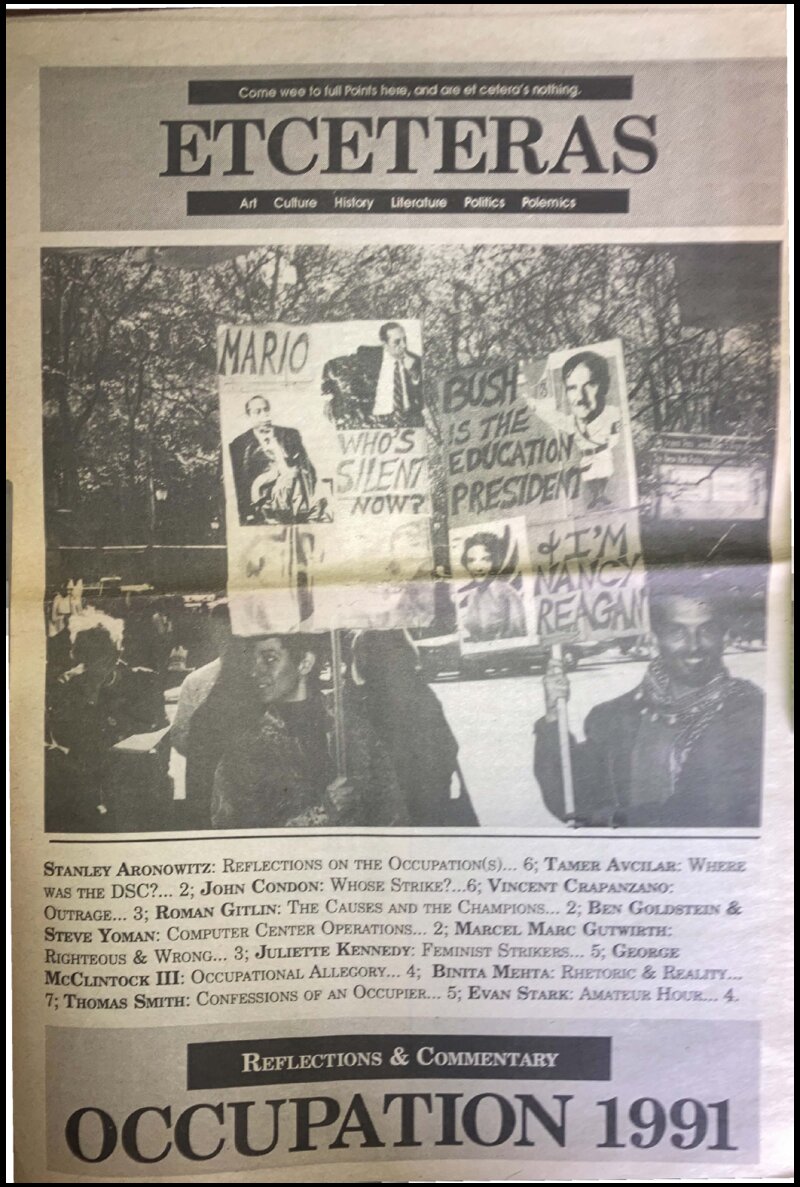
fe, ond cre ef Celero’s ronhing
An Culture History Literotue Politics
rr?
Srantey ARONOWITZ: REFLECTIONS ON THE OCCUPATION(S)... 6; Tamer Avcmar: Were
"WAS THE DSC?... 2; Joun CONDON: WHoseE Srrike?...6; Vincent CRAPANZANO:
Ourrace... 3; RomAN GITLIN: THe CAUSES AND THE CHAMPIONS... 2; Ben Gotpsremx &
Steve Yoman: Computer CENTER OPERATIONS... 2; Marce Manc Gurmmru-
Garzous & WRONG... 3; JULIETTE KENNEDY: Feminist Sreiens... 5, Guorcz
sCuintock III: OccuPATIONAL ALLEGORY... 4; Brnrra Menta: armies * & Reais
ws
Tuomas Surru: CONFESSIONS OF AN Occupier... 5; Evan Srarx: Auatzur Hove.
My mothercan notsleep until two in
the morning. A long time ago her father
‘was not POLITICALLY CORRECT. They
could have taken him away at any mo-
ment. Soeach night she waited. Her fears
Jong gone, the habit stays.
The time was 1937, the place was the
USSR and the situation was hardly
unique. When I learned that “political
correctness” is a buzzword of the Ameri-
‘can left, | was amused. Here, of all
places... Well, the more different things
are, the more they are the same.
A few years back at the Graduate
Center I met some nice people, all con-
cerned with the fate of humanity. Ina
friendly and only slightly patronizing
manner they would try to explain how
infinitely better off I had been back in the
USSR. I guess my reaction fell short of en-
thusiastic, for when I met one of them in
an elevator, he gazed straight past me,
through the walls of oppression, into the
bright lights of the future.
Many of my compatriots had similar
experiences, and as | listened to their rec-
collections, the word “jerk” seemed to be
rather benign. As the joke hasit, there are
three types of people: decent people, in-
| marxists. ~
and Sey jean be inches
If you are decent and intelligent, you can-
not be a marxist. And if you are intelli-
gent and a marxist, you cannot be decent.
We lived the advanced stage of the
STRUGGLE, people annihilated in body
and soul. At that time the joke was true.
While people clamor for causes, causes .
attract people.
The goal of the strikers, who occu-
pied the Graduate Center for ten days,
was to defend the people's right to educa-
tion. So they said. For me, it was more
like moral gratification! Since their ideas
of education and mine are as far apart as
it gets, and nobility of intent is as much
their refuge as it is my fear, I do not want
_ to discuss the merits of the strike per se.
Instead, I will speak about the way the
‘strike FELT.
_ It was noisy. “Education is our right!
Right, right, right”
echoing “Education is our right! Fight,
pened All could see was a bunch
of kids, some of them red in the face with
effort, rising on the swell of their slogans.
And there was nothing to counter the
= impression. There was a poster, carried
| byaman witha happy, half-absent smile.
fj The poster equated Mario Cuomo to Sad-
_ dam Hussein. Though undeniably
« subtle, it was nevertheless appalling. Ido
hypocrite, a tiny bit of the grocery store
__ still in him, he has a difficult time beliey-_
show good HIS life turned out to be.
Yet, tocompare him to the murderer, who
cuts. Never mind that the state does not
have money. Raise the taxes! Now! And
nobody, nobody talked about GOOD and
BAD, only about RIGHT and WRONG.
The skulls of the people caught in the
STRUGGLE and lost to this subtle distinc-
tion could haye filled the Graduate Cen-
ter many times over!
And there was FREEDOM! Everybody
could breathe it;a pair of earplugs did the
trick. A student from the Anthropology
stood next to me amid the di-
vided crowd. Filled with scorn and an-
ger, he explained that most of the strikers
{though not all of them) had the freedom
to be full-time politicians by virtue of
their wealthy parents. There was nothing
in the way the strikers were dressed to
contradict his assertion.
A yellow poster on the wall next to
the entrance made me see red (no pun
intended). “Come to the liberated Gradu-
ate Center!” it proclaimed. The occasion
was a seminar on gays and lesbians in
RADICAL STRUGGLES. The perversion
was obvious! I do not mean their sexual
orientation. This was none of my busi-
ness! And donot mean their decision to
let themselves in, while keeping the rest
of us out. Swinish behavior is not uncon-
2 ee ee ee
SENSE OF FREEDOM that shocked me;
for all practical purposes, the building
was LOCKED! And yet they called it LIB-
ERATED??? The symbolism was tragic,
pure gore.
It was a cold day. The meeting was
over. As! sat sipping coffee with a couple
of my friends in Le Croissant Shop, I saw
one of the strikers take a seat next to us. I
had seen her before with another striker,
a tall man with a friendly face and quick
eyes. Sheseemed to be friendly too. Since
she had left the meeting after we did, I
asked her if the seminar went on as
planned. At first she did not understand.
Thenshe brushed me off with a short ges-
ture of scorn. I heard her tell her compan-
ion a garrulous version of my complaint.
When I asked the question again, she
taised her voice and asked me to leave her
alone, please.
And there was RAGE, RAGE, RAGE.
Another place, another time. Almost
twenty years ago in Leningrad | met an
‘old Jewish man. Ready smile, grey hair,
grey skin, he was possessed by a wither-
ing, all-consuming hatred. Back in the
thirties, a fellow traveller, he had left New
York and moved to the Soviet Union. So
eager he was to sever all links with his
bourgeois past that upon arrival, his first
action was to give up his American pass-
port. The first thing they did once he had
given it up was to send him to a labor
camp. Eighteen years later, a broken
man, they let him go. I don’t know what
he was out, Wasit the ideals of
his youth that let him down? Or was it
the country that made his life a living
hell? His was a generation of upheaval.
A few years after he left New York the
I imagine—! have to imagine—that
the students... No, not the students... I
must remind myself of the dangers of
such an impersonalizing objectification,
Particularly now that the occupations are
over and anger, resentment, and the de-
sire for vindication in certain quarters is
felt. I have then to imagine that the men
and women who occupied the Graduate
Center and buildings on other CUNY
campuses were acting in full reflective
and self-reflective subjectivity out of out-
tage and a sense of being betrayed.
We have, | believe, to consider the
role of outrage in any political formation.
Itis more intense than rage. It is at once
more diffuse and more focused. It is
stimulated by what is deemed to be a
wrongful act, a budget cut, for example,
an increase in tuition, thatis itself indica~
tive of some greater impropriety—a
breach of contractual obligation, an injus-
tice. In other words, the act that triggers
outrage calls attention to a betrayal of
some set of values that is held to be, ifnot
sacrosanct, fundamental. It reveals the
uncertain footing of such values, their
manipulation for personal advantage by
those in power, the artifice of the political
theodicies that mask hypocrisy and jus-
tify the “evil” that arises from such ma-
the hypocrisy of the governor, so famous
for his oratory, of his failure to keep his
promise, the promise, of a state in which
higher education would be open to all
who qualified intellectually and not just
economically, the revelation that the cher-
ished values and promise of the United
States have been sacrificed yet again toa
crude, unimaginative pragmatism, and
the disclosure of the virtual impossibility
of communicating in a meaningful and
powerful, an effective, way this vision. If
anything led to anger, I assume, it was
this disclosure.
Whatcould be done? A symbolic act:
the occupation of buildings. To occupy a
building, though, is to be occupied by the
building. To occupy and be occupied bya
symbol. To be isolated from the symbolic
effect of the symbol, the symbolic act. To
live within the liminal world of the sym-
bol without “real” contact with the out-
side world in which the symbol is meant
to be effective. limagine that the menand
women in the Graduate Center, whatever
their realism, their political savvy, their
cynicism even, were structurally unable
to appreciate fully the effect of their act.
Whatever their intentions, they never
claimed torepresent the full student body
but were open democratically to any and
nipulation. It reminds the outraged of
their entrapment in, for lack of
split in those other communi-
symbol for that fac-
tion that for whatever reasons, personal,
political, or moral, did notapprove of the
occupation. They became an object of
anger. Their act served to deflect and re-
focus the outrage other members of their
community had at the impropriety of the
proposed budget cuts and tuition in-
crease onto them, the students, and their
occupation. As a displaced focus of out-
tage their symbolic act subverted its in-
tended goal and was divisive.
1am not sure if this subversion is in
the nature of all disempowered symbolic
acts. Ido know that angerand rage—and
outrage insofar as it lies at anger and
rage’s alluring border—are self-propa-
gating and divisive. Focused on an ob-
ject, however justifiably, they can enrage
all those whose anger and rage are not
directed to that object. Where division is
intolerable, anger and rage become conta~
gious, creating an illusion of solidarity, of
shared values and goals, a single vantage
point, where there is in fact little that is
shared. With such repressive contagion,
there can be no dialogue and without dia-
logue no community.
And yet, we mustadmit, the occupa-
tion did call attention to both the initial
outrage and its source. | remember acon-
versation I had with two men about it,
‘one a conservative republican and the
other a middle-of-the-road democrat, nei-
ther of whom were connected to the uni-
versity but both of whom had very con-
siderable political and economic power.
They each observed: “Politically you can’t
legislate out universal education but you
can do it through the budget.” One of
them thought the budget cuts a good
thing; the other an outrage. The outrage
persists.
poverty of political imagination.
Outrage can lead to anger, and as the
stoics tell us, anger has to be contained,
“There is no passion that so shakes the
clarity of our judgment as anger,” Mon-
taigne observed. “No one would hesitate
to punish with death a judge who had
condemned his criminal through anger.”
But, whether or not we see the stoic’s
view of anger as accommodating to the
status quo, whether or not we accept the
blindness that arises with anger, we must
differentiate anger from outrage, for out-
rage need not lead to anger. It can pro-
duce striking clarity and lead to the com-
munication of that clear vision. Here lies
the force of outrage and the threat it poses
to those responsible for the act, the
events, that triggered it.
1 imagine, I like to imagine, that the
men and women who occupied the
Graduate Center and the other campuses
had that clarity of vision: the exposure of
Are you sick of
Bad Budgets
and
Tuition Hikes?
Write the
Governor
Mz M. Cuomo
executive Chamber
tate Capitol
Albany, NY 12224
Vincent Crapanzano
Distinguished Professor
Executive Officer,
Comparative Literature
Tommuruty and per-
RIGHTEOUS AND WRONG
As a relative newcomer to the tur-
moil of CUNY life | should not have ven-
tured to offer my reflections on the occu-
pation of parts of the University in protest
against a very real threat to its continued
existence without friendly prodding from
the editor of this broadsheet. My views, |
explained. to him, are hopelessly di-
vided—as befits the academic mind,
prone to see both sides of every question.
He insisted; here goes,
Standing in the crowd that as-
sembled in the entrance-way of the
Graduate Center time after time, strain-
ing to hear the speakers out of their bull-
horn, amid the roar of passing traffic, | felt
acutely the rightness and the wrongness
of the occasion. The rightness first. Of
course, we must protest being taken to
the slaughterhouse. The University can
hardly survive the cuts that are proposed
for its budget. The students can scarcely
be expected to sustain a hefty rise in tui-
tion costs, a cut in aid, being frozen out of
adjunct positions, when they barely exist
on what little we can provide for their
support as it is. The nation has been
stripped to its undershirt in the heedless
Reagan years. The governor's bookkeep-
ers miscalculated the impact of tax “re-
work, w
owe a debt of gratitude to the student!
who took upon t
vexation in a desperate gamble for atten-
tion to the seriousness of our plight.
Thus far the rightness of it. And I
reckon in their sleepless nights of feverish
deliberation, their risk-taking, their un-
certainty that it would pay off.
The wrongness of it, to my mind, is
just as patent. What manner of damage
do we inflict on an indifferent body poli-
tic by occupying our own buildings,
wrecking our own institution, halting
services that cater to ourselves primarily?
When the railroads go on strike, travelers
Ivesourangerand erty
are stranded, Interfering with our own
education—while loudly proclaiming
that we strike for free access to educa-
tion—was akin to cutting off our nose to
Spite our face. No one was seriously put
out but ourselves. The media were
largely unmoved by a gesture that was
intended to make our plight visible. And
a lot of predictable unpleasantness got
painted into the picture. Bullhorn demcc-
racy proved no less of an exercise ir
make-believe than much of its ballot-box
counterpart. Those who boomed slogans
comforting the crowd in its own beliets.
garnered loud and spirited approval
Those who voiced misgivings merely ex-
cited tumultuous unrest, and they proved
by and large far less adept with the bul
horn, having little to offer that a crowd
wanted to hear, Their pleas to be allowed
to complete their education were g:
ally dismissed as “selfishness” by th«
who posed as the defenders of educ
for all. Where ever have I heard bef
the interests and the welfare of living
people held as nothing in the face of the
promise of an unendingly radiant future
Thus a mixture of futility, self-righteous
ness, deluded arrogance that spawned an
ever-lengthening list of DEMANDS call-
_ing upon others to come to heel and set
What di
contained within
we must be thankf "
sity of the provocation, I cannot |:
my heart, when all is said anc
condemn an action that may ha
futile, that was certainly aggrav
that was wrung from the aggrievec
overwhelming sense that to gc
withouta fight was unendurable
Marcel Mare Gutwirt>
Distinguished Professor
Executive €
Ph.D. Program in Frencr
Americans, the etc—as if
n we were a band of plutocrats. (Some of
the ‘less fortunate’ were standing right in
| Democ- front of them and wanted in.) Why did
the occupiers assume that they were they
only people with a social conscience?
taking over Why do they assume that I’m any less
committed to what they ostensibly stand
for, simply because I don’t agree with
their occupation tactic? Their class-iden-
tification comments wreaked of unjustifi-
able moral condescension.
The occupation was weakened by a
diffuse and unrealistic focus. Many
‘people at the the occupation used the
gaily speechmaking forum to trumpet
‘their particular causes. For example, one
Woman, presumably lesbian, used her
turn at the mike to speak stridently about
lesbian issues and of a ‘liberated Gradu-
ate School.’ Linkage of issues can be a
great way to get the most bang out of
your protest buck—if and when the side
with whom you're negotiating is affected
by your fundamental bargaining chip,
What gives students the right to secure
fayors from those who would be their
mentors? Above all, what gives the Pro-
fessional Staff Congress [PSC], whose
leaders run for election unopposed, the
tight to perpetuate CUNY’s exploitation
of adjunct lecturers and research assis-
tants, without whom the University
could not function?
To deny the Graduate School occu-
pation its allegorical magnitude is to deny
the injustice of CUNY’s impending dev-
_ astation, as well as the horror of our col-
lective impotence before the carnage.
As if by surprise, the occupation be-
gan to wither. Once a political act of
metaphor and pedagogy, the strategic
‘value of the action waned. Why? Alle-
_Borically, the strikers’ ideal microcosm—
_ @“liberated” Graduate School—mirrored
tionally futile attempt to synthesize
Symbol and reality, to make history as
alchemists made gold from lead. We may
pledge allegiance to a flag of social prog-
SS, we may devote ourselves to demo-
well-funded public education, but
° it devotion does not necessarily trans-
Tate into tactical sagacity. The Graduate
School | ve been “liberated” sym-
, the community was
when the doors were
@ mainframe computers
supposed to be able to
which was, in this case, the building.
Because there was no evidence that the
primary tactic of occupation was effec-
tive, allowing people to trumpet their pet
causes and to link them to the occupation
reduced the protest to little more than a
public forum for individual self-expres-
sion. (I criticize the tactic of linkage,
though I was in full agreement with what
the “linkers” had to say.) Thinking the
occupation would constructively affect
the budget talks was unrealistic; linking it
to peripheral issues turned it into Ama-
teur Hour.
Ishare the occupiers’ views about the
tuition hike, and I’m willing to fight. But
the only things I'll remember about the
occupation are tactics and behavior that
would've made a right-winger proud.
Evan Stark
Psychology
individuals voiced their opposition to the
occupation, they were asked to make sac-
uficrs: pulust ea the strikers themselves
Graduate School, CUNT: Wes F8¥8 &hS
the world. When individuals suggested
voter registration as an effective, if ineffi-
cient, political tactic to influence govern-
ment policy, strikers derided this demo-
cratic tradition as rendered nonsensical
by capitalism’s brutal efficiency. The
strikers’ desire to take their place as ideo-
logical leaders in the protests instigated
by CUNY undergraduates apparently tri-
umphed over their intention to diagnose
and treat the University’s terminal can-
cer, Even The Washington Post reported
that “At the Graduate School and Univer-
sity Center ... students answer the central
phone line, ‘Strike center.” (4/20/91)
When spectators realized that the occupa-
tion had no method to its madness, the
strikers’ sacrifice began to smack of self-
immolation. The occupation’s symbolic
significance, an ideal CUNY, free and
open to all, was tarnished.
CUNY must not be martyred by
ambitious politicians who would deny its
right to educate the peoples of New York.
Isalute the students who risked their aca-
demic careers at the Graduate School in
order to teach us how the destruction of
public education is an open invitation to
fascism. | alsosalute the Graduate School
administrators who, despite pressure
from their superiors, did not fear for
CUNY property, and refused to call for
police intervention, even when the per-
formance of guerilla theater was over and
the strikers failed to leave the stage.
Unfortunately, what was for two
days a superb allegory of our collective
political paralysis eventually paralyzed
everyone, distilled everyone down to al-
legorical slaves, masters, and eunuches,
Surgling together in an ancient cauldron
of distrust. When the actresses and actors
ofa powerful production became trapped
in an allegory of power for power’s sake,
the occupation of the Graduate School
ceased to be ‘
m Suerilla theater and lost its
Volume 0 Number 0
OCCUPIER
Alright, so we took over your build-
ing. We made your lives miserable for a
week—a week out of your academic ca-
teers! During that time you couldn’t use
the library. You couldn’t use the com-
puter center. You couldn’tattend classes.
I'm not happy about that, God knows I’m
busy enough myself, what with teaching
out at Rutgers (which I still had to do) and
working on my proposal (which I haven't
had the time to do anyway because I have
to work asan adjunct for shit pay to make
ends meet all year), So why did I support
the occupation? Bubby, why did I help to
lock you out of the building, when you
were yelling and screaming and kicking
me and my fellow occupiers in the face
that you had to get in there? Aren’t we
supposed to be pals?
Yea, but look, we needed to do this,
Governor Primo Domo Cuomo is once
again screwing us and hundreds of thou-
sands of undergraduates with another
$500 tuition increase (this, plus the $200
increase already passed in January, adds
up toa 50% increase) plus abouta 10% cut
in the total CUNY budget. For a sizable
number of undergraduates, struggling at
one or two or three jobs just to make ends
meet, this will mean the end of their
chance for an education. For about 800
adjuncts such as myself, it will mean we
will not be employed in the fall—making
us doubtful about our futures. And
Cuomo says these are cuts and hikes that
we can afford to make!
The governor won't listen to reason!
He won't tax the rich instead, h
_ whoh
economy Into a awful mess. Why? Be-
cause he’s locked into his own logic, the
logic of an elite politician, who depends
on campaign funds and bond sales to
keep his career afloat, and because he’s
afraid of what might happen to his elec-
toral fortune if these corporations and
banks divest out of the local economy
rather than pay a measly 3% increase.
He won’ tbe lobbied, and neither will
his friends in the State Assembly. The last
time he tried something like this, in 1989,
we had to occupy buildings to call atten-
tion to our plight. As a result of that at-
tention, as a result of the mobilization
among undergraduates and graduate stu-
dents we achieved, we pulled 20,000 stu-
dents into the streets. That evening, the
governor announced that there would be
no tuition hikes (but he went through
with the budget cuts),
We at the Graduate Center, unlike
many of the other campuses, used the
week we occupied to mobilize students.
We held public meetings every weekday
at4p.m., toask if we should continue the
Occupation, and up until the last day, we
got overwhelming support. We were
democratic, because we knew that it's
Dintnc Commons
Reports Loss
The price of the Graduate
School occupation was much
higher than mere inconvenience for
faculty and students. College assis-
tants, who work for hourly wages,
were paid only for a maximum of
three hours per day. Although the
custodial staff and security person-
nel were pald, the employees of the
Dining Commons and Bar lost al-
most $9,500 in wages. The Dining
Commons also reported more than
$32,000 In lost banquet, restaurant
through democracy that we would
achieve our limited objectives. We
sought to mobilize our ranks, to show the
university administration, and the State
Assembly, that students en masse, not just
a few leaders, utterly reject these hikes
and cuts, and are quite willing to organize
to disrupt business as usual to stop them.
And we showed them that graduate stu-
dents, who have already made it past the
first few hurdles in higher education, are
not about to accept the rhetoric about
“quality” admission standards and “se-
lective” tuition rates which would deny
our undergraduate colleagues and stu-
dents the chance to receive a quality edu-
cation.
As the enthusiasm at meetings out-
side, and energy inside, began to wane,
some of us began to go into vanguard
mode. They began to argue that “we
shouldn't have the vote tomorrow; we
know what's best; we should occupy un-
til the administration gives in.” I felt they
were confusing the ends with the means.
Fortunately they realized that you would
not allow that. Democracy has its own
dynamic: we kept voting, and we got
what we wanted from the administra-
tion—the chance to use GC facilities to
continue to organize against the cuts and
hikes.
The vanguardism—never acted
upon—was understandable. It was a
long ordeal for us, and we got tired fast.
Try sleeping on sofa cushions ina room
‘a pretty wicked case of insom-
nia which has already plagued you
throughout the the semester! The place
isn’t exactly designed for camping out. It
felt like that until you tried to get to sleep.
I remember with special fondness a
bullshit conversation we had while
guarding the door at 1:00 in the morning,
about the class politics of Hamlet. 1
haven’t had so much fun and sense of
interdisciplinary community since | was
in the dorms at ol’ Penn State! But then I
tried sleeping. This attempt continued
until 7 A.M., and was successful until 8
AM. (my roomie’s alarm woke me). I felt
screwed, blued and tattooed, but then I
went to staff the telephones. That was a
bit more fun, I learned how to use a
switchboard (and I’m not even a member
of the union!),
The second to last day we had our
tally downtown. We only got 5000 stu-
dents—perhaps because the undergradu-
ates didn’t hold daily public meetings the
way we did. Instead, some of them put
up signs saying “Classes cancelled, go
home,” and wouldn’t let anyone on the
campus without a security clearance. By
the way, where were you guys—the ones
who were against our occupation at those
public meetings?! I recall you talking
about other ways of going about putting
Pressure on the governor—why. didn’t
you use them?
The Grad Center Occupation was a
model for the others, and the first firing
shot in a long campaign. The economy
isn’t going to get any better. Supply-side
economics has been a disaster, and fatcats
like Cuomo and his banking pals aren’t
about to foot the bill for Keynsian spend-
ing anymore, unless we start mobilizing.
We're sorry we caused you this inconven-
ience. But we did consult with you demo-
cratically, we needed to doit, and we only
did it for a week. Please give us some
understanding.
Thomas Smith
Political Science
This is an open letter to the women
who participated in the takeover of the
Graduate Center; at the end of it there isa
message for a particular woman on the
strike committee with whom I spoke at
about 12:00 noon on the day the strike
ended,
Why did you, as feminists, allow the
situation to deteriorate to the extent that
the predominant tone at the afternoon
meetings was one of: Aggression! What
possible effect did you think this would
have on people? Well I’ll tell you the ef-
fect it had on me: | kept my mouth shut.
Out of fear. It is inevitable that tempers
flare in these situations, but I can testify
that the behavior of some on your side
was beyond the pale. Land other women
were bullied, screamed at and physically
menaced for expressing views which dif-
fered, however slightly, from yours. Did
you concern yourselves with this aspect
of things atall? You did not appear to, to
me, Did you have a responsibility to
address yourselves to this issue? Asfemi-
nists, absolutely. | do not know if a lot of
other women had the same reaction,
mainly because most of the people that
know who disagreed with you stayed
home, and I will not speak for anyone
other than myself. But I willsay that my
anger over this is such as to make it un-
thinkable for me to participate in any-
no matter what the cause.
people who neverthek
now to have been a very minor tactical
point, then it would have been very casy
to sign me, for one, on to all sorts of activi-
ties. The occupation of the building I can
say now | would not have participated in,
but many other things | would have been
willing to do. But you were unable to
bring yourseives to take seriously anyone
who was not in favor of occupying the
building, a gesture which I repeat seems
to be, in the grand scheme of things, of no
import. On the contrary your behavior
towards us ranged from condescension to
outright abuse. In my perception it was a
bit condescending of you to parade in
front of us that day so many people from
other universities and also high school
students, who I suppose were there to
serve as living proof of the “selfishness”
of those of us who opposed the occupa-
tion. We as graduate students know very
well whata disaster these cuts represent:
the undergraduates are potentially out of
an education, but we are potentially out
thing you are now or ever will organize,
what turns out
Page 5
of an education and a job! Even if we are
rehired, either our classes will consist of
150 students, or there will be no students
left to teach! This is all Most Obvious, or
as we say in my trade: too true to be prov-
able. But of course the focal point of that
whole meeting and I understand subse-
quent meetings, was the occupation itself,
how much attention it was attracting, and
all this delivered (at least by those of you
who managed to stay calm) with a sort of
hyperactive smugness and self-righteous-
ness that angered quite a few people
Now | am not saying: you know, you
folks are badly in need of some tutoring
in public relations, I'm saying: this is
where I think things gota little ugly
To an outsider, but especially to
someone on the receiving end, the rage of
the self-righteous is one of the ugliest of
all things. This cannot be said enougt
times. Don’t you realize that much of the
brutality that is committed by people ha:
its genesis right there? In people who
know they are RIGHT, and to hell with
any single person, who means precisely
ZERO. | am surprised that so many of
you missed this point, this being one of
the great themes of world literature, no?
That you had lost sight of this seemed to
be more and more evident as time went
on, so that at the end, when you left the
building, you could have been, en masse,
any group of fanatics, from the fascists of
the 1930s to the fascists ‘of the Cultural
Wil end by
which illustrates this very thing
me in the following context: wh
ing to enter the building on Thur
struck up a conversation with a woma
the English department, an avid
porter of the occupation. We had a
lized conversation during which | sta:
in the strongest terms my anger and d
appointment with the feminists or
strike committee. After a while we we:
joined by another woman whom | r
nized as one of the leaders of the oc
tion, and who, after listening to m
about 20 seconds, turned to the
woman and said, and | quote: “Th
to-one stuff is a bad idea.” Well to tt
woman who perhaps recognizes her
mark | would like to say: Remember
you are a human being and that | ar
that without your humanity you are no
ing, and that finally the “one-to-on
as you call it, isall there is. Is PRIMA
Juliette Kennc
Mathemat
After lecturing the troups on the futility of the occupation, Professor
Bogdan Denitch hands off the megaphone and exits stage right.
publish their
findings. That's the American Way; that’s
caritedeaareqitartbeloop of
"working-class families at or near the bot-
| Eierapsecehecrpeey
‘thé reverse of those that propel tradi-
political
police and landlords, they
school has never been
_ most of us :
tical directorate are, routinely, acting
that government is genuinely and
tative is hotly contested
"
Volume 0 Number 0
fone would have paid attention.
anyone Seay. tet
the university would not restore the cuts
or rescind the tuition increases. But the
students know, better than their critics,
that the familiar channels of: protest do
not work very well and for those without
money and power, not atall. Intuitively,
if not articulated in the rhetoric of pol
cal science, they are also aware that there
isa crisis of democracy—not only in East-
ern Europe, but in these United States,
and that it is getting worse, not better.
That's why the occupations were justified
and why those who condemned them,
most of whom are safely within the politi-
cal mainstream (which is only half the
population) liveina different world from
those who acted this Spring.
One of the most important aspects of
the event(s) is that on some campuses,
notably the Graduate Center, some fm
meetings for students and faculty,
thedeclsion was made, ona daily basis, to
continue the occupation. And, when the
students finally surrendered the campus
to the authorities, it was only afterengaz~
ing in a three-way negotiation with the
administration. (The third party was a
small faculty “mediator” group.) Th
experience confirms that students were
not engaged in some kind of adventure,
but are seriously concerned, not only
xi by most peopleofcolorand workingclass _with the immediate issues of the budget
crisis, but with the problem of taking con-
to legitimate:
yne marshals.
Or,
—
He.
Nor does the racial and subcultural
composition of legislatures, and the lead-
ing officials of most public agencies, offer
any comfort. Moreover, most teachers
are white. For many students, almost
‘none of the representations of au-
yi would
lead to direc by the Governor
or the legislature to their protest, they
were mistaken. Their real audience was
the media and, in some respects, they
failed to play it adroitly, although with-
" out the occupations it is doubtful that
political demands of the university and
the state. If they considered themselves
professionals, they might be over-
1ed by the demands of the scholar-
) that lay before them, and the daunt-
ount of personal sacrifice and hard
education demands. But perhaps
nthis thats
‘that
5 oll
trol of their own education through
shared decision-making. This preoccupa-
tion was manifested in some of the nego-
tiating demands that addressed curricu-
lum as well as economic and disciplinary
issues. In my view, the question of
whether CUNY could become a leading
innovator in pedagogy and curriculum
the major new feature of
that should remain atthe
in September, renovatic
educational mission of the Graduate Cen-
ter should be possible.
Stanley Aronowitz
Professor
Sociology
_ The 3 Biggest Lies
0 Number 0
mber feeling a sense of élation
n I first heard about the occupation of
Graduate Center, and even said
“More power to the students.” For
.e first two days, the occupation was an
ffective symbolic gesture of the occupi-
support for their undergraduate col-
at other CUNY campuses. How-
;, as the days went by and the strikers
ppeared to be wrapped up in their
wer to allow or to deny access to the
ilding, it became clear both that the
pation was not heading toward any
concrete solutions, and that the occupiers
were unwilling to listen to any dissenting
voices. In fact, double standards
ibounded. Certain groups and individu-
ie
__ als were allowed to enter the building.
The Part-Timers United [PTU], an organi-
zation of adjunct lecturers, was allowed
_ to hold a meeting, although PTU officials
Jater ‘ed that the occupiers insisted
that the PTU endorse the occupation. The
f a Fie PTU refused to comply with the occupi-
___ ers’ demand. The Organization for Gay,
bre
Lesbian and Bisexual Concerns [OGLBC]
was also permitted to hold a teach-in in
_ theauditorium. The topic was the role of
gaysand lesbians in radical struggles.
Rallies or “open forums” were held
every afternoon, where members of the
Graduate Center community voiced their
support for, or their opposition to, the
occupation. At 5:30 every evening, the
occupiers sponsored a vote in order to
decide whether or not the occupation
should continue. Unfortunately, the ral-
dies soon became platforms for the occu-
piers to air their self-righteousness and to
dismiss dissenters as selfish and hypo-
‘al, who were “not thinking of the
good of all CUNY students.” It was as-
sumed that people opposed to
p e apathetic to CUN)
pé
ETCETERAS
Ruetoric & REALITY
trous fiscal crisis. This position was reit-
erated in an editorial published in the
May issue of The Graduate Student Ad-
vocate: “Some graduate students may feel
that their interests lie with the institution
and not with other CUNY students, and
that their careers are best secured this
way.” The Advocate’s only news report
about. the occupation—entitled “The
Graduate School Strikes Back!”—focused
on the support for the action; opposition
voices were mentioned only in passing:
“An open microphone was provided for
people to express their opinion of the ac-
tion, whether in support or opposition.”
The article failed to mention that the oc-
cupiers monopolized the microphone to
such an extent that when it came time to
vote, the dissenters had left the rally in
disgust. Thus the “open forum” deterio-
rated into a monologue by the occupiers,
who insisted that the occupation was
“morally” justified. This demagogic atti-
tude and the false sense of empowerment
thatit fostered among the occupiers alien-
ated many dissenters.
The rhetoric for and against the occu-
pation was heated and emotional, some-
times absurd. There were students who
supported the occupation because they
felt that it was the only effective way to
pressure the administration to fight
against the impending budget cuts and
tuition hike. For those students, to give
up the building was to abandon the pro-
test altogether. Another occupier argued
about the need for some students to give a
fully stated thatas a member of an upper-
middle-class family, she could afford the
$500 tuition hike, but that she was fight-
ing for the rights of the less privileged
who cannot afford the increase. One oc-
cupier even confessed that he had op-
posed the occupation at first, but decided
to go along with the majority opinion,
thus bowing to peer pressure.
A Latina student mentioned the fact
that the occupiers in the building were
notall white, and that many were “people
of color.” She went on to explain how
skin color is not only a physical trait but
also a state of mind. The Latina student
spoke about “people of color” as a face-
less collectivity, without individual dif-
ferences. Does the fact that there were
“people of color” in the group of occupi-
ers legitimize their action? Or was the
Latina stident’s rhetoric merely phony
and manipulative? Although the occupa-
tion seemed to demonstrate that it is pos-
sible for people of different sexualities,
genders and races to work together to-
ward a common goal, the occupier was
obviously not speaking for all “people of
color.” A nursing student at Borough of
Manhattan Community College, who ob-
jected to the occupation of BMCC,
pointed to the color of her skin and told
reporters thatas a black woman it is only
through education that she will succeed
in this country.
Since the end of the occupation more
than two weeks ago, a silent war has been
/
Page7
a number of meetings to discuss protest
strategy and their continuing negotia-
tions with the administration. Neverthe-
less, when flyers were posted last week
announcing a forum for dissenting views,
they were defaced, presumably by stu-
dent occupiers, who challenged dissent-
ers to propose their own ideas to fight the
budget cuts. Although the occupiers
have said that they want to put the occu-
pation behind them and to work with the
entire student body, they have not yet
learned that many students who opposed
their action are still spitting fire.
In retrospect, it is easy to speculate
on what should or should not have been
done. Nonetheless, it is vital that such a
post-mortem take place, if only toassuage
the anger felt by those on both sides of the
controversy. It may be purely conjectural
to wonder whether the occupiers, with-
out taking over the building, could have
persuaded the administration to partici-
pate in the battle against the budget cuts.
If the occupiers had organized rallies to
discuss ways to fight CUNY’s problems
before taking over the building, they
might have achieved their ideal demo-
cratic process. And in doing so, they
might have been able to build consensus
among the Graduate Center community.
If anything positive resulted from the
occupation, it was the interchange be-
tween the administration and students, as
well as the dialogue, however vitriolic,
between the students themselves. <
The occupiers will have to listen to
the views of the dissenters in order to
achieve the solidarity they so desperately
seek.
: =a Poca itive eS
Computer Science
Criminal Justice
b Earth & Environmental Science
s Economics
Engineering
English
nee ee CL ibexal Studies
Linguistics
Mathematics
Music
Ne Neuropsychology
Philosophy
—-._. Physics
Political Science
ee ee
Psychology
Clinical
Developmental
Educational
Environmental
Experimental
oo Seem Cognition
oot & Organizational
ing Processes |
Alfredo Gonzalez
Christine Kovic
Virginia Rutledge
Mignon Nixon
Andrew Gibson
Steven Spiegel
_ Annette Cantarella
Kathy McKay
César Maloles ©
' Steve Papamarcos
Stephanie Habif
Joan Parkin
Tamer Avcilar
Michael Yomi
Joanna Scharf
Cheryl Fish
Paul Salkind
Jarrod Hayes
Violet Healy
Peggy McNamara
Tara McGann
Sharon Meltzer
Nick Papalostas
Gordon Crandall
Antonio Piza
Luann Dragone
Nan Min
Ian Gardner
Huao Qiang
Yan Li
Jonathan Kranz
Dan Evans
Mara Silverman
Tlene Green
Elizabeth Kelly
Rachel Riesenberg
Eric Graig
Michael Kushner
Laura Gooler
Mun Wong
David Feldstein
Manjula Giri
Dana Fenton
Pat Belcon
Dorys Schnabel
Maria Mody
___ Chris Mack
- Carol Pederson
Cathy Crissy Binita Mehta
Danny Choriki Pat Moore
Vivian Gill Terry Myers
Michael Glassman Arlene Nichols
Robert Greer Elizabeth Powers
Juan Heredia Karen Schlenker
Brian James Peter Slomanson
Christine Kallinger - Tamseela Tayyabkhan
Michael Lewis Vincent J. Tirelli
Ed Marx Karl Wiederquist
George McClintock TII Carina Yervasi
Megan McCormick
Mep14 Boarp
Betsy Andrews
Charles Menzes
WEDEspay,
‘May 15, 1991
2:30 P.M,
Room S.C.10
Occupation’
FRipay,
May 17, 1991
4:30 P.M.
STUDENT CENTER
An Culture History Literotue Politics
rr?
Srantey ARONOWITZ: REFLECTIONS ON THE OCCUPATION(S)... 6; Tamer Avcmar: Were
"WAS THE DSC?... 2; Joun CONDON: WHoseE Srrike?...6; Vincent CRAPANZANO:
Ourrace... 3; RomAN GITLIN: THe CAUSES AND THE CHAMPIONS... 2; Ben Gotpsremx &
Steve Yoman: Computer CENTER OPERATIONS... 2; Marce Manc Gurmmru-
Garzous & WRONG... 3; JULIETTE KENNEDY: Feminist Sreiens... 5, Guorcz
sCuintock III: OccuPATIONAL ALLEGORY... 4; Brnrra Menta: armies * & Reais
ws
Tuomas Surru: CONFESSIONS OF AN Occupier... 5; Evan Srarx: Auatzur Hove.
My mothercan notsleep until two in
the morning. A long time ago her father
‘was not POLITICALLY CORRECT. They
could have taken him away at any mo-
ment. Soeach night she waited. Her fears
Jong gone, the habit stays.
The time was 1937, the place was the
USSR and the situation was hardly
unique. When I learned that “political
correctness” is a buzzword of the Ameri-
‘can left, | was amused. Here, of all
places... Well, the more different things
are, the more they are the same.
A few years back at the Graduate
Center I met some nice people, all con-
cerned with the fate of humanity. Ina
friendly and only slightly patronizing
manner they would try to explain how
infinitely better off I had been back in the
USSR. I guess my reaction fell short of en-
thusiastic, for when I met one of them in
an elevator, he gazed straight past me,
through the walls of oppression, into the
bright lights of the future.
Many of my compatriots had similar
experiences, and as | listened to their rec-
collections, the word “jerk” seemed to be
rather benign. As the joke hasit, there are
three types of people: decent people, in-
| marxists. ~
and Sey jean be inches
If you are decent and intelligent, you can-
not be a marxist. And if you are intelli-
gent and a marxist, you cannot be decent.
We lived the advanced stage of the
STRUGGLE, people annihilated in body
and soul. At that time the joke was true.
While people clamor for causes, causes .
attract people.
The goal of the strikers, who occu-
pied the Graduate Center for ten days,
was to defend the people's right to educa-
tion. So they said. For me, it was more
like moral gratification! Since their ideas
of education and mine are as far apart as
it gets, and nobility of intent is as much
their refuge as it is my fear, I do not want
_ to discuss the merits of the strike per se.
Instead, I will speak about the way the
‘strike FELT.
_ It was noisy. “Education is our right!
Right, right, right”
echoing “Education is our right! Fight,
pened All could see was a bunch
of kids, some of them red in the face with
effort, rising on the swell of their slogans.
And there was nothing to counter the
= impression. There was a poster, carried
| byaman witha happy, half-absent smile.
fj The poster equated Mario Cuomo to Sad-
_ dam Hussein. Though undeniably
« subtle, it was nevertheless appalling. Ido
hypocrite, a tiny bit of the grocery store
__ still in him, he has a difficult time beliey-_
show good HIS life turned out to be.
Yet, tocompare him to the murderer, who
cuts. Never mind that the state does not
have money. Raise the taxes! Now! And
nobody, nobody talked about GOOD and
BAD, only about RIGHT and WRONG.
The skulls of the people caught in the
STRUGGLE and lost to this subtle distinc-
tion could haye filled the Graduate Cen-
ter many times over!
And there was FREEDOM! Everybody
could breathe it;a pair of earplugs did the
trick. A student from the Anthropology
stood next to me amid the di-
vided crowd. Filled with scorn and an-
ger, he explained that most of the strikers
{though not all of them) had the freedom
to be full-time politicians by virtue of
their wealthy parents. There was nothing
in the way the strikers were dressed to
contradict his assertion.
A yellow poster on the wall next to
the entrance made me see red (no pun
intended). “Come to the liberated Gradu-
ate Center!” it proclaimed. The occasion
was a seminar on gays and lesbians in
RADICAL STRUGGLES. The perversion
was obvious! I do not mean their sexual
orientation. This was none of my busi-
ness! And donot mean their decision to
let themselves in, while keeping the rest
of us out. Swinish behavior is not uncon-
2 ee ee ee
SENSE OF FREEDOM that shocked me;
for all practical purposes, the building
was LOCKED! And yet they called it LIB-
ERATED??? The symbolism was tragic,
pure gore.
It was a cold day. The meeting was
over. As! sat sipping coffee with a couple
of my friends in Le Croissant Shop, I saw
one of the strikers take a seat next to us. I
had seen her before with another striker,
a tall man with a friendly face and quick
eyes. Sheseemed to be friendly too. Since
she had left the meeting after we did, I
asked her if the seminar went on as
planned. At first she did not understand.
Thenshe brushed me off with a short ges-
ture of scorn. I heard her tell her compan-
ion a garrulous version of my complaint.
When I asked the question again, she
taised her voice and asked me to leave her
alone, please.
And there was RAGE, RAGE, RAGE.
Another place, another time. Almost
twenty years ago in Leningrad | met an
‘old Jewish man. Ready smile, grey hair,
grey skin, he was possessed by a wither-
ing, all-consuming hatred. Back in the
thirties, a fellow traveller, he had left New
York and moved to the Soviet Union. So
eager he was to sever all links with his
bourgeois past that upon arrival, his first
action was to give up his American pass-
port. The first thing they did once he had
given it up was to send him to a labor
camp. Eighteen years later, a broken
man, they let him go. I don’t know what
he was out, Wasit the ideals of
his youth that let him down? Or was it
the country that made his life a living
hell? His was a generation of upheaval.
A few years after he left New York the
I imagine—! have to imagine—that
the students... No, not the students... I
must remind myself of the dangers of
such an impersonalizing objectification,
Particularly now that the occupations are
over and anger, resentment, and the de-
sire for vindication in certain quarters is
felt. I have then to imagine that the men
and women who occupied the Graduate
Center and buildings on other CUNY
campuses were acting in full reflective
and self-reflective subjectivity out of out-
tage and a sense of being betrayed.
We have, | believe, to consider the
role of outrage in any political formation.
Itis more intense than rage. It is at once
more diffuse and more focused. It is
stimulated by what is deemed to be a
wrongful act, a budget cut, for example,
an increase in tuition, thatis itself indica~
tive of some greater impropriety—a
breach of contractual obligation, an injus-
tice. In other words, the act that triggers
outrage calls attention to a betrayal of
some set of values that is held to be, ifnot
sacrosanct, fundamental. It reveals the
uncertain footing of such values, their
manipulation for personal advantage by
those in power, the artifice of the political
theodicies that mask hypocrisy and jus-
tify the “evil” that arises from such ma-
the hypocrisy of the governor, so famous
for his oratory, of his failure to keep his
promise, the promise, of a state in which
higher education would be open to all
who qualified intellectually and not just
economically, the revelation that the cher-
ished values and promise of the United
States have been sacrificed yet again toa
crude, unimaginative pragmatism, and
the disclosure of the virtual impossibility
of communicating in a meaningful and
powerful, an effective, way this vision. If
anything led to anger, I assume, it was
this disclosure.
Whatcould be done? A symbolic act:
the occupation of buildings. To occupy a
building, though, is to be occupied by the
building. To occupy and be occupied bya
symbol. To be isolated from the symbolic
effect of the symbol, the symbolic act. To
live within the liminal world of the sym-
bol without “real” contact with the out-
side world in which the symbol is meant
to be effective. limagine that the menand
women in the Graduate Center, whatever
their realism, their political savvy, their
cynicism even, were structurally unable
to appreciate fully the effect of their act.
Whatever their intentions, they never
claimed torepresent the full student body
but were open democratically to any and
nipulation. It reminds the outraged of
their entrapment in, for lack of
split in those other communi-
symbol for that fac-
tion that for whatever reasons, personal,
political, or moral, did notapprove of the
occupation. They became an object of
anger. Their act served to deflect and re-
focus the outrage other members of their
community had at the impropriety of the
proposed budget cuts and tuition in-
crease onto them, the students, and their
occupation. As a displaced focus of out-
tage their symbolic act subverted its in-
tended goal and was divisive.
1am not sure if this subversion is in
the nature of all disempowered symbolic
acts. Ido know that angerand rage—and
outrage insofar as it lies at anger and
rage’s alluring border—are self-propa-
gating and divisive. Focused on an ob-
ject, however justifiably, they can enrage
all those whose anger and rage are not
directed to that object. Where division is
intolerable, anger and rage become conta~
gious, creating an illusion of solidarity, of
shared values and goals, a single vantage
point, where there is in fact little that is
shared. With such repressive contagion,
there can be no dialogue and without dia-
logue no community.
And yet, we mustadmit, the occupa-
tion did call attention to both the initial
outrage and its source. | remember acon-
versation I had with two men about it,
‘one a conservative republican and the
other a middle-of-the-road democrat, nei-
ther of whom were connected to the uni-
versity but both of whom had very con-
siderable political and economic power.
They each observed: “Politically you can’t
legislate out universal education but you
can do it through the budget.” One of
them thought the budget cuts a good
thing; the other an outrage. The outrage
persists.
poverty of political imagination.
Outrage can lead to anger, and as the
stoics tell us, anger has to be contained,
“There is no passion that so shakes the
clarity of our judgment as anger,” Mon-
taigne observed. “No one would hesitate
to punish with death a judge who had
condemned his criminal through anger.”
But, whether or not we see the stoic’s
view of anger as accommodating to the
status quo, whether or not we accept the
blindness that arises with anger, we must
differentiate anger from outrage, for out-
rage need not lead to anger. It can pro-
duce striking clarity and lead to the com-
munication of that clear vision. Here lies
the force of outrage and the threat it poses
to those responsible for the act, the
events, that triggered it.
1 imagine, I like to imagine, that the
men and women who occupied the
Graduate Center and the other campuses
had that clarity of vision: the exposure of
Are you sick of
Bad Budgets
and
Tuition Hikes?
Write the
Governor
Mz M. Cuomo
executive Chamber
tate Capitol
Albany, NY 12224
Vincent Crapanzano
Distinguished Professor
Executive Officer,
Comparative Literature
Tommuruty and per-
RIGHTEOUS AND WRONG
As a relative newcomer to the tur-
moil of CUNY life | should not have ven-
tured to offer my reflections on the occu-
pation of parts of the University in protest
against a very real threat to its continued
existence without friendly prodding from
the editor of this broadsheet. My views, |
explained. to him, are hopelessly di-
vided—as befits the academic mind,
prone to see both sides of every question.
He insisted; here goes,
Standing in the crowd that as-
sembled in the entrance-way of the
Graduate Center time after time, strain-
ing to hear the speakers out of their bull-
horn, amid the roar of passing traffic, | felt
acutely the rightness and the wrongness
of the occasion. The rightness first. Of
course, we must protest being taken to
the slaughterhouse. The University can
hardly survive the cuts that are proposed
for its budget. The students can scarcely
be expected to sustain a hefty rise in tui-
tion costs, a cut in aid, being frozen out of
adjunct positions, when they barely exist
on what little we can provide for their
support as it is. The nation has been
stripped to its undershirt in the heedless
Reagan years. The governor's bookkeep-
ers miscalculated the impact of tax “re-
work, w
owe a debt of gratitude to the student!
who took upon t
vexation in a desperate gamble for atten-
tion to the seriousness of our plight.
Thus far the rightness of it. And I
reckon in their sleepless nights of feverish
deliberation, their risk-taking, their un-
certainty that it would pay off.
The wrongness of it, to my mind, is
just as patent. What manner of damage
do we inflict on an indifferent body poli-
tic by occupying our own buildings,
wrecking our own institution, halting
services that cater to ourselves primarily?
When the railroads go on strike, travelers
Ivesourangerand erty
are stranded, Interfering with our own
education—while loudly proclaiming
that we strike for free access to educa-
tion—was akin to cutting off our nose to
Spite our face. No one was seriously put
out but ourselves. The media were
largely unmoved by a gesture that was
intended to make our plight visible. And
a lot of predictable unpleasantness got
painted into the picture. Bullhorn demcc-
racy proved no less of an exercise ir
make-believe than much of its ballot-box
counterpart. Those who boomed slogans
comforting the crowd in its own beliets.
garnered loud and spirited approval
Those who voiced misgivings merely ex-
cited tumultuous unrest, and they proved
by and large far less adept with the bul
horn, having little to offer that a crowd
wanted to hear, Their pleas to be allowed
to complete their education were g:
ally dismissed as “selfishness” by th«
who posed as the defenders of educ
for all. Where ever have I heard bef
the interests and the welfare of living
people held as nothing in the face of the
promise of an unendingly radiant future
Thus a mixture of futility, self-righteous
ness, deluded arrogance that spawned an
ever-lengthening list of DEMANDS call-
_ing upon others to come to heel and set
What di
contained within
we must be thankf "
sity of the provocation, I cannot |:
my heart, when all is said anc
condemn an action that may ha
futile, that was certainly aggrav
that was wrung from the aggrievec
overwhelming sense that to gc
withouta fight was unendurable
Marcel Mare Gutwirt>
Distinguished Professor
Executive €
Ph.D. Program in Frencr
Americans, the etc—as if
n we were a band of plutocrats. (Some of
the ‘less fortunate’ were standing right in
| Democ- front of them and wanted in.) Why did
the occupiers assume that they were they
only people with a social conscience?
taking over Why do they assume that I’m any less
committed to what they ostensibly stand
for, simply because I don’t agree with
their occupation tactic? Their class-iden-
tification comments wreaked of unjustifi-
able moral condescension.
The occupation was weakened by a
diffuse and unrealistic focus. Many
‘people at the the occupation used the
gaily speechmaking forum to trumpet
‘their particular causes. For example, one
Woman, presumably lesbian, used her
turn at the mike to speak stridently about
lesbian issues and of a ‘liberated Gradu-
ate School.’ Linkage of issues can be a
great way to get the most bang out of
your protest buck—if and when the side
with whom you're negotiating is affected
by your fundamental bargaining chip,
What gives students the right to secure
fayors from those who would be their
mentors? Above all, what gives the Pro-
fessional Staff Congress [PSC], whose
leaders run for election unopposed, the
tight to perpetuate CUNY’s exploitation
of adjunct lecturers and research assis-
tants, without whom the University
could not function?
To deny the Graduate School occu-
pation its allegorical magnitude is to deny
the injustice of CUNY’s impending dev-
_ astation, as well as the horror of our col-
lective impotence before the carnage.
As if by surprise, the occupation be-
gan to wither. Once a political act of
metaphor and pedagogy, the strategic
‘value of the action waned. Why? Alle-
_Borically, the strikers’ ideal microcosm—
_ @“liberated” Graduate School—mirrored
tionally futile attempt to synthesize
Symbol and reality, to make history as
alchemists made gold from lead. We may
pledge allegiance to a flag of social prog-
SS, we may devote ourselves to demo-
well-funded public education, but
° it devotion does not necessarily trans-
Tate into tactical sagacity. The Graduate
School | ve been “liberated” sym-
, the community was
when the doors were
@ mainframe computers
supposed to be able to
which was, in this case, the building.
Because there was no evidence that the
primary tactic of occupation was effec-
tive, allowing people to trumpet their pet
causes and to link them to the occupation
reduced the protest to little more than a
public forum for individual self-expres-
sion. (I criticize the tactic of linkage,
though I was in full agreement with what
the “linkers” had to say.) Thinking the
occupation would constructively affect
the budget talks was unrealistic; linking it
to peripheral issues turned it into Ama-
teur Hour.
Ishare the occupiers’ views about the
tuition hike, and I’m willing to fight. But
the only things I'll remember about the
occupation are tactics and behavior that
would've made a right-winger proud.
Evan Stark
Psychology
individuals voiced their opposition to the
occupation, they were asked to make sac-
uficrs: pulust ea the strikers themselves
Graduate School, CUNT: Wes F8¥8 &hS
the world. When individuals suggested
voter registration as an effective, if ineffi-
cient, political tactic to influence govern-
ment policy, strikers derided this demo-
cratic tradition as rendered nonsensical
by capitalism’s brutal efficiency. The
strikers’ desire to take their place as ideo-
logical leaders in the protests instigated
by CUNY undergraduates apparently tri-
umphed over their intention to diagnose
and treat the University’s terminal can-
cer, Even The Washington Post reported
that “At the Graduate School and Univer-
sity Center ... students answer the central
phone line, ‘Strike center.” (4/20/91)
When spectators realized that the occupa-
tion had no method to its madness, the
strikers’ sacrifice began to smack of self-
immolation. The occupation’s symbolic
significance, an ideal CUNY, free and
open to all, was tarnished.
CUNY must not be martyred by
ambitious politicians who would deny its
right to educate the peoples of New York.
Isalute the students who risked their aca-
demic careers at the Graduate School in
order to teach us how the destruction of
public education is an open invitation to
fascism. | alsosalute the Graduate School
administrators who, despite pressure
from their superiors, did not fear for
CUNY property, and refused to call for
police intervention, even when the per-
formance of guerilla theater was over and
the strikers failed to leave the stage.
Unfortunately, what was for two
days a superb allegory of our collective
political paralysis eventually paralyzed
everyone, distilled everyone down to al-
legorical slaves, masters, and eunuches,
Surgling together in an ancient cauldron
of distrust. When the actresses and actors
ofa powerful production became trapped
in an allegory of power for power’s sake,
the occupation of the Graduate School
ceased to be ‘
m Suerilla theater and lost its
Volume 0 Number 0
OCCUPIER
Alright, so we took over your build-
ing. We made your lives miserable for a
week—a week out of your academic ca-
teers! During that time you couldn’t use
the library. You couldn’t use the com-
puter center. You couldn’tattend classes.
I'm not happy about that, God knows I’m
busy enough myself, what with teaching
out at Rutgers (which I still had to do) and
working on my proposal (which I haven't
had the time to do anyway because I have
to work asan adjunct for shit pay to make
ends meet all year), So why did I support
the occupation? Bubby, why did I help to
lock you out of the building, when you
were yelling and screaming and kicking
me and my fellow occupiers in the face
that you had to get in there? Aren’t we
supposed to be pals?
Yea, but look, we needed to do this,
Governor Primo Domo Cuomo is once
again screwing us and hundreds of thou-
sands of undergraduates with another
$500 tuition increase (this, plus the $200
increase already passed in January, adds
up toa 50% increase) plus abouta 10% cut
in the total CUNY budget. For a sizable
number of undergraduates, struggling at
one or two or three jobs just to make ends
meet, this will mean the end of their
chance for an education. For about 800
adjuncts such as myself, it will mean we
will not be employed in the fall—making
us doubtful about our futures. And
Cuomo says these are cuts and hikes that
we can afford to make!
The governor won't listen to reason!
He won't tax the rich instead, h
_ whoh
economy Into a awful mess. Why? Be-
cause he’s locked into his own logic, the
logic of an elite politician, who depends
on campaign funds and bond sales to
keep his career afloat, and because he’s
afraid of what might happen to his elec-
toral fortune if these corporations and
banks divest out of the local economy
rather than pay a measly 3% increase.
He won’ tbe lobbied, and neither will
his friends in the State Assembly. The last
time he tried something like this, in 1989,
we had to occupy buildings to call atten-
tion to our plight. As a result of that at-
tention, as a result of the mobilization
among undergraduates and graduate stu-
dents we achieved, we pulled 20,000 stu-
dents into the streets. That evening, the
governor announced that there would be
no tuition hikes (but he went through
with the budget cuts),
We at the Graduate Center, unlike
many of the other campuses, used the
week we occupied to mobilize students.
We held public meetings every weekday
at4p.m., toask if we should continue the
Occupation, and up until the last day, we
got overwhelming support. We were
democratic, because we knew that it's
Dintnc Commons
Reports Loss
The price of the Graduate
School occupation was much
higher than mere inconvenience for
faculty and students. College assis-
tants, who work for hourly wages,
were paid only for a maximum of
three hours per day. Although the
custodial staff and security person-
nel were pald, the employees of the
Dining Commons and Bar lost al-
most $9,500 in wages. The Dining
Commons also reported more than
$32,000 In lost banquet, restaurant
through democracy that we would
achieve our limited objectives. We
sought to mobilize our ranks, to show the
university administration, and the State
Assembly, that students en masse, not just
a few leaders, utterly reject these hikes
and cuts, and are quite willing to organize
to disrupt business as usual to stop them.
And we showed them that graduate stu-
dents, who have already made it past the
first few hurdles in higher education, are
not about to accept the rhetoric about
“quality” admission standards and “se-
lective” tuition rates which would deny
our undergraduate colleagues and stu-
dents the chance to receive a quality edu-
cation.
As the enthusiasm at meetings out-
side, and energy inside, began to wane,
some of us began to go into vanguard
mode. They began to argue that “we
shouldn't have the vote tomorrow; we
know what's best; we should occupy un-
til the administration gives in.” I felt they
were confusing the ends with the means.
Fortunately they realized that you would
not allow that. Democracy has its own
dynamic: we kept voting, and we got
what we wanted from the administra-
tion—the chance to use GC facilities to
continue to organize against the cuts and
hikes.
The vanguardism—never acted
upon—was understandable. It was a
long ordeal for us, and we got tired fast.
Try sleeping on sofa cushions ina room
‘a pretty wicked case of insom-
nia which has already plagued you
throughout the the semester! The place
isn’t exactly designed for camping out. It
felt like that until you tried to get to sleep.
I remember with special fondness a
bullshit conversation we had while
guarding the door at 1:00 in the morning,
about the class politics of Hamlet. 1
haven’t had so much fun and sense of
interdisciplinary community since | was
in the dorms at ol’ Penn State! But then I
tried sleeping. This attempt continued
until 7 A.M., and was successful until 8
AM. (my roomie’s alarm woke me). I felt
screwed, blued and tattooed, but then I
went to staff the telephones. That was a
bit more fun, I learned how to use a
switchboard (and I’m not even a member
of the union!),
The second to last day we had our
tally downtown. We only got 5000 stu-
dents—perhaps because the undergradu-
ates didn’t hold daily public meetings the
way we did. Instead, some of them put
up signs saying “Classes cancelled, go
home,” and wouldn’t let anyone on the
campus without a security clearance. By
the way, where were you guys—the ones
who were against our occupation at those
public meetings?! I recall you talking
about other ways of going about putting
Pressure on the governor—why. didn’t
you use them?
The Grad Center Occupation was a
model for the others, and the first firing
shot in a long campaign. The economy
isn’t going to get any better. Supply-side
economics has been a disaster, and fatcats
like Cuomo and his banking pals aren’t
about to foot the bill for Keynsian spend-
ing anymore, unless we start mobilizing.
We're sorry we caused you this inconven-
ience. But we did consult with you demo-
cratically, we needed to doit, and we only
did it for a week. Please give us some
understanding.
Thomas Smith
Political Science
This is an open letter to the women
who participated in the takeover of the
Graduate Center; at the end of it there isa
message for a particular woman on the
strike committee with whom I spoke at
about 12:00 noon on the day the strike
ended,
Why did you, as feminists, allow the
situation to deteriorate to the extent that
the predominant tone at the afternoon
meetings was one of: Aggression! What
possible effect did you think this would
have on people? Well I’ll tell you the ef-
fect it had on me: | kept my mouth shut.
Out of fear. It is inevitable that tempers
flare in these situations, but I can testify
that the behavior of some on your side
was beyond the pale. Land other women
were bullied, screamed at and physically
menaced for expressing views which dif-
fered, however slightly, from yours. Did
you concern yourselves with this aspect
of things atall? You did not appear to, to
me, Did you have a responsibility to
address yourselves to this issue? Asfemi-
nists, absolutely. | do not know if a lot of
other women had the same reaction,
mainly because most of the people that
know who disagreed with you stayed
home, and I will not speak for anyone
other than myself. But I willsay that my
anger over this is such as to make it un-
thinkable for me to participate in any-
no matter what the cause.
people who neverthek
now to have been a very minor tactical
point, then it would have been very casy
to sign me, for one, on to all sorts of activi-
ties. The occupation of the building I can
say now | would not have participated in,
but many other things | would have been
willing to do. But you were unable to
bring yourseives to take seriously anyone
who was not in favor of occupying the
building, a gesture which I repeat seems
to be, in the grand scheme of things, of no
import. On the contrary your behavior
towards us ranged from condescension to
outright abuse. In my perception it was a
bit condescending of you to parade in
front of us that day so many people from
other universities and also high school
students, who I suppose were there to
serve as living proof of the “selfishness”
of those of us who opposed the occupa-
tion. We as graduate students know very
well whata disaster these cuts represent:
the undergraduates are potentially out of
an education, but we are potentially out
thing you are now or ever will organize,
what turns out
Page 5
of an education and a job! Even if we are
rehired, either our classes will consist of
150 students, or there will be no students
left to teach! This is all Most Obvious, or
as we say in my trade: too true to be prov-
able. But of course the focal point of that
whole meeting and I understand subse-
quent meetings, was the occupation itself,
how much attention it was attracting, and
all this delivered (at least by those of you
who managed to stay calm) with a sort of
hyperactive smugness and self-righteous-
ness that angered quite a few people
Now | am not saying: you know, you
folks are badly in need of some tutoring
in public relations, I'm saying: this is
where I think things gota little ugly
To an outsider, but especially to
someone on the receiving end, the rage of
the self-righteous is one of the ugliest of
all things. This cannot be said enougt
times. Don’t you realize that much of the
brutality that is committed by people ha:
its genesis right there? In people who
know they are RIGHT, and to hell with
any single person, who means precisely
ZERO. | am surprised that so many of
you missed this point, this being one of
the great themes of world literature, no?
That you had lost sight of this seemed to
be more and more evident as time went
on, so that at the end, when you left the
building, you could have been, en masse,
any group of fanatics, from the fascists of
the 1930s to the fascists ‘of the Cultural
Wil end by
which illustrates this very thing
me in the following context: wh
ing to enter the building on Thur
struck up a conversation with a woma
the English department, an avid
porter of the occupation. We had a
lized conversation during which | sta:
in the strongest terms my anger and d
appointment with the feminists or
strike committee. After a while we we:
joined by another woman whom | r
nized as one of the leaders of the oc
tion, and who, after listening to m
about 20 seconds, turned to the
woman and said, and | quote: “Th
to-one stuff is a bad idea.” Well to tt
woman who perhaps recognizes her
mark | would like to say: Remember
you are a human being and that | ar
that without your humanity you are no
ing, and that finally the “one-to-on
as you call it, isall there is. Is PRIMA
Juliette Kennc
Mathemat
After lecturing the troups on the futility of the occupation, Professor
Bogdan Denitch hands off the megaphone and exits stage right.
publish their
findings. That's the American Way; that’s
caritedeaareqitartbeloop of
"working-class families at or near the bot-
| Eierapsecehecrpeey
‘thé reverse of those that propel tradi-
political
police and landlords, they
school has never been
_ most of us :
tical directorate are, routinely, acting
that government is genuinely and
tative is hotly contested
"
Volume 0 Number 0
fone would have paid attention.
anyone Seay. tet
the university would not restore the cuts
or rescind the tuition increases. But the
students know, better than their critics,
that the familiar channels of: protest do
not work very well and for those without
money and power, not atall. Intuitively,
if not articulated in the rhetoric of pol
cal science, they are also aware that there
isa crisis of democracy—not only in East-
ern Europe, but in these United States,
and that it is getting worse, not better.
That's why the occupations were justified
and why those who condemned them,
most of whom are safely within the politi-
cal mainstream (which is only half the
population) liveina different world from
those who acted this Spring.
One of the most important aspects of
the event(s) is that on some campuses,
notably the Graduate Center, some fm
meetings for students and faculty,
thedeclsion was made, ona daily basis, to
continue the occupation. And, when the
students finally surrendered the campus
to the authorities, it was only afterengaz~
ing in a three-way negotiation with the
administration. (The third party was a
small faculty “mediator” group.) Th
experience confirms that students were
not engaged in some kind of adventure,
but are seriously concerned, not only
xi by most peopleofcolorand workingclass _with the immediate issues of the budget
crisis, but with the problem of taking con-
to legitimate:
yne marshals.
Or,
—
He.
Nor does the racial and subcultural
composition of legislatures, and the lead-
ing officials of most public agencies, offer
any comfort. Moreover, most teachers
are white. For many students, almost
‘none of the representations of au-
yi would
lead to direc by the Governor
or the legislature to their protest, they
were mistaken. Their real audience was
the media and, in some respects, they
failed to play it adroitly, although with-
" out the occupations it is doubtful that
political demands of the university and
the state. If they considered themselves
professionals, they might be over-
1ed by the demands of the scholar-
) that lay before them, and the daunt-
ount of personal sacrifice and hard
education demands. But perhaps
nthis thats
‘that
5 oll
trol of their own education through
shared decision-making. This preoccupa-
tion was manifested in some of the nego-
tiating demands that addressed curricu-
lum as well as economic and disciplinary
issues. In my view, the question of
whether CUNY could become a leading
innovator in pedagogy and curriculum
the major new feature of
that should remain atthe
in September, renovatic
educational mission of the Graduate Cen-
ter should be possible.
Stanley Aronowitz
Professor
Sociology
_ The 3 Biggest Lies
0 Number 0
mber feeling a sense of élation
n I first heard about the occupation of
Graduate Center, and even said
“More power to the students.” For
.e first two days, the occupation was an
ffective symbolic gesture of the occupi-
support for their undergraduate col-
at other CUNY campuses. How-
;, as the days went by and the strikers
ppeared to be wrapped up in their
wer to allow or to deny access to the
ilding, it became clear both that the
pation was not heading toward any
concrete solutions, and that the occupiers
were unwilling to listen to any dissenting
voices. In fact, double standards
ibounded. Certain groups and individu-
ie
__ als were allowed to enter the building.
The Part-Timers United [PTU], an organi-
zation of adjunct lecturers, was allowed
_ to hold a meeting, although PTU officials
Jater ‘ed that the occupiers insisted
that the PTU endorse the occupation. The
f a Fie PTU refused to comply with the occupi-
___ ers’ demand. The Organization for Gay,
bre
Lesbian and Bisexual Concerns [OGLBC]
was also permitted to hold a teach-in in
_ theauditorium. The topic was the role of
gaysand lesbians in radical struggles.
Rallies or “open forums” were held
every afternoon, where members of the
Graduate Center community voiced their
support for, or their opposition to, the
occupation. At 5:30 every evening, the
occupiers sponsored a vote in order to
decide whether or not the occupation
should continue. Unfortunately, the ral-
dies soon became platforms for the occu-
piers to air their self-righteousness and to
dismiss dissenters as selfish and hypo-
‘al, who were “not thinking of the
good of all CUNY students.” It was as-
sumed that people opposed to
p e apathetic to CUN)
pé
ETCETERAS
Ruetoric & REALITY
trous fiscal crisis. This position was reit-
erated in an editorial published in the
May issue of The Graduate Student Ad-
vocate: “Some graduate students may feel
that their interests lie with the institution
and not with other CUNY students, and
that their careers are best secured this
way.” The Advocate’s only news report
about. the occupation—entitled “The
Graduate School Strikes Back!”—focused
on the support for the action; opposition
voices were mentioned only in passing:
“An open microphone was provided for
people to express their opinion of the ac-
tion, whether in support or opposition.”
The article failed to mention that the oc-
cupiers monopolized the microphone to
such an extent that when it came time to
vote, the dissenters had left the rally in
disgust. Thus the “open forum” deterio-
rated into a monologue by the occupiers,
who insisted that the occupation was
“morally” justified. This demagogic atti-
tude and the false sense of empowerment
thatit fostered among the occupiers alien-
ated many dissenters.
The rhetoric for and against the occu-
pation was heated and emotional, some-
times absurd. There were students who
supported the occupation because they
felt that it was the only effective way to
pressure the administration to fight
against the impending budget cuts and
tuition hike. For those students, to give
up the building was to abandon the pro-
test altogether. Another occupier argued
about the need for some students to give a
fully stated thatas a member of an upper-
middle-class family, she could afford the
$500 tuition hike, but that she was fight-
ing for the rights of the less privileged
who cannot afford the increase. One oc-
cupier even confessed that he had op-
posed the occupation at first, but decided
to go along with the majority opinion,
thus bowing to peer pressure.
A Latina student mentioned the fact
that the occupiers in the building were
notall white, and that many were “people
of color.” She went on to explain how
skin color is not only a physical trait but
also a state of mind. The Latina student
spoke about “people of color” as a face-
less collectivity, without individual dif-
ferences. Does the fact that there were
“people of color” in the group of occupi-
ers legitimize their action? Or was the
Latina stident’s rhetoric merely phony
and manipulative? Although the occupa-
tion seemed to demonstrate that it is pos-
sible for people of different sexualities,
genders and races to work together to-
ward a common goal, the occupier was
obviously not speaking for all “people of
color.” A nursing student at Borough of
Manhattan Community College, who ob-
jected to the occupation of BMCC,
pointed to the color of her skin and told
reporters thatas a black woman it is only
through education that she will succeed
in this country.
Since the end of the occupation more
than two weeks ago, a silent war has been
/
Page7
a number of meetings to discuss protest
strategy and their continuing negotia-
tions with the administration. Neverthe-
less, when flyers were posted last week
announcing a forum for dissenting views,
they were defaced, presumably by stu-
dent occupiers, who challenged dissent-
ers to propose their own ideas to fight the
budget cuts. Although the occupiers
have said that they want to put the occu-
pation behind them and to work with the
entire student body, they have not yet
learned that many students who opposed
their action are still spitting fire.
In retrospect, it is easy to speculate
on what should or should not have been
done. Nonetheless, it is vital that such a
post-mortem take place, if only toassuage
the anger felt by those on both sides of the
controversy. It may be purely conjectural
to wonder whether the occupiers, with-
out taking over the building, could have
persuaded the administration to partici-
pate in the battle against the budget cuts.
If the occupiers had organized rallies to
discuss ways to fight CUNY’s problems
before taking over the building, they
might have achieved their ideal demo-
cratic process. And in doing so, they
might have been able to build consensus
among the Graduate Center community.
If anything positive resulted from the
occupation, it was the interchange be-
tween the administration and students, as
well as the dialogue, however vitriolic,
between the students themselves. <
The occupiers will have to listen to
the views of the dissenters in order to
achieve the solidarity they so desperately
seek.
: =a Poca itive eS
Computer Science
Criminal Justice
b Earth & Environmental Science
s Economics
Engineering
English
nee ee CL ibexal Studies
Linguistics
Mathematics
Music
Ne Neuropsychology
Philosophy
—-._. Physics
Political Science
ee ee
Psychology
Clinical
Developmental
Educational
Environmental
Experimental
oo Seem Cognition
oot & Organizational
ing Processes |
Alfredo Gonzalez
Christine Kovic
Virginia Rutledge
Mignon Nixon
Andrew Gibson
Steven Spiegel
_ Annette Cantarella
Kathy McKay
César Maloles ©
' Steve Papamarcos
Stephanie Habif
Joan Parkin
Tamer Avcilar
Michael Yomi
Joanna Scharf
Cheryl Fish
Paul Salkind
Jarrod Hayes
Violet Healy
Peggy McNamara
Tara McGann
Sharon Meltzer
Nick Papalostas
Gordon Crandall
Antonio Piza
Luann Dragone
Nan Min
Ian Gardner
Huao Qiang
Yan Li
Jonathan Kranz
Dan Evans
Mara Silverman
Tlene Green
Elizabeth Kelly
Rachel Riesenberg
Eric Graig
Michael Kushner
Laura Gooler
Mun Wong
David Feldstein
Manjula Giri
Dana Fenton
Pat Belcon
Dorys Schnabel
Maria Mody
___ Chris Mack
- Carol Pederson
Cathy Crissy Binita Mehta
Danny Choriki Pat Moore
Vivian Gill Terry Myers
Michael Glassman Arlene Nichols
Robert Greer Elizabeth Powers
Juan Heredia Karen Schlenker
Brian James Peter Slomanson
Christine Kallinger - Tamseela Tayyabkhan
Michael Lewis Vincent J. Tirelli
Ed Marx Karl Wiederquist
George McClintock TII Carina Yervasi
Megan McCormick
Mep14 Boarp
Betsy Andrews
Charles Menzes
WEDEspay,
‘May 15, 1991
2:30 P.M,
Room S.C.10
Occupation’
FRipay,
May 17, 1991
4:30 P.M.
STUDENT CENTER
Title
Etceteras Newspaper Volume 0 Number 0
Description
Following the Graduate Center takeover, Etceteras Vol.0 No.0 featured reflections and commentary on the "Occupation 1991," which had lasted over a week. Various students from multiple programs not actively involved in the takeover of the Graduate Center expressed their frustration, anger, and misgivings. Tamer Avcilar of the Doctoral Student Council (DSC) stated that the takeover was an "act committed by several students who were able to take advantage of a vacuum of power" and lamented the elected officials of the DSC inability to take action. Juliette Kennedy in Feminist Strikers wrote of the fear of speaking out at the daily general assemblies and the self-righteousness of the organizers, while in "Amateur Hour," Evan Stark argued that "lacking grassroots support, the building occupation defeated itself." Stanley Aronowitz, a professor in Sociology, offered a geopolitical analogy and defended the students in their actions, as he acknowledged that the intended audience was not the legislators but rather the press, who may not have responded to more traditional modes of protest. However, to Aronowitz, the event's main success was the direct democracy that was practiced and the possibility that CUNY could become a leading "innovator in pedagogy and curriculum."
The 1991 CUNY strikes were part of the larger story of austerity measures imposed on New York City and the community efforts to resist those measures. On April 16th, students mainly from the Graduate Center Anthropology PhD program occupied the Graduate Center in solidarity with a broader undergraduate mobilization across CUNY against the threat of steep tuition hikes, massive budget cuts, and faculty layoffs. What began as a one-day strike turned into a ten-day take-over in which students and faculty practiced forms of participatory democracy, discussed the root causes of the austerity problems being faced, and debated actions for change. Students often drew on CUNY’s history as the premier urban, public institution of higher education in the United States to argue that education was a right and that the proposed measures threatened working-class New Yorkers' ability to receive an education.
Contributor
McCaffrey, Katherine
Date
May 1991
Language
English
Rights
Copyrighted
Source
McCaffrey, Katherine
Original Format
Newspaper / Magazine / Journal / Catalogue
“Etceteras Newspaper Volume 0 Number 0”. Letter. 2000, 2000, CUNY DIGITAL HISTORY ARCHIVE, accessed September 5, 2026, https://stephenz.tailc22a4b.ts.net/s/cdha/item/1714