Revised and Expanded In-Process Agenda: Cultural Anthropology Meeting
Item
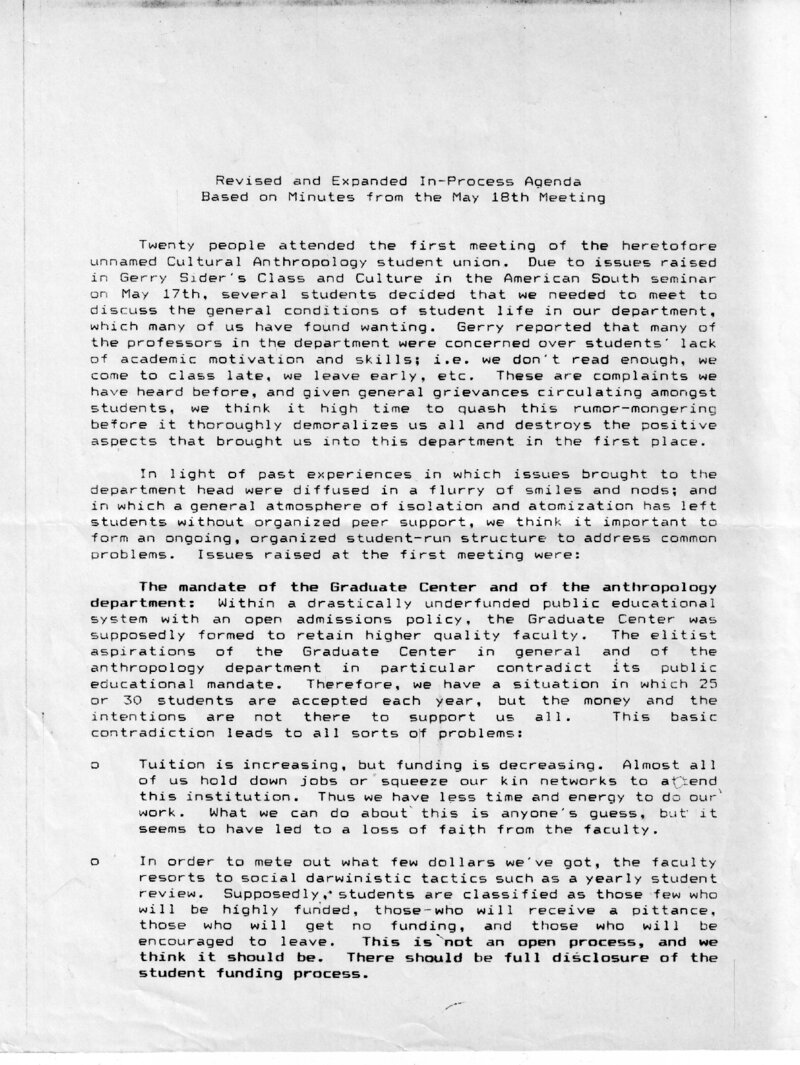
Revised and Expanded In-Process Agenda
Based on Minutes from the May 18th Meeting
Twenty people attended the first meeting of the heretofore
unnamed Cultural Anthropology student union. Due to issues raised
in Gerry Sider’s Class and Culture in the American South seminar
on May 17th, several students decided that we needed to meet to
discuss the general conditions of student life in our department,
which many of us have found wanting. Gerry reported that many of
the professors in the department were concerned over students’ lack
of academic motivation and skills; i.e. we don’t read enough, we
come to class late, we leave early, etc. These are complaints we
have heard before, and given general grievances circulating amongst
students, we think it high time to quash this rumor-mongering
before it thoroughly demoralizes us all and destroys the positive
aspects that brought us into this department in the first place.
In light of past experiences in which issues brought to the
department head were diffused ina flurry of smiles and nods; and
in which a general atmosphere of isolation and atomization has left
students without organized peer support, we think it important toa
form an ongoing, organized student-run structure to address common
oroblems. Issues raised at the first meeting were;
The mandate of the Graduate Center and of the anthropology
department: Within a drastically underfunded public educational
system with an open admissions policy, the Graduate Center was
supposedly formed to retain higher quality faculty. The elitist
aspirations of the Graduate Center in general and of the
anthropology department in particular contradict its public
educational mandate. Therefore, we have a situation in which 25
or 30 students are accepted each year, but the money and the
intentions are not there to support us all. This basic
contradiction leads to all sorts of problems:
Oo Tuition is increasing, but funding is decreasing. Almost all
of us hold down jobs or squeeze our kin networks to attend
this institution. Thus we have less time and energy to do our’
work. What we can do about this is anyone’s guess, but it
seems to have led to a loss of faith from the faculty.
Oo In order to mete out what few dollars we’ve got, the faculty
resorts to social darwinistic tactics such as a yearly student
review. Supposedly,* students are classified as those few who
will be highly funded, those-who will receive a pittance,
those who will get no funding, and those who will be
encouraged to leave. This is “not an open process, and we
think it should be. There should be full disclosure of the
student funding process.
ee Si! aw ees lll eae 7 7 “ae = ae eS —_— a
oO. Financial stress compounds faculty anxiety about the
performance and quality of individual students which is an
aspect of a larger undervaluing of public education.
Invidious comparisons between CUNY and well-funded, private,
elitist universities disgust students who chose CUNY in part
because it is not the latter. Students feel coerced,
intimidated, beat upon instead of proud, encouraged,
appreciated. We need peer-run advocacy procedures’ for
individual students.
The structures of the Graduate Center and of the department
individualize student experiences here. The fact that faculty so
rarely can be found in the building precludes open discussion of
intellectual concerns, career strategies, departmental procedures,
or anything else. This creates the perfect environment in which
rumors can foment and in which students are dealt with on a totally.
personalistic basis. As well, it leaves structural and procedural
decisions up to the faculty and allows them to manipulate what
little student involvement there is in decisionmaking. To correct
these problems, we need:
a More opportunities for student and faculty communication,
including:
monthly open forums to discuss departmental issues, etc.
ongoing advising for students before and after they have
formed their committees. Faculty advisers should be
assigned to incoming students on a better ratio than 1:10
or 12 and should meet regularly with students on a better
than once-a-semester basis.
small groups of students and faculty for advocacy for
individual students, for grievance, for general
information flow. These small groups can be appointed
from amongst our student union on a rotating basis.
use of the brown bag slots for regular strategy reports
from faculty to let students know what, when, how, why
to manage the various aspects of our careers in and
outside of the department. oO
Q Evaluations of each class by-students to be filled out at the
end of the semester and posted openly.
a Student representatives should be voted onto faculty
committees (Executive, First Exam, etc.) by students. There
should be students sitting on the Admissions Committee.
Other issues that were raised at the meeting which as well
have to do with the structure of contradictions in which we find
curselves are: -
re) The position of minority students within the department. We
need better recruitment and support of minority students.
fa) The disappearance of faculty members mid-semester to
conferences, the field, etc. which would seem to reveal an
apathy toward teaching.
oO Lack of use, misuse, and abuse of existing resources. The
library is not chockful., space on the eleventh floor is scant.
the autotron is under lock-and-key, but we could better use
what we've got. ‘
oO Students have nowhere to meet. Our "lounge" has been
appropriated for classes and conferences. We need a real
lounge with places ‘to sit and a coffee pot.
In order to address these and other concerns, we propose the
formation of a Cultural Anthropology students’ union as per our
statement of purpose. We spoke at the last meeting about our group
structure, which we decided would be democratic and
Basar dk twig <4, including rotating chairs and committee members.
ease note that the above is a composition of suggestions and open
ideas gener ated from our first meeting, and not — & - a _---.)
s Kiko Ses a ONS everything is 2 Tay = open to
revision ona point to-point basis and generally. As well, we need
& name.
Based on Minutes from the May 18th Meeting
Twenty people attended the first meeting of the heretofore
unnamed Cultural Anthropology student union. Due to issues raised
in Gerry Sider’s Class and Culture in the American South seminar
on May 17th, several students decided that we needed to meet to
discuss the general conditions of student life in our department,
which many of us have found wanting. Gerry reported that many of
the professors in the department were concerned over students’ lack
of academic motivation and skills; i.e. we don’t read enough, we
come to class late, we leave early, etc. These are complaints we
have heard before, and given general grievances circulating amongst
students, we think it high time to quash this rumor-mongering
before it thoroughly demoralizes us all and destroys the positive
aspects that brought us into this department in the first place.
In light of past experiences in which issues brought to the
department head were diffused ina flurry of smiles and nods; and
in which a general atmosphere of isolation and atomization has left
students without organized peer support, we think it important toa
form an ongoing, organized student-run structure to address common
oroblems. Issues raised at the first meeting were;
The mandate of the Graduate Center and of the anthropology
department: Within a drastically underfunded public educational
system with an open admissions policy, the Graduate Center was
supposedly formed to retain higher quality faculty. The elitist
aspirations of the Graduate Center in general and of the
anthropology department in particular contradict its public
educational mandate. Therefore, we have a situation in which 25
or 30 students are accepted each year, but the money and the
intentions are not there to support us all. This basic
contradiction leads to all sorts of problems:
Oo Tuition is increasing, but funding is decreasing. Almost all
of us hold down jobs or squeeze our kin networks to attend
this institution. Thus we have less time and energy to do our’
work. What we can do about this is anyone’s guess, but it
seems to have led to a loss of faith from the faculty.
Oo In order to mete out what few dollars we’ve got, the faculty
resorts to social darwinistic tactics such as a yearly student
review. Supposedly,* students are classified as those few who
will be highly funded, those-who will receive a pittance,
those who will get no funding, and those who will be
encouraged to leave. This is “not an open process, and we
think it should be. There should be full disclosure of the
student funding process.
ee Si! aw ees lll eae 7 7 “ae = ae eS —_— a
oO. Financial stress compounds faculty anxiety about the
performance and quality of individual students which is an
aspect of a larger undervaluing of public education.
Invidious comparisons between CUNY and well-funded, private,
elitist universities disgust students who chose CUNY in part
because it is not the latter. Students feel coerced,
intimidated, beat upon instead of proud, encouraged,
appreciated. We need peer-run advocacy procedures’ for
individual students.
The structures of the Graduate Center and of the department
individualize student experiences here. The fact that faculty so
rarely can be found in the building precludes open discussion of
intellectual concerns, career strategies, departmental procedures,
or anything else. This creates the perfect environment in which
rumors can foment and in which students are dealt with on a totally.
personalistic basis. As well, it leaves structural and procedural
decisions up to the faculty and allows them to manipulate what
little student involvement there is in decisionmaking. To correct
these problems, we need:
a More opportunities for student and faculty communication,
including:
monthly open forums to discuss departmental issues, etc.
ongoing advising for students before and after they have
formed their committees. Faculty advisers should be
assigned to incoming students on a better ratio than 1:10
or 12 and should meet regularly with students on a better
than once-a-semester basis.
small groups of students and faculty for advocacy for
individual students, for grievance, for general
information flow. These small groups can be appointed
from amongst our student union on a rotating basis.
use of the brown bag slots for regular strategy reports
from faculty to let students know what, when, how, why
to manage the various aspects of our careers in and
outside of the department. oO
Q Evaluations of each class by-students to be filled out at the
end of the semester and posted openly.
a Student representatives should be voted onto faculty
committees (Executive, First Exam, etc.) by students. There
should be students sitting on the Admissions Committee.
Other issues that were raised at the meeting which as well
have to do with the structure of contradictions in which we find
curselves are: -
re) The position of minority students within the department. We
need better recruitment and support of minority students.
fa) The disappearance of faculty members mid-semester to
conferences, the field, etc. which would seem to reveal an
apathy toward teaching.
oO Lack of use, misuse, and abuse of existing resources. The
library is not chockful., space on the eleventh floor is scant.
the autotron is under lock-and-key, but we could better use
what we've got. ‘
oO Students have nowhere to meet. Our "lounge" has been
appropriated for classes and conferences. We need a real
lounge with places ‘to sit and a coffee pot.
In order to address these and other concerns, we propose the
formation of a Cultural Anthropology students’ union as per our
statement of purpose. We spoke at the last meeting about our group
structure, which we decided would be democratic and
Basar dk twig <4, including rotating chairs and committee members.
ease note that the above is a composition of suggestions and open
ideas gener ated from our first meeting, and not — & - a _---.)
s Kiko Ses a ONS everything is 2 Tay = open to
revision ona point to-point basis and generally. As well, we need
& name.
Title
Revised and Expanded In-Process Agenda: Cultural Anthropology Meeting
Description
This “Revised and Expanded In-Process Agenda” based on minutes from a May 18th Cultural Anthropology graduate student meeting emphasized that the document was not a manifesto but rather a collection of ideas that were open to discussion and revision. The students called for “a student-run structure to address common problems.” Claiming that the Graduate Center was failing to live up to its “public educational mandate,” the Cultural Anthropology students enumerated the program’s problems: tuition increases, financial stress, a lack of peer-run advocacy procedures, and a misuse of resources. Among other points of contention, the students advocated for more opportunities for students and faculty to communicate, student representation in the admissions process, and a designated student meeting place. This item documented student activism in the Cultural Anthropology program prior to the 1991 City University of New York (CUNY) strikes.
The 1991 CUNY strikes were part of the larger story of austerity measures imposed on New York City and the community efforts to resist those measures. On April 16th, students mainly from the Graduate Center Anthropology PhD program occupied the Graduate Center in solidarity with a broader undergraduate mobilization across CUNY against the threat of steep tuition hikes, massive budget cuts, and faculty layoffs. What began as a one-day strike turned into a ten-day take-over in which students and faculty practiced forms of participatory democracy, discussed the root causes of the austerity problems being faced, and debated actions for change. Students often drew on CUNY’s history as the premier urban, public institution of higher education in the United States to argue that education was a right and that the proposed measures threatened working-class New Yorkers' ability to receive an education.
Contributor
McCaffrey, Katherine
Creator
Students from the Cultural Anthropology department
Date
May 18, 1990
Language
English
Rights
Copyrighted
Source
McCaffrey, Katherine
Original Format
Notes / Minutes
Students from the Cultural Anthropology department. Letter. “Revised and Expanded In-Process Agenda: Cultural Anthropology Meeting.”, CUNY DIGITAL HISTORY ARCHIVE, accessed September 5, 2026, https://stephenz.tailc22a4b.ts.net/s/cdha/item/1700