A Series of Correspondences between Zalk and Orozco
Item
READING ANITA HILL'S TESTIMONY VERSUS THOMAS'S CONFIRMATION
By Wilhelmina Orozco
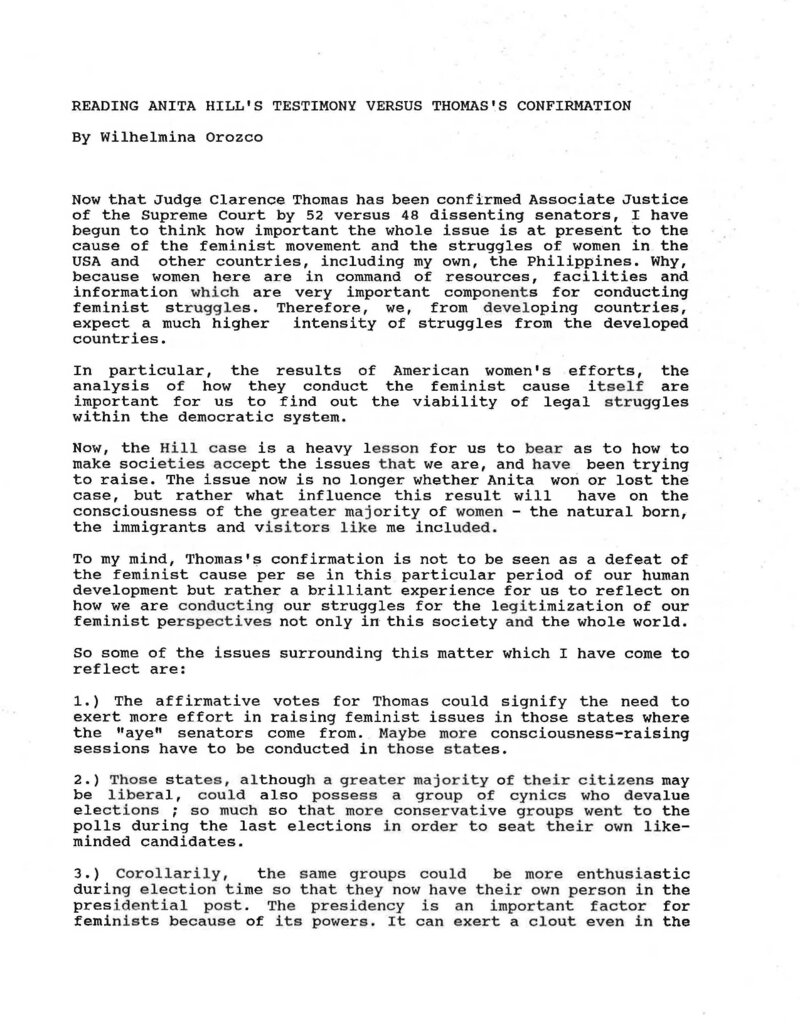
Now that Judge Clarence Thomas has been confirmed Associate Justice
of the Supreme Court by 52 versus 48 dissenting senators, I have
begun to think how important the whole issue is at present to the
cause of the feminist movement and the struggles of women in the
USA and other countries, including my own, the Philippines. Why,
because women here are in command of resources, facilities and
information which are very important components for conducting
feminist struggles. Therefore, we, from developing countries,
expect a much higher intensity of struggles from the developed
countries.
In particular, the results of American women's efforts, the
analysis of how they conduct the feminist cause itself are
important for us to find out the viability of legal struggles
within the democratic system.
Now, the Hill case is a heavy lesson for us to bear as to how to
make societies accept the issues that we are, and have been trying
to raise. The issue now is no longer whether Anita won or lost the
case, but rather what influence this result will have on the
consciousness of the greater majority of women - the natural born,
the immigrants and visitors like me included.
To my mind, Thomas's confirmation is not to be seen as a defeat of
the feminist cause per se in this particular period of our human
development but rather a brilliant experience for us to reflect on
how we are conducting our struggles for the legitimization of our
feminist perspectives not only in this society and the whole world.
So some of the issues surrounding this matter which I have come to
reflect are:
1.) The affirmative votes for Thomas could signify the need to
exert more effort in raising feminist issues in those states where
the "aye" senators come from. Maybe more consciousness-raising
sessions have to be conducted in those states.
2.) Those states, although a greater majority of their citizens may
be liberal, could also possess a group of cynics who devalue
elections ; so much so that more conservative groups went to the
polls during the last elections in order to seat their own like-
minded candidates.
3.) Corollarily, the same groups could be more enthusiastic
during election time so that they now have their own person in the
presidential post. The presidency is an important factor for
feminists because of its powers. It can exert a clout even in the
selection of key persons in sensitive posts like the Supreme Court
where many legal problems of women could be lodged and resolved
with finality, as we have seen. Hence, elections in general have to
be taken seriously by feminists. I am not aware of the consensus
of American feminists on this matter though.
4.) In terms of strategies and tactics, did the conscious women who
campaigned against Thomas's confirmation, personally approach the
wives of those affirmative-voting senators? I think majority of the
senatorial wives are self-effacing and humble. They could always be
projecting the macho views of their own husbands. And so, if a bit
of campaigning with them had been done, maybe they could have
influenced their husbands to think twice their position on the
matter. Evidently, building sisterhood even with wives, and
daughters of conservative politicians is highly important. To
approach them, we need to talk to them as sisters, not as misguided
beings who made the wrong choice of partners in their lives.
Having followed through this case on sexual harassment through
print-radio and tv media, I must say that this media coverage in
itself is one other triumphant score for the feminist cause.
Moreover, Anita Hill, the law professor who made this country of 52
states talk, read, listen and debate on sexual harassment, maybe
one person even suffered from nightmares about it, or two including
his wife, has really created our story - the women's her(his) tory.
She has brought out into the open what has long been considered a
private, personal problem of women. Her testimonies of the stance
which Judge Clarence Thomas took while she was an Equal Employment
Opportunity Commission employee now reprove one thing also: that
black women can take up the cudgels of feminist struggles once
given the opportunity to do so.
Let us remember then that in our struggles for equality, humane
development and peace, nothing is lost or won, but each experience
is an opportunity for us to reflect on how we are relating with the
closest persons in our lives and with the greater society in
general to make them, including the men, accept us as we are, as we
should be and as we want to become.
Wilhelmina Orozco is a visiting scholar based at the Center for the Study of
Women and Society, City University of New York. Last September, she was invited
by Dr. Sue Rosenber Zalk, the director, to talk on the feminist literacy project
of MAKAMASA, an urban poor-based women's organization in the Philippines at an
international symposium on Women, the Working Environment and Sustainable
Development in Urban Communities. Being coordinator of that project, Ms. Orozco
has written and published books one of which is entitled, Feminist Objectives
in the Third World and Other Writings. To advance sisterhood and for psychic
benefits, she writes the regular weekly column, "Feminist Reflections" for the
Philippine Daily Inquirer, a newspaper in her country. Currently, she wants to
absorb as many experiences and thoughts on the women's movement in America,
especially those concerning Asian American women.
INVOLVEMENT IN THE WOMEN'S MOVEMENT:
Member, Philippine Women's Research Collective which produced the
Alternative Report on the Status of Philippine Women, and helped
coordinate the Asian women's over-all report covering the UN Decade
for Women, 1975-85. This group produced a series of pamphlets on
the same subject.
Coordinator, Toys for Peace Campaign, under the Forward Looking
Women (FLOW), 1987-88.
Coordinator, Feminist Literacy Program, MAKAMASA, an urban poor
women-based organization in Tondo, Manila
Coordinator of several celebrations of March 8, International
Women's Day.
BOOKS PUBLISHED:
Philippine Women in the World of Work, Manila, 1983.
Feminist Objectives in the Third World and Other Writings, Manila,
1985
Economic Refugees: Voyage of the Commoditized, Manila, 1985
Towards Our Own Image (Women and Films), Manila, 1985
Tayo'y Magbasa, Kabaro! (Let's Read Sister!) (Manila: Makamasa)
1990
UNPUBLISHED WORKS:
Philippine Women's Search for Liberation, (Manila: Philippine
Social Science Research Council), 1986.
Halinang Bumasa, Kabaro (first literacy primer)
Women's Primer (third literacy primer)
INTERNATIONAL CONFERENCES ATTENDED:
Philippine Delegate, First International Conference of Women on
Film and Video, Amsterdam, Nederland, 1981.
Philippine Delegate (Films), Celebration of the End of the UN
Decade for Women, Nairobi, Kenya, 1985.
Philippine Delegate (Media), World Congress of Women, Moscow, USSR,
1987.
Philippine Delegate, Asian Women and Media Exchange, Kuala Lumpur,
Malaysia, 1988.
Rockefeller Humanist-in-Residence Program 1992-93
WOMEN'S STUDIES PROGRAM, HUNTER COLLEGE, CITY UNIVERSITY OF NEW YORK
Cover Sheet
Application for Rockefeller
Humanist-in-Residence Fellowship 1992-93
Women's Studies Program, said College
695 Park Avenue
New York, New York 10021
WILHELMINA cc
Name First Middle Last
9 + 7 ; . . .
Mailing Address 89 Kapiligan Street, Araneta Subdivision
Street or Institution
Quezon City Philippines
City State or Country Zip Code
Telephone( ) _/14.27.10 (office);( (63.2) 712.27.10 (home)
Citizenship Filipina
Dateof Birth ___/ July 1948 Social Security Number
KAMALAPINA Women in Media-Theatre Collective
MAKAMASA, Urban Poor Women's Organization
. . oi. ‘MEDIA PORTRAYAL OF PHILIPPINE AND A
Project Title and Brief Description -T=e"FeraTIONSHIP TO THE POLITICAL DIRECTIONS OF THE
WOMEN'S MOVEMENTS DURING THE PERIOD OF AMERICAN
COLONIZATION OF THE PHILIPPINES, 1898-1946.
Institutional Affiliation (if applicable)
References
(Please give the names and addresses of three persons from whom you are requesting letters of
recommendation.)
1. ALICE CARDONA, Assistant Director, New York State Division for Women
2. __-SYBIt WONG of Women’s International Resource Fxchange; and
3. SUE ROSENBERG 7AlK, PhD, Center for the sz, re o¢—Women and Society, CUNY
1 February 1992 vA Chit ;
cr renee: STILE
WILHELMINA S. OROZCO
Residence: 89 Kapiligan Street
Araneta Subdivision
Quezon City
PILIPINAS
Telephone: 63 (2)712.27.10
Coordinator, MAKAMASA
119 Sta. Elena Street
Bloke 2 Magsaysay Village
Tondo, Manila
EDUCATIONAL ATTAINMENT:
A.B. Speech and Drama University of the Philippines, 1969
M.A. Communications Ateneo de Manila University, 1991
TRAINING COURSES:
Vocational Preparation Seminar-Workshop for Out-of-School Youth,
National Manpower and Youth Council, 1975.
Audio-Visual Workshop, Kodak Phils, Inc., 1974.
Paraprofessional Training Course on Social Work and Community
Development, University of the Philippines, 1975
Management by Objectives, SGV Institute, Makati, MMLA, 1977.
Film Studies: Animation, Women's Independent Cinema House,
Liverpool, 1982
Film and Music, Nottingham, 1982
16mm Film Workshop, Four Corners Cinema,
London,1982
EMPLOYMENT:
Audio-Visual Specialist, National Manpower and Youth Council,
1974-76
Senior Management Specialist, Office of Budget and Management,
1976-79
Faculty Member, Department of Communication Arts, Philippine
College of Commerce, now Polytechnic University of the
Philippines, 1975
Faculty Member, Department of Communications, Maryknoll College,
1988; Miriam College (formerly Maryknoll); 1989
Training Workshops:
Super 8mm Film Workshop, Communications Foundation for Asia, "Best
Film Awardee", Manila
Film Editing Workshop, Goethe Institut Scholar, conducted by Karl
Fugunt from Munich, Germany, held in Baguio City
16mm Film Workshop, Four Corners Cinema, London, England
Animation Workshop, Women's Independent Cinema House, Liverpool,
England
Music in Cinema, conducted by the Nottingham Independent Filmmakers
Association, England
Cuban Cinema, Dartmouth College, England
Conferences and Film Festivals Attended:
Third World Women Filmmakers Workshop Conceptualizer and
Coordinator, First International Conference of Women on Film
and Video, Amsterdam, Nederland, 1981.
Third World Filmmaker Speaker, Oberhausen Film Festival, 1982
International Jury Member, Super 8mm Film Festival, Belgium, 1984
Philippine Delegate, Film Forum, NGO End of the UN Decade for Women
Celebration in Nairobi, Kenya
Philippine Delegate to the Mass Media Commission, World Congress of
Women, Moscow, USSR, 1987
Philippine Delegate, International Symposium on Women, the Working
Conditions and the Environment, sponsored by the Center for
the Study of Women and Society, City University of New York,
Writings:
Books Published:
Philippine Women in the World of Work, 1983.
Feminist Objectives in the Third World and Other Writings, 1985.
Economic Refugees: Voyage of the Commoditized, 1985.
Towards Our Own Image, (Women and Cinema), 1985.
Other Writings:
Alternative Media for Relevance: Development, Production and
Evaluation of an Alternative Media During the Marcos Regime, MA
Thesis, Ateneo de Manila University, 1991.
Mag-Koop Tayo, Kabaro! (Let's Go Coop!) a feminist literacy primer
on cooperativism for urban poor women (Unpublished).
Improving Working Women's Lives: A Case Study of the Feminist
Literacy Project for Urban Poor Women in Tondo, Manila, 1992.
Huwag Gamitin ang Kamao (Don't Use the Fist!), a primer on Violence
Against Women, 1992.
Present Concerns:
Coordination of the Feminist Literacy Program of MAKAMASA, an
urban-based women's organization in Tondo, Manila.
Coordination of KAMALAPINA Women in Media-Theatre Collective,
engaged in raising a positive image of women in print and on
screens,
"Feminist Reflections," a weekly column in the Philippine Daily
Inquirer.
MEDIA PORTRAYAL OF PHILIPPINE AND AMERICAN WOMEN AND ITS
RELATIONSHIP TO THE POLITICAL DIRECTIONS OF THE WOMEN'S MOVEMENTS
DURING THE PERIOD OF AMERICAN COLONIZATION OF THE PHILIPPINES,
1898-1946
Proponent: Wilhelmina Orozco, Independent Scholar
Description of the Project:
Whenever we talk of "Third World" (TW) Women, and "Western" Women,
we always think in current economic terms, that the TW are poor and
the western women are rich. Yet, located within First World cities
are the same TW women who may have acquired already the same
economic status of the latter and yet may still be called third
world women by virtue of their consciousness. And within the cities
of these developing and underdeveloped countries too may be women
who exhibit the same kind of consciousness. This situation is
traceable to the historical roots of third world consciousness.
That consciousness is rooted essentially in the process of
colonization that imposed or is imposing certain dominant images in
the minds of third world women. In the case of the Philippines, the
process of American colonization from 1898 to 1946 greatly
influenced the images of women affecting their own status, roles
and participation in the shaping of Philippine history.
This particular study concerns how the colonial media in the
Philippines from 1898 to 1946 portrayed Philippine and American **
women and how these images were related to the political directions
of the women's movements and were reflective of the political
realities at that time.
CSTV See RS yes jute ian ys Pash Ok
Rationale:
The power of media to control the thought processes and to shape
the values of the audience has been researched and written about
much already. This has been done covering the various types of
media from print to radio, tv and film and with different audiences
too. Women's studies have also done this, focusing on the ways
media shape or produce stereotyped images of women. A few have gone
into studying the common roles assigned to women in tv and radio
programs defining what is "feminine" or "unfeminine" roles.
In a study by Larry Gross, "Out of the Mainstream: Sexual
Minorities and the Mass Media," in Gay People, Sex, and the Media,
(1991) edited by Michelle A. Wolf, and Alfred P. Kielwasser, he
briefly characterized the role of the mass media, television in
particular in (American) society. Succinctly, he wrote that "the
economic political and social integration of modern industrial
society allows few communities or individuals to maintain an
q
independent integrity."
He also wrote that "representation in the mediated 'reality'of our
mass culture is in itself power...that non-representation maintains
the powerless status of groups that do not possess significant
material or political power bases." Then, he continued that "when
groups or perspectives do attain visibility, the manner of that
representation will itself reflect the biases and interests of
those elites who define the public agenda. And these elites are
(mostly) white, (mostly) middle aged, (mostly) male, (mostly)
“a SS 1 RTE RH GUSH gph TOD DALAT FETA ®
middle and upper-middle class, and entirely heterosexual (at least
in public).
The assertions of Larry Gross, although pertaining to the current
media realities can be readily applied to the historical period
under study. The elements he mentioned, of $domination-
subordination, representation and non-representation, visibility
and invisibility reflected in audio-visual images are significant
categories for the study which is contextualised within a very
obviously unequal political situation.
In the case of the Philippines though, women were barraged with
images not only by a dominant male power but those of the'foreign
female power which became the model for them.
Hence, the questions that this study will attempt to answer shall
be the following:
Social Roles:
In what ways did the media during that colonial period enforce or
reenforce the social roles of women? What roles were these? In what
ways did the media project or subvert prevailing images of women?
In what ways did they contribute to the subversion of the ethnic or
national identities of women?
Americanization:
In particular, did media play a role in the development of
Americanized consciousness of the Filipino women? What values about
women did media in the Philippines reflect during the colonial
period? Did media abet the colonization process of the Filipino
women? If so, how and why?
Similarities/Differences:
Were there similarities or differences in the portrayal of
Philippine and American women during the same period? What were
these similarities and differences? In what ways did they hasten or
abate the colonization process?
Resistance:
Was there resistance on the part of Philippine women to the
colonization process? What forms of media did they use to project
their resistance? What images of women did they project? What
values? In what way did racial color affect the portrayal of
Philippine and American women in the media?
Women's Movements:
Was there a women's movement at the time? What issues did they
carry and in what way were their objectives reflected in the media?
What political directions did the women's movement take and how
were these reflected in the media?
General Objectives
1. To show the power of media in reflecting dominant-
subordinate roles of women;
26 To show how race affects media portrayal in a colonial or
unequal political situation; and
“3s To show .how colonialism affects the images of the colonial
masters and the colonized, in particular, the women.
Specific Objectives:
The study aims at attaining the following general objectives:
Ae To show how the media projected the values and participation
of Filipino women in the shaping of Philippine history;
2 « To show the relationship of the media portrayal of
Philippine and American women to the political realities in
the Philippines;
as To show how and the ways the portrayal of Philippine women
were affected by the race we belonged to;
4. To show how the media reenforced American colonial policies
to bring about the domination and/or subordination of women;
and
5. To show the differences and similarities in the visual
portrayal of Philippine and American women in the printmedia
at the time.
Methodology:
This project will undertake a descriptive analysis of the visual
images of women in the printmedia covering books, magazines,
newspapers, posters, postcards, photos, leaflets and the like that
were published during the American period in the Philippines from
1898-1946. It will involve archival research on the historical
documents of the American government in the Philippines, and
publications of both private and governmental nature found in the
libraries, museums and galleries here in the
United States.
B. Current Status of the Project
From 1985 to 1986, I undertook a study on the Americanization of
women in the Philippines, entitled: Philippine Women's Search for
Liberation, 1898-1946, sponsored by the Philippine Social Science
Council. The study focused on the status and role of Philippine
women in this particular period - their colonial education, their
participation in the campaign to gain the right of suffrage and
their involvement in the anti-colonial struggles.
The study was deemed important as it was written from a feminist
perspective. Most often in the past, historians, mostly male,
neglected women's roles in their writings, as if to say that
Philippine history has been shaped and molded by men alone. Or
should they mention women at all, their approach is patronizing if
not condescending, and at other times, grossly insulting.
The study highlights the thesis that no critical transition in
history ever transpired without the participation and contribution
of women.
In this regard, I would like to continue this study this time
focusing on the MEDIA PORTRAYAL OF PHILIPPINE AND AMERICAN WOMEN
AND ITS RELATIONSHIP TO THE POLITICAL DIRECTIONS OF THE WOMEN'S
MOVEMENTS DURING THE PERIOD OF AMERICAN COLONIZATION OF THE
PHILIPPINES, FROM 1898 TO 1946.
Cc. The Residency Program's Theme and Purposes:
This study is highly relevant to the residency program's theme of
"Third World" Women, "Western" Women: Differences, Commonalities,
and Cross-Currents of Experience. Few cross-cultural (economic,
political) studies of this kind exists, especially those written by
and from the point of view of Third World women and covering such
period. Existing studies of women in that period consist of
accounts of how American women lived during that time in the
Philippines; or how Philippine women were educated by the American
schoolmarm. Books written of the period focused on the political
and economic aspects of colonization. None exists on the media
portrayal of Philippine and American women, except for my own study
which cursorily tackled Philippine women's images in advertising,
the magazines, vaudeville, and cabaret clubs.
Other studies rarely tackle the role of women from colonizing
countries in the processes of colonization itself. In answer to
this gap, this study points out how the American women were used as
models for colonizing the minds of Philippine women ev the
patriarchal structures built by the American male powers.
When planning, pursuing or outlining the directions of the global
‘women's movements, feminist activists and theoreticians can use
this study as it provides the roots of inequalities between women
and men, and among women as well. It also renders a background of
the domination of Third World women through the creation of
colonial and patriarchal structures, in particular through media.
By Wilhelmina Orozco
Now that Judge Clarence Thomas has been confirmed Associate Justice
of the Supreme Court by 52 versus 48 dissenting senators, I have
begun to think how important the whole issue is at present to the
cause of the feminist movement and the struggles of women in the
USA and other countries, including my own, the Philippines. Why,
because women here are in command of resources, facilities and
information which are very important components for conducting
feminist struggles. Therefore, we, from developing countries,
expect a much higher intensity of struggles from the developed
countries.
In particular, the results of American women's efforts, the
analysis of how they conduct the feminist cause itself are
important for us to find out the viability of legal struggles
within the democratic system.
Now, the Hill case is a heavy lesson for us to bear as to how to
make societies accept the issues that we are, and have been trying
to raise. The issue now is no longer whether Anita won or lost the
case, but rather what influence this result will have on the
consciousness of the greater majority of women - the natural born,
the immigrants and visitors like me included.
To my mind, Thomas's confirmation is not to be seen as a defeat of
the feminist cause per se in this particular period of our human
development but rather a brilliant experience for us to reflect on
how we are conducting our struggles for the legitimization of our
feminist perspectives not only in this society and the whole world.
So some of the issues surrounding this matter which I have come to
reflect are:
1.) The affirmative votes for Thomas could signify the need to
exert more effort in raising feminist issues in those states where
the "aye" senators come from. Maybe more consciousness-raising
sessions have to be conducted in those states.
2.) Those states, although a greater majority of their citizens may
be liberal, could also possess a group of cynics who devalue
elections ; so much so that more conservative groups went to the
polls during the last elections in order to seat their own like-
minded candidates.
3.) Corollarily, the same groups could be more enthusiastic
during election time so that they now have their own person in the
presidential post. The presidency is an important factor for
feminists because of its powers. It can exert a clout even in the
selection of key persons in sensitive posts like the Supreme Court
where many legal problems of women could be lodged and resolved
with finality, as we have seen. Hence, elections in general have to
be taken seriously by feminists. I am not aware of the consensus
of American feminists on this matter though.
4.) In terms of strategies and tactics, did the conscious women who
campaigned against Thomas's confirmation, personally approach the
wives of those affirmative-voting senators? I think majority of the
senatorial wives are self-effacing and humble. They could always be
projecting the macho views of their own husbands. And so, if a bit
of campaigning with them had been done, maybe they could have
influenced their husbands to think twice their position on the
matter. Evidently, building sisterhood even with wives, and
daughters of conservative politicians is highly important. To
approach them, we need to talk to them as sisters, not as misguided
beings who made the wrong choice of partners in their lives.
Having followed through this case on sexual harassment through
print-radio and tv media, I must say that this media coverage in
itself is one other triumphant score for the feminist cause.
Moreover, Anita Hill, the law professor who made this country of 52
states talk, read, listen and debate on sexual harassment, maybe
one person even suffered from nightmares about it, or two including
his wife, has really created our story - the women's her(his) tory.
She has brought out into the open what has long been considered a
private, personal problem of women. Her testimonies of the stance
which Judge Clarence Thomas took while she was an Equal Employment
Opportunity Commission employee now reprove one thing also: that
black women can take up the cudgels of feminist struggles once
given the opportunity to do so.
Let us remember then that in our struggles for equality, humane
development and peace, nothing is lost or won, but each experience
is an opportunity for us to reflect on how we are relating with the
closest persons in our lives and with the greater society in
general to make them, including the men, accept us as we are, as we
should be and as we want to become.
Wilhelmina Orozco is a visiting scholar based at the Center for the Study of
Women and Society, City University of New York. Last September, she was invited
by Dr. Sue Rosenber Zalk, the director, to talk on the feminist literacy project
of MAKAMASA, an urban poor-based women's organization in the Philippines at an
international symposium on Women, the Working Environment and Sustainable
Development in Urban Communities. Being coordinator of that project, Ms. Orozco
has written and published books one of which is entitled, Feminist Objectives
in the Third World and Other Writings. To advance sisterhood and for psychic
benefits, she writes the regular weekly column, "Feminist Reflections" for the
Philippine Daily Inquirer, a newspaper in her country. Currently, she wants to
absorb as many experiences and thoughts on the women's movement in America,
especially those concerning Asian American women.
INVOLVEMENT IN THE WOMEN'S MOVEMENT:
Member, Philippine Women's Research Collective which produced the
Alternative Report on the Status of Philippine Women, and helped
coordinate the Asian women's over-all report covering the UN Decade
for Women, 1975-85. This group produced a series of pamphlets on
the same subject.
Coordinator, Toys for Peace Campaign, under the Forward Looking
Women (FLOW), 1987-88.
Coordinator, Feminist Literacy Program, MAKAMASA, an urban poor
women-based organization in Tondo, Manila
Coordinator of several celebrations of March 8, International
Women's Day.
BOOKS PUBLISHED:
Philippine Women in the World of Work, Manila, 1983.
Feminist Objectives in the Third World and Other Writings, Manila,
1985
Economic Refugees: Voyage of the Commoditized, Manila, 1985
Towards Our Own Image (Women and Films), Manila, 1985
Tayo'y Magbasa, Kabaro! (Let's Read Sister!) (Manila: Makamasa)
1990
UNPUBLISHED WORKS:
Philippine Women's Search for Liberation, (Manila: Philippine
Social Science Research Council), 1986.
Halinang Bumasa, Kabaro (first literacy primer)
Women's Primer (third literacy primer)
INTERNATIONAL CONFERENCES ATTENDED:
Philippine Delegate, First International Conference of Women on
Film and Video, Amsterdam, Nederland, 1981.
Philippine Delegate (Films), Celebration of the End of the UN
Decade for Women, Nairobi, Kenya, 1985.
Philippine Delegate (Media), World Congress of Women, Moscow, USSR,
1987.
Philippine Delegate, Asian Women and Media Exchange, Kuala Lumpur,
Malaysia, 1988.
Rockefeller Humanist-in-Residence Program 1992-93
WOMEN'S STUDIES PROGRAM, HUNTER COLLEGE, CITY UNIVERSITY OF NEW YORK
Cover Sheet
Application for Rockefeller
Humanist-in-Residence Fellowship 1992-93
Women's Studies Program, said College
695 Park Avenue
New York, New York 10021
WILHELMINA cc
Name First Middle Last
9 + 7 ; . . .
Mailing Address 89 Kapiligan Street, Araneta Subdivision
Street or Institution
Quezon City Philippines
City State or Country Zip Code
Telephone( ) _/14.27.10 (office);( (63.2) 712.27.10 (home)
Citizenship Filipina
Dateof Birth ___/ July 1948 Social Security Number
KAMALAPINA Women in Media-Theatre Collective
MAKAMASA, Urban Poor Women's Organization
. . oi. ‘MEDIA PORTRAYAL OF PHILIPPINE AND A
Project Title and Brief Description -T=e"FeraTIONSHIP TO THE POLITICAL DIRECTIONS OF THE
WOMEN'S MOVEMENTS DURING THE PERIOD OF AMERICAN
COLONIZATION OF THE PHILIPPINES, 1898-1946.
Institutional Affiliation (if applicable)
References
(Please give the names and addresses of three persons from whom you are requesting letters of
recommendation.)
1. ALICE CARDONA, Assistant Director, New York State Division for Women
2. __-SYBIt WONG of Women’s International Resource Fxchange; and
3. SUE ROSENBERG 7AlK, PhD, Center for the sz, re o¢—Women and Society, CUNY
1 February 1992 vA Chit ;
cr renee: STILE
WILHELMINA S. OROZCO
Residence: 89 Kapiligan Street
Araneta Subdivision
Quezon City
PILIPINAS
Telephone: 63 (2)712.27.10
Coordinator, MAKAMASA
119 Sta. Elena Street
Bloke 2 Magsaysay Village
Tondo, Manila
EDUCATIONAL ATTAINMENT:
A.B. Speech and Drama University of the Philippines, 1969
M.A. Communications Ateneo de Manila University, 1991
TRAINING COURSES:
Vocational Preparation Seminar-Workshop for Out-of-School Youth,
National Manpower and Youth Council, 1975.
Audio-Visual Workshop, Kodak Phils, Inc., 1974.
Paraprofessional Training Course on Social Work and Community
Development, University of the Philippines, 1975
Management by Objectives, SGV Institute, Makati, MMLA, 1977.
Film Studies: Animation, Women's Independent Cinema House,
Liverpool, 1982
Film and Music, Nottingham, 1982
16mm Film Workshop, Four Corners Cinema,
London,1982
EMPLOYMENT:
Audio-Visual Specialist, National Manpower and Youth Council,
1974-76
Senior Management Specialist, Office of Budget and Management,
1976-79
Faculty Member, Department of Communication Arts, Philippine
College of Commerce, now Polytechnic University of the
Philippines, 1975
Faculty Member, Department of Communications, Maryknoll College,
1988; Miriam College (formerly Maryknoll); 1989
Training Workshops:
Super 8mm Film Workshop, Communications Foundation for Asia, "Best
Film Awardee", Manila
Film Editing Workshop, Goethe Institut Scholar, conducted by Karl
Fugunt from Munich, Germany, held in Baguio City
16mm Film Workshop, Four Corners Cinema, London, England
Animation Workshop, Women's Independent Cinema House, Liverpool,
England
Music in Cinema, conducted by the Nottingham Independent Filmmakers
Association, England
Cuban Cinema, Dartmouth College, England
Conferences and Film Festivals Attended:
Third World Women Filmmakers Workshop Conceptualizer and
Coordinator, First International Conference of Women on Film
and Video, Amsterdam, Nederland, 1981.
Third World Filmmaker Speaker, Oberhausen Film Festival, 1982
International Jury Member, Super 8mm Film Festival, Belgium, 1984
Philippine Delegate, Film Forum, NGO End of the UN Decade for Women
Celebration in Nairobi, Kenya
Philippine Delegate to the Mass Media Commission, World Congress of
Women, Moscow, USSR, 1987
Philippine Delegate, International Symposium on Women, the Working
Conditions and the Environment, sponsored by the Center for
the Study of Women and Society, City University of New York,
Writings:
Books Published:
Philippine Women in the World of Work, 1983.
Feminist Objectives in the Third World and Other Writings, 1985.
Economic Refugees: Voyage of the Commoditized, 1985.
Towards Our Own Image, (Women and Cinema), 1985.
Other Writings:
Alternative Media for Relevance: Development, Production and
Evaluation of an Alternative Media During the Marcos Regime, MA
Thesis, Ateneo de Manila University, 1991.
Mag-Koop Tayo, Kabaro! (Let's Go Coop!) a feminist literacy primer
on cooperativism for urban poor women (Unpublished).
Improving Working Women's Lives: A Case Study of the Feminist
Literacy Project for Urban Poor Women in Tondo, Manila, 1992.
Huwag Gamitin ang Kamao (Don't Use the Fist!), a primer on Violence
Against Women, 1992.
Present Concerns:
Coordination of the Feminist Literacy Program of MAKAMASA, an
urban-based women's organization in Tondo, Manila.
Coordination of KAMALAPINA Women in Media-Theatre Collective,
engaged in raising a positive image of women in print and on
screens,
"Feminist Reflections," a weekly column in the Philippine Daily
Inquirer.
MEDIA PORTRAYAL OF PHILIPPINE AND AMERICAN WOMEN AND ITS
RELATIONSHIP TO THE POLITICAL DIRECTIONS OF THE WOMEN'S MOVEMENTS
DURING THE PERIOD OF AMERICAN COLONIZATION OF THE PHILIPPINES,
1898-1946
Proponent: Wilhelmina Orozco, Independent Scholar
Description of the Project:
Whenever we talk of "Third World" (TW) Women, and "Western" Women,
we always think in current economic terms, that the TW are poor and
the western women are rich. Yet, located within First World cities
are the same TW women who may have acquired already the same
economic status of the latter and yet may still be called third
world women by virtue of their consciousness. And within the cities
of these developing and underdeveloped countries too may be women
who exhibit the same kind of consciousness. This situation is
traceable to the historical roots of third world consciousness.
That consciousness is rooted essentially in the process of
colonization that imposed or is imposing certain dominant images in
the minds of third world women. In the case of the Philippines, the
process of American colonization from 1898 to 1946 greatly
influenced the images of women affecting their own status, roles
and participation in the shaping of Philippine history.
This particular study concerns how the colonial media in the
Philippines from 1898 to 1946 portrayed Philippine and American **
women and how these images were related to the political directions
of the women's movements and were reflective of the political
realities at that time.
CSTV See RS yes jute ian ys Pash Ok
Rationale:
The power of media to control the thought processes and to shape
the values of the audience has been researched and written about
much already. This has been done covering the various types of
media from print to radio, tv and film and with different audiences
too. Women's studies have also done this, focusing on the ways
media shape or produce stereotyped images of women. A few have gone
into studying the common roles assigned to women in tv and radio
programs defining what is "feminine" or "unfeminine" roles.
In a study by Larry Gross, "Out of the Mainstream: Sexual
Minorities and the Mass Media," in Gay People, Sex, and the Media,
(1991) edited by Michelle A. Wolf, and Alfred P. Kielwasser, he
briefly characterized the role of the mass media, television in
particular in (American) society. Succinctly, he wrote that "the
economic political and social integration of modern industrial
society allows few communities or individuals to maintain an
q
independent integrity."
He also wrote that "representation in the mediated 'reality'of our
mass culture is in itself power...that non-representation maintains
the powerless status of groups that do not possess significant
material or political power bases." Then, he continued that "when
groups or perspectives do attain visibility, the manner of that
representation will itself reflect the biases and interests of
those elites who define the public agenda. And these elites are
(mostly) white, (mostly) middle aged, (mostly) male, (mostly)
“a SS 1 RTE RH GUSH gph TOD DALAT FETA ®
middle and upper-middle class, and entirely heterosexual (at least
in public).
The assertions of Larry Gross, although pertaining to the current
media realities can be readily applied to the historical period
under study. The elements he mentioned, of $domination-
subordination, representation and non-representation, visibility
and invisibility reflected in audio-visual images are significant
categories for the study which is contextualised within a very
obviously unequal political situation.
In the case of the Philippines though, women were barraged with
images not only by a dominant male power but those of the'foreign
female power which became the model for them.
Hence, the questions that this study will attempt to answer shall
be the following:
Social Roles:
In what ways did the media during that colonial period enforce or
reenforce the social roles of women? What roles were these? In what
ways did the media project or subvert prevailing images of women?
In what ways did they contribute to the subversion of the ethnic or
national identities of women?
Americanization:
In particular, did media play a role in the development of
Americanized consciousness of the Filipino women? What values about
women did media in the Philippines reflect during the colonial
period? Did media abet the colonization process of the Filipino
women? If so, how and why?
Similarities/Differences:
Were there similarities or differences in the portrayal of
Philippine and American women during the same period? What were
these similarities and differences? In what ways did they hasten or
abate the colonization process?
Resistance:
Was there resistance on the part of Philippine women to the
colonization process? What forms of media did they use to project
their resistance? What images of women did they project? What
values? In what way did racial color affect the portrayal of
Philippine and American women in the media?
Women's Movements:
Was there a women's movement at the time? What issues did they
carry and in what way were their objectives reflected in the media?
What political directions did the women's movement take and how
were these reflected in the media?
General Objectives
1. To show the power of media in reflecting dominant-
subordinate roles of women;
26 To show how race affects media portrayal in a colonial or
unequal political situation; and
“3s To show .how colonialism affects the images of the colonial
masters and the colonized, in particular, the women.
Specific Objectives:
The study aims at attaining the following general objectives:
Ae To show how the media projected the values and participation
of Filipino women in the shaping of Philippine history;
2 « To show the relationship of the media portrayal of
Philippine and American women to the political realities in
the Philippines;
as To show how and the ways the portrayal of Philippine women
were affected by the race we belonged to;
4. To show how the media reenforced American colonial policies
to bring about the domination and/or subordination of women;
and
5. To show the differences and similarities in the visual
portrayal of Philippine and American women in the printmedia
at the time.
Methodology:
This project will undertake a descriptive analysis of the visual
images of women in the printmedia covering books, magazines,
newspapers, posters, postcards, photos, leaflets and the like that
were published during the American period in the Philippines from
1898-1946. It will involve archival research on the historical
documents of the American government in the Philippines, and
publications of both private and governmental nature found in the
libraries, museums and galleries here in the
United States.
B. Current Status of the Project
From 1985 to 1986, I undertook a study on the Americanization of
women in the Philippines, entitled: Philippine Women's Search for
Liberation, 1898-1946, sponsored by the Philippine Social Science
Council. The study focused on the status and role of Philippine
women in this particular period - their colonial education, their
participation in the campaign to gain the right of suffrage and
their involvement in the anti-colonial struggles.
The study was deemed important as it was written from a feminist
perspective. Most often in the past, historians, mostly male,
neglected women's roles in their writings, as if to say that
Philippine history has been shaped and molded by men alone. Or
should they mention women at all, their approach is patronizing if
not condescending, and at other times, grossly insulting.
The study highlights the thesis that no critical transition in
history ever transpired without the participation and contribution
of women.
In this regard, I would like to continue this study this time
focusing on the MEDIA PORTRAYAL OF PHILIPPINE AND AMERICAN WOMEN
AND ITS RELATIONSHIP TO THE POLITICAL DIRECTIONS OF THE WOMEN'S
MOVEMENTS DURING THE PERIOD OF AMERICAN COLONIZATION OF THE
PHILIPPINES, FROM 1898 TO 1946.
Cc. The Residency Program's Theme and Purposes:
This study is highly relevant to the residency program's theme of
"Third World" Women, "Western" Women: Differences, Commonalities,
and Cross-Currents of Experience. Few cross-cultural (economic,
political) studies of this kind exists, especially those written by
and from the point of view of Third World women and covering such
period. Existing studies of women in that period consist of
accounts of how American women lived during that time in the
Philippines; or how Philippine women were educated by the American
schoolmarm. Books written of the period focused on the political
and economic aspects of colonization. None exists on the media
portrayal of Philippine and American women, except for my own study
which cursorily tackled Philippine women's images in advertising,
the magazines, vaudeville, and cabaret clubs.
Other studies rarely tackle the role of women from colonizing
countries in the processes of colonization itself. In answer to
this gap, this study points out how the American women were used as
models for colonizing the minds of Philippine women ev the
patriarchal structures built by the American male powers.
When planning, pursuing or outlining the directions of the global
‘women's movements, feminist activists and theoreticians can use
this study as it provides the roots of inequalities between women
and men, and among women as well. It also renders a background of
the domination of Third World women through the creation of
colonial and patriarchal structures, in particular through media.
Title
A Series of Correspondences between Zalk and Orozco
Description
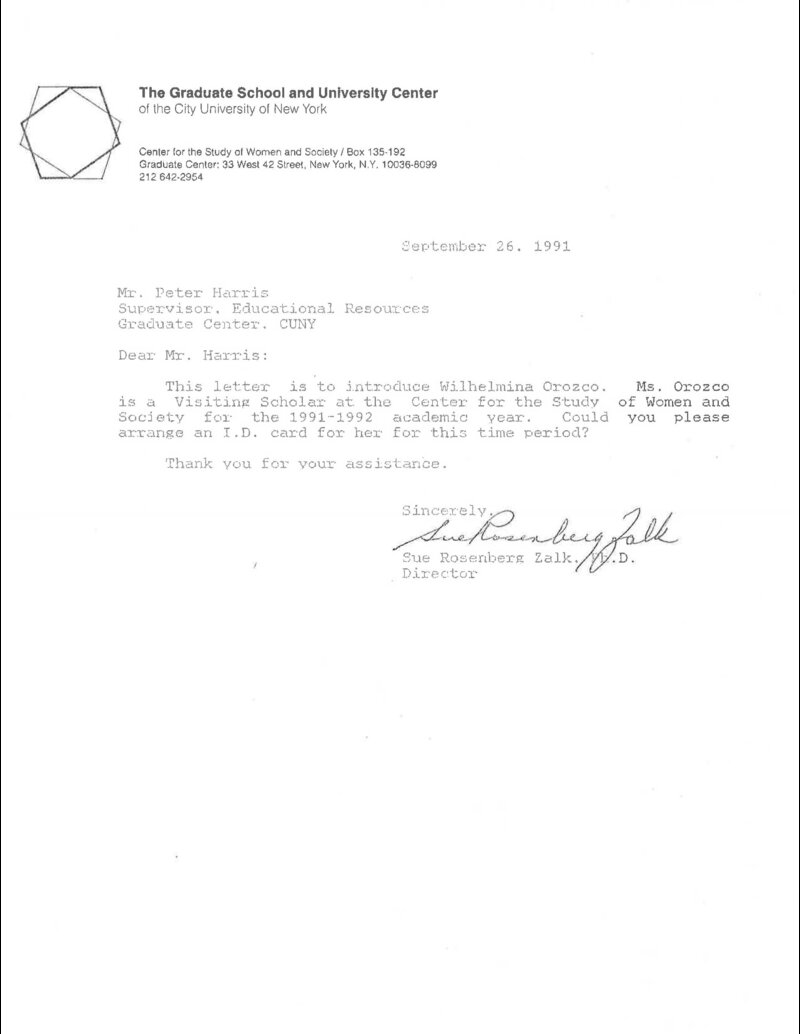
Through the Visiting Scholar program, The Center for the Study of Women and Society (CSWS) supported international scholars impacting communities far beyond CUNY. This 1991-93 collection of primary materials showed the profound and lasting involvement Wilhelmina Orozco – who ran a literacy program for elderly women in Tondo, Philippines – had with the CSWS. Included are letters of support from CSWS, Dr. Sue Rosenberg Zalk, and proof of approval by the City University of New York (CUNY) Graduate Center's Dean for Research and University Programs, Solomon Goldstein. Orozco's correspondence thanked Dr. Zalk and the rest of CSWS for their hospitality and support during her five months in New York. During which, she stated, she was able to produce and edit: two videos, network with various women's groups and film collectives, coordinate a festival of Filipino women's films, participate in workshops, produce two literacy primers, and more, including writing an essay on the outcome of Anita Hill's testimony on the hearings for Clarence Thomas's confirmation to the Supreme Court of the United States. Further documents included an application to the 1992-1993 Rockefeller Humanist-in-Residence Program at the City University of New York (CUNY) Hunter College's Women's Studies Program for a project titled, "Media Portrayal of Philippine and American Women and Its Relationship to the Political Directions of the Women's Movements During the Period of American Colonization of the Philippines, 1898 – 1946". In their entirety, the files illustrate Orozco's dedication to the women's movement and the international advancement of women through scholarship, the arts, and activism.
Since 1977, the Center for the Study of Women and Society (CSWS), Graduate Center, City University of New York (CUNY) has promoted interdisciplinary feminist scholarship. The Center’s research agenda focuses on the intersectional study of gender, sexuality, race, ethnicity, class, and nation in societies worldwide. The Center co-sponsors the Women’s Studies Certificate Program and, most notably, hosts the only stand-alone Women’s and Gender Studies MA Program in New York City.
Contributor
Center for the Society of Women and Society
Creator
Ozorco, Wilhelmina
Zalk, Sue
Date
1991 - 1993
Language
English
Rights
Copyrighted
Source
Center for the Study of Women and Society
Original Format
Correspondence
Ozorco, Wilhelmina, and Zalk, Sue. Letter. “A Series of Correspondences Between Zalk and Orozco.”, CUNY DIGITAL HISTORY ARCHIVE, accessed September 5, 2026, https://stephenz.tailc22a4b.ts.net/s/cdha/item/1685