June 1968 Draft Statement for the Bedford-Stuyvesant Coalition on Educational Needs and Services (B-SCENS)
Item
alition Menbers for further consi ration/
ul to be distributed to Co
pie ve Po DOM WATKING
. 4
mo ) Ga 6 29° WHEAVER Lb AWE
ps LEUITT sie a MG 11756
a
(516)~ Pe b- 7598
Dr. DAVE BERKMAN
(self. —type as plea 90 EIGHTH AVENUE ~ G0 zs oI ol
excuse apne: ey BROOKLYN, N.Y. 11215
(212) STERLING 3-0833
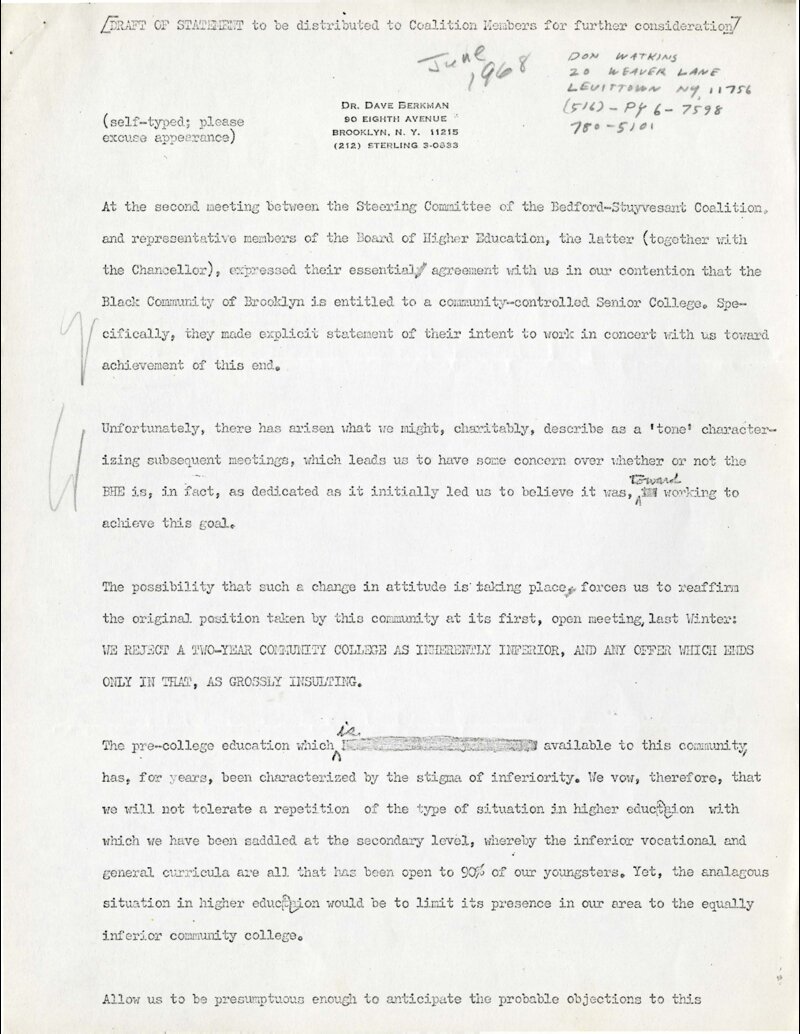
At the second meeting between the Steering Committee of the Bedford~Stuyvesant Coalition,
f the Board of Higher Education, the latter (together with
and representative member
their essentialy” agreement with us in our contention that the
fot}
Spe-
the Chancellor), expresse
sontrolled Senior College.
dee
Brooklyn is entitled to a community~c
Black Community of Br
s tovard
|/ cifically, they made explicit statement of their intent to work in concert with
if
achievement of this end.
might, charitably, describe as a 'tone! character
Unfortunately, there has arisen what we
3 us to have some concern over whether or not the
t S, which leads t
Tard.
zing subsequent meetings,
initially led us to believe it was, Pr working to
fant, as dedicated as
a
a
achieve this goal.
aceg, forces us to xeaffirn
bility that such a change in attitude is’ taking pl
community at its first, open meeting, last Winter:
by this
BR WHICH ENDS
the original position taken
AS INHERENTLY INPERIOR, AND ANY OFPE
Wii RETSCT A TWO-YEAR COMMUNITY COLLAGE
ONLY IN THAT, AS GROSSLY INSULTING.
£4
which hes 33 available to this communi ty
‘
terized by the
The pre-college education
stigma of inferiority. We vow, therefore, that
has, for years, been charac
Sedon with
we will not tolerate a repetition of the tyoe of situation in higher educt
which we have been saddled at the secondary level, whereby the inferior vocational and
general curricula are all that has been open to 90% of our youngsters, Yet, the analagous
n higher eductpion would be to limit its presence in our area to the equally
n
fe
cf
oC
is)
ct
pe
5
bt
Lor community college,
ae
the probable objections to this
nous enough to anticipate
llow us to be presumptr
eaike fa
<
te-urfireg off fat J Tos-Tjpte os lrtdige,
contention: First, we would ask each Board member as an indivadusl, same he would wist
s
to send tits own children? We would then remind the Board that they have officially given
implicit admission of this inferiority by establishing lower admission standards to the
junior units; and, most significantly, by paying es faculty members of equal ranic
fret
lower salaries at the two-year schools than they do,in their senior institutions,
We would also cite as merely one specific index of this inferiority-—~- but a single
index of such grossness, that it should suffice-- the following: At Kingsbordugh where,
despite the rationale with which it was established, the student body it serves is
anything but "disadvantaged," its attrition rate (using the strict definition of the
term, "attr Coes in its third year, was in excess of 90 oof This, we would remind
bara
the Boards BE
: om a figure true of a school where the population, at the time, was
only 10% ae and "disadvantaged!"
If the Board insists that if an institution is to open here | on schedule, &
Fey
ns
open as a Community College (if only because its first year or two of operation has
been been predicated upon en assumption of the availability of the additional,
support from the State which goes to institutions bearing that designation), we will
foetat-
accept the legitimacy of
ieee this contention,
providing that the BOARD AS A WHOLE FORMALLY COMMITS ITSELF to replacing the communit
college after its second year of operation, with a fow-vear senior institution, with
an explicit understanding that the four-year, senior institution wiil operate under
CAN
the same comaunity-controlled governing och as the initiel two-year unit. This
SS A TCL Ce Oe ien
will allow the Board a more than ample two years in which to starythe machinery which
will result in establishment of the four year wi t~- esp Maclay since it has not seemed
to require more than a year to establish senior colleges serving white communities,
If the Board is unwilling to- establish the four year, ofeior college-— we refuse to
grent thet it is Manabe to!"—— let it be understood that this commmity will not allow
ag A
he omeatenrg apt Blew teary Clb rp
itself to permit a repetition of th fein ic whereby it = oh ies saddled with an
: Sgt
ed
inferior eduofbion program, because of a mistaken belief that second rate schooling, 8
—
~ iano
€& better than none. Let is be clearly understood that if the Board of Higher Education
insists, out of a misguided, and anachronistic sense of noblesse oblige, to impose the
gratuitous insult of a permanent junior college in our midst, we will do everything
pos sible to discourage that effort.
Frankly, we cannot understand why the Board would do this, At the aforementioned meeting,
its President, and the Chancellor both, each persory: Uy adaitted the past) guilt
albeit a 'guilt' by omission— of the Board in failing to provide equitable, public
higher eductaion to the 40% of this city which is classed as non-Cancasian, It has
it to establish 10 institutions of higher learning offering baccalaureate deerees
by its own figures, serve full-time, matriculated enrollments Siggy
“yf we Care 13 : ’
sez from 90 to SV white. indeed, when one: notes that the tradition of which public
igher eductaion in New York City is most proud to boast, is the tradition of providing
. . t
the means of upw to this City s "new populations," a refusal to give its
& ae
dargest bl Lack Game
ead
tion’ only holds true where such a 'new population! is white. (It does not escape
LA ta lar tla
notice in this community, though it Se with a somewhat bemised irony, that even the
'comaumity' of 35,000 uniformed law enforcement officers-~ less than 10% of the
population of just this one ghetto-- has been deemed worthy of meriting its ow
ps
senior City Universi oy institution in the John Jay Colleg ze!)
Our et ode senior college carrieg with it.an acceptance of the reality theta
. - i EERE
senior institution-~- and especially a new one-—- cannot possibly offer a total spectrum
of degree DYOETENS. Therefore, we include a second, and co~equal demand: that the Board
nandate that credits earned in the temporary community college, and later during the
two years of the senior institution, must be accepted as fully transferable
throughout the City University system. This will enable those of owr youngsters who wut,
—
a
attend their freshman and sophomore years S hers, yey in order to remedy the
A eagle
————
eh
&
ie
deficiencies imposed upon them in their elementary and secondary school = sia
wish to enter major programs of study which this new school. does net off e eee nsfe
.
Ew a
without any fear that the lack of articulation resulting from inter—institutional ~
jealousies, or other causes, which TV conse frequently results in-gross credit
losses when transferring between constituent CUNY units, will affect them in such
a senseless and time~vasting way.
AS Ry Sa
rahe
(1) a community-controlled senior college. We will accept a two-year postponement in
its establishment, during which time a temporary, commmnity-—controlled, Community
College will operate, providng it is clearly understood thet this junior college
will be replaced by the senior institutions) Le
2) a Board of Higher Education ruling which imposes upon, ssmery_ senior colleget 7a am
& oO Dis Ay 6
i 2 ' ; i A i
fe} the requirement of granting full, parity acceptance to all credits
be:
earned by any student in the temporarary two-year college, and in the lower two
years of the senior institution, who transfers to another CUNY unite
e
ul to be distributed to Co
pie ve Po DOM WATKING
. 4
mo ) Ga 6 29° WHEAVER Lb AWE
ps LEUITT sie a MG 11756
a
(516)~ Pe b- 7598
Dr. DAVE BERKMAN
(self. —type as plea 90 EIGHTH AVENUE ~ G0 zs oI ol
excuse apne: ey BROOKLYN, N.Y. 11215
(212) STERLING 3-0833
At the second meeting between the Steering Committee of the Bedford~Stuyvesant Coalition,
f the Board of Higher Education, the latter (together with
and representative member
their essentialy” agreement with us in our contention that the
fot}
Spe-
the Chancellor), expresse
sontrolled Senior College.
dee
Brooklyn is entitled to a community~c
Black Community of Br
s tovard
|/ cifically, they made explicit statement of their intent to work in concert with
if
achievement of this end.
might, charitably, describe as a 'tone! character
Unfortunately, there has arisen what we
3 us to have some concern over whether or not the
t S, which leads t
Tard.
zing subsequent meetings,
initially led us to believe it was, Pr working to
fant, as dedicated as
a
a
achieve this goal.
aceg, forces us to xeaffirn
bility that such a change in attitude is’ taking pl
community at its first, open meeting, last Winter:
by this
BR WHICH ENDS
the original position taken
AS INHERENTLY INPERIOR, AND ANY OFPE
Wii RETSCT A TWO-YEAR COMMUNITY COLLAGE
ONLY IN THAT, AS GROSSLY INSULTING.
£4
which hes 33 available to this communi ty
‘
terized by the
The pre-college education
stigma of inferiority. We vow, therefore, that
has, for years, been charac
Sedon with
we will not tolerate a repetition of the tyoe of situation in higher educt
which we have been saddled at the secondary level, whereby the inferior vocational and
general curricula are all that has been open to 90% of our youngsters, Yet, the analagous
n higher eductpion would be to limit its presence in our area to the equally
n
fe
cf
oC
is)
ct
pe
5
bt
Lor community college,
ae
the probable objections to this
nous enough to anticipate
llow us to be presumptr
eaike fa
<
te-urfireg off fat J Tos-Tjpte os lrtdige,
contention: First, we would ask each Board member as an indivadusl, same he would wist
s
to send tits own children? We would then remind the Board that they have officially given
implicit admission of this inferiority by establishing lower admission standards to the
junior units; and, most significantly, by paying es faculty members of equal ranic
fret
lower salaries at the two-year schools than they do,in their senior institutions,
We would also cite as merely one specific index of this inferiority-—~- but a single
index of such grossness, that it should suffice-- the following: At Kingsbordugh where,
despite the rationale with which it was established, the student body it serves is
anything but "disadvantaged," its attrition rate (using the strict definition of the
term, "attr Coes in its third year, was in excess of 90 oof This, we would remind
bara
the Boards BE
: om a figure true of a school where the population, at the time, was
only 10% ae and "disadvantaged!"
If the Board insists that if an institution is to open here | on schedule, &
Fey
ns
open as a Community College (if only because its first year or two of operation has
been been predicated upon en assumption of the availability of the additional,
support from the State which goes to institutions bearing that designation), we will
foetat-
accept the legitimacy of
ieee this contention,
providing that the BOARD AS A WHOLE FORMALLY COMMITS ITSELF to replacing the communit
college after its second year of operation, with a fow-vear senior institution, with
an explicit understanding that the four-year, senior institution wiil operate under
CAN
the same comaunity-controlled governing och as the initiel two-year unit. This
SS A TCL Ce Oe ien
will allow the Board a more than ample two years in which to starythe machinery which
will result in establishment of the four year wi t~- esp Maclay since it has not seemed
to require more than a year to establish senior colleges serving white communities,
If the Board is unwilling to- establish the four year, ofeior college-— we refuse to
grent thet it is Manabe to!"—— let it be understood that this commmity will not allow
ag A
he omeatenrg apt Blew teary Clb rp
itself to permit a repetition of th fein ic whereby it = oh ies saddled with an
: Sgt
ed
inferior eduofbion program, because of a mistaken belief that second rate schooling, 8
—
~ iano
€& better than none. Let is be clearly understood that if the Board of Higher Education
insists, out of a misguided, and anachronistic sense of noblesse oblige, to impose the
gratuitous insult of a permanent junior college in our midst, we will do everything
pos sible to discourage that effort.
Frankly, we cannot understand why the Board would do this, At the aforementioned meeting,
its President, and the Chancellor both, each persory: Uy adaitted the past) guilt
albeit a 'guilt' by omission— of the Board in failing to provide equitable, public
higher eductaion to the 40% of this city which is classed as non-Cancasian, It has
it to establish 10 institutions of higher learning offering baccalaureate deerees
by its own figures, serve full-time, matriculated enrollments Siggy
“yf we Care 13 : ’
sez from 90 to SV white. indeed, when one: notes that the tradition of which public
igher eductaion in New York City is most proud to boast, is the tradition of providing
. . t
the means of upw to this City s "new populations," a refusal to give its
& ae
dargest bl Lack Game
ead
tion’ only holds true where such a 'new population! is white. (It does not escape
LA ta lar tla
notice in this community, though it Se with a somewhat bemised irony, that even the
'comaumity' of 35,000 uniformed law enforcement officers-~ less than 10% of the
population of just this one ghetto-- has been deemed worthy of meriting its ow
ps
senior City Universi oy institution in the John Jay Colleg ze!)
Our et ode senior college carrieg with it.an acceptance of the reality theta
. - i EERE
senior institution-~- and especially a new one-—- cannot possibly offer a total spectrum
of degree DYOETENS. Therefore, we include a second, and co~equal demand: that the Board
nandate that credits earned in the temporary community college, and later during the
two years of the senior institution, must be accepted as fully transferable
throughout the City University system. This will enable those of owr youngsters who wut,
—
a
attend their freshman and sophomore years S hers, yey in order to remedy the
A eagle
————
eh
&
ie
deficiencies imposed upon them in their elementary and secondary school = sia
wish to enter major programs of study which this new school. does net off e eee nsfe
.
Ew a
without any fear that the lack of articulation resulting from inter—institutional ~
jealousies, or other causes, which TV conse frequently results in-gross credit
losses when transferring between constituent CUNY units, will affect them in such
a senseless and time~vasting way.
AS Ry Sa
rahe
(1) a community-controlled senior college. We will accept a two-year postponement in
its establishment, during which time a temporary, commmnity-—controlled, Community
College will operate, providng it is clearly understood thet this junior college
will be replaced by the senior institutions) Le
2) a Board of Higher Education ruling which imposes upon, ssmery_ senior colleget 7a am
& oO Dis Ay 6
i 2 ' ; i A i
fe} the requirement of granting full, parity acceptance to all credits
be:
earned by any student in the temporarary two-year college, and in the lower two
years of the senior institution, who transfers to another CUNY unite
e
Title
June 1968 Draft Statement for the Bedford-Stuyvesant Coalition on Educational Needs and Services (B-SCENS)
Description
In this June 1968 statement drafted for the Bedford-Stuyvesant Coalition on Educational Needs and Services (B-SCENS), Dr. Dave Berkman, Steering Committee member of the B-SCENS, presents demands for a new public college planned in and for central Brooklyn. Five months before, City University of New York (CUNY) officials had announced the establishment of “Community College 7.” In this document, Berkman lays out forceful arguments for the new college to be a “community-controlled senior college” with four-year degree granting capacities, rather than a “junior” two-year degree granting community college, as CUNY officials had originally proposed.
In February 1968, the City University of New York (CUNY) announced plans to establish a new “Community College 7 in or near Bedford-Stuyvesant. . . oriented to the Bedford-Stuyvesant Community and operated in consultation with the community.” Representatives of a broad network of Central Brooklyn community organizations engaged in an 18 months-long negotiation with CUNY Board of Higher Education officials over CUNY’s plans for its newly announced “Community College 7,” including discussions about the proposed school’s curriculum, who would lead it, and what role the community would play in the school’s governance. The role of the Bedford-Stuyvesant community in planning and determining the leadership of the college remained a central point of controversy between Central Brooklyn’s educational and civil society leaders and CUNY officials in the negotiations that followed.
Contributor
Woodsworth, Michael
Creator
Berkman, Dave
Date
June 1968
Language
English
Source
Donald Watkins Collection (Brooklyn Public Library)
Original Format
Memorandum/Press Release / Statement
Berkman, Dave. Letter. 1968. “June 1968 Draft Statement for the Bedford-Stuyvesant Coalition on Educational Needs and Services (B-SCENS)”, 1968, CUNY DIGITAL HISTORY ARCHIVE, accessed September 5, 2026, https://stephenz.tailc22a4b.ts.net/s/cdha/item/2012