Presidential Search Committee of Community College 7: Minutes July 9, 1968,
Item
_DRAF
|
{
|
i |
|
I.
t
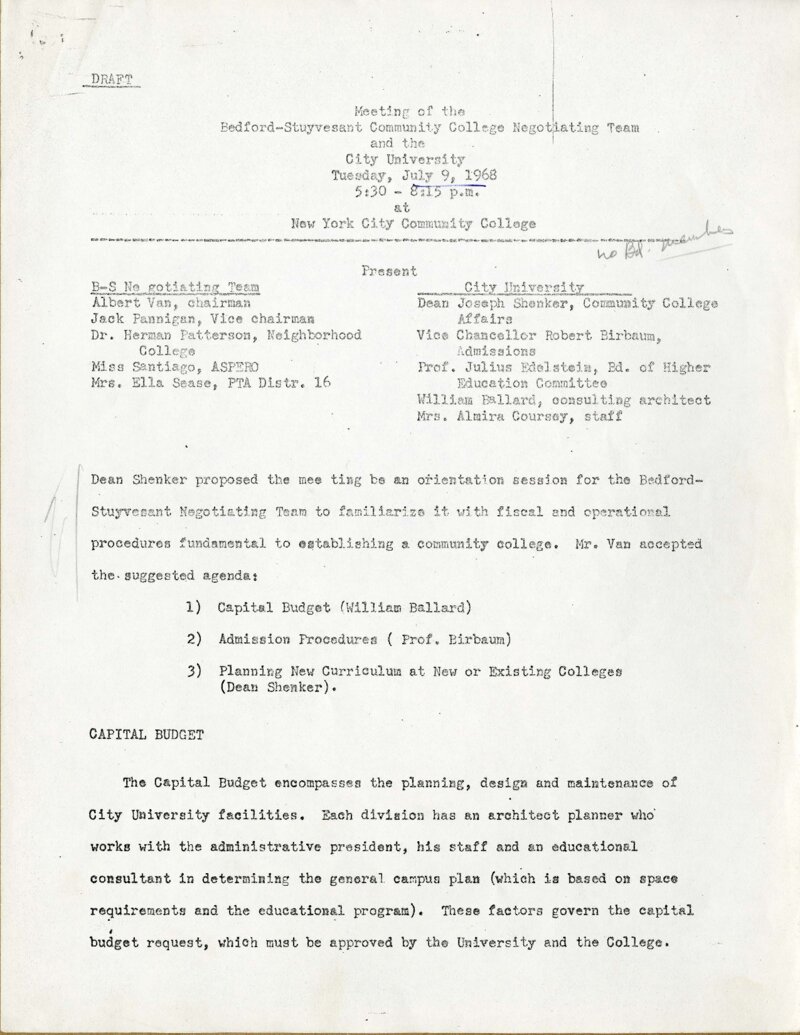
Meeting of the
Bedford-Stuyvesant Community College Negotiating Team
and the j
City University
iy sae Sas
,
at
New York City Community College |
sob cesta wh sat oe ert = Cmte on dr rn i rg ei ences mr on cae rma
he BR a
Present
B-S Nee
‘Albert ar, Comat nity College
Jack Pann’
Dr. Herman Bathe eraon, a lca Robert Birbaun,
Golle
Miss Santi ASPERO idelsteia, hae of Higher
Mre. Ella Sease, PTA Distr. 16 sg A
oomeutatee arebitect
sey, staff
tation session for the Bedford-
Stuyvesant Negotiating Team to familierise it with fiscal and opsrational
procedures fundamental to egtsblishing a community college. Mr. Van accepted
the. suggested agendas
1) Capitel Budget (William Ballard)
2) Admission Procedurea ( Prof. Birbaum)
3) Planning New Curriculum at New or Existing Colleges
(Dean Shenker).
CAPITAL BUDGET
The Capital Budget encompasses the planning, design and maintenance of
City University facilities. Each division has an negHe ict planner who
works with the administrative president, his staff and en educational
consultant in determining the general campus plan (which is based on space
requirements and the educational program). These factors govern the capital
budget request, which must be approved by the University and the College.
ood
Site Selection Board
This board is composed of five members, three of which are representatives
of the ayers City Planning Commission, Budget Director and the Commission
of Real Estate. ‘The City Planning Commission is a key taxtay For new
institutions the site determination must be approved by this Board, following
agreement on the site by the community, City Planning Commission, the college
and the university. The CFC has already been asked to consider the Fedford=
Stuyvesant site.
The Team should not set limites on its capital budget request. The Clty
allocates these funds on the basis of priority of need; and educational
program falls into this category.
ee aera et
Different Capital Budget Procedures for Senior & Junior Colleges
Senior Colleges come under.the State University Construction Fused and alse
receive funds from the State Dormitory Authority, which is empowered to issue
its own bonds. Community colleges are not included in thie legislation, but
they are a part of the State. University system and receive funds from both
the city and the state, necessitating State approval on each step, an
admittedly slower process. The Board of Higher Education decides whether @
faeility will be a two or four year institution. If the Bedford~Stuyvesant
| community wants a senior college, although present plans call for opening a
two year college, a new decision by this 2l-member Board is required.
Question; If the Capital Eudget has been approved for a eommunity
college and the Foard of Higher Education feels it should be
developed into a four year unit, would it affect the Capital
Budget?
-3
Answer; Under present legislation, it is not nacaiuie to do this.
Community colleges come from the City's Capital Budget, senior
colleges funds come from the State Construction Fund, which is
not part of the Capital Budget. City Capital Budget will not
give money if Bedford-Stuyvesant gets the Construction Fund
money.
Question: In the two-year period following opening, is it possible
to convert the school to a senior college? 2
Answer: The sehool is being built under the Community College Act
(Public Law 137, Chap. 13) which allows for transfer to a senior
college.
FOUR-YEAR COLLEGE IN BEDFORD STUYVESANT
The Negotiating Team advised City tare ety the community was in agree-
ment that a two year facility is inadewuude to its needs andaspirations. It
prefers a four-year college awarding a baccalaureate degree. It recommended
change in present legislation to permit transition from a two to four year
institution.
The method for determining the need for a new senior college in Queens
was outlined by Dean Shenker. Surveys were made on the number of students
graduating from public and private high beens and eligible for senior
colleges; projections were obtained from other people on the number of
students graduating and the expected enrollment in senior colleges; compari-
sons with present capacity, our goal of servinga certain percentage of
high school students in the senior Kal iezea. and a datapetnetion as to what
shite meant for new students wishing to enter college revealed the need for
anew senior facility. Prof. Edelstein added, the determination by the
a i }
Board of Higher Education that there is need for the new facility on the
bawis of these statistical projections must be followed by the Board recommene
ding to the Board of Regents that a new facility be included in the Master
Plan (does not specify name or location). Senior colleges are a city-wide
system, not a borough system. In the Queens situation, the site was not
decided upon until months later.
The Negotiating Team reported much of its student population is two years
ce
(2
cr
sa
f2s
@
ee]
(eau
169)
B
&
behind. Soa preparation. period is necessary tefore thes
ready for the regular two anes program, and inasmuch as the €ommunity wants
a four year baccalaureate college, this means a six year program.
Question: If the community accepts the two year Capita al Budge et but
wants a four year progran, and if the Foard of Higher Education
agrees this community should have a four year program, is a
transition possible and how does this affect the money City
University ae received fromthe City?
Answer: To modify the college program requires Foard of Regents
}
whe permission, but it will remain a community college. The State
_lo Legislature will have to pass a bill making it a senior college.
ei A, Gity University noted thet the Master Flan projections indicate enroll~
ies through 1975 will remain around the present level, which means no
need for an additional four year college until that period. Therefore would
the badferd-Stuyvesant protlen be solvea 12 every student who ereoeoned
from the prograw went on to a four year progran without loss of time or
credit. The Team felt the transfer system would not work. Peyehiolopieally
the four-year college is a greater incentive to the Bedford-Stuyvesant .
student who sees sommunity colleges pd stigmatized as inferior schools.
t
Wr
a 3
-City University noted Board of Yigher “ducation had committed itself to-
y £
a two-year college in Brooklyn. As a result of community interest, Bedford
: mn %
Stuyvesant was chosen as the area. The City, Chancellor, and City University
agreed to accomodate the needs of the community by trying to establish a new
form based on this community college. If the comnunity rejects the present
tf 2 *-
x
op ee
20
the proce
ie3
plan, we have to go back to the planning stage, the -beginning o a.
&£
&
We are ready to deliver a community college in 1969 and open with 50
ct
fs
students. If in addition the community wants the Board to consider an
entirely new type of senior college, the Board will consider it, give it
consideration, but it would te something absolutely new for which there is
no model and would require tremendous expert study tefore the Board would
act on sucha proposal, The community wants a commitment from the Committee,
end the Chancellor that he will try to work out some sort of plan in cone
sultetion with the community, the Foard, City University and the Board of }
Regents whereby baccalaureatk degree granting privileges comes out of this
college. This is something new. If we could begin in 1969, we have a going]
concern, If the alternative is to start on a senior collere, we are in a
new ball game.
The Negotiating felt these were the alternatives facing the community:
- accept the two-year program with the assurance that it will be upgraded
to a four year program;
- accept the two-year program with the idea an additional two-year unit
will be provided;
- or, from a community viewpoint, refuse the present plan and try to ae
work for a foureyear unit.
}
i
f
/
/
Prof. Edelstein and Dean Shenker were asked to secire a "Statement of - I
Purpose" from the Chancellor regarding the alternatives the City University
considers as. possibilities for expanding the two-year program into a four-year
baccalaureat¥ degree awarding program. Hopefully this will be ready for the
Steering Commi: ttee meeting Thursday, July 11. The Statement of Purpos st
also include a guarantee to students of transfer and-admission to a senior
college of their choice without loss of any credits.
ADMISSION PROCEDURES
Regular Admission and Special Admission Peosecin es were outlined. The |
x * 2 2 2 Gi | a a a Vy,
Bedford~Stuyvesant Noeotee re Team has the privilese of setting its own y
admission criteria, with a reliable selective mechanism to eliminate those
t be defensitle, none
ce
applicants in excess of capacity. The eriteria mus
peau gueenlie J and cannot | be capri icious or F BbraUrary - The Team was advised
it is advantageous to the student to have B-S Community College applications
processed throughthe City Processing Center. If B-S cannot accommodate some
students the possibility exists that thie itty University might be able to.
The Processing Center will abstain from processing E-S applications if its
admission procedures prove harmful to whet present data processing system.
It was recommended that further diseussion Admission Procedure be put
off for a later date in view of three imperative decision§ that precede this
nn non PanIIT ean
stage: "Statement of Purpose"; whether we move ahead and where; and the
selection of the president of the college. The recommendation was accepted.
OFFICE SPACE,EZQUIPMENT, PERSONNEL
The Steering Committee and the Negotiating Team asked for clarificae M/
v
tion of prior commitments by the Board of Higher Education. They feel the
Board has not adhered to its commitment as little hes been done to set up
the office requested in order to provide services to the community, do __
onto
pestis
nee
whatever research is necessary in conjunction with the project, and personnel
to handle the administrative matterg for the community.
The space obtained has been given on-dmonthly basis, and personnel is to
be hired on this basis as vell. Further clarification on consultants is
needed. )
The Team reported the Revolving Fund for Supplies had gone through and
were informed the furniture and machinery should be delivered sometime
during the middle of next week.
City ere explained the diffieulty with office space lay in the
long delays in going through the Real Ustabe Commission, which normally
secures space (generally takes a six-month period to accomplish). As for
personnel, Civil Service regulations ae union are barriers which could
only be circumvented in the above manner. Otherwise such personnel will
have to come off established civil service lists for the position of
secretary or administrative one arianee These are open-competitive lists,
and the Team would have to select someone from among the top three sent
it by the Civil Service Commission.
The Negotiating Team is to rent the office space obtained md have the
landlord send the bill to the City Univerity (Dean Shenker's office).
The Board of Higher Education Committee assured the Redford- tuyvesant
Team something more stable and long-term would te worked out, although no
present financial quthority exists for this unique situatilon. Space rental
requires Board action and such action will be requested.
The Negotiating Team requested the Committee present a written statement /
earn nina me tae iE en teria /
on its commitment to finance and provide services to the Team. hi
PLANNING NEW CURRICULUM AT NEW OR EXISTING COLLEGES
All consented to postponing until a later -date.
Anniece Garner-Recorder. yy | : : : | 8. Cane
jours abe
pene gins
. cen
(GS Yoewwn
|
{
|
i |
|
I.
t
Meeting of the
Bedford-Stuyvesant Community College Negotiating Team
and the j
City University
iy sae Sas
,
at
New York City Community College |
sob cesta wh sat oe ert = Cmte on dr rn i rg ei ences mr on cae rma
he BR a
Present
B-S Nee
‘Albert ar, Comat nity College
Jack Pann’
Dr. Herman Bathe eraon, a lca Robert Birbaun,
Golle
Miss Santi ASPERO idelsteia, hae of Higher
Mre. Ella Sease, PTA Distr. 16 sg A
oomeutatee arebitect
sey, staff
tation session for the Bedford-
Stuyvesant Negotiating Team to familierise it with fiscal and opsrational
procedures fundamental to egtsblishing a community college. Mr. Van accepted
the. suggested agendas
1) Capitel Budget (William Ballard)
2) Admission Procedurea ( Prof. Birbaum)
3) Planning New Curriculum at New or Existing Colleges
(Dean Shenker).
CAPITAL BUDGET
The Capital Budget encompasses the planning, design and maintenance of
City University facilities. Each division has an negHe ict planner who
works with the administrative president, his staff and en educational
consultant in determining the general campus plan (which is based on space
requirements and the educational program). These factors govern the capital
budget request, which must be approved by the University and the College.
ood
Site Selection Board
This board is composed of five members, three of which are representatives
of the ayers City Planning Commission, Budget Director and the Commission
of Real Estate. ‘The City Planning Commission is a key taxtay For new
institutions the site determination must be approved by this Board, following
agreement on the site by the community, City Planning Commission, the college
and the university. The CFC has already been asked to consider the Fedford=
Stuyvesant site.
The Team should not set limites on its capital budget request. The Clty
allocates these funds on the basis of priority of need; and educational
program falls into this category.
ee aera et
Different Capital Budget Procedures for Senior & Junior Colleges
Senior Colleges come under.the State University Construction Fused and alse
receive funds from the State Dormitory Authority, which is empowered to issue
its own bonds. Community colleges are not included in thie legislation, but
they are a part of the State. University system and receive funds from both
the city and the state, necessitating State approval on each step, an
admittedly slower process. The Board of Higher Education decides whether @
faeility will be a two or four year institution. If the Bedford~Stuyvesant
| community wants a senior college, although present plans call for opening a
two year college, a new decision by this 2l-member Board is required.
Question; If the Capital Eudget has been approved for a eommunity
college and the Foard of Higher Education feels it should be
developed into a four year unit, would it affect the Capital
Budget?
-3
Answer; Under present legislation, it is not nacaiuie to do this.
Community colleges come from the City's Capital Budget, senior
colleges funds come from the State Construction Fund, which is
not part of the Capital Budget. City Capital Budget will not
give money if Bedford-Stuyvesant gets the Construction Fund
money.
Question: In the two-year period following opening, is it possible
to convert the school to a senior college? 2
Answer: The sehool is being built under the Community College Act
(Public Law 137, Chap. 13) which allows for transfer to a senior
college.
FOUR-YEAR COLLEGE IN BEDFORD STUYVESANT
The Negotiating Team advised City tare ety the community was in agree-
ment that a two year facility is inadewuude to its needs andaspirations. It
prefers a four-year college awarding a baccalaureate degree. It recommended
change in present legislation to permit transition from a two to four year
institution.
The method for determining the need for a new senior college in Queens
was outlined by Dean Shenker. Surveys were made on the number of students
graduating from public and private high beens and eligible for senior
colleges; projections were obtained from other people on the number of
students graduating and the expected enrollment in senior colleges; compari-
sons with present capacity, our goal of servinga certain percentage of
high school students in the senior Kal iezea. and a datapetnetion as to what
shite meant for new students wishing to enter college revealed the need for
anew senior facility. Prof. Edelstein added, the determination by the
a i }
Board of Higher Education that there is need for the new facility on the
bawis of these statistical projections must be followed by the Board recommene
ding to the Board of Regents that a new facility be included in the Master
Plan (does not specify name or location). Senior colleges are a city-wide
system, not a borough system. In the Queens situation, the site was not
decided upon until months later.
The Negotiating Team reported much of its student population is two years
ce
(2
cr
sa
f2s
@
ee]
(eau
169)
B
&
behind. Soa preparation. period is necessary tefore thes
ready for the regular two anes program, and inasmuch as the €ommunity wants
a four year baccalaureate college, this means a six year program.
Question: If the community accepts the two year Capita al Budge et but
wants a four year progran, and if the Foard of Higher Education
agrees this community should have a four year program, is a
transition possible and how does this affect the money City
University ae received fromthe City?
Answer: To modify the college program requires Foard of Regents
}
whe permission, but it will remain a community college. The State
_lo Legislature will have to pass a bill making it a senior college.
ei A, Gity University noted thet the Master Flan projections indicate enroll~
ies through 1975 will remain around the present level, which means no
need for an additional four year college until that period. Therefore would
the badferd-Stuyvesant protlen be solvea 12 every student who ereoeoned
from the prograw went on to a four year progran without loss of time or
credit. The Team felt the transfer system would not work. Peyehiolopieally
the four-year college is a greater incentive to the Bedford-Stuyvesant .
student who sees sommunity colleges pd stigmatized as inferior schools.
t
Wr
a 3
-City University noted Board of Yigher “ducation had committed itself to-
y £
a two-year college in Brooklyn. As a result of community interest, Bedford
: mn %
Stuyvesant was chosen as the area. The City, Chancellor, and City University
agreed to accomodate the needs of the community by trying to establish a new
form based on this community college. If the comnunity rejects the present
tf 2 *-
x
op ee
20
the proce
ie3
plan, we have to go back to the planning stage, the -beginning o a.
&£
&
We are ready to deliver a community college in 1969 and open with 50
ct
fs
students. If in addition the community wants the Board to consider an
entirely new type of senior college, the Board will consider it, give it
consideration, but it would te something absolutely new for which there is
no model and would require tremendous expert study tefore the Board would
act on sucha proposal, The community wants a commitment from the Committee,
end the Chancellor that he will try to work out some sort of plan in cone
sultetion with the community, the Foard, City University and the Board of }
Regents whereby baccalaureatk degree granting privileges comes out of this
college. This is something new. If we could begin in 1969, we have a going]
concern, If the alternative is to start on a senior collere, we are in a
new ball game.
The Negotiating felt these were the alternatives facing the community:
- accept the two-year program with the assurance that it will be upgraded
to a four year program;
- accept the two-year program with the idea an additional two-year unit
will be provided;
- or, from a community viewpoint, refuse the present plan and try to ae
work for a foureyear unit.
}
i
f
/
/
Prof. Edelstein and Dean Shenker were asked to secire a "Statement of - I
Purpose" from the Chancellor regarding the alternatives the City University
considers as. possibilities for expanding the two-year program into a four-year
baccalaureat¥ degree awarding program. Hopefully this will be ready for the
Steering Commi: ttee meeting Thursday, July 11. The Statement of Purpos st
also include a guarantee to students of transfer and-admission to a senior
college of their choice without loss of any credits.
ADMISSION PROCEDURES
Regular Admission and Special Admission Peosecin es were outlined. The |
x * 2 2 2 Gi | a a a Vy,
Bedford~Stuyvesant Noeotee re Team has the privilese of setting its own y
admission criteria, with a reliable selective mechanism to eliminate those
t be defensitle, none
ce
applicants in excess of capacity. The eriteria mus
peau gueenlie J and cannot | be capri icious or F BbraUrary - The Team was advised
it is advantageous to the student to have B-S Community College applications
processed throughthe City Processing Center. If B-S cannot accommodate some
students the possibility exists that thie itty University might be able to.
The Processing Center will abstain from processing E-S applications if its
admission procedures prove harmful to whet present data processing system.
It was recommended that further diseussion Admission Procedure be put
off for a later date in view of three imperative decision§ that precede this
nn non PanIIT ean
stage: "Statement of Purpose"; whether we move ahead and where; and the
selection of the president of the college. The recommendation was accepted.
OFFICE SPACE,EZQUIPMENT, PERSONNEL
The Steering Committee and the Negotiating Team asked for clarificae M/
v
tion of prior commitments by the Board of Higher Education. They feel the
Board has not adhered to its commitment as little hes been done to set up
the office requested in order to provide services to the community, do __
onto
pestis
nee
whatever research is necessary in conjunction with the project, and personnel
to handle the administrative matterg for the community.
The space obtained has been given on-dmonthly basis, and personnel is to
be hired on this basis as vell. Further clarification on consultants is
needed. )
The Team reported the Revolving Fund for Supplies had gone through and
were informed the furniture and machinery should be delivered sometime
during the middle of next week.
City ere explained the diffieulty with office space lay in the
long delays in going through the Real Ustabe Commission, which normally
secures space (generally takes a six-month period to accomplish). As for
personnel, Civil Service regulations ae union are barriers which could
only be circumvented in the above manner. Otherwise such personnel will
have to come off established civil service lists for the position of
secretary or administrative one arianee These are open-competitive lists,
and the Team would have to select someone from among the top three sent
it by the Civil Service Commission.
The Negotiating Team is to rent the office space obtained md have the
landlord send the bill to the City Univerity (Dean Shenker's office).
The Board of Higher Education Committee assured the Redford- tuyvesant
Team something more stable and long-term would te worked out, although no
present financial quthority exists for this unique situatilon. Space rental
requires Board action and such action will be requested.
The Negotiating Team requested the Committee present a written statement /
earn nina me tae iE en teria /
on its commitment to finance and provide services to the Team. hi
PLANNING NEW CURRICULUM AT NEW OR EXISTING COLLEGES
All consented to postponing until a later -date.
Anniece Garner-Recorder. yy | : : : | 8. Cane
jours abe
pene gins
. cen
(GS Yoewwn
Title
Presidential Search Committee of Community College 7: Minutes July 9, 1968,
Description
On July 9, 1968, the Presidential Search Committee for “Community College 7,” composed of five City University of New York officials and five appointed representatives of Bedford-Stuyvesant’s community-based organizations, met to discuss plans for the new college. In this meeting, CUNY officials briefed the Bedford-Stuyvesant committee members in detail on pathways and obstacles for the college to open as a four-year degree granting “senior” college, as demanded by the Central Brooklyn community. The Committee also explored possibilities for the Bedford-Stuyvesant community organizations to receive funds to support their research and planning activities in support of the new college, an issue that would prove contentious in the coming weeks with the Ford Foundation’s involvement in funding the project.
In February 1968, the City University of New York (CUNY) announced plans to establish a new “Community College 7 in or near Bedford-Stuyvesant. . . oriented to the Bedford-Stuyvesant Community and operated in consultation with the community.” Representatives of a broad network of Central Brooklyn community organizations engaged in an 18 months-long negotiation with CUNY Board of Higher Education officials over CUNY’s plans for its newly announced “Community College 7,” including discussions about the proposed school’s curriculum, who would lead it, and what role the community would play in the school’s governance. The role of the Bedford-Stuyvesant community in planning and determining the leadership of the college remained a central point of controversy between Central Brooklyn’s educational and civil society leaders and CUNY officials in the negotiations that followed.
Contributor
Woodsworth, Michael
Date
July 9, 1968
Language
English
Source
Donald Watkins Collection (Brooklyn Public Library)
Original Format
Notes / Minutes
“Presidential Search Committee of Community College 7: Minutes July 9, 1968”,. Letter, CUNY DIGITAL HISTORY ARCHIVE, accessed September 5, 2026, https://stephenz.tailc22a4b.ts.net/s/cdha/item/2014