Draft Letter from Al Vann to the Editor of the Amsterdam News
Item
ae
~STUYVESANT?
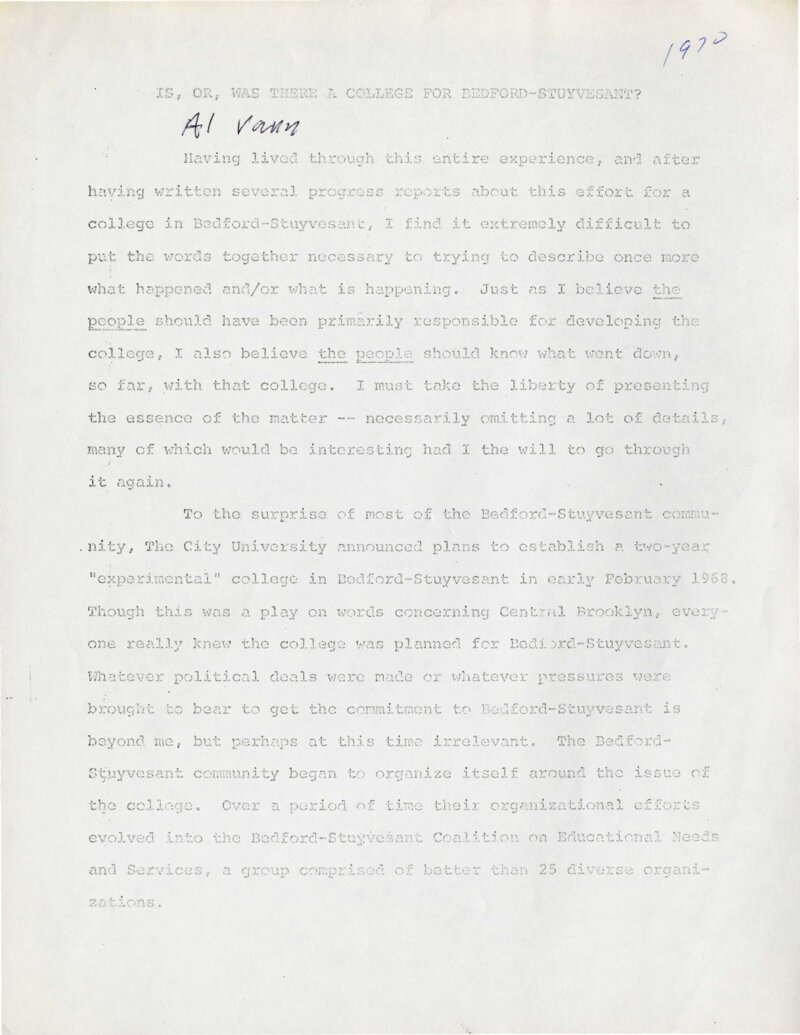
Having lived through this entire experience, and after
i)
haying written several progress reports about this effort for a
college in Bedford-Stuyvesant, I find it extremely difficult to
Bak the words together necessary to trying to describe once more
what happened and/or what is happening. Just ‘as I believe the
people should have been primarily responsible for developing the
should know what went down,
college, Tals o believe the peopl
hg gare that college. I must.take the liberty of presenting
the essence of the matter -- necessarily omitting a lot of details,
“many of which would be interesting had I the will to go through
it again.
To the surprise of most of the Bedford-Stuyvesant commu-
nity, The City University announced plans to establish a two-year
"oxperimentai" college in Bedford-Stuyvesant in early February 1968.
Though this was a play on words concerning Central Brooklyn, eve
one re 7 knew the college was planned for Bedi ord-Stuyvesant.
Whatever political deals were made or whatever pressures were
brought to bear to get the commitment
beyond me, but perhaps at this time
Stpyvesant mity began to organize itself around the issue of
the col Over a period of time their organizational ef
evolved
anyvyesant Coalition on Educati
and Services, a
Zh
om
There were two major dictates under which this community
structure was functioning:
1) Any college to be established in our community had to
be community controlled; and
2) Any college to be established in our community had to
be a senior college and not a junior (community)
college.
The Coalition elected seven people to represent them in meetings
with members of the Board of Higher Education: Bro. Albert Vann,
Chairman; Bro, Jack Pannigan, Vice Chairman; Miss Isaura Santiago;
Hon. Thomas R. Jones, J.S.C.; Bro. Robert (Sonny) Carson;
Mes. Ella Sease; and Prof. Herman Patterson. A more representative
group of Black people would be hard to find anywhere in the world.
More pertinent, they were a reflection of the Coalition which was
representative of the involved, or, concerned Bedford-Stuyvesant
community.
‘ S
4
vt
- The membérs of the Coalition and those on the Negotiating Team
represented the Bedford-Stuyvesant community exceptionally well.
In spite of arguments, profanity, intimidation, and grandstand plays
at their own meetings, individual differences for the most part were
submerged when confronting the Board of Higher Education. During
the prodackive pericd of the Coalition's negotiations, City
University agreed to finance the establishment of the group's office
and staff; they agreed to the concept that a policy-making board
fo¢ the college come from the community; they agreed to change the
proposal for a two-year college to one for a senior college. With
the aid of consultants the Coalition Geveloped proposals for a
Black Studies Department, a Puerto Rican Studies Department, 1
Dd
concepts in Teacher Education and admission policies, and
suggested courses of study and degree~granting programs. In addi-
tion, Federal City Ccllege in Washington, D. C. was visited and
evaluated, and served to provide invaluable information concerning
the pitfalls to be avoided in establishing a new college. ‘The
Coalition had also found interim facilities for the college and was
moving to explore for a permanent site.
. Negotiations with The City University were all that could be
eqeooeed between the Establishment and a bona fide Black community.
whe Negotiating Team's strength stemmed from the fact that with the
exception of one person no one on the Team was on City University's
paproil: thus they exemplified almost total independence.
After more than a year of dealing with The City University,
dealing with their community, and progressing with the college, it
became apparent that the Bedford-Stuyvesant Coalition was for real,
and that perhaps for the first time a united Black comaunity had
Corie together to make decisions on matters (i.e., the college)
pertinent to the community. The surface issue that destroyed this
cotimunity unity dealt with the selection of a President for the
plbecd: “After having undergone an extensive national search for
the appropriate man, only a handful were produced who met the
requirements of both the Coalition and The City University.
bility among the top prospects narrowed the selection down to one
= &
man -~ who happened to have been the community's first choice. At
ad
this point representatives of the Board of Higher Education found
this man, Mr. Rhody McCoy, to be totally unaccep
that, they. completely disregarded and disrespected the entire
Bedford-Stuyvesant community by trying to determine for them who
could best serve them.
Veiled (and not so veiled) threats which came from City U.
regarding the possibility of loss of the college if the choice of
a Presi@ent was not altered provided the necessary wedge, which
would begin to divide and conquer. As always, there were niggers
waiting in the wings to "do their thing". Politicians who had not
been heard from before suddenly became involved, making their entrance
with the consent of The City University, but without notice to the
established community structure and their constituents. Members
of the Coalition whe had not been seen since its first days estab-
lished direct communication with City U. to oppose the position
taken by the community structure. Unfortunately for Black people,
it was real easy to divide and conquer. Niggers with their waxped
egos, who think that nothing should move without their worn~out
leadership, pulled their nasty strings behind the scenes; and
niggers whose personal greed far outweighed any concern for the
broader community responded when their strings were pulled.
Nevertheless, the majority opinion within the Coalition
withstood: Despite the break-aways, the Bedford-Stuyvesant commun
maintained its dignity and its right to choose a President for their
college; but more pertinently, it maintained its right to detexmine
its own destiny. With the knowledge that a college is not just a
building nor a plant which would provide a few choice Blacks with
$20,000 jobs and menial jobs for a few less fortunate brothers and
sisters, this position came easily. The understanding that a
college in their community would make a dynamic impact, but, too,
that an impact could be positive or detrimental, made it even easier.
In summary, it should be of prime interest to Black
communities throughout the nation to know that there exists a Black
community which is awakened enough, concerned enough, and involved
enough to do what is necessary to protect their young and to begin
to build a firm foundation -- necessary for rebirth of the dignity
and strength of the Black man.
Peace and Power.
Albert Vann
Chairman
Bedford-Stuyvesant Coalition on
Educational Needs and Services.
~STUYVESANT?
Having lived through this entire experience, and after
i)
haying written several progress reports about this effort for a
college in Bedford-Stuyvesant, I find it extremely difficult to
Bak the words together necessary to trying to describe once more
what happened and/or what is happening. Just ‘as I believe the
people should have been primarily responsible for developing the
should know what went down,
college, Tals o believe the peopl
hg gare that college. I must.take the liberty of presenting
the essence of the matter -- necessarily omitting a lot of details,
“many of which would be interesting had I the will to go through
it again.
To the surprise of most of the Bedford-Stuyvesant commu-
nity, The City University announced plans to establish a two-year
"oxperimentai" college in Bedford-Stuyvesant in early February 1968.
Though this was a play on words concerning Central Brooklyn, eve
one re 7 knew the college was planned for Bedi ord-Stuyvesant.
Whatever political deals were made or whatever pressures were
brought to bear to get the commitment
beyond me, but perhaps at this time
Stpyvesant mity began to organize itself around the issue of
the col Over a period of time their organizational ef
evolved
anyvyesant Coalition on Educati
and Services, a
Zh
om
There were two major dictates under which this community
structure was functioning:
1) Any college to be established in our community had to
be community controlled; and
2) Any college to be established in our community had to
be a senior college and not a junior (community)
college.
The Coalition elected seven people to represent them in meetings
with members of the Board of Higher Education: Bro. Albert Vann,
Chairman; Bro, Jack Pannigan, Vice Chairman; Miss Isaura Santiago;
Hon. Thomas R. Jones, J.S.C.; Bro. Robert (Sonny) Carson;
Mes. Ella Sease; and Prof. Herman Patterson. A more representative
group of Black people would be hard to find anywhere in the world.
More pertinent, they were a reflection of the Coalition which was
representative of the involved, or, concerned Bedford-Stuyvesant
community.
‘ S
4
vt
- The membérs of the Coalition and those on the Negotiating Team
represented the Bedford-Stuyvesant community exceptionally well.
In spite of arguments, profanity, intimidation, and grandstand plays
at their own meetings, individual differences for the most part were
submerged when confronting the Board of Higher Education. During
the prodackive pericd of the Coalition's negotiations, City
University agreed to finance the establishment of the group's office
and staff; they agreed to the concept that a policy-making board
fo¢ the college come from the community; they agreed to change the
proposal for a two-year college to one for a senior college. With
the aid of consultants the Coalition Geveloped proposals for a
Black Studies Department, a Puerto Rican Studies Department, 1
Dd
concepts in Teacher Education and admission policies, and
suggested courses of study and degree~granting programs. In addi-
tion, Federal City Ccllege in Washington, D. C. was visited and
evaluated, and served to provide invaluable information concerning
the pitfalls to be avoided in establishing a new college. ‘The
Coalition had also found interim facilities for the college and was
moving to explore for a permanent site.
. Negotiations with The City University were all that could be
eqeooeed between the Establishment and a bona fide Black community.
whe Negotiating Team's strength stemmed from the fact that with the
exception of one person no one on the Team was on City University's
paproil: thus they exemplified almost total independence.
After more than a year of dealing with The City University,
dealing with their community, and progressing with the college, it
became apparent that the Bedford-Stuyvesant Coalition was for real,
and that perhaps for the first time a united Black comaunity had
Corie together to make decisions on matters (i.e., the college)
pertinent to the community. The surface issue that destroyed this
cotimunity unity dealt with the selection of a President for the
plbecd: “After having undergone an extensive national search for
the appropriate man, only a handful were produced who met the
requirements of both the Coalition and The City University.
bility among the top prospects narrowed the selection down to one
= &
man -~ who happened to have been the community's first choice. At
ad
this point representatives of the Board of Higher Education found
this man, Mr. Rhody McCoy, to be totally unaccep
that, they. completely disregarded and disrespected the entire
Bedford-Stuyvesant community by trying to determine for them who
could best serve them.
Veiled (and not so veiled) threats which came from City U.
regarding the possibility of loss of the college if the choice of
a Presi@ent was not altered provided the necessary wedge, which
would begin to divide and conquer. As always, there were niggers
waiting in the wings to "do their thing". Politicians who had not
been heard from before suddenly became involved, making their entrance
with the consent of The City University, but without notice to the
established community structure and their constituents. Members
of the Coalition whe had not been seen since its first days estab-
lished direct communication with City U. to oppose the position
taken by the community structure. Unfortunately for Black people,
it was real easy to divide and conquer. Niggers with their waxped
egos, who think that nothing should move without their worn~out
leadership, pulled their nasty strings behind the scenes; and
niggers whose personal greed far outweighed any concern for the
broader community responded when their strings were pulled.
Nevertheless, the majority opinion within the Coalition
withstood: Despite the break-aways, the Bedford-Stuyvesant commun
maintained its dignity and its right to choose a President for their
college; but more pertinently, it maintained its right to detexmine
its own destiny. With the knowledge that a college is not just a
building nor a plant which would provide a few choice Blacks with
$20,000 jobs and menial jobs for a few less fortunate brothers and
sisters, this position came easily. The understanding that a
college in their community would make a dynamic impact, but, too,
that an impact could be positive or detrimental, made it even easier.
In summary, it should be of prime interest to Black
communities throughout the nation to know that there exists a Black
community which is awakened enough, concerned enough, and involved
enough to do what is necessary to protect their young and to begin
to build a firm foundation -- necessary for rebirth of the dignity
and strength of the Black man.
Peace and Power.
Albert Vann
Chairman
Bedford-Stuyvesant Coalition on
Educational Needs and Services.
Title
Draft Letter from Al Vann to the Editor of the Amsterdam News
Description
On February 14, 1970, Al Vann, Chairman of the then-disbanded Bedford-Stuyvesant Coalition on Educational Needs and Services, wrote a letter to the editor of the Amsterdam News, offering his account of the negotiations that had taken place over the past two years between Bedford-Stuyvesant community leaders and City University of New York (CUNY) officials in planning Medgar Evers College, originally referred to as “Community College 7.” In his letter, Vann responded to public criticism, defending the firm stance he and the Coalition had taken in advocating for a college controlled by the community, and willing to “do what is necessary to protect [Black youth], and to build a firm foundation – necessary for the rebirth of the dignity and strength of the Black man.”
In February 1968, the City University of New York (CUNY) announced plans to establish a new “Community College 7 in or near Bedford-Stuyvesant. . . oriented to the Bedford-Stuyvesant Community and operated in consultation with the community.” Representatives of a broad network of Central Brooklyn community organizations engaged in an 18 months-long negotiation with CUNY Board of Higher Education officials over CUNY’s plans for its newly announced “Community College 7,” including discussions about the proposed school’s curriculum, who would lead it, and what role the community would play in the school’s governance. The role of the Bedford-Stuyvesant community in planning and determining the leadership of the college remained a central point of controversy between Central Brooklyn’s educational and civil society leaders and CUNY officials in the negotiations that followed.
Creator
Vann, Al
Date
February 14, 1970
Language
English
Source
Donald Watkins Collection (Brooklyn Public Library)
Vann, Al. “Draft Letter from Al Vann to the Editor of the Amsterdam News.”, CUNY DIGITAL HISTORY ARCHIVE, accessed September 5, 2026, https://stephenz.tailc22a4b.ts.net/s/cdha/item/2111