Faculty Action, May 1976
Item
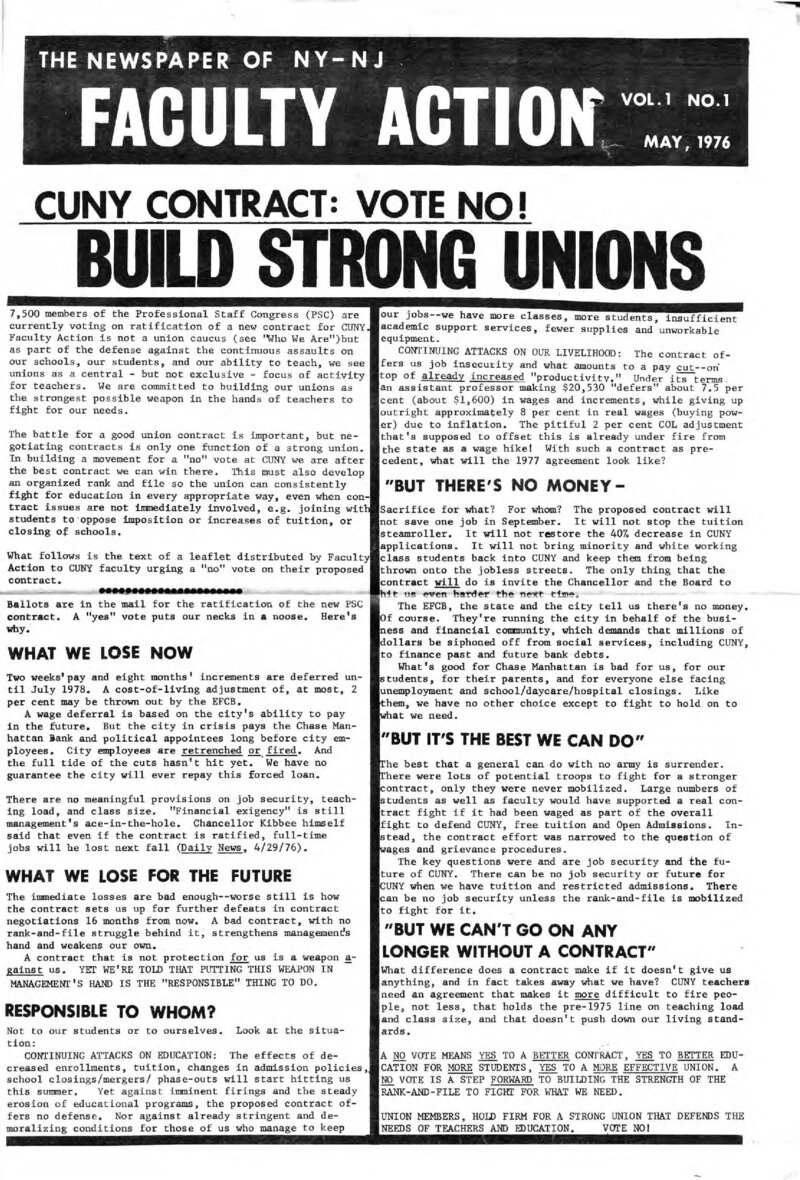
THE NEWSPAPER OF NY-NJ
FACULTY ACTION *....
_CUNY CONTRACT: VOTE NO!
BUILD STRONG UNIONS
7,500 members of the Professional Staff Congress (PSC) are
currently voting on ratification of a new contract for CUNY
Faculty Action is not a union caucus (see "Who We Are")but
as part of the defense against the continuous assaults on
our schools, our students, and our ability to teach, we see
unions as a central - but not exclusive - focus of activity
for teachers. We are committed to building our unions as
the strongest possible weapon in the hands of teachers to
fight for our needs.
The battle for a good union contract is important, but ne-
gotiating contracts is only one function of a strong union.
In building a movement for a "no" vote at CUNY we are after
This must also develop
the best contract we can win there.
an organized rank and file so the union can consistently
fight for education in every appropriate way, even when con-
tract issues are not immediately involved, e.g. joining wit
students to'oppose imposition or increases of tuition, or
closing of schools.
What follows is the text of a leaflet distributed by Facult
Action to CUNY faculty urging a "no" vote on their proposed
contract.
SOLPIO DSO PABLASOSDESIO
Ballots are in the mail for the ratification of the new PSC
contract. A "yes" vote puts our necks in a noose. Here's
why.
WHAT WE LOSE NOW
Two weeks' pay and eight months' increments are deferred un-
til July 1978. A cost-of-living adjustment of, at most, 2
per cent may be thrown out by the EFCB.
A wage deferral is based on the city's ability to pay
in the future. But the city in crisis pays the Chase Man-
hattan Bank and political appointees long before city em-
ployees. City employees are retrenched or fired. And
the full tide of the cuts hasn't hit yet. We have no
guarantee the city will ever repay this forced loan.
There are no meaningful provisions on job security, teach-
ing load, and class size. "Financial exigency" is still
management's ace-in-the-hole, Chancellor Kibbee himself
said that even if the contract is ratified, full-time
jobs will be lost next fall (Daily News, 4/29/76).
WHAT WE LOSE FOR THE FUTURE
The immediate losses are bad enough--worse still is how
the contract sets us up for further defeats in contract
negotiations 16 months from now. A bad contract, with no
rank-and-file struggle behind it, strengthens management's
hand and weakens our own.
A contract that is not protection for us is a weapon a-
gainst us. YET WE'RE TOLD THAT PUTTING THIS WEAPON IN
MANAGEMENT'S HAND IS THE "RESPONSIBLE" THING TO DO.
RESPONSIBLE TO WHOM?
Not to our students or to ourselves.
tion:
CONTINUING ATTACKS ON EDUCATION:
Look at the situa-
The effects of de-
creased enrollments, tuition, changes in admission policies,
school closings/mergers/ phase-outs will start hitting us
this summer.
fers no defense, Nor against already stringent and de-
moralizing conditions for those of us who manage to keep
top of already increased "productivity." Under
an assistant professor making $20,530 "defers" about 7.5 per
cent (about $1,600) in wages and increments, while giving up
outright approximately 8 per cent in real wages (buying pow-
not save one job in September.
Yet against imminent firings and the steady
erosion of educational programs, the proposed contract of-
our jobs--we have more classes, more students, insufficient
academic Support services, fewer supplies and unworkable
equipment.
CONTINUING ATTACKS ON OUR LIVELIHOOD: The contract of-
fers us job insecurity and what amounts to a pay cut--on
its terms.
er) due to inflation. The pitiful 2 per cent COL adjustment
that's supposed to offset this is already under fire from
the state as a wage hike! With such a contract as pre-
cedent, what will the 1977 agreement look like?
“BUT THERE’S NO MONEY -
The proposed contract will
It will not stop the tuition
steamroller. It will not restore the 40% decrease in CUNY
applications. It will not bring minority and white working
class students back into CUNY and keep them from being
thrown onto the jobless streets. The only thing that the
contract will do is invite the Chancellor and the Board to
hit us even harder the next time.
The EFCB, the state and the city tell us there's no money.
Of course. They're running the city in behalf of the busi-
mess and financial community, which demands that millions of
dollars be siphoned off from social services, including CUNY,
to finance past and future bank debts.
What's good for Chase Manhattan is bad for us, for our
students, for their parents, and for everyone else facing
unemployment and school/daycare/hospital closings. Like
hem, we have no other choice except to fight to hold on to
at we need.
“BUT IT’S THE BEST WE CAN DO”
he best that a general can do with no army is surrender.
here were lots of potential troops to fight for a stronger
contract, only they were never mobilized. Large numbers of
students as well as faculty would have supported a real con-
tract fight if it had been waged as part of the overall
fight to defend CUNY, free tuition and Open Admissions. In-
stead, the contract effort was narrowed to the question of
ages and grievance procedures.
The key questions were and are job security and the fu-
ture of CUNY. There can be no job security or future for
CUNY when we have tuition and restricted admissions. There
ican be no job security unless the rank-and-file is mobilized
to fight for it.
“BUT WE CAN’T GO ON ANY
LONGER WITHOUT A CONTRACT”
What difference does a contract make if it doesn't give us
anything, and in fact takes away what we have? CUNY teachers
need an agreement that makes it more difficult to fire peo-
ple, not less, that holds the pre-1975 line on teaching load
and class size, and that doesn't push down our living stand-
ards.
Sacrifice for what? For whom?
A NO VOTE MEANS YES TO A BETTER CONTRACT, YES TO BETTER EDU-
CATION FOR MORE STUDENTS, YES TO A MORE EFFECTIVE UNION. A
NO VOTE IS A STEP FORWARD TO BUILDING THE STRENGTH OF THE
RANK-AND-FILE TO FIGHT FOR WHAT WE NEED.
UNION MEMBERS, HOLD FIRM FOR A STRONG UNION THAT DEFENDS THE
NEEDS OF TEACHERS AND EDUCATION. VOTE NO!
PAGE TWO
FACULTY ACTION
ILD A
TEACHERS
Editor's note: The following is the call distributed
to teachers in the New York-New Jersey area which in-
itiated FACULTY ACTION. It has been slightly edited.
Dear Fellow Teachers:
We are some of the hundreds of teachers in the New
York-New Jersey area who have been taking part in the
recent growing resistance to the cuts in education. We
are fed up with these continuing attacks on education,
on our students, and on our ability to teach. Neither
we nor our students can ignore the absurdity of gradua-
tion into unemployment or the training, of needed nurses
and medical paraprofessionals while hospitals are closed
down. Every program cut, every increase in tuition or
class size takes us further from our hopes of conveying
the accumulated rich knowledge of humanity to our stu-
dents so they can contribute to advancing society still
further. . More and. more we are asking ourselves whether
what we teach in our classes reflects reality and the
way all aspects of society develop, or hides it.
We are fed up with the deterioration of society
we see all around us. Inflation robs our pay while the
spread of X-rated garbage and the forced closings of
libraries and museums robs us of cultural developments
as the economic crisis pushes all of society into an in-
tellectual and cultural wasteland of decadence.
We do not want to live this way. We are convinced
that these attacks on education and throughout society
can and must be resisted and thrown back by a strong,
united, organized mass movement in which teachers have
an important role to play.
Every time. we turn around, some governor or mayor
or corporate leader behind them announces another "plan"
to gut education, throw tens of thousands of students
into the street, close schools, and do away with hun-
dreds of teachers, even overriding tenure. These "plans'!
come amid other plans to close hospitals, factories
and firehouses, cut pay, break unions, and crush peo-
ple in a hundred different ways.
The bewildering variety of "plans" comes in part
from a deliberate attempt to confuse and demoralize us
with uncertainty, to divide us and make us hope someone
else wil¥ get the axe in the end. But the long proces-
sion of "plans" really shows that the rulers of this
country have no plan at all. The economic crisis has
called out the deep conflicts among competing ruling
political and economic interests, as different sections
of the political buréaucracy and different corporate
and banking interests throw mud at each other and des-
perately try to survive at everyone else's expense.
The rulers have to experiment with trial baloons
to test out the resistance and see what they can get
away with. They are scared to death of the anger the
people feel under the cuts, and rightly so. The real
extent of the cuts is by no means predetermined, It
depends to a great degree on our ability to throw off
demoralization and uncertainty, organize and fight back
together with the millions of others -- students, teach-
ers, and workers.-- who have no choice but to fight in
order to maintain even the barest necessities. We want
to help build that fighting movement.
The cuts in education and the deterioration of
living and working conditions do not come from the ill-
will or temporary irrationality of college adminstra-
tors, politicians, or industrial and banking leaders.
As the general economic crisis has developed, the poli-
tical and economic leaders have been forced to admit
that the problems go deep, the "options" are extremely
limited. For them thexcrisis is a crisis of profit --
not enough of it today to make production worthwhile,
a "capital shortage" of trillions of dollars that cre-
ates a bottleneck to their profits and production in
the future.
Of course our capitalist society runs for profit. In
times of crisis it is just more obvious what this means in
terms of cuts and suffering. To "save New York City from
default", thousands of jobs were lost and services cut.
Federal "aid" really has meant more hospitals closed, edu-
cation crippled, and still more suffering for the people.
To make business recover, workers are laid off and those
who remain work doubly hard in unsafe conditions to in-
crease production. All to "save money" -- which means to
put money in the hands of big business.
To restore profitable business conditions and get
out of the crisis, the rulers of this country must at-
tack working people, must try to cut back on social ser-
vices, must bring us closer to war. They must take
their crisis and try to put it on the backs of the peo-
ple. This is not a matter of choice. No amount of
pleading or reasoning with them can change this. But
organized resistance can limit their ability to get
away with it and can go on to win more victories.
Throughout the country, and in the New York-New
Jersey area in particular, this angry resistance is
growing. With thousands of other teachers and stu-
dents, we have marched and demonstrated against the cuts
in New York City, Albany, Trenton, Washington, D.C. and
on local campuses. Like so many others, we have taken
strength from news of worker and community resistance
to hospital and firehouse closings, layoffs and other
abuses.
But too many of these demonstrations, particularly
those focused on education, have been frustrating be-
cause the faculty union and student government leader-
ship follow a strategy of pleading and reasoning with
the corporate leaders and their political front-men.
People are called to rallies to "show we care," and to
strengthen the union or student leadership or some poli-
tician in their participation in planning the cuts. This
strategy cannot work. We care very much, but that isn't
the real issue. We are not creating polarity or manu-
facturing disunity to point out that the people of this
country and their economic and political rulers have
nothing in common. _Our experience in the crisis teaches
us this reality. A strategy based on pleading and a
willingness to concede is not based on reality, cannot
mobilize the people in a sustained way, breeds cynicism
and confusion, and only plays into the hands of those
making the cuts.
People can be won to persist in resisting these
cuts only on the basis of a realistic assessment of
their origin and the steps needed to build a broad, un-
compromising, organized movement of millions of people
going on the offensive to declare: "We will not live
this way -- we can live better!" No amount of croco-
dile tears and bicentennial flag-waving from the econ-
omic and political hit-men can long keep us all from
aiming our anger and struggle directly against them.
Such a social movement is much broader than teach-
ers alone, although teachers have an important place in
it. Already many students, workers in factories and city
government, and community residents are getting organ-
I want more information about FACULTY ACTION __.
I want more information about July 4th __.
I enclose a contribution toward the cost of
this paper and the work of FACULTY ACTION __.
name:
address:
phone(s):
school:
FACULTY ACTION
% Naomi Woronov, Eng. Dept.
Manhattan Community College
1633 B'way, NYC 10019
or call: Bill Friedheim (212 781 1702)
or Mike Zweig (212 568 7346 or 516 246 5070)
FACULTY ACTION
FIGHTING
PAGE THREE
ORGANIZATION
ized, participating in many battles, winning some, and
gaining in understanding and strength. The economic
crisis is not going away. New York City faces at least
three years of mandated cuts while the problems of New
York Sate, New Jersey, and elsewhere are just beginning
to surface. A long series of battles lies ahead of us,
but armed with understanding and organization we can
join in the resistance which is sure to grow, win a lot,
and in building the unity and strength of the people
help lay the basis for a bright future.
We teachers need organization too. Most of us are
in one teachers union or another. We think our unions
must play an important role in organizing resistance to
every attack on education and must take up the fight on
a broader front as well, bringing teachers into united
struggle with others in society. We will continue to
work in our unions to accomplish this by consistently
relying on the energy and initiative of the rank and
file and bringing to the teachers a political under-
standing and plan which can effectively mobilize them.
But our experience in the unions so far has con-
vinced us that we cannot confine eur activities there.
We cannot quickly overcome the sell-out stand of the
union leadership and their present control of many cam-
pus formal structures, The urgency and widespread na-
ture of the attacks require immediate unified work
throughout the New York-New Jersey area to bring to-
gether teachers from the different school systems, each
with a different union (and some with no union at all),
into one organization which can lead teachers to streng-
then our unions and also take up issues of concern to
which our unions cannot now be won.
We therefore propose that a new faculty organization
be formed immediately, uniting college teachers from the
many schools and systems in the New York-New Jersey area.
The organization should be composed of campus chapters
and individuals from schools at which there is not yet a
chapter organized. This organization would have as its
primary responsibility mobilizing and organizing thou-
sands of teachers into active resistance against the
many attacks on education, in cooperation with the ris-
ing student movement. To this end the organization must
8908899 OSGOS0EESS9H0G00008
SUNY TAs STRIKE— WIN JOBS
Recently the History Department graduate students
at the State University of New York at Stony Brook learn-
ed that ten Teaching Assistant (TA) lines were being cut
from next year's budget, almost a 25% reduction. This
threatened to end graduate education for a number of cur-
rent students and cripple the Department's ability to sup-
port incoming students.
The TAs rejected any scheme to keep their own lines
next semester by cutting funds from new students. They
also turned back a plan to allocate TA lines on the basis
of financial need, which would mainly have taken money
away from married women graduate students. This plan was
simply a rationalization for the cuts and divisive among
the students,
After unsuccessful meetings with the Adminstration,
the TAs voted unanimously to strike immediately until the
lines were restored. With the support of most of the
faculty, the TAs picketed every History class and refused
to meet their own classes. They won the support of un-
dergraduate History students, who have every interest in
joining to secure jobs for teachers so the education pro-
cess can continue without overcrowding or cancelled classes.
The TAs were able to build broad support by taking up the
cuts ag a battle for education, not limiting the question
to their own jobs.
After five days the Adminstration came up with eight
new TA lines, not pirated from other departments, showing
again that the extent of the cuts is in no way predeter-
mined, but depends on our ability to build unity and fight
for everything we need. ®
take up ways to make the unions themselves real fighting
organizations. We should be based in work on our own
campuses but be able to draw faculty into city- and
state-wide actions and have an influence far beyond our
own campuses.
In connection with this central function, the
teachers' organization would also mobilize teachers
to participate in an organized way in the broad social
movement growing in opposition to every aspect of soc-
ial deterioration stemming from the economic crisis.
Only by strengthening and building this broad resistance
will we be able to simultaneously build the strongest,
most focused resistance to educational cuts on each
and every campus. By mobilizing the largest numbers
of teachers we will also be able to play the best pos-
sible role in the unions, making them fight for our
needs as well. We want to develop a fighting movement
based on a realistic assessment of the’ crisis, direct-
ing the anger and strength of the teachers, united with
students and others, at the economic and political ru-
lers of this country. This is the way to overcome
cynicism and to win.
We remember in the: past our colleagues joining in
the thousands with students and others to unite with
the struggle for Black liberation, to protest the Viet-
nam War, to fight for open admissions and ethnic pro-
grams, to defeat Defense Department research. Recently
teachers have again joined in struggle around budget
cuts, helping to win some victories and learning bet-
ter how to fight. In proposing this organization, we
do not envision a union caucus, nor are we turning our
backs on the unions. We are anticipating a growing an-
ger and fight against the persistent attempts to place
the crisis of capitalism on the backs of the people,
including teachers.
No single battle will resolve this long-term
problem. We know this organization will be small at
first in comparison to the needs. But a first step
is necessary and is now possible, so that as the
struggle does mount we will be able to enter into it
in an organized way, attempt to give leadership to
the teachers in it, and in that way grow in numbers
and unity and make the greatest possible contribution
to changing the conditions of society. : |
UNITE WITH THE
STUDENT MOVEMENT
600 students fought their way into a N.J,.
Board of Trustees meeting at Paterson
State College to demand an end to teach-
er firings, The action resulted in the
rehiring of 64 teachers.
FACULTY ACTION PAGE FOUR
We’ve Carried the Rich for 200 Years
Let’s Get Them Off Our Backs!
Demonstrate July 4th
Jobs or Income!
es We Won't Fight Another Rich Man's War!
Come to Philadelphia!
The point of NY-NJ FACULTY ACTION is to organize teachers, in unity with students, on every campus. That's where
we are and that's where we're being attacked. But we know that ours is only one arena and that we are part of a broad
social movement fighting every attack on our lives and livelihoods. On July 4th in Philadelphia the Vietnam Veterans,
Against the War has called for a demonstration of all people involved in struggle om every front. We call on teachers
everywhere to build this demonstration, which in turn will strengthen our sense of organization and determination to
fight when we return to campus next fall. eccecsoece neosacsene
Bicentennial--our first reaction is to get as far as
possible from all the jingles and speeches. But their ela-
borate song and dance is not just a commercial gimmick to
sell red/white/blue paper cups and fancy coins (they'd be
selling us green paper cups and Batman coins if it weren't
the nation's 200th birthday). It's really an attack on us
because it calls for "national unity"--unity between rich
and poor, acquiescence to their mounting attacks on us, and
it tries to convince us that we're all in the same boat -
if only we eat less, pull harder at the oars and don't
rock the damn thing, the rotting timbers will keep us a-
the world to see a responsible citizenry, responsibly
tightening our belts and cheefully celebrating their
rule in the "cradle of democracy."
Because our responsibility is clearly to fight every
attack on education, on our jobs, and in our communities,
we will go to Philadelphia, not to celebrate their rule
but to throw back in their faces the call for us to sup-
port their crises and their wars. We must say that we
have nothing in common with them, we must demand jobs or
income now and their profits be damned!
float.
They use the bicentennial to sum up history for us as
a series of events over which we have no control or a ser-
ies of dead heroes" gloricus deeds. They point to every-
thing we are proud of in this country, everything built
and fought for by the American people, and tell us we have
them to thank for it: Washington beat the British and
Lincoln freed the slaves, the Rockefellers and Fords crea-
ted the great wealth of this country, and Roosevelt ever-
so-kindly presented us with unemployment benefits and soc=
ial security.
The July 4th demonstration in Philadelphia is not
a 60s protest march, not a counter-bicentennial. It
is a militant statement by thousands of veterans fight-
ing for decent benefits and against another rich man's
war; employed and unemployed workers fighting for jobs
or income and against layoffs and speedup and wage cuts;
youth and students fighting for the right to an educa-
tion and a meaningful future. July 4th is a day when we
stand ‘together to show our unity and resolve to fight
harder on every picket line, every shop floor, every un-
employment line, and in every community for hospitals
and firehouses, and every school.
But its getting harder and harder for them to convince
anyone with this stuff in 1976 --after Vietnam, after Water-
gate, in this era of massive unemployment and severe economi
crisis, in this era when the seeds of world war find fertile
soil in the open contention between the U.S. and the U.S.S.R.
for political and economic control of Angola and South
Africa, Egypt and Israel, Portugal and Italy. Reality states
us in the face: half-built schools and hospitals rust while
construction workers remain idle; tens of thousands of stu-
dents are forced out of college; people suffer and die from
lack of medical care; crime and inflation run rampant.
So the corporations are forced to call out their cho-
rus line of public relations men and politicians who work
overtime trying to sell us blinders. Things are a bit rough
right now, they say, but stick with us: our system "was and
is the most effective, efficient economic system ever de-
vised." (Continental Oil Co. ad in Life Bicentennial Issue).
And July 4th in Philadelphia is supposed to be the big-
gest whitewash job of all. They want to weaken our ability
fight by presenting in all their media for America and all
As teachers, we must and will respond to this bi-
centennial offensive. Thousands of us search for non-
existent jobs. For those of us who have jobs anxiety
has become a constant companion: How much will there be
in next month's check? Will I have a job in the fall?
Next fall? What kind of life will my children have? And
what kind of life have I -- I like to teach and I want
to do useful work. A teacher, I thought, could develop
the skills and talents of others toward a decent, mean-
ingful life. As the attacks on us increase so does our
anger and so must our resistance: at demonstrations in
Trenton and in Albany, on campus after campus at CUNY,
SUNY, and Jersey State, teachers are developing their
strength by joining with students to say with people every-
where: "We can't liva this way - and we won't!"
Our fight is a just fight. Our demands are just
demands. In building for July 4th we are strengthening
our unity and organization and strengthening our under-
standing that we, as teachers, are part of a broad social
movement which fights for our needs: "We've Carried the
Rich for 200 Years - Let's Get Them Off Our Backs!"
JULY 4th COALITION Vietnam Veterans Against the War, Unemployed Workers Organizing Committee,
Revolutionary Communist Party, Revolutionary Student Brigade, United Workers OrganizationINY-NJ
FACULTY ACTION *....
_CUNY CONTRACT: VOTE NO!
BUILD STRONG UNIONS
7,500 members of the Professional Staff Congress (PSC) are
currently voting on ratification of a new contract for CUNY
Faculty Action is not a union caucus (see "Who We Are")but
as part of the defense against the continuous assaults on
our schools, our students, and our ability to teach, we see
unions as a central - but not exclusive - focus of activity
for teachers. We are committed to building our unions as
the strongest possible weapon in the hands of teachers to
fight for our needs.
The battle for a good union contract is important, but ne-
gotiating contracts is only one function of a strong union.
In building a movement for a "no" vote at CUNY we are after
This must also develop
the best contract we can win there.
an organized rank and file so the union can consistently
fight for education in every appropriate way, even when con-
tract issues are not immediately involved, e.g. joining wit
students to'oppose imposition or increases of tuition, or
closing of schools.
What follows is the text of a leaflet distributed by Facult
Action to CUNY faculty urging a "no" vote on their proposed
contract.
SOLPIO DSO PABLASOSDESIO
Ballots are in the mail for the ratification of the new PSC
contract. A "yes" vote puts our necks in a noose. Here's
why.
WHAT WE LOSE NOW
Two weeks' pay and eight months' increments are deferred un-
til July 1978. A cost-of-living adjustment of, at most, 2
per cent may be thrown out by the EFCB.
A wage deferral is based on the city's ability to pay
in the future. But the city in crisis pays the Chase Man-
hattan Bank and political appointees long before city em-
ployees. City employees are retrenched or fired. And
the full tide of the cuts hasn't hit yet. We have no
guarantee the city will ever repay this forced loan.
There are no meaningful provisions on job security, teach-
ing load, and class size. "Financial exigency" is still
management's ace-in-the-hole, Chancellor Kibbee himself
said that even if the contract is ratified, full-time
jobs will be lost next fall (Daily News, 4/29/76).
WHAT WE LOSE FOR THE FUTURE
The immediate losses are bad enough--worse still is how
the contract sets us up for further defeats in contract
negotiations 16 months from now. A bad contract, with no
rank-and-file struggle behind it, strengthens management's
hand and weakens our own.
A contract that is not protection for us is a weapon a-
gainst us. YET WE'RE TOLD THAT PUTTING THIS WEAPON IN
MANAGEMENT'S HAND IS THE "RESPONSIBLE" THING TO DO.
RESPONSIBLE TO WHOM?
Not to our students or to ourselves.
tion:
CONTINUING ATTACKS ON EDUCATION:
Look at the situa-
The effects of de-
creased enrollments, tuition, changes in admission policies,
school closings/mergers/ phase-outs will start hitting us
this summer.
fers no defense, Nor against already stringent and de-
moralizing conditions for those of us who manage to keep
top of already increased "productivity." Under
an assistant professor making $20,530 "defers" about 7.5 per
cent (about $1,600) in wages and increments, while giving up
outright approximately 8 per cent in real wages (buying pow-
not save one job in September.
Yet against imminent firings and the steady
erosion of educational programs, the proposed contract of-
our jobs--we have more classes, more students, insufficient
academic Support services, fewer supplies and unworkable
equipment.
CONTINUING ATTACKS ON OUR LIVELIHOOD: The contract of-
fers us job insecurity and what amounts to a pay cut--on
its terms.
er) due to inflation. The pitiful 2 per cent COL adjustment
that's supposed to offset this is already under fire from
the state as a wage hike! With such a contract as pre-
cedent, what will the 1977 agreement look like?
“BUT THERE’S NO MONEY -
The proposed contract will
It will not stop the tuition
steamroller. It will not restore the 40% decrease in CUNY
applications. It will not bring minority and white working
class students back into CUNY and keep them from being
thrown onto the jobless streets. The only thing that the
contract will do is invite the Chancellor and the Board to
hit us even harder the next time.
The EFCB, the state and the city tell us there's no money.
Of course. They're running the city in behalf of the busi-
mess and financial community, which demands that millions of
dollars be siphoned off from social services, including CUNY,
to finance past and future bank debts.
What's good for Chase Manhattan is bad for us, for our
students, for their parents, and for everyone else facing
unemployment and school/daycare/hospital closings. Like
hem, we have no other choice except to fight to hold on to
at we need.
“BUT IT’S THE BEST WE CAN DO”
he best that a general can do with no army is surrender.
here were lots of potential troops to fight for a stronger
contract, only they were never mobilized. Large numbers of
students as well as faculty would have supported a real con-
tract fight if it had been waged as part of the overall
fight to defend CUNY, free tuition and Open Admissions. In-
stead, the contract effort was narrowed to the question of
ages and grievance procedures.
The key questions were and are job security and the fu-
ture of CUNY. There can be no job security or future for
CUNY when we have tuition and restricted admissions. There
ican be no job security unless the rank-and-file is mobilized
to fight for it.
“BUT WE CAN’T GO ON ANY
LONGER WITHOUT A CONTRACT”
What difference does a contract make if it doesn't give us
anything, and in fact takes away what we have? CUNY teachers
need an agreement that makes it more difficult to fire peo-
ple, not less, that holds the pre-1975 line on teaching load
and class size, and that doesn't push down our living stand-
ards.
Sacrifice for what? For whom?
A NO VOTE MEANS YES TO A BETTER CONTRACT, YES TO BETTER EDU-
CATION FOR MORE STUDENTS, YES TO A MORE EFFECTIVE UNION. A
NO VOTE IS A STEP FORWARD TO BUILDING THE STRENGTH OF THE
RANK-AND-FILE TO FIGHT FOR WHAT WE NEED.
UNION MEMBERS, HOLD FIRM FOR A STRONG UNION THAT DEFENDS THE
NEEDS OF TEACHERS AND EDUCATION. VOTE NO!
PAGE TWO
FACULTY ACTION
ILD A
TEACHERS
Editor's note: The following is the call distributed
to teachers in the New York-New Jersey area which in-
itiated FACULTY ACTION. It has been slightly edited.
Dear Fellow Teachers:
We are some of the hundreds of teachers in the New
York-New Jersey area who have been taking part in the
recent growing resistance to the cuts in education. We
are fed up with these continuing attacks on education,
on our students, and on our ability to teach. Neither
we nor our students can ignore the absurdity of gradua-
tion into unemployment or the training, of needed nurses
and medical paraprofessionals while hospitals are closed
down. Every program cut, every increase in tuition or
class size takes us further from our hopes of conveying
the accumulated rich knowledge of humanity to our stu-
dents so they can contribute to advancing society still
further. . More and. more we are asking ourselves whether
what we teach in our classes reflects reality and the
way all aspects of society develop, or hides it.
We are fed up with the deterioration of society
we see all around us. Inflation robs our pay while the
spread of X-rated garbage and the forced closings of
libraries and museums robs us of cultural developments
as the economic crisis pushes all of society into an in-
tellectual and cultural wasteland of decadence.
We do not want to live this way. We are convinced
that these attacks on education and throughout society
can and must be resisted and thrown back by a strong,
united, organized mass movement in which teachers have
an important role to play.
Every time. we turn around, some governor or mayor
or corporate leader behind them announces another "plan"
to gut education, throw tens of thousands of students
into the street, close schools, and do away with hun-
dreds of teachers, even overriding tenure. These "plans'!
come amid other plans to close hospitals, factories
and firehouses, cut pay, break unions, and crush peo-
ple in a hundred different ways.
The bewildering variety of "plans" comes in part
from a deliberate attempt to confuse and demoralize us
with uncertainty, to divide us and make us hope someone
else wil¥ get the axe in the end. But the long proces-
sion of "plans" really shows that the rulers of this
country have no plan at all. The economic crisis has
called out the deep conflicts among competing ruling
political and economic interests, as different sections
of the political buréaucracy and different corporate
and banking interests throw mud at each other and des-
perately try to survive at everyone else's expense.
The rulers have to experiment with trial baloons
to test out the resistance and see what they can get
away with. They are scared to death of the anger the
people feel under the cuts, and rightly so. The real
extent of the cuts is by no means predetermined, It
depends to a great degree on our ability to throw off
demoralization and uncertainty, organize and fight back
together with the millions of others -- students, teach-
ers, and workers.-- who have no choice but to fight in
order to maintain even the barest necessities. We want
to help build that fighting movement.
The cuts in education and the deterioration of
living and working conditions do not come from the ill-
will or temporary irrationality of college adminstra-
tors, politicians, or industrial and banking leaders.
As the general economic crisis has developed, the poli-
tical and economic leaders have been forced to admit
that the problems go deep, the "options" are extremely
limited. For them thexcrisis is a crisis of profit --
not enough of it today to make production worthwhile,
a "capital shortage" of trillions of dollars that cre-
ates a bottleneck to their profits and production in
the future.
Of course our capitalist society runs for profit. In
times of crisis it is just more obvious what this means in
terms of cuts and suffering. To "save New York City from
default", thousands of jobs were lost and services cut.
Federal "aid" really has meant more hospitals closed, edu-
cation crippled, and still more suffering for the people.
To make business recover, workers are laid off and those
who remain work doubly hard in unsafe conditions to in-
crease production. All to "save money" -- which means to
put money in the hands of big business.
To restore profitable business conditions and get
out of the crisis, the rulers of this country must at-
tack working people, must try to cut back on social ser-
vices, must bring us closer to war. They must take
their crisis and try to put it on the backs of the peo-
ple. This is not a matter of choice. No amount of
pleading or reasoning with them can change this. But
organized resistance can limit their ability to get
away with it and can go on to win more victories.
Throughout the country, and in the New York-New
Jersey area in particular, this angry resistance is
growing. With thousands of other teachers and stu-
dents, we have marched and demonstrated against the cuts
in New York City, Albany, Trenton, Washington, D.C. and
on local campuses. Like so many others, we have taken
strength from news of worker and community resistance
to hospital and firehouse closings, layoffs and other
abuses.
But too many of these demonstrations, particularly
those focused on education, have been frustrating be-
cause the faculty union and student government leader-
ship follow a strategy of pleading and reasoning with
the corporate leaders and their political front-men.
People are called to rallies to "show we care," and to
strengthen the union or student leadership or some poli-
tician in their participation in planning the cuts. This
strategy cannot work. We care very much, but that isn't
the real issue. We are not creating polarity or manu-
facturing disunity to point out that the people of this
country and their economic and political rulers have
nothing in common. _Our experience in the crisis teaches
us this reality. A strategy based on pleading and a
willingness to concede is not based on reality, cannot
mobilize the people in a sustained way, breeds cynicism
and confusion, and only plays into the hands of those
making the cuts.
People can be won to persist in resisting these
cuts only on the basis of a realistic assessment of
their origin and the steps needed to build a broad, un-
compromising, organized movement of millions of people
going on the offensive to declare: "We will not live
this way -- we can live better!" No amount of croco-
dile tears and bicentennial flag-waving from the econ-
omic and political hit-men can long keep us all from
aiming our anger and struggle directly against them.
Such a social movement is much broader than teach-
ers alone, although teachers have an important place in
it. Already many students, workers in factories and city
government, and community residents are getting organ-
I want more information about FACULTY ACTION __.
I want more information about July 4th __.
I enclose a contribution toward the cost of
this paper and the work of FACULTY ACTION __.
name:
address:
phone(s):
school:
FACULTY ACTION
% Naomi Woronov, Eng. Dept.
Manhattan Community College
1633 B'way, NYC 10019
or call: Bill Friedheim (212 781 1702)
or Mike Zweig (212 568 7346 or 516 246 5070)
FACULTY ACTION
FIGHTING
PAGE THREE
ORGANIZATION
ized, participating in many battles, winning some, and
gaining in understanding and strength. The economic
crisis is not going away. New York City faces at least
three years of mandated cuts while the problems of New
York Sate, New Jersey, and elsewhere are just beginning
to surface. A long series of battles lies ahead of us,
but armed with understanding and organization we can
join in the resistance which is sure to grow, win a lot,
and in building the unity and strength of the people
help lay the basis for a bright future.
We teachers need organization too. Most of us are
in one teachers union or another. We think our unions
must play an important role in organizing resistance to
every attack on education and must take up the fight on
a broader front as well, bringing teachers into united
struggle with others in society. We will continue to
work in our unions to accomplish this by consistently
relying on the energy and initiative of the rank and
file and bringing to the teachers a political under-
standing and plan which can effectively mobilize them.
But our experience in the unions so far has con-
vinced us that we cannot confine eur activities there.
We cannot quickly overcome the sell-out stand of the
union leadership and their present control of many cam-
pus formal structures, The urgency and widespread na-
ture of the attacks require immediate unified work
throughout the New York-New Jersey area to bring to-
gether teachers from the different school systems, each
with a different union (and some with no union at all),
into one organization which can lead teachers to streng-
then our unions and also take up issues of concern to
which our unions cannot now be won.
We therefore propose that a new faculty organization
be formed immediately, uniting college teachers from the
many schools and systems in the New York-New Jersey area.
The organization should be composed of campus chapters
and individuals from schools at which there is not yet a
chapter organized. This organization would have as its
primary responsibility mobilizing and organizing thou-
sands of teachers into active resistance against the
many attacks on education, in cooperation with the ris-
ing student movement. To this end the organization must
8908899 OSGOS0EESS9H0G00008
SUNY TAs STRIKE— WIN JOBS
Recently the History Department graduate students
at the State University of New York at Stony Brook learn-
ed that ten Teaching Assistant (TA) lines were being cut
from next year's budget, almost a 25% reduction. This
threatened to end graduate education for a number of cur-
rent students and cripple the Department's ability to sup-
port incoming students.
The TAs rejected any scheme to keep their own lines
next semester by cutting funds from new students. They
also turned back a plan to allocate TA lines on the basis
of financial need, which would mainly have taken money
away from married women graduate students. This plan was
simply a rationalization for the cuts and divisive among
the students,
After unsuccessful meetings with the Adminstration,
the TAs voted unanimously to strike immediately until the
lines were restored. With the support of most of the
faculty, the TAs picketed every History class and refused
to meet their own classes. They won the support of un-
dergraduate History students, who have every interest in
joining to secure jobs for teachers so the education pro-
cess can continue without overcrowding or cancelled classes.
The TAs were able to build broad support by taking up the
cuts ag a battle for education, not limiting the question
to their own jobs.
After five days the Adminstration came up with eight
new TA lines, not pirated from other departments, showing
again that the extent of the cuts is in no way predeter-
mined, but depends on our ability to build unity and fight
for everything we need. ®
take up ways to make the unions themselves real fighting
organizations. We should be based in work on our own
campuses but be able to draw faculty into city- and
state-wide actions and have an influence far beyond our
own campuses.
In connection with this central function, the
teachers' organization would also mobilize teachers
to participate in an organized way in the broad social
movement growing in opposition to every aspect of soc-
ial deterioration stemming from the economic crisis.
Only by strengthening and building this broad resistance
will we be able to simultaneously build the strongest,
most focused resistance to educational cuts on each
and every campus. By mobilizing the largest numbers
of teachers we will also be able to play the best pos-
sible role in the unions, making them fight for our
needs as well. We want to develop a fighting movement
based on a realistic assessment of the’ crisis, direct-
ing the anger and strength of the teachers, united with
students and others, at the economic and political ru-
lers of this country. This is the way to overcome
cynicism and to win.
We remember in the: past our colleagues joining in
the thousands with students and others to unite with
the struggle for Black liberation, to protest the Viet-
nam War, to fight for open admissions and ethnic pro-
grams, to defeat Defense Department research. Recently
teachers have again joined in struggle around budget
cuts, helping to win some victories and learning bet-
ter how to fight. In proposing this organization, we
do not envision a union caucus, nor are we turning our
backs on the unions. We are anticipating a growing an-
ger and fight against the persistent attempts to place
the crisis of capitalism on the backs of the people,
including teachers.
No single battle will resolve this long-term
problem. We know this organization will be small at
first in comparison to the needs. But a first step
is necessary and is now possible, so that as the
struggle does mount we will be able to enter into it
in an organized way, attempt to give leadership to
the teachers in it, and in that way grow in numbers
and unity and make the greatest possible contribution
to changing the conditions of society. : |
UNITE WITH THE
STUDENT MOVEMENT
600 students fought their way into a N.J,.
Board of Trustees meeting at Paterson
State College to demand an end to teach-
er firings, The action resulted in the
rehiring of 64 teachers.
FACULTY ACTION PAGE FOUR
We’ve Carried the Rich for 200 Years
Let’s Get Them Off Our Backs!
Demonstrate July 4th
Jobs or Income!
es We Won't Fight Another Rich Man's War!
Come to Philadelphia!
The point of NY-NJ FACULTY ACTION is to organize teachers, in unity with students, on every campus. That's where
we are and that's where we're being attacked. But we know that ours is only one arena and that we are part of a broad
social movement fighting every attack on our lives and livelihoods. On July 4th in Philadelphia the Vietnam Veterans,
Against the War has called for a demonstration of all people involved in struggle om every front. We call on teachers
everywhere to build this demonstration, which in turn will strengthen our sense of organization and determination to
fight when we return to campus next fall. eccecsoece neosacsene
Bicentennial--our first reaction is to get as far as
possible from all the jingles and speeches. But their ela-
borate song and dance is not just a commercial gimmick to
sell red/white/blue paper cups and fancy coins (they'd be
selling us green paper cups and Batman coins if it weren't
the nation's 200th birthday). It's really an attack on us
because it calls for "national unity"--unity between rich
and poor, acquiescence to their mounting attacks on us, and
it tries to convince us that we're all in the same boat -
if only we eat less, pull harder at the oars and don't
rock the damn thing, the rotting timbers will keep us a-
the world to see a responsible citizenry, responsibly
tightening our belts and cheefully celebrating their
rule in the "cradle of democracy."
Because our responsibility is clearly to fight every
attack on education, on our jobs, and in our communities,
we will go to Philadelphia, not to celebrate their rule
but to throw back in their faces the call for us to sup-
port their crises and their wars. We must say that we
have nothing in common with them, we must demand jobs or
income now and their profits be damned!
float.
They use the bicentennial to sum up history for us as
a series of events over which we have no control or a ser-
ies of dead heroes" gloricus deeds. They point to every-
thing we are proud of in this country, everything built
and fought for by the American people, and tell us we have
them to thank for it: Washington beat the British and
Lincoln freed the slaves, the Rockefellers and Fords crea-
ted the great wealth of this country, and Roosevelt ever-
so-kindly presented us with unemployment benefits and soc=
ial security.
The July 4th demonstration in Philadelphia is not
a 60s protest march, not a counter-bicentennial. It
is a militant statement by thousands of veterans fight-
ing for decent benefits and against another rich man's
war; employed and unemployed workers fighting for jobs
or income and against layoffs and speedup and wage cuts;
youth and students fighting for the right to an educa-
tion and a meaningful future. July 4th is a day when we
stand ‘together to show our unity and resolve to fight
harder on every picket line, every shop floor, every un-
employment line, and in every community for hospitals
and firehouses, and every school.
But its getting harder and harder for them to convince
anyone with this stuff in 1976 --after Vietnam, after Water-
gate, in this era of massive unemployment and severe economi
crisis, in this era when the seeds of world war find fertile
soil in the open contention between the U.S. and the U.S.S.R.
for political and economic control of Angola and South
Africa, Egypt and Israel, Portugal and Italy. Reality states
us in the face: half-built schools and hospitals rust while
construction workers remain idle; tens of thousands of stu-
dents are forced out of college; people suffer and die from
lack of medical care; crime and inflation run rampant.
So the corporations are forced to call out their cho-
rus line of public relations men and politicians who work
overtime trying to sell us blinders. Things are a bit rough
right now, they say, but stick with us: our system "was and
is the most effective, efficient economic system ever de-
vised." (Continental Oil Co. ad in Life Bicentennial Issue).
And July 4th in Philadelphia is supposed to be the big-
gest whitewash job of all. They want to weaken our ability
fight by presenting in all their media for America and all
As teachers, we must and will respond to this bi-
centennial offensive. Thousands of us search for non-
existent jobs. For those of us who have jobs anxiety
has become a constant companion: How much will there be
in next month's check? Will I have a job in the fall?
Next fall? What kind of life will my children have? And
what kind of life have I -- I like to teach and I want
to do useful work. A teacher, I thought, could develop
the skills and talents of others toward a decent, mean-
ingful life. As the attacks on us increase so does our
anger and so must our resistance: at demonstrations in
Trenton and in Albany, on campus after campus at CUNY,
SUNY, and Jersey State, teachers are developing their
strength by joining with students to say with people every-
where: "We can't liva this way - and we won't!"
Our fight is a just fight. Our demands are just
demands. In building for July 4th we are strengthening
our unity and organization and strengthening our under-
standing that we, as teachers, are part of a broad social
movement which fights for our needs: "We've Carried the
Rich for 200 Years - Let's Get Them Off Our Backs!"
JULY 4th COALITION Vietnam Veterans Against the War, Unemployed Workers Organizing Committee,
Revolutionary Communist Party, Revolutionary Student Brigade, United Workers OrganizationINY-NJ
Title
Faculty Action, May 1976
Description
Published in May 1976, in this inaugural issue of Faculty Action, the lead story urges members of the Professional Staff Congress (PSC) to reject a recent contract negotiated by union leadership with the city and state. The issue also presents the motivation behind the paper’s founding in its call for a mobilization of teachers in the face of budget cuts across the nation.
Faculty Action was a newspaper published by a group of radicals active on New York and New Jersey area campuses. The editors consistently advocated positions to the left of both CUNY administration and the Professional Staff Congress (PSC), the union representing CUNY faculty, and maintained connections with the radical social movements of the day.
Faculty Action was a newspaper published by a group of radicals active on New York and New Jersey area campuses. The editors consistently advocated positions to the left of both CUNY administration and the Professional Staff Congress (PSC), the union representing CUNY faculty, and maintained connections with the radical social movements of the day.
Contributor
Friedheim, Bill
Creator
Faculty Action
Date
May 1976
Language
English
Publisher
Faculty Action
Relation
1701
Rights
Creative Commons CDHA
Source
Friedheim, Bill
Original Format
Newspaper / Magazine / Journal
Faculty Action. Letter. 2000. “Faculty Action, May 1976”. 1701, 2000, CUNY DIGITAL HISTORY ARCHIVE, accessed July 8, 2026, https://stephenz.tailc22a4b.ts.net/s/cdha/item/225