LaGuardia's Liberal Arts Program Evaluation, 1972
Item
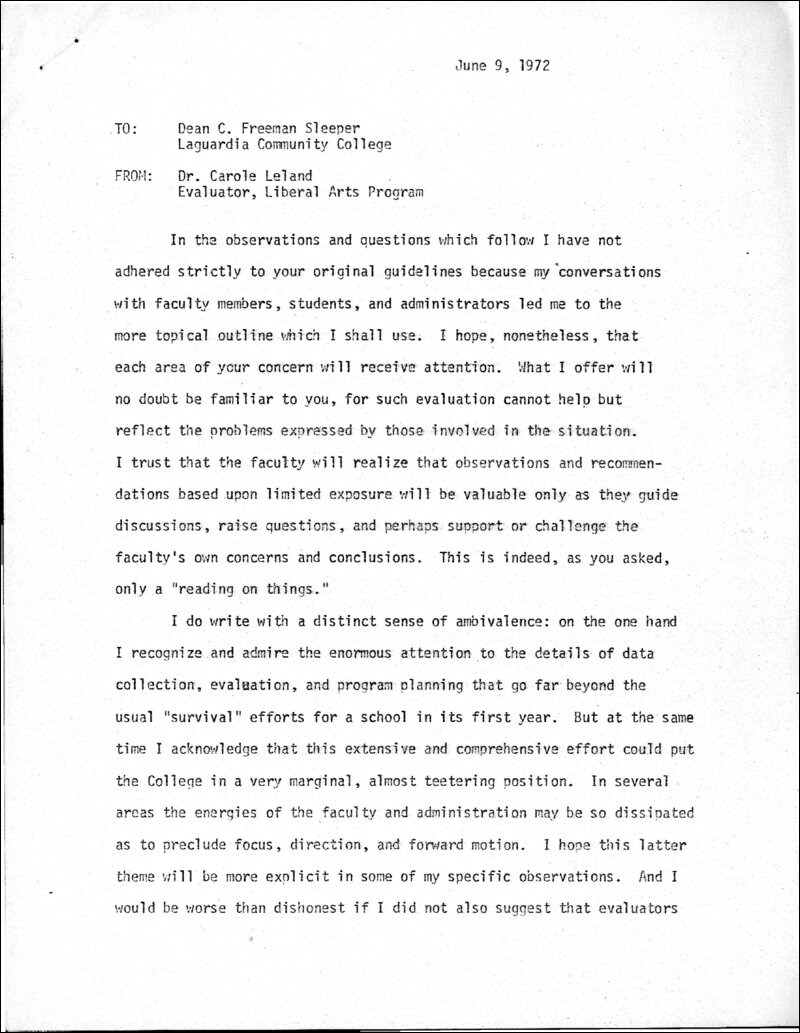
June 9, 1972
TO: Dean C. Freeman Sleeper
Laguardia Community College
FROM: Dr. Carole Leland
Evaluator, Liberal Arts Program
In the observations and questions which follow I have not
adhered strictly to your original guidelines because my conversations
with faculty members, students, and administrators led me to the
more topical outline which I shall use. I hope, nonetheless, that
each area of your concern will receive attention. What I offer will
no doubt be familiar to you, for such evaluation cannot help but
reflect the problems expressed by those involved in the situation.
I trust that the facutty will realize that observations and recommen-
dations based upon limited exposure will be valuable only as they guide
discussions, raise questions, and perhaps. support or challenge the
faculty's own concerns and conclusions. This is indeed, as you asked,
only a "reading on things.”
I do write with a distinct sense of amodivalence: on the one hand
I recognize and admire the enormous attention to the details of data
collection, evaluation, and program planning that go far beyond the
usual "survival" efforts for a school in its first year. But at the same
time I acknowledge that this extensive and comprehensive effort could put
the College in a very marginal, almost teetering position. In several
areas the energies of the faculty and administration may be so dissipated
as to preclude focus, direction, and forward motion. I hone tnis latter
theme will be more explicit in some of my specific observations. And I
would be worse than dishonest if I did not also suqgest that evaluators
29
always seem to emphasize negative or questionable aspects of their
observations and seidom balance those with positive comments. I, too,
have erred in this direction but am well aware of the great strides
this College has made in an incredibly short time.
I. SOME GENERAL OBSERVATIONS
1. Educational atmosphere. I was struck by the lack of a clear sense
of what distinguishes the college from a high school. Students called
attention to this question in particular, speaking of the faculty's desire
to keep them in the “high school mold,” and I wonder if the faculty should spend
some time in trying to develop some symbols of a college. learning environ-
ment? As I shall no doubt suggest in other areas, there seems to be an
enormous effort to make students feel comfortable, even at times entertained.
But I frankly was not conscious of efforts that would-create some intellectual
or cultural influences beyond specific classroom contacts. This may stem
from what also appears to be limited faculty contact among themselves,
and it is also linked to standards and expectations for performance which I
shall refer to later. In essence the advertised "distinctive educational
atmosphere" needs clarity and specificity. What is it that the faculty
wish to create? In an effort not to impose upon the youth culture the faculty
may not be taking seriously the necessity for leading students to some higher
level of intellectual and cultural sophistication which befits a college.
2. Academic goals. The literature of the Colleae states quite clearly
the commitment to an urban, interdisciplinary, "total learning experience"
curriculum. While the goals may be clearly stated I am not sure the faculty
have accepted or internalized them in a way to make them genuine. For
-3-
example, there are courses which constitute the “urban core" but I do
not find expression from either students or faculty members that such a
focus pervades the College. Nor does the interdisciplinary emphasis
seem distinct or near its full potential. The faculty a need some con-
tinuous sessions to talk and re-think the implications of these commitments.
Certainly care should be exercised not to slip back into a completely
traditional emphasis before some honest experimentation along the stated
directions takes place over some defined periods of time.
3. Curriculum development. Understandably in a first year curriculum
development may in some cases be hap-hazard and unfocused. The vehicle of
a curriculum committee may help considerably. But there are some dis-
concerting signals: the interdisciplinary focus is missing in some areas,
particularly social science, and to a degree in humanities. And already
there loom large the possibilities for a proliferation of basic courses
and intensives, in the former case very distinctly discipline-based and in
the latter, unrelated to previous offerings. While I agree with the notion
of options and alternatives, course offerings, it seems to me, have to have
some inherent relationships with the goals of the College and the directions
set for the divisions. It is clear that within and across divisions the
faculty (and students) need to engage in more thorough and focused curri-
culum planning. I see only one area where that seems to be clearly happening:
mathematics.
4. Cooperative education. From the standpoint of the academic prograr
much can and should be done to integrate the cooperative work aspects of
the College with a student's academic program. In some instances, foreign
languages for example, the faculty recognize the problem and are working
at it. I should think it would have a high priority among the faculty
since this concern offers much to them in the way of curriculum planning.
There need to be vehicles for more systematic feedback concerning work
experiences; faculty may need to be more involved in orienting students to
work and to the values to be derived from their experiences; and they may
need to take a greater hand in helping to find suitable work placements,
as several faculty members are now doing. The concern here is to find more
links between these two areas of a student's experience, for at the moment,
they appear headed in somewhat separate directions. I think much can be
gained if more connections can be identified on more than a chance basis.
5. Evaluation. While I appreciate what is so rarely found, great concern
for evaluating students, faculty, and activities, I cannot help but offer
a caution: the saturation point does come and a balance has to be achieved
which allows for thoughtful planning and change without smothering creativity.
There is already some suqgestion that the College is reaching that saturation
point, and in so short a time there does need to be a period to allow courses
and structures to take on some shape before they are altered. Otherwise too
much or premature evaluation leads to superficial solutions and adjustments.
As with curriculum development there may be some wisdom in slowing down.
What may also be needed are some different approaches: faculty members need
to talk more together in sessions which have an evaluative focus; reports
and data should continue to be churned out but with a commitment to analyze
them and to follow through with some implications for the curriculum and
teaching procedures; more refined evaluation procedures need to be developed
-5-
such as focused interviews with students and faculty members, group dis-
cussions, and observations which might be conducted by graduate or even
undergraduate students from other institutions. And perhaps the most im-
portant aspect to further evaluation is to develop some basic standards
of success and performance for individual areas where that has not been done.
6. Standards and expectations of performance. In its planning for curricula,
and in data collection, the College shows genuine concern for "where the
student is," and for realistic assessments of student canacities. In some
areas there are definite efforts to sort out the student's previous achieve-
ment, such as communication skills. But such assessments may also be leading
faculty to lower their expectations of student performance, with insufficient
attention to the question of “where the student should be." With strong
efforts to motivate students and to create pleasant relationships, the faculty
may in some instances be neglecting their responsibility to challenge students
and to expose the reality that learning is not always pleasant and in most
cases is difficult. The students themselves express concern for low expecta-
tions and the lack of challenge in some of their classes. Certainly there
are vehicles to conceptual learning (in literature for example) which are
not purely indulgences for adolescent interests and values. But, however,
true as that may be, there still is the necessity for setting standards which
are flexible and geared toward challenge and the honest difficulty of intel-
lectual effort. To sort out students for whom the challenge and effort
can be greater isn't always easy, but once accomplished it leads to the
possibilities of independent study and student leadership in the academic
program, two promises which now seem unfulfilled.
26-
7. Time. The use of time within the College needs some attention. The
faculty obviously need more time to meet together, formally and informally,
to plan and to share insights. The College needs to take more time in
allowing some offerings and programs to develop and alter within themselves
before they are subjected to extensive external evaluation. And the faculty
need to consider the best uses of time within the instructional program. My
observation is that the 70 minute period, in many cases, is being used
wastefully for lectures and depositing factual information, while violating
what we know about the attention span of even highly verbal students. There
need to be some exnerimental efforts to use time more wisely, freeing faculty
for planning and work with individual students, and giving students more
challenges to learn concepts and skills on their own initiative.
8. Quarter system. ‘hile the shortened period of the quarter system does
place heavy burdens on students and faculty alike, the complaints in this
area may again signal a teaching and learning problem. If the emphasis is
put upon material to be covered, with the student as receptacle, rather than
upon developing "disciplined thought" and the techniques and curiosity of
the independent learner, then indeed the quarter system frustrates its par-
ticipants. But this relates again to an adjustment to new circumstances
which takes time, and to a re-thinking of the best use of time itself in
relation to cleafly conceived objectives and expectations of success.
9. The student situation. Though this admittedly is not a direct dimension
of the academic program, my experiences provoke some comment about students
and their status at Laguardia. I have already referred to the suggestion
which students make about their “high school mold" and my own inability to
recognize differences at Laguardia between high schol and college-level
-7-
performance and atmosphere. But I would add to this my feeling that
students are still considered receptacles for information and that the
promise of "student leadership and peer influence" in the academic program
has not been explored, let along fulfilled. More devastating, to me at
least, is my nint of a condescending, patronizing attitude toward students.
For example, on the evaluation forms students are told, “You are being
asked to do a serious and responsible task" as if suddenly they were in-
structed to act like adults, not children. As a student I would find that
insulting. My suggestion is that in the haste and intensity of program
development the students have been considered mostly in a statistical way.
They are a known quantitative category but otherwise are almost rejected.
They serve on few committees, have relatively few outside classromm con-
tacts with faculty, and are not truly involved in curriculum planning.
Their image is more of “youngsters” as one faculty member boldly tabs them,
which in effect may become a self-fulfilling hypothesis. The faculty
appear to have few opportunities to know the students--their interests and
abilities--except through tests and the other performance scores available.
And for the students rewards seem hard to come by--they are picked up for
errors, tabbed for less-than-average abilities, condemned by lack of .atten-
dance, but in fact, how are they rewarded? I would suagest that the faculty
admit its collective ignorance about students and begin to share in small
focused sessions its insights about their interests, impediments, motivations
et al., in an effort to move from shaky assumptions to evidence and the
involvement of students in planning and evaluation. However well faculty
and administrators describe students, I found a lack of prominence of stu-
dent needs and capacities inherent in program and faculty planning activities.
-8-
10. Intensives. Clearly this ts a high priority item for all at the
College. Nothing at the moment so well embodies the College's central
commitments to the urban setting, to interdisciplinary focuses, and to
the cooperative work program. And certainly it is too soon to judge
the value of the intensives in any stay-or-go fashion. But the problems
and concerns are clear: first, the faculty need to clarify their commit-
ment and values vis-a-vis the intensives. Obviously they generate in-
terest and involvement for both faculty and students. But the faculty
must ask soon whether the intensives are vaguely tickling or genuinely
helding students in terms of learning. And there are inherent dangers
that the intensives will be considered separate and subject to different
evaluation than other courses. It seems important at this juncture not
to solidify or rigidify the format; there should be some flexibility and
experimentation that allows teachers to work with different pertods of
intensity, different forms of follow-up activities, and different possi-
bilities for individual and group projects. And curiously, in describing
the intensives as "different modes of learning than the ordinary schedule"
I am provoked to ask why and how such new modes should be isolated from
the main stream of basic courses and requirements? How do the strengths
and weaknesses of the intensives get fed into the regular college courses
and teaching methodologies?
I think the intensives face the danger of endless proliferation--
reducing the chances to experiment and evaluate the same course over a series
of offerings and with a variety of students--or they can rigidify in their
present and seemingly unquestioned format without benefit of other experi-
feeling i
ments or trials. There is a distinct/ that one week of intensive work serves
-9-
well as a motivational device for both students and faculty members, but
to sustain the interest and involvement is also crucial. The methodology
in at least some intensives is academically questionable if not down right
suspect. If in the students' terms the "teacher makes or breaks" the in-
tensive this may say little for the learning inherent in the scheme. And
it is quite obvious that students need clarity about their performance:
wnat standards should they follow in research projects? What is good and
what is bad in terms of expected performance? Unfortunately I did not find
such structure and standards buried beneath the glitter and enthusiasm of
"relevant" topics. In sum, I am trying to suggest that this feature of
the College is sufficiently promising and enough unique to warrant. better
performance on the part of faculty and more serious attention to modifications.
11. Teaching methodology and professional development. While this is an
area too complex and important to toy with lightly I cannot resist some
observations and questions. I have already suggested my concern about the
inappropriate expenditure of time. Here I raise the question of the College's
commitment to the "wide range of teaching techniques" stated in its plans
and literature. Again, there is the question of marginality: whether the
use of technological devices and sophisticated techniques will teeter toward
gimmickry or will be integrated seneinatacied effectively into learning
experiences. The wide range of teaching techniques is not now inescapably
visible. Such things as independent study, crucial in a population such
as Laguardia's, peer teaching, research projects, and team teaching, as
_ described in the Master Plan, are hard to identify.
Tnouch limited, my exposure to class situations provokes other
concerns: are the faculty providing materials that are honestly relevant to
-10-
student interests and experiences? I suggest that the faculty need more
contact and exposure outside the classroom to make such connections with
students (for example, which works of literature or which topics in science
best lead students to discuss and question societal values and emphases?).
What materials could be programmed for individual study, or handed out for
discussion or put on audio-visual equipment in order to break up the tedium
of a 70 minute lecture? How good is student note taking, of what value te
the student, and how can a teacher check such efforts and quide them? And
how can the faculty engage students in developing curricular emphases and
arrangements? How can a teacher avoid, as I witnessed, negative retorts to
student answers or questions and instead move from such responses to some
nasitive corrective influence?
Many. teachers may be duplicating class and text materials, may also
be neglecting the development of skills of inquiry such as synthesis, analysis,
or perspective. Worse, they may be serving as distinctly negative models
themselves. (I heard one teacher say "you know". and "like" at least a dozen
times in one period, and in another class a teacher accepted a verbal report
without any clear evaluation for the methods of inquiry being used.) And
finally, in terms of structure and methodology, the College has not seemed to
use models of successful programs, such as mathematics and linctinees': which
might offer insights to other areas of the College. The quest for professional
development is recognizable within the administration and with some faculty,
but my impression is that the faculty have found most comfort in traditional
lecture-based methods.
12. Learning. In my limited observations the one question which plagued
me, for which I could find no ready response, was "What are the students
-11-
really learning?" I find it a most compelling auestion for it cannot
evade the focus on goals and objectives to which I have already referred.
At some point the faculty may wish to rest on some qualitative assessments --
their own, or perhaps something like the College-Level Examination Program--
in order to get some comparative data with the populations like Laguardia's.
Again, the question begs attention to the faculty's individual and collective
definitions of performance and success for their students. I could honestly
not find entree into so crucial a question. Even when teachers seem emo-
tionally and energetically involved in their classes, I could not be sure
of the intellectual or conceptual progress they expected or achieved. Arduous
as it may be, I hope this will be a hich priority for the faculty's concern.
IIT. MORE SPECIFIC REACTION WITHIN THE LIBERAL ARTS
1. Liberal arts. Again, I question whether the faculty have some clarity
about what the liberal arts are and what their function is at Laguardia?
I think this needs some definition and understanding since presently it
appears, in the terms of one faculty member as an “entity” with no way
of seeing how it fits the College. In terms of atmosphere and emphasis,
i. e., in relation to my earlier point about college-level expectatians,
and an intellectual or cultural climate, the College could explore other
avenues such as lecture series, displays, films etc., to underscore the
role of the liberal arts in society.
2. Social sciences. The trend in the division to separate disciplinary
emphases is dangerous, unnecessary, and possibly detrimental to the College's
goals. There is a substantial opportunity to combine the skills of the
social sciences with the urban and interdisciplinary thrust of the institution.
The College cannot afford to proliferate courses, as is now the tendency,
-12-
without some integrated objectives which center on the skills and
techniques of the social sciences and their relevance to social problems.
In effect the social sciences need to re-think their goals and emnnases
and to guard against offering too many courses at the expense of not
repeating, evaluating, and perfecting their offerings over a specified
period of time. While the social science electives fit the urban core
focus they also are nighly specialized and not necessarily related enough
to offer students some consistent and comprehensive exposure to the fields
included in the division. Perhaps no other division has the inherent
structure from which to evolve the “inter-disciplinary conceptual base”
to which the College is committed, but at present that is not being realized.
3. Language and culture. My impression is that the language program is
developing into a major resource for the College with carefully conceived
methodologies and strong commitments to integration across disciplines and
with the cooperative program. And since the communication skills have
had separate evaluation I could offer no better observation. But, I will
suggest that the cultural emphasis within the humanities should provoke
more than passing interest, that is only the development of intensives.
In this area the urban emphasis is relatively minor, and the interdisiciplinary
possibilities may not have been fully explored. I had admittedly minor con-
tact with the division but I would expect that it would take on a more
experimental, interdisciplinary focus. At the moment preoccupation with
skill development may legitimately preclude that.
4. Mathematics and science. I have suggested earlier my impression that
the mathematics curricula are being developed with sound philosophy, clear
-13-
objectives, distinct approaches which reflect a commitment to Jearning
by doing and laboratory experience, and support for individual learning
through tutorials, faculty contact, and lab experimentation. At present
this program is exemplary in the College and should be used in some way
to help guide other efforts at curriculum development. It combines
beautifully the sense of reality about. students with a flexible, expan-
sive level of expectation.
The sciences, however, are another but no less important matter.
Perhaps not necessarily a fault, the sciences now appear to be the most
traditional and perhaps the most inadequate area in the liberal arts,
mainly because they do not have sufficient laboratories. . The use of
class time may also be questionable, for some materials now presented
would obviously lend themselves best to programmed instruction. Students
need the motivation of topical emphases rather than textbook chronology.
And in the sciences is a vivid example of how much better the intensives
serve the students than the basic courses. Tne successful topics and
methods of the intensives should certainly be incorporated into the latter.
The College needs little justification for attending to this area: the
sciences are so obviously crucial to understanding the problems. and: their
solutions within an urban setting. But at Laguardia the sciences seem
. pitifully peripheral, doubtfully adequate or relevant. My own recommendation
would be to give this area some priority, to study develonments at other
schools (probably no area is receiving more attention in a number of schools),
especially those directed at courses for non-science majors, and to use
the services of a qualified consultant in this area to help define the
directions it might take within the thrust of the College.
5. Library. I would be remiss not to suggest that even in these early
-]4-
stages the library begins to shape up as a strong resource for the College
and for the Liberal Arts. It is too soon to make other observations but
my guess is that the facilities will continue to support more than adequately
the academic program.
IIT. SUMMARY .
In essence I am calling attention to the heavy burden upon the
faculty to address itself to some difficult academic concerns: the
educational, cultural, intellectual climate of the College; standards
and expectations of performance and success; the integration of the
academic and cooperative programs; and attention to the goals and objec-
tives that lead to an independent learner and resourceful student. Further,
I am asking what students at Laguardia are actually learning and whether
such learning fits the college-level expectations of the faculty.
I have tried to suggest that in this limited time the promise of
the urban focus, interdisciplinary emphases, and technological developments
in teaching, has been approached but not fully planned nor realized.
Faculty involvement in setting goals and standards is crucial to the College's
stability and identity.
Finally, I have given some cautions about time, evaluation, and
methodology which should suggest to the faculty a need for focus, planning,
experimentation, and ultimate reassessment of directions and commitments.
I have emphasized the necessity for communicating with and understanding
students and for the importance of modeling behavior for them in order to
interpret the College's goals and translate those goals into legitimate
actions.
If Laguardia teeters it is understandable for its burdens have been
-15-
heavy and shifting. But the real test is whether it will choose to
build some stability without stifling its passion for innovation and
uniqueness. The balance required is clear and the faculty will need to
invest much energy and intelligence to achieve it.
TO: Dean C. Freeman Sleeper
Laguardia Community College
FROM: Dr. Carole Leland
Evaluator, Liberal Arts Program
In the observations and questions which follow I have not
adhered strictly to your original guidelines because my conversations
with faculty members, students, and administrators led me to the
more topical outline which I shall use. I hope, nonetheless, that
each area of your concern will receive attention. What I offer will
no doubt be familiar to you, for such evaluation cannot help but
reflect the problems expressed by those involved in the situation.
I trust that the facutty will realize that observations and recommen-
dations based upon limited exposure will be valuable only as they guide
discussions, raise questions, and perhaps. support or challenge the
faculty's own concerns and conclusions. This is indeed, as you asked,
only a "reading on things.”
I do write with a distinct sense of amodivalence: on the one hand
I recognize and admire the enormous attention to the details of data
collection, evaluation, and program planning that go far beyond the
usual "survival" efforts for a school in its first year. But at the same
time I acknowledge that this extensive and comprehensive effort could put
the College in a very marginal, almost teetering position. In several
areas the energies of the faculty and administration may be so dissipated
as to preclude focus, direction, and forward motion. I hone tnis latter
theme will be more explicit in some of my specific observations. And I
would be worse than dishonest if I did not also suqgest that evaluators
29
always seem to emphasize negative or questionable aspects of their
observations and seidom balance those with positive comments. I, too,
have erred in this direction but am well aware of the great strides
this College has made in an incredibly short time.
I. SOME GENERAL OBSERVATIONS
1. Educational atmosphere. I was struck by the lack of a clear sense
of what distinguishes the college from a high school. Students called
attention to this question in particular, speaking of the faculty's desire
to keep them in the “high school mold,” and I wonder if the faculty should spend
some time in trying to develop some symbols of a college. learning environ-
ment? As I shall no doubt suggest in other areas, there seems to be an
enormous effort to make students feel comfortable, even at times entertained.
But I frankly was not conscious of efforts that would-create some intellectual
or cultural influences beyond specific classroom contacts. This may stem
from what also appears to be limited faculty contact among themselves,
and it is also linked to standards and expectations for performance which I
shall refer to later. In essence the advertised "distinctive educational
atmosphere" needs clarity and specificity. What is it that the faculty
wish to create? In an effort not to impose upon the youth culture the faculty
may not be taking seriously the necessity for leading students to some higher
level of intellectual and cultural sophistication which befits a college.
2. Academic goals. The literature of the Colleae states quite clearly
the commitment to an urban, interdisciplinary, "total learning experience"
curriculum. While the goals may be clearly stated I am not sure the faculty
have accepted or internalized them in a way to make them genuine. For
-3-
example, there are courses which constitute the “urban core" but I do
not find expression from either students or faculty members that such a
focus pervades the College. Nor does the interdisciplinary emphasis
seem distinct or near its full potential. The faculty a need some con-
tinuous sessions to talk and re-think the implications of these commitments.
Certainly care should be exercised not to slip back into a completely
traditional emphasis before some honest experimentation along the stated
directions takes place over some defined periods of time.
3. Curriculum development. Understandably in a first year curriculum
development may in some cases be hap-hazard and unfocused. The vehicle of
a curriculum committee may help considerably. But there are some dis-
concerting signals: the interdisciplinary focus is missing in some areas,
particularly social science, and to a degree in humanities. And already
there loom large the possibilities for a proliferation of basic courses
and intensives, in the former case very distinctly discipline-based and in
the latter, unrelated to previous offerings. While I agree with the notion
of options and alternatives, course offerings, it seems to me, have to have
some inherent relationships with the goals of the College and the directions
set for the divisions. It is clear that within and across divisions the
faculty (and students) need to engage in more thorough and focused curri-
culum planning. I see only one area where that seems to be clearly happening:
mathematics.
4. Cooperative education. From the standpoint of the academic prograr
much can and should be done to integrate the cooperative work aspects of
the College with a student's academic program. In some instances, foreign
languages for example, the faculty recognize the problem and are working
at it. I should think it would have a high priority among the faculty
since this concern offers much to them in the way of curriculum planning.
There need to be vehicles for more systematic feedback concerning work
experiences; faculty may need to be more involved in orienting students to
work and to the values to be derived from their experiences; and they may
need to take a greater hand in helping to find suitable work placements,
as several faculty members are now doing. The concern here is to find more
links between these two areas of a student's experience, for at the moment,
they appear headed in somewhat separate directions. I think much can be
gained if more connections can be identified on more than a chance basis.
5. Evaluation. While I appreciate what is so rarely found, great concern
for evaluating students, faculty, and activities, I cannot help but offer
a caution: the saturation point does come and a balance has to be achieved
which allows for thoughtful planning and change without smothering creativity.
There is already some suqgestion that the College is reaching that saturation
point, and in so short a time there does need to be a period to allow courses
and structures to take on some shape before they are altered. Otherwise too
much or premature evaluation leads to superficial solutions and adjustments.
As with curriculum development there may be some wisdom in slowing down.
What may also be needed are some different approaches: faculty members need
to talk more together in sessions which have an evaluative focus; reports
and data should continue to be churned out but with a commitment to analyze
them and to follow through with some implications for the curriculum and
teaching procedures; more refined evaluation procedures need to be developed
-5-
such as focused interviews with students and faculty members, group dis-
cussions, and observations which might be conducted by graduate or even
undergraduate students from other institutions. And perhaps the most im-
portant aspect to further evaluation is to develop some basic standards
of success and performance for individual areas where that has not been done.
6. Standards and expectations of performance. In its planning for curricula,
and in data collection, the College shows genuine concern for "where the
student is," and for realistic assessments of student canacities. In some
areas there are definite efforts to sort out the student's previous achieve-
ment, such as communication skills. But such assessments may also be leading
faculty to lower their expectations of student performance, with insufficient
attention to the question of “where the student should be." With strong
efforts to motivate students and to create pleasant relationships, the faculty
may in some instances be neglecting their responsibility to challenge students
and to expose the reality that learning is not always pleasant and in most
cases is difficult. The students themselves express concern for low expecta-
tions and the lack of challenge in some of their classes. Certainly there
are vehicles to conceptual learning (in literature for example) which are
not purely indulgences for adolescent interests and values. But, however,
true as that may be, there still is the necessity for setting standards which
are flexible and geared toward challenge and the honest difficulty of intel-
lectual effort. To sort out students for whom the challenge and effort
can be greater isn't always easy, but once accomplished it leads to the
possibilities of independent study and student leadership in the academic
program, two promises which now seem unfulfilled.
26-
7. Time. The use of time within the College needs some attention. The
faculty obviously need more time to meet together, formally and informally,
to plan and to share insights. The College needs to take more time in
allowing some offerings and programs to develop and alter within themselves
before they are subjected to extensive external evaluation. And the faculty
need to consider the best uses of time within the instructional program. My
observation is that the 70 minute period, in many cases, is being used
wastefully for lectures and depositing factual information, while violating
what we know about the attention span of even highly verbal students. There
need to be some exnerimental efforts to use time more wisely, freeing faculty
for planning and work with individual students, and giving students more
challenges to learn concepts and skills on their own initiative.
8. Quarter system. ‘hile the shortened period of the quarter system does
place heavy burdens on students and faculty alike, the complaints in this
area may again signal a teaching and learning problem. If the emphasis is
put upon material to be covered, with the student as receptacle, rather than
upon developing "disciplined thought" and the techniques and curiosity of
the independent learner, then indeed the quarter system frustrates its par-
ticipants. But this relates again to an adjustment to new circumstances
which takes time, and to a re-thinking of the best use of time itself in
relation to cleafly conceived objectives and expectations of success.
9. The student situation. Though this admittedly is not a direct dimension
of the academic program, my experiences provoke some comment about students
and their status at Laguardia. I have already referred to the suggestion
which students make about their “high school mold" and my own inability to
recognize differences at Laguardia between high schol and college-level
-7-
performance and atmosphere. But I would add to this my feeling that
students are still considered receptacles for information and that the
promise of "student leadership and peer influence" in the academic program
has not been explored, let along fulfilled. More devastating, to me at
least, is my nint of a condescending, patronizing attitude toward students.
For example, on the evaluation forms students are told, “You are being
asked to do a serious and responsible task" as if suddenly they were in-
structed to act like adults, not children. As a student I would find that
insulting. My suggestion is that in the haste and intensity of program
development the students have been considered mostly in a statistical way.
They are a known quantitative category but otherwise are almost rejected.
They serve on few committees, have relatively few outside classromm con-
tacts with faculty, and are not truly involved in curriculum planning.
Their image is more of “youngsters” as one faculty member boldly tabs them,
which in effect may become a self-fulfilling hypothesis. The faculty
appear to have few opportunities to know the students--their interests and
abilities--except through tests and the other performance scores available.
And for the students rewards seem hard to come by--they are picked up for
errors, tabbed for less-than-average abilities, condemned by lack of .atten-
dance, but in fact, how are they rewarded? I would suagest that the faculty
admit its collective ignorance about students and begin to share in small
focused sessions its insights about their interests, impediments, motivations
et al., in an effort to move from shaky assumptions to evidence and the
involvement of students in planning and evaluation. However well faculty
and administrators describe students, I found a lack of prominence of stu-
dent needs and capacities inherent in program and faculty planning activities.
-8-
10. Intensives. Clearly this ts a high priority item for all at the
College. Nothing at the moment so well embodies the College's central
commitments to the urban setting, to interdisciplinary focuses, and to
the cooperative work program. And certainly it is too soon to judge
the value of the intensives in any stay-or-go fashion. But the problems
and concerns are clear: first, the faculty need to clarify their commit-
ment and values vis-a-vis the intensives. Obviously they generate in-
terest and involvement for both faculty and students. But the faculty
must ask soon whether the intensives are vaguely tickling or genuinely
helding students in terms of learning. And there are inherent dangers
that the intensives will be considered separate and subject to different
evaluation than other courses. It seems important at this juncture not
to solidify or rigidify the format; there should be some flexibility and
experimentation that allows teachers to work with different pertods of
intensity, different forms of follow-up activities, and different possi-
bilities for individual and group projects. And curiously, in describing
the intensives as "different modes of learning than the ordinary schedule"
I am provoked to ask why and how such new modes should be isolated from
the main stream of basic courses and requirements? How do the strengths
and weaknesses of the intensives get fed into the regular college courses
and teaching methodologies?
I think the intensives face the danger of endless proliferation--
reducing the chances to experiment and evaluate the same course over a series
of offerings and with a variety of students--or they can rigidify in their
present and seemingly unquestioned format without benefit of other experi-
feeling i
ments or trials. There is a distinct/ that one week of intensive work serves
-9-
well as a motivational device for both students and faculty members, but
to sustain the interest and involvement is also crucial. The methodology
in at least some intensives is academically questionable if not down right
suspect. If in the students' terms the "teacher makes or breaks" the in-
tensive this may say little for the learning inherent in the scheme. And
it is quite obvious that students need clarity about their performance:
wnat standards should they follow in research projects? What is good and
what is bad in terms of expected performance? Unfortunately I did not find
such structure and standards buried beneath the glitter and enthusiasm of
"relevant" topics. In sum, I am trying to suggest that this feature of
the College is sufficiently promising and enough unique to warrant. better
performance on the part of faculty and more serious attention to modifications.
11. Teaching methodology and professional development. While this is an
area too complex and important to toy with lightly I cannot resist some
observations and questions. I have already suggested my concern about the
inappropriate expenditure of time. Here I raise the question of the College's
commitment to the "wide range of teaching techniques" stated in its plans
and literature. Again, there is the question of marginality: whether the
use of technological devices and sophisticated techniques will teeter toward
gimmickry or will be integrated seneinatacied effectively into learning
experiences. The wide range of teaching techniques is not now inescapably
visible. Such things as independent study, crucial in a population such
as Laguardia's, peer teaching, research projects, and team teaching, as
_ described in the Master Plan, are hard to identify.
Tnouch limited, my exposure to class situations provokes other
concerns: are the faculty providing materials that are honestly relevant to
-10-
student interests and experiences? I suggest that the faculty need more
contact and exposure outside the classroom to make such connections with
students (for example, which works of literature or which topics in science
best lead students to discuss and question societal values and emphases?).
What materials could be programmed for individual study, or handed out for
discussion or put on audio-visual equipment in order to break up the tedium
of a 70 minute lecture? How good is student note taking, of what value te
the student, and how can a teacher check such efforts and quide them? And
how can the faculty engage students in developing curricular emphases and
arrangements? How can a teacher avoid, as I witnessed, negative retorts to
student answers or questions and instead move from such responses to some
nasitive corrective influence?
Many. teachers may be duplicating class and text materials, may also
be neglecting the development of skills of inquiry such as synthesis, analysis,
or perspective. Worse, they may be serving as distinctly negative models
themselves. (I heard one teacher say "you know". and "like" at least a dozen
times in one period, and in another class a teacher accepted a verbal report
without any clear evaluation for the methods of inquiry being used.) And
finally, in terms of structure and methodology, the College has not seemed to
use models of successful programs, such as mathematics and linctinees': which
might offer insights to other areas of the College. The quest for professional
development is recognizable within the administration and with some faculty,
but my impression is that the faculty have found most comfort in traditional
lecture-based methods.
12. Learning. In my limited observations the one question which plagued
me, for which I could find no ready response, was "What are the students
-11-
really learning?" I find it a most compelling auestion for it cannot
evade the focus on goals and objectives to which I have already referred.
At some point the faculty may wish to rest on some qualitative assessments --
their own, or perhaps something like the College-Level Examination Program--
in order to get some comparative data with the populations like Laguardia's.
Again, the question begs attention to the faculty's individual and collective
definitions of performance and success for their students. I could honestly
not find entree into so crucial a question. Even when teachers seem emo-
tionally and energetically involved in their classes, I could not be sure
of the intellectual or conceptual progress they expected or achieved. Arduous
as it may be, I hope this will be a hich priority for the faculty's concern.
IIT. MORE SPECIFIC REACTION WITHIN THE LIBERAL ARTS
1. Liberal arts. Again, I question whether the faculty have some clarity
about what the liberal arts are and what their function is at Laguardia?
I think this needs some definition and understanding since presently it
appears, in the terms of one faculty member as an “entity” with no way
of seeing how it fits the College. In terms of atmosphere and emphasis,
i. e., in relation to my earlier point about college-level expectatians,
and an intellectual or cultural climate, the College could explore other
avenues such as lecture series, displays, films etc., to underscore the
role of the liberal arts in society.
2. Social sciences. The trend in the division to separate disciplinary
emphases is dangerous, unnecessary, and possibly detrimental to the College's
goals. There is a substantial opportunity to combine the skills of the
social sciences with the urban and interdisciplinary thrust of the institution.
The College cannot afford to proliferate courses, as is now the tendency,
-12-
without some integrated objectives which center on the skills and
techniques of the social sciences and their relevance to social problems.
In effect the social sciences need to re-think their goals and emnnases
and to guard against offering too many courses at the expense of not
repeating, evaluating, and perfecting their offerings over a specified
period of time. While the social science electives fit the urban core
focus they also are nighly specialized and not necessarily related enough
to offer students some consistent and comprehensive exposure to the fields
included in the division. Perhaps no other division has the inherent
structure from which to evolve the “inter-disciplinary conceptual base”
to which the College is committed, but at present that is not being realized.
3. Language and culture. My impression is that the language program is
developing into a major resource for the College with carefully conceived
methodologies and strong commitments to integration across disciplines and
with the cooperative program. And since the communication skills have
had separate evaluation I could offer no better observation. But, I will
suggest that the cultural emphasis within the humanities should provoke
more than passing interest, that is only the development of intensives.
In this area the urban emphasis is relatively minor, and the interdisiciplinary
possibilities may not have been fully explored. I had admittedly minor con-
tact with the division but I would expect that it would take on a more
experimental, interdisciplinary focus. At the moment preoccupation with
skill development may legitimately preclude that.
4. Mathematics and science. I have suggested earlier my impression that
the mathematics curricula are being developed with sound philosophy, clear
-13-
objectives, distinct approaches which reflect a commitment to Jearning
by doing and laboratory experience, and support for individual learning
through tutorials, faculty contact, and lab experimentation. At present
this program is exemplary in the College and should be used in some way
to help guide other efforts at curriculum development. It combines
beautifully the sense of reality about. students with a flexible, expan-
sive level of expectation.
The sciences, however, are another but no less important matter.
Perhaps not necessarily a fault, the sciences now appear to be the most
traditional and perhaps the most inadequate area in the liberal arts,
mainly because they do not have sufficient laboratories. . The use of
class time may also be questionable, for some materials now presented
would obviously lend themselves best to programmed instruction. Students
need the motivation of topical emphases rather than textbook chronology.
And in the sciences is a vivid example of how much better the intensives
serve the students than the basic courses. Tne successful topics and
methods of the intensives should certainly be incorporated into the latter.
The College needs little justification for attending to this area: the
sciences are so obviously crucial to understanding the problems. and: their
solutions within an urban setting. But at Laguardia the sciences seem
. pitifully peripheral, doubtfully adequate or relevant. My own recommendation
would be to give this area some priority, to study develonments at other
schools (probably no area is receiving more attention in a number of schools),
especially those directed at courses for non-science majors, and to use
the services of a qualified consultant in this area to help define the
directions it might take within the thrust of the College.
5. Library. I would be remiss not to suggest that even in these early
-]4-
stages the library begins to shape up as a strong resource for the College
and for the Liberal Arts. It is too soon to make other observations but
my guess is that the facilities will continue to support more than adequately
the academic program.
IIT. SUMMARY .
In essence I am calling attention to the heavy burden upon the
faculty to address itself to some difficult academic concerns: the
educational, cultural, intellectual climate of the College; standards
and expectations of performance and success; the integration of the
academic and cooperative programs; and attention to the goals and objec-
tives that lead to an independent learner and resourceful student. Further,
I am asking what students at Laguardia are actually learning and whether
such learning fits the college-level expectations of the faculty.
I have tried to suggest that in this limited time the promise of
the urban focus, interdisciplinary emphases, and technological developments
in teaching, has been approached but not fully planned nor realized.
Faculty involvement in setting goals and standards is crucial to the College's
stability and identity.
Finally, I have given some cautions about time, evaluation, and
methodology which should suggest to the faculty a need for focus, planning,
experimentation, and ultimate reassessment of directions and commitments.
I have emphasized the necessity for communicating with and understanding
students and for the importance of modeling behavior for them in order to
interpret the College's goals and translate those goals into legitimate
actions.
If Laguardia teeters it is understandable for its burdens have been
-15-
heavy and shifting. But the real test is whether it will choose to
build some stability without stifling its passion for innovation and
uniqueness. The balance required is clear and the faculty will need to
invest much energy and intelligence to achieve it.
Title
LaGuardia's Liberal Arts Program Evaluation, 1972
Description
Written at the close of LaGuardia Community College's first academic year, this assessment of the college provides a sobering account of the difficulties present at the school in its infancy. The report, written by Dr. Carole Leland, examines various aspects of the college (e.g. atmosphere, curriculum, teaching methodology, evaluation) and bases its findings on observations and interviews conducted on campus.
Contributor
Khan, Fern
Creator
Leland, Carole
Date
June 9, 1972
Language
English
Relation
2912
Rights
Obtained from Contributor - Copyright Unknown
Source
Khan, Fern
Original Format
Report / Paper / Proposal
Leland, Carole. Letter. “LaGuardia’s Liberal Arts Program Evaluation, 1972”. 2912, CUNY DIGITAL HISTORY ARCHIVE, accessed September 5, 2026, https://stephenz.tailc22a4b.ts.net/s/cdha/item/368