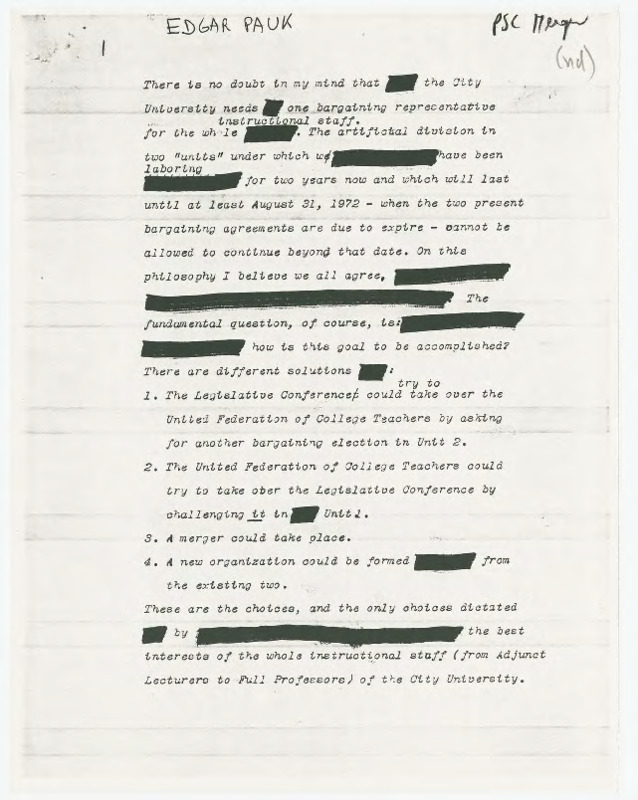
Edgar Pauk Statement on Union Merger
Item
~ EDGAR PAUK | (SC Mpg
Cre
There ts no doubt tn my mind that -_= the City
University needs one bargaining representative
é instruc nal staff.
for the whole . The arttfictal division in
two “units” under which wd have been
laboring
for two years now and which will last
unttl at least August 31, 1972 - when the two present
bargaining agreements are due to exptre - vannot be
allowed to continue beyong that date. On this
philosophy I belteve we all agree, meee
The
fundamental question, of course, ITS
ey how ts this goal to be accomplished?
There are different solutions
try to
1. The Legtslative Conferencep could take over the
Untted Federation of College Teachers by asking
for another bargaining election in Unit 2.
2. The United Federation of College Teachers could
try to take ober the Legislative Conference by
challenging tt inj Uniti.
3. A merger could take place.
4. A new organization could be jorned from
the extsttng two. .
These are the choices, and the only choices dictated
interests of the whole instructional staff (from Adjunct
Lecturers to Full Professors) of the City University.
Of the four posstbiltties, solutione 3 and 4 are, of
course, the most bloodless and should have the widest.
appeal. A& ta solution number 3, however, a merger
means thatcat best some compromise must be reached,
at worst that one organization ts_merged into the other.
Unfortunately, when the smoke of rhetoric ts cleared,
such merger does not seem acceptable to either organization,
at least at the present. But time ts of the essence if we
are gotng to make a common front against the Administratton,
tn time for the nest round of contract negotiattons.in
the Sunmer of 1972.
The sane considerations of time would seem to rule out
solution nunber 4, espectally in vtew of the national
affiltattons that both organizations have.
The chotce, when all is satd and done, comes down to this:
which of the two organizations has thé greatest potenttal
for becoming a ma :-.- spokesman for the whole
instructional staff of the City University in time for
(week
the 1972 contract negottations. Those of us
closely assoctated with the workings of the
bargatning agreements could not tgnore the
necesstty forc a chotce, since we are more than
of
A °<" what thts present diviston is
doing to the tnterests of the whole instructional
staff.
After serving fatthfully 1 Ea the faculty
of so-called "Unit 2" since the tnceptton of the Contract,
I have come to the coneluston that the United Federation
of College Teachers in the City University ts netther
healthy as an organization nor does it have the type
of 5 namely Dr. Israel Kugler, to restore it
to organtzattonal health. There are many reasons for
this situations reasons of which I becane slowly and
awar.
painful ae over the course of my involvement with
some
the organization, just as 707] ay
i othe ae:
SE" 6221202, before me and are realizting,at
race I have not come to this conclusion lightly,
even though it has always been my beltef that loyalty
to an organization
Po ees ee far less important than loyalty
to those prineoniae that nade lf Jotn the organization
tn the first placeff, Wendy the vigorous enforcement
of the rights of thea imisemuon total staff of the City
University.
I have, therefor, resigned my posttion and membership
in the Untted Federation of College Teachers ond iy
offered my services to the Legislative Conferencé, with
a view to having one bargaining agent for the whole
tnstructtonal staff in time for negottating a strong
contract tn 1972
As to the gallant members of the United Federation
of College Teachers ¥f vho fought so hard and
accomplished so auch despite
overwhelming odds, I trust they do understand id
wf my chotce and will follow thetr consciences in
reaching thetr own choice.
Mes QL
EDGa laa cies
| + = Tag ree
© Sra aerate atest
Cre
There ts no doubt tn my mind that -_= the City
University needs one bargaining representative
é instruc nal staff.
for the whole . The arttfictal division in
two “units” under which wd have been
laboring
for two years now and which will last
unttl at least August 31, 1972 - when the two present
bargaining agreements are due to exptre - vannot be
allowed to continue beyong that date. On this
philosophy I belteve we all agree, meee
The
fundamental question, of course, ITS
ey how ts this goal to be accomplished?
There are different solutions
try to
1. The Legtslative Conferencep could take over the
Untted Federation of College Teachers by asking
for another bargaining election in Unit 2.
2. The United Federation of College Teachers could
try to take ober the Legislative Conference by
challenging tt inj Uniti.
3. A merger could take place.
4. A new organization could be jorned from
the extsttng two. .
These are the choices, and the only choices dictated
interests of the whole instructional staff (from Adjunct
Lecturers to Full Professors) of the City University.
Of the four posstbiltties, solutione 3 and 4 are, of
course, the most bloodless and should have the widest.
appeal. A& ta solution number 3, however, a merger
means thatcat best some compromise must be reached,
at worst that one organization ts_merged into the other.
Unfortunately, when the smoke of rhetoric ts cleared,
such merger does not seem acceptable to either organization,
at least at the present. But time ts of the essence if we
are gotng to make a common front against the Administratton,
tn time for the nest round of contract negotiattons.in
the Sunmer of 1972.
The sane considerations of time would seem to rule out
solution nunber 4, espectally in vtew of the national
affiltattons that both organizations have.
The chotce, when all is satd and done, comes down to this:
which of the two organizations has thé greatest potenttal
for becoming a ma :-.- spokesman for the whole
instructional staff of the City University in time for
(week
the 1972 contract negottations. Those of us
closely assoctated with the workings of the
bargatning agreements could not tgnore the
necesstty forc a chotce, since we are more than
of
A °<" what thts present diviston is
doing to the tnterests of the whole instructional
staff.
After serving fatthfully 1 Ea the faculty
of so-called "Unit 2" since the tnceptton of the Contract,
I have come to the coneluston that the United Federation
of College Teachers in the City University ts netther
healthy as an organization nor does it have the type
of 5 namely Dr. Israel Kugler, to restore it
to organtzattonal health. There are many reasons for
this situations reasons of which I becane slowly and
awar.
painful ae over the course of my involvement with
some
the organization, just as 707] ay
i othe ae:
SE" 6221202, before me and are realizting,at
race I have not come to this conclusion lightly,
even though it has always been my beltef that loyalty
to an organization
Po ees ee far less important than loyalty
to those prineoniae that nade lf Jotn the organization
tn the first placeff, Wendy the vigorous enforcement
of the rights of thea imisemuon total staff of the City
University.
I have, therefor, resigned my posttion and membership
in the Untted Federation of College Teachers ond iy
offered my services to the Legislative Conferencé, with
a view to having one bargaining agent for the whole
tnstructtonal staff in time for negottating a strong
contract tn 1972
As to the gallant members of the United Federation
of College Teachers ¥f vho fought so hard and
accomplished so auch despite
overwhelming odds, I trust they do understand id
wf my chotce and will follow thetr consciences in
reaching thetr own choice.
Mes QL
EDGa laa cies
| + = Tag ree
© Sra aerate atest
Title
Edgar Pauk Statement on Union Merger
Description
In this draft document, Edgar Pauk, a lecturer at Queens College and vice president of the 4-year public college unit of the United Federation of College Teachers (UFCT), announces his break with the union's leader, Israel Kugler, stating that he had decided to leave the UFCT in favor of joining the rival Legislative Conference (LC). His statement speaks to many of the concerns facing the union at the time, particularly the need for a single bargaining unit for all of CUNY faculty and staff. Pauk is especially critical of both the UFCT as an organization and its leadership provided by Kugler.
Pauk would come to play an important role once the two unions decided upon a merger with the creation of the Professional Staff Congress (PSC) in April 1972. In the first election of the new union in 1973, Pauk decided to run for union presidency doing so against Belle Zeller, president of the LC, and also Israel Kugler, president of the UFCT. Pauk received a meager 321 votes in the election, however, the winner, Zeller, defeated runner-up Kugler by only 124 votes. Kugler would thereafter claim that most of Pauk’s votes came from those who otherwise would have supported him, and that without Pauk in the election, he would have won. Instead, the caucus led by Zeller and members of the former LC took control of the union in its early years. While Kugler's claims remain unproven, Pauk undoubtedly had a real impact on the election though such would forever remain the extent of his influence with the PSC.
Pauk would come to play an important role once the two unions decided upon a merger with the creation of the Professional Staff Congress (PSC) in April 1972. In the first election of the new union in 1973, Pauk decided to run for union presidency doing so against Belle Zeller, president of the LC, and also Israel Kugler, president of the UFCT. Pauk received a meager 321 votes in the election, however, the winner, Zeller, defeated runner-up Kugler by only 124 votes. Kugler would thereafter claim that most of Pauk’s votes came from those who otherwise would have supported him, and that without Pauk in the election, he would have won. Instead, the caucus led by Zeller and members of the former LC took control of the union in its early years. While Kugler's claims remain unproven, Pauk undoubtedly had a real impact on the election though such would forever remain the extent of his influence with the PSC.
Contributor
Professional Staff Congress
Creator
Pauk, Edgar
Date
1971 (Circa)
Language
English
Relation
4922
Rights
Obtained from Contributor - Copyright Unknown
Source
Robert F. Wagner Labor Archives
Original Format
Report / Paper / Proposal
Pauk, Edgar. Letter. 1971. “Edgar Pauk Statement on Union Merger”. 4922, 1971, CUNY DIGITAL HISTORY ARCHIVE, accessed September 5, 2026, https://stephenz.tailc22a4b.ts.net/s/cdha/item/768