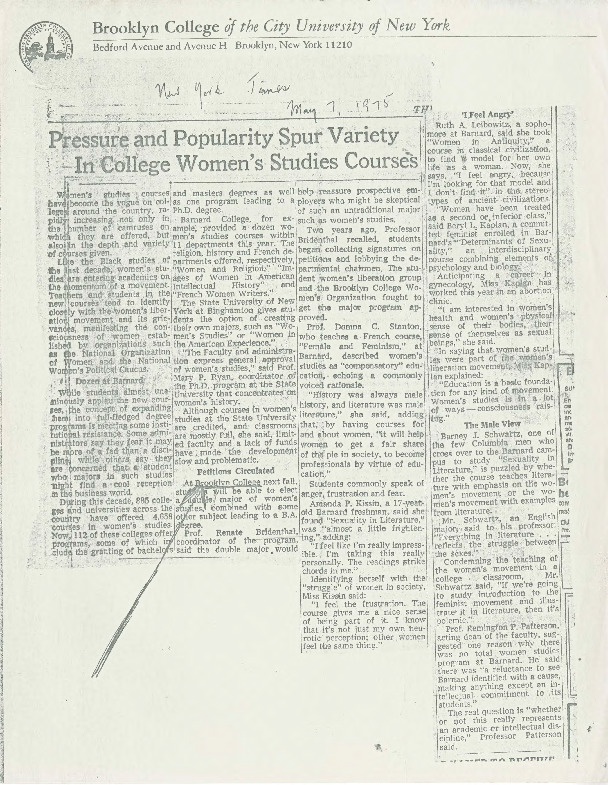
"Pressure and Popularity Spur Variety In College Women's Studies Courses"
Item
Brooklyn College of the City University of New York
Bedford Avenue and Avenue H_ Brooklyn, New York 11210
ie: ‘1.Feel Angry”
“Ruth A, Leibowitz, a sopho-
Pressure and Popularity Spur Variety _ [nys.t "atari
In College Women’s Studies Courses! ti» ml or, er ow
" wil WIsays, .‘1 feel angry, ‘because
-W men’s studies courses|and masters. degrees _as_well|help . I'm looking for that model and
-» fhavéibecome the vogue on‘col-las one Tea ending to alpl pareessure prospective, Ot: 41 don't: find -if, Mite the: stoned:
4 ‘around ‘the country, 1a-|Ph.D. degree. ployets who might be skeptical||types of ancient- civilizations.
pit incteasing. ,not: only in| Barnard Colle eae ae of, such an untraditional major||..““Women have been treated
« the Jhumber of’ camiruses | on|ample, provided Benet a (iucges women's sindies, as a second or, inferior class,”
which they. ere offered, butlmen’s studies courses. within Two years ago, Professor said Beryl L, Kaplan, a commit
alsoin the depth and yariety}11 departments this: year. The Bridenthal recalled, students ted’ feminist enrolled in| Bar-
y religion, history and French de-|began. collecting signatures on): Ba s*'Determinants of Sexu-
pactinents offered, respectively, petitions and lobbying the de- eee Ra eae guaalage
febaeey aus ‘Repo ein Pertinent ehmiemie, Te abe psychology and biology: ORE
“arailechiaic? «History; end dent women’s liberation group}| Anticipating a veareet'~: Jn
“French Women Writers.” and ithe Brooklyn College Wo-||eynecology, Miss’ Kenlin. has}
with aan State University of New men’s: Organization fought to}. Wpikes this year in an abortion}
atio movement and its grie- dents AED ott cena ae m3 JO8 RTO stam (AP heget am interested in wworten’s
vances, manifesting the con- heir own majors, such as “Wo. ‘I health and women’s © physical}:|
sciousness: of women estab-|men’s Studies” or “Women in Prof. Domna C. Stanton,||sense of their bodies, their
lished by organizations. such|the American Experience.” who teaches a. French course,||sense of themselves as sexual
as fhe National Organization) ° “The Faculty, and edministra-| Female and Feminism,” at beings,” she said.
. of Women. and: the: Nationalition express general a rovailBamerd, described women’s||; “In saying that-women’s stud-
Women’s Political Caucus. of women’s studies,” said Prof.|studies as “compensatory” igs. were part of the. semien's
{ 7 Rie ere »” S : ory” edu-} |) es i i
Mary P. Ryan, coordinator of cation, - Jiberation movement; Mi ‘Kapésly
ag OS Aine eg pa Biv A etiam dH reer oor a cea
voiced rationale. {| “Education is a basic founda-
‘gl tthe: ne "|University that concentrates on) © « rs
ate Ad teae a ite onere history! On| “History was always male tion for any kind of movernent. |
‘hen inte full-fh edged degree Although courses In women’s history, and literature was male| | Women’s studies is in @- lot
5 £Tee| studies at the State Universityjliterature,” she said, adding), of ways—consciousness rais-
| progtams:{s meeting some insti- ; % . %
oo pearl mieeraitle tn cate re, teresa, Meme, soe SO ae
| pistrators say they fear it.mayjeq faculty and’a lack of rales about women, “it will help} ‘parney J. Schwattz, one of
be more of-@ fad than a disci-have made the development women to get a fair share| |the few Columbla men who
pling erie ene slow and problematic. of the pie in society, to become} |cross over to the Barnard cam-
| Whalmajors in wich studies| Petitlons Circulated professionals by virtue of edu-||pus to study ort
Digah Sind. mveaal recenticn| next fall|" "students comm Literate) ee es era: =
} j business world. t @ able to elect s commonly speak of| ltr with emphasis on te wo-/Bt
Range ‘of women’s|*"8er, frustration and fear. men’s movement or the wo-
ies. combined with some Amanda P. Kissin, a 17-yeat-| |men’s moyement with examples be
other subject leading to a B.A.|ld Barnard freshman, said she) |from literature. » Hen
gree, found | Sexuality in Literature,” Mr. Schwartz, an English bibs
Prof. _ Renate Bridenthal,|was, “almost a little frighten- major;~said to.,his professor:
coordinator of the program, |!Mé adding: MEverything in literature. . -|oe
said the double major , would] _ ‘1 feel like I'm really impress- |. |reflec - the, aod
t. e 81
~_ Dpring this decade, 885 colle-ja
ges @nd universities across the
country ‘have ‘offered 4,658
~~ | -gourges:: in. women’s studies.
~) Now, 112.of these colleges offer,
ams, some of which i
+ chu 3 thé granting of bachelofs
ible. I’m taking this really} |th Le ee on
t je sexes. aA
aes Ne The readings strike Condemning the teaching of
s in me. the women’s movement in a
,_Wentifying herself with the] |college .', classroom, Mr.
neuen les of women in society,| |Schwartz said, “If we're going
ue See said: - to study introduction to the
i eel the frustration. The), |feminist ‘movement and _illus-
ourse gives me a mice sense) |trate it in literature, then it’s
of being part of it. I know) |polemic.”
that it's not just my own neu- Prof, Remington P. Patterson,
pane Aagted aa a other women| |acting dean of the faculty, sug-
‘eel the same thing. gested’ one reason whiy there] |
was no total women studies
|program at Barnard. He said
there was “a reluctance to see
Barnard identified with a cause,
making anything except an in-
+tellectual. commitment to its
.|students.” 7
The real question is “whether
or not this really represents
jan academic or intellectual dis- e
cipline,” Professor Patterson} } >
*, said.
soN mA RAITT
Bedford Avenue and Avenue H_ Brooklyn, New York 11210
ie: ‘1.Feel Angry”
“Ruth A, Leibowitz, a sopho-
Pressure and Popularity Spur Variety _ [nys.t "atari
In College Women’s Studies Courses! ti» ml or, er ow
" wil WIsays, .‘1 feel angry, ‘because
-W men’s studies courses|and masters. degrees _as_well|help . I'm looking for that model and
-» fhavéibecome the vogue on‘col-las one Tea ending to alpl pareessure prospective, Ot: 41 don't: find -if, Mite the: stoned:
4 ‘around ‘the country, 1a-|Ph.D. degree. ployets who might be skeptical||types of ancient- civilizations.
pit incteasing. ,not: only in| Barnard Colle eae ae of, such an untraditional major||..““Women have been treated
« the Jhumber of’ camiruses | on|ample, provided Benet a (iucges women's sindies, as a second or, inferior class,”
which they. ere offered, butlmen’s studies courses. within Two years ago, Professor said Beryl L, Kaplan, a commit
alsoin the depth and yariety}11 departments this: year. The Bridenthal recalled, students ted’ feminist enrolled in| Bar-
y religion, history and French de-|began. collecting signatures on): Ba s*'Determinants of Sexu-
pactinents offered, respectively, petitions and lobbying the de- eee Ra eae guaalage
febaeey aus ‘Repo ein Pertinent ehmiemie, Te abe psychology and biology: ORE
“arailechiaic? «History; end dent women’s liberation group}| Anticipating a veareet'~: Jn
“French Women Writers.” and ithe Brooklyn College Wo-||eynecology, Miss’ Kenlin. has}
with aan State University of New men’s: Organization fought to}. Wpikes this year in an abortion}
atio movement and its grie- dents AED ott cena ae m3 JO8 RTO stam (AP heget am interested in wworten’s
vances, manifesting the con- heir own majors, such as “Wo. ‘I health and women’s © physical}:|
sciousness: of women estab-|men’s Studies” or “Women in Prof. Domna C. Stanton,||sense of their bodies, their
lished by organizations. such|the American Experience.” who teaches a. French course,||sense of themselves as sexual
as fhe National Organization) ° “The Faculty, and edministra-| Female and Feminism,” at beings,” she said.
. of Women. and: the: Nationalition express general a rovailBamerd, described women’s||; “In saying that-women’s stud-
Women’s Political Caucus. of women’s studies,” said Prof.|studies as “compensatory” igs. were part of the. semien's
{ 7 Rie ere »” S : ory” edu-} |) es i i
Mary P. Ryan, coordinator of cation, - Jiberation movement; Mi ‘Kapésly
ag OS Aine eg pa Biv A etiam dH reer oor a cea
voiced rationale. {| “Education is a basic founda-
‘gl tthe: ne "|University that concentrates on) © « rs
ate Ad teae a ite onere history! On| “History was always male tion for any kind of movernent. |
‘hen inte full-fh edged degree Although courses In women’s history, and literature was male| | Women’s studies is in @- lot
5 £Tee| studies at the State Universityjliterature,” she said, adding), of ways—consciousness rais-
| progtams:{s meeting some insti- ; % . %
oo pearl mieeraitle tn cate re, teresa, Meme, soe SO ae
| pistrators say they fear it.mayjeq faculty and’a lack of rales about women, “it will help} ‘parney J. Schwattz, one of
be more of-@ fad than a disci-have made the development women to get a fair share| |the few Columbla men who
pling erie ene slow and problematic. of the pie in society, to become} |cross over to the Barnard cam-
| Whalmajors in wich studies| Petitlons Circulated professionals by virtue of edu-||pus to study ort
Digah Sind. mveaal recenticn| next fall|" "students comm Literate) ee es era: =
} j business world. t @ able to elect s commonly speak of| ltr with emphasis on te wo-/Bt
Range ‘of women’s|*"8er, frustration and fear. men’s movement or the wo-
ies. combined with some Amanda P. Kissin, a 17-yeat-| |men’s moyement with examples be
other subject leading to a B.A.|ld Barnard freshman, said she) |from literature. » Hen
gree, found | Sexuality in Literature,” Mr. Schwartz, an English bibs
Prof. _ Renate Bridenthal,|was, “almost a little frighten- major;~said to.,his professor:
coordinator of the program, |!Mé adding: MEverything in literature. . -|oe
said the double major , would] _ ‘1 feel like I'm really impress- |. |reflec - the, aod
t. e 81
~_ Dpring this decade, 885 colle-ja
ges @nd universities across the
country ‘have ‘offered 4,658
~~ | -gourges:: in. women’s studies.
~) Now, 112.of these colleges offer,
ams, some of which i
+ chu 3 thé granting of bachelofs
ible. I’m taking this really} |th Le ee on
t je sexes. aA
aes Ne The readings strike Condemning the teaching of
s in me. the women’s movement in a
,_Wentifying herself with the] |college .', classroom, Mr.
neuen les of women in society,| |Schwartz said, “If we're going
ue See said: - to study introduction to the
i eel the frustration. The), |feminist ‘movement and _illus-
ourse gives me a mice sense) |trate it in literature, then it’s
of being part of it. I know) |polemic.”
that it's not just my own neu- Prof, Remington P. Patterson,
pane Aagted aa a other women| |acting dean of the faculty, sug-
‘eel the same thing. gested’ one reason whiy there] |
was no total women studies
|program at Barnard. He said
there was “a reluctance to see
Barnard identified with a cause,
making anything except an in-
+tellectual. commitment to its
.|students.” 7
The real question is “whether
or not this really represents
jan academic or intellectual dis- e
cipline,” Professor Patterson} } >
*, said.
soN mA RAITT
Title
"Pressure and Popularity Spur Variety In College Women's Studies Courses"
Description
This New York Times article chronicles the advent of the establishment of women's studies programs at universities across the country in the 1970s, featuring the newly established double major at Brooklyn College. Program co-founder and co-coordinator Renate Bridenthal (History) was interviewed: "Two years ago, Professor Bridenthal recalled, students began collecting signatures on petitions and lobbying the departmental chairmen, the student women's liberation group, and the Brooklyn College Women's Organization (BCWO) fought to get the major program approved." However, the article gives the last word to the male dean of faculty at Columbia University, reinforcing the climate of sexism within the academy: "The real question is 'whether or not this really represents an academic or intellectual discipline.'" This article demonstrates the frequent efforts to delegitimize women's studies that organizers faced, which reinforced their evidence for the importance and need for their work.
Contributor
Brooklyn College Library Archive
Creator
New York Times
Date
May 7, 1975
Language
English
Publisher
New York Times
Rights
Copyrighted
Source
Brooklyn College Library, Archives and Special Collections
Original Format
Article / Essay
New York Times. Letter. “‘Pressure and Popularity Spur Variety In College Women’s Studies Courses’.”, CUNY DIGITAL HISTORY ARCHIVE, accessed September 5, 2026, https://stephenz.tailc22a4b.ts.net/s/cdha/item/876