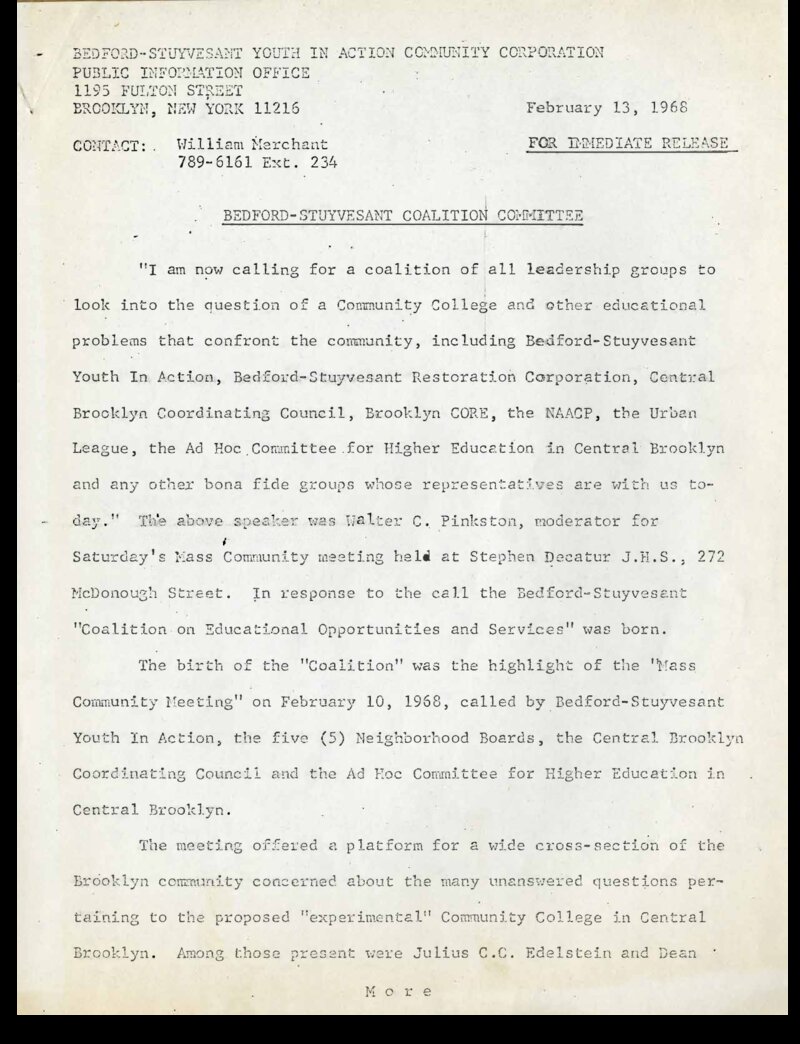
February 13, 1968 Youth in Action Press Release Announcing Formation of the Bedford-Stuyvesant Coalition on Educational Opportunities and Services
Item
BEDFORD-STUYVESANT YOUTH IN ACTION COMMUNITY CCRPORATION
Lic INFORMATION OFFICE
PUBL
POS SPURTON STREET
BROOKLYN, NeW YORK 11216 February 13, 1968
GONTACT:. William Merchan FOR IMMEDIATE RELEASE
SIE Gg
789-6161 ips
it
BEDFORD-STUYVESANT COALITION COMMETTER
"J am now calling for a coalition of all leadership groups to
4
Qu
ot
ie tional
HK
» Saher,
cr
r
me
|
|
look into the question of a Community College and ©
problems that confront the community, including Bedford-Stuyvesant
Youth In Action, Bedford-Stuyvesant Restoration Carporation, Central
Brocklya Coordinating Council, Brooklyn CORE, the NAACP, the Urban
League, the Ad Hoc Conmittee.for Higher Education in Central Brooklyn
46
and any other bona fide groups whose representatives are with us to-
day.'' The above speaker was Walter C. Pinkston, moderator for
é
Saturdey's Mass Community meeting held at Stephen Decatur J.H.S., 272
McDonough Street. In response to
"Coalition on Educational Opportunities and Services" was born.
he "Coalition" was the highlight of the 'Mass
foo
Community Meeting" on February 10, 1958, called by Bedford-Stuyvesant
Je
Youth In Action, the five (5) Neighborhood Boards, the Central Brooklyn
Coordinating Council and the Ad Hoc Committee for Higher Education in
Central Brooklyn.
J
The meeting offered a platform for a wide cro ection of the
Brooklyn community concerned about the many unanswered questions per-
iy
taining to the proposed "experimental" Community College in Central
Brooklyn. Among those present were Julius C.C. Edelstein and
Joseph Shanker, etre denen the City University system. Also local
political leaders, including Assemblywoman Shirley Chisholm and
Senator William Thompson and cal eeaarint Emanuel Celler. Also
observed in the audience were Horace L. Morancie, Director of Models
Cities for Central Brooklyn; Mrs. Almira Coursey of the local school
system; Judge Thomas R. Jones, Chairman of the Board for Restoration
Corporation; Mrs. Lucille Rose, of YIA; Mrs. Connie McQueen of Central
Brooklyn Coordinating Council; Lionel Payne of Central Brooklyn
Coordinating Council.
The questions addressed to Messers Edelstein and Shanker by
the community people in attendance revolved around at least five (5)
crucial issues concerning the Community College. They were:
1. Would the Community College be in Bedford-Stuyvesant?
2. Would the community have a voice in planning the
curriculum and in the selection of faculty?
3. Would the community be informed about the money
spent for the College "before" it is spent?
4. What did the term "experimental" mean in this
particular instance?
5. Would the College be a two (2) year, four (4) year
or six (6) year institution?
It became apparent after a time that Mr. Edelstein and
Mr. Shanker were unable to answer the questions asked of them from
the floor by the community persons present. This development prompted
Waldaba Stewart, YIA's Associate Director of Penerentns) on remark
that "Since it is apparent that the representatives (of the Board of
Higher Education) are not sufficiently informed to answer our questions,
can we, during this meeting today, redirect our energies towards
Mo. Gee
forming a group that can begin planning for a Community College to
suit the needs’ of this community."
The "Coalition of Educational Opportunities and Services" will
meet on Saturday, February 17th, at 10:00 A.M., at the YMCA, 1121
Bedford Avenue, Brooklyn. The group plans to find the answers to the
|
questions that the representatives of the Board could not answer to
the satisfaction of the community - also to set up an Advisory Board
|
|
|
:
to inform the Board of Higher Education of just what the needs of this
community are.
# tt + #
Lic INFORMATION OFFICE
PUBL
POS SPURTON STREET
BROOKLYN, NeW YORK 11216 February 13, 1968
GONTACT:. William Merchan FOR IMMEDIATE RELEASE
SIE Gg
789-6161 ips
it
BEDFORD-STUYVESANT COALITION COMMETTER
"J am now calling for a coalition of all leadership groups to
4
Qu
ot
ie tional
HK
» Saher,
cr
r
me
|
|
look into the question of a Community College and ©
problems that confront the community, including Bedford-Stuyvesant
Youth In Action, Bedford-Stuyvesant Restoration Carporation, Central
Brocklya Coordinating Council, Brooklyn CORE, the NAACP, the Urban
League, the Ad Hoc Conmittee.for Higher Education in Central Brooklyn
46
and any other bona fide groups whose representatives are with us to-
day.'' The above speaker was Walter C. Pinkston, moderator for
é
Saturdey's Mass Community meeting held at Stephen Decatur J.H.S., 272
McDonough Street. In response to
"Coalition on Educational Opportunities and Services" was born.
he "Coalition" was the highlight of the 'Mass
foo
Community Meeting" on February 10, 1958, called by Bedford-Stuyvesant
Je
Youth In Action, the five (5) Neighborhood Boards, the Central Brooklyn
Coordinating Council and the Ad Hoc Committee for Higher Education in
Central Brooklyn.
J
The meeting offered a platform for a wide cro ection of the
Brooklyn community concerned about the many unanswered questions per-
iy
taining to the proposed "experimental" Community College in Central
Brooklyn. Among those present were Julius C.C. Edelstein and
Joseph Shanker, etre denen the City University system. Also local
political leaders, including Assemblywoman Shirley Chisholm and
Senator William Thompson and cal eeaarint Emanuel Celler. Also
observed in the audience were Horace L. Morancie, Director of Models
Cities for Central Brooklyn; Mrs. Almira Coursey of the local school
system; Judge Thomas R. Jones, Chairman of the Board for Restoration
Corporation; Mrs. Lucille Rose, of YIA; Mrs. Connie McQueen of Central
Brooklyn Coordinating Council; Lionel Payne of Central Brooklyn
Coordinating Council.
The questions addressed to Messers Edelstein and Shanker by
the community people in attendance revolved around at least five (5)
crucial issues concerning the Community College. They were:
1. Would the Community College be in Bedford-Stuyvesant?
2. Would the community have a voice in planning the
curriculum and in the selection of faculty?
3. Would the community be informed about the money
spent for the College "before" it is spent?
4. What did the term "experimental" mean in this
particular instance?
5. Would the College be a two (2) year, four (4) year
or six (6) year institution?
It became apparent after a time that Mr. Edelstein and
Mr. Shanker were unable to answer the questions asked of them from
the floor by the community persons present. This development prompted
Waldaba Stewart, YIA's Associate Director of Penerentns) on remark
that "Since it is apparent that the representatives (of the Board of
Higher Education) are not sufficiently informed to answer our questions,
can we, during this meeting today, redirect our energies towards
Mo. Gee
forming a group that can begin planning for a Community College to
suit the needs’ of this community."
The "Coalition of Educational Opportunities and Services" will
meet on Saturday, February 17th, at 10:00 A.M., at the YMCA, 1121
Bedford Avenue, Brooklyn. The group plans to find the answers to the
|
questions that the representatives of the Board could not answer to
the satisfaction of the community - also to set up an Advisory Board
|
|
|
:
to inform the Board of Higher Education of just what the needs of this
community are.
# tt + #
Title
February 13, 1968 Youth in Action Press Release Announcing Formation of the Bedford-Stuyvesant Coalition on Educational Opportunities and Services
Description
In this February 13, 1968 press release, Youth in Action (YiA), a Bedford-Stuyvesant-based anti-poverty organization, announced the formation of the “Coalition on Educational Opportunities and Services,” (later changed to “Bedford-Stuyvesant Coalition on Educational Needs and Services” or B-SCENS). The new organization, which had been created in response to the mass meeting held several days earlier, was composed of prominent Bedford-Stuyvesant community-based education and anti-poverty organizations. According to press release, the Coalition would continue to meet to seek satisfactory answers from City University of New York (CUNY) officials to questions raised in that earlier meeting about CUNY’s proposed new “Community College 7” in order to allow the community to formulate and propose its own plans for the new college.
In February 1968, the City University of New York (CUNY) announced plans to establish a new “Community College 7 in or near Bedford-Stuyvesant. . . oriented to the Bedford-Stuyvesant Community and operated in consultation with the community.” Representatives of a broad network of Central Brooklyn community organizations engaged in an 18 months-long negotiation with CUNY Board of Higher Education officials over CUNY’s plans for its newly announced “Community College 7,” including discussions about the proposed school’s curriculum, who would lead it, and what role the community would play in the school’s governance. The role of the Bedford-Stuyvesant community in planning and determining the leadership of the college remained a central point of controversy between Central Brooklyn’s educational and civil society leaders and CUNY officials in the negotiations that followed.
Contributor
Woodsworth, Michael
Creator
Youth in Action
Date
February 13, 1968
Language
English
Source
Donald Watkins Collection (Brooklyn Public Library)
Youth in Action. Letter. “February 13, 1968 Youth in Action Press Release Announcing Formation of the Bedford-Stuyvesant Coalition on Educational Opportunities and Services.”, CUNY DIGITAL HISTORY ARCHIVE, accessed September 5, 2026, https://stephenz.tailc22a4b.ts.net/s/cdha/item/2029