Chancellor Bowker to NYS Politicians Opposing Community College Faculty Advancement
Item
The City University of New York Office of the Chancellor
535 East 80 Street, New York, N. . Y. 10021
212/360-2121
February 21, 1968
To: Lt, Governor Wilson, Senators Brydges, Zaretzki, Bloom, Marchi and
Liebowitz.
Speaker Travia, Assemblymen Weinstein, Duryea, Cincotta, Maresca and
Amann.
DISAPPROVED
S. 487 - New York City Committee (BLOOM)
A.789 - New York City Committee (CINCOTTA)
Gentlemen:
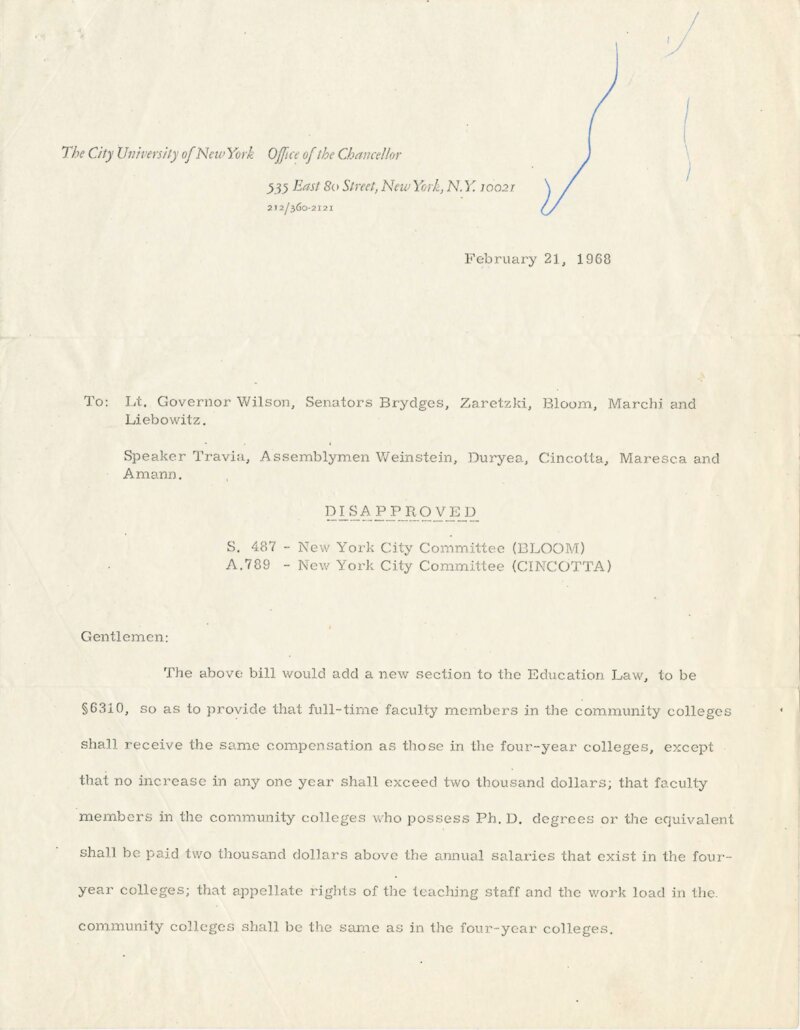
The above bill nach add a new section to the Education Law, to be
§6310, so as to provide that full-time faculty members in the community colleges
shall receive the same compensation as those in the four-year colleges, except
that no increase in any one year shall exceed two thousand dollars; that faculty
‘members in the community colleges who possess Ph.D, degrees or the equivalent
shall be paid two thousand dollars above the annual salaries that exist in the four-
year colleges; that appellate rights of the teaching staff and the work load in the.
community colleges shall be the same as in the four-year colleges,
The Board strives constantly to upgrade salaries of faculty members
of all colleges it administers, On January 9, 1968 the Board adopted increased
salary schedules with mandatory annual increments for the full-time teaching
staff in the community colleges and provided for payment of additional compen-
sation to persons with advanced study or degrees in accordance with the Bylaws.
The increases are retroactive to September 1, 1967, and further increases are
effective on October 1, 1968,
The award of a two thousand dollars supplement to persons with Ph. D.
degrees is opposed on several grounds, The present salary schedules now take
into account the possession of such degrees. The proposed bill, moreover, would
split the community colleges in two, since most liberal arts faculty possess the
Ph.D. degree and would thus receive the additional two thousand dollars supplement,
while most of the career and technology faculty at the community colleges do not
‘possess the Ph.D, degree and would thus be excluded from such additional com-
pensation. Extensive efforts by all persons associated with community colleges
have been directed toward welding the career and transfer programs of the com-
munity colleges into a cohesive unit. The proposed bill is extremely detrimental
in that it will create an upper and lower class faculty divided primarily along
career-liberal arts lines,
The appellate rights of full-time community college faculty are and always
have been equal to those of senior college faculty. . Accordingly, this proposal is
unnecessary.
It is both unfeasible and improvident to establish identical work loads
fcr the community college and senior college faculties. ‘The formula governing
pits.
student contact load for full-time faculty at both college units reflects the research
responsibilities of the faculties. Since it is assumed that the senior college faculty
are equally teachers and researchers, while the community college faculty are
primarily teachers, the amount of released time must vary accordingly.
There are also fundamental differences in the role of faculty at the
community colleges as compared to those at the senior colleges, and therefore,
they should not be tied together, The teaching load of the community college
faculty should be determined by the actual responsibility of the faculty and, indeed,
if appropriate, a certain community college faculty member might have a teaching
load lower than his senior college counterpart.
It is, therefore, requested that the above bill not be enacted into law.
Respectfully submitted,
te Cb. al (BLL, By
Albert H, Bowker
10283 © os ; Chancellor
Copy to: The Honorable Anthony P, Savarese
Legislative Representative
Albany and New York
535 East 80 Street, New York, N. . Y. 10021
212/360-2121
February 21, 1968
To: Lt, Governor Wilson, Senators Brydges, Zaretzki, Bloom, Marchi and
Liebowitz.
Speaker Travia, Assemblymen Weinstein, Duryea, Cincotta, Maresca and
Amann.
DISAPPROVED
S. 487 - New York City Committee (BLOOM)
A.789 - New York City Committee (CINCOTTA)
Gentlemen:
The above bill nach add a new section to the Education Law, to be
§6310, so as to provide that full-time faculty members in the community colleges
shall receive the same compensation as those in the four-year colleges, except
that no increase in any one year shall exceed two thousand dollars; that faculty
‘members in the community colleges who possess Ph.D, degrees or the equivalent
shall be paid two thousand dollars above the annual salaries that exist in the four-
year colleges; that appellate rights of the teaching staff and the work load in the.
community colleges shall be the same as in the four-year colleges,
The Board strives constantly to upgrade salaries of faculty members
of all colleges it administers, On January 9, 1968 the Board adopted increased
salary schedules with mandatory annual increments for the full-time teaching
staff in the community colleges and provided for payment of additional compen-
sation to persons with advanced study or degrees in accordance with the Bylaws.
The increases are retroactive to September 1, 1967, and further increases are
effective on October 1, 1968,
The award of a two thousand dollars supplement to persons with Ph. D.
degrees is opposed on several grounds, The present salary schedules now take
into account the possession of such degrees. The proposed bill, moreover, would
split the community colleges in two, since most liberal arts faculty possess the
Ph.D. degree and would thus receive the additional two thousand dollars supplement,
while most of the career and technology faculty at the community colleges do not
‘possess the Ph.D, degree and would thus be excluded from such additional com-
pensation. Extensive efforts by all persons associated with community colleges
have been directed toward welding the career and transfer programs of the com-
munity colleges into a cohesive unit. The proposed bill is extremely detrimental
in that it will create an upper and lower class faculty divided primarily along
career-liberal arts lines,
The appellate rights of full-time community college faculty are and always
have been equal to those of senior college faculty. . Accordingly, this proposal is
unnecessary.
It is both unfeasible and improvident to establish identical work loads
fcr the community college and senior college faculties. ‘The formula governing
pits.
student contact load for full-time faculty at both college units reflects the research
responsibilities of the faculties. Since it is assumed that the senior college faculty
are equally teachers and researchers, while the community college faculty are
primarily teachers, the amount of released time must vary accordingly.
There are also fundamental differences in the role of faculty at the
community colleges as compared to those at the senior colleges, and therefore,
they should not be tied together, The teaching load of the community college
faculty should be determined by the actual responsibility of the faculty and, indeed,
if appropriate, a certain community college faculty member might have a teaching
load lower than his senior college counterpart.
It is, therefore, requested that the above bill not be enacted into law.
Respectfully submitted,
te Cb. al (BLL, By
Albert H, Bowker
10283 © os ; Chancellor
Copy to: The Honorable Anthony P, Savarese
Legislative Representative
Albany and New York
Title
Chancellor Bowker to NYS Politicians Opposing Community College Faculty Advancement
Description
In this letter to New York State politicians, CUNY Chancellor Albert Bowker opposes a bill in the New York State Legislature that would have changed full time faculty salaries in the community colleges to be equal to that of faculty in the senior (four-year) colleges; provided a higher salary for full time community college faculty who had the doctorate or its equivalent as compared to those who did not; and equalized the workload between full time community college and senior college faculty. Bowker outlines his reasons for opposing all three provisions. The bill did not become law, but a single salary schedule became a basic element of the first collective bargaining contracts in 1969. The other two provisions of the bill did not materialize.
Contributor
Professional Staff Congress
Creator
Bowker, Albert
Date
February 21, 1968
Language
English
Relation
3282
Rights
Obtained from Contributor - Copyright Unknown
Source
Robert F. Wagner Labor Archives
Original Format
Diary / Correspondence
Bowker, Albert. Letter. “Chancellor Bowker to NYS Politicians Opposing Community College Faculty Advancement”. 3282, CUNY DIGITAL HISTORY ARCHIVE, accessed September 5, 2026, https://stephenz.tailc22a4b.ts.net/s/cdha/item/453