LaGuardia Community College - An Assessment of the Needs of the Western Queens Community, 1980
Item
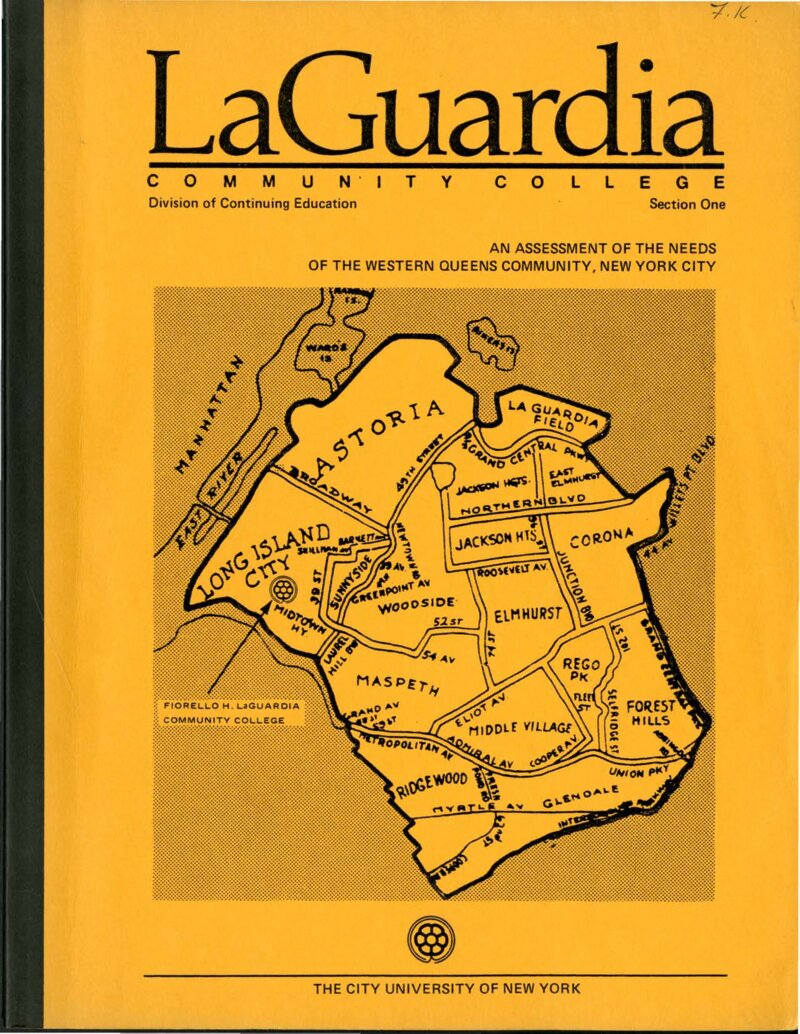
AN ASSESSMENT OF
AN ASSESSMENT OF THE NEEDS
OF THE WESTERN QUEENS COMMUNITY
NEW YORK CITY
1980
DIVISION OF CONTINUING EDUCATION
Augusta Kappner, Dean
Judy McGaughey, Assistant Dean
Fern J. Khan, Project Director
Edithann Kane, Research Assistant
Mary Gallagher, Research Assistant
Diane Carter, Secretary
LAGUARDIA COMMUNITY COLLEGE, CITY UNIVERSITY OF NEW YORK
Joseph Shenker, President
Martin Moed, Vice President
TABLE OF CONTENTS
Genestscof Project: |... cyte eyo aS ps wet eee on ats
Acknowledgements and Project Staff .............
SECTION I
PART I
I. Introduction: The Urban Demonstration Project...
II. The Assessment Process: How and What Was Done...
PART II
I. The Community Profile: Introduction. .......
II.” Profile of Community District 1...508.......
Ill. Profile ‘of Community District 25 520.55 < 6s 3
IV. Profile of Community District 3... .:.0.....
V. Profile of Community District 4... .u5.......
VE. ‘Proftie of ‘Community District 5.7. 50506 25 os x
VII. The Western Queens Telephone Survey. ........
VIII. Western Queens: An Overview from Findings .... .
IX. Recommendations: Exploring Possibilities for Action
X. Since the Assessment: Some Unanticipated Outcomes .
_XI. Information Sources for Needs Assessment Report. . .
PART III
ADPEAGICES or. Meek i 5 2 SANG th ow oy: re emp Ss
SECTION II
The Kane, Parsons and Associates Report: A Survey of
the Attitudes of Adults Towards Continuing Education
GENESIS OF PROJECT
During 1979, LaGuardia Community College was actively considering ways of
more formally analyzing the special needs of its community.
In January 1980, Ms. Suzanne Fletcher, Director, Center for Community
Education, American Association of Community and Junior Colleges, provided us with
a vehicle through which to realize this goal. LaGuardia and 5 other community
colleges nationwide known for their interest in and work with urban populations,
were invited to participate in an Urban Demonstration Projectt The goal of the
project was to strengthen the relationships between community colleges and their
surrounding communities.
The invitation was timely, LaGuardia had been actively involved with its
community. However, no formal analysis of the communities' special needs had
ever been undertaken. Therefore, to say the least, we were delighted to join
this consortium. Participation would provide the opportunities, technical
assistance and some necessary funding to implement the needs assessment project
which was agreed on.
The visits from Suzanne Fletcher, AACJC, the meetings held with adminis-
trators (Presidents and project staff) from all six participating colleges were
invaluable in helping all of us to focus on goals and anticipated outcomes.
The themes selected by AACJC were youth, neighborhood stability, unemploy-
ment/underemp]oyment and aging. Each college was free to focus on whatever theme
it so desired.
* 1) Bunker Hill Community College, Charlestown, MA: 2) Cuyahoga Community
Soe e Cleveland, 0H; 3) San Francisco Community College, San Francisco,
CA; 4) Seattle Community College, Seattle, WA; 5) Shelby State Community
College, Memphis, TN
29x
At their initial meeting in Washington, DC, administrators from
participating institutions struggled to identify which theme each college
would select. It became evident that limiting attention to one theme might
not be the most effective approach. LaGuardia's staff decided to allow a theme
(or themes) to emerge from the assessment process itself, especially since we
were, in some way, already involved with most of the AACJC's themes. The second
group meeting in Seattle, Washington allowed us to share our progress and/or
problems and to receive valuable feedback. Information gained from guest
speakers provided other perspectives and approaches to dealing with community,
as well as social, legislative and educational issues.
Staff within the Division of Continuing Education at LaGuardia Community
College spent many hours discussing what direction the project should take,
desired outcomes, research design, budget, a time frame, who to contact in the
community, how best to make these contacts, and what kinds of productive ques-
tions to ask. We also had to look internally at our capacity to undertake new
programs if a need for them emerged from the assessment. Staff availability
and budget were important considerations. Yet we were also eager to solidify
our linkages with our community and to establish new relationships.
Throughout the conceptualtzation and implementation of the project, Acting
President Martin Moed provided the Division with constant encouragement and
support and attended all the meetings arranged through AACJC.
Augusta Kappner, Dean of Continuing Education and Judy McGaughey, Assistant
Dean, spent hours with project staff to develop further the ideas generated from
the various meetings and to ask crucia] questions related to our institution's
overall direction and goals. In addition, a policy - making body, consisting
of the President and the Deans of each of the college's divisions, was actively
involved at every stage of the project's development.
=35
With its approval and support, it was agreed that we would engage the services
of a public opinion research firm to assist us in carrying out one phase of the
assessment. This was a most welcome decision.
The following report therefore consists of two sections. The first section
deals with the entire process of the assessment and a profile of the community.
We acknowledge that in gathering data for the profiles many community
agencies and groups who should have been interviewed or contacted were not, only
because of time and staff limitations. We invite comments and contacts with
these groups so that future profiles may reflect their programs and services to
the community. Additionally, in any future profile, more recent population
figures will be available from the 1980 census and other studies, **
The second section contains the more formal report from Kane, Parsonsand
Associates) "A Survey of the Attitudes of Adults Toward Continuing Education."
The major credit for the preparation of this report goes to Sister Edith
Ann Kane, S.N.D., Project Assistant and Mott Fellow whose capacity to absorb and
interpret figures, data and details was amazing and contagious. Credit for typing
belongs to Ms. Diane Carter, Secretary in the Community Service Program area,
whose skill and accuracy in typing figures were indeed admirable. Appreciation
for editorial assistance goes to Sister Mary Gallagher, S.C., Research Assistant
in the Community Services Program.
President Shenker and Vice President Moed both continue to support the con-
cept of the responsibility of a community College to its community. As such,
President Shenker is now, with the cooperation of staff from the Continuing
Education Division, involved in phase II of the Project, responsible for the
formation and chairing of the College/Community Advisory Committee.
-_
**Researchers from the Jewish & Ethnic Project at Queens College have recently
completed a study of the various groups including information on the
latest immigrant groups, in the borough of Queens.
ds
‘Working on this project has been exciting, enlightening and educational.
We look forward to seeing many rich ideas generated by the survey result in new
programs and services to meet the needs of the Western Queens community.
Fern J. Khan
Project Director
15
~ ACKNOWLEDGEMENTS
Without the cooperation and assistance of the people listed below, the
information collected for this report would not have been possible. The pro-
ject staff extends a real thank you to everyone who participated in making this
project and report possible:
La
2s
35
Telephone Interviewers
James Alexander
Diane Carter
Mary Carvallo
Patricia Curtis
Sylvia Douris
Shirley Fitzhugh
Karen Hartig
Lenora Henderson
Anita Hendricks
Pat O'Donnell
Julia Pappas
Barbara Reilly
Mary Rooney
Janet Roos
Renee Saulsbury
Anna Scobie
Hope Spence
Mary Sperling
Lillian Thomas
Mary Varnavas
Despene Gazianis
Nicholas Kalis
All community organizations and staff as identified in Appendix IX.
LaGuardia Faculty and Staff
Peter Alonso
Glenn Anderson
Susan Armiger
Steve Brauch
Janet Cyril
Sam Farrel]
Allan Goldberg
Elmyria Hull
John Hyland
Richard Kamen
Janet Lieberman
Richard Lieberman
Eileen Mentone
Mildred Roberts
Shirley Saulsbury
David Speights
Sandy Watson
-§= ay (es
Special thanks are extended to the following individuals:
John Kaiteris, Director, Hellenic American Neighborhood
Action Committee and staff for providing us with the
Greek translation of the survey questionnaire. ‘
Steffani Martin, Director, LaGuardia Bilingual Program
who provided us with the Spanish translation and Peter
Alonso who placed all the accents in their proper places.
Jane Planken, Director, Community Boards, who found time
within her hectic schedule to read the profiles and provide
us with invaluable feedback.
SECTION I
PART I
2g
INTRODUCTION: THE URBAN DEMONSTRATION PROJECT ~
In January, 1980, LaGuardia accepted an invitation from the Center for ;
Community Education of the American Association of Community and Junior Colleges
to be one of six urban community colleges in the nation participating in a three
year project aimed at demonstrating the ability of the urban community college
to become more responsive to community needs.
The Center for Community Education has operated under the broad mandate of
increasing the understanding of community education among community colleges
and assisting in the implementation of community education processes. Progress
in urban community education and developing the role of the community college
as a partner in the process is the primary goal of the AACJC Center's activities
jin 1980. Three specific yet interrelated areas of concern have been identified:
neighborhood stability, youth unemployment and alienation of the older popula-
tion. Because the process of developing a partnership with the community so as
to address areas of mutual concern requires time, trust-building and, sometimes,
new competencies, the initially planned three-year cycle would permit development
and some maturation of the efforts in the six demonstration sites, assessment of
the effectiveness of this community college role and an opportunity to disseminate
nationally the successful examples of continuity in planning and implementing
this urban effort.
Fron its very beginnings, LaGuardia has engaged in active dialogue with
the community in developing programs responsive to community needs. Its focus
on cooperative education, the study of urban problems and the requirements of
the surrounding community reflect the institution's belief that "The continued
health of the College depends on--and our primary mission must be to strenghten--
the well being of/the/community." (Partnership in New York City's Future: A
Long Range Plan for LaGuardia Community, P.1.).
af:
As such, LaGuardia is qualified to participate in the urban thrust of the AACJC
Center for Community Education, for LaGuardia is a “community college committed
to the philosophy of community education" eager to be “an active partner with
the citizens it serves in the development of a better community." (AACJC
Proposal, P. 6).
In a self-study prepared for the Middle States Association of Colleges and
Secondary Schools in June 1979, the College reiterated its commitment to the
City, to career education and to non-traditional learners.
LaGuardia Community College's fundamental mission has
remained the same since its planning stages in 1970: to
serve the multiplicity of needs of each segment of its
diverse population; to give special emphasis to prepara-
tion of the individual for work and/or further study; to
combine...practical fieldwork experience with classroom
jnstruction through a universal cooperative education pro-
gram; and to assume a special responsibility for service
to adults, the handicapped, veterans, non-English speaking
students, and other populations generally excluded from
the mainstream of higher education.
Two comments offered in the report from the Middle States Evaluating Team
are particularly relevant to the current involvement in the Urban Demonstration
Project. The report notes:
Imagination and initiative are manifested in the variety
of Continuing Education Programs for special interest
groups...the college must be mindful of the uncertainties
of continued funding...
Compared to regular full-time enrollments, the number of students registered
under the Continuing Education/Adult Education banner is currently relatively
small. The growth potential in the densely populated area in which the College
is located is likely to be great. Further exploration of the "market" and a
comprehensive and continuing needs survey were indicated. A more complete sys-
tem of advisory committees for present and prospective curricular options would
also help identify needs which the College could meet through its Continuing
Education Program.
-10-
Participation in the Center for Community Education's Urban Demonstration
Project has provided an opportunity for LaGuardia to begin addressing these
particular points in a deliberate manner. Even more, it has thrust the College 5.
into a further stage of its development. Always conscious of its role in the
community, LaGuardia has committed itself to developing a closer relationship
with the community, not simply as an agency to provide services but as a parti-
cipant in the process of community renewal.
In College Leadership for Community Renewal James Gollattscheck and his
coauthors present the blueprint for a new kind of college--a community renewal
college. Such a college “determines its direction and develops its goals
through college--community interaction, uses the total community as a learning
laboratory and resource, serves as a catalyst to create in the community a
desire for renewal, provides a vehicle through which the community educates
itself, and evaluates its successes by citizens’
successes that are recognized
as significant by the community itself." The role of such a college is to be
a "cooperator with the community in joint efforts to put people back together
in meaningful human endeavors" and to “avail itself of opportunities to partici-
pate in the continual renewal of individuals and thus in the continual restruc-
turing of the community as a whole."
Itis inthis spirit that LaGuardia's Continuing Education Division has
articulated the following goal and objectives relative to community education.
GOAL
The goal for this needs assessment was defined as enhancement of the college's
ability to develop an effective working relationship with its community and, to-
gether, to maximize our combined strengths and resources to meet identifiable
needs and interests within the community.
The objectives to progress towards this goal were identified as:
oh
OBJECTIVES
1. To initiate a study of the community--its needs, strengths
and resources.
2. To develop a community profile. a
3. To establish communication systems with the community that
will facilitate dialogue, networking and sharing of resources.
4. To develop processes for involvement of the college community
in identifying college needs and resources relative to the
community .
5. To establish an Advisory Board with college and community
representation.
6. To determine priority issues in light of identified needs
and resources of the college and community.
7. To plan and implement programs addressing priority issues.
8. To develop instruments and systems for continual evaluation
of programs and an ongoing assessment of needs.
The initial phase of LaGuardia's involyement in this project was a
community needs assessment. Through telephone and personal interviews and the
collection of existing demographic data, as well as through conversations with
several diverse community organizations, a community profile of Western Queens
was compiled; the college formed an advisory committee representative of the
college and the community to review the findings and make recommendations for
increasing conmunity based activities and linkages.
A description of the needs assessment process, its method, results and
subsequent recommendations for action, comprises the major portion of this
report.
THE COMMUNITY
LaGuardia Community College, formally established in 1970 as the newest of
eight community colleges of the CUNY, is located in the Long Island City section
of Western Queens. Demographic surveys conducted by the Board of Education at
that time revealed that this area manifested among the lowest average family
income and educational attainment of the entire city and that its population was
not being served by any other CUNY institution.
<12-
LaGuardia's community extends beyond the geographical limits of Long
Island City, however, A survey of students registered in the Continuing Educa-
tion division in Fall 1979 reyealed that the majority of students came from those
neighborhoods represented by Queens Community Planning Boards 1,2,3,4, with a
significiant number coming from areas of Board 5 bordering on Brooklyn and from
northwest parts of Brooklyn. While students also come from parts of Manhattan,
Bronx and Long Island, the majority of these are involved in programs directed
to specific populations, e.g., the deaf. Recent college wide statistics indicate
that the bulk of students (53%) are from Queens, while a significant number, 21%
reside in Brooklyn. (Partnership, P. 8, App. D)
For purposes of the needs assessment project, we have limited our under-
standing of the community to refer to relatively loca] neighborhoods. This
is not to deny the LaGuardia commitment to New York City; rather it represents
an effort to focus that commitment, particularly in relation to community educa-
tion, on those populations which are most closely associated with the college,
both geographically and/or through current participation in college programs.
The primary focus of the needs assessment project, then, has been the
neighborhoods grouped under Queens Community Planning Boards 1,2,3,4, Ridgewood
and Glendale in Community Planning Board 5, and Williamsburg, Greenpoint and
Bushwick in Brooklyn.
-13-
THE ASSESSMENT PROCESS
OVERVIEW
The principal strategy chosen for addressing objectives one through three
was a community needs assessment. The following questions guided the initia-
tion of the assessment.
1. Who is the community?
LaGuardia Community College, formally established in 1970 as the newest
of eight community colleges of the CUNY, is located in the Long Island
City section of Western Queens. Demographic surveys conducted by the
Board of Education at that time revealed that this area manifested among
the lowest average family income and educational attainment of the entire
city and that its population was not being served by any other CUNY insti-
tution.
Although located in the Long Island City section of Western Queens,
LaGuardia's "community" extends beyond that geographical limit. Indeed,
the college population includes students from all parts of metropolitan
New York. However, in an effort to focus the assessment process realis-
tically, specific neighborhoods were identified for the survey.
Since the survey was concerned with general community education needs
‘rather than the needs of the traditional student, a study of registration
figures for the Fall 1979 Continuing Education programs was used to help
ascertain the neighborhoods to be included in the survey. Those figures
revealed that 75% of the Continuing Education population during that quar-
ter were from neighborhoods represented by Queens Community Planning Dis-
tricts 1 through 5 and neighboring Brooklyn Districts 1 and 4. (Appendix I)
For purposes of the needs assessment project, then, the term "community"
referred to relatively local neighborhoods:
=2Ex
Long Island City, Astoria Board 1 Queens
Woodside, Sunnyside, Hunters Point Board 2 "
Jackson Heights, East Elmhurst, Corona Board 3 "
Elmhurst, South Corona Board 4 "
Ridgewood, Maspeth Board 5 "
Williamsburg, Greenpoint Board 1 Brooklyn
Bushwick Board 4 "
2. What information about the community is relevant for the project?
In addition to basic demographic information (age, sex, ethnicity,
economic status, level of education) it was important to ascertain educa-
tional needs and interests, It was also considered necessary to obtain
information about issues and problems that are of concern to the community,
as well as available resources for addressing those concerns,
3. Who has the information?
The neighborhood people themselves, employers and employees in the
community, civic, religious and educational leaders, as well as ethnic
and community organizations and social service agencies were identified
as potential sources of information.
4. How would the information be obtained?
From individuals: residents and employees would be asked to provide
data for the assessment through individual interviews by telephone or in
person.
From organizations/agencies: through contact with community planning
boards, general community needs would be ascertained and suggestions sought
as to the most appropriate organizations and community leaders to contact.
From college personnel: through formal and informal means of communi -
cation, college personnel would be informed of the project and invited to
offer information and insights.
ee
B.
21S
From other known opportunities: persons involved in the project would
study any relevant surveys published, community publications and resource
materials, and attend meetings or workshops pertinent to the over-all
project.
5. What resources would support the project?
Project supervision would be provided by a program director in the
Continuing Education Division, as well as some secretarial and administra-
tive services. College funds would be used to hire part-time staff for
interviewing and to employ the services of a public opinion research firm.
Some consultancy monies would be obtained from the AACJC Center for Community
Education to help meet the expenses of these latter services. The AACJC
Center would also provide a Mott Fellowship to support a project assistant
for six months. In addition, the AACJC Center would offer technical assis~
tance as well as opportunities for resource sharing and interchange with
other Urban Demonstration Colleges (including some financial support to
do this). A graduate student on internship would also provide part-time
assistance for seyeral months.
INDIVIDUAL INTERVIEWS
eee
1. Persons interviewed
Initial plans for personal interviews included;
- 1000 residents by telephone
- 150 residents of neighborhood housing projects and Roosevelt
Island, a planned community in near proximity to the college,
all by face to face interview
- 150 factory employees in neighborhood industries, by written
questionnaire.
The telephone interviews would provide a sample of the entire “community”
while the face to face interviews and the forms completed by factory workers
would provide information on specific clusters of people for whom particular
programs could be developed.
In the course of the project it became evident that the latter two method
would not be feasible at this time and they were deferred.
-16-
2. The Instrument Used
The services of Kane, Parsons, and Associates, Inc., a public opinion
research firm, were, employed to assist in the development of a questionnaire
“that would ascertain residents' perceptions of neighborhood problems, their
personal, educational needs and interests, and basic demographic information.
Kane, Parsons was also contracted to assist in drawing the sample and to
code, analyze and prepare a report on the findings.
Using ideas generated at several meetings with Continuing Education
Directors, suggestions requested from various college department chairpersons,
and questions from similar kinds of surveys (e.g. the New York State Needs
Assessment), the project director worked closely with Kane, Parsons Associa-
tes in designing a suitable questionnaire.
Anticipating language barriers, arrangements were made for translating
the questionnaire into Spanish and Greek. The former was undertaken by
staff from the Foreign Language department; the Greek translation was done
by staff members of HANAC, the Hellenic American Neighborhood Action
Committee, an active community organization with which the college had fre-
quent contact. (Appendix II)
3. The Telephone Survey
Duration: The telephone interviews were scheduled to take place over
a six week period, at maximum. (Because of a change in plans regarding other
phases of the survey, this was not a consecutive period, although it did
average approximately six weeks).
Time: Most calls were made on Mondays through Fridays from 5 to 9 PM
and on Saturdays from 10 AM to 6 PM. The experience of a few college-
related interviewers who tried to place calls during the weekday verified
the opinion of Kane, Parsons that such calls would yield only minimum results.
Location: With few exceptions, calls were made from offices in the
Continuing Education Division which were in close proximity to each other.
This facilitated supervision of the interviewers.
are
Interviewers: While the questionnaire was being developed, the process
of hiring interviewers was initiated. Most prospective interviewers learned
of the project through community organizations who publicized the positions;
*some were college employees or persons known to college employees. The pro-
ject director or her assistant met with any interviewers unknown to them to
determine their suitability for the position. Major consideration was given
to their ability to communicate positively on the telephone, availability for
evening or Saturday employment, willingness to be trained, residence in the
community and bilingual skills. (The latter two qualifications were not
universally applied).
A total of 26 persons were scheduled as interviewers; 22 were salaried
($5 per completed interview) and four (4) were college service related.
Heeding the advice of Kane, Parsons, more interviewers than were actually
needed were hired in order to compensate for probable attrition.
Ten interviewers per night was considered necessary to complete the
survey in six weeks. Although this number was not usually achieved (the
average number of interviewers per night was six(6), it soon became evident
that most interviewers could complete more interviews each night than had been
anticipated.
Hired interviewers were paid with tax levy monies through the college
payroll office ona bi-weekly basis, The project assistant served as liaison
between the payrol1 office and the interviewers, preparing time sheets, and
distributing checks, since interviewers were never on campus during payroll
office hours.
Training Interviewers: As soon as the questionniare was complete, two
training sessions were scheduled. Interviewers were asked to attend one of
these four hour sessions, conducted at the college by personnel from Kane,
Parsons. During the training sessions, interviewers were instructed on the
general purpose of the survey, how to use the Call Record Sheet, how to screen
potential respondents, how to handle non-English speakers.
-18-
In order to help them administer the questionnaire effectiyely, each
question was explained, i.e. why it was asked, what kind of information it
was seeking, how general or specific was the desired response. Interviewers
had an opportunity to raise questions, pose problems that might be encountered
and share ideas for successfully handling them. After the survey was under-
way, interviewers received informal training through verbal and written in-
structions from the supervisors, as needed. (Appendix III)
Selection of phone numbers: Although the telephone company was unable
to provide information regarding exchanges unique to each of the neighborhoods,
it did advise as to what exchanges were common in those general areas. Con-
sequently, call sheets were prepared by affixing random numbers to those
exchanges. This procedure probably ensured equal access to all working
telephones, including unlisted and recently installed phones, as well as
those listed in the directories. To be eligible for participation, respon-
dents had to be residing at the number where they were reached; in addition,
they had to be eighteen (18) years of age or older and not engaged in full
time study at the time of the survey. (Appendix IV)
Supervision: A supervisor was on duty whenever interviews were conducted.
The role of the supervisor was to maintain records of attendance, to assign
telephone rooms, to distribute interview materials, to review completed in-
terview forms, to validate a sampling of completed interviews at the begin-
ning,middle and end points of the survey, to monitor interviewers' performance
and to be available to answer questions and offer whatever assistance might
be needed. Supervisors attended the same training session as the interviewers.
In addition, they received formal direction from the project director on con-
sultants when such was needed. (Appendix V)
=19=
Monitoring the survey: Throughout the course of the suryey, it was
necessary to keep a record of the population reached. Statistics relative
to age, sex, ethnicity and neighborhood were recorded daily. A daily tally
of completed questionnaires was kept, as well as a record of telephone
exchange distribution in the neighborhoods contacted.
The monitor was also responsible for preparing each evenings' materials
in an effort to ensure proportional neighborhood representation among the
numbers called. (Using 1970 census statistics, a proportional percentage
of the targeted 1000 interviews was determined for each Community District).
In addition, the monitor maintained the interviewer schedule and tried to
ensure the presence of a maximum number of interviewers for each calling
session. (Appendix VI)
Process statistics: The goal of the process was 1000 completed inter-
views. Success rate was 84%. Together, interviewers called approximately
4000 different numbers at least once; 3000 were called two or three times
and another 500 were called a fourth time. Of all these calls, approxi-
mately 1800 yielded eligible respondents. Of that number, 840 completed
the interview, 770 refused to participate, 60 began the interview but ter-
minated before it was completed, and 130 could not be interviewed because
of a language barrier.
Human Interest: It became evident early in the hiring process that in
conducting the survey we were, on a limited basis, addressing needs of
community people. A couple of the interviewers were presently unemployed and
were happy for even the limited income offered by participation. For a few
women interviewers, it was a response to their need and/or desire to begin
to achieve financial independence; for a senior adult it provided not only a
small source of income but, more importantly, a productive use of her time.
Several students found needed assistance in meeting tuition and other costs.
=20=
Some interviewers became quite adept at encouraging people to participate
and frequently were able to successfully suggest that the respondent indicate
a more convenient time for the interview, rather than refuse it completely.
In the course of validating random completed forms, one gentleman commented
to the monitor that the manner of the interviewer was such as to convince
him to stay with what he considered a "much too long" questionnaire.
Some interviewers frequently relayed human interest stories to the
project director which served to enliven the statistics we collected.
Because we encouraged feedback from the interviewers, they began to feel a
sense of involvement and importance in the survey. They offered suggestions
and, in genera], took "ownership" of their part in the project. They were
interested in progress being made and also kept us up to date on their own
Pplans--e.g. one interviewer obtained a full time job in Washington DC during
the time he was with us and even though the interviews were completed, he
called to inform project staff of his move and new job.
Limitations: As with all human activities, the telephone survey en-
countered difficulties. Some were predictable and possibly avoidable,
others were more beyond our control.
Because of a limited budget and the difficulty of obtaining sufficient
volunteers, it was not possible to complete the goal of 1000 interviews.
While college personnel were generally very supportive of the effort, other
responsibilities precluded their volunteering the time they thought they
would be able to give.
Because project directors were not sufficiently aware of the difficulties.
of translation, the task was not undertaken in time to have Spanish and
Greek versions of the questionnaire available as the calling began. Although
interviewers carefully recorded the phone numbers of Greek and Spanish speakers
so that they could be called back, funds for the project were near depletion
when the translation became available.
«ote
It is possible that more piloting of the questionnaire might have yielded
a more refined instrument. In addition, it might have been more beneficial
to involve community representatives in its design, or to delay the telephone
survey until the other phase of the assessment had been completed and the
questionnaire could be designed in light of those findings.
The training sessions were very valuable in preparing interviewers for
their task. Unfortunately there was no opportunity for interviewers to test
out their skills on each other. Particularly for educational institutions,
it seems feasible that several educational staff could receive training and
then all subsequent sessions could be conducted by them. Two advantages of
this would be cost reduction and more effective adult education techniques
employed in the training.
The process for paying interviewers had not been considered in planning
for the survey. It is possible that others might overlook this step as well.
The main drawback was that of unanticipated work for the project directors.
Preparation of time sheets, payroll records, and dealing with questions from
payroll office and interviewers consumed at least twenty hours that had not
been so scheduled.
RESIDENTIAL INTERVIEWS
1. Purpose
The intent of the residential interviews was to ascertain the educational
needs of specific clusters of people in the community. The hoped for outcome
was the possibility of specific program development at one site.
2. Implementation
Two different kinds of groups were to be approached: persons living
in public housing projects and persons believed to be of mixed socio-economic
backgrounds on Roosevelt Island. Regarding the former, the project directors
found it advisable to approach the housing offices of the respective develop-
ments to ascertain the most feasible way to draw a sample and approach the
persons involved. After visiting one site it was felt that initial contact
220%
should be made through respective community centers rather than a direct
door to door survey. Consequently, these populations were contacted
‘through the process described in Part E.
Further exploration with Ms. Mary Enright, Director of Community
Relations of the community on Roosevelt Island revealed however that 1)
the economic mix was not as thought; 2) only a written sheet would be
allowed; 3) responses to surveys of any kind in recent years had been
misleading and unsatisfactory for the residents. A general sense was that
residents preferred to leaye the island to take whatever courses they de-
sired. A number of colleges located in Manhattan were very accessible to
Roosevelt Island residents and indeed many took advantage of the close
proximity of the colleges and did register for courses.
3. New Decision
As a result of the information cited above, it was decided to divert
funds from this phase of the project into the telephone survey.
FACTORY INTERVIEWS
1, Purpose
It was decided that, given the heavy concentration of industry in the
immediate vicnity of the college, it would be important to find out from
factory employees their educational needs and interests.
2. Instrument
Initially, minimal modifications were made on the telephone questionnaire
to adapt it for written use. Preliminary discussion with some employers
led to a further redesign and simplification of the questionnaire to meet
the reading ability of the employees. A Spanish translation was also pre-
pared. (Appendix VII)
3. Implementation
The director of Programs for Business coordinated administration of
the written questionnaire. His efforts were only minimally successful
because of some resistance from managers and this part of the assessment
was deferred for the time being.
Es
=23-
ORGANIZATION/AGENCY INTERVIEWS
Determining appropriate contacts: Given the enormous diversity of
_ community organizations within the target area, assistance was sought from
Queens Office of the City Planning Department regarding the most appropriate
groups to contact. At the suggestion of the Director and Planning Specialist
efforts were made to meet first with District Managers of the Community
Planning Boards under study, i.e. Queens Districts One through Five and
Brooklyn Districts One and Four. District Managers were asked to describe
their communities, the problems and concerns faced by the residents, their needs
for educational services/activities; and to suggest community organizations
that might be interested in collaborating with LaGuardia in the needs assess-
ment project and in findings ways to address some of the community needs.
These visits, then, served a double purpose: they provided a preliminary
overview of the community under study, as well as information about helpful
contacts to make in that community.
Contacting community organizations: A combination of written and per-
sonal contact was made with organizations suggested by the District Managers.
Organizations that were already somewhat well known were contacted by phone
and arrangements made for on-site visits. Other organizations were con-
tacted through a letter, sent from the President's office, which described
the project and requested information regarding the community serviced by
the organization and potential for college/community collaboration in meeting
community needs. (Appendix VIII)
In some cases, community representatives themselves suggested other help-
ful contacts.
Gathering the data: After every visit with a District Manager or commu-
nity organization representative, minutes of the meeting were prepared so
that none of the information would be lost. Organizations contacted by mail
returned questionnaires with information about services provided, community
needs, collaborative possibilities, etc. (Appendix IX)
aa
Another valuable source of information about the community were the
Portfolios prepared for each Community Planning District and available
through the Department of City Planning. These included information on
population, housing, education, economic development, health, social services,
etc. Much of the information was based on the 1970 census data, although
education and social service information was more recent (1977). This
material was studied in relation to the data gathered from community repre-
sentatives and a profile of each neighborhood was developed.
On-going community contact: As soon as a significant amount of informa-
tion had been gathered, letters were sent to every person who had participated
in the project, whether in person or by mail, thanking them for their assis-
tance, bringing them up to date on the project, informing them of existing
LaGuardia Continuing Education programs (by enclosing a copy of the Divi-
sion's Annual Report) and inviting their continued involyement. (Appendix X)
At the same time, letters were sent to any organization that had not
yet responded to the questionnaire. This letter provided the same informa-
tion as described above, except that it once again invited them to partici-
pate in the project.
Process statistics: As of October 31, 1980, all seven District Managers
had been visited; 48 letters and questionnaires had been sent to community
organizations; fourteen (14) of those organizations had responded. In
addition, fourteen (14) other community organizations had been personally
visited by the Project Director or her assistant.
bet
=965
THE COMMUNITY PROFILE
INTRODUCTION
LaGuardia Community College has identified as its community those neighbor-
hoods which are located in Western Queens and neighboring sections of Brooklyn.
The community profile, then, attempts to describe a large and diverse population
with varying community education needs, and to demonstrate both the uniqueness
of each neighborhood and the common characteristics they share.
No one person, or group of persons, can presume to have adequate knowledge
of a community of such great dimensions. This profile, then, is offered as a
first step in the development of a relationship between the college and the
community that is based on mutual growth in knowledge and understanding of
people and the structures they have created to foster the growth and develop-
ment of their communities.
The first section of the profile will present a narrative description of
each Community Board, touching on the racial and ethnic composition of each
neighborhood, age, and socio-economic conditions of the population. Statistics
from Community Planning Board Portfolios (which rely heavily on 1970 Census
statistics) and other sources are used to support this description and to pro-
vide information on housing, population stability, educational background and
employment patterns.
‘Information about available community services, as well as community pro-
blems and needs, gathered through written and personal contacts with community
agencies/organizations, is summarized and possibilities for college/community
collaboration are noted. Charts outlining this information as well as the
specific populations serviced by each organization are also included.
The second section of the profile will examine the totality of needs ex-
pressed and relate them to the findings of the telephone survey.
The final section will discuss possibilities for further action, taking
into consideration college and community resources.
NEIGHBORHOODS -28-
RIKERS ISLANO
* COMMUNITY DISTRICT 1
STEINWAY
ASTORIA
LONG ISLAND CITY
BRIDGE PLAZAN
QUEENS COMMUNITY DISTRICT 1
=295
COMMUNITY DISTRICT ONE -- ITS NEIGHBORHOODS AND PEOPLE
(Long Island City, Astoria, Steinway
Community District One which includes parts of Long Island City, Astoria
and Steinway, extends from the East River on the west and north to Bridge
Plaza and Northern Boulevard which separates it from Board 2 on the south and
southeast, and to the Brooklyn Queens Expressway separating it from Board 3 on
the east.
The estimated population in 1970 was 191,000, although by 1975 this de-
creased an estimated 4% to 184,000. The majority of the population is white,
with a significant percentage (60%) of persons of foreign stock (i.e. foreign
born or born of foreign parents). Italian and Greek ethnics predominate,
with eleven percent (11%) of the population identified as Spanish speaking.
More recent school statistics (1977) suggest a shift in population, with in-
creasing numbers of younger blacks, hispanics and orientals and an older white
ethnic population. This is not to suggest a decreasing older population. In
fact, there has been an increase of older persons in all but one zip code of
the District.
In 1970, seven percent (7%) of the families were below the federal poverty
level ($3,700), while 32% of unrelated individuals were also in this category.
Statistics for 1977 show ten percent (10%) of the population receiving some
form of income support (i.e. public assistance, medicaid, or supplemental
security income). Approximately one quarter of the census tracts in the Board
are Community Development Block Grant eligible.
The majority of residences (75%) are multiple family dwellings. Only
one out of every five homes is owner occupied. Some sixty percent (60%) of
the residents have lived in the area for more than five years.
Fewer than half of the residents over eighteen have completed high school.
About seventy percent (70%) of those eighteen to twenty-four have a diploma
while little more than a third of those over twenty-five have completed high
school.
-30-
Occupationally, clerical workers are most numerous; they are followed by
factory and transport workers; service workers--janitors, security guards,
waiters, domestics; craftspersons and--mechanics, repairpersons, metal workers,
carpenters, machinists; and a small percentage are professionals--doctors, nurses,
teachers, and engineers.
Long Island City: About 25% of the District population lives in Long
Island City. Of that group, fifteen percent (15%) is black, eleven percent
(11%) is hispanic and the remaining 74% is primarily white, with a small but
growing oriental population evident in school's statistics. More than a quarter
of the residents in Long Island City are predominantly black and hispanic, and
live in federally funded housing projects.
This is the only section of the District that has experienced a decrease
(5%) in the over 65 population since 1970.
Public School statistics reflect the economic and racial mix of the area.
Of five public schools, three receive Title One funds and three provide bi-
lingual education. One of the three parochial schools in the area also receives
Title One. Schools reflect the large black and hispanic population (approximately
50% black and 25% hispanic), although the public school located near Steinway
Street has a fairly large white population (59%) and a relatively small black
population (12%). The intermediate school, as might be expected, has a fairly
even representation of black, hispanic and other. (The two high schools, Long
Island City and William Bryant, which is nearer to Astoria, draw a boroughwide
student population, so their statistics will be considered later in the report).
A representative of a local community agency described the community as
"...a poverty area. About eighty percent (80%) are on some type of Social
Security benefits...or receive public assistance." Half of the nineteen census
tracts in this area are Community Development Block Grant eligible.
Astoria: Beginning north of Broadway Avenue, Astoria comprises 45% of
231
the District population. While there is a black and hispanic population con-
centrated around Woodside Housing in the east and Astoria Housing in the west,
this neighborhood is more accurately characterized as European ethnic. About
thirty percent (30%) of the population here is foreign born, with a high
percentage of second generation immigrants as well. East of Steinway Street
(except around Woodside Housing) and a few blocks west of this main shopping
area, the neighborhood appears more economically advantaged than most of Long
Island City and western Astoria.
North of 31st Avenue, Astoria shows a marked increase (12%) in the over
65 population, although between 31st Avenue and Broadway the increase has been
minimal (1%).
While multi-family residences predominate, there are more two and one
family homes in this area than in Long Island City and about twenty percent
(20%) of the residences are owner occupied. Five of the twenty-four census
tracts in Astoria are Community Block Development Grant eligible.
Public schools west of Steinway Street are all recipients of Title One
funds; one school in this area has a bi-lingual program. East of Steinway
Street, none of the schools receive Title One funds; two have bi-lingual pro-
grams. Schools reflect different racial patterns; those closer to the housing
projects have a larger percentage of black and hispanic students, while those
in central Astoria have a predominantly white population.
Italian, Greek, Yugoslavian and Spanish communities all have churches
located in these neighborhoods, which also have a growing Oriental and East
Indian population. The Spanish speaking population is from a variety of
Latin American countries, especially Colombia. Few are Puerto Rican.
Steinway: North of Astoria Boulevard, in what is sometimes referred to
as Steinway, live about 30% of the Districts residents. Whites comprise 99%
of the population in this area where one third are foreign born and eight
percent (8%) are Spanish speaking. Although there are pockets of low income
32.
persons in this area, on the average the population is more economically stable
than in parts of the District below Astoria Boulevard.
Private homes predominate here, more than in any other section of the
District. In addition, at least 33% are owner occupied, well over the District
average.
While two of the public schools provide bi-lingual education none are
Title One fund recipients. With the exception of the public school in the
northwest corner of the District, where there is a fairly large black and
hispanic population reflective of the immediate neighborhood, schools are pre-
dominantly white (77%). None of the census tracts are Community Development
Block Grant eligible.
Here, too, the population over sixty-five (65) has increased since 1970
by seven percent (7%).
COMMUNITY DISTRICT ONE -- ITS ORGANIZATIONS AND AGENCIES
Contacts were made in person or by letter with ten representatives of
community organizations/agencies in District One. While there is some overlap
of services provided and many similarities among needs expressed, there are
also some differentiating patterns reflective of the particular section of
the district in which an organization is located.
‘In Long Island City, Qualicap Multi-Service Center provides what is
essentially an entitlement program. At nearby Queensbridge Housing Project,
the Jacob Riis Neighborhood Settlement House offers a variety of programs
geared for neighborhood youth, e.g. tutoring, athletics, arts and crafts,
delinquency prevention. The Settlement House also serves as an umbrella
Organization for the Senior Center, the Health Maintenance Clinic for the
elderly and a Mental Hygiene Clinic. Services related to drug abuse are the
focus at A-Way Out, Inc., which provides rehabilitation, group, family and
individual counseling, as well as vocational planning, academic remediation,
-33-
delinquency prevention and referral services. The Steinway Child and Family
Development Center provides psychotherapeutic and education related services
to children, families and adults on an outpatient basis. The Center also
serves as a training ground for social work graduate students and psychology
interns. ,
A variety of programs are offered through the Martin de Porres Center at
Astoria Housing.
At the time of the survey, an Entitlement Outreach Program Director
acquainted us with what she was doing in this program whose funds were soon
to be discontinued, and a couple of the residents described their perceptions
of the community and its needs. Reverend Hernandez, minister at Long Island
City Methodist Church runs a community information center which provides assis-
tance to hispanics, particularly relative to immigration and naturalization
procedures, but also in reference to various entitlements (or benefits).
Personal and marriage counseling is also available here. A large and compre-
hensive organization, HANAC* provides a wide variety of social and educational
services, particularly for, but not limited to the Greek population.
Situated in the more northern section of Astoria (Steinway), the Federation
of Italian American Societies of Queens provides services to immigrants relative
to naturalization processes and social services information. The Astoria Civic
Association has helped form other community organizations (e.g., Astoria Restorat
Association, Greater Astoria Historical Society) and sponsors youth athletic
activities and other community events such as a Health Fair.
COMMUNITY DISTRICT ONE -- ITS CONCERNS AND NEEDS
The District Manager was helpful in providing contacts with these community
organizations, and in describing some of the problems and concerns facing the
people of his District. He cited crime prevention, family problems, alternative
schooling for difficult-to-handle youth and English as a second language
*Hellenic American Neighborhood Action Center
sas
as particular needs that might be addressed by educational programs in this
District. Community representatives reiterated these same concerns, usually
developing and expanding their scope.
Given a larger senior population, concerns in the northern part of the Dis-
trict related primarily to senior citizens services, (e.g. entitlement counsel-
ing, meals on wheels, home care needs) ,although counseling, recreatiom and
youth programs, health care education, language classes and vocational training
were also cited as needs here. While concern for senior citizens and for the
language needs of non-English speaking people was also evident in central
Astoria, the emphasis here and in the remaining sections of the District was
on youth. Remedial and tutorial education, homework assistance, education for
young teenage mothers, alternative schooling for youth with special problems,
job skills and employment training, personal and vocational counseling--all
were frequently cited as needed in this area. Many persons specifically men-
tioned local high school equivalency programs and literacy training as im-
portant needs.
Family disfunctioning and the need for family outreach programs, parent
education and assistance in family relations were often mentioned, as were
preventive health services and education, especially in regard to drug abuse.
Regarding the latter, it was noted that the 1980 Health Systems Plan prepared
by H.S.A. calls for intensive drug abuse prevention, education and treatment
services for adolescents in Northwestern Queens.
A number of representatives cited a lack of recreational facilities and
programs and particularly emphasized the need for structured recreational
activities for youth.
Specifically addressing the needs of the hispanic community, the Puerto
Rican pastor of a Spanish church noted the tendency of hispanics not to assimi-
late and the resulting sense of alienation and isolation they experience. Most
often, economics have been the motivating factor for coming to the United
=35-
States and they will spend long hours at work and live in poor conditions in
order to achieve some economic stability. This leaves little time for obtain-
ing the language and job skills they need, so frustration is common. He also
noted the tendency of this population to rely on the spoken, rather than the
written ord and the consequent need for radio and television publicity if
services are to be made known to them.
COMMUNITY DISTRICT ONE -- POSSIBILITIES FOR COLLABORATION
——SSSaam a A NE wm PUSS IDILITIES FOR COLLABORATION
Suggestions for developing a college/community partnership varied. The
Director of Qualicap suggested a jointly sponsored meeting at which the
community could voice its needs and concerns. Similarly, HANAC's director
thought the college could act as a neutral organization sponsoring regional
conferences for local people to discuss their needs and be a kind of starting
point for self-help groups. He also expressed willingness to continue the
cooperative relation already existing between HANAC and the college and
stressed the need for collaborative efforts in determining community needs.
He proposed a symposium of community representatives gathered for the purpose
of doing this at the conclusion of the survey. A-Way Out voiced a need for
technical, planning and program development assistance for the organization
itself and also noted that "many doors are open for cooperative efforts."
Student internships for persons interested in working with the elderly are
possibilities through Steinway Development Center. Joint programs in citizen-
ship education and bi-lingual education were suggested by the Federation of
Italian American Societies while the Astoria Civic Association invited the
college to attend its civic meetings.
*1977 Statistics
-36- All others are 1970
COMMUNITY BOARD I Long Island City, Astoria, Steinway
STATISTICS
Population 191,000 White 88.1% Foreign Stock 59.6%
0-5 6.7% a +e Black 7.3% Native born 29.0%
ote od Puerto Rican 3.5% Foreign born 30.6%
13-17 8.6%
18-24 11.6% Other 1.2% Spanish Language 10.8%
os ee Italian 16.8%
45-64 25.7%
65+ 13.5% Greek 7.0%
Median Age 36.57
Housin Income Education
*1 Family 5% Median family $9,166 18+ with high school 42.0%
*2 Family 20% Below poverty 7.4% 18-24 69.4%
Above $15,000 19.5% 25+ 37.8%
*3+Family 75%
Median unrelated $3,097
Owner occupied 20 .9% individuals
Renter occupied 79.1% Betow Haverty 32.2%
Residency in District *Income Assisted 8.9% of total population
1-5 years 40.9
6-20 years 35.2
21+ years 23.9
Laborforce Total, 16+ White Black Puerto Rican**
Clerical 27.1% 27.1% 31.6% 25.5%
Operatives, including transport 177% 17.3% 17.5% 28.2%
Service workers 16.1% 15.8% 20.8% 18.3%
Craftsmen, Foremen 13.4% 13.7% 9.6% 11.43%
Prof., Tech 8.4% 8.1% 6.3% 2.7%
Sales Workers 5.2% 5.4% 2.0% 2.9%
Managers, Administrators 5.1% 5.1% 3.5% 4.0%
Laborers 3.9% 3.9% 4.1% 4.7% |
**also included in white/black
Hi ic Oriental Other
*Schools Total Black ispan.
Public Schools 10.987 21.1% 20.4% 3.8% 54.7%
Intermediate Schools 4,957 19.7% 20.9% 4.7% 54.7%
High Schools 7,089 14.2% 22.4% 3.6% 59.8%
Non Public Schools Elementary 7,156
Non Public Schools Secondary 1,200
j
-38-
NEIGHBORHOODS
COMMUNITY DISTRICT 2
HUNTERS POINT
SUNNYSIDE
WOODSIDE
QUEENS COMMUNITY DISTRICT 2
-39-
COMMUNITY DISTRICT TWO -- ITS NEIGHBORHOOD AND PEOPLE
(Hunters Point, Sunnyside, Woodside)
Community District Two comprises part of Long Island City, including
Hunters Point, as well as Sunnyside, Woodside and a small section of Maspeth.
Bounded by the East River on the west, it is separated from Districts Three
and Four on the east by the New York connecting railroad, from District One
on the north by Bridge Plaza, the Long Island Railroad and Northern Boulevard
and from Brooklyn and District Five on the south by Newtown Creek and Maurice
Avenue.
The estimated population in 1970 was 95,500, although by 1975 this de-
creased an estimated seven percent (7%) to 89,000. The majority of the popu-
lation is white, with a significant percentage of persons of foreign stock
(61%). Irish and Italian ethnics predominate with twelve percent (12%) of
the population identified as Spanish speaking. School statistics for 1977
suggest a shift in population toward a younger black, hispanic and oriental
population, the latter twice as large (proportionately) as is found in Dis-
trict One. As in District One, statistics indicate an increase in the older
population since 1970.
In 1970 statistics, six percent (6%) of the families were below the
federal poverty level while 24% of unrelated individuals were also in this
category. Statistics for 1977 show about 7.5% of the population receiving
some form of income support. Only three of the District's thirty (30) census
tracts are Community Development Block Grant eligible.
The great majority of residences (77%) are multiple family dwellings.
Less than a quarter of the population own their own homes. Sixty percent
(60%) have lived in the area for more than five years.
Approximately half of those eighteen or older have completed high school.
About 75% of the eighteen to twenty-four year olds finished high school while
only 46% of those over twenty-five have a diploma.
-40-
Occupationally, clerical workers are most numerous as in District One.
Here they are followed by service workers--janitors, security guards, waiters;
then by factory and transport workers. A similar percentage as are craftspersons
and plant supervisors are also in the professions.
Hunters Point:
Somewhat separated from the rest of the District by the railroad yards is
the area of Long Island City known as Hunters Point. Approximately 6,000 people,
mostly white, low to middle income ethnics, live in this largely industrial and
manufacturing area. Rezoning for manufacturing in 1960 led to deterioration
of neighborhood services, and the closing of the public school a few years later
supposedly foreshadowed the demise of the residential population. However,
that population has remained fairly stable in this area where sixteen percent
(16%) of the homes are privately owned.
Although families have been in the area a long time, there is a younger
population, particularly hispanic. In addition, there has been a five percent
(5%) decrease in persons over 65 since 1970 which results in an overall popula-
tion which is younger than the District as a whole. Closer to Bridge Plaza the
population is less elie and a proportionately large black and Spanish speaking
population resides in this heavily industrial and commercial area which is
Community Deyelopment Block Grant eligible. More than seven percent (7%) of
this small population receives some form of income assistance.
‘peagentiy the area faces the prospects of development and it remains to be
seen whether a coalition of the diverse interests-business and industry; art,
culture and recreation interests; or the residential community-will emerge for
the benefit of the entire community.
Long Island City:
East of the railroad yards, the rest of Long Island City (home of about
4,700 persons) remains primarily industrial. The black and hispanic population
are more heavily represented in areas north of Queens Boulevard.
-41-
They, and a growing oriental population west of 40th Street, are a major source
of the younger population in the District.
_ Multiple family dwellings predominate in this part of Long Island City
as well as in Hunters Point; sixteen percent (16%) of the homes are owner
occupied, most of them south of the Boulevard.
Sunnyside:
Encompassing the area between 40th Street and New Calvary Cemetery
from the railroad yards to the Brooklyn Queens Expressway, Sunnyside is a
markedly older neighborhood although the older population has increased only
two percent (2%) since 1970. Sunnyside is a highly residential area, with
the main commercial strip centered around Greenpoint Avenue (which becomes
Roosevelt Avenue north of the Boulevard). About 47% of the District popula-
tion resides here.
Here, again, multiple family residences are in the majority; approxi-
mately ten percent (10%) of the dwellings are owner occupied.
Reflecting the neiahborhood population, PS 150, above Queens Boulevard, has
sizable balance of black (17%) and even larger hispanic (28%) student body as wel
as a significant representation of oriental students (14%). A bilingual pro-
gram at PS 199, below the Boulevard, reflects the even larger hispanic popu-
lation there (44%).
' Woodside:
Approximately 41% of the District population lives east and immediately
north of New Calvary Cemetery in Woodside. East of the cemetery and below
Queens Boulevard, as well as in a section north of Broadway, the neighborhoods
are characterized by single and two family dwellings with the exception of two
Mitchell Lama Housing projects near the cemetery. Approximately 65% of the
residents are in owner occupied homes, a percentage well above the District
average of 21%. White, non-hispanic ethnics seem to predominate in these
areas which also tend to have a somewhat younger population than Sunnyside,
=42.
at least- according to 1970 statistics. Since then Woodside has had a seven
percent (7%) increase in the over 65 population.
North of Queens Boulevard and south of Broadway, multi-family dwellings
predominate again; approximately half of the residences are owner occupied and
there is a larger hispanic and oriental population, the latter more concen-
trated between Roosevelt Avenue and Queens Boulevard.
In the southernmost part of this District, surrounded by two cemeteries
and the Queens Midtown and Brooklyn Queens Expressways, is a section of Mas-
peth with about 1,000 residents. This appears to be a relatively young white
ethnic population, living in single and two family dwellings, 48% of which are
owner occupied.
More than a third of the school population in Woodside is hispanic.
Statistics reflect a significant percentage of oriental youngsters, especially
in PS 12 which has a 22% oriental population. The intermediate school,
Woodside Junior High, is probably most representative of the racial and ethnic
distribution of the District; it gives ample evidence of the growing hispanic
population. A Brookings Institute Study recognized the pattern of immigra-
tion into the Woodside/Sunnyside community as indicated by admission of the
children to IS 125 (Woodside JHS). Over a four year period, 256 children from
forty-four countries entered the school. Almost half were from Spanish speak-
ing. countries of the Caribbean and of Central and South America; 18% were
oriental; about 11% from the Middle East and 7% from Eastern European coun-
tries. The rest were from Europe or from English or French speaking countries
of the Caribbean. Countries most often the place of orgin were: Colombia
(40 students), Dominican Republic (23), Ecuador (23), Korea (21), Guyana (17),
Taiwan (14) and Hong Kong (11).
-43-
COMMUNITY DISTRICT TWO -- ITS ORGANIZATIONS AND AGENCIES
Contacts were made with ten community representatives. The Long Island
City Interblock Association in Hunters Point primarily tries to keep the local
area in good condition and particularly works at maintaining a new park in
the area. St. Mary's Parish has the only elementary school in Hunters Point.
A weekly bulletin keeps parishioners aware of both parish and neighborhood
events. An apparently thriving Senior Center is also housed here. It provides
entitlement information, a lunch program, legal and health assistance and a
variety of educational and recreational programs.
Two of the organizations focus primarily, although not exclusively, on
services for the elderly. Sunnyside Community Services provides considerable
assistance to homebound persons and has developed creative alternatives, such as
its Homecare Project, to institutionalization of senior adults. They are in-
volved in offering social services, meals, recreational and educational activi-
ties for people 60 or older. A large volunteer corps makes possible the broad
range of services offered. The Senior Assistance Center, in nearby Woodside,
serves residents 50 years of age and older, or their immediate family, by pro-
viding social services and mental health services, the latter including long
and short term therapy, psychiatric services, and crisis intervention.
Woodside on the Move and Gateway Community Restoration were both started
in an effort to preserve and improve the quality of life in the community
through commercial revitalization projects, cultural events for all ages, and
youth programs. Woodside on the Move also runs a local employment service for
Woodsiders, home improvement courses, and workshops for merchants. They are
engaged in a joint effort with Sunnyside Community Services to build a small
scale, non-institutionalized housing project for senior adults.
-44-
Gateway has been involved in. housing issues, has a general information and
referral service and is currently developing an after school and evening pro-
gram at Woodside Junior High through a grant .from the New York City Youth Board.
The Armenian ‘anarn'bnneaolent Union (AGBU) offers job placement and
vocational counseling; immigration counseling and citizenship orientation pro-
grams; ESL and cultural activities. It is also involved in CETA training pro-
grams which conform to government eligibility requirements. The majority of
services described above are for persons of Armenian descent, whether immigrants
or citizens.
Dr. Kim of John Jay College serves on the New York State Ethnic Council
and is apparently well known within the Korean community. He provided informa-
tion about that community's particular needs, and also recommended additional
contacts.
The Korean American Women's Association was founded by Mrs. Yum with the
encouragement of Dr. Kim, to provide support and assistance to Korean women.
Mrs. Yum herself maintains a hot line for Korean women. Through a scholarship
to the New School, Mrs. Yum is pursuing studies in sociology to enable her to
increase her effectiveness on the hot line and in addressing the needs of the
Korean community in general.
COMMUNITY DISTRICT TWO -- ITS CONCERNS AND NEEDS
William O'Sullivan, Assistant District Manager, offered a broad overview
of community needs and concerns. He noted the very large senior population in
the District and the many needs they have. He also expressed concern about
problems connected with youth, aggravated by alcohol abuse and limited recrea-
tional facilities and activities. The adjustment and concomitant problems faced
by an increasing oriental population, especially the Korean people, were noted
as well as economic development and housing related needs,
-45-
Needs and program ideas suggested by other community representatives
tend to fall into the same categories.
Additional social services for the eldérly, particularly those who are
homebound, was cited as a definite need by the two organizations who work
with older adults. Particular concern for the frail and confused elderly
was also noted. Both organizations asked that courses be made available to
senior adults in their neighborhoods.
Youth problems were highlighted by almost every contact. The lack of
youth services, and the absence of recreational and employment opportunities
compounds problems caused by increased use of alcohol and drugs and inter-
generational difficulities. Skills training, employment counseling and train-
ing, High School equivalency and recreational programs for youth were cited
frequently as specific needs. Embracing both youth and seniors and extending
beyond them were needs expressed relative to family life. Parent education,
family educational experiences and intergenerational activities were seen as
potential solutions to some youth problems and intergenerational tensions.
The special needs of immigrants centered on English as a second language,
and programs for integration into American society which would also alert
people to their rights and responsibilities in that society were noted by
most respondents. From another perspective, several noted the need to have
programs that would develop among all in the community an appreciation for the
Qniqueness of each culture present, as well as a respect for one's own culture.
Community representatives here felt there was fairly strong discrimination
against blacks and considerable resentment toward hispanics. This is not seen
as the case with the oriental community whose behavior and life-style are
perceived as more consonant with that of the traditional community.
-46-
Several of the respondents expressed the need for programs that would
address issues of neighborhood stability; e.g. home improvement courses, neigh-
borhood preservation activities; programs for, merchants. Of particular concern
to the westernmost section of this district is the question of projected
development and its impact on the neighborhood. Rever end Walsh of St. Mary's
was particularly aware of this situation, noting that some residents are al-
ready being pressured to sell their property. He cited a need for
assistance in neighborhood planning so that residents could help determine the
future of their neighborhood.
COMMUNITY DISTRICT TWO -- POSSIBILITIES FOR COLLABORATION
CUMMUNT TY Uist Rit) ONO ee
Sunnyside Community Services expressed interest in exploring possibi-
lities for collaboration with a working committee established for that pur-
pose. Woodside on the Move noted the possibility of joint program develop-
ment in meeting the needs of youth, the unskilled unemployed and the non-
English speaking residents. Woodside as well as Gateway would like to explore
the feasibility of having LaGuardia students as interns in their organiza-
tions and Gateway noted the potential of local businesses as sites for career
education programs. Gateway also suggested joint planning of programs with
Gateway's particular contribution being that of providing facilities for
dietghbowtiads based programs. The Armenian General Benevolent Union welcomed
the possibility of assistance in designing programs to address the needs of
the immigrant population.
Both Mrs. Yum and Dr. Kim expressed interest in developing a definite
relationship with the college, particularly in relation to cultural programs.
Reverend Walsh of St. Mary's asked if the college could assist with neighbor-
hood planning and suggested participation in a local meeting being held to
explore this concern St. Mary's would be willing to publish brief items re-
garding current events and programs at the college which might be of interest
to the community.
*1977 Statistics
-47- All others are 1970
COMMUNITY BOARD 2 Long Island City (Hunters Point) ,
STATISTICS Sunnyside, Woodside, Maspeth (a section)
*
Population 95,566 White 92.9% Foreign Stock 61.3%
(89 ,000-1975)
O- 5 6.0% Black 2.8% Native born 31.0%
5-12 8.18 3
13-17 6.9% Puerto Rican 2.3% Foreign born 30 . 3%
18-24 9.6% Other 1.2% Spanish Language 12.3%
25-44 25.2% .
45-64 28.1% Irish Stock 11.1%
65+ 15.9% Italian Stock 8.9%
Median Age 40.06 Other America 5.0%
Housing Income Education
*l1 Family 7% Median family $9,587 18+ with high school 50.
*2 Family lot Below poverty 5.7% 18-24 75.5%
*34Family 77% sbo ve: 525 000 oe 25+ 46.6%
Median unrelated $4,202 3
Owner occupied 21.1% COMMUNITY DISTRICT
Renter occupied 78.9% BELOW PEONSEY, ens
*Income Assisted 7.4% Total population
Residency in District JACKSON HEIGHTS
1-5 years 40.9%
6-20 years 35.2%
21+ years 23.8% EAST ELMHURST
Laborforce Total, 16+ White Black Puerto Rican ** NORTH CORONA
Clerical 31.8% 31.9% 33.5% 20.3%
Service Workers 13.9% 13.9% 19.7% 17.9%
Operatives, including transport 12.8% 12.7% 17.6% 27.3%
Craftsmen, Foremen 11.6% 11.9% 6.3% 11.4%
Prof., Tech 11.4% 11.1% 9.0% 5.9%
Managers, Administrators 6.6% 6.6% 3.1% 3.6%
Sales Workers 5.6% 5.6% 3.2% 3.1%
Laborers 2.8% 2.9% 2.9% 4.3%
** also included in white/black
*Schools Total Black Hispanic Oriental Other
Public Schools 4,489 5.0% 36 .0% 14.5% 44.6%
Intermediate Schools 1,787 14.4% 34.1% 10.5% 41.0%
High Schools 4,134 15.1% 33.1% 4.2% 47.6%
Vocational/Technical Indep. 413 29.0% 22.0% 0.0% 49 0%:
Non Public Elementary Schools 3,284
Non Public Secondary Schools 257
NEIGHBORHOODS
PARKWAY
EAST
ELMHURST
Boulevard
Northern
CUEENS EXPRESSWAY
ROOSEVELT AVE.
QUEENS COMMUNITY DISTRI
-50-
COMMUNITY DISTRICT THREE -- ITS NEIGHBORHOODS AND PEOPLE
(Jackson Heights, East Elmhurst, North Corona)
Community District Three, including Jackson Heights, East Elmhurst and North
Corona in its boundaries, is outlined by the Grand Central Parkway on the north
and east, the Brooklyn Queens Expressway on the west where it borders District
One and Roosevelt Avenue on the south where it borders District Four.
The population was estimated at 123,000 in 1970 and at 120,000 in 1975--a
3% decrease. As in Districts One and Two, the population is predominantly
white, although the percentage here is considerably less (76%). More than half
of the population is of foreign stock, thirty percent (30%) of them actually
foreign born. Italians are the major ethnic group, representing about nine per-
cent (9%) of the population. A larger percentage are from a variety of Spanish
speaking countries (16%). School statistics for 1977 reflect a large black
and hispanic population and suggest a growing oriental representation as well.
Statistics for 1970 estimated that 6.5% of the families were below the
federal poverty level while 27% of unrelated individuals were also in this
category. According to 1977 statistics, more than ten percent(10%) are receiv-
ing some form of income support and one third of the census tracts in the District
are Community Development Block Grant eligible.
The majority of residences are multiple family dwellings (66%). Approxi-
mately one third of the homes are owner occupied and 57% of the residents have
lived in the area for more than five years.
Slightly more than half the residents over 18 have completed high school.
Figures for 18-24 year olds only are about 20% higher.
Here, again, clerical workers are most numerous. Professionals, engineers,
and technicians rank next, followed closely by service workers and factory, in-
dustry and transport workers. It is likely that the nearby location of Elmhurst
Hospital contributes to the higher percentage of professionals in this district.
-51-
Jackson Heights: Approximately seventy percent (70%) of the District
population lives in Jackson Heights. Extending from Grand Central Parkway
to Roosevelt Avenue and from the Brooklyn Queens Expressway to approximately
94th Street, this neighborhood was characterized by one community member as
"predominantly white, middle to upper middle class, with a predominance of
Italian, Irish, Jewish and some Greek ethnics." The hispanic population here,
as in all parts of the District, is growing as is the oriental population.
Moving from south to north, patterns of age, residence, and home owner-
ship emerge. Between Roosevelt Avenue and Northern Boulevard the population
is older, and the percentage of persons over 65 reaches into the 20 thousand.
Population estimates (1975) from the Department of Aging show a sixteen percent
(16%) increase in the over 65 population in this part of the District since 1970.
Less than twenty percent (20%) of the residents are home owners in this
area of predominantly multifamily dwellings (88%). Neighborhood stability
approaches the District average (57%).
North of Northern Boulevard, the median age is considerably younger and
most tracts show a smaller than average percentage of over 65 persons. In
addition, 1975 statistics indicate an eight percent (8%) decrease in that popu-
lation here. About two-fifths of the Jackson Heights population lives here
above the Boulevard where home owners represent about 55% of the population
and dwellings are predominantly one and two family homes and cooperative apart-
ments. Here too, the percentage of persons living in the neighborhood six or
more years is similar to that for the District as a whole.
The presence of a Hebrew school as well as four synagogues attests to a
sizable Jewish population in Jackson Heights. One Greek church and school
(300 students) is a reminder of the Greek presence.
CD3-2
~§9-
Statistics for public schools in the western section of Jackson Heights
show more than nine percent (9%) of the population to be oriental and almost a
third hispanic with a small black representation. The two other public schools
in Jackson Heights, both located near the eastern part of this neighborhood,
have bi-lingual programs. At the present time the Chinese and Italian popu-
lations are sufficiently large to warrant a bi-lingual teacher in both these
languages. Reflecting the dominant population of North Corona, both these
schools have a large black and even larger hispanic (43%) population. As in
other districts, the Intermediate School probably best reflects the diversity
of the school age population. A Title One recipient, along with the two
other schools just cited, the Intermediate School has a population that is 36%
hispanic, 28% black, and six percent (6%) oriental.
East Elmhurst: A community representative described East Elmhurst, which
represents seven percent (7%) of District Three population, as predominantly
biack, middle to upper middle class. Indeed, 89% of the population in this
area is black. Here, as in the northern section of Jackson Heights, one and
two family homes predominate and about 59% are owner occupied. The median age
js below the District average as is the percentage of residents over 65.
However, Department of Aging statistics indicate a sixteen percent (16%) in-
crease of persons over 65 in this general area. The percentage of foreign
stock.is considerably smaller than the District average, as is the Spanish
speaking population. On the other hand the percentage of persons residing in
the neighborhood for more than five years is greater (69%) than the District
average.
Unlike Jackson HeightSwhere the percentage of public assistance recipients
is below the District average, in East Elmhurst it is approximately 17%. However,
this high percentage may be due to the presence of Elmhurst Manor Adult Home
(300 occupants) whose omission from the calculations brings the percentage down
to around twelve percent (12%).
=o
Two of the census tracts in this neighborhood are Community Development
Block Grant eligible.
The public school in East Elmhurst has almost a fifty percent (50%)
black population anda sizeable hispanic one (30%), although it is likely that
some of the hispanic students come from below Astoria Boulevard in North Corona
where the Spanish speaking population is larger. Both the public and parochial
schools in East Elmhurst are Title One recipients.
North Corona: Extending east of Junction Boulevard between Astoria Boule-
vard and Roosevelt Avenue, North Corona is the home of 22% of the District
Three population. Two different community persons described the area as pre-
dominantly black and hispanic, of low to moderate income. In fact, about
twenty percent (20%) receive income assistance, ten percent (10%) above the Dis-
trict average.
Except for the Greek school, all of the schools in the area receive
Title One funds and two have bi-lingual programs. School statistics collaborate
the black/hispanic designation of the neighborhood.
The median age is considerably younger than that of the District and the
percentage of persons over 65 is low (9.7%). Department of Aging statistics
show a five percent (5%) decrease in this latter population,
The percentage of homeowners is slightly above the average in this area
where two family and multiple family dwellings are in most evidence. Neighbor-
hood stability is a bit below average.
COMMUNITY DISTRICT THREE -- ITS ORGANIZATIONS AND AGENCIES
————$ KS CATIONS AND AGENCIES
Four community organizations/agencies were visited in Board 3, all of
them in East Elmhurst or North Corona. Two sites visited are components of
Elmcor Youth and Adult Activities, Inc. a comprehensive community organization
which provides a broad range of recreational, cultural and human service programs.
The Senior Center provides lunch programs, cultural arts seminars, recreational
ssi
activities and trip programs for over two hundred (200) seniors in the Corona-
East Elmhurst Community. Only the lunch program is government funded.
The community services component of Elmcor sponsors a number of programs
such as the Youth Community Conservation Improvement Program, CETA VI Out-
reach program, CETA VI Revitalization, Youth Employment Program, Pre-School
and Cultural program, Rehabilitation Program, T.A.P Center, and a variety of
neighborhood services related to education, social service, housing and con-
sumer problems, as well as senior citizens problems. The center tries to main-
tain regular contact with government agencies so they are aware of and helping
to meet neighborhood needs.
Also located in North Corona, the :Corona Congregational Church sponsors a
Head Start program and a Senior Center, as well as counseling services of
various kinds provided by volunteers from the community. Presently the Church
is constructing a community center which will be used for a wide spectrum of
educational, recreational and social services.
The District Manager noted the service limitations in North Corona and
East Elmhurst, with the exception of health related services which she feels
are well covered. She noted that PS 69 sponsors an ESL program for the oriental
population and that an Adult Education Program sponsored by the Jackson Heights
Civic Association and the Jackson Heights Community Development Corporation is
housed at IS 227.
COMMUNITY DISTRICT THREE -- ITS CONCERNS AND NEEDS
Addressing the question of concerns the District Manager, Ms. Sarro,
noted in particular the assimilation of immigrants into American life and ex-
Pressed fear that failure to assimilate would destroy the community. District
Three hopes to develop a program to address this concern. How to deal with
illegal aliens was also a question she raised. Reverend Sherard commented on
the need for ESL classes, given the growing hispanic population in North Corona.
ese. -56-
*1977 Statistics
All others are 1970
Lack of recreational facilities and of services for seniors were also
COMMUNITY BOARD 3 Jackson Heights, East Elmhurst, North Corona
mentioned by Ms. Sarro. Needs expressed by Ann Henderson, the director of the
STATISTICS
Senior Center, related to facilities to service the mentally and physically :
- : sou ee Population 123,651 White 75.9% Foreign Stock 56.9%
frail, and services for the homebound. Weekend activities, workshops on entitle- (120 ,000-1975)
o- 5 6.8% (-38) Black 19.7% | Native born 26.7%
ments and transportation were other major concerns she had for the senior popu- = a Puerto Rican 2.1% Foreign born 30.2%
lation. 18-24 9.9% Other 2.2% Spanish Language 16.6%
25-44 =. 26.5% ;
Other America 11.5%
Both Ms. Woolford of Elmcor and Reverend Sherard of the Congregational 45-64 26.7%
65+ 13.8% Italian Stock 9.2%
Church raised the need for parent education, the latter citing especially the
Median Age 37.36
importance of parental involvement in the activities of youth.
Reverend Sherard also emphasized what he seesas a need for ongoing guidance Housing Income Education
for youth and flexible educational institutions to better meet their needs. *l Family =: 10% Median Family $9,800 (te powith high: sehoe a
*2 Family 24% Below poverty 6.5% 18-24 72.2%
Ways must be found to tap the human talent and resources so that people can Above $15,000 26.9% 25+ 52.2%
*3+Family 66%
help themselves. In a similar vein, Ms. Woolford suggested the need for recrea- Median unrelated $4,570
Qwener occupied 32.2%
: F " Renter occupied 67.8% Below poverty 23.6%
tional and vocational programs for young adults as well as remedial education -
; ‘ ‘ ‘ *Income assisted 10.7% total population
Residency in District
Programs.
1-5 years 43.1%
Looking to the economic development of the community, Ms. Woolford also 6-20 years 40.7%
21+ years 16.2%
voiced a need for training for community business owners, for project managers
and for community organization staff. Laborforce Total 16+ White Black Puerto Rican**
Clerical 28.0% 29.2% 23.8% 22.7%
COMMUNITY DISTRICT THREE -- POSSIBILITIES FOR COLLABORATION Prof. Tech 14.2% 14.8% = 10.8% 5.4%
SE ee ee Service workers 13.8% 11.6% 22.9% 13.8%
Operatives, including transport 13.5% 12.4% 16.8% 28.8%
: : P j Craftsmen/Foremen 9.9% 10.2% 9.2% . 10.6%
Reverend Sherard is eager for off campus programs at the projected Communit Managers/Administrators 7.3% 8.2% 3.9% 8.4%
a0 ke yh z Sales Workers 6.7% 7.7% 3.0% 5ic7¥
Center. He also sees possibilities for student internships there. Laborers 2.7% 2.1% 5.2% 1.7%
f = aeeene **also included in white/black
Ms. Woolford, too, mentioned the possibility of student interns working at
Elmcor.
*Schools Total Black Hispanic Oriental Other
Public Schools 4,303 34.0% 37.8% 4.8% 23.4%
Intermediate 1,599 28.0% 35.7% 5.9% 30.5%
Non Public Elementary 4,382
Non Public Secondary 1,088
NEIGHBORHOODS
57th Avenue
COMMUNITY DISTRICT 4
ELMHURST
CORONA
HORACE HARDING EXPWY.
N.Y. CONNECTING R.R.
QUEENS COMMUNITY DISTRICT
-59-
COMMUNITY DISTRICT FOUR -- ITS NEIGHBORHOOD AND PEOPLE
(Elmhurst, Corona)
Community District Four includes the neighborhoods of Elmhurst and Corona.
The New York connecting railroad forms its western border, separating it from
District Two, while the Grand Central on the east separates it from Flushing,
The Horace Harding Expressway forms the southern boundary and Roosevelt Boule-
vard the northern, separating it from Districts Five and Six and District Three,
respectively.
In 1970 the population was estimated at 108,000. By 1975 this increased
2.5% to 111,000. The population is predominantly white and has the largest
percentage of Spanish language speakers. Italian stock constitutes a sizeable
Proportion of the population (12%).
As was true in other Districts, school statistics reflect changes in the
population between 1970 and 1977, indicating an increase in blacks, hispanics
and orientals.
In 1970, five percent (5%) of the families were below the federal poverty
level, while 21% of unrelated individuals were also in this category. These
figures are the lowest of the four districts thus far considered. By 1977,
statistics show about 9.7% of the total Population receiving some kind of in-
come support. Ten of the District's 29 census tracts are Community Development
Block Grant eligible. Six (6) of those tracts are shared with District Three.
More than three fourths of the residences are multiple family dwellings.
Less than a quarter own their own homes, while fewer than half have lived in
the area for more than five years. (In the other Districts this figure is near
or over 60%.)
At leas: half of the residents over eighteen (18) have completed high
school, with a much higher percentage of eighteen to twenty-four year olds fall-
ing in this category (75%) and 54% of those over 25 holding diplomas.
Occupationally, workers fall into a similar distribution as in District
Three, although here there are a few more professionals, and factory/transport
workers out number service workers.
-60-
Corona: Separated from North Corona by Roosevelt Boulevard and sharing six of
its census tracts, Corona is home for forty percent (40%) of the District Four
population. The area touching both Districts is predominantly hispanic. The
public school, which receives Title One funds and has a bilingual program, shows
a 75% hispanic student body.
The population here appears more stable than the district average, fifty
percent (50%) having lived in the area five or more years. However, it is
somewhat less stable when compared to the average for nearby District Three.
Almost thirty percent (30%) are homeowners in neighborhoods of mixed housing.
Public Assistance recipients constitute twenty percent (20%) of the popu-
lation in this area which is a relatively young one, falling a good five years
below the median age for the District. Since 1970, there has been a five per-
cent (5%) decrease in those over 65.
The rest of Corona consists of a diversity of people: blacks, hispanics,
orientals and whites--especially Italian ethnics--with hispanics constituting
about twenty percent (20%). About 35% are homeowners, most of them in two
family dwellings near the eastern border of the District. As can be expected,
an increase in multiple family dwellings is accompanied by a decrease in home
owners. This occurs especially around the housing project which borders Horace
Harding Boulevard.
Elmhurst: Sixty percent (60%) of the District lives in Elmhurst. While
there: appt to be some areas more predominantly populated by a particular race
or ethnic group (e.g. the Spanish speaking near Roosevelt Avenue; hispanics and
Orientals below Corona Avenue; white ethnics in the triangle formed by Queens
Boulevard and the Districts western and southern boundaries; orientals and East
Indians in the northwest parts of the District); and while there are neighbor-
hoods with distinctive housing characteristics (e.g. multiple family dwellings
and few homeowners near Roosevelt Avenue), sharp distinctions are less evident
than in some other neighborhoods.
-61-
A quarter of the census tracts have persons receiving above average in-
come support, especially just west of Corona near Jackson Heights and in the
north west corner of the District where an adult home accounts for about ten
percent (10%) of the tract population. Most other areas are well below the
district average of 9.7%.
Every public school in the District has a bilingual program and statistics
reflect the ethnic concentrations described above; e.g. all three schools have
approximately a twenty percent (20%) oriental population; the school nearest
Corona has a fifteen percent (15%) black population while that in the south
west corner of the District has less than one percent (1%) black population and
more than 54% white--the highest in the District. In northern Elmhurst, a 53%
hispanic school population reflects the concentration of Spanish speaking per-
sons near Roosevelt Avenue.
COMMUNITY DISTRICT FOUR -- ITS ORGANIZATIONS AND AGENCIES
Contacts were made with three organizations by letter and with the Dis-
trict Manager in person. Two of the organizations recommended were in Elmhurst
while the third, the Chinatown Planning Council, is actually located outside the
District in Flushing, although persons from the District benefit from its progr
The Chinatown Planning Council provides a variety of social services,
vocational training, housing assistance, youth and senior citizen programs,
English classes, adult education classes, cultural and arts programs and em-
ployment referrals. Eligibility varies according to the program but is usually
related to age or income. The Casa Social Cultural Ecuatoriana provides infor-
mation to the whole community re: all aspects of Ecuadorian life and history,
library services and a speakers bureau. There are no eligibility requirements
(although the district manager has the impression that they are limited to
Ecuadorians).
-62-
Your Block Association puts particular emphasis on monitoring city agency
effectiveness and On neighborhood improvement. A newsletter is published six
times a year which reports progress as well as work to be done on issues of
concern to residents, as well as helpful hints for improving problematic con-
ditions. The publication demonstrates a real effort to bring together the
diverse population in a way that benefits all. It also provides information
re: activities in the community.
According to the District manager, senior services are well supplied in
the area. Besides regular community board services, District Four plans to
run a housing program in the fall of 1980 and has recently formed a youth
committee.
COMMUNITY DISTRICT FOUR -- ITS CONCERIS AND NEEDS
The District manager noted major problem areas related to housing, youth
and the large immigrant population. ESL, citizen training and cultural under-
standing, as well as technical skills are needed for the latter population.
Mr, Rowan noted that ethnic tension has decreased since more family units have
developed among the immigrant population which was originally predominantly
young single persons. The Ecuadorian society noted the need for ESL and GED
as well as social services to assist the immigrant population.
Recreational facilities for youth and alternative schooling to address
the drop out problem are also needed. There is some racial tension between
black and Italian youth in Corona which was once a predominantly Italian neigh-
borhood. Involvement in drugs and low-level organized crime are also youth
problems needing attention. Concerns about youth were also verbalized by Your
Block Association which saw the need for a youth center and for more youth
employment. Gangs and crime were problems noted by the Chinatown Planning
Council.
Health care and programs for retarded childred were needs cited also by
the Chinatown Planning Council.
-63- Ons **1977 Statistics
All others are 1970
Regarding issues around housing, Mr. Rowan noted that block associations
COMMUNITY BOARD 4 Elmhurst, Corona
tend to be very unsophisticated and need help in addressing housing needs. In STATISTICS.
general, he felt that Corona organizations are not well organized or effective.
Population 108,251 White 90.1% Foreign Stock 67.1%
o- 5 7.2% 111,000 Black 3.18 Native born 28.5%
COMMUNITY DISTRICT FOUR -- POSSIBILITIES FOR COLLABORATION 5-12 8.5% (+2.53) ‘ ‘Foreign born 38.6%
Puerto Rican 2.5%
ae t7 eaae Spanish Language 23.5%
18-24 11.3% Other 4.2y PP suas :
The Chinatown Planning Council suggested that a thorough understanding 25-44 = 30.08% Other America 13.6%
cag Italian Stock 11.7%
of each other's organization, services and functions could help in meeting 65+ 11.2% :
- = : ; Median A 34.06%
community needs more effectively. The Ecuadorian Society suggested that —
someone attend its meetings so that community problems could be openly dis-
Housin Income Education
cussed together. *l1 Family 7% Median Family $9,971 18+ with high school 57.2%
*2 Family 16% Below poverty 5.2% 18-24 75.8%
Above $15,000 29.5% 25+ 54.0%
*3 Family 78%
Owner occupied 22.78 Median unrelated $4,788
Renter occupied 77.3% Below p vety 20.9%
Residency in District Tneome’ aastaeeds onde
1-5 years 56.5%
6-20 years 29.4%
21+ years 14.1%
Laborforce Total 16+ White Black Puerto Rican**
Clerical 28.3% 28.6% 28.4% 23.5%
Prof,, Tech. 16.2% 15.1% 22.4% 8.8%
‘ Operatives, including transport 13.1% 13.2% 15.5% 21.3%
Service workers 11.2% 11.1% 12.6% 19.9%
Craftsmen/Foremen 10.1% 10.6% 4.7% 7.9%
Managers/Administrators 8.3% 8.2% 6.2% 6.2%
Sales workers 7.2% 7.4% 4.8% 5.5%
Laborers 2.4% 2.5% 2.9% 1.9%
**also included in White/Black
*Schools Total Black Hispanic Oriental Other
Public Schools 6,361 9.8% 50.1% 12.3% 27.9%
Intermediate 2,227 22.8% 49.0% 6.7% 21.5%
High Schools 4,862 16.3% 37.1% 8.9% 37.6%
Non Public Elementary 2,748
Non Public Secondary 180
NEIGHBORHOODS =
COMMUNITY DISTRICT 5
MASPETH
RIDGEWOOD
GLENDALE
MIDDLE VILLAGE
QUEENS COMMUNITY DISTRICT 5
67
COMMUNITY DISTRICT FIVE -- ITS NEIGHBORHOODS AND PEOPLE
(Maspeth, Ridgewood, Glendale, Middle Village)
Community District Five comprises Maspeth, Ridgewood, Glendale and Middle
Village. For purposes of the assessment, only Maspeth and Ridgewood were
studied in any detail. These neighborhoods border on Queens Community District
Two and Brooklyn District Four, respectively:
In 1970, the population of the District was 160,000; sixty percent (60%)
live in Ridgewood and Maspeth. An extremely high percentage of the population
is white. About half are of foreign stock, primarly German and Italian. A
very small percentage (2%) is Spanish speaking.
School statistics suggest some change in the population since 1970 with
a small increase in blacks and hispanics.
In 1970, 5.4% of the families in the District were considered below the
poverty level while 32% of unrelated individuals were in that category. Sta-
tistics for 1977 show less than two percent (2%) of the total population re-
ceiving income support.
In the District as a whole, two family and multiple family dwellings are
equally represented; about twenty percent (20%) are single family homes. This
District has, by far, the largest percentage of home owners, as well as the
most stable population. More than 65% have lived in the area for more than
five years; 43% are home owners.
Fewer than half the residents over eighteen have completed high school;
little more than a third over age 25 have done so, while 75% of those between
eichteen and twenty-four have a diploma.
As in all other districts studied, clerical workers account for the largest
percentage of the work force. They are followed by industry and transportation
workers; craftspeople and supervisors and service workers, with a small percen-
tage of professionals
“68%
Maspeth and Ridgewood each match closely with the percentages described
for the District as a whole.
Maspeth: Maspeth appears to have a slightly younger population and a
greater percentage of home owners (55%). However, income support statistics
are higher here than for the District as a whole and Department of Aging Sta-
tistics show an eighteen percent (18%) increase in the over 65 population since
1975.
It is possible that the public and intermediate schools near District Two,
both of which have bilingual programs, draw many of the hispanic and oriental
students from nearby Woodside and contribute somewhat to the higher percentage
of black, hispanic and oriental students than might otherwise be expected.
Ridgewood: Ridgewood differs from Maspeth in the smaller percentage of
home owners (24%), the somewhat greater number of multiple family dwellings,
the slightly older population, and the exceedingly small percentage of persons
receiving income support (less than one percent-1%). This neighborhood has had
a six percent (6%) increase in its over 65 population.
The southern corner of this neighborhood, even in 1970, had a twelve
percent (12%) Spanish speaking population. As of 1977, the public school there,
with a bilingual program, reflects a 32% hispanic student body and a small
black student population. While percentages of black, hispanic and oriental
students in other Ridgewood schools are relatively small, they do show a
definite change from the less than one percent (1%) black, hispanic and orien-
tal population of 1970.
COMMUNITY DISTRICT FIVE--ITS ORGANIZATIONS AND AGENCIES--ITS NEEDS AND CONCERNS
Contacts were made with two community organizations, one of them the
District Manager's office. The other was the Queens Youth Outreach Project,
actually located in Glendale, which provides short term counseling, job place-
ment and drug program referral.
*According to the Queens College study cited earlier, Maspeth “was the only area
identified as predominantly ‘other white'."
*1977 Statistics
=69-
-70-
3 . : * All oth
The director of Queens Youth Outreach cited family disintegration, tru- COMMUNITY BOARD 5 Ridgewood, Maspeth, Glendale, Middl ~~ a
© e Villa
ancy and drug abuse as particular problems in the community and identified Soe SECS
youth services, job development and vocational counseling as areas of need. - .
Population 160,000 (R/M - 97,000)
He noted, in particular, the lack of organized youth activities, especially 0-5 6.7% .
: ‘ 5-12 9.3% we 98.8% Foreign Stock 50.3%
for girls, as well as lack of jobs for middle class youth. 13-17 7.9% Black 2 ; ;
18-24 9.7% t og eee Native born 30.8%
Mrs. Planken, then District Manager of District Five, also identified the 25-44 22.5% Puerto Rican -5% Foreign born 19.5%
45-64 28.3% Other Spanish Lanuga
same needs and concerns. She elaborated on the additional strain in inter- 65+ 15.5% oat al cc
iii Germany 13.3%
generational difficulties that results from the tendency of the adult ethnic dian Age 39.67% Italy 13.18
population to stay removed from the mainstream of society. She also noted
that many so called "crime" related concerns stem from these problems. Housin ae
me
~ —— Education
Parent education, drug education, courses in personal and professional *l Family 20% Median family $9,647 18+ with hi
*2 Family 40% ‘ with high school 42.1%
development, she feels should receive high priority. : Below poverty 5.4% 18-24 76.6%
*3+Family 40% Above $15,000 23.9% 25+ 37.1%
Programs to enhance small business would also be helpful. Efforts are Owner occupied 43.1% Median unrelated $2,636
Dat Renter occupied a
nd industry and employment training = eee Below poverty 32.4%
*Income assisted 1.3%
presently being made in Maspeth to expa
Residency in District
2-5 years 34.2
6-20 years 38.8
20+ years 27.0
is needed for the hardcore unemployed.
Senior citizens are fairly well served. The District itself provides
a monthly “one-stop" day when senior adults can have any entitlement related
Laborforce Total 16+ White Black Puerto Rican
affairs handled.
Racial tension is virtually non-existent, mostly because of high popu- Ponsa: eh out ie ies
Operatives 19.2% 19.2% 11.1% 11-96
lation stability. Mrs. Planken mentioned a Yugoslavian community that has aeailents aes oes 3:53
xrvice 9.6% 9.5 9. J
been in the area for about seven years but which has remained completely iso- coma tt chs 73 as oo
: Managers 6.1% 6.1% Pe :
lated. She was particularly concerned about the youth of this community. aborted alas alae ee ee
Laborers 4.2% 4.2% 4.2
Time and again, Mrs. Planken stated the need for education in government, =
and for ways to help people realize that they are the government, that they “Schools, sling Ses) meee
Total Black Hispanic Oriental Other
oa a Schools 8,106 7.6% 9.7% 2.5% 80
ae ae 4,858 12.1% 17.1% 6.1% on
asi 00 4,571 15.7% 10.4% 0.5% 73.
pecial 122 56.5% 26.6% f Os 16. ok
Non Public (R/M)
Non Public Elementary 3,950
Non Public Secondary 400
COMMUNITY DISTRICT FIVE -- POSSIBILITIES FOR COLLABORATION
The Director of Queens Youth Outreach indicated that there was a need for
volunteers to work on the agency's hot lines and that training would be provided
to all volunteers.
ms 5
THE WESTERN QUEENS TELEPHONE SURVEY
Specifically addressing needs of the adult population, the Western Queens
Telephone Survey (which included parts of Brooklyn) raised some similar concerns
and interests as did the assessment conducted through contact with community
representatives. This survey focused on the adult population and consequently
does not elicit the same range of resources as did the very open-ended inter-
views with community people. However, there are some correlations between the
two. (These are discussed in the next section of this report).
The population sampled was 840 persons, eighteen years of age or older
who were not involved in full time study. The racial/ethnic distribution of
respondents was more in line with the population distribution suggested by 1977
school statistics than census statistics of 1970. Sixty-seven percent of the
respondents were white; fourteen percent black; thirteen percent hispanic and
four percent other. When asked what language was spoken in the home, 1.5%
mentioned orjental languages. For reasons described elsewhere, a number of
calls to the Spanish speaking population and other non-English speaking persons
could not be completed, a fact which probably accounts for the low hispanic and
oriental percentage.
The median age of survey respondents was 36.6, just one year over the
average median age for Queens and slightly lower than the median age in the
Districts targeted for the study. Thirteen percent of the sample was 18-24
and seventeen percent was over 65, a figure somewhat higher than the percentage
of persons over 65 in the targeted Districts. The age group from 25-44 was
most highly represented at forty-three percent.
Seventy percent of the respondents have lived in their neighborhood for
more than five years. This is much higher than the borough average and the tar-
geted area average.
-72-
This, too,
may be a function of the inability to contact more non-English speaking
persons.
Fifteen percent of those willing to respond to the survey's income question
indicated that they receive an average family/individual income of $7,000 or
less, a figure which is considered below poverty level today. Seventeen percent
have an average annual income which exceeds $15,000. These figures are similar
to 1970 figures which show a seventeen percent average for family/individual in-
come below the poverty level (which was then about $3,500) .
Survey respondents were, on the whole, better educated than the population
of Queens as a whole and the targeted Districts. Only twenty-seven percent did
not complete high school; fifteen percent were college graduates.
In relation to the targeted Districts' populations, a reasonably propor-
tionate sample was interviewed, although about fourteen percent of the respon-
dents live in neighborhoods outside the targeted area.
The Kane, P i
arsons report describes the survey sample as q "reasonable repre-
sentative cross-section of adults living in Western Queens and Northern Brooklyn."
A complete report of the findings of the survey, as prepared by Kane, Parsons
and Associates, is attached.
73:
WESTERN QUEENS--AN OVERVIEW
Both the distinctive and the common features of Western Queens come into
focus when the Districts are viewed in relation to each other and to the total
borough and city. This overview will attempt to demonstrate those relationships
and to integrate some of the findings from the telephone survey which are par-
ticularly relevant.
Race & Ethnicity: One has only to board a subway in Western Queens to be
conscious of the racia] and ethnic diversity of the area. This reality is so
clear that statistical data can only serve to underscore the obvious. When
LaGuardia Community College opened its doors in 1971, it admitted a student
body that was seventy-five percent white, eighteen percent black, five percent
hispanic and 1.5% American Indian and oriental. Eight years later, twenty-one
percent of the students describe themselves as white, forty percent as black
American, thirty percent as hispanic in orgin, three percent as oriental and
one percent American Indian. In the day student population alone, 747 students
were born in 66 different countries. In both cases, the largest numbers are
from the Caribbean, although other South American countries, as well as Greece,
China, Vietnam, Korea, Taiwan, the Middle East, India and Eastern European
countries are also represented in increasing numbers.
Figures obtained from the bilingual office at the Board of Education
identify 8,761 non-English speaking students in School District 24 and 7,041 in
School District 30.
Overall high school statistics for the Western Queens area demonstrate
the increasing numbers of hispanics and orientals.
-74-
As noted previously, it is questionable how representative each high school
population is of its geographical locale; however, an almost nine percent
oriental population at Newtown High School in District 4 appears quite repre-
sentative of that District, as does the thirty-seven percent hispanic population.
This district is unique in its exceedingly high percentage of persons of foreign
stock 6ixty-seven percent), many of whom seem to have been oriental even in 1970.
This District also records a Spanish speaking population of higher percentage
(twenty-three percent) than the borough or the city (eight percent and sixteen
percent). The black population in nearby District 3 is the largest in the
Western Queens target area and so the sixteen percent black population at Newtown
High School is predictable. Average percentages for high schools and vocational/
technical schools in Districts 1 and 2 reflect great ethnic diversity also,
although here the percentages of blacks, hispanics and orientals are lower.
Grover Cleveland High School in Board 5 reflects the relative "homogeneity" of
that population.
It is not surprising, then, that major concerns in District 4 relate to the
immigrant population and that similar emphasis is also evident in Boards 1,2,
and 3. Community representatives in these districts focused on ESL needs--
especially at neighborhood sites and on programs that would facilitate the
integration of immigrants into American life, both in terms of understanding
American values and culture as well as learning how to function effectively
within the society (e.g., legally, economically, socially, politically).
Community representatives frequently mentioned the importance of finding
ways to deepen each group's appreciation for its own culture--whether foreign
or native--while learning to understand and appreciate that of others.
A representative of School District 30 views polarization within the
community as a serious problem.
575.
At the School District level, efforts have been made to counteract the polar-
ization through specific events like international food nights, or through
setting up broad policy such as the "paired school" concept, an attempt to
limit racial and ethnic separation. The students of two contiguous schools
are brought together in one setting. For example, all students in Ist and
2nd grades come together in one school and the remaining grades meet in the
second school. Kindergarden classes are not included in this plan. The bi-
lingual office has a program of day and evening ESL classes as well as classes
in career and consumer education in the dominant languages.
A major limitation of the telephone survey is immediately obvious when
dealing with concerns related to ethnicity. The limited number of translations
(only Greek and Spanish were prepared) and the delay in their availability
resulted in very limited contact with the non-English speaking population.
According to the survey, only ten percent of the respondents viewed racial
and/or ethnic tension as a neighborhood problem but a slightly higher percentage
of blacks and hispanics held this view (thirteen percent). However, community
representatives in their respective Districts specifically addressed this issue:
In District 4 regarding young Italians and blacks; in Districts 2 and 3 regard-
ing hispanics and other ethnic groups. Concern for developing mutual understand-
ing among peoples has already been noted above. Probably tension is more subtle
than explicit in most instances and because not usually explosive, was not rated
as a major neighborhood problem.
English as a second language is cited by eighteen percent of the respondents
as a course that definitely appeals and another five percent would consider it.
Given that eighteen percent of the survey respondents described themselves as
hispanic and ‘other', and that fifteen percent indicated that a language other
than English was spoken in their homes, this is a significant statistic, even
if ESL ranks low on the list of courses which appeal to the total population
surveyed.
=16-
The survey also showed that respondents from homes where languages other
than English are spoken are more interested in all aspects of career-oriented
education programs than persons from English speaking households. This supports
the emphasis given by community representatives to job training for non-English
speaking populations.
Economics: In June 1980, twelve percent of the respondents to the Western
Queens telephone survey cited unemployment as a problem affecting them personally,
while eight percent were actually unemployed themselves. With the exception
of Queens District 5, every District had over five percent of the respondents
declaring themselves unemployed and looking for work. The highest was Brooklyn
District 4 with a thirty percent unemployment rate; this was followed by
Brooklyn District 1 and Queens Districts 3 and 4 with a nine percent rate; Queens
District 1 and 2 had rates of seven percent and six percent respectively.
This is critical when one considers that in 1970, none of the districts
approached the city wide unemployment rate of 4.8%; District 3 came closest with
a 2.4% rate of enemployment. In February 1980, United States Bureau of Labor
Statistics quoted in The New York Times place city unemployment at 8.7% and the
community we profiled reflects this alarming rate of growth in unemployment.
The same Labor Bureau Statistisc displayed the discrepancy between white
and black/hispanic patterns of unemployment, the latter at twelve percent being
considerably higher than the rate for whites (seven percent). The telephone
survey had similar findings: 5.6% of the whites surveyed were unemployed, 10.5%
of the blacks, 21.5% of the hispanics.
In addition to high unemployment, Districts 1 and 3 exceed the borough
average of persons receiving income support. (For Brooklyn Districts this
information was not available). These Districts also have the highest percen-
tage of blacks in their population. It is significant, then, that the need for
employment-related skills is more frequently mentioned here and in Brooklyn
District 4.
aay =
However, it is certainly not neglected by representatives in other Districts
who frequently discussed this issue in terms of the non-English speaking popu-
lation.
That unemployment ranks only ninth on the telephone survey as a neighbor-
hood problem is hardly indicative of its seriousness, given its interrelatedness
with crime and neighborhood deterioration (ranked second and third) and family
related problems so frequently mentioned by community representatives.
The telephone survey showed blacks, low-income persons and women to be
most interested in job-related education in all its aspects. Almost half of
the total sample felt additional training would be necessary for them if they
sought a better job. This reflects some awareness of the reality articulated
by the City Commissioner of Employment in The New York Times article noted
above: "The jobs that are opening up require education and training. Those
jobs that require limited or no skills are going to decrease over the next
decade."
General deterioration of the neighborhood was cited by twenty-three percent
of the telephone respondents and ranked third as an important problem affecting
them personally. Thirty-three percent of the black respondents, twenty-nine
percent of the hispanics, and twenty percent of the white respondents held this
view.
‘Discussion with community representatives indicated that neighborhoods
particularly anxious to revitalize or to continue the revitalization that has
already begun were interested in programs for home owners and merchants, tenants
associations, consumer education and assistance with neighborhood planning.
Sunnyside, Woodside, Hunters Point, North Corona and Maspeth stand out as neigh-
borhoods with particular concerns in these areas.
Particularly in need of creating linkages with and developing new community
resources are North Corona in District Three, Western Astoria and Long Island
City in District One, and Bushwick in Brooklyn District Four.
-78-
It is probably indicative of the vast range of human needs in these Districts
that they focused on these particular needs rather than those specifically re-
lated to neighborhood revitalization.
Age: Age plays a part in community concerns also. The population of
Western Queens tends to be older than that of both the borough and the city.
District Four stands out as the only area that has experienced a decrease in
the over 65 population, and that has the lowest median age in the needs assess-
ment area (34.1). It is not surprising, then, that community representatives
in this District did not mention concerns related to the senior population. In
all other Districts, social services for seniors, as well as increased recrea-
tional and educational services were identified as a need. Northern Astoria
and East Elmhurst have experienced more than a ten percent increase in their
senior population and additional senior services are much needed.
Sunnyside, with a markedly older population, is particularly aware of the
need to continually develop existing senior services and this may well be an
area where present resources can be further expanded.
Among respondents over 65 who participated in the Western Queens telephone
survey, more than fifteen percent cited crime, neighborhood deterioration and
poor housing as neighborhood problems which affected them personally. More
than fifteen percent also expressed definite interest in courses related to:
arts.and crafts, family relations, consumer education, ESL, performing arts,
basic education and business skills. More than forty percent have not completed
high school. (A breakdown of statistics relative to the over 65 population is
available with the telephone survey report) .
Considerable emphasis is given in every District to the needs of youth.
Recreational facilities and structured recreational activities especially for
(although not limited to) youth are needs cited repeatedly.
-79-
The Western Queens telephone survey, too, showed that inadequate recreational
facilities ranked first as an important neighborhood problem personally affect-
ing the respondents, with almost one-third of the respondents so designating it
and another sixteen percent viewing it as a general problem.
Community representatives in Districts One, Two and Five particularly
mentioned the importance of addressing increased alcohol and drug abuse among
the young as well as the need for vocationally-oriented counseling and education.
Alternative schooling for specific populations is needed, e.g., for acting out
youth, young mothers, drop outs (Board of Education statistics show a forty-five
percent drop out rate in 1977); also mentioned were supportive educational ser-
vices such as homework assistance for young children, tutorial and remedial pro-
grams, on-going guidance and counseling for youth. Mrs. Sadowski at School
District 30 emphasized the need for training for school volunteers as well as
for programs that would enable school personnel and students to more willingly
and successfully integrate handicapped students into regular programs.
Youth unemployment and lack of basic education and job skills are of
universal concern. Among youthful (18-24) respondents to the telephone survey,
twenty percent described themselves as unemployed and looking for work, twenty-
five percent have not completed high school and an even higher percentage said
that Business Skills (forty-five percent), Basic Education (thirty-nine percent)
| and High School Equivalency (twenty-six percent) were courses that definitely
interested them.
Population projections for Queens, issued by the Policy Planning Bureau of
New York State's Economic Development Board in 1977, posit an average ten percent
decrease in the under 24 population between 1975 and 1985 and an average fourteen
percent increase in the over 25 population, especially in the 35-39 bracket which
is projected to increase by forty percent.
2a0e
Since Western Queens population figures closely resemble those of the borough,
it is reasonable to expect a similar pattern of population growth in the Dis-
tricts under study. Already, more than two-thirds of the Western Queens popu-
lation is over 25; of that group, more than half are without a high school
diploma, according to 1970 statistics. In Districts One and Five the popula-
tion without a high school diploma reaches above sixty percent. Even allowing
for some inaccuracy due to the date of the statistics, it is reasonable to
assume that there are significant numbers of persons throughout the area with-
out a high school education. A survey of LaGuardia freshmen (fifty-one percent
of whom reside in Queens) showed that thirty-eight percent of their fathers and
forty-three percent of their mothers did not finish high school.
The need for high school equivalency and basic literacy programs is noted
in almost every District, however, they are most frequently mentioned in connec-
tion with youth and immigrants. In Districts One and Two, community representa-
tives recognized that they are particularly needed by the adult population.
Both these Districts, with District Five, have the highest percentage of adults
who have not completed high school.
The Western Queens telephone survey found twenty-seven percent of the
over 24 sample to be lacking a diploma; however, the failure to reach a number
of non-English speaking respondents may account for this relatively low percen-
tage. About twenty-three percent of those between 25 and 64 indicated a definite
interest in Basic Education, sixteen percent in High School Equivalency, and
twenty-seven percent in Business Skills.
The need for parent education was explicitly articulated in all but one
District, sometimes focusing on problems of family life resulting from working
parents or divorce, other times directed toward integenerational conflict.
Frequently the need for acitvities and programs inclusive of all ages was noted
as a possible way to begin to address family disfunctioning.
vf
—Si-
A quarter of the respondents to the telephone survey indicated definite interest
in courses on family relations and communications. Of the total sample, a larger
percentage of hispanics (forty percent) and blacks (thirty-six percent) declared
an interest while among the age groups, the 18-24 year old indicated the greatest
interest.
Preventive health education was also cited as a need, particularly in
Districts One, Two and Three. In the telephone survey, inadequate health care
information was ranked fourth out of eleven items as a neighborhood problem
affecting the respondent.
Education for participation in government was cited as a need in at least
half of the Districts (Queens 1, 2, 5; Brooklyn 4). A related need for technical
assistance in setting up or maintaining citizen organizations like block and
tenant associations or community development organizations was also mentioned
in several Districts (Queens 2, 3, 4). According to the phone survey, interest
in community and political affairs is generally low (eighteen percent), although
thirty percent of the black respondents declared interest in such a course, as
did twenty-three percent of the 18-24 year olds. Many needs already discussed
are, of course, related to the adult population, since ethnicity and economics
cut across the age span.
“935
EXPLORING POSSIBILITIES FOR ACTION
The following discussion will attempt to relate the recommendations offered
by the Kane, Parsons report on the telephone survey, with ideas either expli-
citly suggested by community representatives and college personnel, or which
emerged implicitly from the assessment findings. This discussion is intended
to provide some preliminary ideas relative to the important task of determining
priorities and implementing programs.
The Kane, Parsons report recommended that a major focus of continuing edu-
cation at LaGuardia should be on career and vocationally oriented instruction.
Among community representatives surveyed there is ample evidence of a need for
employment skills, particularly for minorities and youth.
At the college, expansion of its Cooperative Education model to include
adults seems an obvious response to this need. Conversations with the Director
of adult programs within the Division of Cooperative Education explored possi-
bilities for such a response. Also considered was the possibility of a Career
Institute, either co-sponsored by the Divisions of Cooperative and Continuing
Education or developed as a Continuing Education program that would address pre-
employment and employment skills, job advancement and re-tooling, as well as
pre-retirement issues.
A careful study of "A Profile of the Economic Development and Training
Needs of Manufacturing Firms in Long Island City" prepared in April 1980 by
Interface might well reveal particular training needs for which LaGuardia could
provide assistance.
Gateway, Woodside on the Move, the Department of City Planning and other
local community organizations show potential for providing sites for interns
and career training.
-83-
In response to participants’ concern about poor recreational activities in
the community, LaGuardia could make the college gym facilities available (e.g.,
Basketball Clinics) and could also attempt to provide programs at neighborhood
sites or in collaboration with organizations having specific recreational facili-
ties (e.g., Bulova Watch Company's pool). Kane, Parsons recommended that, since
over half of the sample enjoys attending classes, a potential market exists for
courses by depicting education as a way of making life more enjoyable (and
"recreational"), Within the broad scope of concerns voiced by community repre-
sentatives, some could be addressed with this approach. Frequently the need
being expressed was for activities that would provide alternatives to crime and
drugs for youth, as well as for enriching the lives of all community members.
Cultural activities and intergenerational programs could well be explored
in this framework, touching on parent education needs as well as those related
to cultural diversity. For example, perhaps the college could sponsor a weekend
Family Institute that would include seminars and activities relevant to each
age group. Organizations that cited these needs might work with Continuing
Education and Human Services to develop such a program.
Possibilities for further collaboration between the Community History Pro-
ject in the Social Sciences Department and Continuing Education should certainly
be explored. Already, the project director has enabled staff in the NEH funded
Community History Project to make contact with a variety of handicapped groups
in the community to offer seminars in Community History. (Continuing Education
has established programs for deaf, blind and physically handicapped adults) .
A similar approach might be used for the growing immigrant population. An
Institute for New Citizens could deal with issues of cultural values, common
American laws and citizens rights, and citizenship training, etc. Perhaps
off-campus institutes could be held in conjunction with existing ESL programs
or in collaboration with the local School District bilingual programs.
-84-
Obviously, there is a continuing need for English as a Second Language
program, clearly evidenced by the large numbers of students in the Continuing
Education Division's ESL programs as well as by community representatives’
comments. Kane, Parsons notes that the small percentage of respondents who
cited ESL interest in the phone survey is not an indication that such courses
should be discontinued.
The fact that possible course topics covered in the questionnaire were
not sharply differentiated by respondent's preference led Kane, Parsons to
suggest that LaGuardia concentrate on developing courses not widely available
at other neighborhood institutions. The frequent mention by community repre-
sentatives of specific content such as community health education, consumer
education, merchants (small business) programs, etc., suggests that these topics
be considered for continuing education courses. Further, the fact that inade-
quate adult education facilities was cited as a moderately important neighbor-
hood problem highlights the possibility of conducting more courses off-campus.
Several community organizations noted interest in collaborating in such efforts.
Not mentioned in the telephone survey but of major concern to several
community representatives was the question of community involvement in decisions
affecting their lives, sometimes described as a need for “education in government"
or as a program on "government in the community." Possibilities mentioned in
conversations with the Social Science Department's chairperson and faculty
relative to this included a Community Studies Program which could be directed
toward persons interested in Community Service, persons already involved in
community services (e.g., training for community planning board members), and
persons needing greater awareness of the importance of citizens' participation
in community affairs.
Somewhat related to community involvement, but also connected with employ-
ment training, is the concept of a community Training Institute that would help
local community organizations through technical assistance, staff training, etc.
San.
Discussions of concerns relative to citizen participation bring this discussion
to the very essence of community education as "a process aimed at helping the
entire community identify and prioritize problems and develop the skills neces-
sary to solve them." (Robert Shoop in Community Education Journal, VIII, #3,
April 1980) .
The first steps taken in implementing the survey findings has been the
deyelopment of plans for on-going efforts to tnvolve the community, through the
formation of a Community/College Advisory Committee.
This committee, chaired by President Joseph Shenker of LaGuardia Community
College held its inttial meeting on October 20, 1980. Members included Directors
of a variety of social, governmental, political, and religious agencies and in-
stitutions in the Queens area, community residents and college representatives.
(See atteched list of members). The charge to this committee was specifically
to review the findings of the survey, to prioritize the areas of need, and to
establish sub-committees to work on those areas selected. (Appendix XI)
The current active involvement of the Advisory group will enable the
people in Western Queens to not only identify current and emerging needs but
also to participate in the discusston making processes to meet those needs,
Later, other efforts to tnvolve community participation, such as open forums,
Symposiums, etc., could be provided,
-86-
COLLEGE/COMMUNITY INVOLVEMENT SINCE THE ASSESSMENT:
UNANTICIPATED QUTCOMES
A-Way Out, a drug rehabilitation facility, contacted Community Service
staff to request assistance in obtaining a projector for classes. Commu-
nity Service Program staff contacted LaGuardia Library which arranged for
a weekly loan of the projector on an ongoing basis.
In conjunction with Richard Lieberman of the Community History Project,
Community Services staff worked with Asotria First Reformed Church to
plan a fitting celebration for Martin Luther King's birthday in February.
The project involved linking this community group with outside resources
and city agencies who could be responsive to their needs. Both President
Shenker and Gil Nobel were guest speakers.
Through the LaGuardia Recreational Programs directed by Richard Kamen, two
basketball clinics were held at the College in December. One of the clinics
attracted some 250 hearing impaired children from six different schools and
the second, open to the general public, had 650 in attendance. Five members
of the New York Knicks conducted both sessions. The players discussed and
demonstrated the various skills of basketball and the importance of avoiding
sports - related injuries. Some of the audience were invited onto the court
for first-hand contact with the pros.
One member of the team, Mike Glenn, fluent in American Sign Language, in-
‘structed the young attendees who were deaf.
Qne community organization, HANAC, actually prepared the Greek translation
of the Western Queens telephone survey.
Staff at Astoria Houses have requested and received materials and referrals
on nutrition to assist them in setting up an informational program for
community residents.
Tentative plans have been made to involve residents whom we met at Astoria
Houses during the Survey in a homebound education assistants’ program for
visually impaired adults,
-87-
INFORMATION SOURCES FOR NEEDS ASSESSMENT REPORT
Portfolio: An Information System for Community Districts (based on
1970 statistics)
This was a source for: District population statistics
Socio Economic data
School statistics (1977)
Income assisted population (1977)
Housing stock/ownership
Neighborhood stability
Facts for Action: Estimated change in New York City's Elderly
Population--1970-1975 by Zip Code, New York
City Department of Aging
This was a source for: All references to population
changes in the over 65 age group
Final Report: A Survey of the Attitude of Adults Toward Continuing
Education. Detailed Tabulation Report - of the same.
This was a source for: All references to the telephone survey
Partnership in New York City's Future: A Long Range Plan for
LaGuardia Community College
This was a source for: Statistics from Policy Planning Bureau
of New York State Economic Development
Board, December 1977
Statistics from Board of Education
re: LaGuardia's ethnic distribution
of students
(N.B. This document contains various tables relative to economic
and demographic trends in the city and in the Long Island City area
‘that might be helpful in further study of employment related needs.
Sections of the document seem particularly relevant to the present
needs assessment, also. Example, "Meeting the Needs of Adults and
Special Populations" and "Serving New York's Economic Future.")
Student Profile, Fall 1979, prepared by Admissions Office of LaGuardia
This was a source for: Current information of ethnicity/race
Fall_1979 Demographic Study. from Kenneth Berger, LaGuardia Community
College Institutional Research
This was a source for: Demographic data re: Freshmen admitted
Fall 1979 (particularly parents'
educational background)
-88-
New York City Needs Assessment: Notes from this report are available;
however, it was not possible, at this
Report #2 time, to incorporate material from that
assessment into the Western Queens
assessment.
Continuing Education Student Profile, Fall 1979 - Prepared by Edith Kane
This was used as a source for: Determining geographical representa-
tion of the Continuing Education popu-
lation as a way of setting the para-
meters for the Western Queens Needs
Assessment
_ University of the State of New York
New York State Education Department: New York State Continuing Education
Needs Assessment, Report #1: State-
wide Analysis, January 1977.
PART III
VII.
xX,
XI,
APPENDICES
ConTINUING EDUCATION STUDENT PROFILE
Ree Tega: Qegruaganes 1
INTERVIEWER INSTRUCTIONS
TELEPHONE CALL RECORD SHEET
INTERVIEWERS’ SCHEDULING SHEETS
STATISTICAL OVERVIEW OF TARGET AREA
QUESTIONNAIRE FOR FACTORY WORKERS
LETTER AND QUESTIONNAIRE TO COMMUNITY
ORGANIZATIONS
PROFILES OF COMMUNITY ORGANIZATIONS
Fottow-Up LETTERS To Community ORGANIZATIONS
Community/CoLLEGE ADVISORY BOARD
APPENDIX 1
CONTINUING EUDCATION STUDENT
PROFILE
The attached charts represent the geographic,age and sex distribu-
tion of students registered for non-credit courses during the Fall
1979 semester, within the following areas: Adult Learning Center,
English Language Center, Programs for the Deaf and General Continu-
ing Education.
The total number of students enrolled for these courses was 1,283.
They registered as follows:
ESL - 795 (62%)
- 243 (198)
ashycrs - 90 (78)
CED - i155 (123%)
Chart A shows the precentage of students represented from various
geographical locales. Percentages are presented in relation to total
enrollment as-well as for enrollment in each course area. (See Key
for description cf geographical areas).
The greatest percentage of all students (25%) are from Board 3. This
Board also has the highest representation in HSE and places second
highest in ESL and Continuing Education. Boards 1 and 2 have.the
hichest representation in Continuing Education (2%) and ESL (19%)
respectively.
The Deaf Programs attract persons from beyond the Western Queens:
22% of the students are from New York City and 11% each fram Brooklyn
and combined Boards 7, 8 and 11. While these figures are less than
the combined representation from Boards 1, 2, 3 and 4 (31%), together
they represent almost half of the Deaf Programs population. Even
when the figures for ASL and GIS for Deaf are considered separately,
New York City shows similar representation with Boards 1 through 4:
both constitute 11% of the GIS population; 27% of ASL an from New York
City, 32% are from Boards/ through 4.
Brooklyn has the third highest representation in general continuing
education (12%), closely following Board 3 (14%) and exceeding both
Board 2 (6%) and 4 (9%).
Chart B reflects student interest according to geographical locale.
In every case except Long Island, (where mst are in Deaf Programs),
the greatest percentage of students’ from each area enroll in ESL. In
nine of the thirteen areas desiqnated, more than 50% of the students
are in ESL.
Seven of the thirteen areas have the second greatest percentage of
students enrolled in HSE. In New York and New Jersey the enrollments
are in Deaf Programs while in Board 1, Boards 5-6 and Brooklyn the en-
rellments are in Continuing Educaticn. ‘the Bronx had equal enrollment
in Deaf Programs and HSE, the wajority in the Deaf Program taking GIS.
page 1 of 2
CONTINUING EDUCATION STUDENT PROFILE, FALL '79 Page 2 of 2
Charts C & D presents age distribution. The & majori
are between 20 and 39 (71%) with most PALL dd Pecans 20 cate
This younger group is the most highly represented in each subject area
with the 30 to 39 group next highest, except in HSE where the 19 and ‘
under group represent 34% of the students.
Within each age group the greatest percenta: i
h ag ge of students enroll in
ESL. HSE is the next most preferred for students 20 to 39; for students
over 40 continuing etdcation is next preferred.
Charts E & F present sex distribution. Women i jori
x ‘ constitute the rm
of the Population (58%) and are the highest Percentage of ali. aval ©
very noticeably in Continuing Education (73%). i
In both sexes, ESL is the most preferred course, with HSE coming second.
COMMENTS
Given the distribution of enrollments in the Fall 1979 seems
t 72 quarte:
we eee to eer Board's one through four as EAR va llg Si
rimary "conmmunity' with which the colli shoul i i
ri Se . a ege da concern itself in
The high proportion of students in ESL suggests that this wi continue
: ie
to be an important area of service. * a
It might be helpful to review the distribution of students i neral
continuing education courses to determine their attraction peey
in Board 1 and in New York City and Brooklyn. Why is such a high per-
centa: -(208) of enrollments fram Board 1 in continuing education when
nearly, Boards are significantly less. What prompts students to come
seem and New York City for courses which do not attract local
PERCENTAGE OF STUDENTS FROM GEOGRAPHICAL LOCALES
CHART A
% of Total % of ESL % of HSE
(1,283) (795) (243)
Board 1 7 17 13
Board 2 15 19 16
Board 3 J V4 25 73 18 bf 22
Board 4 13 16 12
Board 5,6 3 3 5
Board 7,8,11 7 7 5,
Board 9,10 1 2 2
Board 12, 13 5 4 ll
Brooklyn a 6 7
-Long Island 1 2 9
New York City 5 4 4
Bronx 2 ua 2
New Jersey 5 1 -
100% 100% 100%
% of Deaf
(90)
11
22
% of C. Ed.
(155)
28
63f ,
100%
Board 1
Board 2
Board 3
Board 4
Board 5,6
Board 7,8,11
Board 9,10
Board 12,13
Brooklyn
Long Island
New York City
Bronx
New Jersey
‘Total 1,283
Total No.
Students
216
230
175
% in ESL
63
7
64
73
42
64
57
53
21
44
45
64
% in HSE
14
20
23
17
25
14
30
30
a7;
16
14
21
% in Deaf
37
28
21
27
% in C.Ed
20
AGE_DISTRIBUTION WITHIN COURSES
CHART C
AGE % of Total % of ESL % of HSE % of Deaf % of C.Ed.
bent 16 13, 34 10 9
20-29 50 50 350 55 45
30-39 20 24 20 20 20
40-49 9 gS 9 5 14
50 + 5 4 2 10 12
COURSE PREFERENCE ACCORDING TO AGE GROUPS
CHART D
AGE NUMBER Qin ESL &inHSE ‘&inDeaf 3% in C.Ed
- 19 206 504 40 4 6
20-29 621 65 15 8 12
30-39 275 76 15 6 12
40-49 115 60 18 4 1g
50 + 64 50 5 16 29
SEX DISTRIBUTION WITHIN COURSES
CHART E
% Total % of ESL % of HSE % of Deaf % of C.Ed.
W 58 60 58 70 73
M 42 40 42 30 27
COURSE PREFERENCE ACCORDING 'TO SEX
CHART F
Number % in ESL $ in HSE % in Deaf % in C.Ed.
i 79R 60 | 18 8 2
M 485 65 21 6 8
MOST HIGHLY REPRESENTED AREAS
AREA
Jackson Heights
Woodside
Elmhurst
Astoria
Corona
Long Island
Brooklyn
Flushing
New York City
Sunnyside
CHART G
ALL COURSES
50+)
162
144
128
102
95
93
El
a5
72
58
CONT. ED. ONLY DEAF ONLY
Ba 6 a
(9+ 5+)
19 5
}
13
10 5
33
1st 10
10 5
10 20
Bronx 6
Long Island 7
KEY
CPB 2
CYB: 3
CPB 4
CPB 5, 6
CPB 7, 8, 11
CPB 9, 10
CPB 12, 13
Brooklyn
Long Island
New York City
Bronx
New Jersey
Long Island City, Broadway, Astoria,
Steinway
Woodside, Sunnyside, Hunter Point,
Maspeth (NW Corner)
Jackson Heights, East Elmhurst, Corona (North)
Elmhurst, Corona (South)
Maspeth, Middle Village, Rego Park,
Forest Hills
Flushing, Linden Hill, Bayside, Fresh
Meadows, Utopica, Whitestone, College Point
Richmond Hill, Ozone Park, Rochdale,
Central Station, Kew Gardens, Howard Beach,
Woodhaven
Jamacia, Hollis, Queens Village, St. Albans,
Cambia Heights, Rosedale vn
= {
All Brooklyn
All zips beyond Queens
All Manhattan zips
All Bronx zips
Englewood, Jersey City, Iwington, Garden
City, East Meadow, East Northport
APPER ERR
RESEARCH INSTRUMENT:
QUESTIONNATRES IN ENGLISH,
SPANISH AND GREEK
a eer ee
en e13p ements we:10.g epee ©
ewe ne
er ee
oe wanenes
Laguscaia Community Collec oe Tivso :
ane; Parsons & Associates, inc. FOR CFFICE , General Population
1995S Broadway USE ONLY
New Yack, New York 10023
at
May, 1930
Exchange CONTINUIN CATION SURVEY a
ren ie a — siangpeiboaataes
Hello, this is + I'm conductiag a survey of residents of Brocklyn _
and Queens to find out what they think about their communities and to determine
their educational needs and interests. I would like tc ask a few questions,
the first of which is...
1. wWhac neighborhood do you live in? (DO NOT READ LIST)
Astoria-<-<<-<-- 6-¥ Long Island City _ 1
Bedford Stuyvesant: x Maspeth---- 2
Brownsvilleq<<----<------—— i} Middle Village-----—--- 3
Bushwick: L North Corona: 4
Corona: 7 = 2 Rego Park od s
East Elmhurst: commend 3 Richmond Hill. 6
East New York 4 Ridgewood 7
Elmhurst-- s Steinway-- ae 3
Flatbush--- —— 6 Sunnyside-----~-<------— 9
+ Forest Sills 7 Williamsburg----------- 3-yY
Glendale--. ——<— 8 Woodhaven--=- x
Greenpoint-----------—--— 9 Woods ide--------------- f)
Hunter's Point T-¥ Other _ L
Jackson Heights ——— x ( eo 4 )
Kew Gardens Q
iy
. Na
A f
|
a Ze. About how long have you lived in this neighborhood?
Less than one yeare<<-<-<<------— 9-1
One year to less than three years--- ~ 2
Three years to less than five years- ~ 3
Five years to less than ten years--- - 4
Ten years oF MOTe@———--——s—— anna
Not sure, refused mrsnmmen. = §
3. Here are some issues that may cor may not.be problems in your neighborhood.
For each, please tell me if that is an important problem that affects you
personally, an important problem though one that doesn't affect you personally,
or if it's not an important problem in your neighborhood. The first is...
(READ LIST)
Important Important, Not Moc
and Though Not Important ‘Sure
ee i Personal Personal Problem (YOu)
Poor housing in your
neighborhcod------ ee ennnnn—— 10 = 1 2 3 4
General deterioration of your
neighborhood: —-ll-1 2 3 +
Ethnic and/or racial tension-----12 - 1 2 3 ‘
Crime--. eee nennenn= li = 1 2 -3 4
Poor transportationq—---—---+-<--1i - 1 2 a 4
Unemp Loyment--- ewww nnnnnn- 15 - 1 2 3 4
Poor educational facilizies for
adults-----. meinwiioreneneen LG = /f 2 3 ;
Unfriendly secple--~---------. EP wid 2 3 i
Inadequate recreational
facilities-------- mawwennnn 13 = 2 3 $
Taadequate information about
nealth careq—----------------- 13 - 1 2 3 :
Poor library service-------------20 - 1 2 3 4
er ij
=__———_ Ct - en a - ee teee ae
110338
Which of the follewing phrases best describes you now? (READ LIST)
Employed
Retized---—
Unemployed looking for work:
Unemployed not looking for work, but
not: retired.
Other (VOL) —
Refused (VOL)
NOW EMPLOYED corms
Sa. What kind of work ds you do?
21-1 (ASK Qs. Sa-lia, 14 TO =ND)
2 (SKIP To Q. 14)
3 (ASK Q. Sb-8b, 10b, 11b)
THEN SKIP TO Q. 14)
4 (SKIP TO Q. 12)
5
8 } esx 20 0. 14)
LOOKING FOR WORK COLUMN
Sb. What kind of work do you
usually do when you are
working?
22-
6a. Deo you work full-time or part-time? 6b. Do you usually work full-
time or part-time?
Pull-time—-—————-----———— 23- 1
Part-tine--—-—--—-—---—-— 2
Both, it depends, etc.-—— 3
4
7a. What kind of company or organization Tb. What kind of company or
do you work ‘for? erganizatiscn do you
usually work for?
- 2s-
NOW EMPLO LOOKING 7OR WORK COLUMN
Sa. Are you self-employed? 85. When you are working, are
Yes, self-employed
Ne, not self-emplcyed--————
Taries-—————_______—_———-
Not sure, refused-
ASK Q.9
(ASK Q. 9 ONLY AMONG THOSE NOW WORKING)
9.
you self-emploved?
26-L
2
3
3 -
sxrI? TO Q. 106
Thinking about your present job, would you say that you are satisfied
with your present jchS and olan cs keep it, that you hope ta get a Setter sosi-
cicn in yoursresent company, or chat you hose ts get a job in another
company?
Keep resent jeb————-——— 27-1
Betcer sositicn in sresent .
{——---- +
compan:
Job in another company
Not sure-——-~=
3
+
20. Regardless of whether or not you have been enrolled in any educational
programs since finishing full-time school, we would like you to think about
the kinds of things that might prevent you from taking any courses. For each
of the following, please tell me. i+ that. is.a major reasan you, aren’t taking
Bene renee ee ee Cae etn ae Saciding: teeters: Or: not
at all a reason not to take a course. The first is... ( LIst)
Somewhat
Important
But Not a Not At Not
Major Deciding Alla Sure
Reason Factor Reason (VOL)
You couldn't afford the course fees-----48-1 2 3
You have a child to care for 49—1 2 3 4
Your work leaves you no time for school-50-1 2 3
You've been aut of school so lang you i"
don't think you could adjust to going
to class and studying——--——--——---——-=-S1-1 2
ow
-
You have a physical disability or
handicap that prevents you from
going to school: $2=1
_ You don't have any way of getting to
educational institutions---- Si-1
Tt would take tco long to get to class--S4-1
It's not safe to travel to and from the
place where courses would be given----55-1
Tt would take toc long to complete a
ECOG nn $61
s &* 2S &
Nebedy you know takes courses-=—————-——~-57-1
You'se toe old to go to schogl————————-S58-1
Your spouse wouldn't approves—————————-— 59-1
No classes are cffered in the subjects
chat interest
Courses aren't given at a convenient
NNN NN ON NN ON
Yow Ww & Wwe uo
eee
6d—L
61-1
You haven't seen enough information on
available courses:
You just aren't interested in taking
any courses
62-1
63-1
nN YN
wow | | wt
¢ & & &
21. People have differant ideas about studying and going to school. Would
you say that attending classes is something you enjoy doing, something you
don't like but are willing to put up with if necessary so achieve scme
goal, or is attending classes something you don’t want to ¢o under any
circumstances?
Ey hc dl
‘ Den't Like, but would sut up with———— > 8
Son't want to do under any
circumstances
Not sure, refused
22.
FIRST
23.
4n fus various reasons.
““Lie3a
Tf you were interested in enrolling in a course, what sources of infor-
mation would you rely on so learn about what is available?
What about (READ
Not
Interested~ ‘Not
In Courses
uw & ow
euw
ITEM), would vou rely on that or not? (CONTINUE WITH LIST)
Would
Would Not
Rely Rely
on on
Radic commercial. 65-1 2
Television commercial 66-1 2
Daily newspaper advertisement: 67-1 2
Notices in trade or professional
journals or in company union paper----68-1 2
Notices in neighborhood, church or
synagogue newslatter------———-——-- -—-—- 69-1 2
A fziend or relative-————---———-——-—-—— 70-1 2°
People at work. TL=1 a
Advertisement on bulletin board at .
community centers, local stores,
health clinics. etc. 72-1 2
3
+e
4
I'm going to suggest some different types of courses adulzs could enroll
Por each type of course, tell me if that is the kind
of course that definitely appeals to you, if it's something you possibly might
be interested in, or if you have no interest at all in that topic. The first
is .. . (READ LIST) .
Definitely Possibly No Not
Appeals to Might Iaterest Sure
You Interest You At All (VOL)
Courses in basic business ee
skills, such as sotiees
shorthand and accoun! 7391 2 3 4
Basic education, that is,
reading, writing, and math---74-L 2 3 4
Eaglish as a second language-——-75-L 2 3 5 6
A course in improving family
vealations and commzi- -
cations 76-1 2 3 *
Arts and crafts, such as
painting, macrame, photog= "
raphy, knitting, etc. -77-L z 3 +
A course on how to become
iavelved in local
community and political
affairs T8=L z er 4
Landlord-tenant relations——————79~L 2 > +
Gow to operate and maintain
your home or apartment: So—1 2 3 4
High school equivalency—“az0Im 6-1 2 3 4
Computer science-——————-——————_ 7-1 z 3 +
Management skills and ; an |
administration: aL z 3 +
Consumer education, such as
how ts shop wisely——————_ 9-1 2 3 +
Performing arcs such as music,
ésama anc JanCem——————n 1921 2 3 +
24.
or on
Weuld you prefer to take 4 course on weekdays, weeknicgh=s,
Sunday?
Weekdays He All satisfactory, 10 Mes
deeknights: 11-2 difference (VOL) bbe8
Saturday 1l-3. yee interested in course ,. .
Sunday: Tied (TOL) Loe
Not sure-——--——--—----
Me
- }J<7
oe
whew ejay roy
-7- 11035
25. what time of day would be best for you to take 4 course? (READ LIST)
(MULTIPLE RECORD IF NECESSARY)
Before work--------—------------ 12-1 Jetween EH and S p.
Between 3 and 12 in the morning- 2 From § to? 3.2.0"
During lunch hours<<<<-<-<===—-= 3 Prom 7 to 9 B.M.wwm——nnn——
Before 2 in the afternocon=-—---— 4 Not sure, it depends (VOL)-
2.——— 3
6. -.
would most prefer to take a
ZB. during what seasons of the year you gest press Aen Se
course: spring, summer, fall or winter? (MULT
l3-L Winter--------------—----——-_ 4
oan 2 No preference (VOL) --s----—- s
Pall-—--------------——— = 3 Not sure (VOL) ---<--<—""—"—
27. Suppose you were interested in taking a course. As DT name different
winds of places where you could take a course, please tell me if it is. the
kind of place you definitely would want to go for a course, a place you would
consider, or the kind of place that wouldn't interest you at all. ‘The
fisst is... (READ LIST)
Definitely
Would Want Would Wouldn't Not
—Te So Consider Interest Sure
A commercial business school or
technical institute——-—---—-------———-_ Lé-1
A local high school ls-1L
A community center or local community
organization: 16-1
& local church or synagogue-----———————-._ 17-1
A four-year college=———————--—— 18-1
A sye-year college——————---——--_.. 19-1
NNNN NK
www ww
ae
.
(ASK Q. 28.ONLY IF R ANSWERS “DEFINITELY WOULD WANT TO GO” OR “WOULD CONSIDER”
FOR 2-¥EAR COLLEGE IN Q. 27)
28. Which two-year colleges would you consider as a place to take a course?
(00 MOT READ LIST: MULTICLE RECORD IF NECESSARY)
Scone Community College=——————————————————— 2a- 1
Xingsborcugh Community College—-————=————————
LaGuardia Commnity Collese——————————————
Manhattan Community College-——————-————————
New York City Commmnity College———————————
Queensberceugh Community Csllege---—————————
Other __-——
Ween: aa
Not suze---———
NMOAU PUN
“Lh -3- 11033
29. at's turn new to how you might go about choosing a particular college
or other educational insticution at which to take a course. For each factor
I mention, please tell me whether that would be a major consideration, impor-
tant though not a deciding factor, or not a consideration at all in selectiag
a place to take a course. The first is...
Important,
Though Not A
Major Not aA Consider=- Not
Consider- Oecidiag ation Sure
ation Factor At All (vou)
The cost per ccurse-- 21-1 2 3 4
The institution's overall prestige-———— 22-1 2 3 4
The convenience of travel from home----—- 23-1 2. 3 4
The convenience of travel from work: 24-1 2 3 4
The availability of credit for life a
exper ience--—-----—------—--—-------—— 25-1 27 3 4
The availability of small, personalized
ctassageeooet«: 26<1 2 3 4
Whether courses are for credit or
non-credit: 27-1 2 3 4
The campus and community surroundings--=- ..-1 2 3 4
The availability of parking facilities—— 29-1 2 3 4
A good job placement service-—-————--——- 30-1 2 3 «
The academic quality of the course or
program-—---—~----—-—- = 1-1 2 3 4
Has courses aimed especially at adults-- 32-1 2 a 4
A recommendation from someone who
attended the iastituticn: 33-1 2 3 4
A recommencation from a friend or
velative—--——--————---—-_-—______.._.._ 34-1 2 3 +
30. Se you plan to purchase cable TV service when it is available in your
neighborhood?
Yes-—---——--————-— 35-1
No—--—--—————__ z
Not suzre-——--———— 3
Finally, I have a few questions for classification purposes only.
31. What is your marital status?-
Siagle—————-——— 3 6-1 Divercad/separated s|
Maxi 2 Widowed: +
Refused: $
32- what language is spoken in your home?
Chinese—-————-——_---__- 37- Xorean: +
English=- x Slavic languages
Prench g (Serbo=-Croation,
German: L Polish, Czech, etc.)- $5
Greek 2 Spanish: 6
Japanese-—-—-------———-- 3 Yiddish T
Other —— 3
(ahacs oN)
Refused 9
32. In which of these age catagories dco you selcng? (READ LIST)
bh pst ee ee 45-54 4
2$-14-—-—~---—-----_. 2 $5-64 - 3
3$-44---------- -. a 2 45 and qver———- 3
Refused=-—--—-—
(es Wats ahaa
34.
’ 5 white non-Hispanic,
35 What is your racial or ethnic background? Are you
11035
?
What is the highest lavel of education you have completed?
years or less:
sone high school, but did not
dua t@——————
school graduate———--——-—-—-———
ome of yosatianal or
technical schoel.
Graduace of Geowyear college——
te
fers of four-year colleg
Graduate school. e
Not sure (VOL)
3g=1
WOnnAMe nD
(READ LIst)
Hola, me llamo es
con los residentes de Brooklyn Y Queens
piens a sobre su comunidad y para determinar cuales son sus intereses y
necesidades educacionales. Me gustaria hacerle varias
1. En que vecindario vive usted? (No lera la lista)
Preguntas, la Primera
> - 2
thnic backg=ound? AStoriaw=-----2_ 6-¥ Long Island City------. 1
: or of some other =acial or eth Sedford Stuyvesant----___ x Maspeth------2-2_ 2
c, Hispanic, :
' wluck non-Hispanic, = 40-1 Srownsville-------_____ 0 Middle Village------.__ 3
White non~Hispani ce 2 Bushwick--------.2__ ooo 1 North Corona--------.__ 4
. Black non-Hispani cw —-—-ee nnn 3 Corona------... - 2 Rego Park--------. 5
i ml NA a Le a East Elmhurst-----------> 3? Richmond #il1----- 6
Cther East New York-~. - 4 7
} (ss eer 5 Elmnurst------__. ~—ae 5 enema a
S Platbush~=-----._ 1 777 6 Sunnyside---~---_____ oo 9
: Refused. y
} ills----------. 5 Williamsburg-~--------- g_y
1 into which of the Forest Hills :
' nly, please estimate working Glendale-------____ oT” 8 Woodhaven=-=-------. 00 *"y
; 36. ror pee rN trl epee chine household, including all Greenpoint----------- > 5 Woodside--------.... 07> 5
following groups the rrst) a : Hunter's Point---.-._____ T=¥ Other -- 1
members, falls. (READ . fk: iin Jackson Heights-----.____ x (RITE IN)
6 Kew Gardens------.____ 0
$7,000 c= less:
$10,000 iene
hig ede he oT 2. Ree
$15,001 to $20,0¢0———— + Cuan Smpo hace que usted vive en ese vecindario>
$Z0,00L ts $25,006:
Over $25,000 eimai
Refused, not sux
YAU uD
Less than one YOAaLwm mm mmm nn gL us
One year to less than three years--- - 2
Three years to less than five years- - 3
ae
= Ss
5
¥ z
aie——————————
Five years to less than ten years---
INTERVIEW AND EAS SEEN OBTAINED ACCORDING TO QUOTA
AuO ALL INTERVIEWER SPECSYECATTONS-
Rescondent’s Name
oe wees
importante Importante No es No
' x a Pero no un problema esta
eee t's Address personal personal importante seguro
; hey /reweyzae ie Condiciones Pesimas de
; a vivienda en sy vecindario -19-) 2
ate = Deterioracion en general ; ‘
nes en su vecindariow-----___ yy) 2 3 4
. pension etnica y racial-----_}3_) 2 3 4
‘ E TA TRD we wee ree merece Permits Se. 2
SCC y LUNE" 6 Nee Transporte Pesimo---__. ----14-] 2 3 :
yeaa Pasinee ai eee 2 : :
a : ooo Pesimas facilidades educacion-~
7 P ales para adultas-~--- JW gs
i meagen of Intecviaet Personas Boca amigables-~—--_17_; 3 3 :
: Facilidades tecreativas ”
I
CR eae A ee
eS BRAS a sg}
informacion inadecuada sobre
el cuidado de la Salud-----19.)
CS servicas de
nN
w
-
nu
w
rg
+
w
a gh nee
ore rey
ps wig aes wah og aeser =
)
4. Cual de estas frases lo describo mejor a usted? (Favor de leer la lista)
cP ee oatalesicsncosanewces 217 bye (AME lOse Sa~Lla, 14 TO END)
Desempleado buscando trabajo---- 2 «(SKIP TO Q. 14)
3 (ASK Q. Sb-8b, 10b, 11b)
7 THEN SKIP TO Q. 14)
Desempleado pero no esta buscando
trabajo y no estaretirado------ 4 . (SKIP To Q. 12)
5
Otro (VOL) 6 } exe To Q. 14)
Rehuse (VOL) ----------=----------~ —— 2
Columna para los Columna para los que
que estan empleadas estar. buscando trabajo
Sa. Que clase de trabajo hace usted? 5b. Que clase de trabajo hace usted
sego larmeute cuando esta
trabajando?
6a. Trabaja usted a horario completo 6b. Regularmente, trabaja usted a
o a horario parcial? liorario completo o a horario
parcial?
Horario completo won 23-1
Horario parcial---------- 2
Los dos, depende--------~- 3
Rehuso---~ 4
7a. Con que compania u organizacion Te. Con que compania u organizacion
trabaja usted? trabaja usted regularmente?
a E
8a. Tiene usted su propio empleo? 8b. Cuando usted trabajo es en su
propio empleo?
Si, empleo propio-----=--26-1
No es empleo propio------ 2
Vari an-- 2 - nnn = 3
No estoy seguro, rehuso-- 4
ASK Q. 9 SKIP TO Q. 10b.
(ASK Q. 9 ONLY AMONG THOSE NOW
WORKING)
9. Con relacion a su trabajo, puede usted decir que esta satisfecho con su
empleo actual y desa continuar en el, Usted cree que puede consecuir una
posision mejor con la compania para la cual esta trabajando o usted cree que
puede conseguir un trabajo mejor en otra compania para la cual esta trabajando
© usted cree que puede conseguir un trabajo mejor en otra compania?
Continuar en el trabajo actual-27-1
Una posision mejor con la
compania actualq-<<<<<<--<-<--— 2
Trabajo con otra compania--- 3
No esta seguro----<<--<-------- 4
eee es
iy nate
i
ea
Columna para los
Columna para los que
gue estan empleadas
estar buscando trabajo
lO0a. Si usted buscara mejor trabajo 10b, Para conseguir trabajo, cree usted
lla. Se presento varios tipos de
uma promocion, cree usted
que necesitari calificaciones o
que necesitaria calificaciones
entrenamiento adicionales o son
© entrenamiento adicional o son suficientes sus destrezas actuales
sus destrezas actuales y cali- : y actuales y calificaciones
ficaciones educativas suficiento? educativas?
Se necesita mas entrenamiento
© educacionq-------- =n a= 28-1
Las habiledad y educacion
ahora estan suficiente------ 2
No este seguro, depende------ 3
llb. Se presento varios tipos de
entrenamiento que le pueden
ayudar a conseguir trabajo.
Para cada uno...
entrenamiento que le puden
ayudar a conseguir mejor
trabajo. Para cada uno, diria
usted que este tipo le interesa
mucho, algo, o no le interesa?
Interesa No le No esta
Mucho Algo interesa seguro
Entrenamiento para mejorar
sus destrezas en el tipo
de trabajo que lace ahora-----29-1 2 3 4
Entrenamiento para aprendes
como pude hacer otra clase
de trabajo------. enmn me mennne 30 =] 2 3 4
Habilidados academicas mas
fuertes tales como lectura y
mMatematices---9-------=-------31-1 2 3 4
Ingles como segundo idioma------32-1 4 3 4
Edificar confiauzaen su mismo y
definir los metos de la correraj3-1 2 3 4
(SALTE A LA PREGUNTA 14) (SALTE A LA PREGUNTA 14)
(HAGO LAS PREGUNTAS 12 & 13, SOLAMENTE SI "R" NO ES EMPLEADO Y NO ESTA BUSCANDO
TRABAJO, PERO NO RETIRADO; SALTE TODAS LAS OTRAS HASTA LA PREGUNTA 14)
12.
en
no
un
en
13.
Algunas personas quien no estan buscando trabajo podrian estan interesado
trabajar si se le presenta un buen empleo, mientras otras personas quien
estan trabajando definitivamente no quieren un empleo. Que acera de usted,
buen empleo si se le presentard, o definitivamente no esta usted enteresado
trabajar?
Tendra en cuereta un buen (HAGA LA
trabajo----<-<-<-<--=: wewe=34-1 (PREGUENTA 13)
Definitivamente no esta
interesado en trabajar---- 2 (SALTE A LA
No esta sequro----<--<-------- 3 (PREGUENTA 14)
Aque hay algunas differente clases de preparacion que podran ayudarlo a
conseguio un empleo. Para cada una, Por favor diga si esa es la clase de
preparacion que usted definitivamente tendra para obtenen un empleo, si es
preparacion que usted considera, o si no le interesa. La premiva es ...(lea ia
lista)
eepin ate
muy
'
‘
ougraget | een mee
seta
Definitivamente Voy a No mas No Esta
me_interesa Considerar Interesa Segura
Appreuder a deseiupenar
un trabajo de su
interesa-----<------<<----35-1 2 3 4
Fuentes desbrecas
academicas como matema-
tica y lectura--- mon 36-1 . 2 3 4
Ingles como segundo
idioma-- —--------. --=37-1 2 3 4
Edificar confianza en se
mismo y precisar la meta
de su profesion-. we nmn 38—1 2 3 4
(CONTESTE TODOS)
14. Desde que dejo la escula de diario completo, ha tomado usted algunos
cursos, ha trabajado para obtener un titulo o un certificado, o ha seguido
algien curso de fundamentos individualos?
(ANOTACION MULTIPLE SI ES NECESARIO)
Trabajando hacia una categonia (4 anos) ---------------39-1°2 (salta a la
Trabajando hacia una categonia (2 anos) ------<--<-<-<--<-= 2 pregunta
Trabajando hacia un certificado, otro
credenciales de ninguina categoria---<-<-<-------<<--<<- 3) (Haga
Cursos individual ----------<--- <n nnn n nnn nnn nnennn= 4%pregunta 1
Otro a a i
Meee). tls ios lve
18)
S-1
a
NO 2-222 oo on nn nn on on nn nn nn oe ee eens 6 z2(salta a la
No estoy seguro:
7 pregunta 20)
15. Describiria usted este curso o programa en relacion prinicpalmente con su
ocupacion o esta usted estudiando principalmente por interes personal.
wn mnn40—1
- 2
——- 3
Ocupacion Principal
Principalmente por interes personal-.
No esta seguro----
16. Que curso (esta tomanto/toma) ? 41-
42-
17. (Son/Fueron) estos cursos para creditc o no?
Para creditq------<---<<-0-------43-1
Sin creditojw--------------------- 2
No esta sequroq--------------<--- 3
18. Donde (esta tomando usted/tomo usted) (este curso/estos cursos) ?
(PRUEBA DEL TRIPO DE INSTITACION, EQUIVALENTE DE ESCUELA SUPERIOR,
VIVANESIDED, ETC., SI FUERA DE MINESIDAD, CONSIGRA EL NOMBRE DE DIDIA
UNIVERSIDED)
44-
45-
19. Por al seleiciorio ud, esta institucion (NOMBRE DE LA INSTITUCION EN LA
46
PREGUNTA 18) para tomar cursos?
4
Ta
vere
ore ee ny
O28) kis Siew se Gf ax<-p memes.
ee
20. A pesar que hace algin tiempo que usted no ha estado matriculado en
ningun programa educacional desde que termino de ir a la escuela con horario
completo. Nos gustaria que pensar acerca de las cosas que le impiden tomar
algin curso. Para cada una de las siguientes categorias, por favor diganos
si hay alguna razon primordial por la cual usted no esta tomando ningun curso
Somewhat
Important
But Not a Not At Not
Major Deciding Alla Sure
Usted no tenia los medios para pagar BSas08 Factor Reason (vou)
la cuota de los cursos-----—--—-----~ 48-1 2 3 4
Usted tiene un nino que cuidar 49-1 2 3 4
Su trabajo no le deja tiempo para 50-1 2 3 4
estudiar
Usted ha estado fuera de la escuela por i"
tanto tiempo que peinsa que no 51-1 2 3 4
podria adaptarse a estudiar
Usted tiene en defcto fisco o
incapacidad que le impide ir a la
escuela--~---------~----~ + 52-1 2 3 4
Usted no tiene niguna manera de llegar
instituciones iducacionales--------- 53-1 2 3 s
Le tomaria mucho tiempo legar a clases- 54-1 2 3 4
No esta seguro de poder viajar adonde
ofreceron los cursos--------------.. 55-1 2 3 4
Le tomaria mucho tiempo terminar un
programa--------——---—— ~~ 56-1 2 3 4
Nadie que usted conoce toma clases S7-1 2 3 4
Ud. es demesiado viejo para ira la escuela——58-1 2 3 ‘
Sa esposo no lo aprobaria-------------- 59-1 2 3 ‘
No ofrecen cursos que le interesa 60-1 2 3 4
Las clases no se ofrecen a una hora
conveniente------~------—.-. mem Gi-L 2 3 4
Usted no ha visto suficiente informacion
en relacion a los cursos: — 62-1 2 3 4
Usted no esta interesado en tomar
01 8808-5295 enn nn. 63-1 2 3 4
21. Las personas tienen difereutes ideas acerca de estudiar e ir a la escuel.
Dira usted que asistir a clases es algo que le divierte? 0 alco que usted a
esta dispuesto a hacer si fuera necesaria para alcanzar una meta? 0 si es
que asistio a clases es algo que usted no desea hacer bajo ninguna circunstancia?
Divertido-------~~-----§ 4-1
No le gusta pero lo
haria si fuera
necesaric---.
No le gusta bajo
ninguna curcunstancia 3
No esta suguro, rehusa 4
i 2
xe
a ee ee a
ecentiohe: mwa
feo nega eee
weeeee
22. Si estuniera interesado en matricularse en un curso en que fuentes de
informacion se fasaria para anerignar los que se afrecen?
el primer articulo), se Basaria en eso o no?
Acerca de (Lea
(Continue con la lista)
Me No me No me No estoy
fasaria fasaria Interesan seguro
cursos
Anuncios de radio enn an 6 5-1 2 3 4
Anuncios de TV: —66—1 2 3 4
Anuncios del periodico enn nn 6 J-1 2 3 4
Anuncios en revistos profesionales
© en el periodico de la caompania
° siudicato nnn §8=1 2 3 4
Anuncios en circulares de la
comunidad, iglesia o sinagoga—-69-1 2 3 4
Amigo o pariente _ 70-1 2 3 4
Colegas del trabajo. — Tl-1 2 3 4
Anuncios en tableros de la
comunidad, tiendas, locales,
clinicas, etc. ——— mee 72-1 2 3 4
23. Voy a sugerirle difereutes cursos la cual adultos puden matricularse por
varias razones.
Para cada tipo de curso, digame si es el curso que definitiva-
mente le atrae, si es algo que posiBlemente pueda interesarles o si es que no
tiene ningun interes en el tema,
Definitiva- Posible-
mente le
El primero es.,,., (lea la lista).
No le
interesa
No estoy
mente seguro Ud.
atrae o le pueda
interesa
Cursos en comocimientos fasicos
en negocios, como meanografia,
taguigrafia y contabilidad------73-1
Educacion fasica, esto es lectura
escritura y matematicas---<<<<=-74-1 |
75-1
Ingles como segundo idtomae--
Un curso para mejorar la comunica-
cion y relacion con la familia--76-1
Artes y artesanios, como dibujo,
fotografia tejido de punto, etc-77-1
Un curso en como desenvolverse en
asuntos locales de la comunidad
y politicos----------.
e inguilinos------.
Como manejar y mantener su casa o
apartamento---
Equivalencia de escuela secundoria
(high School) ------=
Ciericias de computadoras
Educacion del consumidor, pro
ejemplo saber como comprar
prudentemente
Ejicutar artes como musica, drama
y baile---------.
sf
Tel
Conocimientos de administracton----8-1
78-1
Relaciones de propietarios de casas
79—1
80-1
interesarle
nN N NN ON
ww wwe w
-
NNN N N WN
wu ww w
—enenerenenenenenen om], 2 3 4
10-1 2 3 4
24. Preferiria usted tomar cursos durante el dic, por las noches, los sabados
© los domingos?
Durante el dia------~~-~------ 11-1
Por la noche--<---------------—
Sabados-~--~---------=--------
Domingos ----------------------
3
4
Todos satifactorios sin diferencia--5
No interesada en el curso-----------§
No estoy seguro----------------. <7
ven:
igs Sin ean
aiswaly uae gt
graee ==,
25.
26.
27.
nombrar varios sitios.
Antes del trabajo---------. wmmnl2=-1
Entre las 9 y 12 de la manana-----
Durante la hora del almuerzo---—--
Antes de las 2 de la tarde--------
Entre la ly las 5 pm---=
Entre las S y 7 pMe<<----------———
Entre las 7 y 9 pm--=
No esta Ud. seguro, depende-----——
OuKnnewn
Que hora del dia le convendria mas para matricularse en un curso?
Que estaciones del ano preferiria usted para ciatricularse en un curso:
primavera, verano, antono, invierno?
Supongamos que tuvera ud. interesa en matricularse en un curso.
sitio que o le interesa.
28,
definitely
Would want
To Go
Una escuela comercial o un instituto
ticrico---------------------=-----= 14-1
Una escuela secundaria en su barrio-—-~15-1
Un centro organizacion comural en su
barrio----— noneen LE=],
Una iglesia o sinagoga en su barrio---17~-]
Una universidad de cuatro anos--------i3-1
Una universidad de dos anos----------- 19-1
Would
Consider Interest
NNNN NN
Yo voy a
Digame si cada sitio es el tipo a donde definitivamente
le gustaria ir para asister a un curso, un sitio que usted consiceraria oun
Wouldn't Not
WW wu
hee He
Sure
Cual de las universidades de dos anos consideraria usted para matticularse
en un curso?
Bronx Community Col leger-------—----——---—-— 20- 1
Kingsborough Community College-~-
LaGuardia Community College—-------------——~
Manhattan Community College--.
New York City Community College-—---------—
Queensborough Community College----.
Other.
(RIS IN apes So pres
Not sure----<---------~~—-.
YAN PWN
ver
shee ee yng
vere
34. Cual es el nruel de educacion mal alto que usted lia adquirido?
sree ney
29. Veames ahora como podria usted a degin una universidad u otro entidad
educatina su la cual pueda tomar en curso. Por cada factor o manciorie, i
digame si eso sena de una mayor sonsideraciou, importante pero no factor !
8 anos 0 menos---~-------~~........ een = 39-1,
Asistio a la escuela superior pero no su
graduo---------2
On 8 Ceensine.+s g Rte epee
teensy ree
era ees
.
decisino, 0 no se una consideracion o lo ayude a selecciouar en lugar para : Graduado de lL. as 2
q - ‘ 4 escuela superior--------~----.... 3
tomar su curso. Lo primero eS............ Graduade zs GR_a_aacuale vochainpei jo tension :
Mayor Importante Ninguna No esta ; a ia universidad--~--~. eee 5
onside are no un pase lyed seguro . aes de una universidad de dos anos------.~- 6
racion factor racion : poser ace universidad de cuatro anos------ 7
a ~—s decisino =<. ‘ NO eata gra Wa aan nnn een 3
= : seguro (respuesta
El costo por curso-- wenn 21-1 2 ES 4 i voluntaria) ------~-----......_ 9
El prestigio de la institucion---22-1 3 4
La wen Gen tanta de viajar desde : 35. A que grapo racial o etnreo pertenere usted?
la casa----------- enna 23-1 2 3 4 : .
La corrvecuilucia de viajar 2 bug < 7
desde el trabajo---------- 24-1 2 3 4 ; bp Ssh pale Sa ROESIRT tyne eerie a
La disponibilidad de credito por fitepaniosecuceticl ERTS
experiencion de vida-. emma 25—1 2 3 4 t Other 0s) ee x 3
La disponibilidad de clases I a eT 4
pequenos y personalizador-- 26-1 2 3 4 Refused+----. _ oe:
Cursos con credito o sin credito-27-1 2 3 4 } Fb 5
Los alrededores del campus y de H peril = . “ety
la comunidad--. 28-1 2 3 4 : + Podria calcular el ingreso tolal de 1979
La disponibilidad de pacilidador ! casa y trabajar? : de las personas que vivea en su
de estacioramiento de vehiculor29-1 2 3 4 :
Un Buen servicio de colocacion de é SMe ae
trabajo—— - ana 30=1 2 3 4 KY $7,000 or less----------——---— 4)
La calidad academica del curso o * $7,001 to $10,000------~----. 5
programs--------~. aonqoacernvesen:S En: 2 3 4 $10,001 to $15,000--------.... 3
Tiene cursos espacialmente por $15,001 to $20,000—-—----------
adultos---= _ 32-1 2 3 4 : $20,0
Una recomendacion de alguien i eRe Out 1901 to $25,000-----------. ss
que asistio a esa institucion--33-1 2 3 4 ; ~ Over e000 nr arerem era er é
Una recomendacion de su amigo o Refused, not sure-----—---—... 7
un pariente--------. _ 34-1 2 3 4 : sere
30. Piersa usted comprar el servicio de circuito cerrado de TV pueudo este SEX: Malew------———- gy
disponsible en su vencindario? Female~—-------—-____ ry
Si------------- 35-1
No-=<——.
No esta seguro- 3
——— 2
THTS IS A Tr >
TI £ BONA FIDE INTERVIEW
AND HAS BEEN OBTAINED ACCORDING ‘© QUOTA
Finalmente, tango unos preguntos solamente para propositos de clasificacion. }
: Respondent's Name
EB ere ae
Respondent's Address
: City/Town/Zip
: epee
31. Cual es su estado civil?
Soltora (a) --<<---36-1 Divorciado/separado-------—3
Cosado (a)---
37-2 Viysswassaeenwarsaaaees
Ruhisa-----------~~-------=5 ‘Telephone
Contestar ; a eS
32. Que idigma se habla en su casa? - F Interviewer's
Chinese=--~-a-ane~—-——~ 37=F per EET = ft a
nett eas x Slavic languages ; Date of £
Engst sh 0 (Serbo-Croation, - ; ie SREY E Goa oe aee sre ee ata ae
1 Polish, Czech, etc.)- 3 beayth é Ine
2 Spanish---------------- 6 SS a se
3 Yiddish---------------- 7 ;
Other - w-== 8 7 Validaced by
Refused---------------— 9 Ne a (pare)
aaa nnae _=Mlir Lbs FLL eee cement
33. A cual de estos catagorar de edad perterses usted (lea la lista)
18-24-----------38-1 45-54-----—---——4
$5-64-—-—-—--—-5
25-34----------- 2
63 ¥ Overq—--——=6§
33-44----------- 3
Rehuso——---=----7
xen
en er
+ eee meee
juardia Communi ty College
ve, Parsons & Associates, Inc.
35 Broadway
« York, New York 10023
Medétn SXETLX!
change__ we.
erat werd td extonus
11038 :
Tevexds Taneveus:
Mdtos, 1980
Dewcn rov guvext-
Lyoduad xedvea
rod od beteer te xLotevory ot xdtou-
Coete, dvoudzouay. ae
& tod Brooklyn xac queens oxetLxe we tes xO!
vg dvdyxes xat th tvévascpoved tous. Odbeda
ete touticers altés elvat fh axddoven. + +
Lé coud cuvouata cette;
Kéve ped peddtn
uverntés tous Kat souds elvat
r ob éxxavdeutuxés
vd as puttiow ucouxds tputticers ot A ti
(DO NOT READ LIST)
Astoria .o-eseccseeesere® ravees JON. Long Island City ---- Saseasess GS
Bedford Stuyversant x Maspeth ..---+rss+° 2
Brownsville «---++++* Q Middle Village - oS Tio
Bushwick . 1 North Corona -- 4
Corona ---- 2 Rego Park .---+ - §
East Elmhurst - 3 Richmond HII! - - 6
East New York 4 Ridgewood .- eeegnaeny
Elmhurst --+- 5 Steinway --- OLR SA
Flatbush .--- i 6 Sunnnyside -- 9
Forest Hills - wry. Williamsburg -8-¥
Glendale -- ane Woodhaven .-- x
Greenpoint - Heke, Woodside .--- Qo
Hunter's Point « 7e¥ aan cuvovata éxtés tiv
Jackson Heights - ome! Gvagepoudvav.ceceececcrerrerereee” 1
Kew Gardens --+-+-*- aE)
2. Iéao xavod cette ath guvouxta auth;
Auyétepo ad Eva XPGVO vececeeecces® -1
"Eva xpdvo GAAd AUystE0o axé te eae we
Tota xedvea Gaad Auydérepo and xévte xpdvea ++ ~ 3
Mévre xodvea Gadd AvyétE9° and 6éxa xedved -» ~ 4
Mepucedtepo and Bena XoGvea «seeseeers: - -5
sovotuat v' axavtriow - -6
Adv etyat otyoupes, seve
3. Bg xagoverdgoue wepuxd Sduata rod uo
Suvouxta cas. Tid xdde Zva axé td tduata ab
sac Evévagéoe. tooownLn
gosaod yud thy guvouxta cas.
dé % dv elvar cosas gard
(Avagdote xodta S40 we
et vd anacxoAodv fi uxopet vd univ axagxoAotv tiv
Sxosetere wou dv té Sua eZvar gogaed xat
bév cag evdcaeéoet sooowxuxd § dv Sev etvau
dvaypagdueve Séuata)
Logacd Mié- Losaod Mod- ‘actuavto Adv eluate
Banya xat |= BAnua aaad TodBinua st youces
rooowruxs Sxe roogwRexd
2 rs
thy
“sgynun oteyactuad xatdotadn
TRAE TUVOLALAS. +e eee ee ret® ceawewost esi = 3
Teveat tapaudAnon xat xatdxtwon
ths GUUOUNEGE ss ocr ecssncerereees ai-=1t 2 3 4
*Eguuxd at gudetext xeon. w-1 2 3 4
*EynAnuatunstnta..-seerererstt* w3-1 2 3 4
"acxnun quyXOLvavLaxs xatdotacn. wel 2 3 4
“AEH Ub ees ere wrserweomncemases cece *** w- 1 2 3 4
"AOKNUES Exnavdevtexes éyuatactdsets
yud trv udoeucn évnAtawy.-- sees seins 2 3 4
*avdommon ud Sxe ouauxés 6uatecers- 2 3 4
Rroxés yuxaywyex€s Eynatagtdcels--+-+* 2 3 a
Adyes tAnpooootes oxetexd pé duets ;
Gycewvllcarensscesc sores eee ee eee Te ug9-1 2 3 4
20-1 2 3 « &
“aoxnun egurne
ars
serps +
ee ery
-2-
%. Aveddete ped and ts xapaxdte
jedai C
naddtepe todno; (Auaédore Sres te <a “oo Sr ee ae ee
"Eoyagduevos/épyatéuev >
pore eta Mececcecccecesee2i~l (PATHETE AMO EPQTHEH
Duvraé | S LODXN...+ « ‘AINETE LTHN Serene “ .
Avepyos xav d¢dxvete yud SouAeud ..... 5 ens EPQTHEH 58-8! is) aces
88, 118)
“Avepyos xat 5¢v ddxvete yud bovderd aiid RATALHE TE COM EEE. 15
ws RQUGVETE GUVTAEN..-...eeeeeseeee 4% (NHTAINETE CTHN EPQTHIH
"AAA bagagr éxtds tiv dvagepoudvev.. Ss = =
ApvoOuat v' Gxavetow.........0eeeeeeee. 6 (MHTAINETE CTHN EPOTHEH 14)
_EPOTHEEIZ MOY A®OPOYN AYTOYE
MOY EPPAZONTAI | EPNTHEEIL MOY AGOPOYN AYTOYE MOY YAXNOYN [IA
Te ef : Se. Te cts 2 dvi 3 &
Sa. etSous épyacta xdvete; 8. Tee Epyacta cuviitus ete Otay Sou-
is
TE-
Aor
6a. ‘Epydgccte dAdxa:
es x. seg Beebe Sided iad 68. “Orav Sovrevete éoydtecte SAdxA: 6
pyacta; (part fi épydtecte of uepuar éoyacta tant =
“OAdnAnpo dard
Roger 9 oti aaa "
OASuAnpo éxtduco nat
eounr épyacta, x.A.2
Apvotyet v’ dzavtriow.
7a. Movs etvar to
Speaecavou!s S ceees sine yastas f to | 78. Moud etvar td Svouc this é 5
. Sayavucued rod ccnttag Gaahetece] a we
Ga. “Exete bux : . a
lane Prtceiliio épyacta toS 4 Céuos + 88. “Orav douvdevete Exete Suxrf cas é
: & Su0¢g eLore deevtuxd; s cayeowa ees
Nat éxw duxdés you ux
Ny uRtoves........26-1
Oxu, 6év Exw bux: w
Fist li iaal lee Mcatagld
POTHETE EPQTHEH 9
MAPAAETYTE EPQTHEH 9 KAI THTAINETE STHN EPOTH-
(EPQTHEH 9 ANEYOYNETE TH 108
MONON =” AYTO
TOY EPPAZONTAI TRPA) me BEAGee
+ Noucgete Stu elote edvyaovotnudvos ud t ovrerd rod Exere tidoa xat oxdrt az
3. OM 6 if fy 6 eote vd tiv xoa
thcete, éancgete vd rei
2 . naoeTte oaywyt otry é a
aé GAAn Etauoeta; si lv éraupeva tov Sovdevete 4 éAntcete vd Bofire GAAn 5
@AAn Sovde
8d xoattcete trv xaoov
ica Sou.
Tooaywyrt A xaddreon aon a ae =
étavpeta ov 6ovAevete
dovreud of GAAn éracoe ;
adv elote atyousos...... : ;
Lt
wee
Sateen wae oe ome
‘gree
.
see ene ny
-3-
ZPQTHIEIZ MOY ACOPOYN AYTOYE MOY EPFAZONTAI | EPQTHEEIE MOY ASOPOYN AYTOYE MOY ¥AXNOYN [IA
SOYAEIA
Lda. “Av dxoSdcouue Stu xoutate yud xpoa- 108. ‘Agod ddxvete yud Sovderd voursete Ste xpe
yur 4 xadvrepn ¢on, vouczete Stu Sé xpeva- | Seate Ext tAdov udpgwan xat GAdkes Lxavdrntes A
3tette xepucodtepn udpqwon f repucodtepes vouttete Stu A tapo0ca udpqwor cas xat ixa~
lxavdtntes, fi vouctete Stu ot ixavdtntes ov | vorntés cag elvar doxetés;
Exete tudoa xat td wopgwtuxd cag éxtxedo
etvau dpxertd;
Xpecdtecte ext tidov éxxacSeven A
GKOAET Os ce ccesccccccccesecccesccscesarh
Ob txaverntes cas xat fh uopewor cas
GEVEL GONE a<ccccccascsccscsccaces, 2
Adv elote otyoupos, éfaptitar...... 3
lia. Mapaxdrw avagdpovtan Suagopetund efin | 118. Mapaxdrw dvagdpovrar Sagopetixd clin éx-
éxzatSevons zo uropoty vd c&s Bonéraouv ratSevons tov uxooodv vd cas Sonéricouv vd Sofi-
vd Sofite uud xadvreon Sovlerd. Moud ad td | re Souderd. Moud ded td rapaxdtw xpoyeduuarta
xapaxdrm xpoypduyara vouccete Stu otis év- voutgete Stu ofig Evduaedper xdoa rorv, adic év-
Svagdéper rdoa xoAU, ofs Evétagdper Acyo, Gvagépe xaddiou. (Avasdote xodita Sta td xpoyodu
S€v o&s évévagdper xatdiov. (auasdere xG— yara).
ta Sia té zpovedyuata)
T&s évévagdper Las évéuaedper Adv cas adv ef
rdoa old Atyo évévagdper avyoupo:
“Exmavéeutuxd xodypauya nov of ava~
etvEeu tis txavdrntés cas ott rapotca
SQUAELE DiC cccccncsnccccvcscvescesccccesee 29-1 2 3 4
“Exmauéeutuxd xpdypauya tov ad cds
SuddEeu nig vd xdvete ued Gdn Sovderd....30-1 2 3 4
Teavocdéteon udpeuon Scov agopd t’s ua
anuatuxds xat avayvwotuxds cag ixavdrntes 31-1 2 3 4
“AyyAund odv devreon Pdcoa 32-1 2 3 4
Ka@oénytes yud abroxexov$non xat xato-
ovcud xarvolpytou éxayyeAuatuxod tp0ca- .
vatoAucuod 33-1 2 3 &
THTAINETE [THN EPQTHEH 14 MHTAINETE CTHN EPQTHIH 14
( POTHETE EPQTHEEIZ 12 KAI 13 MONON AN TO MPOLQMO NOY PATATAI EINAI ANEPTO KAI GEN YAXNEI TIA
QOYAEIA: AAAA AEN MAIPNET LYNTASH, OAOI OI YMOAOINOI MHIAINETE LCTHN EPQTHIH 14)
12. Meovxot dveowzo. 6¢v daxvouv yud Soudeud GAAd Stav xapovovacret urd évdcagdoovuca Sovderd
uxopel vd SevEouv tvécagdoov yu" abt eva uepixot dAdo Sev sdxvouv yd Sovderd xa bev
Sédouv uauurd 6ovdeud. “Ecets xpocwauxd, ¢ ravovare wed xadrf Sovrerd dv rapovcuacéray 4 dv
évévagépecte xaédiou yud dxouaérixote SovAerd;
@d ratovate utd waar Souderd...34-1 (PQTHETE EPQTHEH 13)
Adv évécagdpecte xaddiou yud
éxovaétizote Souderd.
Adv elcte atyougcs.
2
3 (RHTAINETE STEN EPQTHEH 14)
sTaoaxdtw $d Sofite Suagopetixd rooyeduuata tov tusavdv vd ods Zondcouv vd gofite Sovderd. Ted
xdGe Eva and ti tooypduuata alrd wdote uou édv eZvac td todypauua tov vourgere Stu ovyouca
Sd cGs Sonéicer vd Bofite Sovderd, Ste elvac rd todypauua tod ad té oxegdtite A Stu Sév cdc év-
Svasdper xatddou (Avagdete toGrta Ska td tooyoduuara)
BGtela vd tapaxodoutticu ad td ste oe dév eTuae
td nodypauua tdoa toAU =axenS éEvéragdper ctyouses
TS Modyeauua af ss SuédEeu rv
Sovdeud tod chs Evdtaodoer......... 35-1 2 3 4
"Ext tadov udoewon Scov deond
td yadquatuxd xat ty avdywwen..... 36-1 2 3 4
“AyvAuad odv Gereon yAudicoa 2721 2 3 +
Yatoénytes yud avrozezocénen
xa xaSoougud «acvotoyvou
ExayyeAuatLxod toocavaroAucuod......38-2 2 3 4
cig een ae
vecae
(POTHETE OAOYE)
r. “And tH aruyur nov tereicate td oxoreto, éxete napaxodoueicer xavéva udenuc ud oxoxd vd rd-
rte Eva rruxdo A éva S¢xAwua fi yud vd tuavoxourcete tooowxuxds tveuuatuxds avdyxes;
saverfote ud xepucadtepes axd uta dzdvtnen dv elvat dxapacrnto)
Lxovédgere yud xtuxto cov dxautel 4 ypdvea.......39-1 MHTAINETE CTHN EPQTHEH 18
Exovédzete yud xruxto tov axautet 2 xpdvua....... 2
Leovédgete yud vd adoere Eva Stxdwua, ff tate-
vete vattuata xwots ord télos vd xdoete Eva
ruxto..
“Anda satovete watrueta yud xpocwxux txavd- ;
BOCNIU. oe ccccccvecccccccccscccccccccevecccecscecest PRTHEATE EPQTHEH 15-17
"AAAN xuSavdrtnta. xo08
"OXLs eceececcccsce oe «e-6 MHTAINETE CTHN EPQTHIH 20
BEV eTpat GU YOUPOS..- ce sewecesenencccuectecsccsceeeel
ie Noutgete Stu td udenua f to rodypauua xov xapaxoAousette Exer duueon oxdon ud tH SovAeud
té xapaxodovtetre yud xpoowxuarl Lxavorotnen;
"auueon oxdon ud tH S0vAEUd.... cece eee ee cece ee oHOnL
Tpocwruxt ixavoxotnon...... 2
Adv elate GU youpes...-ceccccencesccceccesccccees 9
PQTHIATE EPQTHIH 15-17
Seca ec ce ee ce eceeeseeessscsseseceeess
35 te uetHusts xapaxoAoutelre Hf zapaxodovércate;
41-
42=
nena
7, Td patruata tov rapancdouteCte f rapawoAouéoate cfs Suicav credit A dxu;
MoO éuicav credit.....43-1
ddv yod édouv credit. 2
Adv eTuae atyoupos... 3
8. I xoud cxodeto tapaxoAouédcate f xapaxchovtetre té udemuc/uattuata; (1.X. Tuuvdoro, KoAAd-
vo, édv Arav KoAAdyo éGete td Svoua tod KoAAdytou) .
he
if ‘ 4S-
9. Teatd Svakdfate vd xe ord cxoketo xov dvaedpare ory gpuitnon 18 xat bév trfyate o€ xdxovo
AAO ayodeTo;
tg
47=
—_———
mete g freee ewes
eee wee
Seer =
-5-
20. “AveEdotnta dv éxete rapaxodoutricet A Sxt uaeruata aed tH otuyunt rov tedetdoare td cxo-
eTo, 9d Sédaue wi cxevaiite xat vi pds xfite tos Adyous tov cfc éuxdSducay wh rapaxodovercere
Sedgopa wattyata. Mapaxdrw avaypdgovrat weouxot and tovs Adyous tov oc éuxdévcayv vd cate
std cyoAeto. Ls rapaxadd és te pou yud xdde Eva axd tovs Adyous abrovs dv Arav 6 sacunds Ad=
yos xov 6€y erfyate ord cyoteto, Auydtepo Bacuxds Adyos GAAd Syu fh xdora airda tov S¢v xfyare
codeto, f Stu deVirfioxe xavevac Adyos vd uriv ware cxolcto. (Avasdate xofita ious tovs Adyous).
Bacuxds Avydtepo gacuids 9 Agv defioxe bév eTuar
Adyos . Adyos GAAd Syn = Kavévas Ad= = E¢youpos
i K¥ous airta = yos
ddv ecyate xprueta doxerd yud vd d=
TE OXOAETOS sv cccccoccccccccseccsesccccs HOOL 2 3 4
Moder vd gpovrtcete yud td “xavéd
“H d0vAeud cag b€év.cd¢ derive. xoo- ‘
VUNd KEDLOMOLO+ se ececeesecceceeceeseces SOML 2 3 4
Adv éxete rdev otd cxodeto yud roA-
Ad xpdvec xat eZvar bvcxoho vd -xaéri=
gete dav. ord Spavco xat ¥" doxtce-
Te tdAu td SudBacua.....eseeececeeceees S11 2 3 4
dév uxopetre vd rate ord cyoleto
Adyw EAAcvgns cuynouvwveaned uc
JOVscccccccsccccccccevecscccccccccccscs S2eL 2 3 “4
Od xdvate rod dea udxee vd ged- .
ETE OTS GXOAETO. cere eeeccccccsccrecees SIAL 2 3 4
Elvat éxuxtvéuve vd tnyatvere
xnav vd yuoctete otd cxodcto rod
Rapadtvovrat td padriyata....escececeees SUel 2 3 4
Elore dudenpos yu" abtd Sév uxo-
peCte vd ete otd cyodeloreceeseeescees SSHL Zz 3 4
TS xpovexd budetnus cov axautel-
rau yud vd redeuioet xavets td ---
rpéypauua eZvar rod ueyddo....-.--2-0- S6-1 2 3 4
Adv yowotzere xavéva tod vd rao
PANCACUSET UaerpaTae eres eceeeseeeeeees STHL 2 3 4
Elote ueydios ottiv Aduxta yud vd ‘
RGre tiloa otd TKOAELO~+eseceeeecececeee SB°1L 2 3 4
“O/A aSguyos 6év Eyxotver trv
axdgaon yud vd tdte otd codeto.....---. S91 2 3 4
4év raoaécéovta. uaérueta tol
vd ud Evévagdpouv.........- Latah cash ars 60-1 2 3 4
Té uattuata 6€v rapaécéovtau trv xa-
THEAAMAN Boa yud ydvac..eeceeceecccseees 61-1 2 3 4
adv Exetedel doxetds tinposoptes oxe-
tuxd ud td uaértuata zov xooggdpovtay... 62-1 2 3 4
dév Exete évéragdpov vd xapaxolouet-
gete uatrpata.....-.. SSecscccecevicsees 6892 2 3 &
21. Aagopetuxo’ Gveowzon Exouv Suasocetixds yvGues oxetixd ud td cxodeto xad tH weddrn tov
Gxautettav. Nouctere Stu té vd xnyatvere até cyoketo elvar xdtu tov cs evxaouotel, xdre rod
6€y cfs dodcer ard rodzer wi té xdvere édv Siete vd tetvyete Eva oxond, § xdtu tov S¢v a¢he-
te vd xdvere ud xavéva tpdzo;
Kdeu tov ofc ebyapuctel....... cc ecceeeceee 64-1
Kdtu tov 6€v cas dodcer aiid
SOEKEU Vd: <i “HveTE ST noc cess cewecsecceee 2
Kdre nod Sdv étete vd xdvere
i MON in ORI wan 0 6k UE NES 6 MKUTIEIIO EN 3
dév eluae styoupes
ws
wee rny
eS o; évévaedoov vd yoagefire o° Eva udénua, of te elSous TAnpogopces ad Bacvcécacte
; tare ee tects seatdesvend xodyuata oxetuxd ud <6 udSnua & tt etSous uceryeta evar bua
fo.ya. Mapaéecyuatos xdouv dv Svagdcate trv tpditn cevod (AIABALTE THN IPRTH TEIPA) vouctete
te 8d elyate doxetés Adowues tAnpogootes yud vd yoagefite até udenua fA Syu; (TAPA AIABALTE TIL
xa nas @¢ Sacutduouy Adv Sd Bacugd- Adv Evécagdpo- adv elyar
a” avré pouv a’ atrd war yud waer= otyoupos
pata
Avagnutcers udow padvogdvou..
Avagnuccers dow tnrcdpacns
Avagnuccers axd égnueptSes....-+eeee eee + 67-1
TAnpogoptes udow éExayyeAuatuxdv
NNN
wow
ere
RepLoduxiv 4 udow éenucotSuv épyo~ ; i
TUXRGY SPYAVUGUTV. «oeeeeeeeeresereee sees eS8eL 2 ;
TAnpogoptes axé th yertoved, éxxAncta i
cuvayuyt xov xuxdogopotv aé gudAdéuc...69-1 2 3 :
"And QUAO A GUYyEVie- werner ener 27091 2 3 ;
"ad avOpudxous tov SovAcToUV.------ ee eee 71nd 2 8
"And dvaxouvicers tov touxoxoAAodvrat
oté xtvaxa dvaxotvicewy cf kouvotuxd
xévtpa, yertoverd xatactipata, xAL~ ; 4 x .,
vunds OYLELVAS Xe TeAseeeecceccecceceeeeee ark
13. @d cig dxosetEw Suagoperuxd uadtuata tov Eviduxor uxopoty vd éyypagotv xatd Svagopetuxd
pret Sntaiat Ted ade éva axd td uaétueta tod Gvagdpovtat xapaxdrw, xés te uov dv té
idOnua drevédvete otts avdyxes cas, eZvae xdtu tov propel vd ols évéuagdper, S¢v exete xavd-
va évécagépov yud té xpocgenduevo udénua. (ATABALTE MPQTA OAA TA ANATPAGOMENA MAOHMATA)
Té ydenuc/uattueta Mropet vd Adv Exw xavé- adv etuau
Axevavvovtat audcus ud évéua- va évdcagdpov atyoupos
arts avdynes you egoey
Baguxd yatruata yed uxtoves,
T.X. SaxtvAcypagounxavil, stevo~ i
YOAQUA, ACYLOTUAMs ee ee eeeeensecereeee eoccecels™h ] 3
Bacuxd udogwon, %.x- avdywwon n
yodduue xa uaenuatuxd.... asgecese tink 2 3 .
“AyyAuxd odv éedreon yAdcoa cwweceny ork 2 3
Mattuata yud Sedttwon olxcyeraxdv -
HAC MOLVOTLADY SEOUTV...ceececceeceeeeeceeee 76-1 yey 3
Ma@fuata otts xadds téxves xat xeL-
potexvta, t.x. Gwypagexnt, guToyeagunr, ‘
RACELUO X.T.Ase eons eeccceece ecceee cesscesgvatine 2 3
Mattuata tov vd Suédexouv tis xdzovos
umopet vd avaurxsel otd toAutuad tis *
MOLVOTHTES TOU. see ececeecereceree 267891 2 3
us wetags évotxou xa gxLtovouxo
ey a i apace ese UB eesesTL 2 3 s
TGs vd Suatnpetre of xadt xatdotacn td 5 A
ontte gag A td Suaucoucud cas......- Cesces - .80-1 2
Ma@ruata yud trv dxdxtnon to0 6uAd-
patos toS icoduvauet ud td axoAutroro z , r)
yuuvactou....sseee+ waves eee 621 2 : :
Maétuata yud Adextoovexos dxodoyuatds 2 :
Avouxntuxds Lxavdtntes 2
Méoqwon yud tév xatavaduth Smws tis vot
Eodevete td xptuatd cas ud EEutvo tod- 3 : a
ROeeee 2 3
Moucuxt Spaua xav xood-
24. @d toottucvcate vd racaxcdcuetcete uaéruara tTYs xatnueouvds trv fudoa, tes xadnueouvds tiv
viyta, té EdSgato A tiv Kuovaxd;
Katnuepuvds trv fudoa.....-----+- Adv wd cevodcer Audoa... 2... ee ee eee eee
Xatnuepuves trv vuyts. . ; .
TdeBerto... os dév évécaodoouce yud uadruata.......---+
Adv eluae alyou00s.. ee. cece e eee ee ee eens
KUPUanth...cccecccccccccercecece °
Aer
ee eee ey
cova: rue
=2is
'S, Mout a Arav A ud xardAAnAn doa yud ads yud vd sate até cxodeto; (AIABALTE TA MAPAKATR,
MOPEITE NA AMANTHEETE LE MEPILIOTEPEL AMO MIA EXAOrH)
Mody aud triv Sovdeud.....cseeceeeeeD3-L MeragS 1 Wad Suste.ereeeereeeeee rere
MetagS 1-12 td towl.......~ 2 ‘And S-7u.u...
Kata tiv 6udpxera tod Advto. 3 ‘And T-Tyetersseeeees
Mety and ris 2 to dxoyevuc... & Adv eluate otyoupes, é€aptGtar...----8
2%6. Moud éxoxt elvar xud xatdAAnAn yud ods vd x&te até cxodeto; “Avovgn, Kadoxatpu, %uvdeweo
{ xevudva (Mxopette v' axavricete of repvocdtepes aed wid éxdort)
"AVOLEN ss cccccccccccccccccccscccceeLSoh KEUUMVEs.ssesseeececeeccececcssees cel
- 2 bt toottunon.... «08
~ 3 Bev eluae otyoupag....seeeeeeee cee e eS
27. "Ac bnotécoue Stu Evéecagdoecte vd rapaxodovercere Eva udtma. Od cds dvagdow xapaxdra u
serod Suaopetexiw cyodetwv cov uxopette vd rapaxodovericete wetryata. Tas rapaxadG rds te you
fv atyoupa 8d adiate vd te ord cxodeCo alts, dv od td cxepefire yud vd rte A td cxodeto attd
Sév os. évécagdper xaeddou. (Avasdere xpita Sia td oxoAeCla).
Léyoupa sdteda Of td Adv ud év- Adv eCuae
vd xd oxcoea Sagéoe._ otyouses
A fyodeto yud éuxopuxds Groudds f éxayyeAuate-- ‘
NG» LVOTLTOOTO< cececcvecccccccescccccccesccscccceselbol 2 3 "
A Ltd yuurvdaro ths PELTOVLdS. ++ -eceeeeeeceeeecsee cece lal 2 3
A Iné xdvtpo <2fis guvouxtag A ordy roxuxd
DVRULADG UE ioe ase had cocus Cad osesvetdsevse.sere.Seset 2 3 4
A Utty éxwAnoda { cuvaywyd ths yeutoveds..-----+++ ++ e171 2 3 4
A Lé xodAdyuo rod Exeu téacepa xodvea goutn-
ans slsasacs cue oeskabaascest ses Saex «18-1 2 3 4
A Lé xodddyro rod Exe, SWhe-ypSurae ces esecseeeccwecee LG 2 3 4
KANETE EPQTHEH 28 MONON AN EXEI AMANTHEH '* CITOYPA BAGEAA NA TAQ" '@A TO CXEeGQ" CTHN EPQ=
THEH 27 TIA @OITHEH TE AIXPONO KOAAETIO)
28. Moud and td- xapandtw S¢xpova xoAAdyta Sd Suaddyare yd vd ropaxcAovercete yadruata; (
QIABAITE OAA TA KOAAETIA, YNOAEIZTE THN MPOTIMHEH CAL KAGQE TA AIABAZETE, MNOPEITE NA YTIO.
HEPIZIOTEPA AMO ENA KOAAETIO)
Bronx Community College......-+-++-++ eevcece eceweessou
Kingsborough Community College
LaGuardia Community College.
Manhattan Community College...
New York City Community Col leg
29. Mae Sd xudvete trv éxAoy# to xoAAdyuou A GAAou éxxavdeutuxod tdovuaros ro od Slate vd
Kapaxolduencete pattuata. [ud xdde xapdyovta tov Sd adc dvagdpouv rapaxdtw bxodevEre pou dv
& xapdyovtas aités elvar xdoa todd cxouéatos yud ods, elvat crovdatos aAdd b¢v elvar 6 xapd-
yovtas nov Sd c&s xetcer v' dxopactcete, S¢v elvar crovéalos yud trv axogacr cag vd xapaxoAou=
Sficete yatrpata.
Idea t0AV'cxou- Ixovéatos ra- Adv etvar exou- Adv etuae
6altos tapdyov- ptfyovtas GAAd alos xrapdyov- otyoupos
tas . Sy Bacuxds tas
Adyos yeud triv
Gxogach cas
Td xpriuata nov rodzer vd xAnpd-
ete yud td wdOnyaeessccecccccccccccscccvesetanh 2 3 4
"H OedAngn tod cyOACCOU.~ +e eeeeeeeeeee seanncaenk: 2 3 &
“H ouyxotvavia and té oxten ord :
OYOAELOo cacccccccesccccsccveccsccvccccecceccetsee 2 3 4
*H guyxouvaveda Ged tH Sovderd ord cxo-
NECA ve cvcgvccocsssncvceccceeuccaese oeeeedtal 2 3 4
‘H xvtavdtnta v" axoxticete tevoa.. ++25-1 2 3 4
‘H xugavdtnta yud tdéEeus ud Atyous yatn-
tds tov cfs Stvete repvcodtrepn xoogoxr......26-1 2 3 4
“Av td uaétuata etvar ud credit f .
TS xepusddrov nov Sptaxetar td cyodcCo......28-1 2 3 4
dvasdcuuo udpos yud vd xapxdpete rd ad-
TONCUNTE CBSsccccccccccccccccccsccccccsccecs 29-1 2 3 4
“H xusavdérnta vd toxoterntetre cf Sou- *
Rede vicecciscecccssecaccese Prereeeeerr reer ert eo 2 3 4
H xoudtnta to paéruatos A tod xpcypdu-
WATOS oc ccveccvcsccccccccecccssscssceces sooeediol 2 3 4
"Av td ud@ruc arevStivete fbn xat of évif-
ALNOUES> cccccccccce Sec nane voesseeneececeeoeudees 2 3 4
Tvdun axd xdeovov rod Exe rapaxoAovericet
waetyara ard cxodclo rod évécagdpecte.......33-1 2
Tvelun évds gUAou A GUYYEVH. cece cece eee eee ee del 2 3 4
30. Txedudgete v' dyopdcere cable tniedoacn Srav th rpoyeduuard tns sé e%var Sraedonua ott
yetovud cas; ;
Ol redevtales cowtricers tod Exw vd cfs xdw evar udvov yud ud xatardoue tdv eAnduoud of
6udgopes xatnyooves.
31. Toud efvat A olxcyevuaxt cag xatdotacn;
"avdxavtpos .... Xwoucudvos/"Exete rdoev Suatvyuo 3
Tavrpeudvos ... WCC YAO sv visx scans cacnansweee 4
"AovoDuae v" dxavtricw.......- eee eee . 5
32. Te yAdoca ucafte ord oxtre cas;
Kuvéguxa ceseccecce coeed7=¥ KOpEd tuners cscccccencccscscccasces 4
AyyAuxd. x DraBext yAdcoa (Todwvétuxa,
TadAuad. ° TépBuxa, ToexocAaSducxa x.T.A.)
Teouavuad 1 .
“EAAnvexd. 2
3
PrammveSuna....ceeeses
we
ray
té woud xatnyoota Aduxtas Uedyeste; (Avasdete todta Sies tts xatnyvooves)
WSSU. cece ewww cece 4
2 55-64....
3 Tdvw axd 65.
*Aovoduar v' dravttiow7
tee en ny
Sok ees wote.y eee’.
eee meee
34. Mdoa xpdvea éxete xdev otd oxodelo; (Suahdote xpiita 6ia td tapaxdtw)
8 xpdvua A Auydrepo dad 8 XpSVLa.-.eeeeeereree cee SIL
Wya otd yuuvdero yud Eva xpoverd dudotnua
GAAG Séy th TEAC CWIG. occ cece sence ecerneeseeeeeees
Teretuda td yuuvdore....scecseeeees
Tedretwou éxayyeAuatuxt # texvexrt cxodr...-.-
Mhya yud Atyo xpovexd Sudetnua até xodAdyo.
"Axdgoutos Stxpovou KOAACYLOU....ceccceeeeee
"axdgoutos tetpdxpoveu xoAAdyvou. eseeee
Metartuxrands croudds...-seeeee cocves eee
Adv elpar al youpos....scecececececcecccescccncceecee
35. Moud efvay fh gudetuxt cag % ébvenrf cas xataywyt; Elore doxpos Glad Sxu Loxavexfis
Yiis, wadpos GAAd sxe toxavuxfis xatayuyfis; “Ioxavexfis xataywyfis, diAns ésvexdrntas ff gvAfis;
ODAIMAHEWN
.
"Acxpos SxuIonavenrfis nataywyfis.---eseeececcecceees eHOnl
Madpos éxu “Ioxavuxiis xctaywyfis.
"Toxavexfis xataywryfis.
"AAAns "E@vexdtntas.
“ApvoOuar v"
36. Tud oratvotuxovs udvo oxoxovs Sodovyetote xéco Arav td cicdénua ths olxoyéveras cas td
@rog 1979 nat etd UeodetEre of oud ad tis xapandtw xarnyootes Undyeote (Avaidote xpdta
Sres tUs xatnyootes)
2
3
rs
s
$7.000 AoAAdpra A Auydrepes...ceeeccccceccceceees Hel
7.001 " yéxpe $10.000. 2
10.001 " yéxer $15.000. 3
15.001 m wéxee $20.000. 4
20.001 " yéxpu $25.000. 5
Mddvs Gnd $25.000.....cccccceccccesccccecs 6
“ApvoOuat v" dravtiow, S¢v eluate ctyoupos.......- 7
(KATAPPAYTE MONON, MHN KANETE EPQTHIH)
@YAON: Tévous dpcevexc0.....---.0- 42-1 Tévoug 6nduxed...-..-- cecdeccecesd
TO EPQTHMATOAOTIO AYTO EXEI AMNANTHGEI ME AMOAYTA AAHGEIZ AMANTHIEIZ, EXE. YIOBAH@EI £’ AN@PR-
MOYE META AMO CTATIETIKH ANAAOIA KAI LYM@QNA ME TIE YMOASEISEIZ TOY AN@PAMOY MOY EKANE TIE
EPQTHEEIL.
"Ovouateriivuuo tod avepuizou tov andvtnce
Acvevsuven
MéAn. Taxvépourxds toudas
TnAdguvo.
“Qvouatexuvuuc Tob dvéowxou rod Exave tvs éowticers
"Huepounvia cov 4 cuvévrevén Erase xuoa
dudoxera tis cuvévrevéns,
“ExuSewordnne and
irts (Auepounvea)
APPENDIX III
INTERVIEWER INSTRUCTIONS
Fiorello H. LaGuardia Community College
Fiorello H. LaGuardia Community College
Memorandum
To: Staff of Continuing Date: —2Pri+ <21 =="
April 29, 1980
Subject; —Dxaining Program
—
: Pega
} z
From: Fern Khan. vie L
‘ Kane Parsons & Associates will conduct training sessions
: s in the Community Needs Assessment tele-
etter pgs ode os ea gm i i
. F ‘or te inter- for interviewer
ve will be held on Thursday, May 1 and Tuesday, May Sessions will be held in the Executone
will begin at 5:00 p.m. and 1 , May 6. Sessions
provided. . conclude at 9:00 p.m. Coffee will be
The cult sessions will be held at the inui
‘ 7 n Contin Educati
Division located on the third f. ened bin
Sheniecn: Aeeae hace a loor of the Executone Building, 29-10
All interviewers must attend one of these i When
vie sessions.
ve the training, please be prepared to inform is which vi os
pa pag Saturdays (10-6) , as well as which times you will be
7. conduct interviews. Interviewing will begin on Wednesday,
We look forward to seeing you.
FK:de
phone survey.
Building on T
9:00 p.m.
hursday May 1 and Tuesday May 6 from 5:00 to
erviewers are expected to attend one
In addition, any staf= member who
would like to receive this training is welcome t- attend.
Please contact Fern Khan or Fdith Kane at 2705 by Wednesday,
April 30, if you are interested.
Prospective int
cf these sessions.
Thursday May 1 - £332
Tuesday May 6 - E341
‘ FK:de
LAGUARDIA COMMUNITY COLLEGE May, 1980
KANE, PARSONS & ASSOCIATES
1995 Broadway
New York, New York 10023
CONTINUING EDUCATION SURVEY
INTERVIEWER INSTRUCTIONS
The purpose of this study is to measure attitudes toward their
communities of residents of western Queens and parts of Brooklyn,
and, more importantly, to determine needs for and interest in
continuing education. There are two main tasks of these instructions:
to explain how to conduct the interview, and to teach you how to use
the telephone screening procedures. While neither of these tasks is
very difficult, there are some details and regulations that must be
kept in mind while interviewing. Always remember that if you are not
sure about how to do something, ask your supervisor.
Telephone Screening Procedures
The most important document for the screening process is the Call
Record Sheet. This sheet (see the sample provided for you) tells
you what numbers to call and lets you keep a record of what happens
on every call you make.
Always put your name in the "interviewer" blank at the top of the
form.
The space labelled "prefix" at the upper right of the form contains
the first five digits of a telephone number. By adding on the 25
separate two digits listed down the left hand column (labelled
"random digits"), you have 25 different telephone numbers you can
call. These are the numbers you will be dialing.
The first three digits of the prefix (the "exchange") have been
selected because telephone numbers beginning with these numbers
are located in the areas of interest to us. The last four digits
of each number are taken from random number tables (you need not
understand what random numbers are). The advantage of this pro-
cedure is that it lets us dial numbers not listed in the telephone
books, that is, phones that have recently bean installed or those
where the subscriber has requested an unlisted number.
The disadvantage of this procedure is that not all of the numbers
you will be dialing are of interest to us. Some numbers will not
be in service, and some will be businesses, hospitals, etc. where
we don't want to interview people. All our interviews are to be
conducted at residential telephones.
Each time you dial a number, record the date and time of your call
and the disposition of the call. The four boxes next to each
number are spaces for you to record up to four different calls for
each number. The disposition codes are shown at the bottom of the
sheet and are a shorthand way of telling us what happened on a call.
INTERVIEWER INSTRUCTIONS PAGE TWO
If no answer or busy, write "NA" in the appropriate box. Similarly,
write "NW" for non-working numbers; if a business, cultural institu-
tion, pay phone, etc., enter "C".
If there are eligible people at the number you call but they refuse
to be interviewed, put "R" in the box. In some cases you will be
asked to call back at a better time; indicate this with "CB" and note
any other comments that are important. "L" equals language barrier;
your supervisor will give you complete instructions on this.
Finally, put "I" in the box each time you complete an interview. When
you have finished a page, count the number of times you were refused an
interview on that page and write the number at the bottom of the sheet.
The disposition codes cover most situations you will encounter. When
something comes up that isn't covered by a disposition code, make a
small, concise note on that sheet. |
Finding Eligible Respondents
All adults (18 years or older) who are not full-time students in high
school or college programs are eligible for the study. When you re-
search a household you should ask the kinds of questions suggested by
the screening interview to eliminate non-eligible persons. You should
improvise on these questions as the situation demands.
Administering the Questionnaire
Although the questionnaire may look difficult at first, once you have
been through it several times and familiarized yourself with its
intricacies, you should have no problems.
Write the exchange (the first 3 digits of the telephone number) at the
top left of each completed questionnaire after it is done.
Qi1 Don't read the choices but circle the number next to the
neighborhood. You should familiarize yourself with the
‘ list so you will be able to mark the answer quickly. If
the answer is "Queens" or "Brooklyn:, probe for the
neighborhood. If some neighborhood not listed is given,
write it in the "Other" space and circle the "1".
Q. 4 This is a very important question used to determine what
to ask next. Please try to classify respondents into one
of the first four categories. Notice that housewives would
be classified as "3" or "4" depending upon whether or not
they are looking for work. . . presumably most are not.
Handicapped persons would be classified "4".
P. 2 and P. 3 use left and right halves of the page that are asked
as appropriate. The "now employed column" is asked only of people
who are now working, either full or part-time. On the other hand,
people who say in Q. 4 that they are looking for work are asked the
questions in the "looking for work column". No respondent should
ever be asked the questions in both columns. Respondents who are not
PAGE THREE
INTERVIEWER INSTRUCTIONS
employed or not looking for work are skipped to Q. 12 or Q. 14 depend-
ing upon whether they are retired or not. Study this section closely
to make sure you understand what to do in different situations. Note
that everyone should be asked Q. 14.
Q. 14 This question included everything from courses in academic
subjects (such as math or philosophy) at a university to
recreational courses (such as folk dancing) at a neighbor-
hood community center. The skip pattern here is simple; make
sure you understand it. If the respondent has taken more than
one course, you should multiple record as necessary on this
and the following questions.
Qc217 “For credit" means for academic credit towards a high school
diploma or degree only. A course that gives a certificate
only is not necessarily a credit program; for example, a
person who gets a certificate from a barber school is not
considered to have taken a credit course.
Q. 19 Read the type or name of institution when asking this
question, e.g., "Why did you select a high school?" or
“Why did you select LaGuardia Community College?"
Q. 28 This is asked only if the answer for two-year college in
Q. 27 is "definitely would want to go" or “would consider".
Always ask all the classification questions (Q.s 31-36). Most people
will answer these personal questions.
Ask for the respondent's name and address. If the respondent is
reluctant, accept first name only, etc. Always record the phone
number, as well as your name, the date and length of the interview.
KANE, aPARSONS & ASSOCIATES, INC. P.N. 1103hb
1995 Broadway
New, York, New York 10023
COMMUNITY NEEDS ASSESSMENT STUDY
SCREENING INTERVIEW
Hello, this is _» I"m conducting a survey of
respondents in Brooklyn and Queens co find out what they think about
their communities and to determine cheir educational needs and
interests. I would like to ask you a few questions.
Are you 18 years of age or older?
a. Yes (SKIP TO Q. 3)
b. No (ASK Q. 2)
Can I speak with someone 18 yeas of age or older?
a. Yes, spoi
b.. No such 4
12 ba
to such a person (ASK Q. 3)
3 (TERMINATE INTERVIEW)
(NOTE BEST TIME TO CALL ON
CALL RECORD SHEET)
Are yeu prese:.ly enrolled in a full-time high school or
college prog?
co ¥Us (PERMINATE TNTERVILEW AND ‘THANK RESPONDENT)
es <0 (CONTINUE WITH QUESTIONNAIRE)
Ge. ‘Other (VOLUNTEEREN BY RESPONDENT; CONTINUE IF
RESPONDENT ONLY TAKING ONE COURSE OR
SOME VERY LIMITED EDUCATIONAL PROGRAM)
What nc ad do you live in? (as on questionnaire)
Terminite if one of the following:
MOSANL Glendale
Kew G
Maspett}
Middle Villace
Rego Park
Richmond Hil!
Ridgewood
Woodhaven
anes
ewig (g NR EO ip eee
ewetnes ne oe oe
meee
KANE, PARSONS & ASSOCIATES, INC. P.N. 1103b
and
LaCUARDLA COMMUNITY COLLEGE
COMMUNITY NEEDS ASSESSMENT STUDY
CALL RECORD SHEET
Unless otherwise instructed, never take more than four completed
interviews per call record sheet; 6nly take one completed inter-
view per household. ‘
INTERVIEWER CLUSTER & Ss ~ ee 3
wax
BOROUGH AREA
Random
_DATE/TIME/DISPOSITION
lO
i"
Vlease use the Disposition Code above wherever appropriate.
NA = No aiguer, Busy
NW = Non-working: changed (and do not call a changed #)
disconnected
not in service now
= Commercial, business, governmental #, etc.
= Refused
cB = Call back to complete interview: note time convenient to do this/
time scheduled; eligible respondent, e.g. one uver 18, etc.,
not home at time of your initial call
Languaye barrier*
kdseos' NQ = Not qualified
tuterview completed
peaking, expect to assiyn a Spanish-sjeuking interviewer to
complece this.
rerAl, NUMBER OF ‘USFUSALS ON PAGE:
APPENDIX V
INTERVIEWERS’ SCHEDULING SHEETS
=]
TIME LN
2VIEWEE
—————————
ionday-Friday 5 - 9 P.M. SCHEDULE A-1
Saturday 10 - 5 P.M, Page 1 of 2
LaGuardia Community College
HRL - Hourly Division of Continuing Education
STF - Laguardia Staff COMMUNITY NEEDS ASSESSMENT PROJECT
MASTER SCHEDULE
First Week Second Week Third Week
| Status
Hours
Interviewers
i
SCHEDULE C
Interviewers Log Home Visits
Telephone Survey - Available Phones Date
COMMUNITY NEEDS ASSESSMENT
Weekly Schedule
ROOM EXTENSION INTERVIEWER Ts
Name of Interviewer: of:
302 5091 ae eens.
303 5096 a ee eee ee ee # of
kesidential # of # of Total
304-A 2705 a ee Actual Units Initial Completed Hours
rile Date - Hours Contacted Contacts Interviews worked Comments
304-B irre re NE ee ee
306-A 2709 i ee ee ee Monday
306 2710 See ee ee eee eee A
305-A 2711 Tae ed
306 2712 ne rs '
'
ana 2706 & {
310 BOs 5 =e ie
333 2708
Wednesday
Thursday
Friday
Saturday
Supervisor's Signature
This sheet is to t ned to the Supervisor each night before you leave.
COMMUNITY PLANNING DISTRICT
(1970 Census)
TOTAL
POPULATION
CPB1- 5 1 2 3 4 5 BROOKLYN 4
679,110 191,001 95,566 123,651 108,251 160,641 | 137,895
AGE
-5 12,862 5,785 8,418 7,816 10,813 | 16,779
5-12 18,138 7,748 . 10,801 9,175 14,906
39,503
13-17 16.412 6,644 9,232 7,709 12,789
v1 13-24 22,150 9,208 12,258 12,288 15,668
APPENDIX i,
25-44 °46,656 24,071 32,833 32,505 36,139 72 ,066
STATISTICAL OVERVIEW OF TARGET AREA 45-64 49,071 26,856 33,013 26,539 45,395
65+ 25,707 15,234 17,073 ~=—:12,181 ~~, 926 9,547
ADULT SEX
RATIO 90.50 80.22 78.78 83.88 83.61 78.00
(Shows number of males age 18 years and over per 100 females
age 18 and over. Extremes (below 75 or over 125) are consi-
dered to indicate non-family areas)
Read: For every 100 females there are 90.5 males in District
1, 80.2 in District 2, etc.
ABPPEMD IX Wil
QUESTIONNAIRE FOR FACTORY WORKERS
Community Needs Assessment Survey
Local Employees
Aer i
LaGuardia Community College is conducting a survey of the edu-
cational and social needs of residents and workers in Queens
Your answers are completely confidential; please
and Brooklyn.
do not sign your name to this paper.
Please draw a circle around the answer you chose for each question.
Here is how to show which answer you choose:
Are you a man or a woman?
If you da not understand a question, ask for help.
1. What neighborhood do you live in?
AStOria---sse-o p< 3-7 = 6-Y Long Island City----------
Bedford Stuyvesant------- 4 Maspeth------------------.
Brownsville------------ ie} Middle Village------------
Bushwick------------------ 1 North Corona--------------
Corona-----~--=-- === === === 2 Rego Park-----------------
East Elmhurst------------- 3 Richmond Hill-----<«<ss=se
East New York------------- 4 Ridgewood-----------------
Elmhurst------------------ 5 Steinway------------------
Platbush--------=--=-<s==- 6 Sunnyside-----------------
Forest Hills-------------- 7 Williamsburg--------------
Glendale------------------ 8 Woodhaven-----------------
Greenpointt--------------- 9 Woodside--««essssccccceawe
Hunter's Point------------ THX. Some other part of Queens-
Jackson Heights----------- x Some other part of Brook-
Kew Gardens--------------- 0) lyn---------------------
Manhattan-----------------
Bronx---------------------
Staten Island-------------
Outside New York City-----
2. How long have you lived there?
t t Peale meen rrr 9-1
Less than one year
One year to less than three years----~ 2
Three vears to less than five years--- 3
i years to less than ten years----~ 4
Ten Véars Gr Ors < <3 ea 2
rPOKKODYUDUH WHE
OU & Wn
3. Which of these are important problems which affect you per-
sonally where you live? Which are problems, but do not affect
you persoanlly? Which are not important problems? (You may
circle more than one)
Important Important
Problem Problem
And Though Does
Affects Me Not Affect
Personally Me Personally
Poor housing in your neighborhood------ 10-1 2
General deterioration of your
neighborhood----------~-~-----~------ Lll-1 2 3
Ethnic and/or racial tension----------- L2=1 2 3
Crime-~---~----------------------------- 13-1 2 3
Poor transportation-------------------- 14-1 2 3
Unemp loyment-~------------------------. 15-1 2 3
Poor educational facilities for adults-16-1 2 3
Unfriendly people---------------~-----. 17-1 2 3
Inadequate recreational facilities----- 18-1 2 3
Inadequate information about health
CAL Gn n nn nw nn nnn 19-1 2 3
Poor library service----------~---~-~--- 20-1 2 3
|
i
|
4. Which.of these are problems where you work? (You may circle
more than one)
Important Important
Problem Problem
And Though Does
Affects Me Not Affect
Personally Me Personally
General deterioration of the neighbor-
hodd t= <<----<<- nn nnn eee sen a ssesn= 21-1 2 3
Health hazards=<<<=<=<-<<-<=<==<<s=<=<= 22-1 2 3
Ethnic and/or racial tension----------- 23-1 2 3
Cr iM@n 9-9 enn nnn nn nnn nnn ne ne === 24-1 2 g
Poor transportatlon=<-=-----=-<<<-=--=== 25-1 2 3
Poor educational facilities for adults-26-1 2 3
Uniriendly people---------------------- 27-1 2 3
2
Some people con't know enough English--28-1
5. What kind of work do you do?
such as laborer, materials handler, messenger,
be
ver,
Oo UI de We 0
6. Do you work full-time or part-time?
Full-time--------------- at
Part-time--------------- 2
Both, it depends-------- i3
7. Which are the important reasons why you are doing the kind of
work you're doing now? (You may.check more than one)
i er cre -
ee A Somewhat Not a Very
A Major Important Important
Reason Reason Reason
Tidshecthe kind of work=-==s-=<—<+<+-
The: pay 1s {qood==<-=-s-s==+ss<s==s=--=-
I don't know how to do anything
O1LSO eons reer ssersss
8. Which are important reasons why you are working for the
company you work for now? (You may ché¢ek more than one)
t
'
A Somewhat Not a Very
A Major Important Important
Reason Reason Reason
It's the only place I looked------
The pay is good------------------- =
It's convenient to where I live---
It's the only place I could get
a job------------------------
It's the only place I can use
my particular skills---------
My friends work here~--------------
9. Would you like to keep your present job, get a different
job in the same company, or get a job with a different
company?
Keep present job------------------ 1
Better position in present
COMPAN Yon wn nnn rn nnn nnn n= 2
Job in another company------------ 3
T2..
13.
i4.
10. Pretend you are looking for a different job: do you think
you would need more training or qualifications?
I would need additional
training or education----- l
My present educational
qualifications are
sufficient----------------— 2
ll. Which kinds of training would you take to get a different
job?
Of Great Of Some of
Interest Interest Inter
Training to improve your skills in the
kind of job you do now----------------
Training to teach you how to do some
other kind of work--------------------
Stronger academic skills such as
reading and math----------------------
English as a second language------------
Building self confidence and defining {, 17
career goals-------------~------------- i
THE FOLLOWING QUESTIONS ARE FOR CLASSIFICATION PURPOSES ONLY.....
What is your marital status?
Sing le--------------------
: Divorced/separated----------
Murried-------------------
Widowed-osen— ower seo— nae
What language is spoken in your home?
Chines@----------------- Korean-----------------
king lLish-<--------------- Slavic languages
French emt esa e nnn e------ (Serbo-Croaction,
Gertianq-9--------------- Polish, Czech, etc.)-
Gteukq--------------- - Spanish wwe ew we ew ee ee eee
Icalian-- - Viibddishn--<<-----<<----—
Japanese~--------------- Other eae
(WRITE IN)
fn which of these age categories do you belong?
Pat jiwwtacoe cS Ss lit 45-54----------
25-l4--------------- Sie Bila eee ee eee ee
3534 fares sse~-- SS 635 and overe---
16. what is your racial or ethnic background? Ar
plack non-Hispanic, Hispanic, or of some other racl
for statistical purposes only, please estimate
tolLlowing groups the 1979 income of your household, including all working
muubers, falls.
18 Are you male or female?
is the highest level of education you have completed?
8 years or: less-----9-9--- 99 9559"=77 -1
Some high school, but did not
graduateqjq---2 99 on ne nner ew enen=
High) school. qraduateq--<-<-<<-----=-
Graduate of vocational or
technical. school<<<<<<-<7=<--<---
Some college-------- Sa eal
Graduate of two-year college------
Graduate of four-year college-----
Graduate schoo0l------------9------
aOnaun wn
e you white non-Hispanic,
ial or ethnic background?
White non-Hispanic--------- srr oe aed,
Black non-Hispanic-------- rst r rrr rrr 2
Hispanic----------9 9-999 n~ enesanenesnae= 3
Other =n rn on a an as wom os 4
(WRITE IN)
into which of the
$7,000 or less--------------"~
$7,001 to $10,000------------~
$10,001 to $15,000-------=----
$15,001 toi $20;,000---~==s==="=
bewWnNre
$20,001 to $25,000-----------"
Over $25,000------- 99909999
awn
THANK YOU FOR YOUR COOPERATION.
Ik Fiorello H. LaGuardia Community College THE city UNIVERSITY OF NEW YORK
Ne 31-10 THOMSON AVENUE, LONG ISLAND CITY, N.Y. 11101 + Telephone (212) 626-2700
Re: Community Needs Assessment
laGuardia Community College is currently engaged in 2 major effort
to determine iow we can be more respamsive to the needs of the canmunity
in Western Queens, particularly as these relate to educatimm.
LaGuardia has a strong traditim of cooperatio with camunity
organizations in designing programs to meet cammunity needs. In keeping
with that tradition and because we are convinced of the importance cf
mutual collatoratim in developing effective programs for the canmunity,
we are seeking the assistance of a variety of community organizaticns in
cur effort to assess commmity needs.
Eileen Mentcne, LaGuardia's Director of Community Relaticns,
sugzested that you might be interested in collaborating with us on
APPENDIX V I I I , this project.
At this time we are interested in any data you have about the
LETTER AND QUESTIONNAIRE TO nature cf your carmunity, your assessment of its educaticnal needs and
the kinds cf’ programs. that might address these needs. Attached is a
COMMUNITY ORGANIZATIONS : questionnaire to assist you in providing the information we are
; ‘. We would appreciate it if you could return it to us at your
earliest ccnvenience.
cf our project, we have already conducted a telephone
dents in Westem Queens and nearby Prooklyn neighborhoadis
n their percerticns cf conmunity and perscnal educational
. we will be happy to share our findings with any canmunity groups
» interested, although individual respmses remain emfidential.
Page 1 of 2
Page 2 of 2
July , 1980
Within the next few weeks, Fern Khan, Project Director or Edith
Kane, Project Assistant, (626-2705), will be in tcuch with you by phone
to discuss the possibility for ongoing cooperation in this effort.
Thank you for your time and continued interest in LaGuardia.
Sincerely,
Martin Moed
President
MM:de
Attachment AQuestionnaire
COMMUNITY ORGANIZATIONS PAGE _ONE
George Delis
District Manager, Board 1
34-31 35th Street
Long Island City, NY 11101
William O'Sullivan
Assistant Manager, Board 2
55-11 Queens Boulevard
Woodside, NY 11377
Mary Sarro
District Manager, Board 3
34-33 Junction Boulevard
Corona, NY 11368
John Rowan
District Manager, Board 4
86-22 Broadway
Elmhurst, NY 11373
Joannene Coppinger
Acting District Manager, Board 5
71-24 Fresh Pond Road
Ridgewood, NY 11227
Jane Planken
Office of Borough President
120-55 Queens Boulevard
Kew Gardens, NY 11424
Irish Rodriguez
District Manager, Board 4
335 Central Avenue
Brooklyn, NY
Gerald Esposito
District Manager, Board 1
151 Maujer Street
Brooklyn, NY 11208
Peter Vallone
Astoria Civic Association
22-45 31st Street
Astoria, NY 11105
Carolyn Armfield
Jacob Riis Settlement House
10-25 41st Avenue
Long Island City, NY 11101
Mary Redd
Steinway Child & Family Development
Center
32-48 Steinway Street
Long Island City, NY 11103
Ronald Brinn
Associate Executive Director
A-Way Out
41-14 27th Street
Long Island City, NY 11101
Senator Anthony Gazzara
Executive Director
Italian Federation
29-15 Astoria Boulevard
Astoria, NY 11102
Luke Adams
Gateway Restoration
45-55 46th Street
Long Island City, NY 11104
Elenor Denker
Peggy Slattery
Woodside on the Move
41-04 56th Street
Woodside, NY 11377
Byron Stookey
Sunnyside Community Services
46-02 Skillman Avenue
Long Island City, NY 11104
Erica Crandall
Senior Assistance Center
55-11 Queens Boulevard
Woodside, NY 11377
Patrick Cheng
Chinatown Planning Council
41-25 Kissena Boulevard RM 120
Flushing, NY 11355
Dorothy Pam
Gateway Community Restoration
45-14 46th Street
Long Island City, NY 11104
Edaolfo Villavicencio
Casa Social Cultural Ecuatoriana, Inc.
91-16 43rd Avenue
Elmhurst, NY 11373
Kevin Duffy
Your Block Association
79-02 Woodside Avenue
Elmhurst, NY 11373
Father Costello
Queens Youth Outreach
74-09 Myrtle Avenue
Ridgewood, NY 11227
COMMUNITY ORGANIZATIONS
Candace Greene
Qualicap Multi-Service Center
29-28 41st Avenue
Long Island City, NY 11101
Dorothy Schneider
Long Island City Interblock Association
21-45 45th Avenue
Long ‘Island City, NY 11101
Annie Sandrich
Armenian General Benevolent Union
39-11 61st Street
Woodside, NY 11377
Dr. Theoni Zelli-Spyropoulos
HANAC Child & Family Counseling Service
31-14 30th Avenue
Long Island City, NY 11102
Jonn Kaiteris, Executive Director
HANAC
31-14 30th Avenue
Long Island City, NY 11102
Rev. Ramon Hernandez
14-54 31st Road
Astoria, NY 11106
Rev. Robert Sherard
Corona Congregational Church
102-18 34th Avenue
Corona, NY 11368
Dr. Kim
John Jay College
445 West 59th Street, RM 3253
New York, NY 10019
Hellene Wool ford
Elmcor Youth & Adult Activities, Inc.
1013-19 Northern Boulevard
Corona, NY 11368
Bernice Bellow
Martin De Porres Center
4-25 Astoria Boulevard
Astoria, NY 11102
Valerie Carter
3-10 Astoria Boulevard
Astoria, NY 11102
Ann Henderson
Elmcor Senior Citizens
98-19 Astoria Boulevard
E. Elmhurst, NY 11369
PAGE TWO
Robbie Coleman
1-25 Astoria Boulevard
Astoria, NY 11102
Sam Perez, Director
Martin de Porres Community Center
4-25 Astoria Boulevard
Astoria, NY 11102
Phyllis Derasmo
Long Island City/Astoria
Human Service Center
10-15 49th Avenue
Long Island City, NY 11101
Mary Kojas
Hellenic American Educators
155-24 Cherry Street
Flushing, NY 11355
Stephen Cooper
Sunnyside Gardens Community Association
48-21 39th Avenue
Long Island City, NY 11104
Robert Frosch
New Elmhurst Civic League
51-39 Ireland Street
Elmhurst, NY 11373
Newtown Civic Association
c/o A.L. Post 298
88-24 43rd Avenue
Elmhurst, NY 11373
Carla Bruno
Greater Ridgewood Youth Council
70-20 Fresh Pond Road
Ridgewood, NY 11227
Theodore Renz
Myrtle Avenue Local Development Corp.
60-13 Myrtle Avenue
Ridgewood, NY 11227
James McQuade
Glendale Human Service Center
67-29 Myrtle Avenue
Brooklyn, NY 11227
Sal Anzalone
Hunters Point Community Council
47-18 Vernon Boulevard
Long Island City, NY 11101
Lou Ladati
Sunnyside Chamber of Commerce
c/o Lowery Wine & Liquor
40-14 Queens Boulevard
Long Island City, NY 11101
COMMUNITY ORGANIZATIONS
Joe Sabba
Kiwanis Club of Sunnyside
48-03 Skillman Avenue
Sunnyside, NY 11104
Frank Tempone
YMCA
27-04 41st Avenue
Long Island City, NY 11101
Eddie Moffitt
Rotary Club
c/o YMCA
27-04 41st Avenue
Long Island City, NY 11101
Long Island City Multi-Service Center
42-25 27th Street
Long Island City, NY 11101
Ms. Susan Bady
Lona Island City/Astoria
Human Service Center
10-15 49th Avenue
Long Island City, NY 11101
Mr. Vincent Iannace, President
Italian Federation
2518 34th Street
Astoria, NY 11105
Mr. Lenny Gonzales
LATINO
35-18 43rd Street
Long Island City, NY 11101
Mr. Henry Romanoff
Gateway Community Restoration
P.0.*Box 4160
Long Island City, NY 11104
Mr. Marco Colosi
Queens President's Council on Housing
43-47 45th Street
Sunnyside, NY 11104
Ms. Arlene Gibbons, Director
Senior Assistance Center
55-11 Queens Boulevard
Woodside, NY 11377
Ms. Joann Chin
Chinatown Planning Council
39-01 Main Street
Flushing, NY
PAGE THREE
Ms. Margaret Markey
Maspeth Town Hall
53-37 72nd Street
Maspeth, NY
Mr. Al Arena
United Merchants Association
European American Bank
1 Lefrak City Plaza
Corona, NY 11368
Coalition of Hispanic American Organizations
37-60 43rd Avenue
Elmhurst, NY 11373
Hispanic Chamber of Commerce of Queens
75-12 43rd Avenue
Elmhurst, NY 11373
Mr. Frank Guidice
Italian American Multi-Service Center
390 Graham Avenue
Brooklyn, NY 11211
Mr. Zully Rolan
Hispanic Alliance Programs
454 Bedford Avenue
Brooklyn, NY 11211
Williamsburg/Greenpoint
Human Service Center
690 Metropolitan Avenue
Brooklyn, NY 11211
Ms. Mildred Tudy, Director
Crispus Attucks Education Center
804 Broadway Avenue
Brooklyn, NY 11206
People for People
208 Calger Street
Brooklyn, NY 11222
Ms. Marie Sadowski
Winthrop Civic Association
Brooklyn, NY 11222
Mr. George Perez
Greennoint/Williamsbura
Coalition of Community Organizations
11-29 Catherine Street
Brooklyn, NY 11206
Schoolsettlement Association
120 Jackson Street
Brooklyn, NY 11211
ORGANIZATION/AGENCY QUESTIONNAIRE
NAME OF ORGANIZATION L :
LOCATION:
PHONE:
In order to assess community education needs, it is important to know what
services, activities, training are already available, as well as those which
are seem to be lacking. Because of your knowledge of the community, we are
hopeful that you will provide us with the following information.
1. Name of services, activity, training, etc., offered by your organization.
2. List eligibility requirements if any, for citizen participation in your
service, activity, training, etc.
3. Name any services, activities, training, etc., which your community needs
but which are not available to them.
ie
Name any problems that are of particular concern to your community.
Please indicate if there are any ways LaGuardia could work with
organization in meeting the community needs. ng
Please give the number of individuals who participated in your services,
activities, training, etc., during the curren ; if figures ar
available, please estimate. SAR Aa eT OOF
NO. PARTIC. INCOME NO PARTIC.
SEX THIS YEAR LEVEL THIS YEAR
Male Under $ 5,600
$ 5,000-10,000
Female $10 ,000-15,000
Over $15,000
AGE GROUP FAMILY SIZE
Pre-School
Youth__ 2-person
School-age 3-person
_ Youth____ 4-person
14-17_ 5-person_
18-21. Over 5-person
21-65
Over 65
7. Please provide any additional information about the community which might
be helpful to us in our assessment of community educational needs.
Prepared by: Date:
APPENDIX 1X
_ PROFILES OF COMMUNITY ORGANIZATIONS
Return to: Fern J. Khan
LaGuardia Community College
31-10 Thomson Avenue
Long Island City, New York 11101
Phone # (212) 626-2705/6
4.
6.
CD1-2
Neighborhood people
Educational needs of Develop better under-
young mothers (13-14) standing re: LaGuardia
Recreational programs programs/student
H.S.E. for 15-20 services
year olds
Job skills
Counseling
Parent Education
Neighborhood
people
Youth needs, espe-
cially H.S.E.
Recreational facili-
ties
Employment skills
Services for seniors
Community involvement
Jacob Riis Youth programs;
Settlement House tutoring, athletics,
(visit) arts and crafts, cul-
10-25 41st Ave. tural events;
Long Island City New options for
11101 784-3271 Youth programs
Carolyn Armfield Homework Helper
Senior Center
Health Maintenance
Mental Hygiene for
Elderly Clinic
Astoria Houses Entitlement Out-
(visit) reach
4-25 Astoria (Community Center)
Boulevard,
11102
Bernice Bellow
726-2626
Robbie Coleman
626-3838
Valarie Carter
626-4259
L.I.C. Methodist Info/referral re:
Church-Informa- immigration, wel-
tion Center fare, food stamps,
(visit) etc.
14-54 31 Road Counseling
Astoria, 11106 Religious Services
626-1490/3508 Coffee Hours
Rev. Ramon
Hernandez
Hispanic community
ESL
English for Pro-
fessionals
H.S.E
Employment skills
Integenerational
understanding
Vocational/Personal
counseling
COMMUNITY DISTRICT 1
ORGANIZATION SERVICES
Entitlements
Social Services
Qualicap
29-28 41st St.
Long Island City,
NY 11101
786-6602
Candace Greene
ELIGIBILITY
Poverty Level
COMMUNITY NEEDS POSSIBILITIES FOR PARTICIPANTS DURING
COLLABORATION CURRENT YEAR
H.S.E. (local) Jointly sponsored
Homework help 7-10 community meeting
years. Education to discuss needs.
Programs for Teens
Motivation to return
to school.
Steinway Child Mental Health Faci-
Priority to persons
Remediation/tutorial Discuss need for 300 cases
and Family lity. Outpatient in Health Sector A. work for children. remediation services. 75% school age
Development psychotherapeutic Students and interns Structured recrea- Internships for 25% 21-60
Center and educational re- in N.Y. City tion. Social ser- students with in-
32-48 Steinway lated services for universities. vices for seniors. terest in elderly.
St. Astoria, NY child, family, adults. Social Services for
11103 932-3850 Training of Social illegal aliens.
Mary Redd work graduate stu-
dents and psycho-
logy interns.
A-Way Out Drug rehabilitation Over 13, in need of Community based drug Technical, planning M-169 $5K-15 15
41-14 27th St. Speci al Education services related to prevention services program development F- 37 $5-15K 125
Long Island City, Drug-free counseling life-problems associa-for families assistance needed at $15K+ 66
NY 11101 Vocational planning ted with substance Literacy training agency; many doors Age:
784-0200 Academic remediation abuse; minors must Parent education open for collabora- en 89
Peter Chimera, Delinquency preven- be accompanied by Residential treat- tion 18-21: 49
Executive Dir. tion parent at intake ment service for 21-65: 68
Ronald Brinn, Court diversion teens 7
Associate Referrals to Community outreach Family size
(completed form) community service & education on family 1 pers - 13
Behavioral counseling management skills a © - 17
Preventive health 3) & - 32
"= 42
36
66
‘service
COMMUNITY DISTRICT 2
ORGANIZATION
1. Long Island City
SERVICES
Caring for new park
ELIGITILITY
NONE - all is volun-
interblock Assoc. Keeping area in good teer,
21-45 45 Ave.
Long Island City
11101 594-7990/
937-5671
Dorothy Schneider
condition,
COMMUNITY NEEDS
More community in-
volvement; More
activities for
children; Use park
for planting, art,
competitive work;
Remove "ladies of
the evening" at
Queens Plaza
Sunnyside Commu-
nity Services
46-02 Skillman
Ave., Long Is-
land City, 11104
784-0774
Byron Stookey
cD1-3
HANAC
(visit re:
telephone
survey pri-
marily)
31-14 30 Ave.
Long Island City
11102 964-9815
John Kaiteris
Executive Direc.
Home Attendant Pro-
gram
Community Home Care
Program
Home Care Coopera-
tive
Social services,
meals, recreational
and educational ac-
tivities for seniors;
Meals-on-Wheels;
Sunnywood Housing
for Senior Adults
Volunteer services
Varies with program,
Most aimed at senior
adults.
Neighborhood based
courses for elderly
and other adults;
Citizenship and ESL
POSSIBILITIES FOR
COLLABORATION
Opportunity to seek
assistance from
college when needed
(LaGuardia has al-
ready helped us con-
siderably)
Participate in work-
ing committee to ex-
plore possibilities.
Training for Home
at neighborhood sites;Attendant.
leadership, technical ISOA courses.
assistance in develop-
ing recreational and
employment counseling
and training for older
youth who have left
school;
Training program for
home attendants
Housing preservation
Business preservation
Youth services, faci-
lities
Integration of new
PARTICIPANTS
M-300 $5K=450
F-1200 $5-15kK=1,050
$15 + =negli-
gible
Youth 50
14-17 10
65+ 1440
Family Size
Variety of social
services
Greek and Spanish
community particu-
larly.
Literacy training
especially for Greeks
Job training
Counseling services
Preventive health
education
Housing preservation
program
Tenant rights
College as coordina-
tor of services;
Sponsor symposium
of community represen-
tatives to determine
needs.
Federation of
Italian-American
Societies of
Queens
29-15 Astoria
Boulevard,
Astoria, 11102
728-1260
Sen. Anthony V.
Gazzara, Execu-
tive Director
Preparation/filing
of immigration papers;
English instruction
for naturalization;
Social service infor-
mation.
NONE
Expanded senior
citizen services;
Meals on wheels;
Counseling;
Recreational and
youth programs;
Health care educa-
tion.
Set up joint
educational programs
such as bi-lingual
and citizenship prep.
Astoria Civic
Association
22-45 31 St.
Astoria, 11105
274-0909
Peter F.
Vallone
10. Community Board
I (visit)
34-31 35 St.
Long Island City
786-3335
Geroge Delis
District Manager
Scholarship Fund
Health Fair
Youth Activities
Assist develop-
ment of new
organizations
Community Board
services
Community Board
resident
Additional youth
‘facilities
Additional language
facilities
Attend civic
meetings
Dealing with preserva-
tion of status
ESL
Crime prevention
Family relations
Alternate schools
for difficult to
handle youth
1 = 1100 elderly
2= 340 ”
3+= 60 youth
M-500 Income
F-500 $5K=10%
ne $5-15K=70%
27¢ =20%
18-21=5% sot aa
21-65=65%
65+ =30%
CD2-3
Gateway
Restoration
(visit)
45-55 56 St.
Long Island
City, 11104
Luke Adams,
President
Revitalization of
local business;
General information
service;
Information and
ferral service;
Housing issues;
Educational programs
e.g., seminars on
self-defense; after
school program at
Woodside
re-
For merchants, mem-
bership in Gateway is
required to receive
services,
ESL Gateway could some-
Citizenship prepara- times provide facili-
tion ties for programs;
Inter-generational using local businesses
activities as sites for career
Educational programs
in the community
Drug & Alcohol
programs
Youth activities
Programs for Girls
dia students.
education; Gatewway as
intern site for LaGuar-
6. Armenian
General Benevo-
lent Union of
America
39-11 61 St.
Woodside, 11377
457-2428
Annie Sandrik
Mary Matosian
7. John Jay
College
(visit)
445 W.
RM 3253
New York,10019
Dr. Kim
489-5029
59 St.
Job -_placement
Vocational counsel-
ing;
U.S. Orientation
CETA Training
ESL evening classes
Community Cultural
activities
Adult Basic Educa-
tion (part of Queens
Coalition for ABE
providers)
Teaches at John Jay
Provided us with con-
tacts in Korean commu-
nity.
Persons of Armenian
descent;
ESL - 17+
CETA-usual
requirements
Integration into
American life/
Orientation to world
of work in U.S.;
Classes in common
American laws and
rights of citizens;
Day time ESL;
Medical Advice/Refer-
ral;
General Social Services
Legal Counseling
Create course to help
with needs.
ESL for children and Would assist in
adults getting resources
American law for cultural program.
“How the system works"
Programs for specific
Asian populations
Cultural programs
Family education
(More divorce in
U.S. than in Korea)
Attention to senior
adults in Korean
(Serves on NYS Ethnic
Council).
—————_-
CD2=2
Senior Assis-
tance Center
55-11 Queens
Boulevard,
Woodside 11377
779-1234
Erica Crandall,
Director
Woodside on the
Move
(visit also)
41-04 56 St.
Woodside, 11377
476-8449
Eleanor Denker,
Director
Peggy Slatery
(Answer form/
visit)
Social Services; in-
formation, referral,
advocacy, counseling,
nursing assessments,
visiting, escort
service, some trans-
portation, outreach
& home evaluations;
entitlement counsel-
ing.
Mental Health service
long & short term
therapy, psychiatric
services, case mana~
gement, crisis inter-
vention, outreach,
home visits.
Employment Service
Home Improvement
Cultural programs
Summer SYEP
Crime Prevention
for merchants
Must be 50 or over.
In family cases,
client may be under
50 if one relative
is over 50 and
lives in CD2 or 5.
S53
Primarily Woodsiders
Home owners given
preverence for those
courses
SYEP - economically
disadvantage; NYC
residents
Transportation
More outreach and
counseling for
homebound;
Case management
for confused, frail
elderly
Satellite courses
for elderly
Local ESL Develop programs to-
Recreational and
cultural programs
for youth;
skills development
and pre-employment
training for youth,
women, non-English
speakers;
Programs to address
rising alcholism;
Marketing programs;
Consumer education;
Family education
activities;
Programs to raise
awareness of cul-
tural differences;
Programs to interpret
American values;
On site career
training
WOM as intern site
for LaGuardia stu-
dents.
M-600
F-400
$5K = 150
$5-15K= 850
$15K+ = 0
Age
Youth = 52
14-17 = 75
18-21 =250
21-65 =573
65+ = 50
M-2,080
F-3,280
$5K = 2,000
$5-15K = 3,080
S$15K+ =
Age
21-65 = 1,000
65+ = 4,280
Family Size:
1 = 3,080
2 = 2,000
3 200
$10K-15K = 3,986
gether to meet needs.
Employment service
M=450
F=650
Home Impr.= 30
Cultural:
School age 1,609
adult 1,000
SYEP
1979 youth 200
1980 youth staff 43
supervisors 13
COMMUNITY DISTRICT 3
eect 3
ORGANIZATION SERVICES
1. Board 3
Mary Sarro
District Manager
(visit)
34-33 Junction
Boulevard, Corona
11368
458-2707
Usual community board
services.
ELIGIBILITY
ttt
COMMUNITY NEEDS POSSIBILITTES FOR
REEDS
COLLABORATION
Community Board resi- Recreational facili-
dents.
ties
Programs for cultural
assimilation
How to deal with il-
legal aliens
N. Corona and E. Elm-
hurst need services
for seniors
2. Elmcor Youth
——icor south
and Adult Acti-
vities, Inc.
== E8,_ Inc
Senior Citizens ser-
vices
General education
(visit) through information
103-19 Northern dissemination and
Boulevard,
educational programs
Advocacy role for
Suspended students
College advisement
Education for day
care providers
Emergency food program
Reading program
Corona, 11368
Hellene Woolford
779-6300
3. Elmcor Senior
Center
(visit)
98-19 Astoria
Boulevard,
East Elmhurst
11369
429-8675
Classes for seniors
Lunch Program
Sponsors various
activities
a
CD2-4
Community Board
Services
8. Board 2
(visit)
55-11 Queens
Boulevard,
Woodside, 11377
William o'
Sullivan
Assistant Dis-
trict Manager
779-3213
9. Korean American
Women's Assoc. —
(visit)
Mrs. Yum
932-8860
10. St. Mary's Church Religious seryices
: 10-08 49 Ave Elementary school
Long Island City Civic Involvement
11101 Senior Center
(visit)
Rev. William
Walsh 786-0705
Community Board
residents
Korean American
Women
Parent education
recreational/voca-
tional programs for
young adults
Sports clinics
Offer training com-
ponent for community
business owners
Develop management
Package for people in
housing projects
Summer remedial pro-
grams for High School
students
Transportation
Workshops on entitle-
ments
Weekend activities
Recreational services
for homebound
Readers for visually
impaired
Facilities to service
the mentally/physi-
cally frail e.g.
alcohol, drug problems
Explore Internships
Parent education
Activities for youth
Programs to address
alcoholism in youth
Consumer education
Needs of senior adults
Intergenerational con-
flict resolution
More recreational
facilities & programs
Understanding cultural
diversity (especially
Spanish)
Cultural enrichment
programs .
Programs for growing
Oriental population
Coping with Long Is-
land City development
plans
Cultural programs
Meeting their organ-
. &
i's issues
pits ization space needs.
Knowing "the system"
Assistance in Come to neighborhood
hborhood develop- meetings; ;
peed ee Advertise in church
ere bulletin
Facilities use
PARTICIPANTS
———— es
1.
2.
COMMUNITY DISTRICT 4
ORGANIZATION
District Manager
#4
86-22 Broadway
Elmhurst, 11373
John Rowan
651-8070
SERVICES ELIGIBILITY
Usual community
board services
Community residents
COMMUNITY NEEDS POSSIBILITIES FOR
COLLABORATION
PARTICIPANTS
Immigrant population
-ESL
-Cultural understand-
ing
-Citizenship train-
ing
-Technical skills
Youth
-recreational facili-
ties
«programs to address
drug abuse, low level
crime, racial tension
-alternatives to high
school
Housing Programs
Assistance to Block
Associations
Your Block
Association
46-64 77 St.
Elmhurst, 11373
Kevin Duffy
335-2372.
Casa Social
Cultural
Ecuatoriana
91-16 43 Avenue
Elmhurst, 11373
Edaolfo 429-9387
Villavicencio
———
4.
CD3-2
Corona _Congrega~
tional Church
(visit)
102-18 34th
Avenue, Corona
11368
Rev. Robert
Sherard
Monitoring city
agency effectiveness
Distribute bi-monthly
newsletter (copies
available)
Information re:
all aspects of
Ecuadorian life and
history; Library ser-
vices and speakers
bureau
Head Start
Senior Center
Counseling Program
Community Center with
educational programs
(projected)
Youth center
Teenage jobs
Increased police
effectiveness
Information re: en- Send representative
titlements to community meetings
H.S.E. and discuss needs to-
ESL gether
Legal aid
Medical assis-
tance
Eager for off-campus
LaGuardia Program
Integrated approach
to providing services
Developing human ta~
lent/resources to en- Work-study students
able self-help app- at community center.
roach
Parent education
Flexible educational
institutions
On-going guidance
for young people
ESL
APPENDIX X
FOLLOW-UP LETTERS TO COMMUNITY
ORGANIZATIONS
Fiorello H. LaGuardia Community College THE CiTY UNIVERSITY OF NEW YORK
31-10 THOMSON AVENUE, LONG ISLAND CITY, N.Y. 11101 + Telephone (212) 626-2700
October 3, 1980
Mr. George Delis
District Manager, Board l
34-31 35th Street
Long Island City, NY 11101
Dear Mr. Delis,
The enclosed copy of LaGuardia's Division of Continuing Education
Annual Report is sent to you with a multiple purpose.
First, it affords us an opportunity to thank you for your assis-
tance in the Needs Assessment Project. For some of you this meant
providing for the translation of our survey instrument, suggesting
neighborhood centacts for hiring telephone interviewers, or recommending
community organizations who would be interested in the project. For
others, it involved completing a questionnaire re: your organization's
services, needs and concerns of your community, and possibilities for
college/community collaboration in addressing those needs and concerns.
For yet others, it meant time out of your already busy schedules to talk
with us personally about the community and its needs. We are grateful to
all of you.
Second, it enables us to bring you up to date on the project.
Page 27 of the Annual Report provides a precise description of the
Needs Assessment--its aims, accomplishments and future plans. Pre-
liminary study shows some correlation between the findings of the
telephone survey conducted with 840 residents and the opinions of
approximately thirty community organization/agency representatives
and district managers of the targeted Boards (Queens 1,2,3,4,5;
Brooklyn 1,4). Inadequate recreational facilities were cited as an
important neighborhood problem by 46% of the telephone respondents.
Over and over again, community representatives have noted lack of
recreational programs, especially for youth, as a major concern.
From almost every quarter, concern was raised about inadequate educa-
tional opportunities for persons needing English as a second language,
high school equivalency, remedial elementary education, or employment
training. Programs to deal with family relations and problems, with
adjustment concerns of immigrants and with developing appreciation
for cultural diversity were also suggested by many of you. We are
currently preparing a more complete description of our findings which
we would be happy to share with you upon request.
Page 1 of 2
George Delis October 3, 1980
Page 2 of 2
Finally, this mailing is an effort to further demonstrate our
desire to enter into partnership with the community in addressing its
concerns and needs. We hope that the comprehensive description of
programs which the Annual Report provides will increase your knowledge
of the kinds of services the college can and does offer and spark ideas
as to how we might work with your community.
If you have any additional ideas to share with us, or if there is
some way that we might be of assistance to you, please do not hesitate
to contact us at (626-2705). We look forward to a continued, mutually
beneficial relaticnship.
Sincerely,
=! Me yp
é “ ia VA
Kent v/ IHG 4
Fern Khan, Project Director
lf
ent Ac
Edith Kane, Assistant
if
¢t { oe
FK:EK:de
Enclosure/Annual Report
APPENDIX XI
COMMUNITY/COLLEGE ADVISORY BOARD
COMMUNITY NEEDS ASSESSMENT
eee
ADVISORY COMMITTEE MEMBERS
Ms. Jane Planken #520-3280
Executive Director
Office of Borough President
120-55 Queens Boulevard
Kew Gardens, NY 11424
Mr. John Kaiteris #904-9815
Executive Director
HANAC
31-14 30th Avenue
Long Island City, NY 11102
Rev. Robert Sherard #DE5-8185
Corona Congregational Church
102-18 34th Avenue
Corona, NY 11368
Dr. Kim #489-5029
John Jay College
445 West 59th Street
Room 3253
New York, NY 10019
Mr. Peter Magnani, Director #392-0656
Department of City Planning
29-27 41st Avenue
Long Island City, NY
Father Cribben, Director #596-5500
Office for the Handicapped
Catholic Charities
Brooklyn-Queens Archdiocese
191 Joraleman Street
Brooklyn, NY
Ms. Rita Schwartz, Director #344-1265
N.Y.C. Department for the Aging
Queens Division
120-55 Queens Boulevard
Kew Gardens, NY 11415
Mr. Robert J. Fanning #729-6380
Community Superintendent
N.Y.C. School District 30
36-25 Crescent Street
Long Island City, NY 11106
Ms. Awilda S. Martinez #596-8038
Executive Director
N.Y.C. Public Schools
Office of Bilingual Education
131 Livingston Street
Brooklyn, NY 11201
Mr. Peter Chimera #784-0200
Executive Director
A-Way Out
41-14 27th Street
Long Island City, NY 11101
Ms. Ann Henderson, Director #457-9757
Elmcor Senior Citizens Club
98-04 Astoria Boulevard
Elmhurst, NY 11369
Mr. John Rosman #429-7777
Second Vice President
Chase Manhattan Bank
37-67 75th Street
Jackson Heights, NY
Mr. Timothy Flaherty #826-5714
Executive Assistant
Office of Congresswoman Ferraro
6531 Grand Avenue
Maspeth, NY 11378
Ms. Elenor Denker #476-8449
Executive Director
Woodside on the Move
41-04 56th Street
Woodside, NY 11377
Mr. Eugene Reilly #721-5154
President
Astoria West
1422 27th Avenue
Astoria, NY 11102
Mr. Robert Jones #784-6355
Personnel Manager
Armour Handicrafts, Inc.
30-20 Thomson Avenue
Long Island City, NY 11101
Mr. Howard Roher #784-8900
Personnel Manager
Warner-Lambert Company
30-30 Thomson Avenue
Long Island City, NY 11101
LaGuardia Staff Members
Ms. Susan Armiger, Assistant Dean of College
#626-5052
Prof. John Hyland, Chairperson, Social Sciem
Department 4626-5542
Prof. Augusta Kappner, Dean, Continuing
Education Division #626-2709/10 ‘
Prof. Fern Khan, Director, Community Service
Programs #626-2705/6
>»
Fiorello H. LaGuardia Community College
The City University of New York
34-40 Thomson Avenue, Long Island City, N.Y., FE) 101
Telephone (212) 626-5050
Office of the President
November 13, 1980
As you knew, LaGuardia Community College undertook a needs
assessment of the Western Queens area last April. The college was
assisted in selected aspects of the assessment by The Public Opinion
Research Firm, of Kane, Parsons, and Associates which processed and
analyzed the resulting data and prepared an extensive report discuss-
ing the findings and implications.
The study sought to determine what persons living in the variety
of neighborhoods surrounding LaGuardia Community College think about
problems facing their communities and their attitudes and experiences
with adult or continuing education. A major purpose of the survey
was to develon information useful for the collece and the community
in planning Continuing Education programs that would be most respon-
sive to the needs of the community. ;
Now that we have data available from not only the survey, but
also from our visits to/and input from a variety of community organi-
zations, we are ready to enter Phase II of this project: the
a any : formation
of an Advisory Committee.
The role of this committee is to study the
@ata and to prioritize community needs indicated by the study, to ini-
tiate college/community collaboration and to form task forces around
these vriorities.
(Continued)
Fioreiio H, LaGuardia Community College ot the City University of New York is administered by the Board of Higher Education.
I take great pleasure in inviting you to participate as a member
of this Advisory Committee. The initial meeting of the Advisory Com-
mittee will be held in Room M-196 of the college's main building (31-10
Thomson Avenue), on November 24th, from 2:00-4:00 P.M.
If you are unable to participate on this Committee, please inform
us as soon as possible. Otherwise, I will look forward to meeting and
to talking with you on the 24th.
Sincerely,
Joseph Shenker
President
JS/dac
cc: Dean Kappner
Professcer Khan
Fiorello H. LaGuardia Community College, 31-10 Thomson Avenue, Long Island City, N.¥., 11101
SECTION 1?
AN ASSESSMENT OF THE NEEDS
OF THE WESTERN QUEENS COMMUNITY
NEW YORK CITY
1980
DIVISION OF CONTINUING EDUCATION
Augusta Kappner, Dean
Judy McGaughey, Assistant Dean
Fern J. Khan, Project Director
Edithann Kane, Research Assistant
Mary Gallagher, Research Assistant
Diane Carter, Secretary
LAGUARDIA COMMUNITY COLLEGE, CITY UNIVERSITY OF NEW YORK
Joseph Shenker, President
Martin Moed, Vice President
TABLE OF CONTENTS
Genestscof Project: |... cyte eyo aS ps wet eee on ats
Acknowledgements and Project Staff .............
SECTION I
PART I
I. Introduction: The Urban Demonstration Project...
II. The Assessment Process: How and What Was Done...
PART II
I. The Community Profile: Introduction. .......
II.” Profile of Community District 1...508.......
Ill. Profile ‘of Community District 25 520.55 < 6s 3
IV. Profile of Community District 3... .:.0.....
V. Profile of Community District 4... .u5.......
VE. ‘Proftie of ‘Community District 5.7. 50506 25 os x
VII. The Western Queens Telephone Survey. ........
VIII. Western Queens: An Overview from Findings .... .
IX. Recommendations: Exploring Possibilities for Action
X. Since the Assessment: Some Unanticipated Outcomes .
_XI. Information Sources for Needs Assessment Report. . .
PART III
ADPEAGICES or. Meek i 5 2 SANG th ow oy: re emp Ss
SECTION II
The Kane, Parsons and Associates Report: A Survey of
the Attitudes of Adults Towards Continuing Education
GENESIS OF PROJECT
During 1979, LaGuardia Community College was actively considering ways of
more formally analyzing the special needs of its community.
In January 1980, Ms. Suzanne Fletcher, Director, Center for Community
Education, American Association of Community and Junior Colleges, provided us with
a vehicle through which to realize this goal. LaGuardia and 5 other community
colleges nationwide known for their interest in and work with urban populations,
were invited to participate in an Urban Demonstration Projectt The goal of the
project was to strengthen the relationships between community colleges and their
surrounding communities.
The invitation was timely, LaGuardia had been actively involved with its
community. However, no formal analysis of the communities' special needs had
ever been undertaken. Therefore, to say the least, we were delighted to join
this consortium. Participation would provide the opportunities, technical
assistance and some necessary funding to implement the needs assessment project
which was agreed on.
The visits from Suzanne Fletcher, AACJC, the meetings held with adminis-
trators (Presidents and project staff) from all six participating colleges were
invaluable in helping all of us to focus on goals and anticipated outcomes.
The themes selected by AACJC were youth, neighborhood stability, unemploy-
ment/underemp]oyment and aging. Each college was free to focus on whatever theme
it so desired.
* 1) Bunker Hill Community College, Charlestown, MA: 2) Cuyahoga Community
Soe e Cleveland, 0H; 3) San Francisco Community College, San Francisco,
CA; 4) Seattle Community College, Seattle, WA; 5) Shelby State Community
College, Memphis, TN
29x
At their initial meeting in Washington, DC, administrators from
participating institutions struggled to identify which theme each college
would select. It became evident that limiting attention to one theme might
not be the most effective approach. LaGuardia's staff decided to allow a theme
(or themes) to emerge from the assessment process itself, especially since we
were, in some way, already involved with most of the AACJC's themes. The second
group meeting in Seattle, Washington allowed us to share our progress and/or
problems and to receive valuable feedback. Information gained from guest
speakers provided other perspectives and approaches to dealing with community,
as well as social, legislative and educational issues.
Staff within the Division of Continuing Education at LaGuardia Community
College spent many hours discussing what direction the project should take,
desired outcomes, research design, budget, a time frame, who to contact in the
community, how best to make these contacts, and what kinds of productive ques-
tions to ask. We also had to look internally at our capacity to undertake new
programs if a need for them emerged from the assessment. Staff availability
and budget were important considerations. Yet we were also eager to solidify
our linkages with our community and to establish new relationships.
Throughout the conceptualtzation and implementation of the project, Acting
President Martin Moed provided the Division with constant encouragement and
support and attended all the meetings arranged through AACJC.
Augusta Kappner, Dean of Continuing Education and Judy McGaughey, Assistant
Dean, spent hours with project staff to develop further the ideas generated from
the various meetings and to ask crucia] questions related to our institution's
overall direction and goals. In addition, a policy - making body, consisting
of the President and the Deans of each of the college's divisions, was actively
involved at every stage of the project's development.
=35
With its approval and support, it was agreed that we would engage the services
of a public opinion research firm to assist us in carrying out one phase of the
assessment. This was a most welcome decision.
The following report therefore consists of two sections. The first section
deals with the entire process of the assessment and a profile of the community.
We acknowledge that in gathering data for the profiles many community
agencies and groups who should have been interviewed or contacted were not, only
because of time and staff limitations. We invite comments and contacts with
these groups so that future profiles may reflect their programs and services to
the community. Additionally, in any future profile, more recent population
figures will be available from the 1980 census and other studies, **
The second section contains the more formal report from Kane, Parsonsand
Associates) "A Survey of the Attitudes of Adults Toward Continuing Education."
The major credit for the preparation of this report goes to Sister Edith
Ann Kane, S.N.D., Project Assistant and Mott Fellow whose capacity to absorb and
interpret figures, data and details was amazing and contagious. Credit for typing
belongs to Ms. Diane Carter, Secretary in the Community Service Program area,
whose skill and accuracy in typing figures were indeed admirable. Appreciation
for editorial assistance goes to Sister Mary Gallagher, S.C., Research Assistant
in the Community Services Program.
President Shenker and Vice President Moed both continue to support the con-
cept of the responsibility of a community College to its community. As such,
President Shenker is now, with the cooperation of staff from the Continuing
Education Division, involved in phase II of the Project, responsible for the
formation and chairing of the College/Community Advisory Committee.
-_
**Researchers from the Jewish & Ethnic Project at Queens College have recently
completed a study of the various groups including information on the
latest immigrant groups, in the borough of Queens.
ds
‘Working on this project has been exciting, enlightening and educational.
We look forward to seeing many rich ideas generated by the survey result in new
programs and services to meet the needs of the Western Queens community.
Fern J. Khan
Project Director
15
~ ACKNOWLEDGEMENTS
Without the cooperation and assistance of the people listed below, the
information collected for this report would not have been possible. The pro-
ject staff extends a real thank you to everyone who participated in making this
project and report possible:
La
2s
35
Telephone Interviewers
James Alexander
Diane Carter
Mary Carvallo
Patricia Curtis
Sylvia Douris
Shirley Fitzhugh
Karen Hartig
Lenora Henderson
Anita Hendricks
Pat O'Donnell
Julia Pappas
Barbara Reilly
Mary Rooney
Janet Roos
Renee Saulsbury
Anna Scobie
Hope Spence
Mary Sperling
Lillian Thomas
Mary Varnavas
Despene Gazianis
Nicholas Kalis
All community organizations and staff as identified in Appendix IX.
LaGuardia Faculty and Staff
Peter Alonso
Glenn Anderson
Susan Armiger
Steve Brauch
Janet Cyril
Sam Farrel]
Allan Goldberg
Elmyria Hull
John Hyland
Richard Kamen
Janet Lieberman
Richard Lieberman
Eileen Mentone
Mildred Roberts
Shirley Saulsbury
David Speights
Sandy Watson
-§= ay (es
Special thanks are extended to the following individuals:
John Kaiteris, Director, Hellenic American Neighborhood
Action Committee and staff for providing us with the
Greek translation of the survey questionnaire. ‘
Steffani Martin, Director, LaGuardia Bilingual Program
who provided us with the Spanish translation and Peter
Alonso who placed all the accents in their proper places.
Jane Planken, Director, Community Boards, who found time
within her hectic schedule to read the profiles and provide
us with invaluable feedback.
SECTION I
PART I
2g
INTRODUCTION: THE URBAN DEMONSTRATION PROJECT ~
In January, 1980, LaGuardia accepted an invitation from the Center for ;
Community Education of the American Association of Community and Junior Colleges
to be one of six urban community colleges in the nation participating in a three
year project aimed at demonstrating the ability of the urban community college
to become more responsive to community needs.
The Center for Community Education has operated under the broad mandate of
increasing the understanding of community education among community colleges
and assisting in the implementation of community education processes. Progress
in urban community education and developing the role of the community college
as a partner in the process is the primary goal of the AACJC Center's activities
jin 1980. Three specific yet interrelated areas of concern have been identified:
neighborhood stability, youth unemployment and alienation of the older popula-
tion. Because the process of developing a partnership with the community so as
to address areas of mutual concern requires time, trust-building and, sometimes,
new competencies, the initially planned three-year cycle would permit development
and some maturation of the efforts in the six demonstration sites, assessment of
the effectiveness of this community college role and an opportunity to disseminate
nationally the successful examples of continuity in planning and implementing
this urban effort.
Fron its very beginnings, LaGuardia has engaged in active dialogue with
the community in developing programs responsive to community needs. Its focus
on cooperative education, the study of urban problems and the requirements of
the surrounding community reflect the institution's belief that "The continued
health of the College depends on--and our primary mission must be to strenghten--
the well being of/the/community." (Partnership in New York City's Future: A
Long Range Plan for LaGuardia Community, P.1.).
af:
As such, LaGuardia is qualified to participate in the urban thrust of the AACJC
Center for Community Education, for LaGuardia is a “community college committed
to the philosophy of community education" eager to be “an active partner with
the citizens it serves in the development of a better community." (AACJC
Proposal, P. 6).
In a self-study prepared for the Middle States Association of Colleges and
Secondary Schools in June 1979, the College reiterated its commitment to the
City, to career education and to non-traditional learners.
LaGuardia Community College's fundamental mission has
remained the same since its planning stages in 1970: to
serve the multiplicity of needs of each segment of its
diverse population; to give special emphasis to prepara-
tion of the individual for work and/or further study; to
combine...practical fieldwork experience with classroom
jnstruction through a universal cooperative education pro-
gram; and to assume a special responsibility for service
to adults, the handicapped, veterans, non-English speaking
students, and other populations generally excluded from
the mainstream of higher education.
Two comments offered in the report from the Middle States Evaluating Team
are particularly relevant to the current involvement in the Urban Demonstration
Project. The report notes:
Imagination and initiative are manifested in the variety
of Continuing Education Programs for special interest
groups...the college must be mindful of the uncertainties
of continued funding...
Compared to regular full-time enrollments, the number of students registered
under the Continuing Education/Adult Education banner is currently relatively
small. The growth potential in the densely populated area in which the College
is located is likely to be great. Further exploration of the "market" and a
comprehensive and continuing needs survey were indicated. A more complete sys-
tem of advisory committees for present and prospective curricular options would
also help identify needs which the College could meet through its Continuing
Education Program.
-10-
Participation in the Center for Community Education's Urban Demonstration
Project has provided an opportunity for LaGuardia to begin addressing these
particular points in a deliberate manner. Even more, it has thrust the College 5.
into a further stage of its development. Always conscious of its role in the
community, LaGuardia has committed itself to developing a closer relationship
with the community, not simply as an agency to provide services but as a parti-
cipant in the process of community renewal.
In College Leadership for Community Renewal James Gollattscheck and his
coauthors present the blueprint for a new kind of college--a community renewal
college. Such a college “determines its direction and develops its goals
through college--community interaction, uses the total community as a learning
laboratory and resource, serves as a catalyst to create in the community a
desire for renewal, provides a vehicle through which the community educates
itself, and evaluates its successes by citizens’
successes that are recognized
as significant by the community itself." The role of such a college is to be
a "cooperator with the community in joint efforts to put people back together
in meaningful human endeavors" and to “avail itself of opportunities to partici-
pate in the continual renewal of individuals and thus in the continual restruc-
turing of the community as a whole."
Itis inthis spirit that LaGuardia's Continuing Education Division has
articulated the following goal and objectives relative to community education.
GOAL
The goal for this needs assessment was defined as enhancement of the college's
ability to develop an effective working relationship with its community and, to-
gether, to maximize our combined strengths and resources to meet identifiable
needs and interests within the community.
The objectives to progress towards this goal were identified as:
oh
OBJECTIVES
1. To initiate a study of the community--its needs, strengths
and resources.
2. To develop a community profile. a
3. To establish communication systems with the community that
will facilitate dialogue, networking and sharing of resources.
4. To develop processes for involvement of the college community
in identifying college needs and resources relative to the
community .
5. To establish an Advisory Board with college and community
representation.
6. To determine priority issues in light of identified needs
and resources of the college and community.
7. To plan and implement programs addressing priority issues.
8. To develop instruments and systems for continual evaluation
of programs and an ongoing assessment of needs.
The initial phase of LaGuardia's involyement in this project was a
community needs assessment. Through telephone and personal interviews and the
collection of existing demographic data, as well as through conversations with
several diverse community organizations, a community profile of Western Queens
was compiled; the college formed an advisory committee representative of the
college and the community to review the findings and make recommendations for
increasing conmunity based activities and linkages.
A description of the needs assessment process, its method, results and
subsequent recommendations for action, comprises the major portion of this
report.
THE COMMUNITY
LaGuardia Community College, formally established in 1970 as the newest of
eight community colleges of the CUNY, is located in the Long Island City section
of Western Queens. Demographic surveys conducted by the Board of Education at
that time revealed that this area manifested among the lowest average family
income and educational attainment of the entire city and that its population was
not being served by any other CUNY institution.
<12-
LaGuardia's community extends beyond the geographical limits of Long
Island City, however, A survey of students registered in the Continuing Educa-
tion division in Fall 1979 reyealed that the majority of students came from those
neighborhoods represented by Queens Community Planning Boards 1,2,3,4, with a
significiant number coming from areas of Board 5 bordering on Brooklyn and from
northwest parts of Brooklyn. While students also come from parts of Manhattan,
Bronx and Long Island, the majority of these are involved in programs directed
to specific populations, e.g., the deaf. Recent college wide statistics indicate
that the bulk of students (53%) are from Queens, while a significant number, 21%
reside in Brooklyn. (Partnership, P. 8, App. D)
For purposes of the needs assessment project, we have limited our under-
standing of the community to refer to relatively loca] neighborhoods. This
is not to deny the LaGuardia commitment to New York City; rather it represents
an effort to focus that commitment, particularly in relation to community educa-
tion, on those populations which are most closely associated with the college,
both geographically and/or through current participation in college programs.
The primary focus of the needs assessment project, then, has been the
neighborhoods grouped under Queens Community Planning Boards 1,2,3,4, Ridgewood
and Glendale in Community Planning Board 5, and Williamsburg, Greenpoint and
Bushwick in Brooklyn.
-13-
THE ASSESSMENT PROCESS
OVERVIEW
The principal strategy chosen for addressing objectives one through three
was a community needs assessment. The following questions guided the initia-
tion of the assessment.
1. Who is the community?
LaGuardia Community College, formally established in 1970 as the newest
of eight community colleges of the CUNY, is located in the Long Island
City section of Western Queens. Demographic surveys conducted by the
Board of Education at that time revealed that this area manifested among
the lowest average family income and educational attainment of the entire
city and that its population was not being served by any other CUNY insti-
tution.
Although located in the Long Island City section of Western Queens,
LaGuardia's "community" extends beyond that geographical limit. Indeed,
the college population includes students from all parts of metropolitan
New York. However, in an effort to focus the assessment process realis-
tically, specific neighborhoods were identified for the survey.
Since the survey was concerned with general community education needs
‘rather than the needs of the traditional student, a study of registration
figures for the Fall 1979 Continuing Education programs was used to help
ascertain the neighborhoods to be included in the survey. Those figures
revealed that 75% of the Continuing Education population during that quar-
ter were from neighborhoods represented by Queens Community Planning Dis-
tricts 1 through 5 and neighboring Brooklyn Districts 1 and 4. (Appendix I)
For purposes of the needs assessment project, then, the term "community"
referred to relatively local neighborhoods:
=2Ex
Long Island City, Astoria Board 1 Queens
Woodside, Sunnyside, Hunters Point Board 2 "
Jackson Heights, East Elmhurst, Corona Board 3 "
Elmhurst, South Corona Board 4 "
Ridgewood, Maspeth Board 5 "
Williamsburg, Greenpoint Board 1 Brooklyn
Bushwick Board 4 "
2. What information about the community is relevant for the project?
In addition to basic demographic information (age, sex, ethnicity,
economic status, level of education) it was important to ascertain educa-
tional needs and interests, It was also considered necessary to obtain
information about issues and problems that are of concern to the community,
as well as available resources for addressing those concerns,
3. Who has the information?
The neighborhood people themselves, employers and employees in the
community, civic, religious and educational leaders, as well as ethnic
and community organizations and social service agencies were identified
as potential sources of information.
4. How would the information be obtained?
From individuals: residents and employees would be asked to provide
data for the assessment through individual interviews by telephone or in
person.
From organizations/agencies: through contact with community planning
boards, general community needs would be ascertained and suggestions sought
as to the most appropriate organizations and community leaders to contact.
From college personnel: through formal and informal means of communi -
cation, college personnel would be informed of the project and invited to
offer information and insights.
ee
B.
21S
From other known opportunities: persons involved in the project would
study any relevant surveys published, community publications and resource
materials, and attend meetings or workshops pertinent to the over-all
project.
5. What resources would support the project?
Project supervision would be provided by a program director in the
Continuing Education Division, as well as some secretarial and administra-
tive services. College funds would be used to hire part-time staff for
interviewing and to employ the services of a public opinion research firm.
Some consultancy monies would be obtained from the AACJC Center for Community
Education to help meet the expenses of these latter services. The AACJC
Center would also provide a Mott Fellowship to support a project assistant
for six months. In addition, the AACJC Center would offer technical assis~
tance as well as opportunities for resource sharing and interchange with
other Urban Demonstration Colleges (including some financial support to
do this). A graduate student on internship would also provide part-time
assistance for seyeral months.
INDIVIDUAL INTERVIEWS
eee
1. Persons interviewed
Initial plans for personal interviews included;
- 1000 residents by telephone
- 150 residents of neighborhood housing projects and Roosevelt
Island, a planned community in near proximity to the college,
all by face to face interview
- 150 factory employees in neighborhood industries, by written
questionnaire.
The telephone interviews would provide a sample of the entire “community”
while the face to face interviews and the forms completed by factory workers
would provide information on specific clusters of people for whom particular
programs could be developed.
In the course of the project it became evident that the latter two method
would not be feasible at this time and they were deferred.
-16-
2. The Instrument Used
The services of Kane, Parsons, and Associates, Inc., a public opinion
research firm, were, employed to assist in the development of a questionnaire
“that would ascertain residents' perceptions of neighborhood problems, their
personal, educational needs and interests, and basic demographic information.
Kane, Parsons was also contracted to assist in drawing the sample and to
code, analyze and prepare a report on the findings.
Using ideas generated at several meetings with Continuing Education
Directors, suggestions requested from various college department chairpersons,
and questions from similar kinds of surveys (e.g. the New York State Needs
Assessment), the project director worked closely with Kane, Parsons Associa-
tes in designing a suitable questionnaire.
Anticipating language barriers, arrangements were made for translating
the questionnaire into Spanish and Greek. The former was undertaken by
staff from the Foreign Language department; the Greek translation was done
by staff members of HANAC, the Hellenic American Neighborhood Action
Committee, an active community organization with which the college had fre-
quent contact. (Appendix II)
3. The Telephone Survey
Duration: The telephone interviews were scheduled to take place over
a six week period, at maximum. (Because of a change in plans regarding other
phases of the survey, this was not a consecutive period, although it did
average approximately six weeks).
Time: Most calls were made on Mondays through Fridays from 5 to 9 PM
and on Saturdays from 10 AM to 6 PM. The experience of a few college-
related interviewers who tried to place calls during the weekday verified
the opinion of Kane, Parsons that such calls would yield only minimum results.
Location: With few exceptions, calls were made from offices in the
Continuing Education Division which were in close proximity to each other.
This facilitated supervision of the interviewers.
are
Interviewers: While the questionnaire was being developed, the process
of hiring interviewers was initiated. Most prospective interviewers learned
of the project through community organizations who publicized the positions;
*some were college employees or persons known to college employees. The pro-
ject director or her assistant met with any interviewers unknown to them to
determine their suitability for the position. Major consideration was given
to their ability to communicate positively on the telephone, availability for
evening or Saturday employment, willingness to be trained, residence in the
community and bilingual skills. (The latter two qualifications were not
universally applied).
A total of 26 persons were scheduled as interviewers; 22 were salaried
($5 per completed interview) and four (4) were college service related.
Heeding the advice of Kane, Parsons, more interviewers than were actually
needed were hired in order to compensate for probable attrition.
Ten interviewers per night was considered necessary to complete the
survey in six weeks. Although this number was not usually achieved (the
average number of interviewers per night was six(6), it soon became evident
that most interviewers could complete more interviews each night than had been
anticipated.
Hired interviewers were paid with tax levy monies through the college
payroll office ona bi-weekly basis, The project assistant served as liaison
between the payrol1 office and the interviewers, preparing time sheets, and
distributing checks, since interviewers were never on campus during payroll
office hours.
Training Interviewers: As soon as the questionniare was complete, two
training sessions were scheduled. Interviewers were asked to attend one of
these four hour sessions, conducted at the college by personnel from Kane,
Parsons. During the training sessions, interviewers were instructed on the
general purpose of the survey, how to use the Call Record Sheet, how to screen
potential respondents, how to handle non-English speakers.
-18-
In order to help them administer the questionnaire effectiyely, each
question was explained, i.e. why it was asked, what kind of information it
was seeking, how general or specific was the desired response. Interviewers
had an opportunity to raise questions, pose problems that might be encountered
and share ideas for successfully handling them. After the survey was under-
way, interviewers received informal training through verbal and written in-
structions from the supervisors, as needed. (Appendix III)
Selection of phone numbers: Although the telephone company was unable
to provide information regarding exchanges unique to each of the neighborhoods,
it did advise as to what exchanges were common in those general areas. Con-
sequently, call sheets were prepared by affixing random numbers to those
exchanges. This procedure probably ensured equal access to all working
telephones, including unlisted and recently installed phones, as well as
those listed in the directories. To be eligible for participation, respon-
dents had to be residing at the number where they were reached; in addition,
they had to be eighteen (18) years of age or older and not engaged in full
time study at the time of the survey. (Appendix IV)
Supervision: A supervisor was on duty whenever interviews were conducted.
The role of the supervisor was to maintain records of attendance, to assign
telephone rooms, to distribute interview materials, to review completed in-
terview forms, to validate a sampling of completed interviews at the begin-
ning,middle and end points of the survey, to monitor interviewers' performance
and to be available to answer questions and offer whatever assistance might
be needed. Supervisors attended the same training session as the interviewers.
In addition, they received formal direction from the project director on con-
sultants when such was needed. (Appendix V)
=19=
Monitoring the survey: Throughout the course of the suryey, it was
necessary to keep a record of the population reached. Statistics relative
to age, sex, ethnicity and neighborhood were recorded daily. A daily tally
of completed questionnaires was kept, as well as a record of telephone
exchange distribution in the neighborhoods contacted.
The monitor was also responsible for preparing each evenings' materials
in an effort to ensure proportional neighborhood representation among the
numbers called. (Using 1970 census statistics, a proportional percentage
of the targeted 1000 interviews was determined for each Community District).
In addition, the monitor maintained the interviewer schedule and tried to
ensure the presence of a maximum number of interviewers for each calling
session. (Appendix VI)
Process statistics: The goal of the process was 1000 completed inter-
views. Success rate was 84%. Together, interviewers called approximately
4000 different numbers at least once; 3000 were called two or three times
and another 500 were called a fourth time. Of all these calls, approxi-
mately 1800 yielded eligible respondents. Of that number, 840 completed
the interview, 770 refused to participate, 60 began the interview but ter-
minated before it was completed, and 130 could not be interviewed because
of a language barrier.
Human Interest: It became evident early in the hiring process that in
conducting the survey we were, on a limited basis, addressing needs of
community people. A couple of the interviewers were presently unemployed and
were happy for even the limited income offered by participation. For a few
women interviewers, it was a response to their need and/or desire to begin
to achieve financial independence; for a senior adult it provided not only a
small source of income but, more importantly, a productive use of her time.
Several students found needed assistance in meeting tuition and other costs.
=20=
Some interviewers became quite adept at encouraging people to participate
and frequently were able to successfully suggest that the respondent indicate
a more convenient time for the interview, rather than refuse it completely.
In the course of validating random completed forms, one gentleman commented
to the monitor that the manner of the interviewer was such as to convince
him to stay with what he considered a "much too long" questionnaire.
Some interviewers frequently relayed human interest stories to the
project director which served to enliven the statistics we collected.
Because we encouraged feedback from the interviewers, they began to feel a
sense of involvement and importance in the survey. They offered suggestions
and, in genera], took "ownership" of their part in the project. They were
interested in progress being made and also kept us up to date on their own
Pplans--e.g. one interviewer obtained a full time job in Washington DC during
the time he was with us and even though the interviews were completed, he
called to inform project staff of his move and new job.
Limitations: As with all human activities, the telephone survey en-
countered difficulties. Some were predictable and possibly avoidable,
others were more beyond our control.
Because of a limited budget and the difficulty of obtaining sufficient
volunteers, it was not possible to complete the goal of 1000 interviews.
While college personnel were generally very supportive of the effort, other
responsibilities precluded their volunteering the time they thought they
would be able to give.
Because project directors were not sufficiently aware of the difficulties.
of translation, the task was not undertaken in time to have Spanish and
Greek versions of the questionnaire available as the calling began. Although
interviewers carefully recorded the phone numbers of Greek and Spanish speakers
so that they could be called back, funds for the project were near depletion
when the translation became available.
«ote
It is possible that more piloting of the questionnaire might have yielded
a more refined instrument. In addition, it might have been more beneficial
to involve community representatives in its design, or to delay the telephone
survey until the other phase of the assessment had been completed and the
questionnaire could be designed in light of those findings.
The training sessions were very valuable in preparing interviewers for
their task. Unfortunately there was no opportunity for interviewers to test
out their skills on each other. Particularly for educational institutions,
it seems feasible that several educational staff could receive training and
then all subsequent sessions could be conducted by them. Two advantages of
this would be cost reduction and more effective adult education techniques
employed in the training.
The process for paying interviewers had not been considered in planning
for the survey. It is possible that others might overlook this step as well.
The main drawback was that of unanticipated work for the project directors.
Preparation of time sheets, payroll records, and dealing with questions from
payroll office and interviewers consumed at least twenty hours that had not
been so scheduled.
RESIDENTIAL INTERVIEWS
1. Purpose
The intent of the residential interviews was to ascertain the educational
needs of specific clusters of people in the community. The hoped for outcome
was the possibility of specific program development at one site.
2. Implementation
Two different kinds of groups were to be approached: persons living
in public housing projects and persons believed to be of mixed socio-economic
backgrounds on Roosevelt Island. Regarding the former, the project directors
found it advisable to approach the housing offices of the respective develop-
ments to ascertain the most feasible way to draw a sample and approach the
persons involved. After visiting one site it was felt that initial contact
220%
should be made through respective community centers rather than a direct
door to door survey. Consequently, these populations were contacted
‘through the process described in Part E.
Further exploration with Ms. Mary Enright, Director of Community
Relations of the community on Roosevelt Island revealed however that 1)
the economic mix was not as thought; 2) only a written sheet would be
allowed; 3) responses to surveys of any kind in recent years had been
misleading and unsatisfactory for the residents. A general sense was that
residents preferred to leaye the island to take whatever courses they de-
sired. A number of colleges located in Manhattan were very accessible to
Roosevelt Island residents and indeed many took advantage of the close
proximity of the colleges and did register for courses.
3. New Decision
As a result of the information cited above, it was decided to divert
funds from this phase of the project into the telephone survey.
FACTORY INTERVIEWS
1, Purpose
It was decided that, given the heavy concentration of industry in the
immediate vicnity of the college, it would be important to find out from
factory employees their educational needs and interests.
2. Instrument
Initially, minimal modifications were made on the telephone questionnaire
to adapt it for written use. Preliminary discussion with some employers
led to a further redesign and simplification of the questionnaire to meet
the reading ability of the employees. A Spanish translation was also pre-
pared. (Appendix VII)
3. Implementation
The director of Programs for Business coordinated administration of
the written questionnaire. His efforts were only minimally successful
because of some resistance from managers and this part of the assessment
was deferred for the time being.
Es
=23-
ORGANIZATION/AGENCY INTERVIEWS
Determining appropriate contacts: Given the enormous diversity of
_ community organizations within the target area, assistance was sought from
Queens Office of the City Planning Department regarding the most appropriate
groups to contact. At the suggestion of the Director and Planning Specialist
efforts were made to meet first with District Managers of the Community
Planning Boards under study, i.e. Queens Districts One through Five and
Brooklyn Districts One and Four. District Managers were asked to describe
their communities, the problems and concerns faced by the residents, their needs
for educational services/activities; and to suggest community organizations
that might be interested in collaborating with LaGuardia in the needs assess-
ment project and in findings ways to address some of the community needs.
These visits, then, served a double purpose: they provided a preliminary
overview of the community under study, as well as information about helpful
contacts to make in that community.
Contacting community organizations: A combination of written and per-
sonal contact was made with organizations suggested by the District Managers.
Organizations that were already somewhat well known were contacted by phone
and arrangements made for on-site visits. Other organizations were con-
tacted through a letter, sent from the President's office, which described
the project and requested information regarding the community serviced by
the organization and potential for college/community collaboration in meeting
community needs. (Appendix VIII)
In some cases, community representatives themselves suggested other help-
ful contacts.
Gathering the data: After every visit with a District Manager or commu-
nity organization representative, minutes of the meeting were prepared so
that none of the information would be lost. Organizations contacted by mail
returned questionnaires with information about services provided, community
needs, collaborative possibilities, etc. (Appendix IX)
aa
Another valuable source of information about the community were the
Portfolios prepared for each Community Planning District and available
through the Department of City Planning. These included information on
population, housing, education, economic development, health, social services,
etc. Much of the information was based on the 1970 census data, although
education and social service information was more recent (1977). This
material was studied in relation to the data gathered from community repre-
sentatives and a profile of each neighborhood was developed.
On-going community contact: As soon as a significant amount of informa-
tion had been gathered, letters were sent to every person who had participated
in the project, whether in person or by mail, thanking them for their assis-
tance, bringing them up to date on the project, informing them of existing
LaGuardia Continuing Education programs (by enclosing a copy of the Divi-
sion's Annual Report) and inviting their continued involyement. (Appendix X)
At the same time, letters were sent to any organization that had not
yet responded to the questionnaire. This letter provided the same informa-
tion as described above, except that it once again invited them to partici-
pate in the project.
Process statistics: As of October 31, 1980, all seven District Managers
had been visited; 48 letters and questionnaires had been sent to community
organizations; fourteen (14) of those organizations had responded. In
addition, fourteen (14) other community organizations had been personally
visited by the Project Director or her assistant.
bet
=965
THE COMMUNITY PROFILE
INTRODUCTION
LaGuardia Community College has identified as its community those neighbor-
hoods which are located in Western Queens and neighboring sections of Brooklyn.
The community profile, then, attempts to describe a large and diverse population
with varying community education needs, and to demonstrate both the uniqueness
of each neighborhood and the common characteristics they share.
No one person, or group of persons, can presume to have adequate knowledge
of a community of such great dimensions. This profile, then, is offered as a
first step in the development of a relationship between the college and the
community that is based on mutual growth in knowledge and understanding of
people and the structures they have created to foster the growth and develop-
ment of their communities.
The first section of the profile will present a narrative description of
each Community Board, touching on the racial and ethnic composition of each
neighborhood, age, and socio-economic conditions of the population. Statistics
from Community Planning Board Portfolios (which rely heavily on 1970 Census
statistics) and other sources are used to support this description and to pro-
vide information on housing, population stability, educational background and
employment patterns.
‘Information about available community services, as well as community pro-
blems and needs, gathered through written and personal contacts with community
agencies/organizations, is summarized and possibilities for college/community
collaboration are noted. Charts outlining this information as well as the
specific populations serviced by each organization are also included.
The second section of the profile will examine the totality of needs ex-
pressed and relate them to the findings of the telephone survey.
The final section will discuss possibilities for further action, taking
into consideration college and community resources.
NEIGHBORHOODS -28-
RIKERS ISLANO
* COMMUNITY DISTRICT 1
STEINWAY
ASTORIA
LONG ISLAND CITY
BRIDGE PLAZAN
QUEENS COMMUNITY DISTRICT 1
=295
COMMUNITY DISTRICT ONE -- ITS NEIGHBORHOODS AND PEOPLE
(Long Island City, Astoria, Steinway
Community District One which includes parts of Long Island City, Astoria
and Steinway, extends from the East River on the west and north to Bridge
Plaza and Northern Boulevard which separates it from Board 2 on the south and
southeast, and to the Brooklyn Queens Expressway separating it from Board 3 on
the east.
The estimated population in 1970 was 191,000, although by 1975 this de-
creased an estimated 4% to 184,000. The majority of the population is white,
with a significant percentage (60%) of persons of foreign stock (i.e. foreign
born or born of foreign parents). Italian and Greek ethnics predominate,
with eleven percent (11%) of the population identified as Spanish speaking.
More recent school statistics (1977) suggest a shift in population, with in-
creasing numbers of younger blacks, hispanics and orientals and an older white
ethnic population. This is not to suggest a decreasing older population. In
fact, there has been an increase of older persons in all but one zip code of
the District.
In 1970, seven percent (7%) of the families were below the federal poverty
level ($3,700), while 32% of unrelated individuals were also in this category.
Statistics for 1977 show ten percent (10%) of the population receiving some
form of income support (i.e. public assistance, medicaid, or supplemental
security income). Approximately one quarter of the census tracts in the Board
are Community Development Block Grant eligible.
The majority of residences (75%) are multiple family dwellings. Only
one out of every five homes is owner occupied. Some sixty percent (60%) of
the residents have lived in the area for more than five years.
Fewer than half of the residents over eighteen have completed high school.
About seventy percent (70%) of those eighteen to twenty-four have a diploma
while little more than a third of those over twenty-five have completed high
school.
-30-
Occupationally, clerical workers are most numerous; they are followed by
factory and transport workers; service workers--janitors, security guards,
waiters, domestics; craftspersons and--mechanics, repairpersons, metal workers,
carpenters, machinists; and a small percentage are professionals--doctors, nurses,
teachers, and engineers.
Long Island City: About 25% of the District population lives in Long
Island City. Of that group, fifteen percent (15%) is black, eleven percent
(11%) is hispanic and the remaining 74% is primarily white, with a small but
growing oriental population evident in school's statistics. More than a quarter
of the residents in Long Island City are predominantly black and hispanic, and
live in federally funded housing projects.
This is the only section of the District that has experienced a decrease
(5%) in the over 65 population since 1970.
Public School statistics reflect the economic and racial mix of the area.
Of five public schools, three receive Title One funds and three provide bi-
lingual education. One of the three parochial schools in the area also receives
Title One. Schools reflect the large black and hispanic population (approximately
50% black and 25% hispanic), although the public school located near Steinway
Street has a fairly large white population (59%) and a relatively small black
population (12%). The intermediate school, as might be expected, has a fairly
even representation of black, hispanic and other. (The two high schools, Long
Island City and William Bryant, which is nearer to Astoria, draw a boroughwide
student population, so their statistics will be considered later in the report).
A representative of a local community agency described the community as
"...a poverty area. About eighty percent (80%) are on some type of Social
Security benefits...or receive public assistance." Half of the nineteen census
tracts in this area are Community Development Block Grant eligible.
Astoria: Beginning north of Broadway Avenue, Astoria comprises 45% of
231
the District population. While there is a black and hispanic population con-
centrated around Woodside Housing in the east and Astoria Housing in the west,
this neighborhood is more accurately characterized as European ethnic. About
thirty percent (30%) of the population here is foreign born, with a high
percentage of second generation immigrants as well. East of Steinway Street
(except around Woodside Housing) and a few blocks west of this main shopping
area, the neighborhood appears more economically advantaged than most of Long
Island City and western Astoria.
North of 31st Avenue, Astoria shows a marked increase (12%) in the over
65 population, although between 31st Avenue and Broadway the increase has been
minimal (1%).
While multi-family residences predominate, there are more two and one
family homes in this area than in Long Island City and about twenty percent
(20%) of the residences are owner occupied. Five of the twenty-four census
tracts in Astoria are Community Block Development Grant eligible.
Public schools west of Steinway Street are all recipients of Title One
funds; one school in this area has a bi-lingual program. East of Steinway
Street, none of the schools receive Title One funds; two have bi-lingual pro-
grams. Schools reflect different racial patterns; those closer to the housing
projects have a larger percentage of black and hispanic students, while those
in central Astoria have a predominantly white population.
Italian, Greek, Yugoslavian and Spanish communities all have churches
located in these neighborhoods, which also have a growing Oriental and East
Indian population. The Spanish speaking population is from a variety of
Latin American countries, especially Colombia. Few are Puerto Rican.
Steinway: North of Astoria Boulevard, in what is sometimes referred to
as Steinway, live about 30% of the Districts residents. Whites comprise 99%
of the population in this area where one third are foreign born and eight
percent (8%) are Spanish speaking. Although there are pockets of low income
32.
persons in this area, on the average the population is more economically stable
than in parts of the District below Astoria Boulevard.
Private homes predominate here, more than in any other section of the
District. In addition, at least 33% are owner occupied, well over the District
average.
While two of the public schools provide bi-lingual education none are
Title One fund recipients. With the exception of the public school in the
northwest corner of the District, where there is a fairly large black and
hispanic population reflective of the immediate neighborhood, schools are pre-
dominantly white (77%). None of the census tracts are Community Development
Block Grant eligible.
Here, too, the population over sixty-five (65) has increased since 1970
by seven percent (7%).
COMMUNITY DISTRICT ONE -- ITS ORGANIZATIONS AND AGENCIES
Contacts were made in person or by letter with ten representatives of
community organizations/agencies in District One. While there is some overlap
of services provided and many similarities among needs expressed, there are
also some differentiating patterns reflective of the particular section of
the district in which an organization is located.
‘In Long Island City, Qualicap Multi-Service Center provides what is
essentially an entitlement program. At nearby Queensbridge Housing Project,
the Jacob Riis Neighborhood Settlement House offers a variety of programs
geared for neighborhood youth, e.g. tutoring, athletics, arts and crafts,
delinquency prevention. The Settlement House also serves as an umbrella
Organization for the Senior Center, the Health Maintenance Clinic for the
elderly and a Mental Hygiene Clinic. Services related to drug abuse are the
focus at A-Way Out, Inc., which provides rehabilitation, group, family and
individual counseling, as well as vocational planning, academic remediation,
-33-
delinquency prevention and referral services. The Steinway Child and Family
Development Center provides psychotherapeutic and education related services
to children, families and adults on an outpatient basis. The Center also
serves as a training ground for social work graduate students and psychology
interns. ,
A variety of programs are offered through the Martin de Porres Center at
Astoria Housing.
At the time of the survey, an Entitlement Outreach Program Director
acquainted us with what she was doing in this program whose funds were soon
to be discontinued, and a couple of the residents described their perceptions
of the community and its needs. Reverend Hernandez, minister at Long Island
City Methodist Church runs a community information center which provides assis-
tance to hispanics, particularly relative to immigration and naturalization
procedures, but also in reference to various entitlements (or benefits).
Personal and marriage counseling is also available here. A large and compre-
hensive organization, HANAC* provides a wide variety of social and educational
services, particularly for, but not limited to the Greek population.
Situated in the more northern section of Astoria (Steinway), the Federation
of Italian American Societies of Queens provides services to immigrants relative
to naturalization processes and social services information. The Astoria Civic
Association has helped form other community organizations (e.g., Astoria Restorat
Association, Greater Astoria Historical Society) and sponsors youth athletic
activities and other community events such as a Health Fair.
COMMUNITY DISTRICT ONE -- ITS CONCERNS AND NEEDS
The District Manager was helpful in providing contacts with these community
organizations, and in describing some of the problems and concerns facing the
people of his District. He cited crime prevention, family problems, alternative
schooling for difficult-to-handle youth and English as a second language
*Hellenic American Neighborhood Action Center
sas
as particular needs that might be addressed by educational programs in this
District. Community representatives reiterated these same concerns, usually
developing and expanding their scope.
Given a larger senior population, concerns in the northern part of the Dis-
trict related primarily to senior citizens services, (e.g. entitlement counsel-
ing, meals on wheels, home care needs) ,although counseling, recreatiom and
youth programs, health care education, language classes and vocational training
were also cited as needs here. While concern for senior citizens and for the
language needs of non-English speaking people was also evident in central
Astoria, the emphasis here and in the remaining sections of the District was
on youth. Remedial and tutorial education, homework assistance, education for
young teenage mothers, alternative schooling for youth with special problems,
job skills and employment training, personal and vocational counseling--all
were frequently cited as needed in this area. Many persons specifically men-
tioned local high school equivalency programs and literacy training as im-
portant needs.
Family disfunctioning and the need for family outreach programs, parent
education and assistance in family relations were often mentioned, as were
preventive health services and education, especially in regard to drug abuse.
Regarding the latter, it was noted that the 1980 Health Systems Plan prepared
by H.S.A. calls for intensive drug abuse prevention, education and treatment
services for adolescents in Northwestern Queens.
A number of representatives cited a lack of recreational facilities and
programs and particularly emphasized the need for structured recreational
activities for youth.
Specifically addressing the needs of the hispanic community, the Puerto
Rican pastor of a Spanish church noted the tendency of hispanics not to assimi-
late and the resulting sense of alienation and isolation they experience. Most
often, economics have been the motivating factor for coming to the United
=35-
States and they will spend long hours at work and live in poor conditions in
order to achieve some economic stability. This leaves little time for obtain-
ing the language and job skills they need, so frustration is common. He also
noted the tendency of this population to rely on the spoken, rather than the
written ord and the consequent need for radio and television publicity if
services are to be made known to them.
COMMUNITY DISTRICT ONE -- POSSIBILITIES FOR COLLABORATION
——SSSaam a A NE wm PUSS IDILITIES FOR COLLABORATION
Suggestions for developing a college/community partnership varied. The
Director of Qualicap suggested a jointly sponsored meeting at which the
community could voice its needs and concerns. Similarly, HANAC's director
thought the college could act as a neutral organization sponsoring regional
conferences for local people to discuss their needs and be a kind of starting
point for self-help groups. He also expressed willingness to continue the
cooperative relation already existing between HANAC and the college and
stressed the need for collaborative efforts in determining community needs.
He proposed a symposium of community representatives gathered for the purpose
of doing this at the conclusion of the survey. A-Way Out voiced a need for
technical, planning and program development assistance for the organization
itself and also noted that "many doors are open for cooperative efforts."
Student internships for persons interested in working with the elderly are
possibilities through Steinway Development Center. Joint programs in citizen-
ship education and bi-lingual education were suggested by the Federation of
Italian American Societies while the Astoria Civic Association invited the
college to attend its civic meetings.
*1977 Statistics
-36- All others are 1970
COMMUNITY BOARD I Long Island City, Astoria, Steinway
STATISTICS
Population 191,000 White 88.1% Foreign Stock 59.6%
0-5 6.7% a +e Black 7.3% Native born 29.0%
ote od Puerto Rican 3.5% Foreign born 30.6%
13-17 8.6%
18-24 11.6% Other 1.2% Spanish Language 10.8%
os ee Italian 16.8%
45-64 25.7%
65+ 13.5% Greek 7.0%
Median Age 36.57
Housin Income Education
*1 Family 5% Median family $9,166 18+ with high school 42.0%
*2 Family 20% Below poverty 7.4% 18-24 69.4%
Above $15,000 19.5% 25+ 37.8%
*3+Family 75%
Median unrelated $3,097
Owner occupied 20 .9% individuals
Renter occupied 79.1% Betow Haverty 32.2%
Residency in District *Income Assisted 8.9% of total population
1-5 years 40.9
6-20 years 35.2
21+ years 23.9
Laborforce Total, 16+ White Black Puerto Rican**
Clerical 27.1% 27.1% 31.6% 25.5%
Operatives, including transport 177% 17.3% 17.5% 28.2%
Service workers 16.1% 15.8% 20.8% 18.3%
Craftsmen, Foremen 13.4% 13.7% 9.6% 11.43%
Prof., Tech 8.4% 8.1% 6.3% 2.7%
Sales Workers 5.2% 5.4% 2.0% 2.9%
Managers, Administrators 5.1% 5.1% 3.5% 4.0%
Laborers 3.9% 3.9% 4.1% 4.7% |
**also included in white/black
Hi ic Oriental Other
*Schools Total Black ispan.
Public Schools 10.987 21.1% 20.4% 3.8% 54.7%
Intermediate Schools 4,957 19.7% 20.9% 4.7% 54.7%
High Schools 7,089 14.2% 22.4% 3.6% 59.8%
Non Public Schools Elementary 7,156
Non Public Schools Secondary 1,200
j
-38-
NEIGHBORHOODS
COMMUNITY DISTRICT 2
HUNTERS POINT
SUNNYSIDE
WOODSIDE
QUEENS COMMUNITY DISTRICT 2
-39-
COMMUNITY DISTRICT TWO -- ITS NEIGHBORHOOD AND PEOPLE
(Hunters Point, Sunnyside, Woodside)
Community District Two comprises part of Long Island City, including
Hunters Point, as well as Sunnyside, Woodside and a small section of Maspeth.
Bounded by the East River on the west, it is separated from Districts Three
and Four on the east by the New York connecting railroad, from District One
on the north by Bridge Plaza, the Long Island Railroad and Northern Boulevard
and from Brooklyn and District Five on the south by Newtown Creek and Maurice
Avenue.
The estimated population in 1970 was 95,500, although by 1975 this de-
creased an estimated seven percent (7%) to 89,000. The majority of the popu-
lation is white, with a significant percentage of persons of foreign stock
(61%). Irish and Italian ethnics predominate with twelve percent (12%) of
the population identified as Spanish speaking. School statistics for 1977
suggest a shift in population toward a younger black, hispanic and oriental
population, the latter twice as large (proportionately) as is found in Dis-
trict One. As in District One, statistics indicate an increase in the older
population since 1970.
In 1970 statistics, six percent (6%) of the families were below the
federal poverty level while 24% of unrelated individuals were also in this
category. Statistics for 1977 show about 7.5% of the population receiving
some form of income support. Only three of the District's thirty (30) census
tracts are Community Development Block Grant eligible.
The great majority of residences (77%) are multiple family dwellings.
Less than a quarter of the population own their own homes. Sixty percent
(60%) have lived in the area for more than five years.
Approximately half of those eighteen or older have completed high school.
About 75% of the eighteen to twenty-four year olds finished high school while
only 46% of those over twenty-five have a diploma.
-40-
Occupationally, clerical workers are most numerous as in District One.
Here they are followed by service workers--janitors, security guards, waiters;
then by factory and transport workers. A similar percentage as are craftspersons
and plant supervisors are also in the professions.
Hunters Point:
Somewhat separated from the rest of the District by the railroad yards is
the area of Long Island City known as Hunters Point. Approximately 6,000 people,
mostly white, low to middle income ethnics, live in this largely industrial and
manufacturing area. Rezoning for manufacturing in 1960 led to deterioration
of neighborhood services, and the closing of the public school a few years later
supposedly foreshadowed the demise of the residential population. However,
that population has remained fairly stable in this area where sixteen percent
(16%) of the homes are privately owned.
Although families have been in the area a long time, there is a younger
population, particularly hispanic. In addition, there has been a five percent
(5%) decrease in persons over 65 since 1970 which results in an overall popula-
tion which is younger than the District as a whole. Closer to Bridge Plaza the
population is less elie and a proportionately large black and Spanish speaking
population resides in this heavily industrial and commercial area which is
Community Deyelopment Block Grant eligible. More than seven percent (7%) of
this small population receives some form of income assistance.
‘peagentiy the area faces the prospects of development and it remains to be
seen whether a coalition of the diverse interests-business and industry; art,
culture and recreation interests; or the residential community-will emerge for
the benefit of the entire community.
Long Island City:
East of the railroad yards, the rest of Long Island City (home of about
4,700 persons) remains primarily industrial. The black and hispanic population
are more heavily represented in areas north of Queens Boulevard.
-41-
They, and a growing oriental population west of 40th Street, are a major source
of the younger population in the District.
_ Multiple family dwellings predominate in this part of Long Island City
as well as in Hunters Point; sixteen percent (16%) of the homes are owner
occupied, most of them south of the Boulevard.
Sunnyside:
Encompassing the area between 40th Street and New Calvary Cemetery
from the railroad yards to the Brooklyn Queens Expressway, Sunnyside is a
markedly older neighborhood although the older population has increased only
two percent (2%) since 1970. Sunnyside is a highly residential area, with
the main commercial strip centered around Greenpoint Avenue (which becomes
Roosevelt Avenue north of the Boulevard). About 47% of the District popula-
tion resides here.
Here, again, multiple family residences are in the majority; approxi-
mately ten percent (10%) of the dwellings are owner occupied.
Reflecting the neiahborhood population, PS 150, above Queens Boulevard, has
sizable balance of black (17%) and even larger hispanic (28%) student body as wel
as a significant representation of oriental students (14%). A bilingual pro-
gram at PS 199, below the Boulevard, reflects the even larger hispanic popu-
lation there (44%).
' Woodside:
Approximately 41% of the District population lives east and immediately
north of New Calvary Cemetery in Woodside. East of the cemetery and below
Queens Boulevard, as well as in a section north of Broadway, the neighborhoods
are characterized by single and two family dwellings with the exception of two
Mitchell Lama Housing projects near the cemetery. Approximately 65% of the
residents are in owner occupied homes, a percentage well above the District
average of 21%. White, non-hispanic ethnics seem to predominate in these
areas which also tend to have a somewhat younger population than Sunnyside,
=42.
at least- according to 1970 statistics. Since then Woodside has had a seven
percent (7%) increase in the over 65 population.
North of Queens Boulevard and south of Broadway, multi-family dwellings
predominate again; approximately half of the residences are owner occupied and
there is a larger hispanic and oriental population, the latter more concen-
trated between Roosevelt Avenue and Queens Boulevard.
In the southernmost part of this District, surrounded by two cemeteries
and the Queens Midtown and Brooklyn Queens Expressways, is a section of Mas-
peth with about 1,000 residents. This appears to be a relatively young white
ethnic population, living in single and two family dwellings, 48% of which are
owner occupied.
More than a third of the school population in Woodside is hispanic.
Statistics reflect a significant percentage of oriental youngsters, especially
in PS 12 which has a 22% oriental population. The intermediate school,
Woodside Junior High, is probably most representative of the racial and ethnic
distribution of the District; it gives ample evidence of the growing hispanic
population. A Brookings Institute Study recognized the pattern of immigra-
tion into the Woodside/Sunnyside community as indicated by admission of the
children to IS 125 (Woodside JHS). Over a four year period, 256 children from
forty-four countries entered the school. Almost half were from Spanish speak-
ing. countries of the Caribbean and of Central and South America; 18% were
oriental; about 11% from the Middle East and 7% from Eastern European coun-
tries. The rest were from Europe or from English or French speaking countries
of the Caribbean. Countries most often the place of orgin were: Colombia
(40 students), Dominican Republic (23), Ecuador (23), Korea (21), Guyana (17),
Taiwan (14) and Hong Kong (11).
-43-
COMMUNITY DISTRICT TWO -- ITS ORGANIZATIONS AND AGENCIES
Contacts were made with ten community representatives. The Long Island
City Interblock Association in Hunters Point primarily tries to keep the local
area in good condition and particularly works at maintaining a new park in
the area. St. Mary's Parish has the only elementary school in Hunters Point.
A weekly bulletin keeps parishioners aware of both parish and neighborhood
events. An apparently thriving Senior Center is also housed here. It provides
entitlement information, a lunch program, legal and health assistance and a
variety of educational and recreational programs.
Two of the organizations focus primarily, although not exclusively, on
services for the elderly. Sunnyside Community Services provides considerable
assistance to homebound persons and has developed creative alternatives, such as
its Homecare Project, to institutionalization of senior adults. They are in-
volved in offering social services, meals, recreational and educational activi-
ties for people 60 or older. A large volunteer corps makes possible the broad
range of services offered. The Senior Assistance Center, in nearby Woodside,
serves residents 50 years of age and older, or their immediate family, by pro-
viding social services and mental health services, the latter including long
and short term therapy, psychiatric services, and crisis intervention.
Woodside on the Move and Gateway Community Restoration were both started
in an effort to preserve and improve the quality of life in the community
through commercial revitalization projects, cultural events for all ages, and
youth programs. Woodside on the Move also runs a local employment service for
Woodsiders, home improvement courses, and workshops for merchants. They are
engaged in a joint effort with Sunnyside Community Services to build a small
scale, non-institutionalized housing project for senior adults.
-44-
Gateway has been involved in. housing issues, has a general information and
referral service and is currently developing an after school and evening pro-
gram at Woodside Junior High through a grant .from the New York City Youth Board.
The Armenian ‘anarn'bnneaolent Union (AGBU) offers job placement and
vocational counseling; immigration counseling and citizenship orientation pro-
grams; ESL and cultural activities. It is also involved in CETA training pro-
grams which conform to government eligibility requirements. The majority of
services described above are for persons of Armenian descent, whether immigrants
or citizens.
Dr. Kim of John Jay College serves on the New York State Ethnic Council
and is apparently well known within the Korean community. He provided informa-
tion about that community's particular needs, and also recommended additional
contacts.
The Korean American Women's Association was founded by Mrs. Yum with the
encouragement of Dr. Kim, to provide support and assistance to Korean women.
Mrs. Yum herself maintains a hot line for Korean women. Through a scholarship
to the New School, Mrs. Yum is pursuing studies in sociology to enable her to
increase her effectiveness on the hot line and in addressing the needs of the
Korean community in general.
COMMUNITY DISTRICT TWO -- ITS CONCERNS AND NEEDS
William O'Sullivan, Assistant District Manager, offered a broad overview
of community needs and concerns. He noted the very large senior population in
the District and the many needs they have. He also expressed concern about
problems connected with youth, aggravated by alcohol abuse and limited recrea-
tional facilities and activities. The adjustment and concomitant problems faced
by an increasing oriental population, especially the Korean people, were noted
as well as economic development and housing related needs,
-45-
Needs and program ideas suggested by other community representatives
tend to fall into the same categories.
Additional social services for the eldérly, particularly those who are
homebound, was cited as a definite need by the two organizations who work
with older adults. Particular concern for the frail and confused elderly
was also noted. Both organizations asked that courses be made available to
senior adults in their neighborhoods.
Youth problems were highlighted by almost every contact. The lack of
youth services, and the absence of recreational and employment opportunities
compounds problems caused by increased use of alcohol and drugs and inter-
generational difficulities. Skills training, employment counseling and train-
ing, High School equivalency and recreational programs for youth were cited
frequently as specific needs. Embracing both youth and seniors and extending
beyond them were needs expressed relative to family life. Parent education,
family educational experiences and intergenerational activities were seen as
potential solutions to some youth problems and intergenerational tensions.
The special needs of immigrants centered on English as a second language,
and programs for integration into American society which would also alert
people to their rights and responsibilities in that society were noted by
most respondents. From another perspective, several noted the need to have
programs that would develop among all in the community an appreciation for the
Qniqueness of each culture present, as well as a respect for one's own culture.
Community representatives here felt there was fairly strong discrimination
against blacks and considerable resentment toward hispanics. This is not seen
as the case with the oriental community whose behavior and life-style are
perceived as more consonant with that of the traditional community.
-46-
Several of the respondents expressed the need for programs that would
address issues of neighborhood stability; e.g. home improvement courses, neigh-
borhood preservation activities; programs for, merchants. Of particular concern
to the westernmost section of this district is the question of projected
development and its impact on the neighborhood. Rever end Walsh of St. Mary's
was particularly aware of this situation, noting that some residents are al-
ready being pressured to sell their property. He cited a need for
assistance in neighborhood planning so that residents could help determine the
future of their neighborhood.
COMMUNITY DISTRICT TWO -- POSSIBILITIES FOR COLLABORATION
CUMMUNT TY Uist Rit) ONO ee
Sunnyside Community Services expressed interest in exploring possibi-
lities for collaboration with a working committee established for that pur-
pose. Woodside on the Move noted the possibility of joint program develop-
ment in meeting the needs of youth, the unskilled unemployed and the non-
English speaking residents. Woodside as well as Gateway would like to explore
the feasibility of having LaGuardia students as interns in their organiza-
tions and Gateway noted the potential of local businesses as sites for career
education programs. Gateway also suggested joint planning of programs with
Gateway's particular contribution being that of providing facilities for
dietghbowtiads based programs. The Armenian General Benevolent Union welcomed
the possibility of assistance in designing programs to address the needs of
the immigrant population.
Both Mrs. Yum and Dr. Kim expressed interest in developing a definite
relationship with the college, particularly in relation to cultural programs.
Reverend Walsh of St. Mary's asked if the college could assist with neighbor-
hood planning and suggested participation in a local meeting being held to
explore this concern St. Mary's would be willing to publish brief items re-
garding current events and programs at the college which might be of interest
to the community.
*1977 Statistics
-47- All others are 1970
COMMUNITY BOARD 2 Long Island City (Hunters Point) ,
STATISTICS Sunnyside, Woodside, Maspeth (a section)
*
Population 95,566 White 92.9% Foreign Stock 61.3%
(89 ,000-1975)
O- 5 6.0% Black 2.8% Native born 31.0%
5-12 8.18 3
13-17 6.9% Puerto Rican 2.3% Foreign born 30 . 3%
18-24 9.6% Other 1.2% Spanish Language 12.3%
25-44 25.2% .
45-64 28.1% Irish Stock 11.1%
65+ 15.9% Italian Stock 8.9%
Median Age 40.06 Other America 5.0%
Housing Income Education
*l1 Family 7% Median family $9,587 18+ with high school 50.
*2 Family lot Below poverty 5.7% 18-24 75.5%
*34Family 77% sbo ve: 525 000 oe 25+ 46.6%
Median unrelated $4,202 3
Owner occupied 21.1% COMMUNITY DISTRICT
Renter occupied 78.9% BELOW PEONSEY, ens
*Income Assisted 7.4% Total population
Residency in District JACKSON HEIGHTS
1-5 years 40.9%
6-20 years 35.2%
21+ years 23.8% EAST ELMHURST
Laborforce Total, 16+ White Black Puerto Rican ** NORTH CORONA
Clerical 31.8% 31.9% 33.5% 20.3%
Service Workers 13.9% 13.9% 19.7% 17.9%
Operatives, including transport 12.8% 12.7% 17.6% 27.3%
Craftsmen, Foremen 11.6% 11.9% 6.3% 11.4%
Prof., Tech 11.4% 11.1% 9.0% 5.9%
Managers, Administrators 6.6% 6.6% 3.1% 3.6%
Sales Workers 5.6% 5.6% 3.2% 3.1%
Laborers 2.8% 2.9% 2.9% 4.3%
** also included in white/black
*Schools Total Black Hispanic Oriental Other
Public Schools 4,489 5.0% 36 .0% 14.5% 44.6%
Intermediate Schools 1,787 14.4% 34.1% 10.5% 41.0%
High Schools 4,134 15.1% 33.1% 4.2% 47.6%
Vocational/Technical Indep. 413 29.0% 22.0% 0.0% 49 0%:
Non Public Elementary Schools 3,284
Non Public Secondary Schools 257
NEIGHBORHOODS
PARKWAY
EAST
ELMHURST
Boulevard
Northern
CUEENS EXPRESSWAY
ROOSEVELT AVE.
QUEENS COMMUNITY DISTRI
-50-
COMMUNITY DISTRICT THREE -- ITS NEIGHBORHOODS AND PEOPLE
(Jackson Heights, East Elmhurst, North Corona)
Community District Three, including Jackson Heights, East Elmhurst and North
Corona in its boundaries, is outlined by the Grand Central Parkway on the north
and east, the Brooklyn Queens Expressway on the west where it borders District
One and Roosevelt Avenue on the south where it borders District Four.
The population was estimated at 123,000 in 1970 and at 120,000 in 1975--a
3% decrease. As in Districts One and Two, the population is predominantly
white, although the percentage here is considerably less (76%). More than half
of the population is of foreign stock, thirty percent (30%) of them actually
foreign born. Italians are the major ethnic group, representing about nine per-
cent (9%) of the population. A larger percentage are from a variety of Spanish
speaking countries (16%). School statistics for 1977 reflect a large black
and hispanic population and suggest a growing oriental representation as well.
Statistics for 1970 estimated that 6.5% of the families were below the
federal poverty level while 27% of unrelated individuals were also in this
category. According to 1977 statistics, more than ten percent(10%) are receiv-
ing some form of income support and one third of the census tracts in the District
are Community Development Block Grant eligible.
The majority of residences are multiple family dwellings (66%). Approxi-
mately one third of the homes are owner occupied and 57% of the residents have
lived in the area for more than five years.
Slightly more than half the residents over 18 have completed high school.
Figures for 18-24 year olds only are about 20% higher.
Here, again, clerical workers are most numerous. Professionals, engineers,
and technicians rank next, followed closely by service workers and factory, in-
dustry and transport workers. It is likely that the nearby location of Elmhurst
Hospital contributes to the higher percentage of professionals in this district.
-51-
Jackson Heights: Approximately seventy percent (70%) of the District
population lives in Jackson Heights. Extending from Grand Central Parkway
to Roosevelt Avenue and from the Brooklyn Queens Expressway to approximately
94th Street, this neighborhood was characterized by one community member as
"predominantly white, middle to upper middle class, with a predominance of
Italian, Irish, Jewish and some Greek ethnics." The hispanic population here,
as in all parts of the District, is growing as is the oriental population.
Moving from south to north, patterns of age, residence, and home owner-
ship emerge. Between Roosevelt Avenue and Northern Boulevard the population
is older, and the percentage of persons over 65 reaches into the 20 thousand.
Population estimates (1975) from the Department of Aging show a sixteen percent
(16%) increase in the over 65 population in this part of the District since 1970.
Less than twenty percent (20%) of the residents are home owners in this
area of predominantly multifamily dwellings (88%). Neighborhood stability
approaches the District average (57%).
North of Northern Boulevard, the median age is considerably younger and
most tracts show a smaller than average percentage of over 65 persons. In
addition, 1975 statistics indicate an eight percent (8%) decrease in that popu-
lation here. About two-fifths of the Jackson Heights population lives here
above the Boulevard where home owners represent about 55% of the population
and dwellings are predominantly one and two family homes and cooperative apart-
ments. Here too, the percentage of persons living in the neighborhood six or
more years is similar to that for the District as a whole.
The presence of a Hebrew school as well as four synagogues attests to a
sizable Jewish population in Jackson Heights. One Greek church and school
(300 students) is a reminder of the Greek presence.
CD3-2
~§9-
Statistics for public schools in the western section of Jackson Heights
show more than nine percent (9%) of the population to be oriental and almost a
third hispanic with a small black representation. The two other public schools
in Jackson Heights, both located near the eastern part of this neighborhood,
have bi-lingual programs. At the present time the Chinese and Italian popu-
lations are sufficiently large to warrant a bi-lingual teacher in both these
languages. Reflecting the dominant population of North Corona, both these
schools have a large black and even larger hispanic (43%) population. As in
other districts, the Intermediate School probably best reflects the diversity
of the school age population. A Title One recipient, along with the two
other schools just cited, the Intermediate School has a population that is 36%
hispanic, 28% black, and six percent (6%) oriental.
East Elmhurst: A community representative described East Elmhurst, which
represents seven percent (7%) of District Three population, as predominantly
biack, middle to upper middle class. Indeed, 89% of the population in this
area is black. Here, as in the northern section of Jackson Heights, one and
two family homes predominate and about 59% are owner occupied. The median age
js below the District average as is the percentage of residents over 65.
However, Department of Aging statistics indicate a sixteen percent (16%) in-
crease of persons over 65 in this general area. The percentage of foreign
stock.is considerably smaller than the District average, as is the Spanish
speaking population. On the other hand the percentage of persons residing in
the neighborhood for more than five years is greater (69%) than the District
average.
Unlike Jackson HeightSwhere the percentage of public assistance recipients
is below the District average, in East Elmhurst it is approximately 17%. However,
this high percentage may be due to the presence of Elmhurst Manor Adult Home
(300 occupants) whose omission from the calculations brings the percentage down
to around twelve percent (12%).
=o
Two of the census tracts in this neighborhood are Community Development
Block Grant eligible.
The public school in East Elmhurst has almost a fifty percent (50%)
black population anda sizeable hispanic one (30%), although it is likely that
some of the hispanic students come from below Astoria Boulevard in North Corona
where the Spanish speaking population is larger. Both the public and parochial
schools in East Elmhurst are Title One recipients.
North Corona: Extending east of Junction Boulevard between Astoria Boule-
vard and Roosevelt Avenue, North Corona is the home of 22% of the District
Three population. Two different community persons described the area as pre-
dominantly black and hispanic, of low to moderate income. In fact, about
twenty percent (20%) receive income assistance, ten percent (10%) above the Dis-
trict average.
Except for the Greek school, all of the schools in the area receive
Title One funds and two have bi-lingual programs. School statistics collaborate
the black/hispanic designation of the neighborhood.
The median age is considerably younger than that of the District and the
percentage of persons over 65 is low (9.7%). Department of Aging statistics
show a five percent (5%) decrease in this latter population,
The percentage of homeowners is slightly above the average in this area
where two family and multiple family dwellings are in most evidence. Neighbor-
hood stability is a bit below average.
COMMUNITY DISTRICT THREE -- ITS ORGANIZATIONS AND AGENCIES
————$ KS CATIONS AND AGENCIES
Four community organizations/agencies were visited in Board 3, all of
them in East Elmhurst or North Corona. Two sites visited are components of
Elmcor Youth and Adult Activities, Inc. a comprehensive community organization
which provides a broad range of recreational, cultural and human service programs.
The Senior Center provides lunch programs, cultural arts seminars, recreational
ssi
activities and trip programs for over two hundred (200) seniors in the Corona-
East Elmhurst Community. Only the lunch program is government funded.
The community services component of Elmcor sponsors a number of programs
such as the Youth Community Conservation Improvement Program, CETA VI Out-
reach program, CETA VI Revitalization, Youth Employment Program, Pre-School
and Cultural program, Rehabilitation Program, T.A.P Center, and a variety of
neighborhood services related to education, social service, housing and con-
sumer problems, as well as senior citizens problems. The center tries to main-
tain regular contact with government agencies so they are aware of and helping
to meet neighborhood needs.
Also located in North Corona, the :Corona Congregational Church sponsors a
Head Start program and a Senior Center, as well as counseling services of
various kinds provided by volunteers from the community. Presently the Church
is constructing a community center which will be used for a wide spectrum of
educational, recreational and social services.
The District Manager noted the service limitations in North Corona and
East Elmhurst, with the exception of health related services which she feels
are well covered. She noted that PS 69 sponsors an ESL program for the oriental
population and that an Adult Education Program sponsored by the Jackson Heights
Civic Association and the Jackson Heights Community Development Corporation is
housed at IS 227.
COMMUNITY DISTRICT THREE -- ITS CONCERNS AND NEEDS
Addressing the question of concerns the District Manager, Ms. Sarro,
noted in particular the assimilation of immigrants into American life and ex-
Pressed fear that failure to assimilate would destroy the community. District
Three hopes to develop a program to address this concern. How to deal with
illegal aliens was also a question she raised. Reverend Sherard commented on
the need for ESL classes, given the growing hispanic population in North Corona.
ese. -56-
*1977 Statistics
All others are 1970
Lack of recreational facilities and of services for seniors were also
COMMUNITY BOARD 3 Jackson Heights, East Elmhurst, North Corona
mentioned by Ms. Sarro. Needs expressed by Ann Henderson, the director of the
STATISTICS
Senior Center, related to facilities to service the mentally and physically :
- : sou ee Population 123,651 White 75.9% Foreign Stock 56.9%
frail, and services for the homebound. Weekend activities, workshops on entitle- (120 ,000-1975)
o- 5 6.8% (-38) Black 19.7% | Native born 26.7%
ments and transportation were other major concerns she had for the senior popu- = a Puerto Rican 2.1% Foreign born 30.2%
lation. 18-24 9.9% Other 2.2% Spanish Language 16.6%
25-44 =. 26.5% ;
Other America 11.5%
Both Ms. Woolford of Elmcor and Reverend Sherard of the Congregational 45-64 26.7%
65+ 13.8% Italian Stock 9.2%
Church raised the need for parent education, the latter citing especially the
Median Age 37.36
importance of parental involvement in the activities of youth.
Reverend Sherard also emphasized what he seesas a need for ongoing guidance Housing Income Education
for youth and flexible educational institutions to better meet their needs. *l Family =: 10% Median Family $9,800 (te powith high: sehoe a
*2 Family 24% Below poverty 6.5% 18-24 72.2%
Ways must be found to tap the human talent and resources so that people can Above $15,000 26.9% 25+ 52.2%
*3+Family 66%
help themselves. In a similar vein, Ms. Woolford suggested the need for recrea- Median unrelated $4,570
Qwener occupied 32.2%
: F " Renter occupied 67.8% Below poverty 23.6%
tional and vocational programs for young adults as well as remedial education -
; ‘ ‘ ‘ *Income assisted 10.7% total population
Residency in District
Programs.
1-5 years 43.1%
Looking to the economic development of the community, Ms. Woolford also 6-20 years 40.7%
21+ years 16.2%
voiced a need for training for community business owners, for project managers
and for community organization staff. Laborforce Total 16+ White Black Puerto Rican**
Clerical 28.0% 29.2% 23.8% 22.7%
COMMUNITY DISTRICT THREE -- POSSIBILITIES FOR COLLABORATION Prof. Tech 14.2% 14.8% = 10.8% 5.4%
SE ee ee Service workers 13.8% 11.6% 22.9% 13.8%
Operatives, including transport 13.5% 12.4% 16.8% 28.8%
: : P j Craftsmen/Foremen 9.9% 10.2% 9.2% . 10.6%
Reverend Sherard is eager for off campus programs at the projected Communit Managers/Administrators 7.3% 8.2% 3.9% 8.4%
a0 ke yh z Sales Workers 6.7% 7.7% 3.0% 5ic7¥
Center. He also sees possibilities for student internships there. Laborers 2.7% 2.1% 5.2% 1.7%
f = aeeene **also included in white/black
Ms. Woolford, too, mentioned the possibility of student interns working at
Elmcor.
*Schools Total Black Hispanic Oriental Other
Public Schools 4,303 34.0% 37.8% 4.8% 23.4%
Intermediate 1,599 28.0% 35.7% 5.9% 30.5%
Non Public Elementary 4,382
Non Public Secondary 1,088
NEIGHBORHOODS
57th Avenue
COMMUNITY DISTRICT 4
ELMHURST
CORONA
HORACE HARDING EXPWY.
N.Y. CONNECTING R.R.
QUEENS COMMUNITY DISTRICT
-59-
COMMUNITY DISTRICT FOUR -- ITS NEIGHBORHOOD AND PEOPLE
(Elmhurst, Corona)
Community District Four includes the neighborhoods of Elmhurst and Corona.
The New York connecting railroad forms its western border, separating it from
District Two, while the Grand Central on the east separates it from Flushing,
The Horace Harding Expressway forms the southern boundary and Roosevelt Boule-
vard the northern, separating it from Districts Five and Six and District Three,
respectively.
In 1970 the population was estimated at 108,000. By 1975 this increased
2.5% to 111,000. The population is predominantly white and has the largest
percentage of Spanish language speakers. Italian stock constitutes a sizeable
Proportion of the population (12%).
As was true in other Districts, school statistics reflect changes in the
population between 1970 and 1977, indicating an increase in blacks, hispanics
and orientals.
In 1970, five percent (5%) of the families were below the federal poverty
level, while 21% of unrelated individuals were also in this category. These
figures are the lowest of the four districts thus far considered. By 1977,
statistics show about 9.7% of the total Population receiving some kind of in-
come support. Ten of the District's 29 census tracts are Community Development
Block Grant eligible. Six (6) of those tracts are shared with District Three.
More than three fourths of the residences are multiple family dwellings.
Less than a quarter own their own homes, while fewer than half have lived in
the area for more than five years. (In the other Districts this figure is near
or over 60%.)
At leas: half of the residents over eighteen (18) have completed high
school, with a much higher percentage of eighteen to twenty-four year olds fall-
ing in this category (75%) and 54% of those over 25 holding diplomas.
Occupationally, workers fall into a similar distribution as in District
Three, although here there are a few more professionals, and factory/transport
workers out number service workers.
-60-
Corona: Separated from North Corona by Roosevelt Boulevard and sharing six of
its census tracts, Corona is home for forty percent (40%) of the District Four
population. The area touching both Districts is predominantly hispanic. The
public school, which receives Title One funds and has a bilingual program, shows
a 75% hispanic student body.
The population here appears more stable than the district average, fifty
percent (50%) having lived in the area five or more years. However, it is
somewhat less stable when compared to the average for nearby District Three.
Almost thirty percent (30%) are homeowners in neighborhoods of mixed housing.
Public Assistance recipients constitute twenty percent (20%) of the popu-
lation in this area which is a relatively young one, falling a good five years
below the median age for the District. Since 1970, there has been a five per-
cent (5%) decrease in those over 65.
The rest of Corona consists of a diversity of people: blacks, hispanics,
orientals and whites--especially Italian ethnics--with hispanics constituting
about twenty percent (20%). About 35% are homeowners, most of them in two
family dwellings near the eastern border of the District. As can be expected,
an increase in multiple family dwellings is accompanied by a decrease in home
owners. This occurs especially around the housing project which borders Horace
Harding Boulevard.
Elmhurst: Sixty percent (60%) of the District lives in Elmhurst. While
there: appt to be some areas more predominantly populated by a particular race
or ethnic group (e.g. the Spanish speaking near Roosevelt Avenue; hispanics and
Orientals below Corona Avenue; white ethnics in the triangle formed by Queens
Boulevard and the Districts western and southern boundaries; orientals and East
Indians in the northwest parts of the District); and while there are neighbor-
hoods with distinctive housing characteristics (e.g. multiple family dwellings
and few homeowners near Roosevelt Avenue), sharp distinctions are less evident
than in some other neighborhoods.
-61-
A quarter of the census tracts have persons receiving above average in-
come support, especially just west of Corona near Jackson Heights and in the
north west corner of the District where an adult home accounts for about ten
percent (10%) of the tract population. Most other areas are well below the
district average of 9.7%.
Every public school in the District has a bilingual program and statistics
reflect the ethnic concentrations described above; e.g. all three schools have
approximately a twenty percent (20%) oriental population; the school nearest
Corona has a fifteen percent (15%) black population while that in the south
west corner of the District has less than one percent (1%) black population and
more than 54% white--the highest in the District. In northern Elmhurst, a 53%
hispanic school population reflects the concentration of Spanish speaking per-
sons near Roosevelt Avenue.
COMMUNITY DISTRICT FOUR -- ITS ORGANIZATIONS AND AGENCIES
Contacts were made with three organizations by letter and with the Dis-
trict Manager in person. Two of the organizations recommended were in Elmhurst
while the third, the Chinatown Planning Council, is actually located outside the
District in Flushing, although persons from the District benefit from its progr
The Chinatown Planning Council provides a variety of social services,
vocational training, housing assistance, youth and senior citizen programs,
English classes, adult education classes, cultural and arts programs and em-
ployment referrals. Eligibility varies according to the program but is usually
related to age or income. The Casa Social Cultural Ecuatoriana provides infor-
mation to the whole community re: all aspects of Ecuadorian life and history,
library services and a speakers bureau. There are no eligibility requirements
(although the district manager has the impression that they are limited to
Ecuadorians).
-62-
Your Block Association puts particular emphasis on monitoring city agency
effectiveness and On neighborhood improvement. A newsletter is published six
times a year which reports progress as well as work to be done on issues of
concern to residents, as well as helpful hints for improving problematic con-
ditions. The publication demonstrates a real effort to bring together the
diverse population in a way that benefits all. It also provides information
re: activities in the community.
According to the District manager, senior services are well supplied in
the area. Besides regular community board services, District Four plans to
run a housing program in the fall of 1980 and has recently formed a youth
committee.
COMMUNITY DISTRICT FOUR -- ITS CONCERIS AND NEEDS
The District manager noted major problem areas related to housing, youth
and the large immigrant population. ESL, citizen training and cultural under-
standing, as well as technical skills are needed for the latter population.
Mr, Rowan noted that ethnic tension has decreased since more family units have
developed among the immigrant population which was originally predominantly
young single persons. The Ecuadorian society noted the need for ESL and GED
as well as social services to assist the immigrant population.
Recreational facilities for youth and alternative schooling to address
the drop out problem are also needed. There is some racial tension between
black and Italian youth in Corona which was once a predominantly Italian neigh-
borhood. Involvement in drugs and low-level organized crime are also youth
problems needing attention. Concerns about youth were also verbalized by Your
Block Association which saw the need for a youth center and for more youth
employment. Gangs and crime were problems noted by the Chinatown Planning
Council.
Health care and programs for retarded childred were needs cited also by
the Chinatown Planning Council.
-63- Ons **1977 Statistics
All others are 1970
Regarding issues around housing, Mr. Rowan noted that block associations
COMMUNITY BOARD 4 Elmhurst, Corona
tend to be very unsophisticated and need help in addressing housing needs. In STATISTICS.
general, he felt that Corona organizations are not well organized or effective.
Population 108,251 White 90.1% Foreign Stock 67.1%
o- 5 7.2% 111,000 Black 3.18 Native born 28.5%
COMMUNITY DISTRICT FOUR -- POSSIBILITIES FOR COLLABORATION 5-12 8.5% (+2.53) ‘ ‘Foreign born 38.6%
Puerto Rican 2.5%
ae t7 eaae Spanish Language 23.5%
18-24 11.3% Other 4.2y PP suas :
The Chinatown Planning Council suggested that a thorough understanding 25-44 = 30.08% Other America 13.6%
cag Italian Stock 11.7%
of each other's organization, services and functions could help in meeting 65+ 11.2% :
- = : ; Median A 34.06%
community needs more effectively. The Ecuadorian Society suggested that —
someone attend its meetings so that community problems could be openly dis-
Housin Income Education
cussed together. *l1 Family 7% Median Family $9,971 18+ with high school 57.2%
*2 Family 16% Below poverty 5.2% 18-24 75.8%
Above $15,000 29.5% 25+ 54.0%
*3 Family 78%
Owner occupied 22.78 Median unrelated $4,788
Renter occupied 77.3% Below p vety 20.9%
Residency in District Tneome’ aastaeeds onde
1-5 years 56.5%
6-20 years 29.4%
21+ years 14.1%
Laborforce Total 16+ White Black Puerto Rican**
Clerical 28.3% 28.6% 28.4% 23.5%
Prof,, Tech. 16.2% 15.1% 22.4% 8.8%
‘ Operatives, including transport 13.1% 13.2% 15.5% 21.3%
Service workers 11.2% 11.1% 12.6% 19.9%
Craftsmen/Foremen 10.1% 10.6% 4.7% 7.9%
Managers/Administrators 8.3% 8.2% 6.2% 6.2%
Sales workers 7.2% 7.4% 4.8% 5.5%
Laborers 2.4% 2.5% 2.9% 1.9%
**also included in White/Black
*Schools Total Black Hispanic Oriental Other
Public Schools 6,361 9.8% 50.1% 12.3% 27.9%
Intermediate 2,227 22.8% 49.0% 6.7% 21.5%
High Schools 4,862 16.3% 37.1% 8.9% 37.6%
Non Public Elementary 2,748
Non Public Secondary 180
NEIGHBORHOODS =
COMMUNITY DISTRICT 5
MASPETH
RIDGEWOOD
GLENDALE
MIDDLE VILLAGE
QUEENS COMMUNITY DISTRICT 5
67
COMMUNITY DISTRICT FIVE -- ITS NEIGHBORHOODS AND PEOPLE
(Maspeth, Ridgewood, Glendale, Middle Village)
Community District Five comprises Maspeth, Ridgewood, Glendale and Middle
Village. For purposes of the assessment, only Maspeth and Ridgewood were
studied in any detail. These neighborhoods border on Queens Community District
Two and Brooklyn District Four, respectively:
In 1970, the population of the District was 160,000; sixty percent (60%)
live in Ridgewood and Maspeth. An extremely high percentage of the population
is white. About half are of foreign stock, primarly German and Italian. A
very small percentage (2%) is Spanish speaking.
School statistics suggest some change in the population since 1970 with
a small increase in blacks and hispanics.
In 1970, 5.4% of the families in the District were considered below the
poverty level while 32% of unrelated individuals were in that category. Sta-
tistics for 1977 show less than two percent (2%) of the total population re-
ceiving income support.
In the District as a whole, two family and multiple family dwellings are
equally represented; about twenty percent (20%) are single family homes. This
District has, by far, the largest percentage of home owners, as well as the
most stable population. More than 65% have lived in the area for more than
five years; 43% are home owners.
Fewer than half the residents over eighteen have completed high school;
little more than a third over age 25 have done so, while 75% of those between
eichteen and twenty-four have a diploma.
As in all other districts studied, clerical workers account for the largest
percentage of the work force. They are followed by industry and transportation
workers; craftspeople and supervisors and service workers, with a small percen-
tage of professionals
“68%
Maspeth and Ridgewood each match closely with the percentages described
for the District as a whole.
Maspeth: Maspeth appears to have a slightly younger population and a
greater percentage of home owners (55%). However, income support statistics
are higher here than for the District as a whole and Department of Aging Sta-
tistics show an eighteen percent (18%) increase in the over 65 population since
1975.
It is possible that the public and intermediate schools near District Two,
both of which have bilingual programs, draw many of the hispanic and oriental
students from nearby Woodside and contribute somewhat to the higher percentage
of black, hispanic and oriental students than might otherwise be expected.
Ridgewood: Ridgewood differs from Maspeth in the smaller percentage of
home owners (24%), the somewhat greater number of multiple family dwellings,
the slightly older population, and the exceedingly small percentage of persons
receiving income support (less than one percent-1%). This neighborhood has had
a six percent (6%) increase in its over 65 population.
The southern corner of this neighborhood, even in 1970, had a twelve
percent (12%) Spanish speaking population. As of 1977, the public school there,
with a bilingual program, reflects a 32% hispanic student body and a small
black student population. While percentages of black, hispanic and oriental
students in other Ridgewood schools are relatively small, they do show a
definite change from the less than one percent (1%) black, hispanic and orien-
tal population of 1970.
COMMUNITY DISTRICT FIVE--ITS ORGANIZATIONS AND AGENCIES--ITS NEEDS AND CONCERNS
Contacts were made with two community organizations, one of them the
District Manager's office. The other was the Queens Youth Outreach Project,
actually located in Glendale, which provides short term counseling, job place-
ment and drug program referral.
*According to the Queens College study cited earlier, Maspeth “was the only area
identified as predominantly ‘other white'."
*1977 Statistics
=69-
-70-
3 . : * All oth
The director of Queens Youth Outreach cited family disintegration, tru- COMMUNITY BOARD 5 Ridgewood, Maspeth, Glendale, Middl ~~ a
© e Villa
ancy and drug abuse as particular problems in the community and identified Soe SECS
youth services, job development and vocational counseling as areas of need. - .
Population 160,000 (R/M - 97,000)
He noted, in particular, the lack of organized youth activities, especially 0-5 6.7% .
: ‘ 5-12 9.3% we 98.8% Foreign Stock 50.3%
for girls, as well as lack of jobs for middle class youth. 13-17 7.9% Black 2 ; ;
18-24 9.7% t og eee Native born 30.8%
Mrs. Planken, then District Manager of District Five, also identified the 25-44 22.5% Puerto Rican -5% Foreign born 19.5%
45-64 28.3% Other Spanish Lanuga
same needs and concerns. She elaborated on the additional strain in inter- 65+ 15.5% oat al cc
iii Germany 13.3%
generational difficulties that results from the tendency of the adult ethnic dian Age 39.67% Italy 13.18
population to stay removed from the mainstream of society. She also noted
that many so called "crime" related concerns stem from these problems. Housin ae
me
~ —— Education
Parent education, drug education, courses in personal and professional *l Family 20% Median family $9,647 18+ with hi
*2 Family 40% ‘ with high school 42.1%
development, she feels should receive high priority. : Below poverty 5.4% 18-24 76.6%
*3+Family 40% Above $15,000 23.9% 25+ 37.1%
Programs to enhance small business would also be helpful. Efforts are Owner occupied 43.1% Median unrelated $2,636
Dat Renter occupied a
nd industry and employment training = eee Below poverty 32.4%
*Income assisted 1.3%
presently being made in Maspeth to expa
Residency in District
2-5 years 34.2
6-20 years 38.8
20+ years 27.0
is needed for the hardcore unemployed.
Senior citizens are fairly well served. The District itself provides
a monthly “one-stop" day when senior adults can have any entitlement related
Laborforce Total 16+ White Black Puerto Rican
affairs handled.
Racial tension is virtually non-existent, mostly because of high popu- Ponsa: eh out ie ies
Operatives 19.2% 19.2% 11.1% 11-96
lation stability. Mrs. Planken mentioned a Yugoslavian community that has aeailents aes oes 3:53
xrvice 9.6% 9.5 9. J
been in the area for about seven years but which has remained completely iso- coma tt chs 73 as oo
: Managers 6.1% 6.1% Pe :
lated. She was particularly concerned about the youth of this community. aborted alas alae ee ee
Laborers 4.2% 4.2% 4.2
Time and again, Mrs. Planken stated the need for education in government, =
and for ways to help people realize that they are the government, that they “Schools, sling Ses) meee
Total Black Hispanic Oriental Other
oa a Schools 8,106 7.6% 9.7% 2.5% 80
ae ae 4,858 12.1% 17.1% 6.1% on
asi 00 4,571 15.7% 10.4% 0.5% 73.
pecial 122 56.5% 26.6% f Os 16. ok
Non Public (R/M)
Non Public Elementary 3,950
Non Public Secondary 400
COMMUNITY DISTRICT FIVE -- POSSIBILITIES FOR COLLABORATION
The Director of Queens Youth Outreach indicated that there was a need for
volunteers to work on the agency's hot lines and that training would be provided
to all volunteers.
ms 5
THE WESTERN QUEENS TELEPHONE SURVEY
Specifically addressing needs of the adult population, the Western Queens
Telephone Survey (which included parts of Brooklyn) raised some similar concerns
and interests as did the assessment conducted through contact with community
representatives. This survey focused on the adult population and consequently
does not elicit the same range of resources as did the very open-ended inter-
views with community people. However, there are some correlations between the
two. (These are discussed in the next section of this report).
The population sampled was 840 persons, eighteen years of age or older
who were not involved in full time study. The racial/ethnic distribution of
respondents was more in line with the population distribution suggested by 1977
school statistics than census statistics of 1970. Sixty-seven percent of the
respondents were white; fourteen percent black; thirteen percent hispanic and
four percent other. When asked what language was spoken in the home, 1.5%
mentioned orjental languages. For reasons described elsewhere, a number of
calls to the Spanish speaking population and other non-English speaking persons
could not be completed, a fact which probably accounts for the low hispanic and
oriental percentage.
The median age of survey respondents was 36.6, just one year over the
average median age for Queens and slightly lower than the median age in the
Districts targeted for the study. Thirteen percent of the sample was 18-24
and seventeen percent was over 65, a figure somewhat higher than the percentage
of persons over 65 in the targeted Districts. The age group from 25-44 was
most highly represented at forty-three percent.
Seventy percent of the respondents have lived in their neighborhood for
more than five years. This is much higher than the borough average and the tar-
geted area average.
-72-
This, too,
may be a function of the inability to contact more non-English speaking
persons.
Fifteen percent of those willing to respond to the survey's income question
indicated that they receive an average family/individual income of $7,000 or
less, a figure which is considered below poverty level today. Seventeen percent
have an average annual income which exceeds $15,000. These figures are similar
to 1970 figures which show a seventeen percent average for family/individual in-
come below the poverty level (which was then about $3,500) .
Survey respondents were, on the whole, better educated than the population
of Queens as a whole and the targeted Districts. Only twenty-seven percent did
not complete high school; fifteen percent were college graduates.
In relation to the targeted Districts' populations, a reasonably propor-
tionate sample was interviewed, although about fourteen percent of the respon-
dents live in neighborhoods outside the targeted area.
The Kane, P i
arsons report describes the survey sample as q "reasonable repre-
sentative cross-section of adults living in Western Queens and Northern Brooklyn."
A complete report of the findings of the survey, as prepared by Kane, Parsons
and Associates, is attached.
73:
WESTERN QUEENS--AN OVERVIEW
Both the distinctive and the common features of Western Queens come into
focus when the Districts are viewed in relation to each other and to the total
borough and city. This overview will attempt to demonstrate those relationships
and to integrate some of the findings from the telephone survey which are par-
ticularly relevant.
Race & Ethnicity: One has only to board a subway in Western Queens to be
conscious of the racia] and ethnic diversity of the area. This reality is so
clear that statistical data can only serve to underscore the obvious. When
LaGuardia Community College opened its doors in 1971, it admitted a student
body that was seventy-five percent white, eighteen percent black, five percent
hispanic and 1.5% American Indian and oriental. Eight years later, twenty-one
percent of the students describe themselves as white, forty percent as black
American, thirty percent as hispanic in orgin, three percent as oriental and
one percent American Indian. In the day student population alone, 747 students
were born in 66 different countries. In both cases, the largest numbers are
from the Caribbean, although other South American countries, as well as Greece,
China, Vietnam, Korea, Taiwan, the Middle East, India and Eastern European
countries are also represented in increasing numbers.
Figures obtained from the bilingual office at the Board of Education
identify 8,761 non-English speaking students in School District 24 and 7,041 in
School District 30.
Overall high school statistics for the Western Queens area demonstrate
the increasing numbers of hispanics and orientals.
-74-
As noted previously, it is questionable how representative each high school
population is of its geographical locale; however, an almost nine percent
oriental population at Newtown High School in District 4 appears quite repre-
sentative of that District, as does the thirty-seven percent hispanic population.
This district is unique in its exceedingly high percentage of persons of foreign
stock 6ixty-seven percent), many of whom seem to have been oriental even in 1970.
This District also records a Spanish speaking population of higher percentage
(twenty-three percent) than the borough or the city (eight percent and sixteen
percent). The black population in nearby District 3 is the largest in the
Western Queens target area and so the sixteen percent black population at Newtown
High School is predictable. Average percentages for high schools and vocational/
technical schools in Districts 1 and 2 reflect great ethnic diversity also,
although here the percentages of blacks, hispanics and orientals are lower.
Grover Cleveland High School in Board 5 reflects the relative "homogeneity" of
that population.
It is not surprising, then, that major concerns in District 4 relate to the
immigrant population and that similar emphasis is also evident in Boards 1,2,
and 3. Community representatives in these districts focused on ESL needs--
especially at neighborhood sites and on programs that would facilitate the
integration of immigrants into American life, both in terms of understanding
American values and culture as well as learning how to function effectively
within the society (e.g., legally, economically, socially, politically).
Community representatives frequently mentioned the importance of finding
ways to deepen each group's appreciation for its own culture--whether foreign
or native--while learning to understand and appreciate that of others.
A representative of School District 30 views polarization within the
community as a serious problem.
575.
At the School District level, efforts have been made to counteract the polar-
ization through specific events like international food nights, or through
setting up broad policy such as the "paired school" concept, an attempt to
limit racial and ethnic separation. The students of two contiguous schools
are brought together in one setting. For example, all students in Ist and
2nd grades come together in one school and the remaining grades meet in the
second school. Kindergarden classes are not included in this plan. The bi-
lingual office has a program of day and evening ESL classes as well as classes
in career and consumer education in the dominant languages.
A major limitation of the telephone survey is immediately obvious when
dealing with concerns related to ethnicity. The limited number of translations
(only Greek and Spanish were prepared) and the delay in their availability
resulted in very limited contact with the non-English speaking population.
According to the survey, only ten percent of the respondents viewed racial
and/or ethnic tension as a neighborhood problem but a slightly higher percentage
of blacks and hispanics held this view (thirteen percent). However, community
representatives in their respective Districts specifically addressed this issue:
In District 4 regarding young Italians and blacks; in Districts 2 and 3 regard-
ing hispanics and other ethnic groups. Concern for developing mutual understand-
ing among peoples has already been noted above. Probably tension is more subtle
than explicit in most instances and because not usually explosive, was not rated
as a major neighborhood problem.
English as a second language is cited by eighteen percent of the respondents
as a course that definitely appeals and another five percent would consider it.
Given that eighteen percent of the survey respondents described themselves as
hispanic and ‘other', and that fifteen percent indicated that a language other
than English was spoken in their homes, this is a significant statistic, even
if ESL ranks low on the list of courses which appeal to the total population
surveyed.
=16-
The survey also showed that respondents from homes where languages other
than English are spoken are more interested in all aspects of career-oriented
education programs than persons from English speaking households. This supports
the emphasis given by community representatives to job training for non-English
speaking populations.
Economics: In June 1980, twelve percent of the respondents to the Western
Queens telephone survey cited unemployment as a problem affecting them personally,
while eight percent were actually unemployed themselves. With the exception
of Queens District 5, every District had over five percent of the respondents
declaring themselves unemployed and looking for work. The highest was Brooklyn
District 4 with a thirty percent unemployment rate; this was followed by
Brooklyn District 1 and Queens Districts 3 and 4 with a nine percent rate; Queens
District 1 and 2 had rates of seven percent and six percent respectively.
This is critical when one considers that in 1970, none of the districts
approached the city wide unemployment rate of 4.8%; District 3 came closest with
a 2.4% rate of enemployment. In February 1980, United States Bureau of Labor
Statistics quoted in The New York Times place city unemployment at 8.7% and the
community we profiled reflects this alarming rate of growth in unemployment.
The same Labor Bureau Statistisc displayed the discrepancy between white
and black/hispanic patterns of unemployment, the latter at twelve percent being
considerably higher than the rate for whites (seven percent). The telephone
survey had similar findings: 5.6% of the whites surveyed were unemployed, 10.5%
of the blacks, 21.5% of the hispanics.
In addition to high unemployment, Districts 1 and 3 exceed the borough
average of persons receiving income support. (For Brooklyn Districts this
information was not available). These Districts also have the highest percen-
tage of blacks in their population. It is significant, then, that the need for
employment-related skills is more frequently mentioned here and in Brooklyn
District 4.
aay =
However, it is certainly not neglected by representatives in other Districts
who frequently discussed this issue in terms of the non-English speaking popu-
lation.
That unemployment ranks only ninth on the telephone survey as a neighbor-
hood problem is hardly indicative of its seriousness, given its interrelatedness
with crime and neighborhood deterioration (ranked second and third) and family
related problems so frequently mentioned by community representatives.
The telephone survey showed blacks, low-income persons and women to be
most interested in job-related education in all its aspects. Almost half of
the total sample felt additional training would be necessary for them if they
sought a better job. This reflects some awareness of the reality articulated
by the City Commissioner of Employment in The New York Times article noted
above: "The jobs that are opening up require education and training. Those
jobs that require limited or no skills are going to decrease over the next
decade."
General deterioration of the neighborhood was cited by twenty-three percent
of the telephone respondents and ranked third as an important problem affecting
them personally. Thirty-three percent of the black respondents, twenty-nine
percent of the hispanics, and twenty percent of the white respondents held this
view.
‘Discussion with community representatives indicated that neighborhoods
particularly anxious to revitalize or to continue the revitalization that has
already begun were interested in programs for home owners and merchants, tenants
associations, consumer education and assistance with neighborhood planning.
Sunnyside, Woodside, Hunters Point, North Corona and Maspeth stand out as neigh-
borhoods with particular concerns in these areas.
Particularly in need of creating linkages with and developing new community
resources are North Corona in District Three, Western Astoria and Long Island
City in District One, and Bushwick in Brooklyn District Four.
-78-
It is probably indicative of the vast range of human needs in these Districts
that they focused on these particular needs rather than those specifically re-
lated to neighborhood revitalization.
Age: Age plays a part in community concerns also. The population of
Western Queens tends to be older than that of both the borough and the city.
District Four stands out as the only area that has experienced a decrease in
the over 65 population, and that has the lowest median age in the needs assess-
ment area (34.1). It is not surprising, then, that community representatives
in this District did not mention concerns related to the senior population. In
all other Districts, social services for seniors, as well as increased recrea-
tional and educational services were identified as a need. Northern Astoria
and East Elmhurst have experienced more than a ten percent increase in their
senior population and additional senior services are much needed.
Sunnyside, with a markedly older population, is particularly aware of the
need to continually develop existing senior services and this may well be an
area where present resources can be further expanded.
Among respondents over 65 who participated in the Western Queens telephone
survey, more than fifteen percent cited crime, neighborhood deterioration and
poor housing as neighborhood problems which affected them personally. More
than fifteen percent also expressed definite interest in courses related to:
arts.and crafts, family relations, consumer education, ESL, performing arts,
basic education and business skills. More than forty percent have not completed
high school. (A breakdown of statistics relative to the over 65 population is
available with the telephone survey report) .
Considerable emphasis is given in every District to the needs of youth.
Recreational facilities and structured recreational activities especially for
(although not limited to) youth are needs cited repeatedly.
-79-
The Western Queens telephone survey, too, showed that inadequate recreational
facilities ranked first as an important neighborhood problem personally affect-
ing the respondents, with almost one-third of the respondents so designating it
and another sixteen percent viewing it as a general problem.
Community representatives in Districts One, Two and Five particularly
mentioned the importance of addressing increased alcohol and drug abuse among
the young as well as the need for vocationally-oriented counseling and education.
Alternative schooling for specific populations is needed, e.g., for acting out
youth, young mothers, drop outs (Board of Education statistics show a forty-five
percent drop out rate in 1977); also mentioned were supportive educational ser-
vices such as homework assistance for young children, tutorial and remedial pro-
grams, on-going guidance and counseling for youth. Mrs. Sadowski at School
District 30 emphasized the need for training for school volunteers as well as
for programs that would enable school personnel and students to more willingly
and successfully integrate handicapped students into regular programs.
Youth unemployment and lack of basic education and job skills are of
universal concern. Among youthful (18-24) respondents to the telephone survey,
twenty percent described themselves as unemployed and looking for work, twenty-
five percent have not completed high school and an even higher percentage said
that Business Skills (forty-five percent), Basic Education (thirty-nine percent)
| and High School Equivalency (twenty-six percent) were courses that definitely
interested them.
Population projections for Queens, issued by the Policy Planning Bureau of
New York State's Economic Development Board in 1977, posit an average ten percent
decrease in the under 24 population between 1975 and 1985 and an average fourteen
percent increase in the over 25 population, especially in the 35-39 bracket which
is projected to increase by forty percent.
2a0e
Since Western Queens population figures closely resemble those of the borough,
it is reasonable to expect a similar pattern of population growth in the Dis-
tricts under study. Already, more than two-thirds of the Western Queens popu-
lation is over 25; of that group, more than half are without a high school
diploma, according to 1970 statistics. In Districts One and Five the popula-
tion without a high school diploma reaches above sixty percent. Even allowing
for some inaccuracy due to the date of the statistics, it is reasonable to
assume that there are significant numbers of persons throughout the area with-
out a high school education. A survey of LaGuardia freshmen (fifty-one percent
of whom reside in Queens) showed that thirty-eight percent of their fathers and
forty-three percent of their mothers did not finish high school.
The need for high school equivalency and basic literacy programs is noted
in almost every District, however, they are most frequently mentioned in connec-
tion with youth and immigrants. In Districts One and Two, community representa-
tives recognized that they are particularly needed by the adult population.
Both these Districts, with District Five, have the highest percentage of adults
who have not completed high school.
The Western Queens telephone survey found twenty-seven percent of the
over 24 sample to be lacking a diploma; however, the failure to reach a number
of non-English speaking respondents may account for this relatively low percen-
tage. About twenty-three percent of those between 25 and 64 indicated a definite
interest in Basic Education, sixteen percent in High School Equivalency, and
twenty-seven percent in Business Skills.
The need for parent education was explicitly articulated in all but one
District, sometimes focusing on problems of family life resulting from working
parents or divorce, other times directed toward integenerational conflict.
Frequently the need for acitvities and programs inclusive of all ages was noted
as a possible way to begin to address family disfunctioning.
vf
—Si-
A quarter of the respondents to the telephone survey indicated definite interest
in courses on family relations and communications. Of the total sample, a larger
percentage of hispanics (forty percent) and blacks (thirty-six percent) declared
an interest while among the age groups, the 18-24 year old indicated the greatest
interest.
Preventive health education was also cited as a need, particularly in
Districts One, Two and Three. In the telephone survey, inadequate health care
information was ranked fourth out of eleven items as a neighborhood problem
affecting the respondent.
Education for participation in government was cited as a need in at least
half of the Districts (Queens 1, 2, 5; Brooklyn 4). A related need for technical
assistance in setting up or maintaining citizen organizations like block and
tenant associations or community development organizations was also mentioned
in several Districts (Queens 2, 3, 4). According to the phone survey, interest
in community and political affairs is generally low (eighteen percent), although
thirty percent of the black respondents declared interest in such a course, as
did twenty-three percent of the 18-24 year olds. Many needs already discussed
are, of course, related to the adult population, since ethnicity and economics
cut across the age span.
“935
EXPLORING POSSIBILITIES FOR ACTION
The following discussion will attempt to relate the recommendations offered
by the Kane, Parsons report on the telephone survey, with ideas either expli-
citly suggested by community representatives and college personnel, or which
emerged implicitly from the assessment findings. This discussion is intended
to provide some preliminary ideas relative to the important task of determining
priorities and implementing programs.
The Kane, Parsons report recommended that a major focus of continuing edu-
cation at LaGuardia should be on career and vocationally oriented instruction.
Among community representatives surveyed there is ample evidence of a need for
employment skills, particularly for minorities and youth.
At the college, expansion of its Cooperative Education model to include
adults seems an obvious response to this need. Conversations with the Director
of adult programs within the Division of Cooperative Education explored possi-
bilities for such a response. Also considered was the possibility of a Career
Institute, either co-sponsored by the Divisions of Cooperative and Continuing
Education or developed as a Continuing Education program that would address pre-
employment and employment skills, job advancement and re-tooling, as well as
pre-retirement issues.
A careful study of "A Profile of the Economic Development and Training
Needs of Manufacturing Firms in Long Island City" prepared in April 1980 by
Interface might well reveal particular training needs for which LaGuardia could
provide assistance.
Gateway, Woodside on the Move, the Department of City Planning and other
local community organizations show potential for providing sites for interns
and career training.
-83-
In response to participants’ concern about poor recreational activities in
the community, LaGuardia could make the college gym facilities available (e.g.,
Basketball Clinics) and could also attempt to provide programs at neighborhood
sites or in collaboration with organizations having specific recreational facili-
ties (e.g., Bulova Watch Company's pool). Kane, Parsons recommended that, since
over half of the sample enjoys attending classes, a potential market exists for
courses by depicting education as a way of making life more enjoyable (and
"recreational"), Within the broad scope of concerns voiced by community repre-
sentatives, some could be addressed with this approach. Frequently the need
being expressed was for activities that would provide alternatives to crime and
drugs for youth, as well as for enriching the lives of all community members.
Cultural activities and intergenerational programs could well be explored
in this framework, touching on parent education needs as well as those related
to cultural diversity. For example, perhaps the college could sponsor a weekend
Family Institute that would include seminars and activities relevant to each
age group. Organizations that cited these needs might work with Continuing
Education and Human Services to develop such a program.
Possibilities for further collaboration between the Community History Pro-
ject in the Social Sciences Department and Continuing Education should certainly
be explored. Already, the project director has enabled staff in the NEH funded
Community History Project to make contact with a variety of handicapped groups
in the community to offer seminars in Community History. (Continuing Education
has established programs for deaf, blind and physically handicapped adults) .
A similar approach might be used for the growing immigrant population. An
Institute for New Citizens could deal with issues of cultural values, common
American laws and citizens rights, and citizenship training, etc. Perhaps
off-campus institutes could be held in conjunction with existing ESL programs
or in collaboration with the local School District bilingual programs.
-84-
Obviously, there is a continuing need for English as a Second Language
program, clearly evidenced by the large numbers of students in the Continuing
Education Division's ESL programs as well as by community representatives’
comments. Kane, Parsons notes that the small percentage of respondents who
cited ESL interest in the phone survey is not an indication that such courses
should be discontinued.
The fact that possible course topics covered in the questionnaire were
not sharply differentiated by respondent's preference led Kane, Parsons to
suggest that LaGuardia concentrate on developing courses not widely available
at other neighborhood institutions. The frequent mention by community repre-
sentatives of specific content such as community health education, consumer
education, merchants (small business) programs, etc., suggests that these topics
be considered for continuing education courses. Further, the fact that inade-
quate adult education facilities was cited as a moderately important neighbor-
hood problem highlights the possibility of conducting more courses off-campus.
Several community organizations noted interest in collaborating in such efforts.
Not mentioned in the telephone survey but of major concern to several
community representatives was the question of community involvement in decisions
affecting their lives, sometimes described as a need for “education in government"
or as a program on "government in the community." Possibilities mentioned in
conversations with the Social Science Department's chairperson and faculty
relative to this included a Community Studies Program which could be directed
toward persons interested in Community Service, persons already involved in
community services (e.g., training for community planning board members), and
persons needing greater awareness of the importance of citizens' participation
in community affairs.
Somewhat related to community involvement, but also connected with employ-
ment training, is the concept of a community Training Institute that would help
local community organizations through technical assistance, staff training, etc.
San.
Discussions of concerns relative to citizen participation bring this discussion
to the very essence of community education as "a process aimed at helping the
entire community identify and prioritize problems and develop the skills neces-
sary to solve them." (Robert Shoop in Community Education Journal, VIII, #3,
April 1980) .
The first steps taken in implementing the survey findings has been the
deyelopment of plans for on-going efforts to tnvolve the community, through the
formation of a Community/College Advisory Committee.
This committee, chaired by President Joseph Shenker of LaGuardia Community
College held its inttial meeting on October 20, 1980. Members included Directors
of a variety of social, governmental, political, and religious agencies and in-
stitutions in the Queens area, community residents and college representatives.
(See atteched list of members). The charge to this committee was specifically
to review the findings of the survey, to prioritize the areas of need, and to
establish sub-committees to work on those areas selected. (Appendix XI)
The current active involvement of the Advisory group will enable the
people in Western Queens to not only identify current and emerging needs but
also to participate in the discusston making processes to meet those needs,
Later, other efforts to tnvolve community participation, such as open forums,
Symposiums, etc., could be provided,
-86-
COLLEGE/COMMUNITY INVOLVEMENT SINCE THE ASSESSMENT:
UNANTICIPATED QUTCOMES
A-Way Out, a drug rehabilitation facility, contacted Community Service
staff to request assistance in obtaining a projector for classes. Commu-
nity Service Program staff contacted LaGuardia Library which arranged for
a weekly loan of the projector on an ongoing basis.
In conjunction with Richard Lieberman of the Community History Project,
Community Services staff worked with Asotria First Reformed Church to
plan a fitting celebration for Martin Luther King's birthday in February.
The project involved linking this community group with outside resources
and city agencies who could be responsive to their needs. Both President
Shenker and Gil Nobel were guest speakers.
Through the LaGuardia Recreational Programs directed by Richard Kamen, two
basketball clinics were held at the College in December. One of the clinics
attracted some 250 hearing impaired children from six different schools and
the second, open to the general public, had 650 in attendance. Five members
of the New York Knicks conducted both sessions. The players discussed and
demonstrated the various skills of basketball and the importance of avoiding
sports - related injuries. Some of the audience were invited onto the court
for first-hand contact with the pros.
One member of the team, Mike Glenn, fluent in American Sign Language, in-
‘structed the young attendees who were deaf.
Qne community organization, HANAC, actually prepared the Greek translation
of the Western Queens telephone survey.
Staff at Astoria Houses have requested and received materials and referrals
on nutrition to assist them in setting up an informational program for
community residents.
Tentative plans have been made to involve residents whom we met at Astoria
Houses during the Survey in a homebound education assistants’ program for
visually impaired adults,
-87-
INFORMATION SOURCES FOR NEEDS ASSESSMENT REPORT
Portfolio: An Information System for Community Districts (based on
1970 statistics)
This was a source for: District population statistics
Socio Economic data
School statistics (1977)
Income assisted population (1977)
Housing stock/ownership
Neighborhood stability
Facts for Action: Estimated change in New York City's Elderly
Population--1970-1975 by Zip Code, New York
City Department of Aging
This was a source for: All references to population
changes in the over 65 age group
Final Report: A Survey of the Attitude of Adults Toward Continuing
Education. Detailed Tabulation Report - of the same.
This was a source for: All references to the telephone survey
Partnership in New York City's Future: A Long Range Plan for
LaGuardia Community College
This was a source for: Statistics from Policy Planning Bureau
of New York State Economic Development
Board, December 1977
Statistics from Board of Education
re: LaGuardia's ethnic distribution
of students
(N.B. This document contains various tables relative to economic
and demographic trends in the city and in the Long Island City area
‘that might be helpful in further study of employment related needs.
Sections of the document seem particularly relevant to the present
needs assessment, also. Example, "Meeting the Needs of Adults and
Special Populations" and "Serving New York's Economic Future.")
Student Profile, Fall 1979, prepared by Admissions Office of LaGuardia
This was a source for: Current information of ethnicity/race
Fall_1979 Demographic Study. from Kenneth Berger, LaGuardia Community
College Institutional Research
This was a source for: Demographic data re: Freshmen admitted
Fall 1979 (particularly parents'
educational background)
-88-
New York City Needs Assessment: Notes from this report are available;
however, it was not possible, at this
Report #2 time, to incorporate material from that
assessment into the Western Queens
assessment.
Continuing Education Student Profile, Fall 1979 - Prepared by Edith Kane
This was used as a source for: Determining geographical representa-
tion of the Continuing Education popu-
lation as a way of setting the para-
meters for the Western Queens Needs
Assessment
_ University of the State of New York
New York State Education Department: New York State Continuing Education
Needs Assessment, Report #1: State-
wide Analysis, January 1977.
PART III
VII.
xX,
XI,
APPENDICES
ConTINUING EDUCATION STUDENT PROFILE
Ree Tega: Qegruaganes 1
INTERVIEWER INSTRUCTIONS
TELEPHONE CALL RECORD SHEET
INTERVIEWERS’ SCHEDULING SHEETS
STATISTICAL OVERVIEW OF TARGET AREA
QUESTIONNAIRE FOR FACTORY WORKERS
LETTER AND QUESTIONNAIRE TO COMMUNITY
ORGANIZATIONS
PROFILES OF COMMUNITY ORGANIZATIONS
Fottow-Up LETTERS To Community ORGANIZATIONS
Community/CoLLEGE ADVISORY BOARD
APPENDIX 1
CONTINUING EUDCATION STUDENT
PROFILE
The attached charts represent the geographic,age and sex distribu-
tion of students registered for non-credit courses during the Fall
1979 semester, within the following areas: Adult Learning Center,
English Language Center, Programs for the Deaf and General Continu-
ing Education.
The total number of students enrolled for these courses was 1,283.
They registered as follows:
ESL - 795 (62%)
- 243 (198)
ashycrs - 90 (78)
CED - i155 (123%)
Chart A shows the precentage of students represented from various
geographical locales. Percentages are presented in relation to total
enrollment as-well as for enrollment in each course area. (See Key
for description cf geographical areas).
The greatest percentage of all students (25%) are from Board 3. This
Board also has the highest representation in HSE and places second
highest in ESL and Continuing Education. Boards 1 and 2 have.the
hichest representation in Continuing Education (2%) and ESL (19%)
respectively.
The Deaf Programs attract persons from beyond the Western Queens:
22% of the students are from New York City and 11% each fram Brooklyn
and combined Boards 7, 8 and 11. While these figures are less than
the combined representation from Boards 1, 2, 3 and 4 (31%), together
they represent almost half of the Deaf Programs population. Even
when the figures for ASL and GIS for Deaf are considered separately,
New York City shows similar representation with Boards 1 through 4:
both constitute 11% of the GIS population; 27% of ASL an from New York
City, 32% are from Boards/ through 4.
Brooklyn has the third highest representation in general continuing
education (12%), closely following Board 3 (14%) and exceeding both
Board 2 (6%) and 4 (9%).
Chart B reflects student interest according to geographical locale.
In every case except Long Island, (where mst are in Deaf Programs),
the greatest percentage of students’ from each area enroll in ESL. In
nine of the thirteen areas desiqnated, more than 50% of the students
are in ESL.
Seven of the thirteen areas have the second greatest percentage of
students enrolled in HSE. In New York and New Jersey the enrollments
are in Deaf Programs while in Board 1, Boards 5-6 and Brooklyn the en-
rellments are in Continuing Educaticn. ‘the Bronx had equal enrollment
in Deaf Programs and HSE, the wajority in the Deaf Program taking GIS.
page 1 of 2
CONTINUING EDUCATION STUDENT PROFILE, FALL '79 Page 2 of 2
Charts C & D presents age distribution. The & majori
are between 20 and 39 (71%) with most PALL dd Pecans 20 cate
This younger group is the most highly represented in each subject area
with the 30 to 39 group next highest, except in HSE where the 19 and ‘
under group represent 34% of the students.
Within each age group the greatest percenta: i
h ag ge of students enroll in
ESL. HSE is the next most preferred for students 20 to 39; for students
over 40 continuing etdcation is next preferred.
Charts E & F present sex distribution. Women i jori
x ‘ constitute the rm
of the Population (58%) and are the highest Percentage of ali. aval ©
very noticeably in Continuing Education (73%). i
In both sexes, ESL is the most preferred course, with HSE coming second.
COMMENTS
Given the distribution of enrollments in the Fall 1979 seems
t 72 quarte:
we eee to eer Board's one through four as EAR va llg Si
rimary "conmmunity' with which the colli shoul i i
ri Se . a ege da concern itself in
The high proportion of students in ESL suggests that this wi continue
: ie
to be an important area of service. * a
It might be helpful to review the distribution of students i neral
continuing education courses to determine their attraction peey
in Board 1 and in New York City and Brooklyn. Why is such a high per-
centa: -(208) of enrollments fram Board 1 in continuing education when
nearly, Boards are significantly less. What prompts students to come
seem and New York City for courses which do not attract local
PERCENTAGE OF STUDENTS FROM GEOGRAPHICAL LOCALES
CHART A
% of Total % of ESL % of HSE
(1,283) (795) (243)
Board 1 7 17 13
Board 2 15 19 16
Board 3 J V4 25 73 18 bf 22
Board 4 13 16 12
Board 5,6 3 3 5
Board 7,8,11 7 7 5,
Board 9,10 1 2 2
Board 12, 13 5 4 ll
Brooklyn a 6 7
-Long Island 1 2 9
New York City 5 4 4
Bronx 2 ua 2
New Jersey 5 1 -
100% 100% 100%
% of Deaf
(90)
11
22
% of C. Ed.
(155)
28
63f ,
100%
Board 1
Board 2
Board 3
Board 4
Board 5,6
Board 7,8,11
Board 9,10
Board 12,13
Brooklyn
Long Island
New York City
Bronx
New Jersey
‘Total 1,283
Total No.
Students
216
230
175
% in ESL
63
7
64
73
42
64
57
53
21
44
45
64
% in HSE
14
20
23
17
25
14
30
30
a7;
16
14
21
% in Deaf
37
28
21
27
% in C.Ed
20
AGE_DISTRIBUTION WITHIN COURSES
CHART C
AGE % of Total % of ESL % of HSE % of Deaf % of C.Ed.
bent 16 13, 34 10 9
20-29 50 50 350 55 45
30-39 20 24 20 20 20
40-49 9 gS 9 5 14
50 + 5 4 2 10 12
COURSE PREFERENCE ACCORDING TO AGE GROUPS
CHART D
AGE NUMBER Qin ESL &inHSE ‘&inDeaf 3% in C.Ed
- 19 206 504 40 4 6
20-29 621 65 15 8 12
30-39 275 76 15 6 12
40-49 115 60 18 4 1g
50 + 64 50 5 16 29
SEX DISTRIBUTION WITHIN COURSES
CHART E
% Total % of ESL % of HSE % of Deaf % of C.Ed.
W 58 60 58 70 73
M 42 40 42 30 27
COURSE PREFERENCE ACCORDING 'TO SEX
CHART F
Number % in ESL $ in HSE % in Deaf % in C.Ed.
i 79R 60 | 18 8 2
M 485 65 21 6 8
MOST HIGHLY REPRESENTED AREAS
AREA
Jackson Heights
Woodside
Elmhurst
Astoria
Corona
Long Island
Brooklyn
Flushing
New York City
Sunnyside
CHART G
ALL COURSES
50+)
162
144
128
102
95
93
El
a5
72
58
CONT. ED. ONLY DEAF ONLY
Ba 6 a
(9+ 5+)
19 5
}
13
10 5
33
1st 10
10 5
10 20
Bronx 6
Long Island 7
KEY
CPB 2
CYB: 3
CPB 4
CPB 5, 6
CPB 7, 8, 11
CPB 9, 10
CPB 12, 13
Brooklyn
Long Island
New York City
Bronx
New Jersey
Long Island City, Broadway, Astoria,
Steinway
Woodside, Sunnyside, Hunter Point,
Maspeth (NW Corner)
Jackson Heights, East Elmhurst, Corona (North)
Elmhurst, Corona (South)
Maspeth, Middle Village, Rego Park,
Forest Hills
Flushing, Linden Hill, Bayside, Fresh
Meadows, Utopica, Whitestone, College Point
Richmond Hill, Ozone Park, Rochdale,
Central Station, Kew Gardens, Howard Beach,
Woodhaven
Jamacia, Hollis, Queens Village, St. Albans,
Cambia Heights, Rosedale vn
= {
All Brooklyn
All zips beyond Queens
All Manhattan zips
All Bronx zips
Englewood, Jersey City, Iwington, Garden
City, East Meadow, East Northport
APPER ERR
RESEARCH INSTRUMENT:
QUESTIONNATRES IN ENGLISH,
SPANISH AND GREEK
a eer ee
en e13p ements we:10.g epee ©
ewe ne
er ee
oe wanenes
Laguscaia Community Collec oe Tivso :
ane; Parsons & Associates, inc. FOR CFFICE , General Population
1995S Broadway USE ONLY
New Yack, New York 10023
at
May, 1930
Exchange CONTINUIN CATION SURVEY a
ren ie a — siangpeiboaataes
Hello, this is + I'm conductiag a survey of residents of Brocklyn _
and Queens to find out what they think about their communities and to determine
their educational needs and interests. I would like tc ask a few questions,
the first of which is...
1. wWhac neighborhood do you live in? (DO NOT READ LIST)
Astoria-<-<<-<-- 6-¥ Long Island City _ 1
Bedford Stuyvesant: x Maspeth---- 2
Brownsvilleq<<----<------—— i} Middle Village-----—--- 3
Bushwick: L North Corona: 4
Corona: 7 = 2 Rego Park od s
East Elmhurst: commend 3 Richmond Hill. 6
East New York 4 Ridgewood 7
Elmhurst-- s Steinway-- ae 3
Flatbush--- —— 6 Sunnyside-----~-<------— 9
+ Forest Sills 7 Williamsburg----------- 3-yY
Glendale--. ——<— 8 Woodhaven--=- x
Greenpoint-----------—--— 9 Woods ide--------------- f)
Hunter's Point T-¥ Other _ L
Jackson Heights ——— x ( eo 4 )
Kew Gardens Q
iy
. Na
A f
|
a Ze. About how long have you lived in this neighborhood?
Less than one yeare<<-<-<<------— 9-1
One year to less than three years--- ~ 2
Three years to less than five years- ~ 3
Five years to less than ten years--- - 4
Ten years oF MOTe@———--——s—— anna
Not sure, refused mrsnmmen. = §
3. Here are some issues that may cor may not.be problems in your neighborhood.
For each, please tell me if that is an important problem that affects you
personally, an important problem though one that doesn't affect you personally,
or if it's not an important problem in your neighborhood. The first is...
(READ LIST)
Important Important, Not Moc
and Though Not Important ‘Sure
ee i Personal Personal Problem (YOu)
Poor housing in your
neighborhcod------ ee ennnnn—— 10 = 1 2 3 4
General deterioration of your
neighborhood: —-ll-1 2 3 +
Ethnic and/or racial tension-----12 - 1 2 3 ‘
Crime--. eee nennenn= li = 1 2 -3 4
Poor transportationq—---—---+-<--1i - 1 2 a 4
Unemp Loyment--- ewww nnnnnn- 15 - 1 2 3 4
Poor educational facilizies for
adults-----. meinwiioreneneen LG = /f 2 3 ;
Unfriendly secple--~---------. EP wid 2 3 i
Inadequate recreational
facilities-------- mawwennnn 13 = 2 3 $
Taadequate information about
nealth careq—----------------- 13 - 1 2 3 :
Poor library service-------------20 - 1 2 3 4
er ij
=__———_ Ct - en a - ee teee ae
110338
Which of the follewing phrases best describes you now? (READ LIST)
Employed
Retized---—
Unemployed looking for work:
Unemployed not looking for work, but
not: retired.
Other (VOL) —
Refused (VOL)
NOW EMPLOYED corms
Sa. What kind of work ds you do?
21-1 (ASK Qs. Sa-lia, 14 TO =ND)
2 (SKIP To Q. 14)
3 (ASK Q. Sb-8b, 10b, 11b)
THEN SKIP TO Q. 14)
4 (SKIP TO Q. 12)
5
8 } esx 20 0. 14)
LOOKING FOR WORK COLUMN
Sb. What kind of work do you
usually do when you are
working?
22-
6a. Deo you work full-time or part-time? 6b. Do you usually work full-
time or part-time?
Pull-time—-—————-----———— 23- 1
Part-tine--—-—--—-—---—-— 2
Both, it depends, etc.-—— 3
4
7a. What kind of company or organization Tb. What kind of company or
do you work ‘for? erganizatiscn do you
usually work for?
- 2s-
NOW EMPLO LOOKING 7OR WORK COLUMN
Sa. Are you self-employed? 85. When you are working, are
Yes, self-employed
Ne, not self-emplcyed--————
Taries-—————_______—_———-
Not sure, refused-
ASK Q.9
(ASK Q. 9 ONLY AMONG THOSE NOW WORKING)
9.
you self-emploved?
26-L
2
3
3 -
sxrI? TO Q. 106
Thinking about your present job, would you say that you are satisfied
with your present jchS and olan cs keep it, that you hope ta get a Setter sosi-
cicn in yoursresent company, or chat you hose ts get a job in another
company?
Keep resent jeb————-——— 27-1
Betcer sositicn in sresent .
{——---- +
compan:
Job in another company
Not sure-——-~=
3
+
20. Regardless of whether or not you have been enrolled in any educational
programs since finishing full-time school, we would like you to think about
the kinds of things that might prevent you from taking any courses. For each
of the following, please tell me. i+ that. is.a major reasan you, aren’t taking
Bene renee ee ee Cae etn ae Saciding: teeters: Or: not
at all a reason not to take a course. The first is... ( LIst)
Somewhat
Important
But Not a Not At Not
Major Deciding Alla Sure
Reason Factor Reason (VOL)
You couldn't afford the course fees-----48-1 2 3
You have a child to care for 49—1 2 3 4
Your work leaves you no time for school-50-1 2 3
You've been aut of school so lang you i"
don't think you could adjust to going
to class and studying——--——--——---——-=-S1-1 2
ow
-
You have a physical disability or
handicap that prevents you from
going to school: $2=1
_ You don't have any way of getting to
educational institutions---- Si-1
Tt would take tco long to get to class--S4-1
It's not safe to travel to and from the
place where courses would be given----55-1
Tt would take toc long to complete a
ECOG nn $61
s &* 2S &
Nebedy you know takes courses-=—————-——~-57-1
You'se toe old to go to schogl————————-S58-1
Your spouse wouldn't approves—————————-— 59-1
No classes are cffered in the subjects
chat interest
Courses aren't given at a convenient
NNN NN ON NN ON
Yow Ww & Wwe uo
eee
6d—L
61-1
You haven't seen enough information on
available courses:
You just aren't interested in taking
any courses
62-1
63-1
nN YN
wow | | wt
¢ & & &
21. People have differant ideas about studying and going to school. Would
you say that attending classes is something you enjoy doing, something you
don't like but are willing to put up with if necessary so achieve scme
goal, or is attending classes something you don’t want to ¢o under any
circumstances?
Ey hc dl
‘ Den't Like, but would sut up with———— > 8
Son't want to do under any
circumstances
Not sure, refused
22.
FIRST
23.
4n fus various reasons.
““Lie3a
Tf you were interested in enrolling in a course, what sources of infor-
mation would you rely on so learn about what is available?
What about (READ
Not
Interested~ ‘Not
In Courses
uw & ow
euw
ITEM), would vou rely on that or not? (CONTINUE WITH LIST)
Would
Would Not
Rely Rely
on on
Radic commercial. 65-1 2
Television commercial 66-1 2
Daily newspaper advertisement: 67-1 2
Notices in trade or professional
journals or in company union paper----68-1 2
Notices in neighborhood, church or
synagogue newslatter------———-——-- -—-—- 69-1 2
A fziend or relative-————---———-——-—-—— 70-1 2°
People at work. TL=1 a
Advertisement on bulletin board at .
community centers, local stores,
health clinics. etc. 72-1 2
3
+e
4
I'm going to suggest some different types of courses adulzs could enroll
Por each type of course, tell me if that is the kind
of course that definitely appeals to you, if it's something you possibly might
be interested in, or if you have no interest at all in that topic. The first
is .. . (READ LIST) .
Definitely Possibly No Not
Appeals to Might Iaterest Sure
You Interest You At All (VOL)
Courses in basic business ee
skills, such as sotiees
shorthand and accoun! 7391 2 3 4
Basic education, that is,
reading, writing, and math---74-L 2 3 4
Eaglish as a second language-——-75-L 2 3 5 6
A course in improving family
vealations and commzi- -
cations 76-1 2 3 *
Arts and crafts, such as
painting, macrame, photog= "
raphy, knitting, etc. -77-L z 3 +
A course on how to become
iavelved in local
community and political
affairs T8=L z er 4
Landlord-tenant relations——————79~L 2 > +
Gow to operate and maintain
your home or apartment: So—1 2 3 4
High school equivalency—“az0Im 6-1 2 3 4
Computer science-——————-——————_ 7-1 z 3 +
Management skills and ; an |
administration: aL z 3 +
Consumer education, such as
how ts shop wisely——————_ 9-1 2 3 +
Performing arcs such as music,
ésama anc JanCem——————n 1921 2 3 +
24.
or on
Weuld you prefer to take 4 course on weekdays, weeknicgh=s,
Sunday?
Weekdays He All satisfactory, 10 Mes
deeknights: 11-2 difference (VOL) bbe8
Saturday 1l-3. yee interested in course ,. .
Sunday: Tied (TOL) Loe
Not sure-——--——--—----
Me
- }J<7
oe
whew ejay roy
-7- 11035
25. what time of day would be best for you to take 4 course? (READ LIST)
(MULTIPLE RECORD IF NECESSARY)
Before work--------—------------ 12-1 Jetween EH and S p.
Between 3 and 12 in the morning- 2 From § to? 3.2.0"
During lunch hours<<<<-<-<===—-= 3 Prom 7 to 9 B.M.wwm——nnn——
Before 2 in the afternocon=-—---— 4 Not sure, it depends (VOL)-
2.——— 3
6. -.
would most prefer to take a
ZB. during what seasons of the year you gest press Aen Se
course: spring, summer, fall or winter? (MULT
l3-L Winter--------------—----——-_ 4
oan 2 No preference (VOL) --s----—- s
Pall-—--------------——— = 3 Not sure (VOL) ---<--<—""—"—
27. Suppose you were interested in taking a course. As DT name different
winds of places where you could take a course, please tell me if it is. the
kind of place you definitely would want to go for a course, a place you would
consider, or the kind of place that wouldn't interest you at all. ‘The
fisst is... (READ LIST)
Definitely
Would Want Would Wouldn't Not
—Te So Consider Interest Sure
A commercial business school or
technical institute——-—---—-------———-_ Lé-1
A local high school ls-1L
A community center or local community
organization: 16-1
& local church or synagogue-----———————-._ 17-1
A four-year college=———————--—— 18-1
A sye-year college——————---——--_.. 19-1
NNNN NK
www ww
ae
.
(ASK Q. 28.ONLY IF R ANSWERS “DEFINITELY WOULD WANT TO GO” OR “WOULD CONSIDER”
FOR 2-¥EAR COLLEGE IN Q. 27)
28. Which two-year colleges would you consider as a place to take a course?
(00 MOT READ LIST: MULTICLE RECORD IF NECESSARY)
Scone Community College=——————————————————— 2a- 1
Xingsborcugh Community College—-————=————————
LaGuardia Commnity Collese——————————————
Manhattan Community College-——————-————————
New York City Commmnity College———————————
Queensberceugh Community Csllege---—————————
Other __-——
Ween: aa
Not suze---———
NMOAU PUN
“Lh -3- 11033
29. at's turn new to how you might go about choosing a particular college
or other educational insticution at which to take a course. For each factor
I mention, please tell me whether that would be a major consideration, impor-
tant though not a deciding factor, or not a consideration at all in selectiag
a place to take a course. The first is...
Important,
Though Not A
Major Not aA Consider=- Not
Consider- Oecidiag ation Sure
ation Factor At All (vou)
The cost per ccurse-- 21-1 2 3 4
The institution's overall prestige-———— 22-1 2 3 4
The convenience of travel from home----—- 23-1 2. 3 4
The convenience of travel from work: 24-1 2 3 4
The availability of credit for life a
exper ience--—-----—------—--—-------—— 25-1 27 3 4
The availability of small, personalized
ctassageeooet«: 26<1 2 3 4
Whether courses are for credit or
non-credit: 27-1 2 3 4
The campus and community surroundings--=- ..-1 2 3 4
The availability of parking facilities—— 29-1 2 3 4
A good job placement service-—-————--——- 30-1 2 3 «
The academic quality of the course or
program-—---—~----—-—- = 1-1 2 3 4
Has courses aimed especially at adults-- 32-1 2 a 4
A recommendation from someone who
attended the iastituticn: 33-1 2 3 4
A recommencation from a friend or
velative—--——--————---—-_-—______.._.._ 34-1 2 3 +
30. Se you plan to purchase cable TV service when it is available in your
neighborhood?
Yes-—---——--————-— 35-1
No—--—--—————__ z
Not suzre-——--———— 3
Finally, I have a few questions for classification purposes only.
31. What is your marital status?-
Siagle—————-——— 3 6-1 Divercad/separated s|
Maxi 2 Widowed: +
Refused: $
32- what language is spoken in your home?
Chinese—-————-——_---__- 37- Xorean: +
English=- x Slavic languages
Prench g (Serbo=-Croation,
German: L Polish, Czech, etc.)- $5
Greek 2 Spanish: 6
Japanese-—-—-------———-- 3 Yiddish T
Other —— 3
(ahacs oN)
Refused 9
32. In which of these age catagories dco you selcng? (READ LIST)
bh pst ee ee 45-54 4
2$-14-—-—~---—-----_. 2 $5-64 - 3
3$-44---------- -. a 2 45 and qver———- 3
Refused=-—--—-—
(es Wats ahaa
34.
’ 5 white non-Hispanic,
35 What is your racial or ethnic background? Are you
11035
?
What is the highest lavel of education you have completed?
years or less:
sone high school, but did not
dua t@——————
school graduate———--——-—-—-———
ome of yosatianal or
technical schoel.
Graduace of Geowyear college——
te
fers of four-year colleg
Graduate school. e
Not sure (VOL)
3g=1
WOnnAMe nD
(READ LIst)
Hola, me llamo es
con los residentes de Brooklyn Y Queens
piens a sobre su comunidad y para determinar cuales son sus intereses y
necesidades educacionales. Me gustaria hacerle varias
1. En que vecindario vive usted? (No lera la lista)
Preguntas, la Primera
> - 2
thnic backg=ound? AStoriaw=-----2_ 6-¥ Long Island City------. 1
: or of some other =acial or eth Sedford Stuyvesant----___ x Maspeth------2-2_ 2
c, Hispanic, :
' wluck non-Hispanic, = 40-1 Srownsville-------_____ 0 Middle Village------.__ 3
White non~Hispani ce 2 Bushwick--------.2__ ooo 1 North Corona--------.__ 4
. Black non-Hispani cw —-—-ee nnn 3 Corona------... - 2 Rego Park--------. 5
i ml NA a Le a East Elmhurst-----------> 3? Richmond #il1----- 6
Cther East New York-~. - 4 7
} (ss eer 5 Elmnurst------__. ~—ae 5 enema a
S Platbush~=-----._ 1 777 6 Sunnyside---~---_____ oo 9
: Refused. y
} ills----------. 5 Williamsburg-~--------- g_y
1 into which of the Forest Hills :
' nly, please estimate working Glendale-------____ oT” 8 Woodhaven=-=-------. 00 *"y
; 36. ror pee rN trl epee chine household, including all Greenpoint----------- > 5 Woodside--------.... 07> 5
following groups the rrst) a : Hunter's Point---.-._____ T=¥ Other -- 1
members, falls. (READ . fk: iin Jackson Heights-----.____ x (RITE IN)
6 Kew Gardens------.____ 0
$7,000 c= less:
$10,000 iene
hig ede he oT 2. Ree
$15,001 to $20,0¢0———— + Cuan Smpo hace que usted vive en ese vecindario>
$Z0,00L ts $25,006:
Over $25,000 eimai
Refused, not sux
YAU uD
Less than one YOAaLwm mm mmm nn gL us
One year to less than three years--- - 2
Three years to less than five years- - 3
ae
= Ss
5
¥ z
aie——————————
Five years to less than ten years---
INTERVIEW AND EAS SEEN OBTAINED ACCORDING TO QUOTA
AuO ALL INTERVIEWER SPECSYECATTONS-
Rescondent’s Name
oe wees
importante Importante No es No
' x a Pero no un problema esta
eee t's Address personal personal importante seguro
; hey /reweyzae ie Condiciones Pesimas de
; a vivienda en sy vecindario -19-) 2
ate = Deterioracion en general ; ‘
nes en su vecindariow-----___ yy) 2 3 4
. pension etnica y racial-----_}3_) 2 3 4
‘ E TA TRD we wee ree merece Permits Se. 2
SCC y LUNE" 6 Nee Transporte Pesimo---__. ----14-] 2 3 :
yeaa Pasinee ai eee 2 : :
a : ooo Pesimas facilidades educacion-~
7 P ales para adultas-~--- JW gs
i meagen of Intecviaet Personas Boca amigables-~—--_17_; 3 3 :
: Facilidades tecreativas ”
I
CR eae A ee
eS BRAS a sg}
informacion inadecuada sobre
el cuidado de la Salud-----19.)
CS servicas de
nN
w
-
nu
w
rg
+
w
a gh nee
ore rey
ps wig aes wah og aeser =
)
4. Cual de estas frases lo describo mejor a usted? (Favor de leer la lista)
cP ee oatalesicsncosanewces 217 bye (AME lOse Sa~Lla, 14 TO END)
Desempleado buscando trabajo---- 2 «(SKIP TO Q. 14)
3 (ASK Q. Sb-8b, 10b, 11b)
7 THEN SKIP TO Q. 14)
Desempleado pero no esta buscando
trabajo y no estaretirado------ 4 . (SKIP To Q. 12)
5
Otro (VOL) 6 } exe To Q. 14)
Rehuse (VOL) ----------=----------~ —— 2
Columna para los Columna para los que
que estan empleadas estar. buscando trabajo
Sa. Que clase de trabajo hace usted? 5b. Que clase de trabajo hace usted
sego larmeute cuando esta
trabajando?
6a. Trabaja usted a horario completo 6b. Regularmente, trabaja usted a
o a horario parcial? liorario completo o a horario
parcial?
Horario completo won 23-1
Horario parcial---------- 2
Los dos, depende--------~- 3
Rehuso---~ 4
7a. Con que compania u organizacion Te. Con que compania u organizacion
trabaja usted? trabaja usted regularmente?
a E
8a. Tiene usted su propio empleo? 8b. Cuando usted trabajo es en su
propio empleo?
Si, empleo propio-----=--26-1
No es empleo propio------ 2
Vari an-- 2 - nnn = 3
No estoy seguro, rehuso-- 4
ASK Q. 9 SKIP TO Q. 10b.
(ASK Q. 9 ONLY AMONG THOSE NOW
WORKING)
9. Con relacion a su trabajo, puede usted decir que esta satisfecho con su
empleo actual y desa continuar en el, Usted cree que puede consecuir una
posision mejor con la compania para la cual esta trabajando o usted cree que
puede conseguir un trabajo mejor en otra compania para la cual esta trabajando
© usted cree que puede conseguir un trabajo mejor en otra compania?
Continuar en el trabajo actual-27-1
Una posision mejor con la
compania actualq-<<<<<<--<-<--— 2
Trabajo con otra compania--- 3
No esta seguro----<<--<-------- 4
eee es
iy nate
i
ea
Columna para los
Columna para los que
gue estan empleadas
estar buscando trabajo
lO0a. Si usted buscara mejor trabajo 10b, Para conseguir trabajo, cree usted
lla. Se presento varios tipos de
uma promocion, cree usted
que necesitari calificaciones o
que necesitaria calificaciones
entrenamiento adicionales o son
© entrenamiento adicional o son suficientes sus destrezas actuales
sus destrezas actuales y cali- : y actuales y calificaciones
ficaciones educativas suficiento? educativas?
Se necesita mas entrenamiento
© educacionq-------- =n a= 28-1
Las habiledad y educacion
ahora estan suficiente------ 2
No este seguro, depende------ 3
llb. Se presento varios tipos de
entrenamiento que le pueden
ayudar a conseguir trabajo.
Para cada uno...
entrenamiento que le puden
ayudar a conseguir mejor
trabajo. Para cada uno, diria
usted que este tipo le interesa
mucho, algo, o no le interesa?
Interesa No le No esta
Mucho Algo interesa seguro
Entrenamiento para mejorar
sus destrezas en el tipo
de trabajo que lace ahora-----29-1 2 3 4
Entrenamiento para aprendes
como pude hacer otra clase
de trabajo------. enmn me mennne 30 =] 2 3 4
Habilidados academicas mas
fuertes tales como lectura y
mMatematices---9-------=-------31-1 2 3 4
Ingles como segundo idioma------32-1 4 3 4
Edificar confiauzaen su mismo y
definir los metos de la correraj3-1 2 3 4
(SALTE A LA PREGUNTA 14) (SALTE A LA PREGUNTA 14)
(HAGO LAS PREGUNTAS 12 & 13, SOLAMENTE SI "R" NO ES EMPLEADO Y NO ESTA BUSCANDO
TRABAJO, PERO NO RETIRADO; SALTE TODAS LAS OTRAS HASTA LA PREGUNTA 14)
12.
en
no
un
en
13.
Algunas personas quien no estan buscando trabajo podrian estan interesado
trabajar si se le presenta un buen empleo, mientras otras personas quien
estan trabajando definitivamente no quieren un empleo. Que acera de usted,
buen empleo si se le presentard, o definitivamente no esta usted enteresado
trabajar?
Tendra en cuereta un buen (HAGA LA
trabajo----<-<-<-<--=: wewe=34-1 (PREGUENTA 13)
Definitivamente no esta
interesado en trabajar---- 2 (SALTE A LA
No esta sequro----<--<-------- 3 (PREGUENTA 14)
Aque hay algunas differente clases de preparacion que podran ayudarlo a
conseguio un empleo. Para cada una, Por favor diga si esa es la clase de
preparacion que usted definitivamente tendra para obtenen un empleo, si es
preparacion que usted considera, o si no le interesa. La premiva es ...(lea ia
lista)
eepin ate
muy
'
‘
ougraget | een mee
seta
Definitivamente Voy a No mas No Esta
me_interesa Considerar Interesa Segura
Appreuder a deseiupenar
un trabajo de su
interesa-----<------<<----35-1 2 3 4
Fuentes desbrecas
academicas como matema-
tica y lectura--- mon 36-1 . 2 3 4
Ingles como segundo
idioma-- —--------. --=37-1 2 3 4
Edificar confianza en se
mismo y precisar la meta
de su profesion-. we nmn 38—1 2 3 4
(CONTESTE TODOS)
14. Desde que dejo la escula de diario completo, ha tomado usted algunos
cursos, ha trabajado para obtener un titulo o un certificado, o ha seguido
algien curso de fundamentos individualos?
(ANOTACION MULTIPLE SI ES NECESARIO)
Trabajando hacia una categonia (4 anos) ---------------39-1°2 (salta a la
Trabajando hacia una categonia (2 anos) ------<--<-<-<--<-= 2 pregunta
Trabajando hacia un certificado, otro
credenciales de ninguina categoria---<-<-<-------<<--<<- 3) (Haga
Cursos individual ----------<--- <n nnn n nnn nnn nnennn= 4%pregunta 1
Otro a a i
Meee). tls ios lve
18)
S-1
a
NO 2-222 oo on nn nn on on nn nn nn oe ee eens 6 z2(salta a la
No estoy seguro:
7 pregunta 20)
15. Describiria usted este curso o programa en relacion prinicpalmente con su
ocupacion o esta usted estudiando principalmente por interes personal.
wn mnn40—1
- 2
——- 3
Ocupacion Principal
Principalmente por interes personal-.
No esta seguro----
16. Que curso (esta tomanto/toma) ? 41-
42-
17. (Son/Fueron) estos cursos para creditc o no?
Para creditq------<---<<-0-------43-1
Sin creditojw--------------------- 2
No esta sequroq--------------<--- 3
18. Donde (esta tomando usted/tomo usted) (este curso/estos cursos) ?
(PRUEBA DEL TRIPO DE INSTITACION, EQUIVALENTE DE ESCUELA SUPERIOR,
VIVANESIDED, ETC., SI FUERA DE MINESIDAD, CONSIGRA EL NOMBRE DE DIDIA
UNIVERSIDED)
44-
45-
19. Por al seleiciorio ud, esta institucion (NOMBRE DE LA INSTITUCION EN LA
46
PREGUNTA 18) para tomar cursos?
4
Ta
vere
ore ee ny
O28) kis Siew se Gf ax<-p memes.
ee
20. A pesar que hace algin tiempo que usted no ha estado matriculado en
ningun programa educacional desde que termino de ir a la escuela con horario
completo. Nos gustaria que pensar acerca de las cosas que le impiden tomar
algin curso. Para cada una de las siguientes categorias, por favor diganos
si hay alguna razon primordial por la cual usted no esta tomando ningun curso
Somewhat
Important
But Not a Not At Not
Major Deciding Alla Sure
Usted no tenia los medios para pagar BSas08 Factor Reason (vou)
la cuota de los cursos-----—--—-----~ 48-1 2 3 4
Usted tiene un nino que cuidar 49-1 2 3 4
Su trabajo no le deja tiempo para 50-1 2 3 4
estudiar
Usted ha estado fuera de la escuela por i"
tanto tiempo que peinsa que no 51-1 2 3 4
podria adaptarse a estudiar
Usted tiene en defcto fisco o
incapacidad que le impide ir a la
escuela--~---------~----~ + 52-1 2 3 4
Usted no tiene niguna manera de llegar
instituciones iducacionales--------- 53-1 2 3 s
Le tomaria mucho tiempo legar a clases- 54-1 2 3 4
No esta seguro de poder viajar adonde
ofreceron los cursos--------------.. 55-1 2 3 4
Le tomaria mucho tiempo terminar un
programa--------——---—— ~~ 56-1 2 3 4
Nadie que usted conoce toma clases S7-1 2 3 4
Ud. es demesiado viejo para ira la escuela——58-1 2 3 ‘
Sa esposo no lo aprobaria-------------- 59-1 2 3 ‘
No ofrecen cursos que le interesa 60-1 2 3 4
Las clases no se ofrecen a una hora
conveniente------~------—.-. mem Gi-L 2 3 4
Usted no ha visto suficiente informacion
en relacion a los cursos: — 62-1 2 3 4
Usted no esta interesado en tomar
01 8808-5295 enn nn. 63-1 2 3 4
21. Las personas tienen difereutes ideas acerca de estudiar e ir a la escuel.
Dira usted que asistir a clases es algo que le divierte? 0 alco que usted a
esta dispuesto a hacer si fuera necesaria para alcanzar una meta? 0 si es
que asistio a clases es algo que usted no desea hacer bajo ninguna circunstancia?
Divertido-------~~-----§ 4-1
No le gusta pero lo
haria si fuera
necesaric---.
No le gusta bajo
ninguna curcunstancia 3
No esta suguro, rehusa 4
i 2
xe
a ee ee a
ecentiohe: mwa
feo nega eee
weeeee
22. Si estuniera interesado en matricularse en un curso en que fuentes de
informacion se fasaria para anerignar los que se afrecen?
el primer articulo), se Basaria en eso o no?
Acerca de (Lea
(Continue con la lista)
Me No me No me No estoy
fasaria fasaria Interesan seguro
cursos
Anuncios de radio enn an 6 5-1 2 3 4
Anuncios de TV: —66—1 2 3 4
Anuncios del periodico enn nn 6 J-1 2 3 4
Anuncios en revistos profesionales
© en el periodico de la caompania
° siudicato nnn §8=1 2 3 4
Anuncios en circulares de la
comunidad, iglesia o sinagoga—-69-1 2 3 4
Amigo o pariente _ 70-1 2 3 4
Colegas del trabajo. — Tl-1 2 3 4
Anuncios en tableros de la
comunidad, tiendas, locales,
clinicas, etc. ——— mee 72-1 2 3 4
23. Voy a sugerirle difereutes cursos la cual adultos puden matricularse por
varias razones.
Para cada tipo de curso, digame si es el curso que definitiva-
mente le atrae, si es algo que posiBlemente pueda interesarles o si es que no
tiene ningun interes en el tema,
Definitiva- Posible-
mente le
El primero es.,,., (lea la lista).
No le
interesa
No estoy
mente seguro Ud.
atrae o le pueda
interesa
Cursos en comocimientos fasicos
en negocios, como meanografia,
taguigrafia y contabilidad------73-1
Educacion fasica, esto es lectura
escritura y matematicas---<<<<=-74-1 |
75-1
Ingles como segundo idtomae--
Un curso para mejorar la comunica-
cion y relacion con la familia--76-1
Artes y artesanios, como dibujo,
fotografia tejido de punto, etc-77-1
Un curso en como desenvolverse en
asuntos locales de la comunidad
y politicos----------.
e inguilinos------.
Como manejar y mantener su casa o
apartamento---
Equivalencia de escuela secundoria
(high School) ------=
Ciericias de computadoras
Educacion del consumidor, pro
ejemplo saber como comprar
prudentemente
Ejicutar artes como musica, drama
y baile---------.
sf
Tel
Conocimientos de administracton----8-1
78-1
Relaciones de propietarios de casas
79—1
80-1
interesarle
nN N NN ON
ww wwe w
-
NNN N N WN
wu ww w
—enenerenenenenenen om], 2 3 4
10-1 2 3 4
24. Preferiria usted tomar cursos durante el dic, por las noches, los sabados
© los domingos?
Durante el dia------~~-~------ 11-1
Por la noche--<---------------—
Sabados-~--~---------=--------
Domingos ----------------------
3
4
Todos satifactorios sin diferencia--5
No interesada en el curso-----------§
No estoy seguro----------------. <7
ven:
igs Sin ean
aiswaly uae gt
graee ==,
25.
26.
27.
nombrar varios sitios.
Antes del trabajo---------. wmmnl2=-1
Entre las 9 y 12 de la manana-----
Durante la hora del almuerzo---—--
Antes de las 2 de la tarde--------
Entre la ly las 5 pm---=
Entre las S y 7 pMe<<----------———
Entre las 7 y 9 pm--=
No esta Ud. seguro, depende-----——
OuKnnewn
Que hora del dia le convendria mas para matricularse en un curso?
Que estaciones del ano preferiria usted para ciatricularse en un curso:
primavera, verano, antono, invierno?
Supongamos que tuvera ud. interesa en matricularse en un curso.
sitio que o le interesa.
28,
definitely
Would want
To Go
Una escuela comercial o un instituto
ticrico---------------------=-----= 14-1
Una escuela secundaria en su barrio-—-~15-1
Un centro organizacion comural en su
barrio----— noneen LE=],
Una iglesia o sinagoga en su barrio---17~-]
Una universidad de cuatro anos--------i3-1
Una universidad de dos anos----------- 19-1
Would
Consider Interest
NNNN NN
Yo voy a
Digame si cada sitio es el tipo a donde definitivamente
le gustaria ir para asister a un curso, un sitio que usted consiceraria oun
Wouldn't Not
WW wu
hee He
Sure
Cual de las universidades de dos anos consideraria usted para matticularse
en un curso?
Bronx Community Col leger-------—----——---—-— 20- 1
Kingsborough Community College-~-
LaGuardia Community College—-------------——~
Manhattan Community College--.
New York City Community College-—---------—
Queensborough Community College----.
Other.
(RIS IN apes So pres
Not sure----<---------~~—-.
YAN PWN
ver
shee ee yng
vere
34. Cual es el nruel de educacion mal alto que usted lia adquirido?
sree ney
29. Veames ahora como podria usted a degin una universidad u otro entidad
educatina su la cual pueda tomar en curso. Por cada factor o manciorie, i
digame si eso sena de una mayor sonsideraciou, importante pero no factor !
8 anos 0 menos---~-------~~........ een = 39-1,
Asistio a la escuela superior pero no su
graduo---------2
On 8 Ceensine.+s g Rte epee
teensy ree
era ees
.
decisino, 0 no se una consideracion o lo ayude a selecciouar en lugar para : Graduado de lL. as 2
q - ‘ 4 escuela superior--------~----.... 3
tomar su curso. Lo primero eS............ Graduade zs GR_a_aacuale vochainpei jo tension :
Mayor Importante Ninguna No esta ; a ia universidad--~--~. eee 5
onside are no un pase lyed seguro . aes de una universidad de dos anos------.~- 6
racion factor racion : poser ace universidad de cuatro anos------ 7
a ~—s decisino =<. ‘ NO eata gra Wa aan nnn een 3
= : seguro (respuesta
El costo por curso-- wenn 21-1 2 ES 4 i voluntaria) ------~-----......_ 9
El prestigio de la institucion---22-1 3 4
La wen Gen tanta de viajar desde : 35. A que grapo racial o etnreo pertenere usted?
la casa----------- enna 23-1 2 3 4 : .
La corrvecuilucia de viajar 2 bug < 7
desde el trabajo---------- 24-1 2 3 4 ; bp Ssh pale Sa ROESIRT tyne eerie a
La disponibilidad de credito por fitepaniosecuceticl ERTS
experiencion de vida-. emma 25—1 2 3 4 t Other 0s) ee x 3
La disponibilidad de clases I a eT 4
pequenos y personalizador-- 26-1 2 3 4 Refused+----. _ oe:
Cursos con credito o sin credito-27-1 2 3 4 } Fb 5
Los alrededores del campus y de H peril = . “ety
la comunidad--. 28-1 2 3 4 : + Podria calcular el ingreso tolal de 1979
La disponibilidad de pacilidador ! casa y trabajar? : de las personas que vivea en su
de estacioramiento de vehiculor29-1 2 3 4 :
Un Buen servicio de colocacion de é SMe ae
trabajo—— - ana 30=1 2 3 4 KY $7,000 or less----------——---— 4)
La calidad academica del curso o * $7,001 to $10,000------~----. 5
programs--------~. aonqoacernvesen:S En: 2 3 4 $10,001 to $15,000--------.... 3
Tiene cursos espacialmente por $15,001 to $20,000—-—----------
adultos---= _ 32-1 2 3 4 : $20,0
Una recomendacion de alguien i eRe Out 1901 to $25,000-----------. ss
que asistio a esa institucion--33-1 2 3 4 ; ~ Over e000 nr arerem era er é
Una recomendacion de su amigo o Refused, not sure-----—---—... 7
un pariente--------. _ 34-1 2 3 4 : sere
30. Piersa usted comprar el servicio de circuito cerrado de TV pueudo este SEX: Malew------———- gy
disponsible en su vencindario? Female~—-------—-____ ry
Si------------- 35-1
No-=<——.
No esta seguro- 3
——— 2
THTS IS A Tr >
TI £ BONA FIDE INTERVIEW
AND HAS BEEN OBTAINED ACCORDING ‘© QUOTA
Finalmente, tango unos preguntos solamente para propositos de clasificacion. }
: Respondent's Name
EB ere ae
Respondent's Address
: City/Town/Zip
: epee
31. Cual es su estado civil?
Soltora (a) --<<---36-1 Divorciado/separado-------—3
Cosado (a)---
37-2 Viysswassaeenwarsaaaees
Ruhisa-----------~~-------=5 ‘Telephone
Contestar ; a eS
32. Que idigma se habla en su casa? - F Interviewer's
Chinese=--~-a-ane~—-——~ 37=F per EET = ft a
nett eas x Slavic languages ; Date of £
Engst sh 0 (Serbo-Croation, - ; ie SREY E Goa oe aee sre ee ata ae
1 Polish, Czech, etc.)- 3 beayth é Ine
2 Spanish---------------- 6 SS a se
3 Yiddish---------------- 7 ;
Other - w-== 8 7 Validaced by
Refused---------------— 9 Ne a (pare)
aaa nnae _=Mlir Lbs FLL eee cement
33. A cual de estos catagorar de edad perterses usted (lea la lista)
18-24-----------38-1 45-54-----—---——4
$5-64-—-—-—--—-5
25-34----------- 2
63 ¥ Overq—--——=6§
33-44----------- 3
Rehuso——---=----7
xen
en er
+ eee meee
juardia Communi ty College
ve, Parsons & Associates, Inc.
35 Broadway
« York, New York 10023
Medétn SXETLX!
change__ we.
erat werd td extonus
11038 :
Tevexds Taneveus:
Mdtos, 1980
Dewcn rov guvext-
Lyoduad xedvea
rod od beteer te xLotevory ot xdtou-
Coete, dvoudzouay. ae
& tod Brooklyn xac queens oxetLxe we tes xO!
vg dvdyxes xat th tvévascpoved tous. Odbeda
ete touticers altés elvat fh axddoven. + +
Lé coud cuvouata cette;
Kéve ped peddtn
uverntés tous Kat souds elvat
r ob éxxavdeutuxés
vd as puttiow ucouxds tputticers ot A ti
(DO NOT READ LIST)
Astoria .o-eseccseeesere® ravees JON. Long Island City ---- Saseasess GS
Bedford Stuyversant x Maspeth ..---+rss+° 2
Brownsville «---++++* Q Middle Village - oS Tio
Bushwick . 1 North Corona -- 4
Corona ---- 2 Rego Park .---+ - §
East Elmhurst - 3 Richmond HII! - - 6
East New York 4 Ridgewood .- eeegnaeny
Elmhurst --+- 5 Steinway --- OLR SA
Flatbush .--- i 6 Sunnnyside -- 9
Forest Hills - wry. Williamsburg -8-¥
Glendale -- ane Woodhaven .-- x
Greenpoint - Heke, Woodside .--- Qo
Hunter's Point « 7e¥ aan cuvovata éxtés tiv
Jackson Heights - ome! Gvagepoudvav.ceceececcrerrerereee” 1
Kew Gardens --+-+-*- aE)
2. Iéao xavod cette ath guvouxta auth;
Auyétepo ad Eva XPGVO vececeeecces® -1
"Eva xpdvo GAAd AUystE0o axé te eae we
Tota xedvea Gaad Auydérepo and xévte xpdvea ++ ~ 3
Mévre xodvea Gadd AvyétE9° and 6éxa xedved -» ~ 4
Mepucedtepo and Bena XoGvea «seeseeers: - -5
sovotuat v' axavtriow - -6
Adv etyat otyoupes, seve
3. Bg xagoverdgoue wepuxd Sduata rod uo
Suvouxta cas. Tid xdde Zva axé td tduata ab
sac Evévagéoe. tooownLn
gosaod yud thy guvouxta cas.
dé % dv elvar cosas gard
(Avagdote xodta S40 we
et vd anacxoAodv fi uxopet vd univ axagxoAotv tiv
Sxosetere wou dv té Sua eZvar gogaed xat
bév cag evdcaeéoet sooowxuxd § dv Sev etvau
dvaypagdueve Séuata)
Logacd Mié- Losaod Mod- ‘actuavto Adv eluate
Banya xat |= BAnua aaad TodBinua st youces
rooowruxs Sxe roogwRexd
2 rs
thy
“sgynun oteyactuad xatdotadn
TRAE TUVOLALAS. +e eee ee ret® ceawewost esi = 3
Teveat tapaudAnon xat xatdxtwon
ths GUUOUNEGE ss ocr ecssncerereees ai-=1t 2 3 4
*Eguuxd at gudetext xeon. w-1 2 3 4
*EynAnuatunstnta..-seerererstt* w3-1 2 3 4
"acxnun quyXOLvavLaxs xatdotacn. wel 2 3 4
“AEH Ub ees ere wrserweomncemases cece *** w- 1 2 3 4
"AOKNUES Exnavdevtexes éyuatactdsets
yud trv udoeucn évnAtawy.-- sees seins 2 3 4
*avdommon ud Sxe ouauxés 6uatecers- 2 3 4
Rroxés yuxaywyex€s Eynatagtdcels--+-+* 2 3 a
Adyes tAnpooootes oxetexd pé duets ;
Gycewvllcarensscesc sores eee ee eee Te ug9-1 2 3 4
20-1 2 3 « &
“aoxnun egurne
ars
serps +
ee ery
-2-
%. Aveddete ped and ts xapaxdte
jedai C
naddtepe todno; (Auaédore Sres te <a “oo Sr ee ae ee
"Eoyagduevos/épyatéuev >
pore eta Mececcecccecesee2i~l (PATHETE AMO EPQTHEH
Duvraé | S LODXN...+ « ‘AINETE LTHN Serene “ .
Avepyos xav d¢dxvete yud SouAeud ..... 5 ens EPQTHEH 58-8! is) aces
88, 118)
“Avepyos xat 5¢v ddxvete yud bovderd aiid RATALHE TE COM EEE. 15
ws RQUGVETE GUVTAEN..-...eeeeeseeee 4% (NHTAINETE CTHN EPQTHIH
"AAA bagagr éxtds tiv dvagepoudvev.. Ss = =
ApvoOuat v' Gxavetow.........0eeeeeeee. 6 (MHTAINETE CTHN EPOTHEH 14)
_EPOTHEEIZ MOY A®OPOYN AYTOYE
MOY EPPAZONTAI | EPNTHEEIL MOY AGOPOYN AYTOYE MOY YAXNOYN [IA
Te ef : Se. Te cts 2 dvi 3 &
Sa. etSous épyacta xdvete; 8. Tee Epyacta cuviitus ete Otay Sou-
is
TE-
Aor
6a. ‘Epydgccte dAdxa:
es x. seg Beebe Sided iad 68. “Orav Sovrevete éoydtecte SAdxA: 6
pyacta; (part fi épydtecte of uepuar éoyacta tant =
“OAdnAnpo dard
Roger 9 oti aaa "
OASuAnpo éxtduco nat
eounr épyacta, x.A.2
Apvotyet v’ dzavtriow.
7a. Movs etvar to
Speaecavou!s S ceees sine yastas f to | 78. Moud etvar td Svouc this é 5
. Sayavucued rod ccnttag Gaahetece] a we
Ga. “Exete bux : . a
lane Prtceiliio épyacta toS 4 Céuos + 88. “Orav douvdevete Exete Suxrf cas é
: & Su0¢g eLore deevtuxd; s cayeowa ees
Nat éxw duxdés you ux
Ny uRtoves........26-1
Oxu, 6év Exw bux: w
Fist li iaal lee Mcatagld
POTHETE EPQTHEH 9
MAPAAETYTE EPQTHEH 9 KAI THTAINETE STHN EPOTH-
(EPQTHEH 9 ANEYOYNETE TH 108
MONON =” AYTO
TOY EPPAZONTAI TRPA) me BEAGee
+ Noucgete Stu elote edvyaovotnudvos ud t ovrerd rod Exere tidoa xat oxdrt az
3. OM 6 if fy 6 eote vd tiv xoa
thcete, éancgete vd rei
2 . naoeTte oaywyt otry é a
aé GAAn Etauoeta; si lv éraupeva tov Sovdevete 4 éAntcete vd Bofire GAAn 5
@AAn Sovde
8d xoattcete trv xaoov
ica Sou.
Tooaywyrt A xaddreon aon a ae =
étavpeta ov 6ovAevete
dovreud of GAAn éracoe ;
adv elote atyousos...... : ;
Lt
wee
Sateen wae oe ome
‘gree
.
see ene ny
-3-
ZPQTHIEIZ MOY ACOPOYN AYTOYE MOY EPFAZONTAI | EPQTHEEIE MOY ASOPOYN AYTOYE MOY ¥AXNOYN [IA
SOYAEIA
Lda. “Av dxoSdcouue Stu xoutate yud xpoa- 108. ‘Agod ddxvete yud Sovderd voursete Ste xpe
yur 4 xadvrepn ¢on, vouczete Stu Sé xpeva- | Seate Ext tAdov udpgwan xat GAdkes Lxavdrntes A
3tette xepucodtepn udpqwon f repucodtepes vouttete Stu A tapo0ca udpqwor cas xat ixa~
lxavdtntes, fi vouctete Stu ot ixavdtntes ov | vorntés cag elvar doxetés;
Exete tudoa xat td wopgwtuxd cag éxtxedo
etvau dpxertd;
Xpecdtecte ext tidov éxxacSeven A
GKOAET Os ce ccesccccccccesecccesccscesarh
Ob txaverntes cas xat fh uopewor cas
GEVEL GONE a<ccccccascsccscsccaces, 2
Adv elote otyoupos, éfaptitar...... 3
lia. Mapaxdrw avagdpovtan Suagopetund efin | 118. Mapaxdrw dvagdpovrar Sagopetixd clin éx-
éxzatSevons zo uropoty vd c&s Bonéraouv ratSevons tov uxooodv vd cas Sonéricouv vd Sofi-
vd Sofite uud xadvreon Sovlerd. Moud ad td | re Souderd. Moud ded td rapaxdtw xpoyeduuarta
xapaxdrm xpoypduyara vouccete Stu otis év- voutgete Stu ofig Evduaedper xdoa rorv, adic év-
Svagdéper rdoa xoAU, ofs Evétagdper Acyo, Gvagépe xaddiou. (Avasdote xodita Sta td xpoyodu
S€v o&s évévagdper xatdiov. (auasdere xG— yara).
ta Sia té zpovedyuata)
T&s évévagdper Las évéuaedper Adv cas adv ef
rdoa old Atyo évévagdper avyoupo:
“Exmavéeutuxd xodypauya nov of ava~
etvEeu tis txavdrntés cas ott rapotca
SQUAELE DiC cccccncsnccccvcscvescesccccesee 29-1 2 3 4
“Exmauéeutuxd xpdypauya tov ad cds
SuddEeu nig vd xdvete ued Gdn Sovderd....30-1 2 3 4
Teavocdéteon udpeuon Scov agopd t’s ua
anuatuxds xat avayvwotuxds cag ixavdrntes 31-1 2 3 4
“AyyAund odv devreon Pdcoa 32-1 2 3 4
Ka@oénytes yud abroxexov$non xat xato-
ovcud xarvolpytou éxayyeAuatuxod tp0ca- .
vatoAucuod 33-1 2 3 &
THTAINETE [THN EPQTHEH 14 MHTAINETE CTHN EPQTHIH 14
( POTHETE EPQTHEEIZ 12 KAI 13 MONON AN TO MPOLQMO NOY PATATAI EINAI ANEPTO KAI GEN YAXNEI TIA
QOYAEIA: AAAA AEN MAIPNET LYNTASH, OAOI OI YMOAOINOI MHIAINETE LCTHN EPQTHIH 14)
12. Meovxot dveowzo. 6¢v daxvouv yud Soudeud GAAd Stav xapovovacret urd évdcagdoovuca Sovderd
uxopel vd SevEouv tvécagdoov yu" abt eva uepixot dAdo Sev sdxvouv yd Sovderd xa bev
Sédouv uauurd 6ovdeud. “Ecets xpocwauxd, ¢ ravovare wed xadrf Sovrerd dv rapovcuacéray 4 dv
évévagépecte xaédiou yud dxouaérixote SovAerd;
@d ratovate utd waar Souderd...34-1 (PQTHETE EPQTHEH 13)
Adv évécagdpecte xaddiou yud
éxovaétizote Souderd.
Adv elcte atyougcs.
2
3 (RHTAINETE STEN EPQTHEH 14)
sTaoaxdtw $d Sofite Suagopetixd rooyeduuata tov tusavdv vd ods Zondcouv vd gofite Sovderd. Ted
xdGe Eva and ti tooypduuata alrd wdote uou édv eZvac td todypauua tov vourgere Stu ovyouca
Sd cGs Sonéicer vd Bofite Sovderd, Ste elvac rd todypauua tod ad té oxegdtite A Stu Sév cdc év-
Svasdper xatddou (Avagdete toGrta Ska td tooyoduuara)
BGtela vd tapaxodoutticu ad td ste oe dév eTuae
td nodypauua tdoa toAU =axenS éEvéragdper ctyouses
TS Modyeauua af ss SuédEeu rv
Sovdeud tod chs Evdtaodoer......... 35-1 2 3 4
"Ext tadov udoewon Scov deond
td yadquatuxd xat ty avdywwen..... 36-1 2 3 4
“AyvAuad odv Gereon yAudicoa 2721 2 3 +
Yatoénytes yud avrozezocénen
xa xaSoougud «acvotoyvou
ExayyeAuatLxod toocavaroAucuod......38-2 2 3 4
cig een ae
vecae
(POTHETE OAOYE)
r. “And tH aruyur nov tereicate td oxoreto, éxete napaxodoueicer xavéva udenuc ud oxoxd vd rd-
rte Eva rruxdo A éva S¢xAwua fi yud vd tuavoxourcete tooowxuxds tveuuatuxds avdyxes;
saverfote ud xepucadtepes axd uta dzdvtnen dv elvat dxapacrnto)
Lxovédgere yud xtuxto cov dxautel 4 ypdvea.......39-1 MHTAINETE CTHN EPQTHEH 18
Exovédzete yud xruxto tov axautet 2 xpdvua....... 2
Leovédgete yud vd adoere Eva Stxdwua, ff tate-
vete vattuata xwots ord télos vd xdoete Eva
ruxto..
“Anda satovete watrueta yud xpocwxux txavd- ;
BOCNIU. oe ccccccvecccccccccscccccccccevecccecscecest PRTHEATE EPQTHEH 15-17
"AAAN xuSavdrtnta. xo08
"OXLs eceececcccsce oe «e-6 MHTAINETE CTHN EPQTHIH 20
BEV eTpat GU YOUPOS..- ce sewecesenencccuectecsccsceeeel
ie Noutgete Stu td udenua f to rodypauua xov xapaxoAousette Exer duueon oxdon ud tH SovAeud
té xapaxodovtetre yud xpoowxuarl Lxavorotnen;
"auueon oxdon ud tH S0vAEUd.... cece eee ee cece ee oHOnL
Tpocwruxt ixavoxotnon...... 2
Adv elate GU youpes...-ceccccencesccceccesccccees 9
PQTHIATE EPQTHIH 15-17
Seca ec ce ee ce eceeeseeessscsseseceeess
35 te uetHusts xapaxoAoutelre Hf zapaxodovércate;
41-
42=
nena
7, Td patruata tov rapancdouteCte f rapawoAouéoate cfs Suicav credit A dxu;
MoO éuicav credit.....43-1
ddv yod édouv credit. 2
Adv eTuae atyoupos... 3
8. I xoud cxodeto tapaxoAouédcate f xapaxchovtetre té udemuc/uattuata; (1.X. Tuuvdoro, KoAAd-
vo, édv Arav KoAAdyo éGete td Svoua tod KoAAdytou) .
he
if ‘ 4S-
9. Teatd Svakdfate vd xe ord cxoketo xov dvaedpare ory gpuitnon 18 xat bév trfyate o€ xdxovo
AAO ayodeTo;
tg
47=
—_———
mete g freee ewes
eee wee
Seer =
-5-
20. “AveEdotnta dv éxete rapaxodoutricet A Sxt uaeruata aed tH otuyunt rov tedetdoare td cxo-
eTo, 9d Sédaue wi cxevaiite xat vi pds xfite tos Adyous tov cfc éuxdSducay wh rapaxodovercere
Sedgopa wattyata. Mapaxdrw avaypdgovrat weouxot and tovs Adyous tov oc éuxdévcayv vd cate
std cyoAeto. Ls rapaxadd és te pou yud xdde Eva axd tovs Adyous abrovs dv Arav 6 sacunds Ad=
yos xov 6€y erfyate ord cyoteto, Auydtepo Bacuxds Adyos GAAd Syu fh xdora airda tov S¢v xfyare
codeto, f Stu deVirfioxe xavevac Adyos vd uriv ware cxolcto. (Avasdate xofita ious tovs Adyous).
Bacuxds Avydtepo gacuids 9 Agv defioxe bév eTuar
Adyos . Adyos GAAd Syn = Kavévas Ad= = E¢youpos
i K¥ous airta = yos
ddv ecyate xprueta doxerd yud vd d=
TE OXOAETOS sv cccccoccccccccseccsesccccs HOOL 2 3 4
Moder vd gpovrtcete yud td “xavéd
“H d0vAeud cag b€év.cd¢ derive. xoo- ‘
VUNd KEDLOMOLO+ se ececeesecceceeceeseces SOML 2 3 4
Adv éxete rdev otd cxodeto yud roA-
Ad xpdvec xat eZvar bvcxoho vd -xaéri=
gete dav. ord Spavco xat ¥" doxtce-
Te tdAu td SudBacua.....eseeececeeceees S11 2 3 4
dév uxopetre vd rate ord cyoleto
Adyw EAAcvgns cuynouvwveaned uc
JOVscccccccsccccccccevecscccccccccccscs S2eL 2 3 “4
Od xdvate rod dea udxee vd ged- .
ETE OTS GXOAETO. cere eeeccccccsccrecees SIAL 2 3 4
Elvat éxuxtvéuve vd tnyatvere
xnav vd yuoctete otd cxodcto rod
Rapadtvovrat td padriyata....escececeees SUel 2 3 4
Elore dudenpos yu" abtd Sév uxo-
peCte vd ete otd cyodeloreceeseeescees SSHL Zz 3 4
TS xpovexd budetnus cov axautel-
rau yud vd redeuioet xavets td ---
rpéypauua eZvar rod ueyddo....-.--2-0- S6-1 2 3 4
Adv yowotzere xavéva tod vd rao
PANCACUSET UaerpaTae eres eceeeseeeeeees STHL 2 3 4
Elote ueydios ottiv Aduxta yud vd ‘
RGre tiloa otd TKOAELO~+eseceeeecececeee SB°1L 2 3 4
“O/A aSguyos 6év Eyxotver trv
axdgaon yud vd tdte otd codeto.....---. S91 2 3 4
4év raoaécéovta. uaérueta tol
vd ud Evévagdpouv.........- Latah cash ars 60-1 2 3 4
Té uattuata 6€v rapaécéovtau trv xa-
THEAAMAN Boa yud ydvac..eeceeceecccseees 61-1 2 3 4
adv Exetedel doxetds tinposoptes oxe-
tuxd ud td uaértuata zov xooggdpovtay... 62-1 2 3 4
dév Exete évéragdpov vd xapaxolouet-
gete uatrpata.....-.. SSecscccecevicsees 6892 2 3 &
21. Aagopetuxo’ Gveowzon Exouv Suasocetixds yvGues oxetixd ud td cxodeto xad tH weddrn tov
Gxautettav. Nouctere Stu té vd xnyatvere até cyoketo elvar xdtu tov cs evxaouotel, xdre rod
6€y cfs dodcer ard rodzer wi té xdvere édv Siete vd tetvyete Eva oxond, § xdtu tov S¢v a¢he-
te vd xdvere ud xavéva tpdzo;
Kdeu tov ofc ebyapuctel....... cc ecceeeceee 64-1
Kdtu tov 6€v cas dodcer aiid
SOEKEU Vd: <i “HveTE ST noc cess cewecsecceee 2
Kdre nod Sdv étete vd xdvere
i MON in ORI wan 0 6k UE NES 6 MKUTIEIIO EN 3
dév eluae styoupes
ws
wee rny
eS o; évévaedoov vd yoagefire o° Eva udénua, of te elSous TAnpogopces ad Bacvcécacte
; tare ee tects seatdesvend xodyuata oxetuxd ud <6 udSnua & tt etSous uceryeta evar bua
fo.ya. Mapaéecyuatos xdouv dv Svagdcate trv tpditn cevod (AIABALTE THN IPRTH TEIPA) vouctete
te 8d elyate doxetés Adowues tAnpogootes yud vd yoagefite até udenua fA Syu; (TAPA AIABALTE TIL
xa nas @¢ Sacutduouy Adv Sd Bacugd- Adv Evécagdpo- adv elyar
a” avré pouv a’ atrd war yud waer= otyoupos
pata
Avagnutcers udow padvogdvou..
Avagnuccers dow tnrcdpacns
Avagnuccers axd égnueptSes....-+eeee eee + 67-1
TAnpogoptes udow éExayyeAuatuxdv
NNN
wow
ere
RepLoduxiv 4 udow éenucotSuv épyo~ ; i
TUXRGY SPYAVUGUTV. «oeeeeeeeeresereee sees eS8eL 2 ;
TAnpogoptes axé th yertoved, éxxAncta i
cuvayuyt xov xuxdogopotv aé gudAdéuc...69-1 2 3 :
"And QUAO A GUYyEVie- werner ener 27091 2 3 ;
"ad avOpudxous tov SovAcToUV.------ ee eee 71nd 2 8
"And dvaxouvicers tov touxoxoAAodvrat
oté xtvaxa dvaxotvicewy cf kouvotuxd
xévtpa, yertoverd xatactipata, xAL~ ; 4 x .,
vunds OYLELVAS Xe TeAseeeecceccecceceeeeee ark
13. @d cig dxosetEw Suagoperuxd uadtuata tov Eviduxor uxopoty vd éyypagotv xatd Svagopetuxd
pret Sntaiat Ted ade éva axd td uaétueta tod Gvagdpovtat xapaxdrw, xés te uov dv té
idOnua drevédvete otts avdyxes cas, eZvae xdtu tov propel vd ols évéuagdper, S¢v exete xavd-
va évécagépov yud té xpocgenduevo udénua. (ATABALTE MPQTA OAA TA ANATPAGOMENA MAOHMATA)
Té ydenuc/uattueta Mropet vd Adv Exw xavé- adv etuau
Axevavvovtat audcus ud évéua- va évdcagdpov atyoupos
arts avdynes you egoey
Baguxd yatruata yed uxtoves,
T.X. SaxtvAcypagounxavil, stevo~ i
YOAQUA, ACYLOTUAMs ee ee eeeeensecereeee eoccecels™h ] 3
Bacuxd udogwon, %.x- avdywwon n
yodduue xa uaenuatuxd.... asgecese tink 2 3 .
“AyyAuxd odv éedreon yAdcoa cwweceny ork 2 3
Mattuata yud Sedttwon olxcyeraxdv -
HAC MOLVOTLADY SEOUTV...ceececceeceeeeeceeee 76-1 yey 3
Ma@fuata otts xadds téxves xat xeL-
potexvta, t.x. Gwypagexnt, guToyeagunr, ‘
RACELUO X.T.Ase eons eeccceece ecceee cesscesgvatine 2 3
Mattuata tov vd Suédexouv tis xdzovos
umopet vd avaurxsel otd toAutuad tis *
MOLVOTHTES TOU. see ececeecereceree 267891 2 3
us wetags évotxou xa gxLtovouxo
ey a i apace ese UB eesesTL 2 3 s
TGs vd Suatnpetre of xadt xatdotacn td 5 A
ontte gag A td Suaucoucud cas......- Cesces - .80-1 2
Ma@ruata yud trv dxdxtnon to0 6uAd-
patos toS icoduvauet ud td axoAutroro z , r)
yuuvactou....sseee+ waves eee 621 2 : :
Maétuata yud Adextoovexos dxodoyuatds 2 :
Avouxntuxds Lxavdtntes 2
Méoqwon yud tév xatavaduth Smws tis vot
Eodevete td xptuatd cas ud EEutvo tod- 3 : a
ROeeee 2 3
Moucuxt Spaua xav xood-
24. @d toottucvcate vd racaxcdcuetcete uaéruara tTYs xatnueouvds trv fudoa, tes xadnueouvds tiv
viyta, té EdSgato A tiv Kuovaxd;
Katnuepuvds trv fudoa.....-----+- Adv wd cevodcer Audoa... 2... ee ee eee eee
Xatnuepuves trv vuyts. . ; .
TdeBerto... os dév évécaodoouce yud uadruata.......---+
Adv eluae alyou00s.. ee. cece e eee ee ee eens
KUPUanth...cccecccccccccercecece °
Aer
ee eee ey
cova: rue
=2is
'S, Mout a Arav A ud xardAAnAn doa yud ads yud vd sate até cxodeto; (AIABALTE TA MAPAKATR,
MOPEITE NA AMANTHEETE LE MEPILIOTEPEL AMO MIA EXAOrH)
Mody aud triv Sovdeud.....cseeceeeeeD3-L MeragS 1 Wad Suste.ereeeereeeeee rere
MetagS 1-12 td towl.......~ 2 ‘And S-7u.u...
Kata tiv 6udpxera tod Advto. 3 ‘And T-Tyetersseeeees
Mety and ris 2 to dxoyevuc... & Adv eluate otyoupes, é€aptGtar...----8
2%6. Moud éxoxt elvar xud xatdAAnAn yud ods vd x&te até cxodeto; “Avovgn, Kadoxatpu, %uvdeweo
{ xevudva (Mxopette v' axavricete of repvocdtepes aed wid éxdort)
"AVOLEN ss cccccccccccccccccccscccceeLSoh KEUUMVEs.ssesseeececeeccececcssees cel
- 2 bt toottunon.... «08
~ 3 Bev eluae otyoupag....seeeeeeee cee e eS
27. "Ac bnotécoue Stu Evéecagdoecte vd rapaxodovercere Eva udtma. Od cds dvagdow xapaxdra u
serod Suaopetexiw cyodetwv cov uxopette vd rapaxodovericete wetryata. Tas rapaxadG rds te you
fv atyoupa 8d adiate vd te ord cxodeCo alts, dv od td cxepefire yud vd rte A td cxodeto attd
Sév os. évécagdper xaeddou. (Avasdere xpita Sia td oxoAeCla).
Léyoupa sdteda Of td Adv ud év- Adv eCuae
vd xd oxcoea Sagéoe._ otyouses
A fyodeto yud éuxopuxds Groudds f éxayyeAuate-- ‘
NG» LVOTLTOOTO< cececcvecccccccescccccccesccscccceselbol 2 3 "
A Ltd yuurvdaro ths PELTOVLdS. ++ -eceeeeeeceeeecsee cece lal 2 3
A Iné xdvtpo <2fis guvouxtag A ordy roxuxd
DVRULADG UE ioe ase had cocus Cad osesvetdsevse.sere.Seset 2 3 4
A Utty éxwAnoda { cuvaywyd ths yeutoveds..-----+++ ++ e171 2 3 4
A Lé xodAdyuo rod Exeu téacepa xodvea goutn-
ans slsasacs cue oeskabaascest ses Saex «18-1 2 3 4
A Lé xodddyro rod Exe, SWhe-ypSurae ces esecseeeccwecee LG 2 3 4
KANETE EPQTHEH 28 MONON AN EXEI AMANTHEH '* CITOYPA BAGEAA NA TAQ" '@A TO CXEeGQ" CTHN EPQ=
THEH 27 TIA @OITHEH TE AIXPONO KOAAETIO)
28. Moud and td- xapandtw S¢xpova xoAAdyta Sd Suaddyare yd vd ropaxcAovercete yadruata; (
QIABAITE OAA TA KOAAETIA, YNOAEIZTE THN MPOTIMHEH CAL KAGQE TA AIABAZETE, MNOPEITE NA YTIO.
HEPIZIOTEPA AMO ENA KOAAETIO)
Bronx Community College......-+-++-++ eevcece eceweessou
Kingsborough Community College
LaGuardia Community College.
Manhattan Community College...
New York City Community Col leg
29. Mae Sd xudvete trv éxAoy# to xoAAdyuou A GAAou éxxavdeutuxod tdovuaros ro od Slate vd
Kapaxolduencete pattuata. [ud xdde xapdyovta tov Sd adc dvagdpouv rapaxdtw bxodevEre pou dv
& xapdyovtas aités elvar xdoa todd cxouéatos yud ods, elvat crovdatos aAdd b¢v elvar 6 xapd-
yovtas nov Sd c&s xetcer v' dxopactcete, S¢v elvar crovéalos yud trv axogacr cag vd xapaxoAou=
Sficete yatrpata.
Idea t0AV'cxou- Ixovéatos ra- Adv etvar exou- Adv etuae
6altos tapdyov- ptfyovtas GAAd alos xrapdyov- otyoupos
tas . Sy Bacuxds tas
Adyos yeud triv
Gxogach cas
Td xpriuata nov rodzer vd xAnpd-
ete yud td wdOnyaeessccecccccccccccscccvesetanh 2 3 4
"H OedAngn tod cyOACCOU.~ +e eeeeeeeeeee seanncaenk: 2 3 &
“H ouyxotvavia and té oxten ord :
OYOAELOo cacccccccesccccsccveccsccvccccecceccetsee 2 3 4
*H guyxouvaveda Ged tH Sovderd ord cxo-
NECA ve cvcgvccocsssncvceccceeuccaese oeeeedtal 2 3 4
‘H xvtavdtnta v" axoxticete tevoa.. ++25-1 2 3 4
‘H xugavdtnta yud tdéEeus ud Atyous yatn-
tds tov cfs Stvete repvcodtrepn xoogoxr......26-1 2 3 4
“Av td uaétuata etvar ud credit f .
TS xepusddrov nov Sptaxetar td cyodcCo......28-1 2 3 4
dvasdcuuo udpos yud vd xapxdpete rd ad-
TONCUNTE CBSsccccccccccccccccccsccccccsccecs 29-1 2 3 4
“H xusavdérnta vd toxoterntetre cf Sou- *
Rede vicecciscecccssecaccese Prereeeeerr reer ert eo 2 3 4
H xoudtnta to paéruatos A tod xpcypdu-
WATOS oc ccveccvcsccccccccecccssscssceces sooeediol 2 3 4
"Av td ud@ruc arevStivete fbn xat of évif-
ALNOUES> cccccccccce Sec nane voesseeneececeeoeudees 2 3 4
Tvdun axd xdeovov rod Exe rapaxoAovericet
waetyara ard cxodclo rod évécagdpecte.......33-1 2
Tvelun évds gUAou A GUYYEVH. cece cece eee eee ee del 2 3 4
30. Txedudgete v' dyopdcere cable tniedoacn Srav th rpoyeduuard tns sé e%var Sraedonua ott
yetovud cas; ;
Ol redevtales cowtricers tod Exw vd cfs xdw evar udvov yud ud xatardoue tdv eAnduoud of
6udgopes xatnyooves.
31. Toud efvat A olxcyevuaxt cag xatdotacn;
"avdxavtpos .... Xwoucudvos/"Exete rdoev Suatvyuo 3
Tavrpeudvos ... WCC YAO sv visx scans cacnansweee 4
"AovoDuae v" dxavtricw.......- eee eee . 5
32. Te yAdoca ucafte ord oxtre cas;
Kuvéguxa ceseccecce coeed7=¥ KOpEd tuners cscccccencccscscccasces 4
AyyAuxd. x DraBext yAdcoa (Todwvétuxa,
TadAuad. ° TépBuxa, ToexocAaSducxa x.T.A.)
Teouavuad 1 .
“EAAnvexd. 2
3
PrammveSuna....ceeeses
we
ray
té woud xatnyoota Aduxtas Uedyeste; (Avasdete todta Sies tts xatnyvooves)
WSSU. cece ewww cece 4
2 55-64....
3 Tdvw axd 65.
*Aovoduar v' dravttiow7
tee en ny
Sok ees wote.y eee’.
eee meee
34. Mdoa xpdvea éxete xdev otd oxodelo; (Suahdote xpiita 6ia td tapaxdtw)
8 xpdvua A Auydrepo dad 8 XpSVLa.-.eeeeeereree cee SIL
Wya otd yuuvdero yud Eva xpoverd dudotnua
GAAG Séy th TEAC CWIG. occ cece sence ecerneeseeeeeees
Teretuda td yuuvdore....scecseeeees
Tedretwou éxayyeAuatuxt # texvexrt cxodr...-.-
Mhya yud Atyo xpovexd Sudetnua até xodAdyo.
"Axdgoutos Stxpovou KOAACYLOU....ceccceeeeee
"axdgoutos tetpdxpoveu xoAAdyvou. eseeee
Metartuxrands croudds...-seeeee cocves eee
Adv elpar al youpos....scecececececcecccescccncceecee
35. Moud efvay fh gudetuxt cag % ébvenrf cas xataywyt; Elore doxpos Glad Sxu Loxavexfis
Yiis, wadpos GAAd sxe toxavuxfis xatayuyfis; “Ioxavexfis xataywyfis, diAns ésvexdrntas ff gvAfis;
ODAIMAHEWN
.
"Acxpos SxuIonavenrfis nataywyfis.---eseeececcecceees eHOnl
Madpos éxu “Ioxavuxiis xctaywyfis.
"Toxavexfis xataywryfis.
"AAAns "E@vexdtntas.
“ApvoOuar v"
36. Tud oratvotuxovs udvo oxoxovs Sodovyetote xéco Arav td cicdénua ths olxoyéveras cas td
@rog 1979 nat etd UeodetEre of oud ad tis xapandtw xarnyootes Undyeote (Avaidote xpdta
Sres tUs xatnyootes)
2
3
rs
s
$7.000 AoAAdpra A Auydrepes...ceeeccccceccceceees Hel
7.001 " yéxpe $10.000. 2
10.001 " yéxer $15.000. 3
15.001 m wéxee $20.000. 4
20.001 " yéxpu $25.000. 5
Mddvs Gnd $25.000.....cccccceccccesccccecs 6
“ApvoOuat v" dravtiow, S¢v eluate ctyoupos.......- 7
(KATAPPAYTE MONON, MHN KANETE EPQTHIH)
@YAON: Tévous dpcevexc0.....---.0- 42-1 Tévoug 6nduxed...-..-- cecdeccecesd
TO EPQTHMATOAOTIO AYTO EXEI AMNANTHGEI ME AMOAYTA AAHGEIZ AMANTHIEIZ, EXE. YIOBAH@EI £’ AN@PR-
MOYE META AMO CTATIETIKH ANAAOIA KAI LYM@QNA ME TIE YMOASEISEIZ TOY AN@PAMOY MOY EKANE TIE
EPQTHEEIL.
"Ovouateriivuuo tod avepuizou tov andvtnce
Acvevsuven
MéAn. Taxvépourxds toudas
TnAdguvo.
“Qvouatexuvuuc Tob dvéowxou rod Exave tvs éowticers
"Huepounvia cov 4 cuvévrevén Erase xuoa
dudoxera tis cuvévrevéns,
“ExuSewordnne and
irts (Auepounvea)
APPENDIX III
INTERVIEWER INSTRUCTIONS
Fiorello H. LaGuardia Community College
Fiorello H. LaGuardia Community College
Memorandum
To: Staff of Continuing Date: —2Pri+ <21 =="
April 29, 1980
Subject; —Dxaining Program
—
: Pega
} z
From: Fern Khan. vie L
‘ Kane Parsons & Associates will conduct training sessions
: s in the Community Needs Assessment tele-
etter pgs ode os ea gm i i
. F ‘or te inter- for interviewer
ve will be held on Thursday, May 1 and Tuesday, May Sessions will be held in the Executone
will begin at 5:00 p.m. and 1 , May 6. Sessions
provided. . conclude at 9:00 p.m. Coffee will be
The cult sessions will be held at the inui
‘ 7 n Contin Educati
Division located on the third f. ened bin
Sheniecn: Aeeae hace a loor of the Executone Building, 29-10
All interviewers must attend one of these i When
vie sessions.
ve the training, please be prepared to inform is which vi os
pa pag Saturdays (10-6) , as well as which times you will be
7. conduct interviews. Interviewing will begin on Wednesday,
We look forward to seeing you.
FK:de
phone survey.
Building on T
9:00 p.m.
hursday May 1 and Tuesday May 6 from 5:00 to
erviewers are expected to attend one
In addition, any staf= member who
would like to receive this training is welcome t- attend.
Please contact Fern Khan or Fdith Kane at 2705 by Wednesday,
April 30, if you are interested.
Prospective int
cf these sessions.
Thursday May 1 - £332
Tuesday May 6 - E341
‘ FK:de
LAGUARDIA COMMUNITY COLLEGE May, 1980
KANE, PARSONS & ASSOCIATES
1995 Broadway
New York, New York 10023
CONTINUING EDUCATION SURVEY
INTERVIEWER INSTRUCTIONS
The purpose of this study is to measure attitudes toward their
communities of residents of western Queens and parts of Brooklyn,
and, more importantly, to determine needs for and interest in
continuing education. There are two main tasks of these instructions:
to explain how to conduct the interview, and to teach you how to use
the telephone screening procedures. While neither of these tasks is
very difficult, there are some details and regulations that must be
kept in mind while interviewing. Always remember that if you are not
sure about how to do something, ask your supervisor.
Telephone Screening Procedures
The most important document for the screening process is the Call
Record Sheet. This sheet (see the sample provided for you) tells
you what numbers to call and lets you keep a record of what happens
on every call you make.
Always put your name in the "interviewer" blank at the top of the
form.
The space labelled "prefix" at the upper right of the form contains
the first five digits of a telephone number. By adding on the 25
separate two digits listed down the left hand column (labelled
"random digits"), you have 25 different telephone numbers you can
call. These are the numbers you will be dialing.
The first three digits of the prefix (the "exchange") have been
selected because telephone numbers beginning with these numbers
are located in the areas of interest to us. The last four digits
of each number are taken from random number tables (you need not
understand what random numbers are). The advantage of this pro-
cedure is that it lets us dial numbers not listed in the telephone
books, that is, phones that have recently bean installed or those
where the subscriber has requested an unlisted number.
The disadvantage of this procedure is that not all of the numbers
you will be dialing are of interest to us. Some numbers will not
be in service, and some will be businesses, hospitals, etc. where
we don't want to interview people. All our interviews are to be
conducted at residential telephones.
Each time you dial a number, record the date and time of your call
and the disposition of the call. The four boxes next to each
number are spaces for you to record up to four different calls for
each number. The disposition codes are shown at the bottom of the
sheet and are a shorthand way of telling us what happened on a call.
INTERVIEWER INSTRUCTIONS PAGE TWO
If no answer or busy, write "NA" in the appropriate box. Similarly,
write "NW" for non-working numbers; if a business, cultural institu-
tion, pay phone, etc., enter "C".
If there are eligible people at the number you call but they refuse
to be interviewed, put "R" in the box. In some cases you will be
asked to call back at a better time; indicate this with "CB" and note
any other comments that are important. "L" equals language barrier;
your supervisor will give you complete instructions on this.
Finally, put "I" in the box each time you complete an interview. When
you have finished a page, count the number of times you were refused an
interview on that page and write the number at the bottom of the sheet.
The disposition codes cover most situations you will encounter. When
something comes up that isn't covered by a disposition code, make a
small, concise note on that sheet. |
Finding Eligible Respondents
All adults (18 years or older) who are not full-time students in high
school or college programs are eligible for the study. When you re-
search a household you should ask the kinds of questions suggested by
the screening interview to eliminate non-eligible persons. You should
improvise on these questions as the situation demands.
Administering the Questionnaire
Although the questionnaire may look difficult at first, once you have
been through it several times and familiarized yourself with its
intricacies, you should have no problems.
Write the exchange (the first 3 digits of the telephone number) at the
top left of each completed questionnaire after it is done.
Qi1 Don't read the choices but circle the number next to the
neighborhood. You should familiarize yourself with the
‘ list so you will be able to mark the answer quickly. If
the answer is "Queens" or "Brooklyn:, probe for the
neighborhood. If some neighborhood not listed is given,
write it in the "Other" space and circle the "1".
Q. 4 This is a very important question used to determine what
to ask next. Please try to classify respondents into one
of the first four categories. Notice that housewives would
be classified as "3" or "4" depending upon whether or not
they are looking for work. . . presumably most are not.
Handicapped persons would be classified "4".
P. 2 and P. 3 use left and right halves of the page that are asked
as appropriate. The "now employed column" is asked only of people
who are now working, either full or part-time. On the other hand,
people who say in Q. 4 that they are looking for work are asked the
questions in the "looking for work column". No respondent should
ever be asked the questions in both columns. Respondents who are not
PAGE THREE
INTERVIEWER INSTRUCTIONS
employed or not looking for work are skipped to Q. 12 or Q. 14 depend-
ing upon whether they are retired or not. Study this section closely
to make sure you understand what to do in different situations. Note
that everyone should be asked Q. 14.
Q. 14 This question included everything from courses in academic
subjects (such as math or philosophy) at a university to
recreational courses (such as folk dancing) at a neighbor-
hood community center. The skip pattern here is simple; make
sure you understand it. If the respondent has taken more than
one course, you should multiple record as necessary on this
and the following questions.
Qc217 “For credit" means for academic credit towards a high school
diploma or degree only. A course that gives a certificate
only is not necessarily a credit program; for example, a
person who gets a certificate from a barber school is not
considered to have taken a credit course.
Q. 19 Read the type or name of institution when asking this
question, e.g., "Why did you select a high school?" or
“Why did you select LaGuardia Community College?"
Q. 28 This is asked only if the answer for two-year college in
Q. 27 is "definitely would want to go" or “would consider".
Always ask all the classification questions (Q.s 31-36). Most people
will answer these personal questions.
Ask for the respondent's name and address. If the respondent is
reluctant, accept first name only, etc. Always record the phone
number, as well as your name, the date and length of the interview.
KANE, aPARSONS & ASSOCIATES, INC. P.N. 1103hb
1995 Broadway
New, York, New York 10023
COMMUNITY NEEDS ASSESSMENT STUDY
SCREENING INTERVIEW
Hello, this is _» I"m conducting a survey of
respondents in Brooklyn and Queens co find out what they think about
their communities and to determine cheir educational needs and
interests. I would like to ask you a few questions.
Are you 18 years of age or older?
a. Yes (SKIP TO Q. 3)
b. No (ASK Q. 2)
Can I speak with someone 18 yeas of age or older?
a. Yes, spoi
b.. No such 4
12 ba
to such a person (ASK Q. 3)
3 (TERMINATE INTERVIEW)
(NOTE BEST TIME TO CALL ON
CALL RECORD SHEET)
Are yeu prese:.ly enrolled in a full-time high school or
college prog?
co ¥Us (PERMINATE TNTERVILEW AND ‘THANK RESPONDENT)
es <0 (CONTINUE WITH QUESTIONNAIRE)
Ge. ‘Other (VOLUNTEEREN BY RESPONDENT; CONTINUE IF
RESPONDENT ONLY TAKING ONE COURSE OR
SOME VERY LIMITED EDUCATIONAL PROGRAM)
What nc ad do you live in? (as on questionnaire)
Terminite if one of the following:
MOSANL Glendale
Kew G
Maspett}
Middle Villace
Rego Park
Richmond Hil!
Ridgewood
Woodhaven
anes
ewig (g NR EO ip eee
ewetnes ne oe oe
meee
KANE, PARSONS & ASSOCIATES, INC. P.N. 1103b
and
LaCUARDLA COMMUNITY COLLEGE
COMMUNITY NEEDS ASSESSMENT STUDY
CALL RECORD SHEET
Unless otherwise instructed, never take more than four completed
interviews per call record sheet; 6nly take one completed inter-
view per household. ‘
INTERVIEWER CLUSTER & Ss ~ ee 3
wax
BOROUGH AREA
Random
_DATE/TIME/DISPOSITION
lO
i"
Vlease use the Disposition Code above wherever appropriate.
NA = No aiguer, Busy
NW = Non-working: changed (and do not call a changed #)
disconnected
not in service now
= Commercial, business, governmental #, etc.
= Refused
cB = Call back to complete interview: note time convenient to do this/
time scheduled; eligible respondent, e.g. one uver 18, etc.,
not home at time of your initial call
Languaye barrier*
kdseos' NQ = Not qualified
tuterview completed
peaking, expect to assiyn a Spanish-sjeuking interviewer to
complece this.
rerAl, NUMBER OF ‘USFUSALS ON PAGE:
APPENDIX V
INTERVIEWERS’ SCHEDULING SHEETS
=]
TIME LN
2VIEWEE
—————————
ionday-Friday 5 - 9 P.M. SCHEDULE A-1
Saturday 10 - 5 P.M, Page 1 of 2
LaGuardia Community College
HRL - Hourly Division of Continuing Education
STF - Laguardia Staff COMMUNITY NEEDS ASSESSMENT PROJECT
MASTER SCHEDULE
First Week Second Week Third Week
| Status
Hours
Interviewers
i
SCHEDULE C
Interviewers Log Home Visits
Telephone Survey - Available Phones Date
COMMUNITY NEEDS ASSESSMENT
Weekly Schedule
ROOM EXTENSION INTERVIEWER Ts
Name of Interviewer: of:
302 5091 ae eens.
303 5096 a ee eee ee ee # of
kesidential # of # of Total
304-A 2705 a ee Actual Units Initial Completed Hours
rile Date - Hours Contacted Contacts Interviews worked Comments
304-B irre re NE ee ee
306-A 2709 i ee ee ee Monday
306 2710 See ee ee eee eee A
305-A 2711 Tae ed
306 2712 ne rs '
'
ana 2706 & {
310 BOs 5 =e ie
333 2708
Wednesday
Thursday
Friday
Saturday
Supervisor's Signature
This sheet is to t ned to the Supervisor each night before you leave.
COMMUNITY PLANNING DISTRICT
(1970 Census)
TOTAL
POPULATION
CPB1- 5 1 2 3 4 5 BROOKLYN 4
679,110 191,001 95,566 123,651 108,251 160,641 | 137,895
AGE
-5 12,862 5,785 8,418 7,816 10,813 | 16,779
5-12 18,138 7,748 . 10,801 9,175 14,906
39,503
13-17 16.412 6,644 9,232 7,709 12,789
v1 13-24 22,150 9,208 12,258 12,288 15,668
APPENDIX i,
25-44 °46,656 24,071 32,833 32,505 36,139 72 ,066
STATISTICAL OVERVIEW OF TARGET AREA 45-64 49,071 26,856 33,013 26,539 45,395
65+ 25,707 15,234 17,073 ~=—:12,181 ~~, 926 9,547
ADULT SEX
RATIO 90.50 80.22 78.78 83.88 83.61 78.00
(Shows number of males age 18 years and over per 100 females
age 18 and over. Extremes (below 75 or over 125) are consi-
dered to indicate non-family areas)
Read: For every 100 females there are 90.5 males in District
1, 80.2 in District 2, etc.
ABPPEMD IX Wil
QUESTIONNAIRE FOR FACTORY WORKERS
Community Needs Assessment Survey
Local Employees
Aer i
LaGuardia Community College is conducting a survey of the edu-
cational and social needs of residents and workers in Queens
Your answers are completely confidential; please
and Brooklyn.
do not sign your name to this paper.
Please draw a circle around the answer you chose for each question.
Here is how to show which answer you choose:
Are you a man or a woman?
If you da not understand a question, ask for help.
1. What neighborhood do you live in?
AStOria---sse-o p< 3-7 = 6-Y Long Island City----------
Bedford Stuyvesant------- 4 Maspeth------------------.
Brownsville------------ ie} Middle Village------------
Bushwick------------------ 1 North Corona--------------
Corona-----~--=-- === === === 2 Rego Park-----------------
East Elmhurst------------- 3 Richmond Hill-----<«<ss=se
East New York------------- 4 Ridgewood-----------------
Elmhurst------------------ 5 Steinway------------------
Platbush--------=--=-<s==- 6 Sunnyside-----------------
Forest Hills-------------- 7 Williamsburg--------------
Glendale------------------ 8 Woodhaven-----------------
Greenpointt--------------- 9 Woodside--««essssccccceawe
Hunter's Point------------ THX. Some other part of Queens-
Jackson Heights----------- x Some other part of Brook-
Kew Gardens--------------- 0) lyn---------------------
Manhattan-----------------
Bronx---------------------
Staten Island-------------
Outside New York City-----
2. How long have you lived there?
t t Peale meen rrr 9-1
Less than one year
One year to less than three years----~ 2
Three vears to less than five years--- 3
i years to less than ten years----~ 4
Ten Véars Gr Ors < <3 ea 2
rPOKKODYUDUH WHE
OU & Wn
3. Which of these are important problems which affect you per-
sonally where you live? Which are problems, but do not affect
you persoanlly? Which are not important problems? (You may
circle more than one)
Important Important
Problem Problem
And Though Does
Affects Me Not Affect
Personally Me Personally
Poor housing in your neighborhood------ 10-1 2
General deterioration of your
neighborhood----------~-~-----~------ Lll-1 2 3
Ethnic and/or racial tension----------- L2=1 2 3
Crime-~---~----------------------------- 13-1 2 3
Poor transportation-------------------- 14-1 2 3
Unemp loyment-~------------------------. 15-1 2 3
Poor educational facilities for adults-16-1 2 3
Unfriendly people---------------~-----. 17-1 2 3
Inadequate recreational facilities----- 18-1 2 3
Inadequate information about health
CAL Gn n nn nw nn nnn 19-1 2 3
Poor library service----------~---~-~--- 20-1 2 3
|
i
|
4. Which.of these are problems where you work? (You may circle
more than one)
Important Important
Problem Problem
And Though Does
Affects Me Not Affect
Personally Me Personally
General deterioration of the neighbor-
hodd t= <<----<<- nn nnn eee sen a ssesn= 21-1 2 3
Health hazards=<<<=<=<-<<-<=<==<<s=<=<= 22-1 2 3
Ethnic and/or racial tension----------- 23-1 2 3
Cr iM@n 9-9 enn nnn nn nnn nnn ne ne === 24-1 2 g
Poor transportatlon=<-=-----=-<<<-=--=== 25-1 2 3
Poor educational facilities for adults-26-1 2 3
Uniriendly people---------------------- 27-1 2 3
2
Some people con't know enough English--28-1
5. What kind of work do you do?
such as laborer, materials handler, messenger,
be
ver,
Oo UI de We 0
6. Do you work full-time or part-time?
Full-time--------------- at
Part-time--------------- 2
Both, it depends-------- i3
7. Which are the important reasons why you are doing the kind of
work you're doing now? (You may.check more than one)
i er cre -
ee A Somewhat Not a Very
A Major Important Important
Reason Reason Reason
Tidshecthe kind of work=-==s-=<—<+<+-
The: pay 1s {qood==<-=-s-s==+ss<s==s=--=-
I don't know how to do anything
O1LSO eons reer ssersss
8. Which are important reasons why you are working for the
company you work for now? (You may ché¢ek more than one)
t
'
A Somewhat Not a Very
A Major Important Important
Reason Reason Reason
It's the only place I looked------
The pay is good------------------- =
It's convenient to where I live---
It's the only place I could get
a job------------------------
It's the only place I can use
my particular skills---------
My friends work here~--------------
9. Would you like to keep your present job, get a different
job in the same company, or get a job with a different
company?
Keep present job------------------ 1
Better position in present
COMPAN Yon wn nnn rn nnn nnn n= 2
Job in another company------------ 3
T2..
13.
i4.
10. Pretend you are looking for a different job: do you think
you would need more training or qualifications?
I would need additional
training or education----- l
My present educational
qualifications are
sufficient----------------— 2
ll. Which kinds of training would you take to get a different
job?
Of Great Of Some of
Interest Interest Inter
Training to improve your skills in the
kind of job you do now----------------
Training to teach you how to do some
other kind of work--------------------
Stronger academic skills such as
reading and math----------------------
English as a second language------------
Building self confidence and defining {, 17
career goals-------------~------------- i
THE FOLLOWING QUESTIONS ARE FOR CLASSIFICATION PURPOSES ONLY.....
What is your marital status?
Sing le--------------------
: Divorced/separated----------
Murried-------------------
Widowed-osen— ower seo— nae
What language is spoken in your home?
Chines@----------------- Korean-----------------
king lLish-<--------------- Slavic languages
French emt esa e nnn e------ (Serbo-Croaction,
Gertianq-9--------------- Polish, Czech, etc.)-
Gteukq--------------- - Spanish wwe ew we ew ee ee eee
Icalian-- - Viibddishn--<<-----<<----—
Japanese~--------------- Other eae
(WRITE IN)
fn which of these age categories do you belong?
Pat jiwwtacoe cS Ss lit 45-54----------
25-l4--------------- Sie Bila eee ee eee ee
3534 fares sse~-- SS 635 and overe---
16. what is your racial or ethnic background? Ar
plack non-Hispanic, Hispanic, or of some other racl
for statistical purposes only, please estimate
tolLlowing groups the 1979 income of your household, including all working
muubers, falls.
18 Are you male or female?
is the highest level of education you have completed?
8 years or: less-----9-9--- 99 9559"=77 -1
Some high school, but did not
graduateqjq---2 99 on ne nner ew enen=
High) school. qraduateq--<-<-<<-----=-
Graduate of vocational or
technical. school<<<<<<-<7=<--<---
Some college-------- Sa eal
Graduate of two-year college------
Graduate of four-year college-----
Graduate schoo0l------------9------
aOnaun wn
e you white non-Hispanic,
ial or ethnic background?
White non-Hispanic--------- srr oe aed,
Black non-Hispanic-------- rst r rrr rrr 2
Hispanic----------9 9-999 n~ enesanenesnae= 3
Other =n rn on a an as wom os 4
(WRITE IN)
into which of the
$7,000 or less--------------"~
$7,001 to $10,000------------~
$10,001 to $15,000-------=----
$15,001 toi $20;,000---~==s==="=
bewWnNre
$20,001 to $25,000-----------"
Over $25,000------- 99909999
awn
THANK YOU FOR YOUR COOPERATION.
Ik Fiorello H. LaGuardia Community College THE city UNIVERSITY OF NEW YORK
Ne 31-10 THOMSON AVENUE, LONG ISLAND CITY, N.Y. 11101 + Telephone (212) 626-2700
Re: Community Needs Assessment
laGuardia Community College is currently engaged in 2 major effort
to determine iow we can be more respamsive to the needs of the canmunity
in Western Queens, particularly as these relate to educatimm.
LaGuardia has a strong traditim of cooperatio with camunity
organizations in designing programs to meet cammunity needs. In keeping
with that tradition and because we are convinced of the importance cf
mutual collatoratim in developing effective programs for the canmunity,
we are seeking the assistance of a variety of community organizaticns in
cur effort to assess commmity needs.
Eileen Mentcne, LaGuardia's Director of Community Relaticns,
sugzested that you might be interested in collaborating with us on
APPENDIX V I I I , this project.
At this time we are interested in any data you have about the
LETTER AND QUESTIONNAIRE TO nature cf your carmunity, your assessment of its educaticnal needs and
the kinds cf’ programs. that might address these needs. Attached is a
COMMUNITY ORGANIZATIONS : questionnaire to assist you in providing the information we are
; ‘. We would appreciate it if you could return it to us at your
earliest ccnvenience.
cf our project, we have already conducted a telephone
dents in Westem Queens and nearby Prooklyn neighborhoadis
n their percerticns cf conmunity and perscnal educational
. we will be happy to share our findings with any canmunity groups
» interested, although individual respmses remain emfidential.
Page 1 of 2
Page 2 of 2
July , 1980
Within the next few weeks, Fern Khan, Project Director or Edith
Kane, Project Assistant, (626-2705), will be in tcuch with you by phone
to discuss the possibility for ongoing cooperation in this effort.
Thank you for your time and continued interest in LaGuardia.
Sincerely,
Martin Moed
President
MM:de
Attachment AQuestionnaire
COMMUNITY ORGANIZATIONS PAGE _ONE
George Delis
District Manager, Board 1
34-31 35th Street
Long Island City, NY 11101
William O'Sullivan
Assistant Manager, Board 2
55-11 Queens Boulevard
Woodside, NY 11377
Mary Sarro
District Manager, Board 3
34-33 Junction Boulevard
Corona, NY 11368
John Rowan
District Manager, Board 4
86-22 Broadway
Elmhurst, NY 11373
Joannene Coppinger
Acting District Manager, Board 5
71-24 Fresh Pond Road
Ridgewood, NY 11227
Jane Planken
Office of Borough President
120-55 Queens Boulevard
Kew Gardens, NY 11424
Irish Rodriguez
District Manager, Board 4
335 Central Avenue
Brooklyn, NY
Gerald Esposito
District Manager, Board 1
151 Maujer Street
Brooklyn, NY 11208
Peter Vallone
Astoria Civic Association
22-45 31st Street
Astoria, NY 11105
Carolyn Armfield
Jacob Riis Settlement House
10-25 41st Avenue
Long Island City, NY 11101
Mary Redd
Steinway Child & Family Development
Center
32-48 Steinway Street
Long Island City, NY 11103
Ronald Brinn
Associate Executive Director
A-Way Out
41-14 27th Street
Long Island City, NY 11101
Senator Anthony Gazzara
Executive Director
Italian Federation
29-15 Astoria Boulevard
Astoria, NY 11102
Luke Adams
Gateway Restoration
45-55 46th Street
Long Island City, NY 11104
Elenor Denker
Peggy Slattery
Woodside on the Move
41-04 56th Street
Woodside, NY 11377
Byron Stookey
Sunnyside Community Services
46-02 Skillman Avenue
Long Island City, NY 11104
Erica Crandall
Senior Assistance Center
55-11 Queens Boulevard
Woodside, NY 11377
Patrick Cheng
Chinatown Planning Council
41-25 Kissena Boulevard RM 120
Flushing, NY 11355
Dorothy Pam
Gateway Community Restoration
45-14 46th Street
Long Island City, NY 11104
Edaolfo Villavicencio
Casa Social Cultural Ecuatoriana, Inc.
91-16 43rd Avenue
Elmhurst, NY 11373
Kevin Duffy
Your Block Association
79-02 Woodside Avenue
Elmhurst, NY 11373
Father Costello
Queens Youth Outreach
74-09 Myrtle Avenue
Ridgewood, NY 11227
COMMUNITY ORGANIZATIONS
Candace Greene
Qualicap Multi-Service Center
29-28 41st Avenue
Long Island City, NY 11101
Dorothy Schneider
Long Island City Interblock Association
21-45 45th Avenue
Long ‘Island City, NY 11101
Annie Sandrich
Armenian General Benevolent Union
39-11 61st Street
Woodside, NY 11377
Dr. Theoni Zelli-Spyropoulos
HANAC Child & Family Counseling Service
31-14 30th Avenue
Long Island City, NY 11102
Jonn Kaiteris, Executive Director
HANAC
31-14 30th Avenue
Long Island City, NY 11102
Rev. Ramon Hernandez
14-54 31st Road
Astoria, NY 11106
Rev. Robert Sherard
Corona Congregational Church
102-18 34th Avenue
Corona, NY 11368
Dr. Kim
John Jay College
445 West 59th Street, RM 3253
New York, NY 10019
Hellene Wool ford
Elmcor Youth & Adult Activities, Inc.
1013-19 Northern Boulevard
Corona, NY 11368
Bernice Bellow
Martin De Porres Center
4-25 Astoria Boulevard
Astoria, NY 11102
Valerie Carter
3-10 Astoria Boulevard
Astoria, NY 11102
Ann Henderson
Elmcor Senior Citizens
98-19 Astoria Boulevard
E. Elmhurst, NY 11369
PAGE TWO
Robbie Coleman
1-25 Astoria Boulevard
Astoria, NY 11102
Sam Perez, Director
Martin de Porres Community Center
4-25 Astoria Boulevard
Astoria, NY 11102
Phyllis Derasmo
Long Island City/Astoria
Human Service Center
10-15 49th Avenue
Long Island City, NY 11101
Mary Kojas
Hellenic American Educators
155-24 Cherry Street
Flushing, NY 11355
Stephen Cooper
Sunnyside Gardens Community Association
48-21 39th Avenue
Long Island City, NY 11104
Robert Frosch
New Elmhurst Civic League
51-39 Ireland Street
Elmhurst, NY 11373
Newtown Civic Association
c/o A.L. Post 298
88-24 43rd Avenue
Elmhurst, NY 11373
Carla Bruno
Greater Ridgewood Youth Council
70-20 Fresh Pond Road
Ridgewood, NY 11227
Theodore Renz
Myrtle Avenue Local Development Corp.
60-13 Myrtle Avenue
Ridgewood, NY 11227
James McQuade
Glendale Human Service Center
67-29 Myrtle Avenue
Brooklyn, NY 11227
Sal Anzalone
Hunters Point Community Council
47-18 Vernon Boulevard
Long Island City, NY 11101
Lou Ladati
Sunnyside Chamber of Commerce
c/o Lowery Wine & Liquor
40-14 Queens Boulevard
Long Island City, NY 11101
COMMUNITY ORGANIZATIONS
Joe Sabba
Kiwanis Club of Sunnyside
48-03 Skillman Avenue
Sunnyside, NY 11104
Frank Tempone
YMCA
27-04 41st Avenue
Long Island City, NY 11101
Eddie Moffitt
Rotary Club
c/o YMCA
27-04 41st Avenue
Long Island City, NY 11101
Long Island City Multi-Service Center
42-25 27th Street
Long Island City, NY 11101
Ms. Susan Bady
Lona Island City/Astoria
Human Service Center
10-15 49th Avenue
Long Island City, NY 11101
Mr. Vincent Iannace, President
Italian Federation
2518 34th Street
Astoria, NY 11105
Mr. Lenny Gonzales
LATINO
35-18 43rd Street
Long Island City, NY 11101
Mr. Henry Romanoff
Gateway Community Restoration
P.0.*Box 4160
Long Island City, NY 11104
Mr. Marco Colosi
Queens President's Council on Housing
43-47 45th Street
Sunnyside, NY 11104
Ms. Arlene Gibbons, Director
Senior Assistance Center
55-11 Queens Boulevard
Woodside, NY 11377
Ms. Joann Chin
Chinatown Planning Council
39-01 Main Street
Flushing, NY
PAGE THREE
Ms. Margaret Markey
Maspeth Town Hall
53-37 72nd Street
Maspeth, NY
Mr. Al Arena
United Merchants Association
European American Bank
1 Lefrak City Plaza
Corona, NY 11368
Coalition of Hispanic American Organizations
37-60 43rd Avenue
Elmhurst, NY 11373
Hispanic Chamber of Commerce of Queens
75-12 43rd Avenue
Elmhurst, NY 11373
Mr. Frank Guidice
Italian American Multi-Service Center
390 Graham Avenue
Brooklyn, NY 11211
Mr. Zully Rolan
Hispanic Alliance Programs
454 Bedford Avenue
Brooklyn, NY 11211
Williamsburg/Greenpoint
Human Service Center
690 Metropolitan Avenue
Brooklyn, NY 11211
Ms. Mildred Tudy, Director
Crispus Attucks Education Center
804 Broadway Avenue
Brooklyn, NY 11206
People for People
208 Calger Street
Brooklyn, NY 11222
Ms. Marie Sadowski
Winthrop Civic Association
Brooklyn, NY 11222
Mr. George Perez
Greennoint/Williamsbura
Coalition of Community Organizations
11-29 Catherine Street
Brooklyn, NY 11206
Schoolsettlement Association
120 Jackson Street
Brooklyn, NY 11211
ORGANIZATION/AGENCY QUESTIONNAIRE
NAME OF ORGANIZATION L :
LOCATION:
PHONE:
In order to assess community education needs, it is important to know what
services, activities, training are already available, as well as those which
are seem to be lacking. Because of your knowledge of the community, we are
hopeful that you will provide us with the following information.
1. Name of services, activity, training, etc., offered by your organization.
2. List eligibility requirements if any, for citizen participation in your
service, activity, training, etc.
3. Name any services, activities, training, etc., which your community needs
but which are not available to them.
ie
Name any problems that are of particular concern to your community.
Please indicate if there are any ways LaGuardia could work with
organization in meeting the community needs. ng
Please give the number of individuals who participated in your services,
activities, training, etc., during the curren ; if figures ar
available, please estimate. SAR Aa eT OOF
NO. PARTIC. INCOME NO PARTIC.
SEX THIS YEAR LEVEL THIS YEAR
Male Under $ 5,600
$ 5,000-10,000
Female $10 ,000-15,000
Over $15,000
AGE GROUP FAMILY SIZE
Pre-School
Youth__ 2-person
School-age 3-person
_ Youth____ 4-person
14-17_ 5-person_
18-21. Over 5-person
21-65
Over 65
7. Please provide any additional information about the community which might
be helpful to us in our assessment of community educational needs.
Prepared by: Date:
APPENDIX 1X
_ PROFILES OF COMMUNITY ORGANIZATIONS
Return to: Fern J. Khan
LaGuardia Community College
31-10 Thomson Avenue
Long Island City, New York 11101
Phone # (212) 626-2705/6
4.
6.
CD1-2
Neighborhood people
Educational needs of Develop better under-
young mothers (13-14) standing re: LaGuardia
Recreational programs programs/student
H.S.E. for 15-20 services
year olds
Job skills
Counseling
Parent Education
Neighborhood
people
Youth needs, espe-
cially H.S.E.
Recreational facili-
ties
Employment skills
Services for seniors
Community involvement
Jacob Riis Youth programs;
Settlement House tutoring, athletics,
(visit) arts and crafts, cul-
10-25 41st Ave. tural events;
Long Island City New options for
11101 784-3271 Youth programs
Carolyn Armfield Homework Helper
Senior Center
Health Maintenance
Mental Hygiene for
Elderly Clinic
Astoria Houses Entitlement Out-
(visit) reach
4-25 Astoria (Community Center)
Boulevard,
11102
Bernice Bellow
726-2626
Robbie Coleman
626-3838
Valarie Carter
626-4259
L.I.C. Methodist Info/referral re:
Church-Informa- immigration, wel-
tion Center fare, food stamps,
(visit) etc.
14-54 31 Road Counseling
Astoria, 11106 Religious Services
626-1490/3508 Coffee Hours
Rev. Ramon
Hernandez
Hispanic community
ESL
English for Pro-
fessionals
H.S.E
Employment skills
Integenerational
understanding
Vocational/Personal
counseling
COMMUNITY DISTRICT 1
ORGANIZATION SERVICES
Entitlements
Social Services
Qualicap
29-28 41st St.
Long Island City,
NY 11101
786-6602
Candace Greene
ELIGIBILITY
Poverty Level
COMMUNITY NEEDS POSSIBILITIES FOR PARTICIPANTS DURING
COLLABORATION CURRENT YEAR
H.S.E. (local) Jointly sponsored
Homework help 7-10 community meeting
years. Education to discuss needs.
Programs for Teens
Motivation to return
to school.
Steinway Child Mental Health Faci-
Priority to persons
Remediation/tutorial Discuss need for 300 cases
and Family lity. Outpatient in Health Sector A. work for children. remediation services. 75% school age
Development psychotherapeutic Students and interns Structured recrea- Internships for 25% 21-60
Center and educational re- in N.Y. City tion. Social ser- students with in-
32-48 Steinway lated services for universities. vices for seniors. terest in elderly.
St. Astoria, NY child, family, adults. Social Services for
11103 932-3850 Training of Social illegal aliens.
Mary Redd work graduate stu-
dents and psycho-
logy interns.
A-Way Out Drug rehabilitation Over 13, in need of Community based drug Technical, planning M-169 $5K-15 15
41-14 27th St. Speci al Education services related to prevention services program development F- 37 $5-15K 125
Long Island City, Drug-free counseling life-problems associa-for families assistance needed at $15K+ 66
NY 11101 Vocational planning ted with substance Literacy training agency; many doors Age:
784-0200 Academic remediation abuse; minors must Parent education open for collabora- en 89
Peter Chimera, Delinquency preven- be accompanied by Residential treat- tion 18-21: 49
Executive Dir. tion parent at intake ment service for 21-65: 68
Ronald Brinn, Court diversion teens 7
Associate Referrals to Community outreach Family size
(completed form) community service & education on family 1 pers - 13
Behavioral counseling management skills a © - 17
Preventive health 3) & - 32
"= 42
36
66
‘service
COMMUNITY DISTRICT 2
ORGANIZATION
1. Long Island City
SERVICES
Caring for new park
ELIGITILITY
NONE - all is volun-
interblock Assoc. Keeping area in good teer,
21-45 45 Ave.
Long Island City
11101 594-7990/
937-5671
Dorothy Schneider
condition,
COMMUNITY NEEDS
More community in-
volvement; More
activities for
children; Use park
for planting, art,
competitive work;
Remove "ladies of
the evening" at
Queens Plaza
Sunnyside Commu-
nity Services
46-02 Skillman
Ave., Long Is-
land City, 11104
784-0774
Byron Stookey
cD1-3
HANAC
(visit re:
telephone
survey pri-
marily)
31-14 30 Ave.
Long Island City
11102 964-9815
John Kaiteris
Executive Direc.
Home Attendant Pro-
gram
Community Home Care
Program
Home Care Coopera-
tive
Social services,
meals, recreational
and educational ac-
tivities for seniors;
Meals-on-Wheels;
Sunnywood Housing
for Senior Adults
Volunteer services
Varies with program,
Most aimed at senior
adults.
Neighborhood based
courses for elderly
and other adults;
Citizenship and ESL
POSSIBILITIES FOR
COLLABORATION
Opportunity to seek
assistance from
college when needed
(LaGuardia has al-
ready helped us con-
siderably)
Participate in work-
ing committee to ex-
plore possibilities.
Training for Home
at neighborhood sites;Attendant.
leadership, technical ISOA courses.
assistance in develop-
ing recreational and
employment counseling
and training for older
youth who have left
school;
Training program for
home attendants
Housing preservation
Business preservation
Youth services, faci-
lities
Integration of new
PARTICIPANTS
M-300 $5K=450
F-1200 $5-15kK=1,050
$15 + =negli-
gible
Youth 50
14-17 10
65+ 1440
Family Size
Variety of social
services
Greek and Spanish
community particu-
larly.
Literacy training
especially for Greeks
Job training
Counseling services
Preventive health
education
Housing preservation
program
Tenant rights
College as coordina-
tor of services;
Sponsor symposium
of community represen-
tatives to determine
needs.
Federation of
Italian-American
Societies of
Queens
29-15 Astoria
Boulevard,
Astoria, 11102
728-1260
Sen. Anthony V.
Gazzara, Execu-
tive Director
Preparation/filing
of immigration papers;
English instruction
for naturalization;
Social service infor-
mation.
NONE
Expanded senior
citizen services;
Meals on wheels;
Counseling;
Recreational and
youth programs;
Health care educa-
tion.
Set up joint
educational programs
such as bi-lingual
and citizenship prep.
Astoria Civic
Association
22-45 31 St.
Astoria, 11105
274-0909
Peter F.
Vallone
10. Community Board
I (visit)
34-31 35 St.
Long Island City
786-3335
Geroge Delis
District Manager
Scholarship Fund
Health Fair
Youth Activities
Assist develop-
ment of new
organizations
Community Board
services
Community Board
resident
Additional youth
‘facilities
Additional language
facilities
Attend civic
meetings
Dealing with preserva-
tion of status
ESL
Crime prevention
Family relations
Alternate schools
for difficult to
handle youth
1 = 1100 elderly
2= 340 ”
3+= 60 youth
M-500 Income
F-500 $5K=10%
ne $5-15K=70%
27¢ =20%
18-21=5% sot aa
21-65=65%
65+ =30%
CD2-3
Gateway
Restoration
(visit)
45-55 56 St.
Long Island
City, 11104
Luke Adams,
President
Revitalization of
local business;
General information
service;
Information and
ferral service;
Housing issues;
Educational programs
e.g., seminars on
self-defense; after
school program at
Woodside
re-
For merchants, mem-
bership in Gateway is
required to receive
services,
ESL Gateway could some-
Citizenship prepara- times provide facili-
tion ties for programs;
Inter-generational using local businesses
activities as sites for career
Educational programs
in the community
Drug & Alcohol
programs
Youth activities
Programs for Girls
dia students.
education; Gatewway as
intern site for LaGuar-
6. Armenian
General Benevo-
lent Union of
America
39-11 61 St.
Woodside, 11377
457-2428
Annie Sandrik
Mary Matosian
7. John Jay
College
(visit)
445 W.
RM 3253
New York,10019
Dr. Kim
489-5029
59 St.
Job -_placement
Vocational counsel-
ing;
U.S. Orientation
CETA Training
ESL evening classes
Community Cultural
activities
Adult Basic Educa-
tion (part of Queens
Coalition for ABE
providers)
Teaches at John Jay
Provided us with con-
tacts in Korean commu-
nity.
Persons of Armenian
descent;
ESL - 17+
CETA-usual
requirements
Integration into
American life/
Orientation to world
of work in U.S.;
Classes in common
American laws and
rights of citizens;
Day time ESL;
Medical Advice/Refer-
ral;
General Social Services
Legal Counseling
Create course to help
with needs.
ESL for children and Would assist in
adults getting resources
American law for cultural program.
“How the system works"
Programs for specific
Asian populations
Cultural programs
Family education
(More divorce in
U.S. than in Korea)
Attention to senior
adults in Korean
(Serves on NYS Ethnic
Council).
—————_-
CD2=2
Senior Assis-
tance Center
55-11 Queens
Boulevard,
Woodside 11377
779-1234
Erica Crandall,
Director
Woodside on the
Move
(visit also)
41-04 56 St.
Woodside, 11377
476-8449
Eleanor Denker,
Director
Peggy Slatery
(Answer form/
visit)
Social Services; in-
formation, referral,
advocacy, counseling,
nursing assessments,
visiting, escort
service, some trans-
portation, outreach
& home evaluations;
entitlement counsel-
ing.
Mental Health service
long & short term
therapy, psychiatric
services, case mana~
gement, crisis inter-
vention, outreach,
home visits.
Employment Service
Home Improvement
Cultural programs
Summer SYEP
Crime Prevention
for merchants
Must be 50 or over.
In family cases,
client may be under
50 if one relative
is over 50 and
lives in CD2 or 5.
S53
Primarily Woodsiders
Home owners given
preverence for those
courses
SYEP - economically
disadvantage; NYC
residents
Transportation
More outreach and
counseling for
homebound;
Case management
for confused, frail
elderly
Satellite courses
for elderly
Local ESL Develop programs to-
Recreational and
cultural programs
for youth;
skills development
and pre-employment
training for youth,
women, non-English
speakers;
Programs to address
rising alcholism;
Marketing programs;
Consumer education;
Family education
activities;
Programs to raise
awareness of cul-
tural differences;
Programs to interpret
American values;
On site career
training
WOM as intern site
for LaGuardia stu-
dents.
M-600
F-400
$5K = 150
$5-15K= 850
$15K+ = 0
Age
Youth = 52
14-17 = 75
18-21 =250
21-65 =573
65+ = 50
M-2,080
F-3,280
$5K = 2,000
$5-15K = 3,080
S$15K+ =
Age
21-65 = 1,000
65+ = 4,280
Family Size:
1 = 3,080
2 = 2,000
3 200
$10K-15K = 3,986
gether to meet needs.
Employment service
M=450
F=650
Home Impr.= 30
Cultural:
School age 1,609
adult 1,000
SYEP
1979 youth 200
1980 youth staff 43
supervisors 13
COMMUNITY DISTRICT 3
eect 3
ORGANIZATION SERVICES
1. Board 3
Mary Sarro
District Manager
(visit)
34-33 Junction
Boulevard, Corona
11368
458-2707
Usual community board
services.
ELIGIBILITY
ttt
COMMUNITY NEEDS POSSIBILITTES FOR
REEDS
COLLABORATION
Community Board resi- Recreational facili-
dents.
ties
Programs for cultural
assimilation
How to deal with il-
legal aliens
N. Corona and E. Elm-
hurst need services
for seniors
2. Elmcor Youth
——icor south
and Adult Acti-
vities, Inc.
== E8,_ Inc
Senior Citizens ser-
vices
General education
(visit) through information
103-19 Northern dissemination and
Boulevard,
educational programs
Advocacy role for
Suspended students
College advisement
Education for day
care providers
Emergency food program
Reading program
Corona, 11368
Hellene Woolford
779-6300
3. Elmcor Senior
Center
(visit)
98-19 Astoria
Boulevard,
East Elmhurst
11369
429-8675
Classes for seniors
Lunch Program
Sponsors various
activities
a
CD2-4
Community Board
Services
8. Board 2
(visit)
55-11 Queens
Boulevard,
Woodside, 11377
William o'
Sullivan
Assistant Dis-
trict Manager
779-3213
9. Korean American
Women's Assoc. —
(visit)
Mrs. Yum
932-8860
10. St. Mary's Church Religious seryices
: 10-08 49 Ave Elementary school
Long Island City Civic Involvement
11101 Senior Center
(visit)
Rev. William
Walsh 786-0705
Community Board
residents
Korean American
Women
Parent education
recreational/voca-
tional programs for
young adults
Sports clinics
Offer training com-
ponent for community
business owners
Develop management
Package for people in
housing projects
Summer remedial pro-
grams for High School
students
Transportation
Workshops on entitle-
ments
Weekend activities
Recreational services
for homebound
Readers for visually
impaired
Facilities to service
the mentally/physi-
cally frail e.g.
alcohol, drug problems
Explore Internships
Parent education
Activities for youth
Programs to address
alcoholism in youth
Consumer education
Needs of senior adults
Intergenerational con-
flict resolution
More recreational
facilities & programs
Understanding cultural
diversity (especially
Spanish)
Cultural enrichment
programs .
Programs for growing
Oriental population
Coping with Long Is-
land City development
plans
Cultural programs
Meeting their organ-
. &
i's issues
pits ization space needs.
Knowing "the system"
Assistance in Come to neighborhood
hborhood develop- meetings; ;
peed ee Advertise in church
ere bulletin
Facilities use
PARTICIPANTS
———— es
1.
2.
COMMUNITY DISTRICT 4
ORGANIZATION
District Manager
#4
86-22 Broadway
Elmhurst, 11373
John Rowan
651-8070
SERVICES ELIGIBILITY
Usual community
board services
Community residents
COMMUNITY NEEDS POSSIBILITIES FOR
COLLABORATION
PARTICIPANTS
Immigrant population
-ESL
-Cultural understand-
ing
-Citizenship train-
ing
-Technical skills
Youth
-recreational facili-
ties
«programs to address
drug abuse, low level
crime, racial tension
-alternatives to high
school
Housing Programs
Assistance to Block
Associations
Your Block
Association
46-64 77 St.
Elmhurst, 11373
Kevin Duffy
335-2372.
Casa Social
Cultural
Ecuatoriana
91-16 43 Avenue
Elmhurst, 11373
Edaolfo 429-9387
Villavicencio
———
4.
CD3-2
Corona _Congrega~
tional Church
(visit)
102-18 34th
Avenue, Corona
11368
Rev. Robert
Sherard
Monitoring city
agency effectiveness
Distribute bi-monthly
newsletter (copies
available)
Information re:
all aspects of
Ecuadorian life and
history; Library ser-
vices and speakers
bureau
Head Start
Senior Center
Counseling Program
Community Center with
educational programs
(projected)
Youth center
Teenage jobs
Increased police
effectiveness
Information re: en- Send representative
titlements to community meetings
H.S.E. and discuss needs to-
ESL gether
Legal aid
Medical assis-
tance
Eager for off-campus
LaGuardia Program
Integrated approach
to providing services
Developing human ta~
lent/resources to en- Work-study students
able self-help app- at community center.
roach
Parent education
Flexible educational
institutions
On-going guidance
for young people
ESL
APPENDIX X
FOLLOW-UP LETTERS TO COMMUNITY
ORGANIZATIONS
Fiorello H. LaGuardia Community College THE CiTY UNIVERSITY OF NEW YORK
31-10 THOMSON AVENUE, LONG ISLAND CITY, N.Y. 11101 + Telephone (212) 626-2700
October 3, 1980
Mr. George Delis
District Manager, Board l
34-31 35th Street
Long Island City, NY 11101
Dear Mr. Delis,
The enclosed copy of LaGuardia's Division of Continuing Education
Annual Report is sent to you with a multiple purpose.
First, it affords us an opportunity to thank you for your assis-
tance in the Needs Assessment Project. For some of you this meant
providing for the translation of our survey instrument, suggesting
neighborhood centacts for hiring telephone interviewers, or recommending
community organizations who would be interested in the project. For
others, it involved completing a questionnaire re: your organization's
services, needs and concerns of your community, and possibilities for
college/community collaboration in addressing those needs and concerns.
For yet others, it meant time out of your already busy schedules to talk
with us personally about the community and its needs. We are grateful to
all of you.
Second, it enables us to bring you up to date on the project.
Page 27 of the Annual Report provides a precise description of the
Needs Assessment--its aims, accomplishments and future plans. Pre-
liminary study shows some correlation between the findings of the
telephone survey conducted with 840 residents and the opinions of
approximately thirty community organization/agency representatives
and district managers of the targeted Boards (Queens 1,2,3,4,5;
Brooklyn 1,4). Inadequate recreational facilities were cited as an
important neighborhood problem by 46% of the telephone respondents.
Over and over again, community representatives have noted lack of
recreational programs, especially for youth, as a major concern.
From almost every quarter, concern was raised about inadequate educa-
tional opportunities for persons needing English as a second language,
high school equivalency, remedial elementary education, or employment
training. Programs to deal with family relations and problems, with
adjustment concerns of immigrants and with developing appreciation
for cultural diversity were also suggested by many of you. We are
currently preparing a more complete description of our findings which
we would be happy to share with you upon request.
Page 1 of 2
George Delis October 3, 1980
Page 2 of 2
Finally, this mailing is an effort to further demonstrate our
desire to enter into partnership with the community in addressing its
concerns and needs. We hope that the comprehensive description of
programs which the Annual Report provides will increase your knowledge
of the kinds of services the college can and does offer and spark ideas
as to how we might work with your community.
If you have any additional ideas to share with us, or if there is
some way that we might be of assistance to you, please do not hesitate
to contact us at (626-2705). We look forward to a continued, mutually
beneficial relaticnship.
Sincerely,
=! Me yp
é “ ia VA
Kent v/ IHG 4
Fern Khan, Project Director
lf
ent Ac
Edith Kane, Assistant
if
¢t { oe
FK:EK:de
Enclosure/Annual Report
APPENDIX XI
COMMUNITY/COLLEGE ADVISORY BOARD
COMMUNITY NEEDS ASSESSMENT
eee
ADVISORY COMMITTEE MEMBERS
Ms. Jane Planken #520-3280
Executive Director
Office of Borough President
120-55 Queens Boulevard
Kew Gardens, NY 11424
Mr. John Kaiteris #904-9815
Executive Director
HANAC
31-14 30th Avenue
Long Island City, NY 11102
Rev. Robert Sherard #DE5-8185
Corona Congregational Church
102-18 34th Avenue
Corona, NY 11368
Dr. Kim #489-5029
John Jay College
445 West 59th Street
Room 3253
New York, NY 10019
Mr. Peter Magnani, Director #392-0656
Department of City Planning
29-27 41st Avenue
Long Island City, NY
Father Cribben, Director #596-5500
Office for the Handicapped
Catholic Charities
Brooklyn-Queens Archdiocese
191 Joraleman Street
Brooklyn, NY
Ms. Rita Schwartz, Director #344-1265
N.Y.C. Department for the Aging
Queens Division
120-55 Queens Boulevard
Kew Gardens, NY 11415
Mr. Robert J. Fanning #729-6380
Community Superintendent
N.Y.C. School District 30
36-25 Crescent Street
Long Island City, NY 11106
Ms. Awilda S. Martinez #596-8038
Executive Director
N.Y.C. Public Schools
Office of Bilingual Education
131 Livingston Street
Brooklyn, NY 11201
Mr. Peter Chimera #784-0200
Executive Director
A-Way Out
41-14 27th Street
Long Island City, NY 11101
Ms. Ann Henderson, Director #457-9757
Elmcor Senior Citizens Club
98-04 Astoria Boulevard
Elmhurst, NY 11369
Mr. John Rosman #429-7777
Second Vice President
Chase Manhattan Bank
37-67 75th Street
Jackson Heights, NY
Mr. Timothy Flaherty #826-5714
Executive Assistant
Office of Congresswoman Ferraro
6531 Grand Avenue
Maspeth, NY 11378
Ms. Elenor Denker #476-8449
Executive Director
Woodside on the Move
41-04 56th Street
Woodside, NY 11377
Mr. Eugene Reilly #721-5154
President
Astoria West
1422 27th Avenue
Astoria, NY 11102
Mr. Robert Jones #784-6355
Personnel Manager
Armour Handicrafts, Inc.
30-20 Thomson Avenue
Long Island City, NY 11101
Mr. Howard Roher #784-8900
Personnel Manager
Warner-Lambert Company
30-30 Thomson Avenue
Long Island City, NY 11101
LaGuardia Staff Members
Ms. Susan Armiger, Assistant Dean of College
#626-5052
Prof. John Hyland, Chairperson, Social Sciem
Department 4626-5542
Prof. Augusta Kappner, Dean, Continuing
Education Division #626-2709/10 ‘
Prof. Fern Khan, Director, Community Service
Programs #626-2705/6
>»
Fiorello H. LaGuardia Community College
The City University of New York
34-40 Thomson Avenue, Long Island City, N.Y., FE) 101
Telephone (212) 626-5050
Office of the President
November 13, 1980
As you knew, LaGuardia Community College undertook a needs
assessment of the Western Queens area last April. The college was
assisted in selected aspects of the assessment by The Public Opinion
Research Firm, of Kane, Parsons, and Associates which processed and
analyzed the resulting data and prepared an extensive report discuss-
ing the findings and implications.
The study sought to determine what persons living in the variety
of neighborhoods surrounding LaGuardia Community College think about
problems facing their communities and their attitudes and experiences
with adult or continuing education. A major purpose of the survey
was to develon information useful for the collece and the community
in planning Continuing Education programs that would be most respon-
sive to the needs of the community. ;
Now that we have data available from not only the survey, but
also from our visits to/and input from a variety of community organi-
zations, we are ready to enter Phase II of this project: the
a any : formation
of an Advisory Committee.
The role of this committee is to study the
@ata and to prioritize community needs indicated by the study, to ini-
tiate college/community collaboration and to form task forces around
these vriorities.
(Continued)
Fioreiio H, LaGuardia Community College ot the City University of New York is administered by the Board of Higher Education.
I take great pleasure in inviting you to participate as a member
of this Advisory Committee. The initial meeting of the Advisory Com-
mittee will be held in Room M-196 of the college's main building (31-10
Thomson Avenue), on November 24th, from 2:00-4:00 P.M.
If you are unable to participate on this Committee, please inform
us as soon as possible. Otherwise, I will look forward to meeting and
to talking with you on the 24th.
Sincerely,
Joseph Shenker
President
JS/dac
cc: Dean Kappner
Professcer Khan
Fiorello H. LaGuardia Community College, 31-10 Thomson Avenue, Long Island City, N.¥., 11101
SECTION 1?
Title
LaGuardia Community College - An Assessment of the Needs of the Western Queens Community, 1980
Description
LaGuardia Community College opened in 1971 but in order to expand outreach and continuing education with the communities it served, this needs assessment of various communities in western Queens was undertaken in 1980. This study was initiated by Dean Augusta (Gussie) Kappner and implemented by Associate Dean and Project Director Fern Khan, and Research Assistant Edithanne Kane.
Contributor
Khan, Fern
Creator
Division of Continuing Education
Date
1980
Language
English
Publisher
LaGuardia Community College
Rights
Creative Commons Attribution
Source
Khan, Fern
Original Format
Report / Paper / Proposal
Division of Continuing Education. Letter. 1979. “LaGuardia Community College - An Assessment of the Needs of the Western Queens Community, 1980”, 1979, CUNY DIGITAL HISTORY ARCHIVE, accessed September 5, 2026, https://stephenz.tailc22a4b.ts.net/s/cdha/item/232